
Specs are compiled from manufacturer listings and verified buyer reviews and can change over time — please confirm the key details on the product page before buying.
You want cafe-quality espresso on your own counter, and the real question is whether to spend your money on a machine that grinds the beans too — because that one choice decides how fresh your shot tastes and how many boxes sit on your counter. A barista machine with a built-in grinder puts the whole workflow in one unit, while a machine that takes pre-ground coffee asks you to own a separate grinder and dial it in yourself. This guide walks through eleven real machines, what each one does well, and who each one actually suits.
I’m Mohammad Maruf — the founder and writer behind KitchPrep. This guide is built by comparing the manufacturers’ published specifications and the patterns across verified customer reviews, so you get each pick’s real strengths and trade-offs instead of marketing spin.
Every option here uses a portafilter and a steam wand, so you can pull a real shot and texture real milk. By the end you will know which barista machine for home fits your counter, your beans, and your patience.
Our Picks at a Glance
How To Choose The Best Barista Machine for Home
Nearly every disappointing home espresso story traces back to one of three things: the wrong portafilter size, a grinder that cannot go fine enough, or temperature that drifts shot to shot. Get those three right and the rest is practice — the machines below are all capable of a genuinely good cup once you learn them.
Start With The Portafilter, Not The Pressure Rating
The portafilter is the handle you lock into the machine, and the basket inside it holds your coffee. A 58mm portafilter is the commercial standard, which means tampers, dosing funnels, bottomless baskets, and puck screens all fit without hunting for odd sizes. A 51mm or 54mm basket still pulls good espresso, but your accessory options shrink. If you plan to tinker with your technique over time, the wider basket rewards you.
Decide if you want A Grinder Inside The Machine
Freshly ground coffee is the single biggest upgrade to flavor, because the oils that carry aroma start fading as soon as the bean cracks. A machine with a built-in grinder grinds straight into the basket, which keeps your counter clear and your routine short. A machine that takes pre-ground coffee costs less upfront, but you will need a burr grinder to match the freshness — and a blade grinder will not get you there.
Look At The Water Tank Size For Your Household
Tank capacity decides how often you stop mid-morning to refill. A 50oz tank suits one or two daily drinkers; a 67oz or larger tank stretches into the week for a busy household. Removable tanks matter more than the number, since you will want to carry it to the sink rather than pour water into a machine wedged under a cabinet.
Quick Comparison
| Model | Best For | Portafilter Size | Pressure | Water Tank | Amazon |
|---|---|---|---|---|---|
| CASABREWS Ultra★ Best Overall | Best overall balance | 58mm | 20 bar | 73 oz | Amazon |
| Espresso Machine 20 Bar (Havato CM5712-UL)Best Compact Pick | Small counters, budget entry | 58mm | 20 bar | 50 oz | Amazon |
| Gevi 58mm Commercial (ECMC0-SS0A1)Best Temperature Control | Temperature fiddlers | 58mm | — | 74 oz | Amazon |
| De’Longhi Classic Signature (Linea Classic) | First-time owners | — | 15 bar | — | Amazon |
| Electactic Espresso Machine with Grinder | Bean-to-cup on one footprint | 58mm | 15 bar | 2.8 L | Amazon |
| Gevi 20 Bar with Built-In Grinder (ECMI0-SS0A1) | Manual or automatic choice | 58mm | 20 bar | 2.3 L | Amazon |
| Hanrose Espresso Machine with Grinder (TCMSA02-US) | Retro looks plus control | 58mm | 20 bar | 2.5 L | Amazon |
| Chefman Crema Supreme (RJ54-G-SS-AM) | Grind settings to spare | 58mm | 15 bar | 3 L | Amazon |
| Gemilai Owl (G3006) | Programmable brewing | 58mm | 15 bar | 57 oz | Amazon |
| De’Longhi Dedica Maestro Plus | Compact easy cleanup | — | 15 bar | 54 oz | Amazon |
| Breville Barista Express (BES870BTR) | The long-haul investment | 54mm | — | 67 oz | Amazon |
In‑Depth Reviews
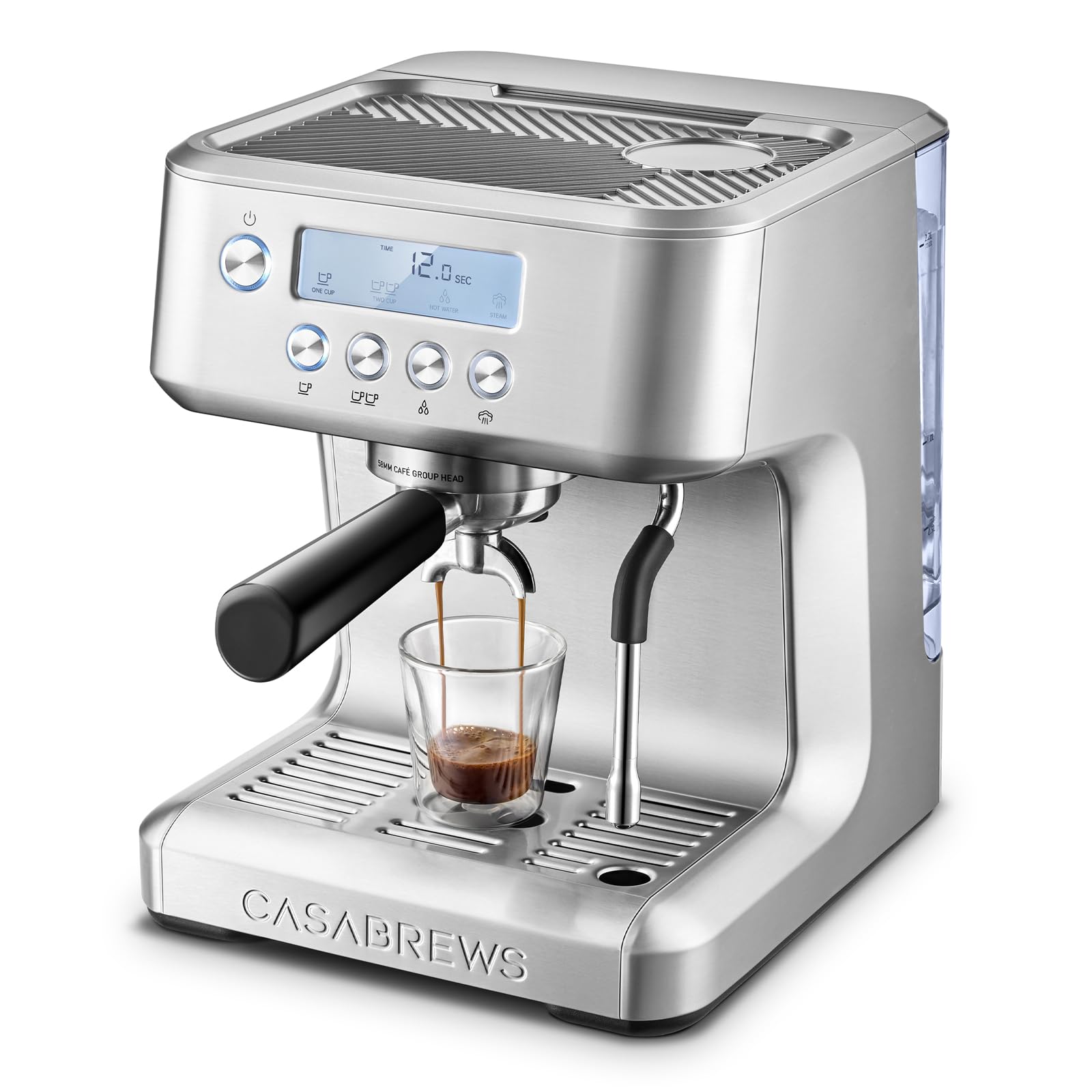
1. CASABREWS Ultra Espresso Machine, Barista Espresso Maker with Steam Wand
Our pick — 4.5★ from 850+ verified ratings; the strongest balance of quality and price.
A 58mm portafilter and four brew temperatures at a mid-range price.
What wins people over here is the build feel against the cost. The 58mm portafilter is the commercial width, so the tamper you buy in two years still fits. A 20-bar Italian pump paired with a 1350W heating system does the extraction, and the overall score sits at 4.5 — strong enough that it holds the top slot against everything below it.
The tank holds 73 ounces, which a two-latte household refills roughly once a week. You get four brew temperature settings to shift flavor between a brighter shot and a rounder one, plus a programmable shot button so your morning pull does not depend on your reflexes at 6 a.m. The steam wand textures microfoam for latte art, and there is a dedicated hot water button for Americanos. It measures 12.2″D x 10.31″W x 12.9″H, so check the gap under your upper cabinets before you commit.
The honest catch is that the stock aluminum portafilter (the handle that locks into the brew group) is light and sheds heat fast, and the included baskets are not the machine’s best face — an aftermarket basket is the usual fix and it changes the crema noticeably. That said, the machine itself is not the problem; the consumables shipped with it are. Cleanup runs a couple of minutes and the cup warmer plate means back-to-back shots stay drinkable. As buyers report, one long-term owner put it this way after two months: it makes “cafe-quality lattes” with a well-known supermarket bean, once a bottomless portafilter and puck screen are part of the routine.
Sturdy build
- 58mm portafilter matches commercial accessories, so upgrades from later machines still fit
- 73oz tank carries a two-person household close to a week between fills
- Four brew temperature settings let you chase a preferred flavor profile shot to shot
- Fast heat-up and a 2-3 minute cleanup window suit a rushed morning
Steam wand quirks
- Lightweight aluminum portafilter loses heat quickly — a heavier handle helps
- Stock baskets produce weaker crema than the machine is capable of
- Occasional internal rattle reported, harmless but audible
Daily home baristas: you want a 58mm portafilter and temperature control without stepping into the premium bracket.
Upgrade seekers: budget for a better filter basket, because the stock one holds the espresso back.
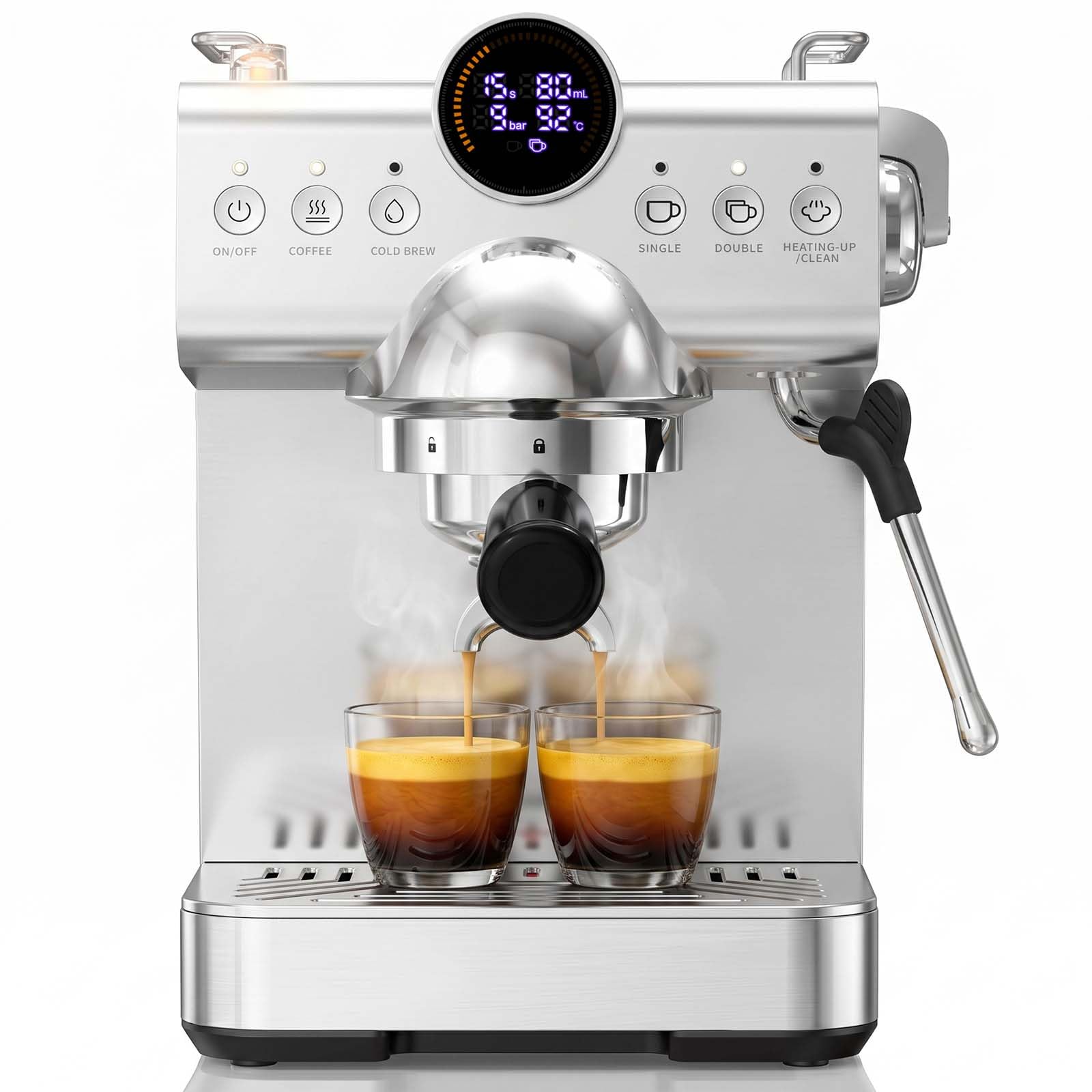
2. Espresso Machine 20 Bar, Hot & Cold Brew Coffee Maker with Steam Wand Milk Frother
Brews hot espresso and cold brew from the same 20-bar machine.
The Havato CM5712-UL is the odd one out in this list because it brews both hot and cold, which matters if your coffee mood changes with the weather. Both temperature and the drink style you are chasing are adjustable, so a morning cappuccino and an afternoon cold brew come off the same machine. It holds a 4.6 rating, the highest here, across a smaller owner base than the bigger names.
At 10.9″D x 9.33″W x 12.24″H, it takes up less depth than the CASABREWS Ultra above, which measures 12.2″D x 10.31″W x 12.9″H — a real difference if your counter ends where a wall begins. The 50oz removable tank is the smallest here, so a busy household will refill more often than the larger-tank options further down. The LED display shows time, temperature, pressure, and water level so you are not guessing at the state of your shot.
The trade-off is the 51mm basket on the budget-minded build, smaller than the 58mm commercial size most of this list shares. That means fewer aftermarket baskets and tampers drop straight in, and it is the main reason to step up if you plan to tinker. There is no three-way solenoid valve, which is the part that dries the puck on pricier machines — so expect a wetter puck and a quick rinse after each shot. Performance leads what owners talk about most, with espresso quality right behind it.
What owners mention: “decent espresso” with the right grind and tamp, and cafe-quality drinks once dialed in.
Budget beginners: counter depth is tight and you will actually use the cold-brew side.
Commercial aspirations: you want a 58mm basket family for long-term accessory shopping.
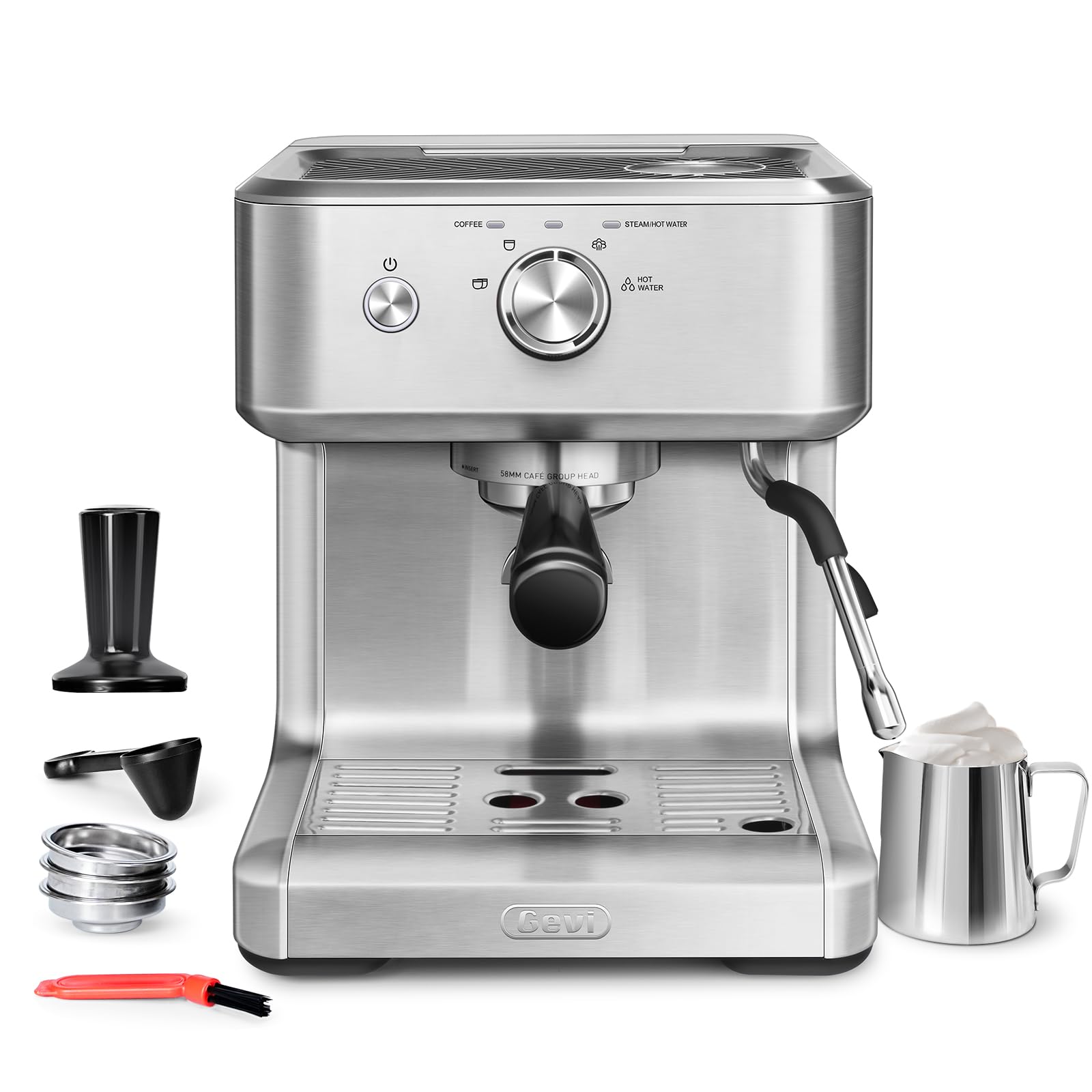
3. Gevi 58mm Commercial Espresso Machine with PID & NTC Temp Control
Holds brew water between 194°F and 204°F with PID and NTC control.
Most espresso machines guess at their brew temperature. This Gevi holds water between 194°F and 204°F — the narrow band where coffee oils release without turning bitter — using a PID controller and an NTC sensor working together. You can nudge that temperature across four settings, and pick from four shot volumes. The dial does the work: one control, four temperatures, four volumes.
The 58mm portafilter is here, along with a tamper and a milk pitcher in the box, so there is no first-week accessory order. Tank capacity is 74 ounces and the machine measures 12.2″D x 10.3″W x 13″H at 13.7 pounds. A 12-month warranty covers it.
Where the machine asks for patience is the steam: owners describe it as loud while frothing, and it demands a wipe-down after each session. The metal body is stainless steel with only the water holder and drip catcher in plastic. Pre-measured shots make the routine fast, and it heats quickly enough that two cups in a row barely pause. A minority of buyers find the cleaning routine more work than a simpler machine demands — worth knowing if you want zero-fuss maintenance.
PID temperature control: four brew temperatures plus four shot volumes means the machine, not the coffee, is the variable you adjust.
Large footprint: the steam is loud, and the post-shot cleanup is a real daily step — not a dealbreaker, but not nothing.
Café-quality shots: the home barista who wants to change variables and taste the difference.
Tiny kitchens: you would rather push one button and walk away than adjust temperature between beans.
4. De’Longhi Classic Signature Espresso Machine, Adjustable Milk Frother
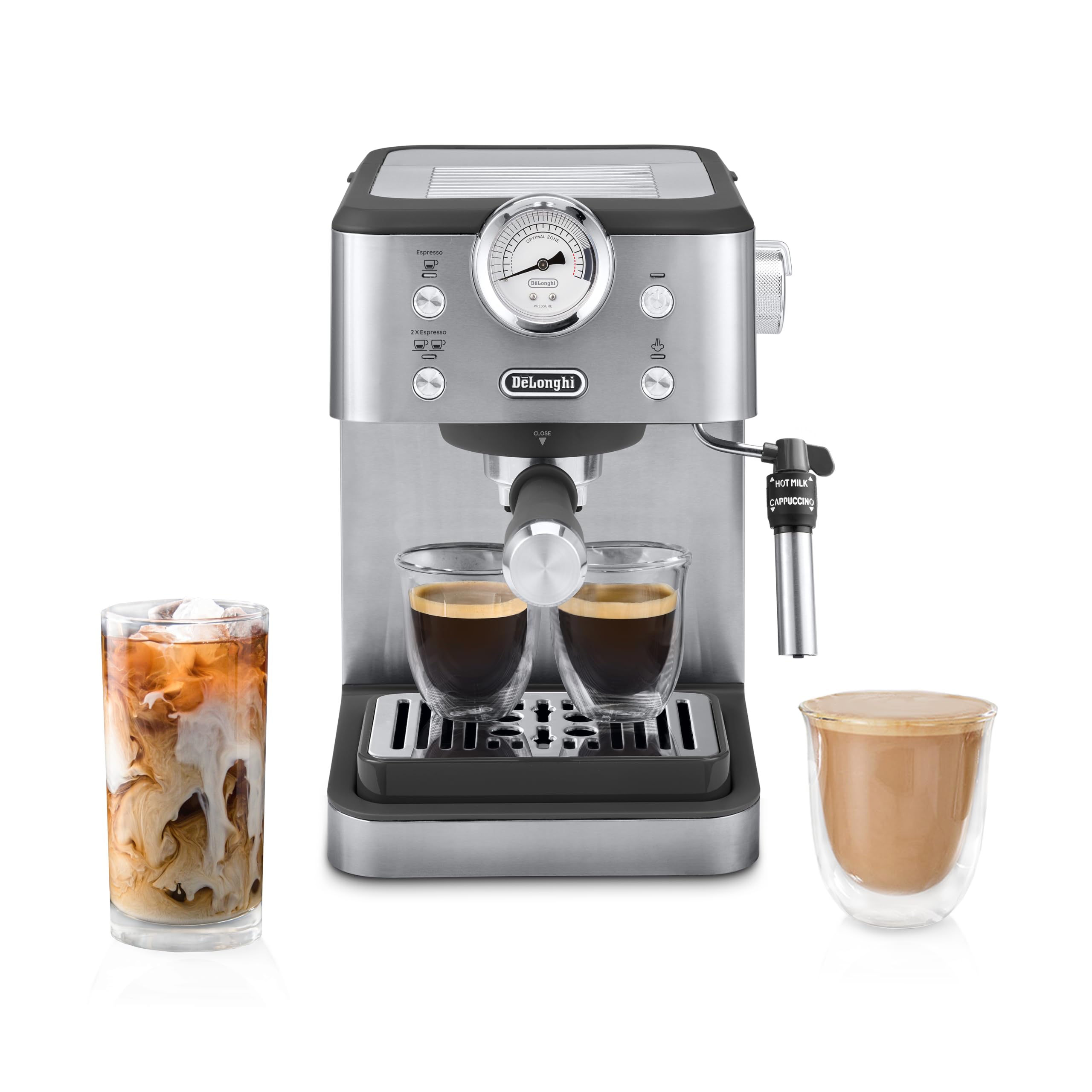
The lowest-effort first machine on this list, and it shows in the controls.
Thermoblock heating brings this machine up to temperature almost the moment you press the button, and the preset single and double shot buttons mean your first pull does not require a scale or a timer. The 15-bar Italian pump does the extraction, and the two-setting steam wand shifts between steamed milk and a microfoam dense enough for latte art. You supply ground coffee only — no beans, no grinder to learn.
It is compact at 11.14″D x 8.89″W x 12″H and weighs only 9 pounds, the lightest machine here by a wide margin, which makes it genuinely easy to move for cleaning. Owners describe it as friendly for a first-time espresso machine with a forgiving learning curve and a helpful set of how-to videos from the brand.
The recurring gripe is heat: the portafilter interior is plastic rather than stainless, and some owners find the outgoing water not hot enough for a proper extraction. If you want a machine to hit a precise temperature and hold it, this is not that machine — the Gevi above is the temperature-first pick. Judged for what it is, though, this is the machine that gets a beginner pulling a recognizable espresso on day one instead of day thirty.
Classic design fans: it is your first espresso machine and you want the shortest path to a drinkable shot.
Speed demons: precise brew temperature is on your list — this one runs cool by nature.
5. Electactic Espresso Machine with Built-In Anti-Clog Grinder and Milk Steam Wand
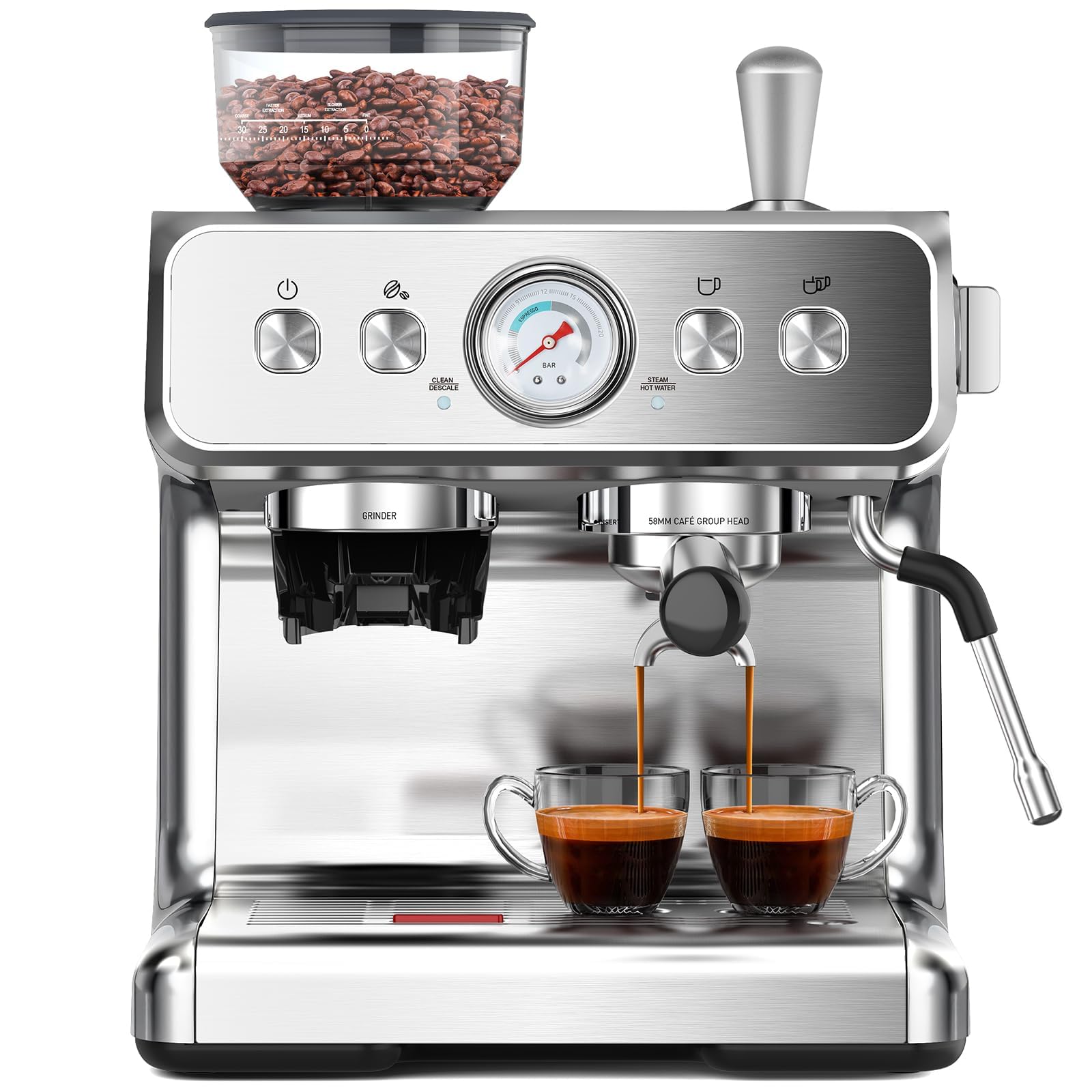
Beans in the top, espresso in the cup, no second appliance on the counter.
The upgrade worth pointing at is inside the grind path: a chute 20% wider than the previous design plus a reinforced helical auger that pushes grounds out instead of letting oily dark roasts cake up and jam. If you have ever fought a stuck grinder on a Sunday morning, that is the fix you want. The machine takes whole beans, grinds on demand, and brews at 15 bar.
Owners rate the coffee quality above everything else about it, which is the right thing for a bean-to-cup machine to win on. The steam wand pulls silky microfoam, and a 58mm portafilter sits in the brew group — the commercial width that accepts standard-sized accessories. The 2.8-liter removable tank is among the largest here, and the drip tray detaches for cleaning.
Expect setup to take real time: one owner noted it took hours to dial in, and the grind setting is the lever that moves flavor the most. It measures 15.75″D x 13.39″W x 16.34″H and weighs 26.2 pounds — the second heaviest and second bulkiest machine in this list, so measure your counter before ordering. Durability draws mixed notes, and the value question splits owners: some call it a bargain, some want more polish for the spend.
Convenience seekers: a one-appliance setup where the grinder and brewer share a footprint.
Quiet environment: it is a large, heavy unit that needs dial-in time before the shots taste right.
6. Gevi 20 Bar Espresso Machine With Built-In Grinder & Milk Frother
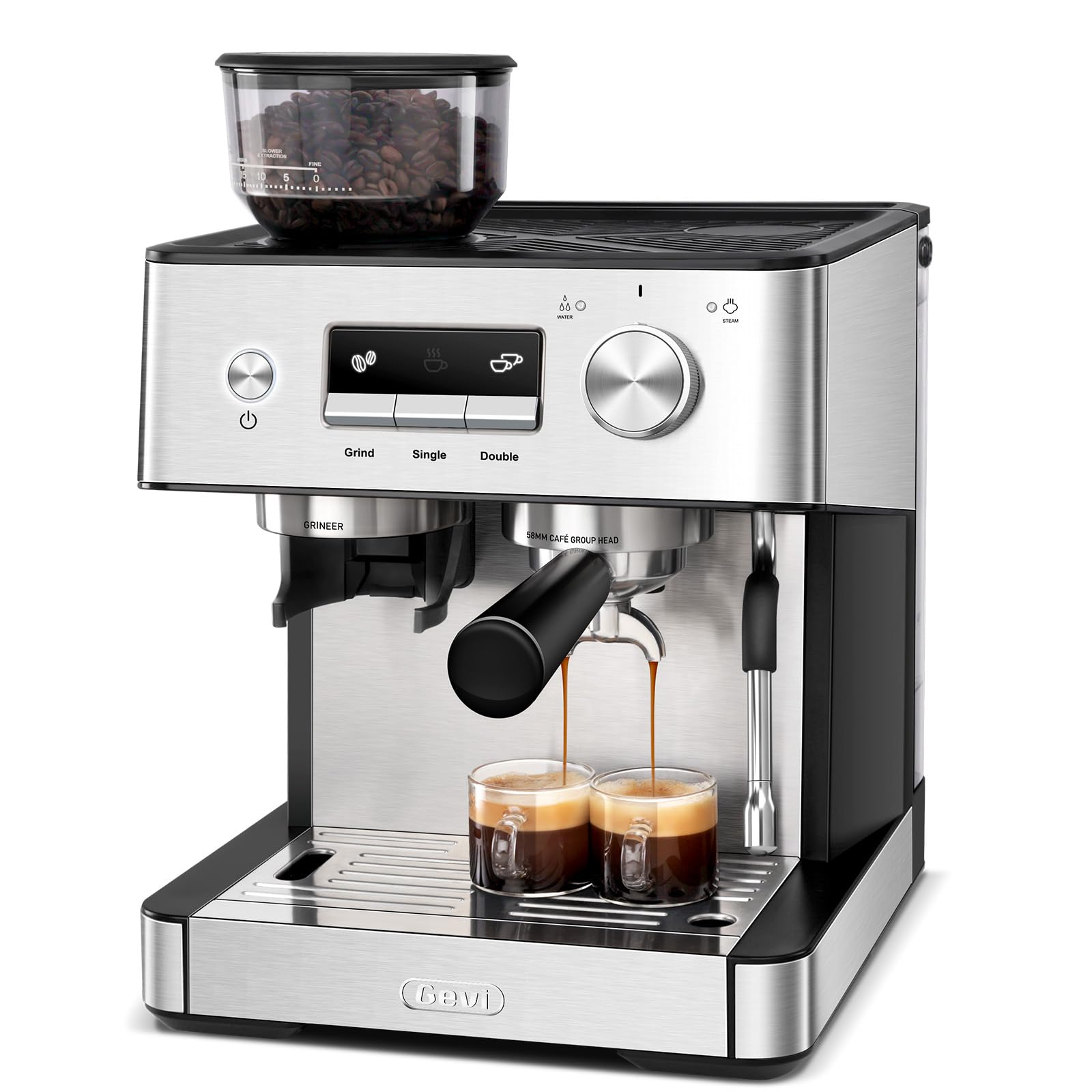
A grinder, a 58mm portafilter, and a big tank for the money.
The pitch here is straightforward: a precision-built grinder with a 0-30 gear adjustable bean box grinds straight into the 58mm portafilter, and a 20-bar pump pushes the shot through. You can move between manual and automatic operation, which is rarer than it sounds at this price — manual gives you control over the pour, automatic handles the routine cup. The 2.3-liter water tank comes off for filling and cleaning.
Ease of use is what this machine is praised for most, with grinding performance right beside it — a good sign for a combo unit, where one of the two halves often lags. Pre-infusion is part of the brewing routine, and there is an auto shut-off plus a cup warmer.
The learning window is real but short. Owners describe roughly an hour of setup, then a stretch of about fifteen cups to dial in the grind — and the sweet setting tends to land around 5 on the dial, with the finest setting tending to clog. Pair it with a scale and a proper 58mm tamper (the tool that presses the coffee flat) and the shots come out with a professional-quality crema. The grinder is decent rather than exceptional; anyone chasing maximum control will prefer the Hanrose below, which exposes more of the grind adjustment.
Built-in grinder: manual or automatic operation on demand, in one machine, with a grinder that empties straight into the basket.
Basic steam wand: plan an hour of setup and about fifteen cups of dial-in before it sings, and keep the grind off the finest setting.
All-in-one solution: a household that wants beans ground fresh without buying a second appliance.
Separate grinder owners: you want a fully automatic bean-to-cup routine — this one rewards hands-on input.
7. Hanrose Espresso Machine with Grinder and Milk Frother, 20 Bar ULKA Pump
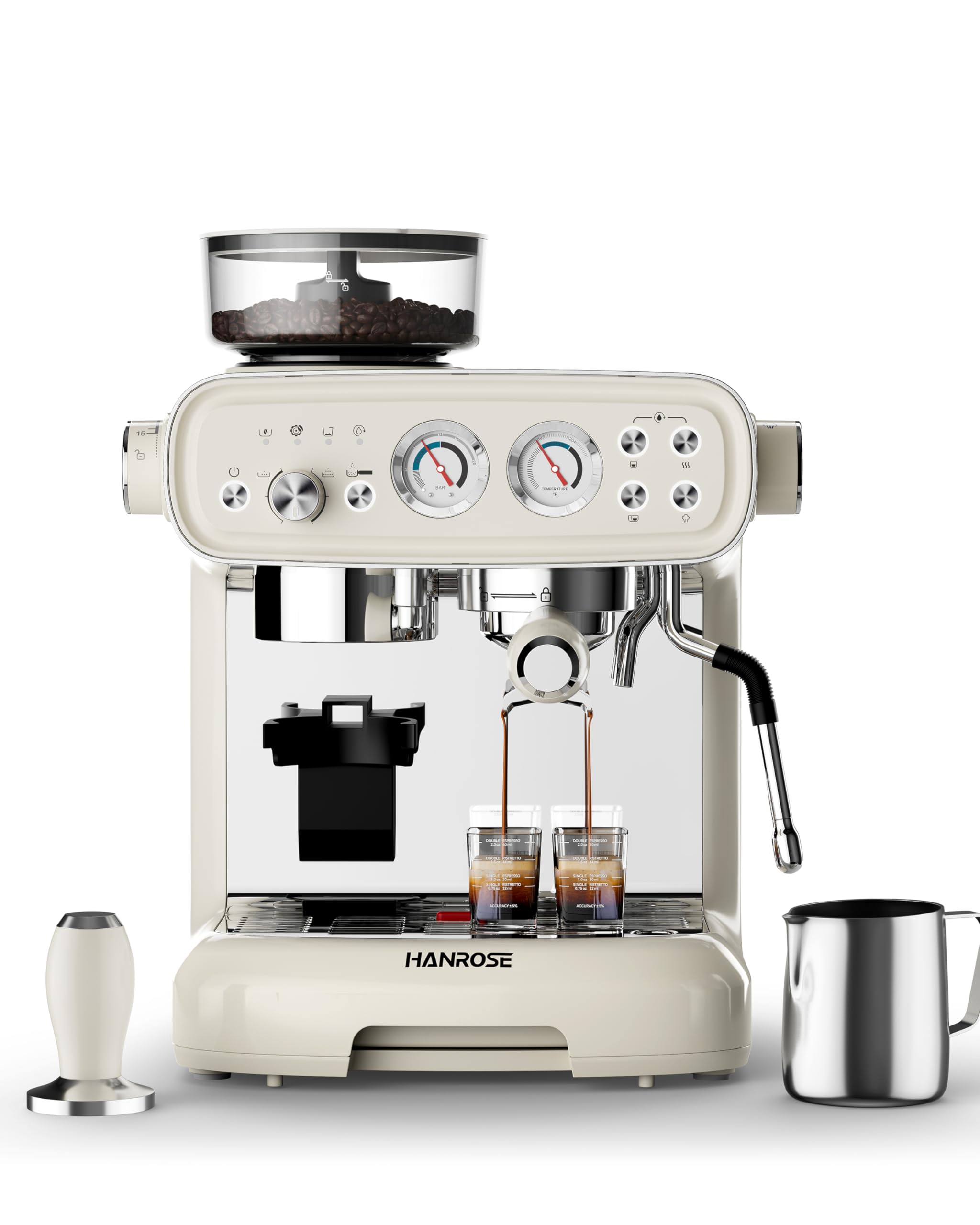
Off-white casing, a 15-step grinder, and a steam wand that behaves.
The grinder dial runs 15 settings from coarse to fine, and grounds drop directly into the filter basket for a grind-to-brew flow with no scoop in between. An Italian ULKA pump supplies the 20-bar extraction behind a 58mm portafilter, and there is a temperature control keeping the brew stable. A separate hot-water outlet means Americanos do not need the steam wand.
Where this machine reads differently to the others is the burr assembly (the grinding teeth): the whole thing lifts out for cleaning with the included brush, which is the most direct answer to the bean-jam problem you can build into a home machine. The steam wand rotates a 10mm tip for foam, and the 2.5-liter tank is removable.
Owners describe the espresso as smooth and balanced rather than burnt, with a heavy portafilter in hand and a large tank that cuts refills. A preheat with the hot water outlet is the local trick for thicker crema. The 1-year warranty covers it, and the body is painted rather than solid metal — a fair trade at this price, and the reason the machine stays lighter than the all-stainless units. Anyone who wants a machine that looks like the espresso bars of forty years ago gets exactly that.
As for what the crowd raves about: it is the quality of the build in daily use, with the retro appearance a close second, and the verdict from experienced hands is that it delivers a balanced, clean shot without the burnt edge that plagues cheaper setups.
Latte lovers: you want grind control and a look that earns its counter space.
High-volume users: I would preheat with the hot-water outlet every morning — that is what thickens the crema.
8. Chefman Crema Supreme 15 Bar Espresso Machine with Grinder, 30 Grind Settings, 3L Water Tank

Thirty grind settings and a big tank, for the household that drinks a lot of coffee.
The conical burr grinder runs 30 adjustable settings and dispenses straight into the 58mm portafilter, which is the widest grind range on this list. A 15-bar pump brews the shot with customizable temperature and volume, and a pressure gauge on the interface shows you what the extraction is doing. There are single and double shot baskets in the box.
The 3-liter reservoir is the largest here, so a brunch crowd barely dents it. The machine covers 1450W at 120 volts and comes with a milk pitcher, stainless tamper, cleaning tools, and a grinding funnel, plus a 1-year warranty. Brew quality and taste are the machine’s strong cards, and the water reaches 200°F.
The gripe ledger is longer here than on the machines above, and it centers on temperature stability over time: some owners hit pressure drift and descaling headaches, and the froth setting has been reported to quit mid-session. It measures 16.14″D x 13.39″W x 16.34″H at 21.8 pounds — the largest footprint among the grinder-equipped machines here — so it wants real counter space. Vibration can also walk a cup around the drip tray, which a silicone coaster fixes.
Wide grind range: 30 settings is more adjustment than the Hanrose’s 15 or a standard dial offers, and it empties straight into the basket.
Fiddly dial: the machine is the biggest footprint in this grinder-equipped group, and descaling matters more here than the price tag suggests.
Grind experimenters: a counter that has the room and a household that wants one grinder dial covering every bean.
Set-and-forget types: tight kitchens — this is a sizeable unit to live with.
9. Gemilai Owl Espresso Machine, 15 Bar Semi-Automatic with Dual Display, G3006

Set brew temperature, pre-infusion, and shot time on the touchscreen.
Long-press the touchscreen and you open up the machine’s internals: brewing temperature adjustable across 176-215°F, pre-infusion time across 0-30 seconds, and brewing time across 10-120 seconds. A dual display tracks pressure, temperature, and time in real time so you can see a change as you make it. The brewing head carries its own PTC heating element and a PID control system, designed to hold temperature steady through the shot.
Steam comes out strong, with an extended swivel wand and a dual-hole nozzle that beginners find forgiving. Power is 1500W, the tank holds 57oz and lifts off for filling, and the retractable drip tray comes away for cleaning. A 58mm filter basket and portafilter are included.
The risk to weigh is heat consistency: a segment of owners reports the group head not reaching temperature, producing lukewarm water, even when the readout suggests otherwise. That runs against the machine’s own design intent and is worth watching closely during your return window. A few also find the casing light for the footprint — it is a tall unit at 14.57″D x 9.23″W x 15.47″H, so some buyers steady the machine when locking the portafilter.
Where the owners who love it land: performance first, then the retro look. A common verdict is that its 58mm portafilter puts it ahead of the 54mm machines at the bottom of the price range — real espresso hardware at a mid-tier cost.
Hands-on hobbyists: granular control over pre-infusion and brew time, with a display that shows you what is happening.
Push-button users: hold onto the return window until you confirm the group head actually heats properly.
10. De’Longhi Dedica Maestro Plus Espresso Machine, Automatic Steam Wand
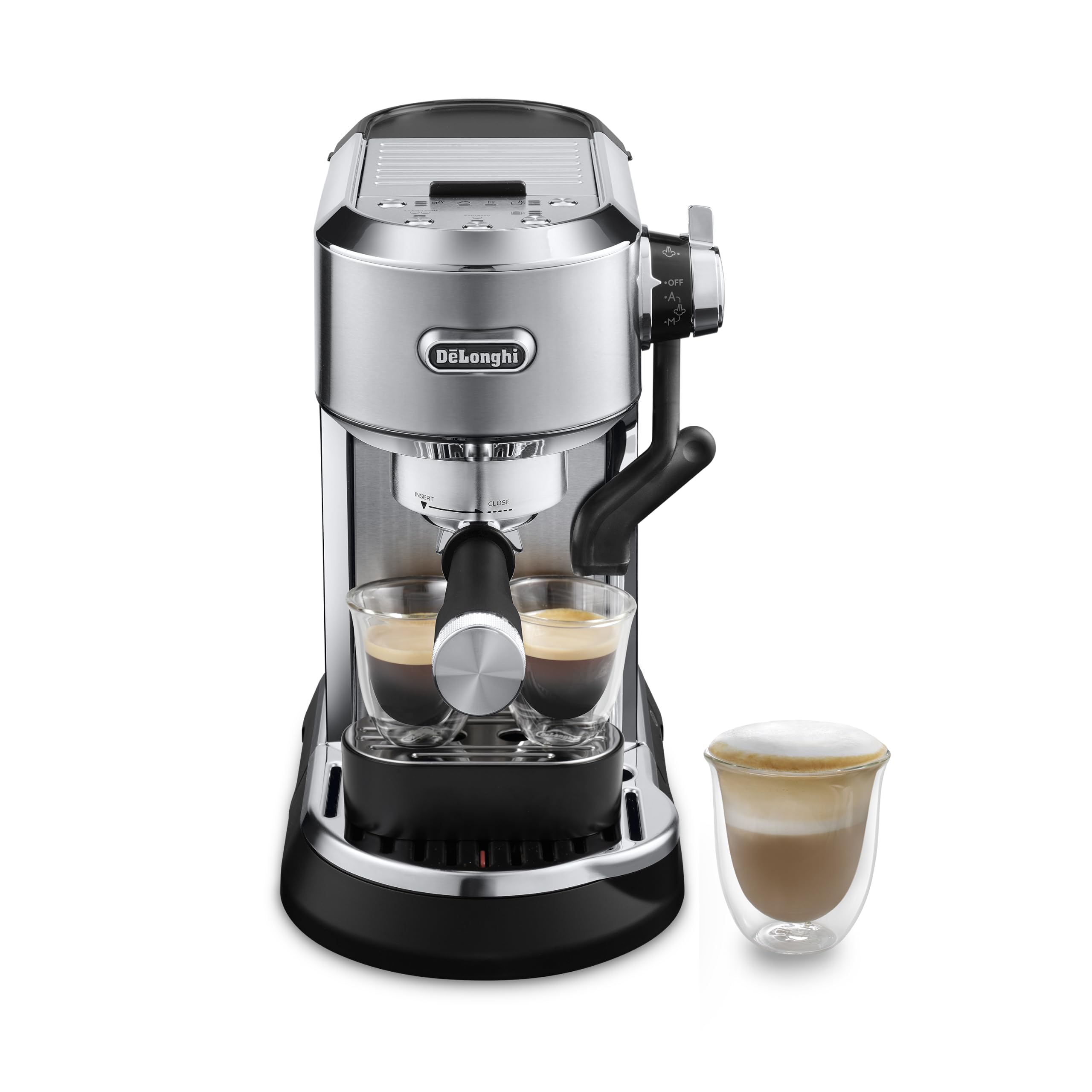
Narrow enough for any counter, with a steam wand that textures milk by itself.
At 8.15 inches wide, this machine squeezes into the gap beside a toaster that most espresso machines cannot enter. The 15-bar pump runs the full pressure curve, dropping low for pre-infusion and hitting an optimal 9 bar during extraction. Three brew temperatures shift the profile to suit your beans, and a separate set of three milk-texture settings changes the froth from loose steamed milk to tight microfoam.
The included kit is unusually complete: a professional tamper, a stainless steel milk jug, measuring scoop, cleaning brush, and both pressurized and unpressurized filter baskets, so you can use pre-ground coffee now and switch to fresh-ground beans later without buying more hardware. Filter baskets are unpressurized for the serious route and pressurized for when your grind is not up to scratch — one owner in the review pages called it a great intermediate machine for exactly that reason.
The catch is that the machine has a firm ceiling on temperature adjustment — three settings, not a continuous dial — and this model line by the same brand runs the cooler end. Anyone who wants to set 94°F to the degree should take the Gemilai above instead. The automatic steam wand also trades some of the manual artistry for convenience, slowing down but smoothing out the process.
As owners put it: the espresso comes out tasting substantial and not bitter, with the auto frother handling the foam while a manual touch on the wand produces microfoam for anyone wanting to pour latte art.
One-touch drinks: small kitchens and anyone who wants the milk frothed for them.
Manual control fans: the temperature control tops out at three presets, so a serious temperature-hunter should look at the Gemilai.
11. Breville Barista Express Espresso Machine, BES870BTR, Black Truffle
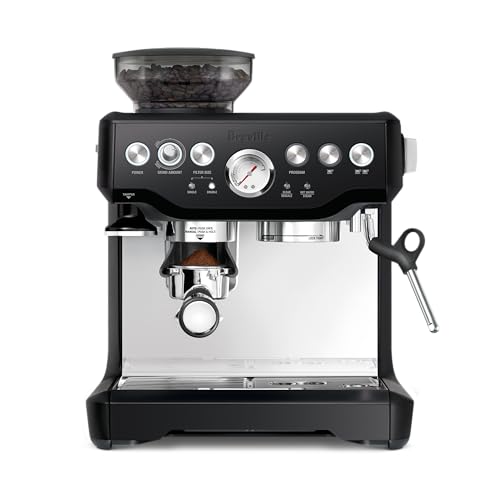
Grind, dose, and pull a shot on one machine in under a minute.
Everything happens on the machine: a precision conical burr grinder (a grinder with cone-shaped teeth) with a grind size dial drops fresh grounds directly into the 54mm portafilter, low-pressure pre-infusion (a gentle first splash of water) draws flavor out evenly, and digital PID temperature regulation (a chip that holds the water steady) keeps the water where it needs to be. The brew group takes 1600W at 120 volts, and the bean hopper holds up to a half pound — enough to keep a two-person household stocked for days.
The steam wand is the other strong point: hand-textured microfoam (fine, velvety milk foam), fast, for anyone working on latte art. Included with the machine are a razor dose trimming tool, single and dual wall filter baskets, a built-in tamper, a stainless steel milk jug, a cleaning disc, tablets, a brush tool, an Allen key, and a water filter with its holder. Tank capacity is 67oz.
The honest ledger: the top and sides are plastic, the water tank wants frequent refills, the standard grind amount setting runs high for many beans, and the machine is the most expensive pick here. It also asks for upkeep — daily wand wipes and showerhead purges, water filter changes on a schedule, weekly cleaning, and occasional o-ring attention. It measures 13.8″D x 12.5″W x 15.9″H and weighs 22.1 pounds.
What the crowd raves about: performance, which by owner consensus dwarfs any other comment about it, with coffee quality close behind. Where the machine falls short is durability at the very long end, where a minority find wear catching up after a year and a half.
Integrated grinder: the grind size dial, dose trimming tool, and PID temperature control together mean you can dial this machine to taste and keep it there.
Heavy machine: plastic casework and a filter-change routine come with the price tag — this is a machine to maintain, not a set-and-forget appliance.
Long-term investment: a household ready to invest once and grind beans fresh for years.
Minimal counter space: the maintenance calendar feels like a chore — a simpler machine will serve you better.
Understanding the Specs
Portafilter Diameter Sets Your Options
The portafilter is the handle that locks into the brew group, and the number that matters is the diameter of the basket it holds. A 58mm basket is the commercial standard, which means tampers, dosing funnels, puck screens, and bottomless baskets all fit without hunting around. A 54mm or 51mm basket still pulls good espresso, but the accessory pool thins out fast. On this list, the CASABREWS Ultra, Havato, both Gevi machines, the Hanrose, the Chefman, and the Gemilai Owl all take a 58mm portafilter; the Breville Barista Express takes a 54mm, and the two De’Longhi machines do not publish a diameter.
Bar Pressure Is A Ceiling, Not A Target
Bar pressure is how hard the pump pushes water through the coffee puck, and 9 bar at the puck is the number espresso actually wants. A 20-bar pump on the machine label gives extra headroom for pre-infusion and steam, which is useful — but it does not mean stronger coffee than a 15-bar machine. Both the 20-bar and 15-bar machines on this list extract properly. What separates them is temperature stability and grind consistency, not the pump figure.
FAQ
Do I need a separate grinder if the machine has one built in?
How fine should I grind beans for a home espresso machine?
What is a 58mm portafilter and does it matter?
How long does an espresso machine last with daily use?
Can I use pre-ground coffee in a barista-style machine?
Do I need to descale a home espresso machine, and how often?
Is a semi-automatic machine harder to use than an automatic one?
Do I need a bottomless portafilter for a machine like these?
What is the difference between a PID controller and a normal thermostat?
Can these machines make cold drinks like iced Americanos?
Final Thoughts: The Verdict
For most households, the barista machine for home winner is the CASABREWS Ultra — a 58mm portafilter, a 73oz tank, four brew temperatures, and a steam wand that textures real microfoam, all at the middle of the price range rather than the top. If you want to brew hot and cold from one machine on a narrow counter, the Espresso Machine 20 Bar earns its place. And if a built-in grinder plus a one-year warranty is what tips the decision, the Hanrose delivers that in a machine that looks the part.
The pick that earns the most trust from long-term owners is still the Breville Barista Express — its owner base runs into the tens of thousands and the recurring verdict is the same: dial it in once, then it keeps delivering. If you are ready for that commitment, it is the safest long haul on this list. Otherwise, the CASABREWS Ultra remains the best balance of capability, price, and 58mm accessory room that this guide has found.
How We Picked
We do not accept paid placement. Every pick is matched to a real buyer and a real use-case; we do not hands-on test units.
Sources & Methodology
Specifications: manufacturer listings and product documentation. Review insights: verified customer reviews, as of September 2026. Pricing: not shown on this page (it changes often); check the current price via the retailer link.
As an Amazon Associate, KitchPrep earns from qualifying purchases. This does not affect which products we feature.
Related Guides
