
Specs are compiled from manufacturer listings and verified buyer reviews and can change over time — please confirm the key details on the product page before buying.
If your basement smells like a wet towel that never dried, the fix is not a dehumidifier running around the clock — it is moving that stale air out of the window. A basement window is small, oddly shaped, and usually blocked by a screen or a sill, so a regular box fan does almost nothing there. All eight fans below are built to sit in a window opening, and several are reversible, so they can push damp air out and pull fresh evening air in.
I’m Mohammad Maruf — the founder and writer behind KitchPrep. This guide is built by comparing the manufacturers’ published specifications and the patterns across verified customer reviews, so you get each pick’s real strengths and trade-offs instead of marketing spin.
You will see how airflow numbers, window width ranges, and reversible modes decide which unit actually clears your space. Here is what separates a basement window exhaust fan that clears damp air from one that only hums.
Our Picks at a Glance


How To Choose The Best Basement Window Exhaust Fan
Basements are the hardest rooms in a house to ventilate. They sit low, often with one or two small windows, and damp air is heavier than dry air, so it settles down there instead of drifting upstairs. That means you need a fan that pulls from the right spot and pushes hard enough to actually swap the air, not just stir it.
Airflow matters more than blade size
Airflow is measured in CFM, which stands for cubic feet per minute — the volume of air the fan shifts every 60 seconds. A 20-inch fan moving 3560 cfm will empty a damp basement far faster than a slim 9-inch unit, simply because it moves more air per minute. Bigger blades do help, but a well-built small fan can still beat a floppy larger one.
Measure your window before anything else
Most returns on these fans happen because the buyer measured the glass instead of the frame. Measure the inner frame height or width — the actual gap the fan will sit in. Some units span a fixed range, others expand with sliding panels, so match that range to your window before you decide.
Exhaust versus intake versus circulation
Exhaust mode pushes stale air outside, which is what clears damp and odors. Intake mode pulls fresh outside air in, which is what cools a stuffy room on a summer evening. Circular or split mode moves air in both directions at once, useful for larger spaces where you want constant turnover rather than a one-way flow.
Quick Comparison
| Model | Best For | Airflow | Window Fit | Modes | Amazon |
|---|---|---|---|---|---|
| Air King 20″ Whole House Window Fan★ Best Overall | Whole-basement air swaps | 3560 cfm | 20-inch window opening | 3-speed circulation and exhaust | Amazon |
| shinic 3-Speeds Window FanBest Value | Rotating heads for tight corners | 450 cfm | 21.65″ to 33.27″ expanders | Dual cooling, dual exhaust, mixed | Amazon |
| Nalle 10 Inch Reversible Exhaust FanBest for Tight Openings | Small basement openings with odors | 460 cfm exhaust | 13.5 x 13.5 panel | Reversible exhaust and intake | Amazon |
| BEYOND BREEZE 9″ Dual Window Fan | Budget dual-direction airflow | Not stated | 23.5″ to 37″ expanders | Intake, exhaust, circulate | Amazon |
| MEOZRI 12 Inch Window Exhaust Fan | Garage and workshop grade venting | 720 cfm | 10.5-inch mounting hole | Single-direction exhaust with knob speed | Amazon |
| AMCHIXIN 13.8-15.7 Inch Vertical Fan | Narrow sliding windows | 98 cfm | 13.8″ to 15.7″ inner frame | Stepless exhaust only | Amazon |
| Vornado PORTAL Window Fan | Quiet reversible exhaust | Not stated | 24″ to 38″ wide | 3-speed reversible exhaust | Amazon |
| EVO Window Fan Air Circulator | Wide windows with remote control | Not stated | Up to 40″ wide | 4-speed reversible with timer | Amazon |
In‑Depth Reviews
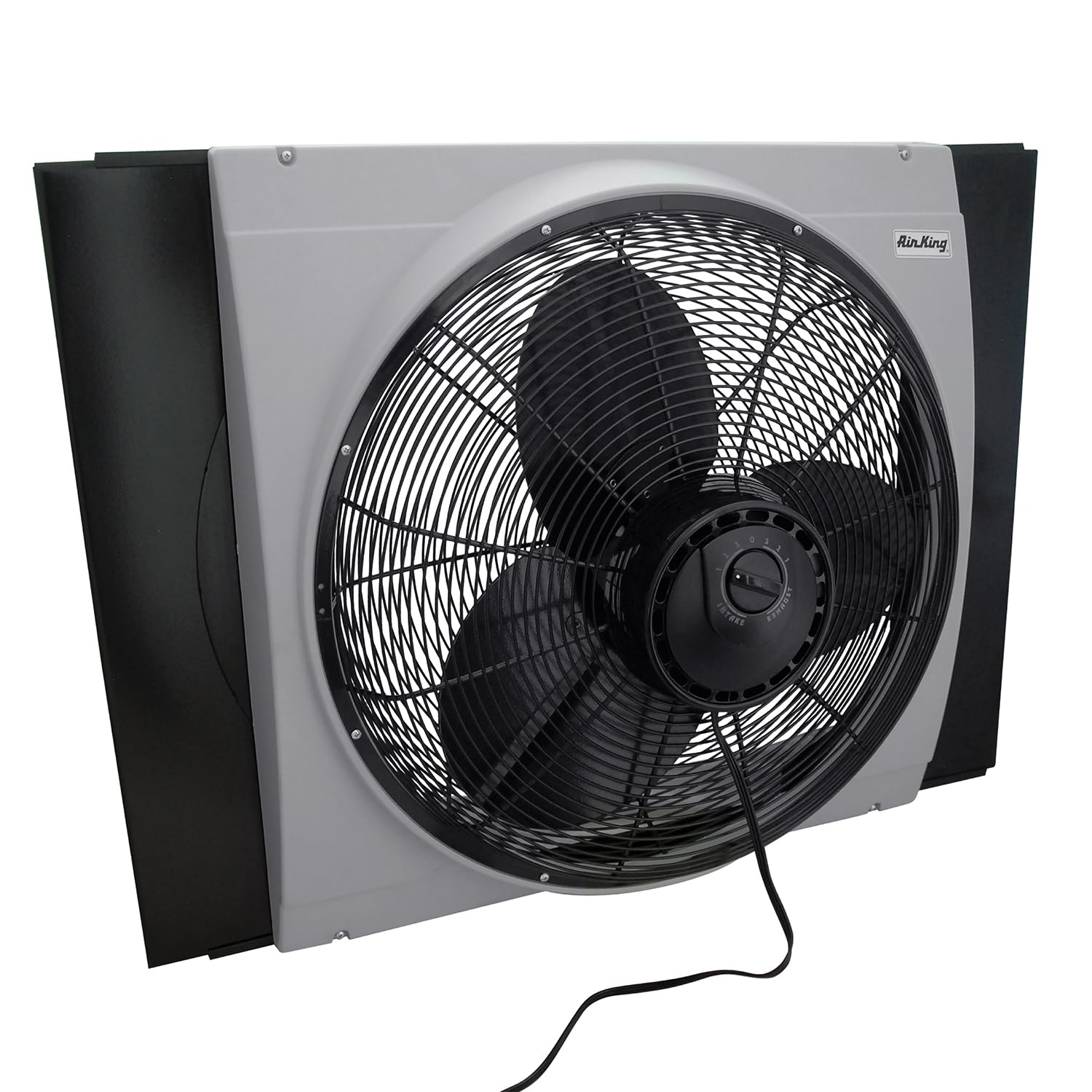
1. Air King 20″ 1/6 HP Whole House Window Fan with 3-Speeds and Storm Guards
Our pick — over 4.5★ from 70+ verified ratings; the strongest balance of quality and price.
The 3560 cfm bruiser that clears a whole damp basement in minutes.
This is the fan you buy when the problem is genuinely a whole floor of stale, humid air, not one corner of it. It moves 3560 cfm — that is cubic feet per minute, the volume of air pushed past the blades every sixty seconds — which is the highest figure in this entire roundup. To put that in perspective, the Nalle 10 Inch in this same list moves 460 cfm, and this Air King is the only unit here that clears an entire first floor in minutes rather than sitting there humming.
The build is deliberately old-school: powder-coated steel blades and grill with an ABS plastic body, plus a permanently lubricated motor that the maker says needs little to no maintenance. Owners describe it as heavy and not flimsy, and the recurring theme in the reviews is sheer volume of air, with buyers saying it “probably puts out twice as much air as the box fan” they used before. The Storm Guard slider panels are the quiet win here — they let you close the window behind the fan, so you are not leaving an open hole in the wall overnight.
What wins people over is the raw throughput, and the quality of the parts holds up alongside it. The honest catch is noise: at high speed this is a loud fan, and even its fans admit it is not a whisperer. It also takes up serious space — its frame measures 26.75 inches wide and 26.25 inches tall, so you need a big window opening, not a slim basement slit. Mounting is on the inside window trim, and it works best set to vent outward so it creates negative pressure and pulls fresh air in from elsewhere.
Why owners keep it
- Highest airflow here at 3560 cfm — clears a whole floor fast.
- Powder-coated steel blades and grill with a permanently lubricated motor.
- Storm Guard panels let you shut the window behind the fan.
- Owners consistently call it durable and worth the money.
Where it asks patience
- Loud at high speed — the trade-off for that airflow.
- Needs a large opening; frame is 26.75″ wide by 26.25″ tall.
- Heavy, so one person alone may struggle to seat it.
Reach for this if: your basement is a full living space that needs whole-floor air turnover and you can live with a fan you can hear.
Think twice if: your window is a narrow slider or you need something you can forget is running — a slim reversible unit will suit you better.
2. shinic 3-Speeds Window Fan with 180°+90° Rotatable Fans
Two 9-inch heads that rotate 180° and angle 90°, so you can aim airflow at the damp corner.
Most window fans blast straight ahead, which is useless if your basement window sits in a corner behind a water heater. This shinic unit solves that with dual 9-inch heads you can rotate 180 degrees and angle 90 degrees, so you can aim one at the damp corner and keep the other pulling fresh air. It offers three functions — dual cooling, dual exhaust, and simultaneous intake and exhaust — chosen simply by turning the two heads. That flexibility is what buyers talk about most, and it is the reason this sits near the top of the list.
Airflow comes in at 450 cfm, which is modest next to the Air King’s 3560 cfm but plenty for a standard basement room, especially since you can point both heads at the problem area. The width adjusts from 21.65 inches out to 33.27 inches using an auto-locking expander on one side and two rigid expanders on the other, and it mounts either horizontally or vertically for sliding windows. It draws 70 watts at 120 volts, weighs 6 pounds, and carries ETL certification, which is an independent safety listing rather than a self-declared claim.
Here is the trade-off worth knowing before you buy: there is no remote, and everything is manual, including the knob. A couple of owners find the speed knob hard to grip and note it can pop out, and the smooth outer tip does not always catch the groove in a window track, so you may need extra window-fitting material. If your window has a screen fitted, the heads cannot be angled sideways past it. It is a hands-on fan, and it rewards people who are fine walking over and adjusting it.
The fit story: the expander spans 21.65″ to 33.27″ and locks on one side, with rigid panels adding stability when it stands vertical.
The honest trade: fully manual control, so if you want a remote on the nightstand, look at the EVO or BEYOND BREEZE instead.
Suits you if: you want directional control and a window that varies in width, and you do not mind adjusting it by hand.
skip it if: you need remote operation or your window has a screen that blocks angled heads.
3. Nalle 10 Inch Window Reversible Exhaust Fan
A 13.5 x 13.5 square blower that pulls litter-box odor out of a small basement window.
The Nalle is a different animal from the wide window fans above — it is a compact 13.5 x 13.5 square panel with a single set of louvers, designed to sit in a small basement or bathroom window. Exhaust runs at 460 cfm and intake at 380 cfm, so it is quiet on the numbers but effective in close quarters. It uses a two-way linkage type motor, which means one pull of the cord runs it in exhaust, a second reverses the blades to pull air in, and a third stops it and closes the louvers. Owners using it in a basement cat room report it vents litter odor straight outside, and running nonstop for months it stayed strong.
Where it earns its place is in problem spaces. Buyers cleared cigar smoke and stale air from a small room with it, and the reversible design gives you the option to bring fresh air in during summer without buying a second unit. The wear-resistant sleeve-bearing motor is rated for 9,000 hours of continuous work, which is the kind of figure you want when you plan to leave a fan running in a damp space. It comes with a 55-inch power cord and plug, so you can reach an outlet without an extension lead.
The catch is fit and noise, and both are worth measuring for. This is not a standard-width window fan and it has no extending arms, so buyers using it in an ordinary window report gaps that need DIY sealing with foam or tape — it works best in a small basement window where the opening is close to its 13.5-inch panel. It also rattles a door on startup from the pressure change, and some owners find it louder than expected at speed. The unit’s own functionality gets mixed signals in the reviews, so treat it as a specialist for small, awkward openings rather than a do-it-all.
What it does well
- 460 cfm exhaust in a compact 13.5 x 13.5 panel.
- Reversible linkage motor — one pull out, one pull in, one pull to close.
- Rated for 9,000 hours of continuous running.
- 55-inch cord reaches an outlet without an extension.
Where it needs planning
- No extending arms — gaps around a standard window need sealing.
- Noise level draws mixed feedback; some find it loud.
- Best matched to a window close to its 13.5-inch panel size.
Pick this one if: you have a small basement window and a stubborn odor problem you want gone, and you are ready to seal around the frame yourself.
Look elsewhere if: your window is a wide standard slider or you want a fan that drops in with no fitting work.
4. MEOZRI 12 Inch Window Exhaust Fan, 720 CFM High-Speed

A 720 cfm metal-housed exhaust fan that drops into a 12-inch slider window and stays quiet at first.
This MEOZRI unit is the fan you buy when the space is a workshop, garage, or grow room rather than a finished basement — it is built to move out heat and humidity in tough conditions. Airflow is 720 cfm, and it uses seven aluminum blades in a metal housing rather than plastic, which is why owners rate build quality highest of anything about it. Fits are the other strong point: buyers seat it into a 12-inch slider-style basement window and it drops in perfectly, and it also removes shower humidity from a bathroom with no other ventilation source. Maximum rotational speed is listed at 1800 rpm, and the noise figure is stated at 50 db.
What stands out is how quiet it stays given the output. Owners repeatedly call it the quietest fan they have owned, with one describing it as quiet, with decent airflow for its small 12-inch square size and four speeds. The mounting hole is 10.5 x 10.5 inches and the overall unit measures 12 x 12 x 5.9 inches, so it takes up a modest square of window rather than a wide strip. Control is a simple knob, which means no remote and no fuss — you set the speed once and leave it.
The things to weigh up are power consistency and control layout. Several owners note the actual blow is not as strong as the 720 cfm headline suggests, so treat that figure as a ceiling rather than a guarantee. The unit also draws noise over time — one reviewer noted it ran fine for a few months before getting louder, especially on low. And it does not restart on its own after a power cut; you have to press the button again after an outage. It exhausts only — air goes out, never in — so it is a one-direction tool.
What buyers prize
- 720 cfm with seven aluminum blades in a metal housing.
- Fits a 12-inch slider basement window exactly.
- Quiet enough that owners call it the quietest fan they have had.
- Knob speed control — set it and walk away.
The honest limits
- Real-world blow feels weaker than 720 cfm suggests.
- Can grow louder over months of use, especially at low speeds.
- Won’t power back on by itself after an outage.
- Exhaust only — no intake mode.
Best matched to: a garage, workshop, or damp utility basement where you want metal construction and low noise at a modest window size.
Not the one if: you want reversible airflow or a fan that resumes after power returns.
5. AMCHIXIN 13.8-15.7 Inch Vertical Window Fan for Sliding Windows
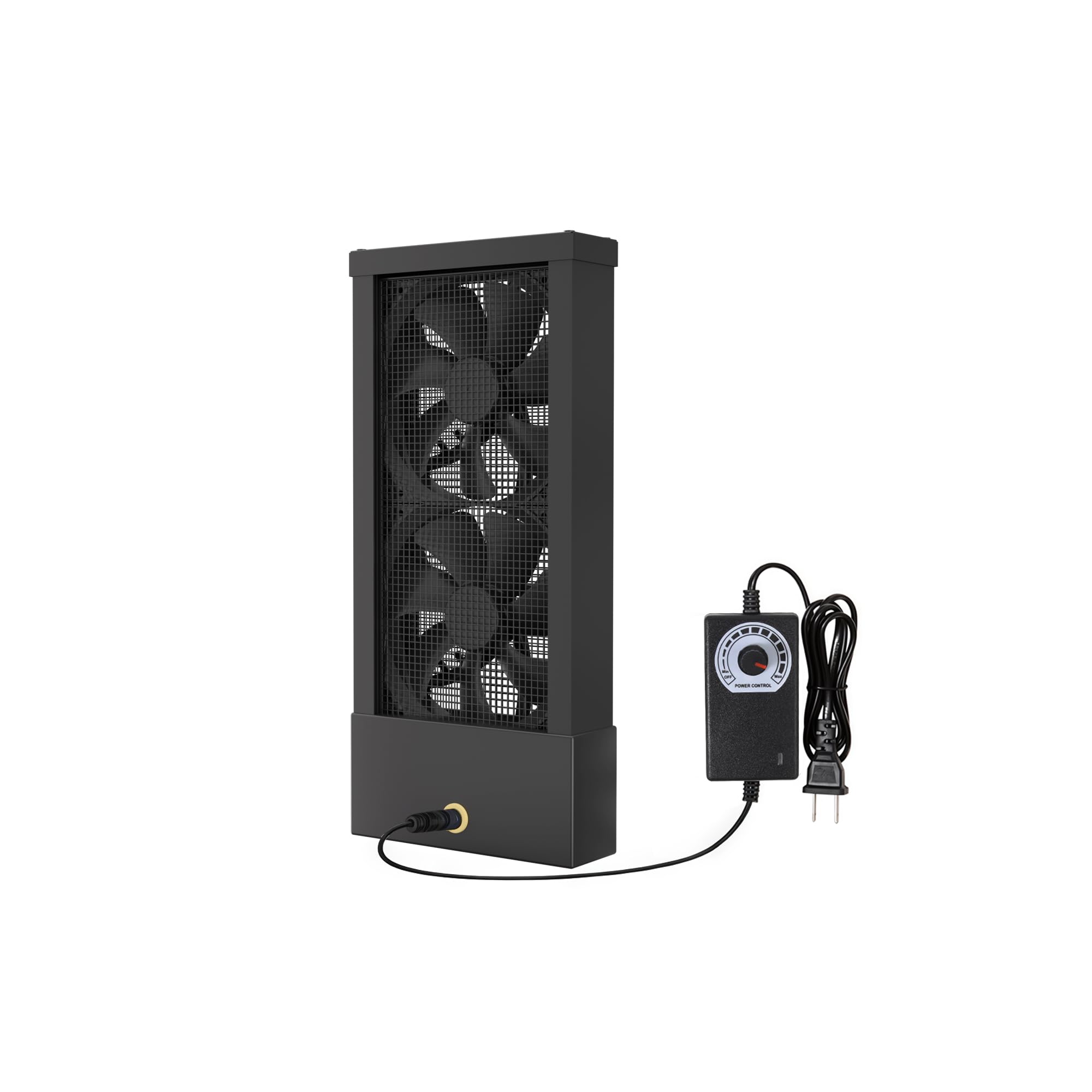
A 1.57-inch-deep vertical fan for sliding windows that fit nothing else.
Some basement windows are tall and narrow, with a sliding pane rather than a sash, and most fans simply cannot seat in them. This AMCHIXIN is made for exactly that: it fits an inner frame height between 13.8 and 15.7 inches, and uses a 1.97-inch extendable spring mechanism that presses into place with no tools. It weighs just 2.1 pounds, so you can lift it in with one hand. The whole point is the slim 1.57-inch depth, which sits flush against the frame so you can open and close the window without pulling the fan out.
Airflow is 98 cfm, which is the smallest figure in this list and honest about what it is: a targeted exhaust unit, not a room-cooler. It is designed for exhaust only — pushing heat, smoke, smells, and humidity out — and buyers use it in pet areas, cigar lounges, and enclosed spaces. A stepless speed controller lets you dial the airflow from a gentle breeze up to full without fixed steps. Construction is an aluminum frame with two fans behind a stainless steel mesh for safety, and the whole thing installs and removes in about 30 seconds without damaging the window.
Be clear-eyed about the size of the job it does. At 98 cfm it will clear smoke and odors from a small room like a 10×15 space, but it will not cool a large basement. Buyers also note the plug can get in the way of a screen, and a few find the output lower than expected for the size. Most importantly, measure first — the window height, not the glass — because this fits a narrow band and will not stretch to a wider opening. Used within its range, it is a genuinely convenient fix for a window nothing else fits.
Where it shines: tool-free spring insertion in about 30 seconds, with a 1.57-inch slim profile that keeps the window usable.
The limit to respect: at 98 cfm it is a targeted exhaust fan for small, enclosed spaces — sizing it up in your head will disappoint you.
Right for you if: your basement window is tall, narrow, and sliding, and you need a fan that slips in without tools or permanent changes.
Wrong fit if: your window is outside the 13.8″ to 15.7″ range, or you want to cool a large room rather than exhaust a small one.
6. Vornado PORTAL Window Fan, Reversible Exhaust Mode

The low-profile reversible fan that people keep buying for their narrowest windows.
Vornado’s PORTAL is a horizontal fan built for windows 24 to 38 inches wide, with a low-profile body that uses a modular block system instead of the usual accordion panels. It needs at least an 8-inch tall opening and installs in the horizontal position only. Reversible exhaust means a touch swaps between pulling cool air in and pushing stale air out, and it runs three speeds. At 6.9 pounds it is light enough to seat by yourself, and its slim frame is one of its clear advantages — it is designed to blend into the window rather than block the view.
What owners consistently praise is the performance in real basements and smoking rooms. Buyers use it to replace window air conditioners in the cooler months, and one described it as the best exhaust fan they had bought, noting that four prior fans in six years failed to pull smoke and this one handled it while being the quietest they had owned. Reversing airflow by push button, quiet operation, and slim appearance all come up again and again. If you need a fan for a narrow window, its fans specifically appreciate that it fits about 21-inch openings where competitors will not.
Two things to plan around. The modular block and foam seals can feel awkward to set up, and in older sash windows with pronounced sills the seal is imperfect — some buyers report the foam blocks leave gaps, and there is no exterior grill, so bugs can come in if it is left in. Its power is also mixed in owner reports: some find the airflow decent for the slim size, others find it weak. And it must be pulled for winter, since the seal alone does not stop a strong draft. Measure the width and sill depth before committing.
The case for it
- Reversible exhaust and intake by a single touch.
- Low-profile modular fit for windows 24″ to 38″ wide.
- Owners rate its performance and quiet operation highest.
- Fits narrow openings other wide fans cannot.
What to expect
- Foam sealing blocks can be fiddly and seal poorly on old sills.
- No exterior grill or mesh, so bugs can enter when installed.
- Airflow feels weak to some buyers given the slim design.
- Must be removed for winter — the baffle alone won’t stop draughts.
Go with this if: your window is on the narrow side and you want a reversible fan that stays quiet and out of the way.
Give it a miss if: your window has a deep exterior sill or you want maximum raw airflow for a large basement.
7. EVO Window Fan Air Circulator with Remote Control

The wide-window fan you can control from the top of the stairs.
If your basement window is broad and you would rather not walk down two flights to change a setting, the EVO is built for you. It fits windows up to 40 inches wide using adjustable side panels, and the remote control handles speed, the electronically reversible exhaust mode, and an adjustable timer. Four speed levels are set through a touch pad on the unit itself. Airflow is multi-directional with three directional settings, plus automatic oscillation that sweeps the air across the room rather than dumping it in one spot. At 8.6 pounds and 26.8 inches wide, it is a substantial horizontal unit.
Owners rate its performance and airflow highest. Buyers fit it into several windows around the house, and it cools rooms well even in high heat and humidity, with some comparing the effect to air conditioning. The remote and a night mode that dims the display come up as favorites, and the weather-resistant case protector with a bug screen keeps rain and insects out — a detail the Vornado lacks. A washable pre-filter traps dust before it cycles back into the room. On high it is reported as quiet and strong, which is exactly the balance a basement fan needs.
The trade-offs are power ceiling and panel length. Some buyers find it underpowered and a few say it barely moves air at all, so for a very large damp space the raw airflow may not match your expectation. The accordion side panels are also reported as too short for a 42-inch window, with extra panels being pricey to add. You cannot run intake and exhaust simultaneously, and the power-off beep is loud enough to notice. If your window is wider than 40 inches, this is not the unit for you.
Why it wins fans: a remote, a timer, automatic oscillation, a bug screen, and a washable pre-filter — a fuller feature set than anything else in this list.
Watch the ceiling: mixed reports on raw power mean it suits a medium room well, but a cavernous basement may leave it wanting.
Made for you if: you want remote control, a timer, and a fan that sweeps air around a medium-to-wide basement window.
Choose another if: your window exceeds 40 inches wide or your space is so large you need the most airflow money can buy.
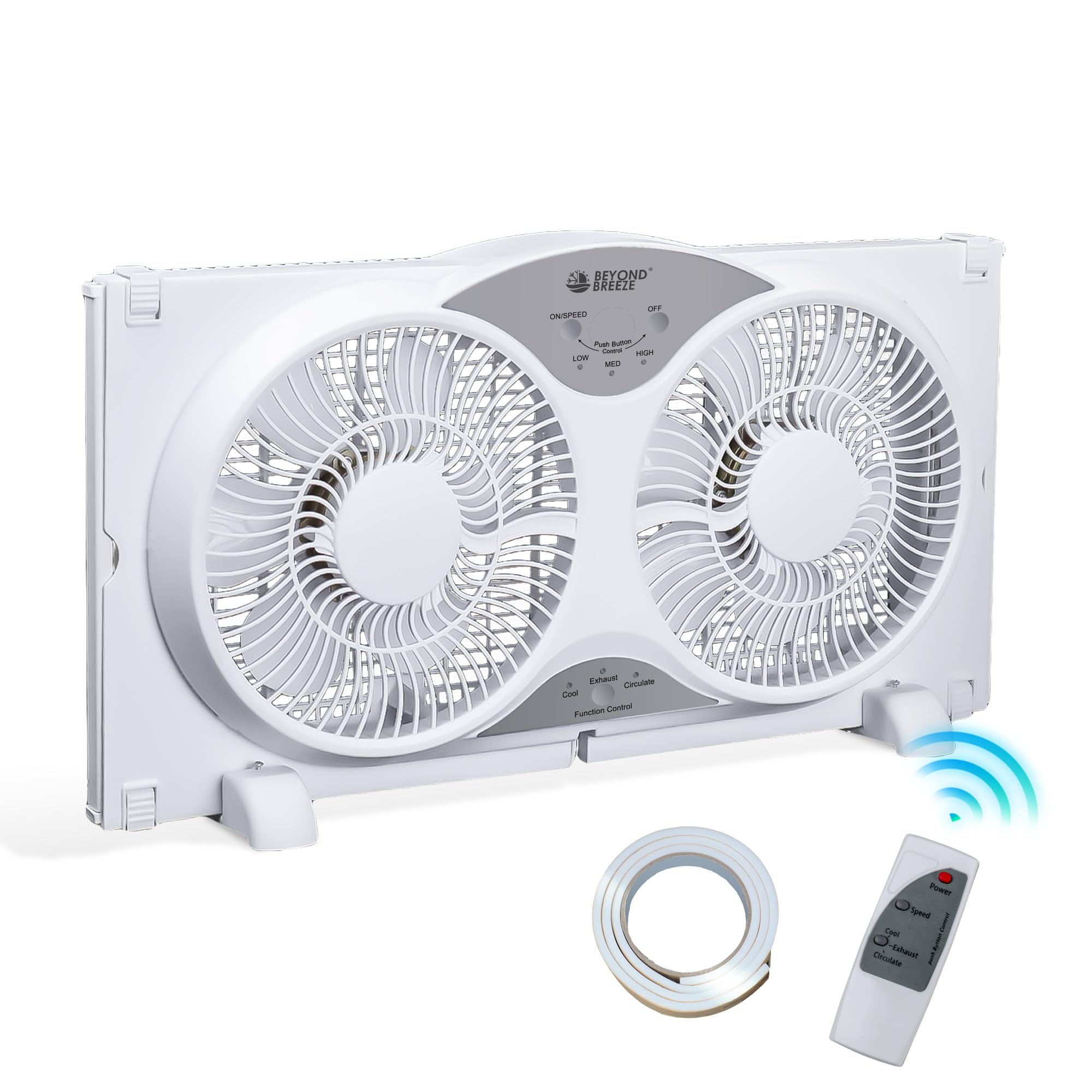
8. BEYOND BREEZE 9″ Dual Window Fan Reversible Airflow
A budget twin-fan that throws air both ways for the price of a pizza night.
For the least money in this roundup you get a dual 9-inch window fan with a remote, three speed settings, and genuinely independent electronically reversible motors. That last point is the clever bit: because each motor reverses separately, you can set one side to pull fresh air in and the other to push stale air out at the same time, or flip both to circulate. A remote handles speed and function selection from across the room, which is rare at this price. The expandable side panels adjust from 23.5 inches out to 37 inches, so it fits most standard horizontal window openings.
Set-up genuinely is a slide-and-close job: owners describe opening the panels, closing the window, and being ready to go in moments. It cools a room by pulling in cool evening air, and switching to exhaust clears smoke and odor out of the room fast. One owner used it in a desert climate for three years and found the high speed cooled the room in minutes. It also ships with two removable legs, so you can run it as a table or floor fan when it is not in the window, and the built-in handle makes it easy to move.
Now the honest part. This is a budget build, and the reviews reflect that — some buyers get years of service while a few report blades breaking or a fan cutting out early. When that happens, owners consistently report the customer service is excellent and refunds are handled. The plastic blades are the weakest link, so treat the unit gently and avoid forcing the heads. For the money, it is a flexible first fan for a small basement window, provided you are comfortable with a lighter build.
Why it earns its place
- Independent reversible motors let one side intake while the other exhausts.
- Remote control at the lowest tier in this list.
- Expanders stretch from 23.5″ to 37″ for most windows.
- Removable legs turn it into a table or floor fan.
What you give up
- Plastic blades are the weak point — a few owners mention breakage.
- Build quality is a common theme in the mixed end of the reviews.
- Handle with care rather than treating it as heavy-duty.
Worth it if: you want dual-direction airflow and a remote on a tight budget and your window sits in the 23.5″ to 37″ range.
Not for you if: you want a heavy-duty fan that will take rough handling — pay up for a metal-bodied pick instead.
Understanding the Specs
Airflow (CFM)
CFM stands for cubic feet per minute — how much air the fan moves every sixty seconds. Higher numbers clear a damp space faster, but they are not the whole story. A 3560 cfm fan in a wide window will empty a basement quickly, while a 98 cfm unit is really a targeted exhaust fan for a small enclosed area. Match the CFM to the volume of the room you need to clear, not to the biggest number on the box.
Reversible vs single-direction
A reversible fan can run its blades both ways, so it either pulls fresh air in or pushes stale air out. Single-direction fans, by contrast, only exhaust. In a basement, reversible is often the more useful choice: run exhaust during a damp spell, then switch to intake on a cool evening to draw fresh air down from outside. A few models also let one side intake while the other exhausts, which moves air through the room rather than just into or out of it.
Window fit and expanders
Fan width is the number that causes most returns. Some models use spring-loaded or accordion expanders to cover a range, others are a fixed panel that only suits a specific opening. Always measure the inner frame — the actual gap the fan sits in — rather than the glass. A fan with expanders that stretch to your window width will seal better and vibrate less than one that only just fits.
Noise and control
Noise is usually measured in decibels, and a fan running in a living basement should stay quiet at the speeds you use most. Higher airflow generally means more noise, which is why several big fans are loud at maximum. Controls range from a simple knob to a touch pad with remote and timer. If you will run the fan overnight or from another floor, a remote and a lower-noise design matter as much as raw CFM.
FAQ
Will a window exhaust fan actually remove damp air from a basement?
How do I measure my basement window for an exhaust fan?
What is the difference between exhaust and intake mode on a window fan?
Can I leave a basement window exhaust fan running all the time?
How much airflow in CFM do I need for a basement?
Will a window exhaust fan fit a sliding window rather than a sash window?
Do I need a reversible fan or is exhaust only enough?
Are window exhaust fans noisy enough to disturb a basement bedroom?
Can a window exhaust fan run on a normal household outlet?
Does a window exhaust fan also cool the room or just move air?
Final Thoughts: The Verdict
For most people dealing with a full basement of stale, damp air, the basement window exhaust fan winner is the Air King 20″ Whole House Window Fan, because nothing else here moves anywhere near its 3560 cfm and the Storm Guard panels let you shut the window behind it. If your window is narrow or oddly shaped, grab the Vornado PORTAL Window Fan — its low-profile modular fit works where wide fans simply will not seat. And for a small, awkward basement opening with a stubborn odor problem, the Nalle 10 Inch Reversible Exhaust Fan is the one to reach for. One last nudge: pick one reversible fan rather than two single-direction units — the Vornado and EVO each let you switch direction in place, so you get both fresh-air cooling and damp-air exhaust from a single window.
How We Picked
We do not accept paid placement. Every pick is matched to a real buyer and a real use-case; we do not hands-on test units.
Sources & Methodology
Specifications: manufacturer listings and product documentation. Review insights: verified customer reviews, as of September 2026. Pricing: not shown on this page (it changes often); check the current price via the retailer link.
As an Amazon Associate, KitchPrep earns from qualifying purchases. This does not affect which products we feature.
Related Guides
