
Specs are compiled from manufacturer listings and verified buyer reviews and can change over time — please confirm the key details on the product page before buying.
If you weld with a fixed-shade helmet, you already know the ritual: flip it up, strike, flip it down, hope you caught the puddle in time. An auto-darkening helmet removes that whole dance — the lens stays clear while you position your torch, then darkens the instant the arc fires, so your eyes never take the hit. This guide covers what actually separates a good auto-darkening filter from a cheap one, which shade range suits stick versus TIG versus MIG, and which helmets hold up to daily shop abuse without draining your wallet.
I’m Mohammad Maruf — the founder and writer behind KitchPrep. This guide is built by comparing the manufacturers’ published specifications and the patterns across verified customer reviews, so you get each pick’s real strengths and trade-offs instead of marketing spin.
A hobbyist laying a first bead and a shop welder logging full days need the same two specs: lens clarity and shade range. This breakdown of the best auto-darkening welding helmet options covers clarity, switching speed, and long-term durability.
Our Picks at a Glance

How To Choose The Best Auto-Darkening Welding Helmet
The three specs that decide whether you will be happy with a helmet a year from now are optical clarity, shade range, and switching speed. Everything else — graphics, padding color, storage bag — is secondary. Here is what each one actually means when you are under the hood.
Optical clarity rating (the four-number code)
You will see numbers like 1/1/1/1 or 1/1/1/2 on helmet listings. Those four digits rate the lens on optical distortion, light diffusion, and angle dependence — the lower the number, the clearer and more uniform your view of the weld puddle. A 1/1/1/1 rating means top-tier clarity across all categories. A 1/1/1/2 means slightly more color variation at the edges. In practice, a 1/1/1/1 lens keeps the puddle edges sharp when you are working on thin TIG material where a blurry view costs you a clean bead.
Shade range and what you actually weld
Shade numbers run from about 4 (lightest) to 13 (darkest). Stick and MIG typically want shade 10 to 13. TIG at low amperage works in the 9 to 11 range. A helmet that only goes to shade 13 handles most heavy welding, but one that dials down to 8 gives you more flexibility on lower-amperage work. If you switch between TIG and stick, a wider shade window saves you from owning two helmets.
Switching speed and arc sensors
Switching speed is how fast the lens goes from clear to dark once the arc fires. Faster is safer. You will see figures like 1/30,000 second, 1/25,000 second, and 1/23,000 second. The difference between these speeds is measured in fractions so small they are hard to feel in practice, but a faster lens means less risk of catching a flash on a cold start. Arc sensor count matters too: four sensors detect the arc from more angles than two, which helps when you are welding out of position or through a tight joint.
Quick Comparison
| Model | Best For | Viewing Area | Shade Range | Switching Speed | Amazon |
|---|---|---|---|---|---|
| Hobart 770890★ Best Overall | All-day shop welding | 9.3″ widescreen | DIN 9-13 | — | Amazon |
| Miller Classic Series ClearLightPremium Clarity | Low-amp TIG precision | 6 sq in | DIN 8-13 | 1/23,000 sec | Amazon |
| Lincoln Electric K3419-1Multi-Process Champ | Multi-process versatility | — | DIN 7-13 | — | Amazon |
| MIGVAN True Color Helmet | Home shop starter | Large viewing screen | DIN 4/5-13 | 1/10,000 sec | Amazon |
| Forney Easy Weld 55731 | Beginner & light duty | 5.97 sq in (3.62″ x 1.65″) | DIN 9-13 | 1/25,000 sec | Amazon |
| TOOLIOM TL-31800H | Weld-cut-grind switching | 3.94″ x 3.66″ | DIN 5-9/9-13 | 1/30,000 sec | Amazon |
| ARCCAPTAIN LY800J | Large-screen budget pick | 3.94″ x 3.66″ | DIN 5-9/9-13 | 1/25,000 sec | Amazon |
| Sunstac SS-A800D | Low-light welding with work light | 3.94″ x 3.27″ | DIN 4/5-9/9-13 | 1/30,000 sec | Amazon |
| TRQWH TRQ-8000FF-LB | First-time hobbyist | 3.94″ x 3.15″ | DIN 5-9/9-13 | 1/30,000 sec | Amazon |
In‑Depth Reviews
1. Hobart 770890 Auto-Darkening Welding Helmet, Large, Black
Our pick — over 4.5★ from 850+ verified ratings; the strongest balance of quality and price.
Nine inches of widescreen view and a lens that fires at the strike — that is the Hobart promise.
At 1.25 pounds, this is the lightest helmet in this entire lineup — noticeably lighter than the TRQWH at 1.8 pounds. That half-pound difference matters when you are wearing a hood for six or eight hours and your neck starts complaining around hour three. The 9.3-inch widescreen viewing area is the largest single window here, and the PureColor lens gives you a natural, accurate color view of your weld puddle instead of the lime-green tint that older filters produce. Four independent arc sensors mean the lens triggers reliably from multiple angles, so it catches the arc on a cold start even when you are working in a tight corner.
The controls are all analog knobs — shade, sensitivity, delay — which means you can feel your way through adjustments without flipping the helmet up. A Weld-to-Grind toggle lets you switch modes so the lens stays clear during grinding, no helmet swap needed. The auto-on/off power control runs off an included CR2 lithium battery and activates the moment the arc strikes, so there is nothing to remember to turn on. The main trade-off here is that the grind/weld switch sits inside the helmet, not on the outside shell — one long-term owner wished it were the other way after 11 months of hard use.
Where the Hobart pulls ahead
- The lightest auto-darkening hood here at 1.25 pounds — noticeably less neck load than the 1.8-pound TRQWH
- 9.3-inch widescreen viewing area — the biggest window in this entire lineup
- PureColor lens technology gives accurate color, not the washed-out green cast of older filters
- Four arc sensors for dependable detection from awkward angles
- Made by the company that also builds Miller helmets — same factory, different badge
What to weigh before buying
- Grind/weld switch lives inside the shell — you have to flip the helmet up to reach it
- Headgear comfort is average — some buyers swap in a pad or aftermarket band
- 4.7-star rating across years of shop use, though heavy welders may prefer digital controls to these analog knobs
Your daily driver: If you weld most days and want a hood that disappears on your head, the 1.25-pound shell and 9.3-inch window make this the one to beat.
The honest catch: The grind toggle is inside, so quick mode switches mean lifting the helmet — not a dealbreaker, just a small friction point on a very strong hood.
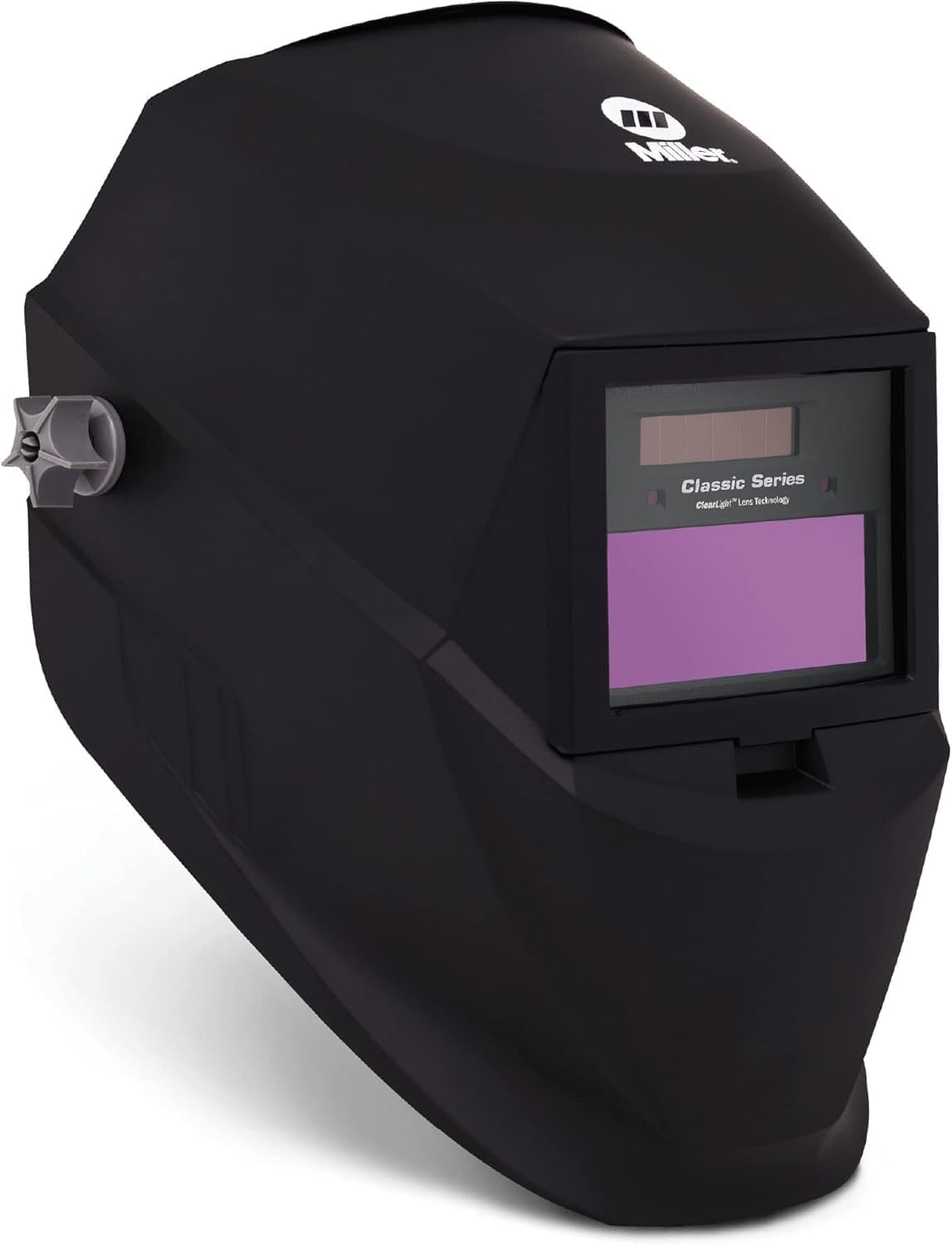
2. Miller Classic Series Welding Helmet, ClearLight™, Shade 8-13, Black
A Miller badge for low-amp TIG welders who need to see the puddle, not guess at it.
What separates the Miller Classic from every budget hood here is the ClearLight lens technology — a high-definition optical system that lets you work at five amps or below without losing sight of the puddle. The 6-square-inch viewing area is smaller than the Hobart’s 9.3-inch window, but the clarity per square inch is what you are paying for. Weld shades run 8 to 13, with a dedicated cut shade range of 5 to 8 and grind shade 3, which means you can keep the hood down between welds thanks to the 3.0 light state. That single feature saves you dozens of helmet flips per session.
Digital controls for shade, delay, and sensitivity replace the analog knobs found on the Hobart, giving you more precise settings when you are dialing in thin TIG work. The ratchet headgear holds tension well over a long day. Switching speed comes in at 1/23,000 second — slower on paper than the TOOLIOM’s 1/30,000 second, but the gap is measured in fractions of a millisecond that you will not notice on a normal arc start. Two arc sensors cover the detection here, which is enough for bench welding but less forgiving than the four-sensor setups on the Hobart and TOOLIOM when you work in tight or out-of-position joints.
Where it earns the badge: If you TIG weld at low amperage and need to see the puddle clearly, the ClearLight lens makes that easier right away. The shade 8 low end is the widest low-shade range of any helmet here, so you get more visibility on thin metal. The 3.0 light state (the lens stays lighter when the arc is off) means you can keep the hood down between passes instead of flipping it up.
What you give up: Only two arc sensors and a smaller 6-square-inch window than several cheaper helmets — this is a lens-first purchase, not a view-first one. The lens also calls for periodic replacement.
Reach for this if: You run TIG under 5 amps and need precise puddle visibility: the ClearLight optics and shade 8 low end are worth the step up.
Look elsewhere if: You want the widest possible viewing window or four-sensor detection — the Hobart and TOOLIOM beat it on both counts for less.
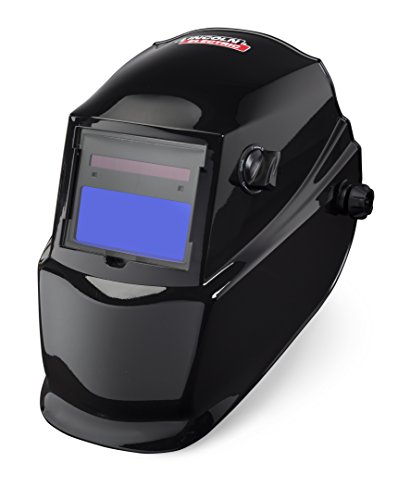
3. Lincoln Electric K3419-1 Glossy VAR 7-13 W/Grind ADF Helmet, Black
Shade 7 on the low end — the widest low-shade range any helmet here can match.
A shade 7 starting point is unusual, and it is the Lincoln’s biggest edge. Most hoods bottom out at shade 8 or 9 for welding. The K3419-1 covers stick, TIG, pulsed TIG, MIG, pulsed MIG, flux-cored, and gouging — more named processes than any other helmet on this list. The polycarbonate shell comes in at 1.5 pounds, right between the ultralight Hobart and the heavier ARCCAPTAIN. An adjustable ratchet headband with an oversize sweatband handles fit, and the nod-to-drop mechanism lets you lower the hood with a head tilt instead of reaching for it.
What keeps this off the top spot is dimming consistency. The listing claims fast switching, but the dimming speed sits in the mixed column, with a portion of owners seeing slow darkening during prolonged welding passes. For a weekend welder running short beads, this rarely surfaces. For someone holding a long arc on heavy plate, that inconsistency becomes the reason to look at the Miller or Hobart instead. The trade-off is honest: this is a versatile, comfortable, well-built helmet that occasionally asks you to slow down and reset.
Process coverage: Seven named welding processes — stick, TIG, pulsed TIG, MIG, pulsed MIG, flux-cored, and gouging — plus a shade-7 floor that opens more low-amp work than most of its rivals. The oversize sweatband and ratchet headband keep fit comfortable through long sessions.
The caveat: Dimming speed draws mixed feedback, so long-held arcs on thick material can occasionally feel less consistent than the Hobart or Miller. Fine for short and moderate passes; less ideal for someone logging eight-hour stick shifts.
Suits you if: You bounce between stick, MIG, and TIG and want one hood that covers all three with a shade-7 low end.
Understand before buying: The dimming speed is not the fastest here — long, unbroken arcs on heavy material may occasionally test your patience.
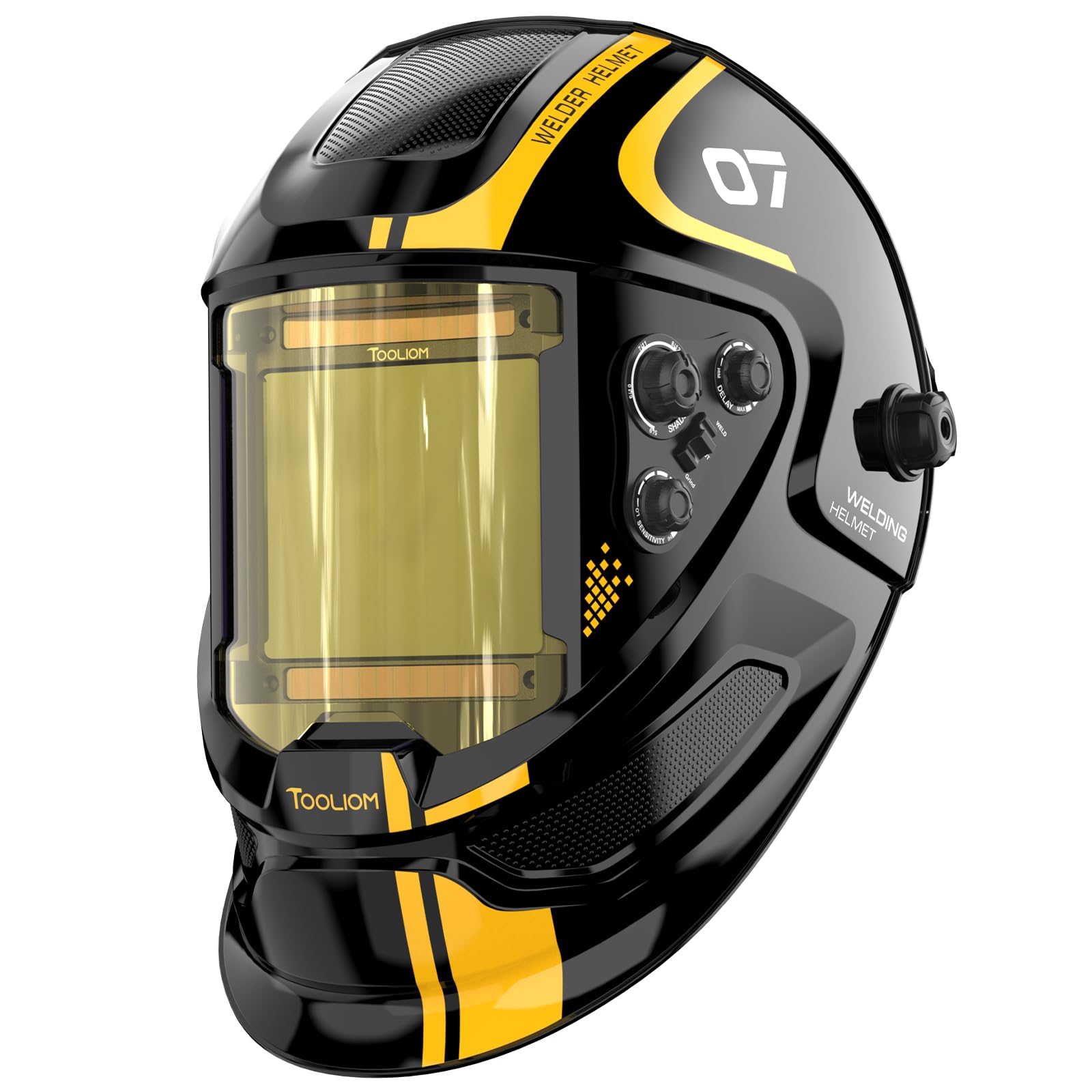
4. TOOLIOM Auto-Darkening True Color Welding Helmet with 3.94 x 3.66 View
One hundredth of a millisecond of arc to dark — the fastest lens on this list.
The TOOLIOM’s headline number is 0.00003 seconds, which is a 1/30,000 second switching speed (how fast the lens darkens when the arc starts). That is the quickest here, faster than the Miller Classic’s 1/23,000 second and the ARCCAPTAIN’s 1/25,000 second. In practice that is a fraction so small you will not feel it, but it matters on cold starts where the arc fires before you expect. The 1/1/1/1 optical clarity rating (a top score for how clear the lens is) and true color technology put it in the top optics tier, so colors look more natural through the lens. The 14.4-square-inch viewing area (3.94 inches by 3.66 inches) gives you real estate to see your puddle edge and the surrounding joint. Four arc sensors detect from multiple angles, so the lens is less likely to miss the arc.
What stands out about how people weld with this one is that the sensitivity errs toward over-darkening — it will occasionally trigger on a bright white vehicle in sunlight, which most welders prefer over the alternative of failing to darken. The headgear is a black butterfly style with sweat-absorbing padding and multiple adjustment joints, which is a real upgrade over the flimsier bands on cheaper hoods. A replaceable lithium battery pairs with solar cells, so you are not stuck if the cell drains.
Speed and view: A 1/30,000-second trigger, 1/1/1/1 optics, and a 3.94″ x 3.66″ screen — the fastest and clearest combination under in this lineup. Weld, Cut, and Grind modes are all reachable from the controls.
Over-darkening quirk: Sensitivity errs on the safe side and occasionally fires on bright white surfaces outdoors — most welders prefer this to the opposite, but it can surprise you in a sunny driveway.
Your match if: You want the fastest switching lens here and prefer a sensitivity setting that errs toward safety.
Consider a different pick if: You weld outdoors in bright sunlight and want zero accidental darkening — the aggressive trigger can fire on white vehicles and bright reflective surfaces.
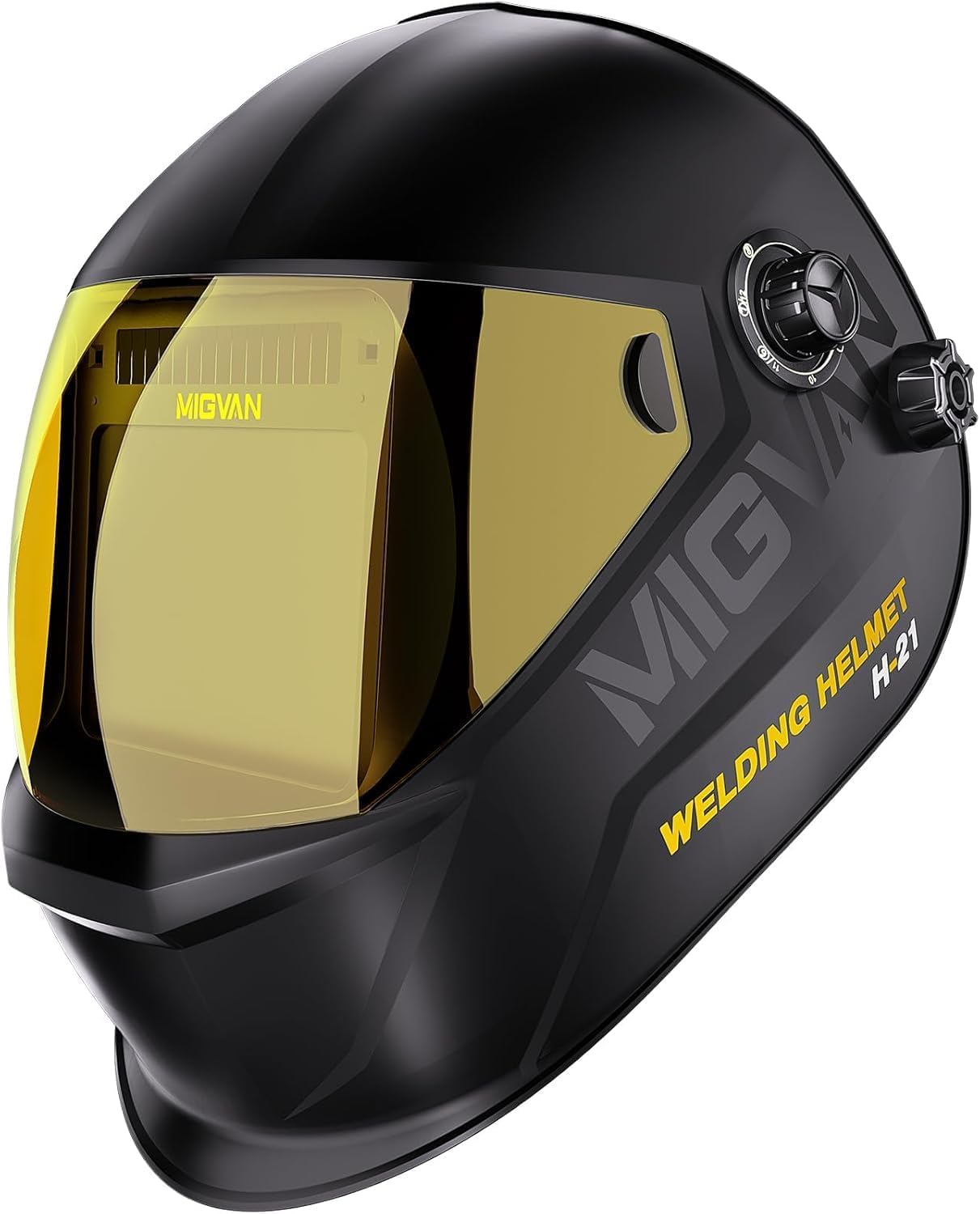
5. MIGVAN Welding Helmet Auto Darkening True Color Large Viewing, Solar/Rechargeable
A starter hood that punches past the yellow-box store shelves.
Four arc sensors and a golden-lens true color filter land this one in the same optical tier as helmets costing significantly more. Din4 light state switches to DIN5-9 or DIN9-13 dark states, giving you a wide shade window for stick, MIG, TIG, cut, and grind. The auto darkening activates in 1/10000 second — slower than the TOOLIOM’s 1/30,000 second, but still a working speed that most home-shop welders will not outrun. Solar cells paired with a replaceable CR2450 battery mean the lens keeps working even in low-light shops, which is where a solar-only hood gives up.
The fit is the honest weak point. The head strap on some units works loose over time, so if you have an odd head shape or wear a bandana under the hood, plan on dialing the adjustment more often. Welding at low amperage with lighter shade settings works well according to beginner welders, and the helmet handles small home projects fine — it is not pitched at professional use, and owners treat it that way. Air circulation inside the closed full-face mask is limited during long sessions, so short passes stay more comfortable than marathon ones.
The bright spots
- Four arc sensors with 1/10000-second activation — plenty of detection speed for home work
- True color golden lens with DIN 4 light state and 5-13 shade range
- Solar plus replaceable battery so the hood works even in dim shops
- Shop owners who outfit welding teams report it stays comfortable through a full day
Where it asks patience
- The head strap can work loose — plan on periodic fit adjustments
- Air circulation inside the closed full-face mask is limited over long sessions
- Not pitched at professional use — a home-shop and hobby hood at its core
Ideal for: Home-shop welders running MIG, stick, or occasional TIG who want pro-level features without a shop-grade outlay.
Know before you commit: The fit adjustment needs periodic attention, so if you want a set-and-forget strap this is not the pick.
6. Forney Easy Weld Series Auto-Darkening Welding Helmet, Model 55731
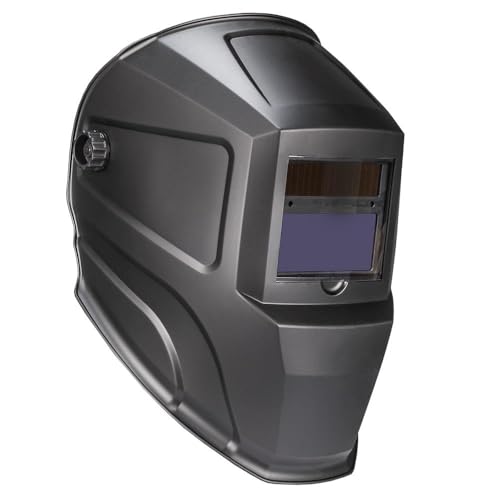
An external shade knob and a light shell — built for the first weld, not the thousandth.
Where most budget helmets make you pop the hood up to tweak settings, the Forney puts the shade selector on the outside of the shell, with a grind option right alongside it. You can drop from shade 10 for stick to shade 9 for lighter work without breaking your rhythm. Switching speed is 1/25,000 second, quick enough for beginner and DIY work. The 5.97-square-inch viewing area (3.62 inches by 1.65 inches) is the narrowest window on this list — a real limitation if you are used to wide screens, but fine for single-pass work where you just need to track the puddle.
The head gear is a dual-crown strap with a five-point geared headband and a sweatband, which reduces the neck fatigue that comes from flipping a heavy hood up and down all afternoon. Internal sensitivity and delay switches are set behind the shell, where they stay protected from bumps and accidental changes. One honest limitation: the 3V lithium cell inside is not user-replaceable, so when the battery eventually gives out, the helmet is done. For casual DIY use, that is likely years away. For someone welding daily, it becomes a real end-of-life issue.
Beginner-friendly design: External shade dial from 9 to 13 with a grind setting, five-point geared headband, and a lightweight impact-resistant shell. Two arc sensors and a 1/25,000-second trigger cover the basics without extras you would not use.
The non-replaceable battery: The 3V lithium cell inside the shell cannot be swapped by the user — the helmet reaches end of life when the cell drains. For occasional DIY use that is a distant concern; for regular shop work, it caps the helmet’s lifespan.
Starting out? This is the hood that makes sense when it is your first helmet and you want to learn the settings without overthinking them.
The trade-off to accept: The narrow 3.62″ x 1.65″ viewing window and sealed-in battery suit occasional use, less so daily production welding.
7. ARCCAPTAIN Welding Helmet, 3.94″×3.66″ Auto Darkening Welding Hood
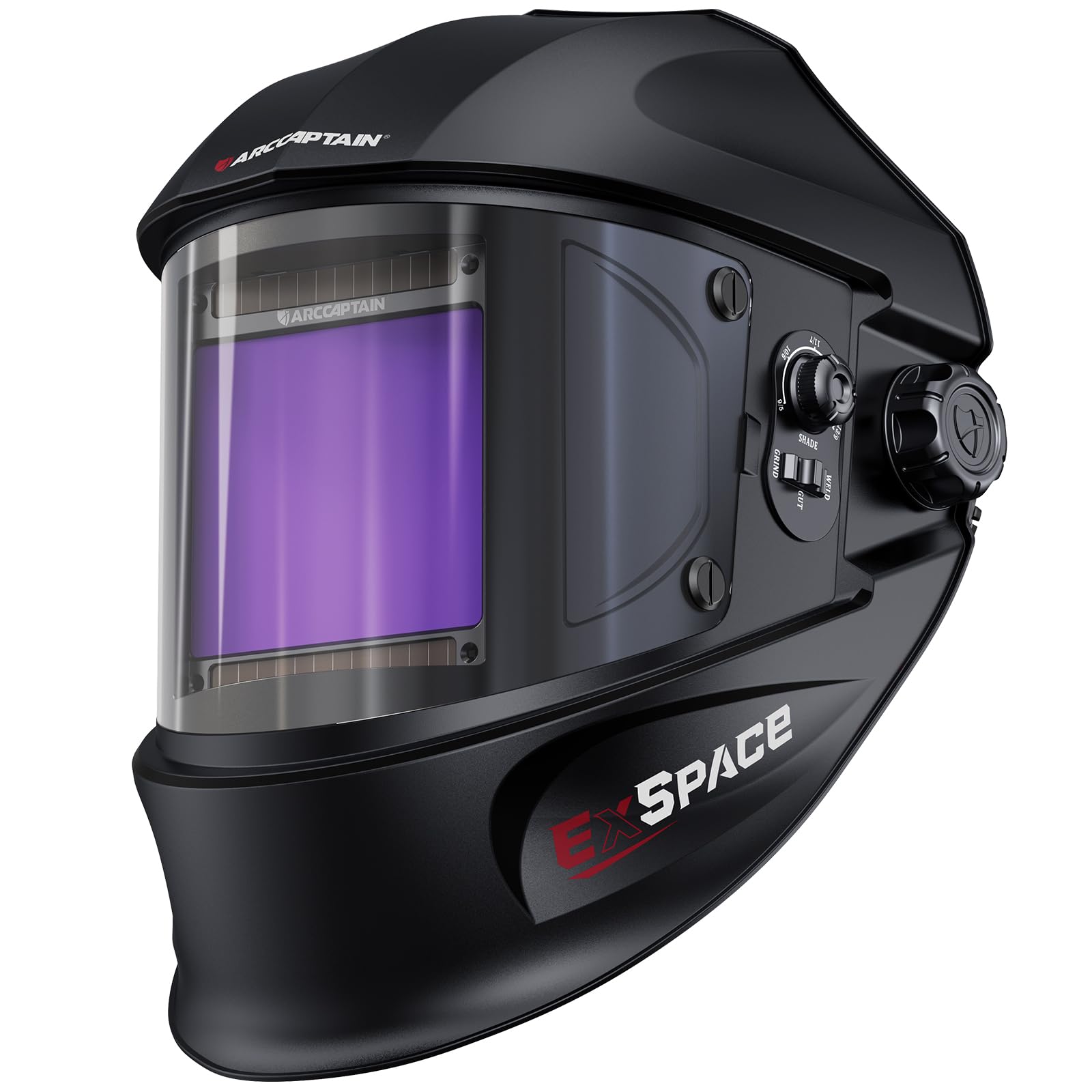
Fourteen square inches of 1/1/1/1 real estate at a hobbyist-friendly figure.
The ARCCAPTAIN’s 3.94-by-3.66-inch screen gives you a 14.4-square-inch viewing area with 1/1/1/1 optical clarity — the same top-tier rating as the TOOLIOM and Miller, at a lower figure. Four premium arc sensors drive the 1/25000-second switching speed, which sits between the TOOLIOM’s 1/30,000 second and the Miller’s 1/23,000 second. Two solar panels on the front and two CR2450 lithium batteries on the back mean you are not dependent on a single power source.
The adjustment knobs are redesigned so you can work them with gloves on — a small touch that saves time when your hands are already occupied. The auto-darkening performance is the honest variable: most users report reliable darkening, but a minority note the lens does not always darken correctly, particularly during long welding passes. That inconsistency mirrors what cheap-lens hoods sometimes do, and it is the reason this one does not top the list despite its large, clear window. Non-issue for most welders; something to know if your work involves long, continuous beads.
Big window, small outlay: 14.4 square inches of 1/1/1/1 true-color screen, dual solar panels plus two replaceable CR2450 cells, and glove-friendly adjustment knobs. A comfortable pick for a hobbyist who wants maximum visibility.
Auto-darkening inconsistency: Most owners get clean, reliable darkening — a minority report the lens does not always respond during extended arcs. For short hobby passes this rarely matters; for long TIG or stick welds, the occasional miss is worth knowing about.
Pick this for: The clearest 1/1/1/1 window at this price tier, backed by dual solar panels and glove-friendly knobs.
skip it if: You log long, unbroken welding passes where a lens that occasionally hesitates would interrupt a bead.
8. Sunstac Auto-Darkening Welding Helmet 3.94 x 3.27″ View with Light
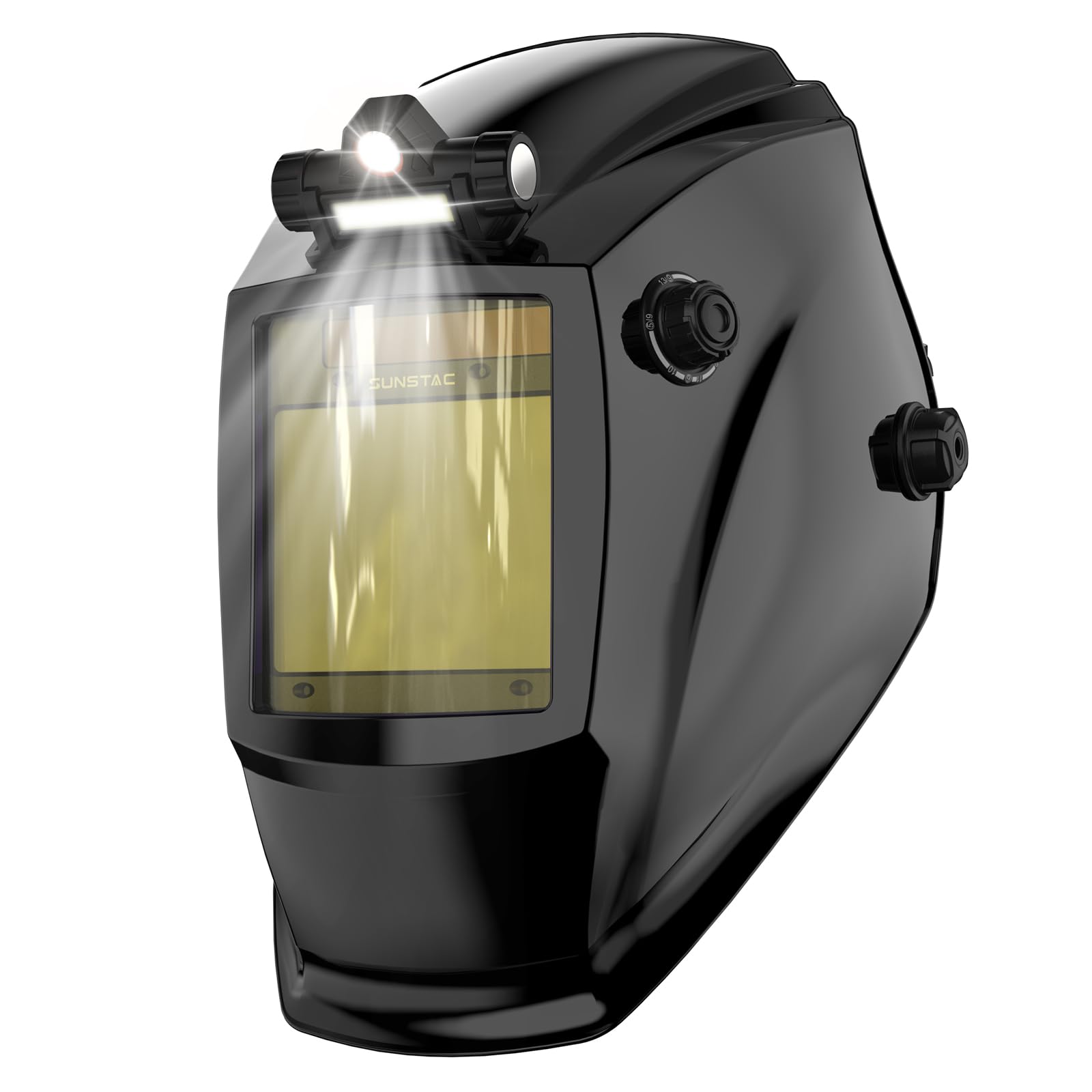
The only hood here that lights your work with a built-in rechargeable lamp.
That auxiliary work light is the whole reason to consider the Sunstac. It is a rechargeable high-brightness lamp with two selectable modes — a concentrated beam for a tight joint or a wider spread for general work — and an adjustable swivel angle so you can aim it exactly where the arc lands. Four arc sensors, a 1/30000-second switching speed, and a 1/1/1/1 true color lens put the core optics on par with the TOOLIOM and ARCCAPTAIN. The 3.94-by-3.27-inch screen pulls slightly smaller than the TOOLIOM’s 3.94-by-3.66 window, but the wide shade range 4/5-9/9-13 covers stick, TIG, MIG, cut, MMA, and plasma with a grind setting on top.
Dual power runs through a lithium battery or solar cells — the helmet keeps working when the cell drains and solar charging tops it up. The harness is adjustable front-to-back, which owners of glasses report as a real fit improvement, since the helmet can be pushed closer to the face while still clearing the frames. The trade-off here is weight: at 2.23 pounds, it sits on the heavier end, so long sessions will feel it more in your neck than the 1.25-pound Hobart. Short to medium jobs stay comfortable; eight-hour marathons bring out the difference.
what separates it: A rechargeable auxiliary light with two modes and an adjustable swivel angle — the only built-in illumination in this lineup. Wide 4/5-9/9-13 shade range and full process coverage for stick, TIG, MIG, plasma, and cut.
Weight to consider: At 2.23 pounds this is one of the heavier hoods here — noticeably more than the Hobart — so long sessions will test your neck more than lighter options.
Reach for this if: You weld in dim shops or tight spaces where the built-in light lets you see the joint before the arc fires.
Look elsewhere if: The 2.23-pound shell would bother your neck over long shifts, or you do not need the work light feature at all.
9. TRQWH Welding Helmet Auto Darkening with 4 Arc Sensor, Wide Shade Range 4~5-8/9-13
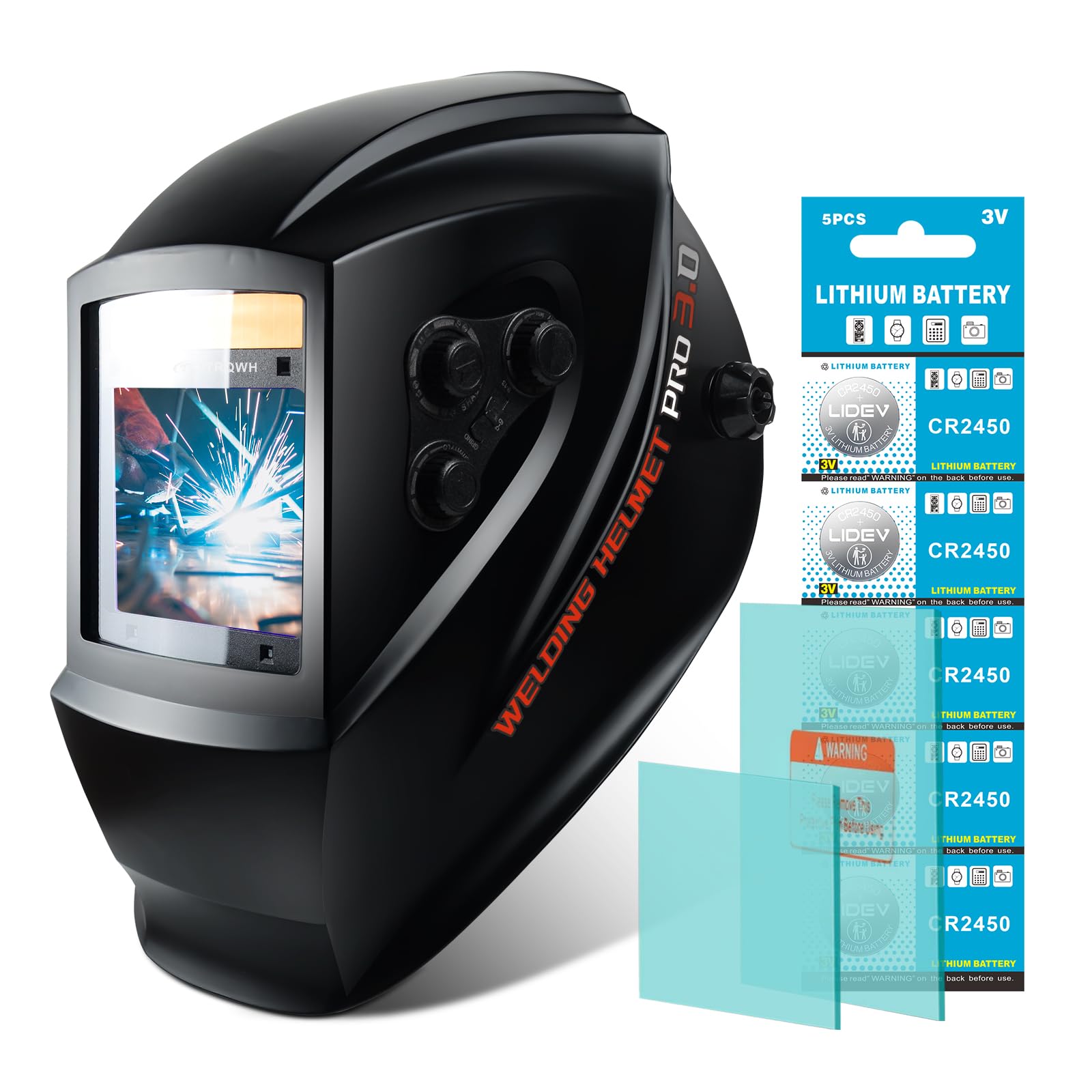
Everything a first-time buyer wants — and one headband caveat to plan around.
For a helmet in this tier, the TRQWH punches above its weight on optics. The 1/1/1/1 clarity rating and true color lens put it in the same visual tier as helmets several times its price — clear enough that experienced welders report it outperforms well-known shop-brand hoods for lens clarity alone. The 3.94-by-3.15-inch view screen is on the smaller side, but the 4/5-9/9-13 shade range with a DIN4 light state covers MIG, TIG, stick, plasma, and grinding without swapping hoods. Four sensors trip the auto-darkening in 1/30000 second, fast enough that you will not outrun the hood on a normal arc start.
Dual power runs on solar cells plus a replaceable CR2450 lithium battery, which matters because the cell is user-swappable when it eventually drains. Forehead and ear padding is thickened and breathable. The frank limitation is the headband — the plastic adjuster and tension buttons are the weak point, and there are reports of the assembly failing on some units. Treat the headband gently and it holds. Wrench on it like a shop horse and it will not. That is the trade-off for the price point.
Optics for the price: 1/1/1/1 clarity with true color technology in an entry-level hood — many owners say the lens view beats what they used before. Four sensors, 1/30000-second switching, and a replaceable CR2450 battery round out the package.
Treat it gently: The headband plastic and tension buttons are lightweight and less durable over time. Occasional use holds up well; heavy daily wear will want a gentler hand on the adjusters.
First hood energy: For a hobbyist or first-time welder who wants 1/1/1/1 optics without committing serious money, this is the pick.
Handle the headband carefully: The plastic tension piece is the known weak spot, so light pressure on the adjusters keeps it around longer.
Understanding the Specs
Shade Numbers (DIN 4 to 13)
The shade number measures how dark the lens goes when the arc fires — the higher the number, the darker the view and the more protection against the bright arc light. A shade 4 is the clear state you weld in before striking; a shade 10 to 13 is what you want for stick and heavy MIG. TIG at low amperage works in the 9 to 11 range. If you switch between processes, a helmet with a wide range like 4/5-9/9-13 lets you cover stick, MIG, TIG, cutting, and grinding without buying a second hood.
Arc Sensors and Switching Speed
Arc sensors are the small detectors that spot the moment the arc fires and tell the lens to darken. Two sensors handle most bench welding. Four sensors detect the arc from more angles, which matters when you are welding out of position or reaching into a tight joint. Switching speed is the time between the arc firing and the lens going dark — you will see 1/30,000 second, 1/25,000 second, and 1/23,000 second. All three are fast enough that a healthy eye will not outrun them, but faster always means a smaller window for a flash on a cold start.
FAQ
Do I need an auto-darkening helmet for TIG welding at low amps?
How long does the auto-darkening filter lens last?
Is true color lens technology worth the upgrade over green tint?
How many arc sensors does a helmet need for reliable darkening?
Can I wear glasses under an auto-darkening helmet?
What is the difference between weld mode and grind mode?
Do I need a replaceable battery in a welding helmet?
Is a lighter helmet worth paying extra for?
What does the 1/1/1/1 optical clarity rating actually mean?
Can an auto-darkening helmet be used for plasma cutting?
Final Thoughts: The Verdict
The winner is the Hobart 770890 because it nails the one spec that matters on a long shift — at 1.25 pounds it is the lightest auto-darkening hood here, half a pound under the TRQWH at 1.8 pounds. That weight gap turns into neck relief by hour three. Add the 9.3-inch widescreen, four arc sensors, and PureColor lens, and it is the helmet most welders reach for on a work week basis.
If you are running low-amp TIG and need to see the puddle in shade 8, reach for the Miller Classic Series. For a home garage shop that wants four arc sensors and true color optics without the pro-tier outlay, the TOOLIOM is the one to grab. And if you are laying your very first bead, the TRQWH gives you a 1/1/1/1 lens for a first-hood figure — just treat the headband gently and it will reward you with clean, clear vision from day one.
How We Picked
We do not accept paid placement. Every pick is matched to a real buyer and a real use-case; we do not hands-on test units.
Sources & Methodology
Specifications: manufacturer listings and product documentation. Review insights: verified customer reviews, as of September 2026. Pricing: not shown on this page (it changes often); check the current price via the retailer link.
As an Amazon Associate, KitchPrep earns from qualifying purchases. This does not affect which products we feature.
Related Guides
