
Specs are compiled from manufacturer listings and verified buyer reviews and can change over time — please confirm the key details on the product page before buying.
A fridge half an inch too wide will not slide under your counter, and one too narrow wastes the space you cleared for it. That is the whole problem with this size. This list sticks to countertop, freestanding, and under-counter units built around that narrow footprint — and it names each one’s real width, from 17.5 inches to 18.9 inches, so a tape measure settles the question before you order. A true 18-inch fridge is rarer than the search suggests, so every pick here is the nearest sold width of the same appliance type, never a 15-inch or 24-inch unit pretending to fit.
I’m Mohammad Maruf — the founder and writer behind KitchPrep. This guide is built by comparing the manufacturers’ published specifications and the patterns across verified customer reviews, so you get each pick’s real strengths and trade-offs instead of marketing spin.
The goal is simple: free up counter space, chill drinks fast, and stay quiet enough for a living room or office corner. The picks below run from budget-friendly to premium, with each unit’s true width called out. This breakdown of the best 18 inch beverage fridge options covers width, can count, and noise so you buy the right one the first time.
Our Picks at a Glance

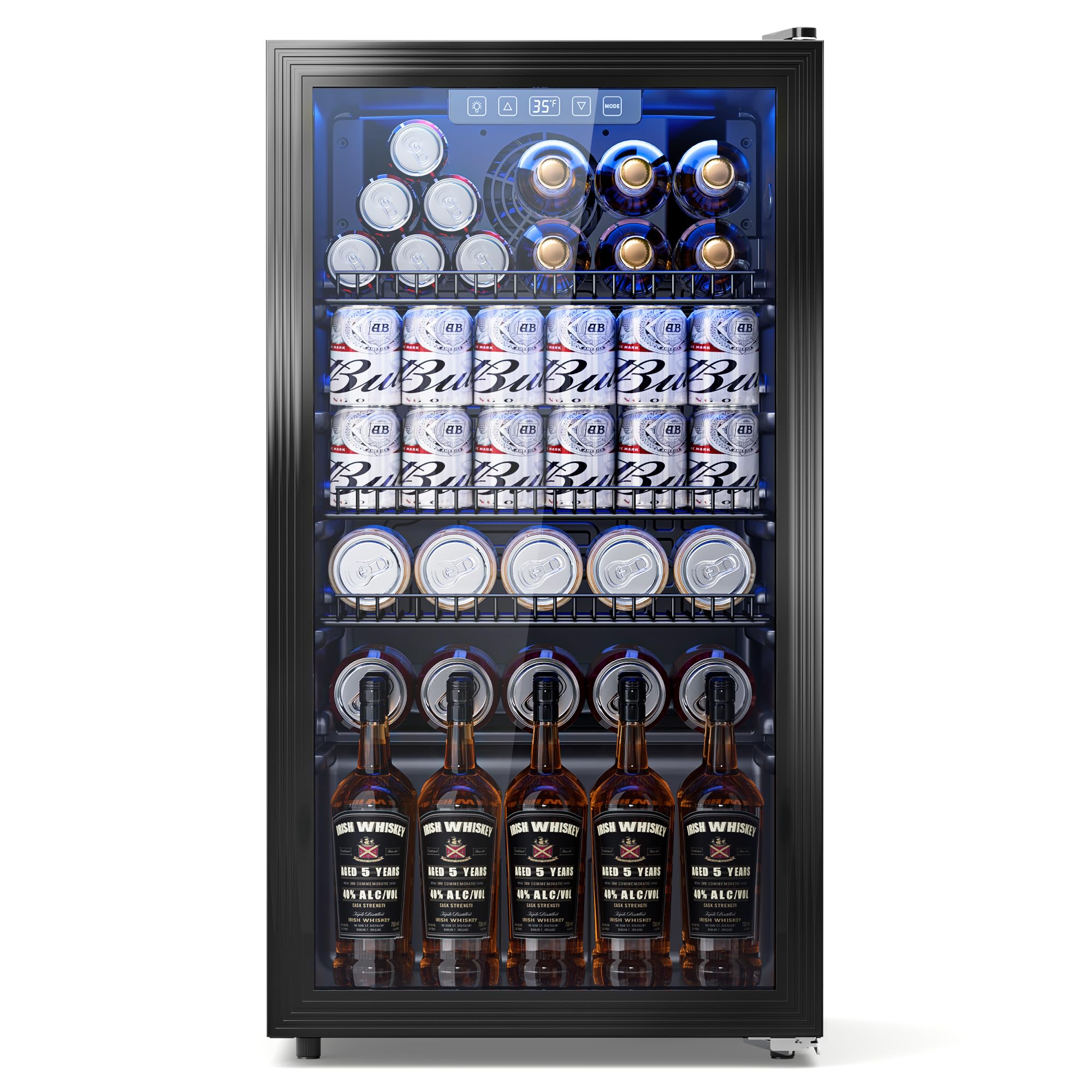
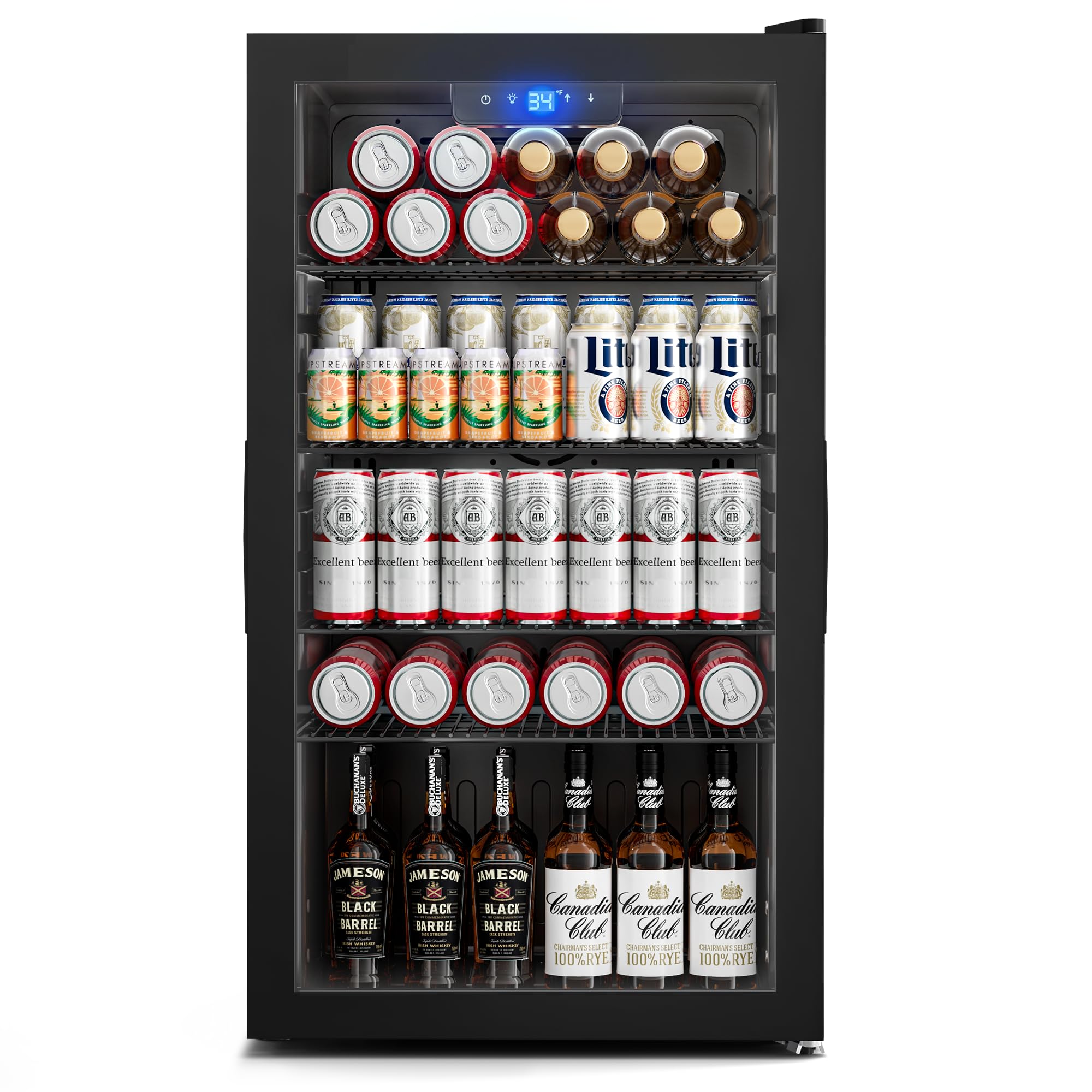
How To Choose The Best 18 Inch Beverage Fridge
One number decides whether this purchase goes smoothly, and it is not the can count. It is the true external width. A fridge sold as an 18-inch model can measure 17.5 inches or 18.9 inches across. In a tight cabinet run, that half-inch decides whether the fridge fits at all. Measure the gap first, then match the fridge’s true width to it.
Width and depth decide the fit, not the label
Leave a little breathing room on each side so the fridge can shed heat — a compressor unit needs air movement to do that. Depth matters just as much for an under-counter spot, because a deep unit can push past your cabinet face or block a drawer. If you plan to build it in, check the depth-with-door-open figure. You still need clearance to swing the door.
Freestanding and built-in are not the same. A freestanding unit vents from the back and sides and needs open space around it. A built-in or front-breathing design pulls air through the front. Putting a freestanding fridge in a sealed cabinet traps heat and shortens its life, so match the ventilation style to where it will actually live.
Zone control and temperature range
Not every drink wants the same temperature. Beer and soda sit best in the mid-30s Fahrenheit, while red wine wants a warmer 53-58°F range. A wide adjustment range — look for something like 34-65°F — lets one cabinet serve both, so you are not running two appliances for a bar setup. A digital touch panel beats a dial for hitting an exact number repeatably.
Noise, lighting, and door swing
A fridge in a bedroom, office, or open kitchen lives or dies on decibels (dB, the unit used to measure sound). Quiet compressor units run at less than 38 dB, which sits near the low end of normal conversation. You notice that hum only in a dead-silent room. A reversible door lets the handle sit on whichever side clears your cabinets. Interior LED lighting helps you read labels in low light but is not a performance spec — treat it as a nice-to-have.
Quick Comparison
| Model | Best For | Can Capacity | Temperature Range | Noise Level | Amazon |
|---|---|---|---|---|---|
| 17″ 126-Can Beverage Refrigerator★ Best Overall | Best overall all-rounder | 126 cans | 37-65°F | Less than 38 dB | Amazon |
| 3.2 Cuft Beverage Fridge, 130 CanBest Value | Value two-in-one wine and cans | 130 cans or 26 wine bottles | 35-65°F | Less than 36 dB | Amazon |
| 130 Can Beverage RefrigeratorCompact Pick (Manastin) | Narrow bar-and-office fit | 130 cans | 34-64°F | — | Amazon |
| KoolMore 18 in. Beverage Refrigerator | Sleek stainless-trim looks | 119 cans | — | 43 dB | Amazon |
| EdgeStar BWC121SSLT | Coldest serving temperature | 80 cans | Low 30s°F | — | Amazon |
| Ca’Lefort 130 Cans Mini Fridge | Retro-styled display center | 130 cans | 34-54°F | Low-noise | Amazon |
| Velivi 24″ Under Counter Built-In | Large dual-zone kitchen install | 180 cans | 37-64°F | ≤40 dB | Amazon |
| Summit 18″ Beverage Center | Built-in plus commercial listings | 2.7 cu.ft. | — | — | Amazon |
In‑Depth Reviews
1. 17″ 126-Can Beverage Refrigerator, Countertop/Freestanding with Glass Door
Our pick — over 4★ from 450+ verified ratings; the strongest balance of quality and price.
The narrow-width all-rounder that fits coffee carts and studio kitchens without stealing a cabinet run.
This FoMup one wins the top spot because it holds 126 cans inside 3.2 cubic feet and still slides into a nearly-18-inch gap. It runs on a rotary scroll compressor (a sealed pump that moves refrigerant without the chug of a piston design) rated at less than 38 dB. That is quiet enough that owners forget it is running until they hear the soft click of it cycling. You get five temperature presets to work from, and the 37°F to 65°F range covers everything from soda to a bottle of white you want ready by dinner.
Its real strength is a mixed load. The three adjustable stainless steel wire shelves have upgraded guardrails, so cans and bottles stay put when you slide a shelf out. A full-length blue LED strip lights the whole interior rather than one dim corner. Buyers report that build quality and overall finish are what they praise most. It is rated for countertop or freestanding placement, so it drops under a prep counter or stands alone beside a coffee station. Bright enough inside to read labels, dim enough outside not to act as a nightlight.
The honest trade-off is durability over the long haul. The interior controls sit on the door rather than a separate panel. One owner reported that after roughly a year and a half the unit grew louder, leaked, and finally stopped cooling with no support available that late. Treat that as a fit note rather than a verdict — the overwhelming majority run past that mark without incident, and this is still the highest-rated pick here. If you expect to run it hard for several years without any thought, budget-tier and premium units alike carry that same appliance risk. Note the leveling feet too: a few buyers found them fussy to adjust on uneven floors.
tall 126-can tower
- 126 cans in 3.2 cubic feet — enough for a full week of cans plus wine bottles
- Less than 38 dB with a rotary scroll compressor, so it disappears into background noise
- Five temperature presets and a 37-65°F range cover soda, beer, and wine in one cabinet
- Three guardrail shelves and full-length blue LED for organized, well-lit storage
- Countertop or freestanding placement gives it flexibility a built-in-only unit lacks
countertop depth check
- Door-mounted controls are slightly awkward to reach behind a full shelf
- Leveling feet need patience to dial in on an uneven floor
- Frost-free design still wants periodic shelf cleaning for spills
stock the garage: If you want the best balance of capacity, quiet operation, and true narrow width in one freestanding unit, this is the pick to start with.
door swing space: You are planning a sealed under-counter build — this one breathes best in the open.
2. 3.2 Cuft Beverage Fridge, 130 Can Mini Fridge With Glass Door, Black
One cabinet that swaps between 130 cans and 26 wine bottles without you changing a thing.
This Tehanld unit earns its place because one same-size cabinet holds either 130 cans or 26 standard wine bottles — a bar-backup and a can chiller in a single box. Inside the same 3.2 cubic foot interior, three removable shelves and five optional slots make the switch. The air-cooling system pushes 360° recirculated air through the cabinet, so the top shelf cools as evenly as the bottom. A low-e coated glass door with a high-density seal keeps that cold from bleeding into your kitchen. Temp-wise, you get a touch panel covering 35-65°F, and you can flip the display between Fahrenheit and Celsius.
Where it undercuts the FoMup is raw quiet: this one is rated at less than 36 decibels, the lowest figure in this guide, and it lands squarely in the sleep-noise band. On the practical side, the fridge is 17.5 inches wide, which is the tightest footprint here, and the interior is genuinely roomy for a unit this narrow. Owners lean on it for eggs and produce as readily as beer, since the clear glass lets you see what is inside at a glance.
Here is the honest catch: temperature retention is the mixed zone. Most buyers get steady cold from 35°F up, but a slice find it will not hold a low setting — one put it plainly, and this is the one quote worth repeating verbatim from the review pages: “It only gets to 35 degrees.” For soda, wine, or produce that is fine; if you want near-freezing beer, know the floor. Give it the 6-12 hour upright rest the listing insists on before first plug-in, since the refrigerant needs to settle back into the compressor after shipping.
glass-door bar fridge: A mixed crowd that wants cans and wine in one footprint, at the lowest noise here.
low shelf reach: If you demand sub-35°F serving temps, this is not the unit for you.
home bar pick: You want can-and-bottle flexibility and the quietest cabinet in this lineup for kitchens, dorms, or offices.
warm room worry: Your priority is hard-frozen cans below 35°F rather than general beverage chilling.
3. 130 Can Beverage Refrigerator, 3.2 Cu.ft Mini Fridge, Glass Door, Black
The one that fits a tight corner because its door swings whichever way your cabinets demand.
The Manastin earns its spot with a reversible glass door — you can hinge it on either side, so you are not stuck with a fridge that opens into a wall. Its 17.5-inch width keeps the footprint tight, it holds up to 130 standard cans, and the four adjustable metal shelves plus eight built-in slots let you rework the interior for tall soda bottles or short craft cans. The two-inch display on the control interface is easy to read, and the 34-64°F range covers the full spread from ice-cold soda to a chilled red.
It lives up to the quiet claim — owners consistently say it runs without drawing attention, and the blue interior light can be switched off entirely if you want the dark look at night. The adjustable front leveling legs keep it steady on a floor that is not perfectly flat, and it carries an ETL certification (a mark that the unit was tested to meet a recognized safety standard). What wins people over here is the size-to-capacity ratio: it slides in where larger units will not, yet still frees up your main kitchen fridge for actual food. For a small office or a corner bar, that fit is the whole point.
The single recurring gripe is shelf strength under load. Stack a full row of bottles on one rack and a few owners notice the shelf dipping slightly — one counted 25 bottles as the point where the bow shows. It is faint and easy to miss, but worth knowing if you plan to max every shelf. Beyond that, this is a straightforward buy for a small office or bar setup, and it is rated for automatic defrost, which means no manual scraping routine.
corner fit win: Reversible door, 17.5-inch width, and enough interior for a full can stash — ideal for offices, bars, and tight kitchens.
crowded shelf risk: Spread heavier bottle loads across shelves rather than piling one rack to the limit.
4. KoolMore 18 in. 3.2 Cu. Ft. Beverage Refrigerator Merchandiser with Stainless Steel Trim and Touch Panel (KM-BR32SS)
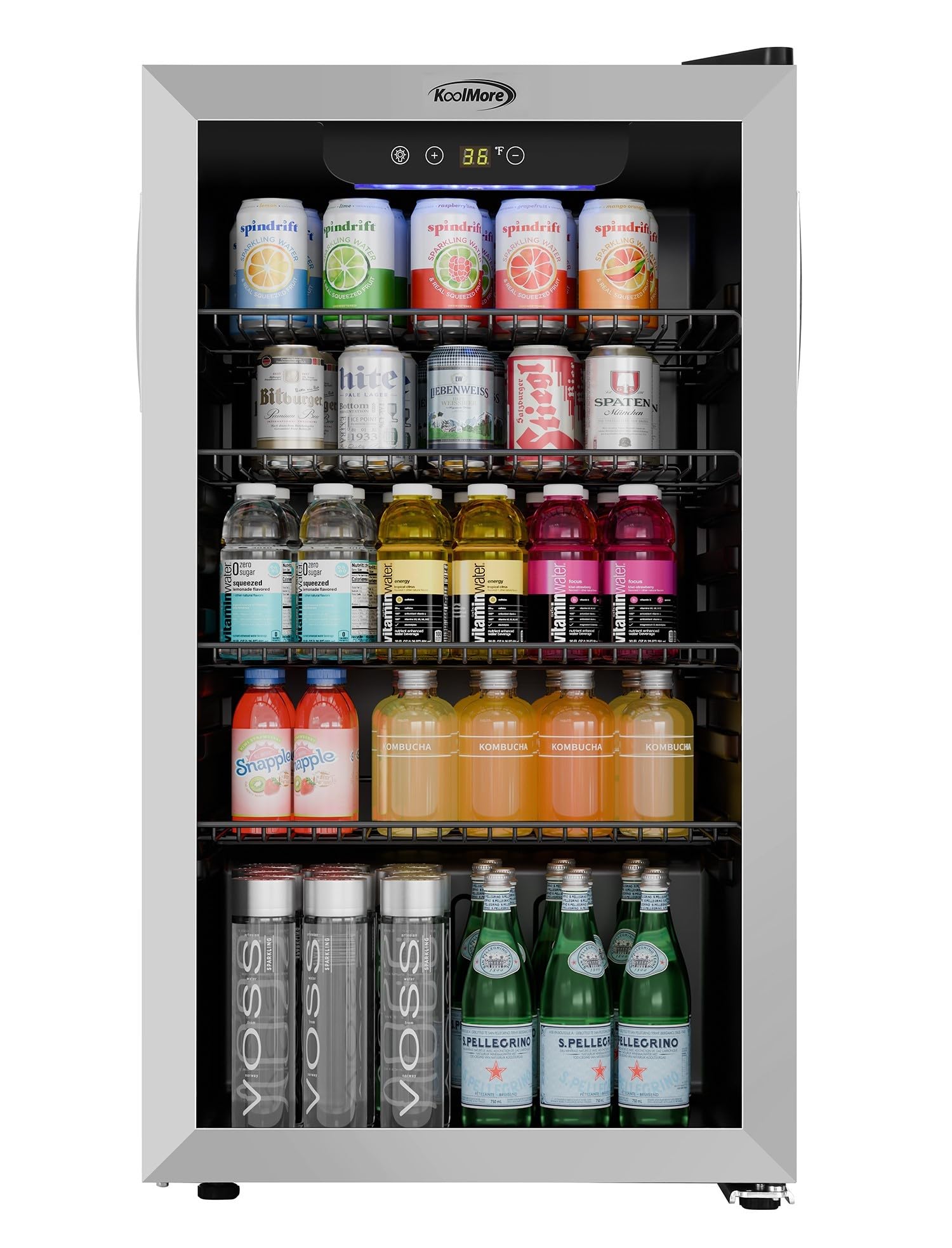
The merchandiser look — stainless trim, tempered glass, blue LED — that reads as built-in furniture, not appliance.
The KoolMore makes this list on looks: a glossy black body, stainless-steel door trim, tempered glass (heat-treated glass made to resist breaking), and blue LED lighting turn the fridge into a lit showcase. It holds up to 119 cans inside 3.2 cubic feet, uses a rotary scroll compressor, and runs at 43 dB — quieter than a typical conversation but a touch more audible than the sub-38 dB FoMup. So it suits a living room better than a bedside. Under a custom bar or in a boardroom, that display factor is the reason you choose it.
The design details show a merchandising mindset. The reversible door lets you flip the swing to suit your cabinetry, there are four adjustable shelves, and the manual defrost system is a maintenance point to plan for rather than ignore. Owners who installed it under custom millwork report that its low-profile shape does not jut past the cabinet face, which is the whole reason someone picks a merchandiser for a built-in surround.
The catch worth naming: the display photos oversell the usable space. The temperature and light controls occupy part of the top row, so you cannot pack the top shelf edge-to-edge as the images suggest — one buyer had to remove a shelf to fit what the photos show. A few others report temperatures drifting from what they set, though at least as many say it holds a good chill. Size your expectations to the real interior, not the picture.
retail display look: Perfect for a custom home bar, boardroom, or wall unit where a stainless-trim display fridge is the point.
budget alternative: Expect the top shelf to carry fewer cans than the promotion photos imply.
5. EdgeStar BWC121SSLT 18 Inch Wide 80 Can Capacity Ultra Low Temp Beverage Center

Built to run colder than anything else on this list, with a lock on the door for good measure.
The EdgeStar wins its spot on temperature: it cools to the low 30s Fahrenheit, the coldest unit in this lineup, so your beer comes out genuinely ice-cold rather than merely cold. Want the coldest pour on this list? This is the only pick that reaches it. The storage comes to 3.1 cubic feet across three adjustable wire shelves, so you get a configurable interior holding up to 80 cans. A reversible door and a built-in lock mean you can set the swing to fit your space and keep the contents secure — a feature none of the other freestanding picks here carry.
It is a freestanding-only design, so it vents from the open air and cannot be sealed into cabinetry; plan for that before you get your heart set on an under-counter spot. The stainless-steel finish and LED interior lit display give it a clean look that fits an office or living room. Given its 80-can ceiling, it trades capacity for coldness — a fair deal if low-30s serving temps are what you actually want.
Now the honest caution. Cold this aggressive has a downside, and the pattern of reviews makes it clear: a small share of owners mention the unit running colder than set, in the worst cases freezing contents and bursting cans. More commonly, buyers just get steady, quiet chilling in the low 30s. The lesson is simple — set the thermostat to the top of your desired range on day one and nudge down slowly, rather than trusting the display as gospel. Let it settle upright before plugging in, and you avoid most first-day surprises.
ultra low temp
- Low-30s°F cooling — the coldest serving temperature in this guide
- Built-in door lock, a security feature the other freestanding picks skip
- 3.1 cubic feet across three adjustable wire shelves
- Reversible door and stainless-steel finish for flexible placement
slow chill time
- 80-can capacity is the smallest here — a deliberate trade for colder running
- Freestanding only; it cannot be built into a sealed cabinet
- Low-30s target means you set and monitor rather than trust the display
cold beer duty: For ice-cold beer drinkers who want a lock and prefer to dial in their own temperature.
quick cool need: You need maximum can count or any form of built-in installation.
6. Ca’Lefort 130 Cans Mini Fridge, Beverage Refrigerator Cooler for Drink/Beer
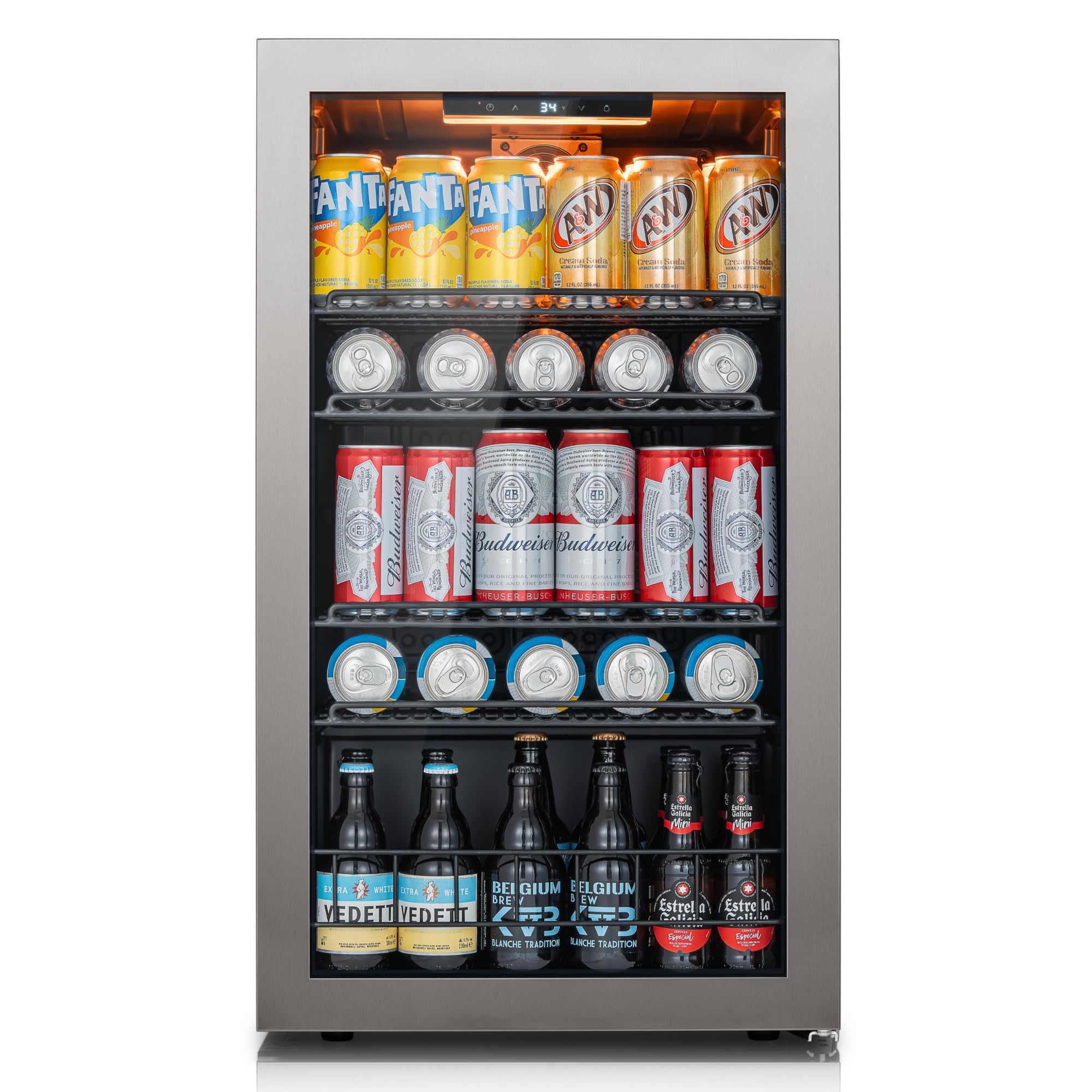
Three interior light colors and a stainless-trimmed door turn this into a lit display, not just cold storage.
Three interior light colors are why the Ca’Lefort is here: amber, white, and blue LED options let you tune the interior glow to the mood, and the stainless-steel-trimmed glass door seals in cold while showing off the contents. Capacity is generous at 3.35 cubic feet, holding up to 130 cans, and the adjustable metal shelves — held by sturdy clips — can be rearranged to fit cans, bottles, or wine. The touch panel runs a 34-54°F range, wide enough for soda, beer, and a chilled white. When you are done, you can hinge the reversible door on either side.
Install-wise, the 18.9-inch width makes this the widest of the countertop-class picks here, but it is built to handle both under-counter and freestanding placement, so it steps up to a kitchen bar or a dorm corner with equal ease. A high-efficiency compressor delivers even cooling throughout, and the low-noise operation suits a home office or bedroom where you are trying to concentrate. If you are weighing it against the Velivi below, remember the Velivi holds way more cans — the Ca’Lefort answers with styling and flexibility instead of sheer volume.
Two things to sort before you commit. First, this is a semi-automatic defrost unit, so it wants the occasional hand rather than running fully self-cleaning. Second, a few buyers hit a flashing error code or heavy condensation on the glass; the same listing also notes the manual calls for standalone placement, while the brand has confirmed cabinetry is fine with an open back for airflow. Follow the airflow guidance and the 24-36 hour upright rest before powering on, and you sidestep most of the trouble.
party-ready shelves: Amber, white, or blue interior lighting plus stainless trim makes this the choice when the fridge doubles as décor.
wipe-down chore: Semi-automatic defrost and a wide 18.9-inch body ask slightly more space and attention than the narrowest picks.
7. Velivi 24” Beverage Refrigerator Under Counter Built-In and Drink Fridge

The big-capacity outlier — dual zones, a lock, and enough room to stock a party without a second trip.
At 4.9 cubic feet, the Velivi holds up to 180 standard cans — no other pick here comes close on volume. It runs a dual-zone design (two separately controlled compartments), which lets you hold beverages and wine at their own ideal temperatures at the same time. Owners call out how quietly it does that, followed closely by how well it holds those zones. A 37-64°F adjustable range, a touch panel with a memory function that restores your last setting after a power cut, and a blue LED interior round out the controls. For the constricted under-counter slot, a front venting design lets it breathe as a built-in, while the safety door lock keeps curious hands out. It is 23.4 inches wide, so this one is for buyers whose cutout is 24 inches, not a snug 18.
The build is designed to hold up: a stainless-steel frame and two layers of tempered glass with a smooth foam layer, silent racking at ≤40 dB, and a memory feature that keeps your settings through outages. If you are deciding between this and the Ca’Lefort, the split is clear — this holds 180 cans versus 130, and adds a door lock, while the Ca’Lefort counters with its three-color lighting.
The one frustration to expect is rack smoothness. The shelves are sturdy, but they do not glide as freely as some buyers want on a full cabinet. That is a small quibble against a fridge this size that otherwise handles a full stocking job without complaint.
dual zone built-in: Dual-zone control plus 180-can storage make it the pick for high-turnover home bars and busy kitchens.
cutout width check: At 23.4 inches wide it needs a true 24-inch gap, so measure your under-counter space before committing.
large capacity win: The right fridge for a machine that must hold a lot, hold it at two temperatures, and lock it down.
cabinet fit risk: Your cabinet opening is a tight 18-inch slot — this unit needs the full 24-inch footprint.
8. Summit 18” Beverage Center, Stainless Steel & Glass-

An 18-inch built-in rated to commercial standards, with a lock and triple pane glass for serious installs.
The Summit earns its place on a 17.75-inch width and a front-breathing design, so it slides into built-in installation or stands freestanding instead of needing open air around it. Its 2.7 cubic feet (76 L) holds roughly a few dozen cans — one buyer counted around 72 12-ounce cans fitting comfortably, with room to spare. The specification that separates it is its ETL-S listing to NSF-7 commercial standards (certifications of how the unit is built and tested for commercial beverage storage), plus a factory-installed lock built into the door and automatic defrost for low maintenance. The user-reversible triple pane tempered glass door carries a smooth stainless-steel trim and handle, and adjustable chrome shelves accept most sizes or pull out for cleanup.
Its placement flexibility is the real draw. The flush back saves depth, the front breathes so it can sit inside a run of cabinets, and the stainless-and-glass face keeps the installation looking sharp. The digital thermostat with electronic controls and a display makes the temperature easy to set and read. Owners who dropped it in report it looks well made from the moment it is unboxed.
Two realities come with the tighter capacity and the built-in class. First, 2.7 cubic feet is the smallest interior here, so buyers who want to stock dozens of cans need to plan accordingly — this is a display and convenience unit, not a party-size one. Second, a small number of owners hit a noisy unit or a door that would not seat correctly, and one noted that service support can be regional. Sizing your expectations to the 17.75-inch width and lower capacity keeps the match clean.
flush cabinet look: For a sealed 18-inch cabinet slot where you want a flush, locked, auto-defrost unit with a commercial build pedigree.
high volume need: 2.7 cubic feet is the smallest here, so measure both your cutout and your storage ambition.
Understanding the Specs
Temperature range and what it changes
The adjustable range is the span of internal temperatures you can dial in. Units here span as wide as 34-65°F, which covers cold soda and beer at the low end and a wine-friendly 53-58°F at the top. A wider range means one cabinet can serve both without a second appliance. Keep in mind the display often shows the temperature you set, not necessarily the actual reading inside, so trust a separate thermometer for critical settings.
Noise level in decibels
Fridge noise is measured in decibels (dB, the unit used for sound level). Lower is quieter, and the units here run from around 36 dB up to 43 dB. For reference, a quiet bedroom sits near 30 dB, so a sub-38 dB fridge tends to fade into the background, while a 43 dB unit is more noticeable in a silent room. If the fridge lives in a bedroom or office, prioritize the lower figure; a garage or bar can absorb more.
FAQ
Will a standard 18 inch beverage fridge fit under a counter?
How many cans does a 3.2 cubic foot beverage fridge hold?
Do I need to let a new beverage fridge sit before plugging it in?
How cold can a beverage fridge get for beer?
What is the difference between a built-in and a freestanding beverage fridge?
Can a beverage fridge hold wine and cans at the same time?
Is a reversible door worth it on an 18 inch beverage fridge?
How much noise should I expect from a small beverage fridge?
Does a beverage fridge use a lot of electricity?
What does an ETL or NSF listing mean on a beverage fridge?
Final Thoughts: The Verdict
For most people wanting a reliable, narrow, quiet beverage
Related Guides
