
Specs are compiled from manufacturer listings and verified buyer reviews and can change over time — please confirm the key details on the product page before buying.
Buying two smoke alarms is easy. The real question is if you need a hardwired pair that ties into the wiring you already have, or a sealed-battery pair that mounts in minutes with no electrician. Choose wrong and you either rewire a ceiling box or replace a chirping alarm early.
I’m Mohammad Maruf — the founder and writer behind KitchPrep. This guide is built by comparing the manufacturers’ published specifications and the patterns across verified customer reviews, so you get each pick’s real strengths and trade-offs instead of marketing spin.
A two-pack only works if both alarms are the right type for your home, so here is how the leading 2-pack smoke detectors actually compare.
Our Picks at a Glance

How To Choose The Best 2-Pack Smoke Detectors
Before you compare brands, settle one question: does the ceiling box where the old alarm sat have a live 120-volt feed and a third interconnect wire? If yes, a hardwired pair is the smarter buy, because one alarm triggers every alarm in the house. If you are replacing battery-only alarms or adding coverage in a room with no wiring, a sealed-battery pair installs in minutes and skips the electrician entirely.
Hardwired vs Sealed Battery: The Real Trade-Off
A hardwired alarm runs on your home’s 120-volt wiring and keeps a 9-volt battery as backup for outages. That backup is the part you maintain — it needs swapping, and the unit will chirp to remind you. A sealed 10-year alarm hides a non-replaceable lithium cell inside and is designed to be thrown away whole once the decade runs out. No yearly battery run, but no second life either.
Interconnect range is where hardwired pairs pull ahead. A wired unit can link into a whole-home network of alarms, so a fire in the basement sets off the bedroom unit upstairs. Battery-only alarms in these 2-packs work independently unless the listing says otherwise — check that line carefully, because it changes how much coverage you actually get.
Sensor Type: Photoelectric vs Ionization
A photoelectric sensor shines light into a chamber and watches for smoke particles scattering that beam, which makes it faster at catching slow, smoldering fires. An ionization sensor uses a tiny radioactive source to detect invisible combustion particles, which suits fast, flaming fires. Each sensor is faster on a different fire type.
For a hallway outside a kitchen, photoelectric tends to mean fewer nuisance alerts, since cooking steam and smoke are the usual culprits behind a mid-dinner chirp. That is why most picks here are photoelectric.
Where The Two Units Go
Buying a two-pack means deciding room placement before you mount anything. One unit belongs on the ceiling inside or just outside each bedroom, and the second covers the main living level near — but not inside — the kitchen. Mounting hardware matters here: a magnetic bracket lets you place and remove a battery-only alarm without a screwdriver, which is a genuine advantage on a high ceiling.
Quick Comparison
| Model | Best For | Power Source | Sensor Type | Alarm Output | Amazon |
|---|---|---|---|---|---|
| Kidde Hardwired Smoke Alarm with 9V Backup, 2 Pack★ Best Overall | Whole-home wired replacement | 120V wired with 9V backup | Ionization | 85 dB | Amazon |
| SITERWELL 10 Year Battery Smoke AlarmBest Value | No-wiring bedroom and hallway coverage | Sealed 3V lithium, 10-year | Photoelectric | 85 dB | Amazon |
| SITERWELL Hardwired Photoelectric Smoke Alarm, 9V Backup | Linking many alarms across levels | Wired with 9V backup | Photoelectric | 85 dB+ | Amazon |
| Siterlink Hardwired Interconnected Smoke Detectors GS562A, 2 Pack | Fast swap on existing wired bases | 120V AC with 9V backup | Photoelectric | Audible | Amazon |
| SITERLINK 10 Year Battery Smoke Detector GS525A, 2 Pack | High ceilings and hard-to-reach rooms | Sealed 10-year battery | Photoelectric | Audible | Amazon |
| First Alert 10 Year Photoelectric Smoke Alarm, 2 Pack | Dropping into an existing compatible base | Sealed 10-year battery | Photoelectric | Audible | Amazon |
In‑Depth Reviews
1. Kidde Smoke Detector, Hardwired Smoke Alarm with 9-Volt Battery Backup, 2 Pack
Our pick — over 4.5★ from 550+ verified ratings; the strongest balance of quality and price.
The two-pack built to replace what is already screwed to your ceiling.
Replacing old wired alarms is the entire job here, and it is the thing this pair does best. The wall plate and harness line up with the boxes most homes already have, so a swap takes minutes rather than an afternoon. Owners walking this exact path call it straightforward work: as buyers report, one “installed 12 around the house. Easy to install”, and another described the unit as “exactly as pictured” and having “plugged right into my old connection.”
You get steady power from a 120-volt corded-electric source, backed by a 9-volt alkaline battery (a small backup that keeps the alarm live during an outage). The interconnect capability stretches furthest of anything in this guide: it links up to 18 Kidde smoke, heat, or CO alarms, plus the option to bring in 6 strobe lights or relay modules. That beats the 12-alarm ceiling on the SITERWELL hardwired model below — the difference between covering one floor and covering a whole house with room to spare.
An 85-decibel alarm handles the waking-up part, and the Test-Hush button does double duty — it tests the unit and silences the cooking-and-steam false alarms that usually set one off. The ionization sensor detects invisible fire particles, which skews it toward fast flaming fires; a photoelectric model such as the SITERWELL units is faster on slow smolder.
Where it wins
- Links to as many as 18 Kidde alarms — the widest network in this lineup, versus a 12-alarm cap on the SITERWELL hardwired pick
- Interconnect means a fire in one room triggers every linked alarm, giving you warning from anywhere in the house
- The Test-Hush button silences nuisance alarms from cooking or shower steam without disconnecting anything
- UL listed with a 10-year limited manufacturer warranty on the alarm itself
What to plan for
- You need live 120-volt wiring and an existing interconnect wire at the box, or this pair will not work as intended
- The supplied 9V batteries have drawn gripes about failing early, so budget for a fresh set on install day
- One long-running annoyance on wired alarms shows up here too: the unit can beep in the middle of the night, usually the low-battery signal
Reach for this if: your ceiling already has hardwired alarms and you want the widest interconnecting network available in a two-pack.
Look elsewhere if: there is no wiring in the box — a sealed-battery pair installs without an electrician and skips the yearly battery chore entirely.
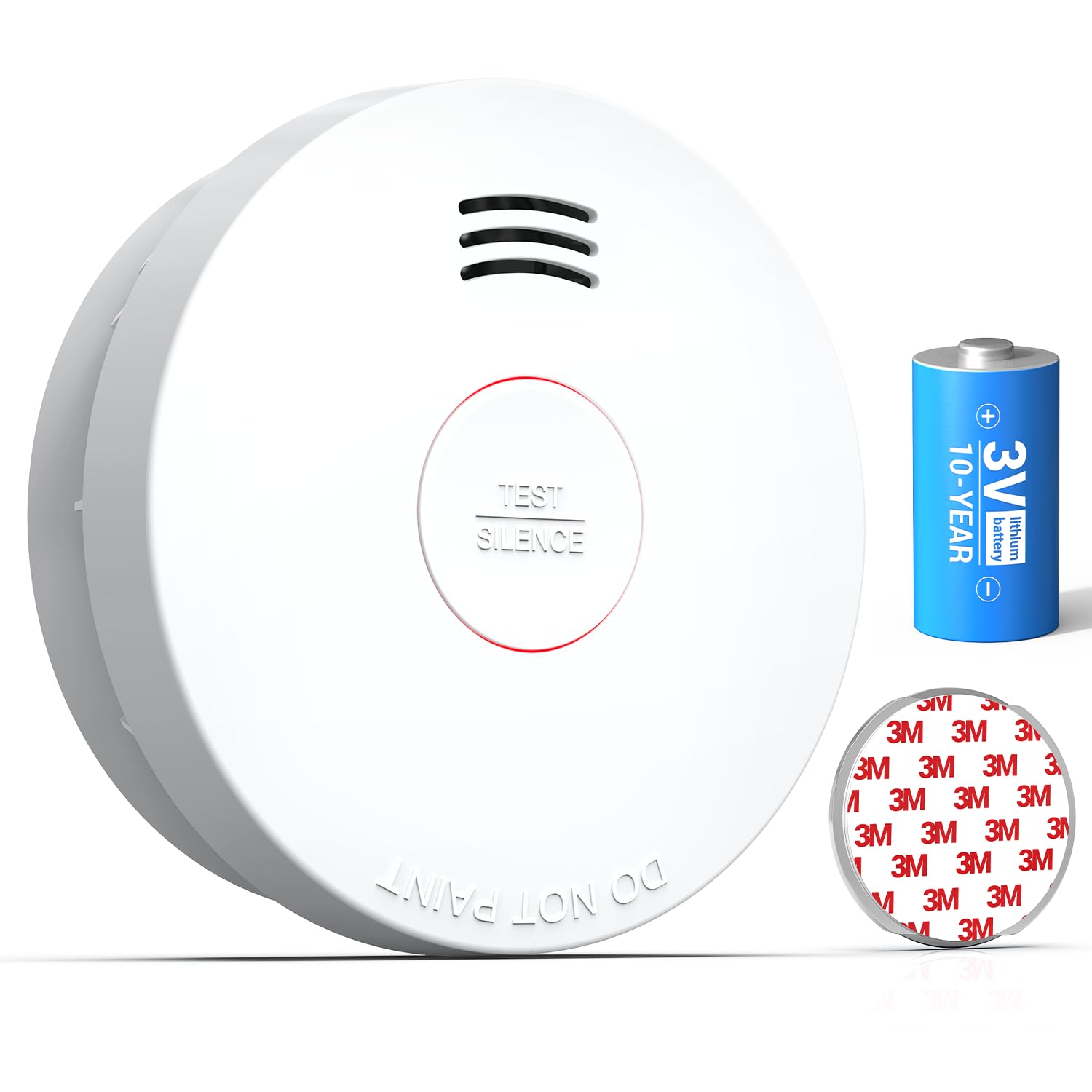
2. SITERWELL Smoke Detector 10 Year Battery Smoke Alarm Fire Detectors
Ten years of coverage with no yearly battery run up a ladder.
Start with the part that saves you the most work: the 3V lithium cell is sealed inside and rated to run for 10 years, then the alarm tells you when it is done. There is no annual 9-volt swap, which is exactly the chore that turns a ladder into an afternoon. The unit still delivers a loud 85-decibel alarm — loud enough to reach a sleeper down the hall — and the large front test button doubles as the mute. Pressing it silences a false alarm for up to 10 hours, which is what stops a cooking alert from ruining dinner.
Mounting is the surprise here. A magnetic fastening kit ships in the box alongside plastic plugs, screws, and double-sided tape, so you can stick a unit to a ceiling without drilling at all. That suits renters and anyone mounting from a stepladder. As owners put it, the magnet hardware is a genuine highlight: “Smaller than usual. Magnet fastener is cool and ten year battery is a plus.” The photoelectric sensor inside (a light-based sensor that spots smoke particles) is designed for slow, smoldering fires — the kind that produce light smoke and little heat and can creep for hours before flames appear.
The honest catch is size and the non-replaceable cell. This unit measures 3.93 inches across, noticeably smaller than the 5.67-inch SITERWELL hardwired model, so it may not cover an old paint ring left by a larger alarm. And because the battery is sealed, the whole alarm gets replaced at the end of its life rather than refreshed with a new battery.
The peace-of-mind math: a sealed decade-long battery means you set it once and stop thinking about it — ideal for a bedroom or hallway where you want protection without maintenance.
Best fit: anyone adding smoke coverage to a room with no wiring and no appetite for a yearly battery change.
The trade-off: the compact 3.93-inch footprint can leave an old ceiling ring exposed where a bigger alarm used to sit.
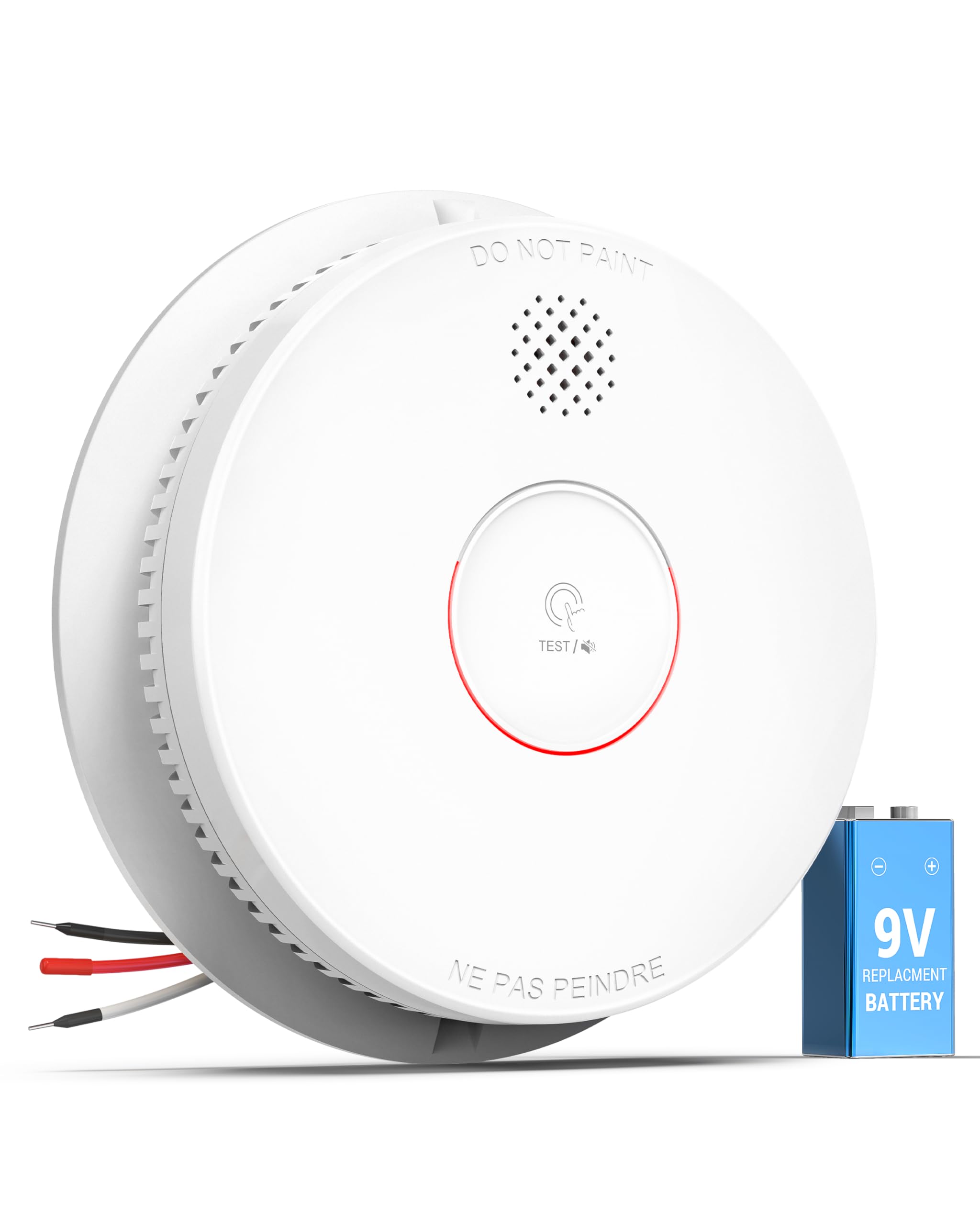
3. SITERWELL Smoke Detector Photoelectric Smoke Alarm 9V Battery Backup
Wired coverage you can chain across a whole house, one alarm at a time.
If your home already runs interconnected wiring, this is the pick that turns every alarm into one system. It hardwires to your 120-volt circuit and links up to 12 alarms — plenty for a typical multi-level house — so when one detects smoke, they all sound. That is still short of the Kidde’s 18-alarm ceiling, but it comfortably clears the practical needs of most single-family homes, and the alarm itself pushes past 85 decibels so a sleeper upstairs hears it.
What sells owners on the day-to-day is the Do Not Disturb mode. When the unit detects low voltage or a fault, pressing the test button quiets it for roughly ten hours — the fix for the 2 a.m. chirp that otherwise wakes the house. The included wall plate fits most smoke detectors on the market and mounting uses the provided screws. As a homeowner making the swap on an early-2000s house put it, “My husband managed to get them all replaced in a couple hours.”
One quirk worth knowing before you install: the 9-volt backup is not a pop-in swap. You have to unplug the power cord to change that battery, and the alarm will beep roughly yearly when it needs one. The 5.67-inch body also runs larger than the SITERWELL sealed-battery unit at 3.93 inches. A handful of units arrived with manufacturer defects, though the seller handled those cases quickly.
Why it earns a spot: the combination of 12-alarm interconnect, 9-volt outage backup, and a Do Not Disturb mode that kills the nighttime chirp is a lot of real-world protection in a wired unit.
Who it suits: homeowners with existing interconnected wiring who want a broad linked network and a built-in way to silence middle-of-the-night alerts.
Who should weigh other options: if you would rather never change a battery, the unplug-to-swap 9V backup on this model makes a sealed 10-year alarm the calmer choice.
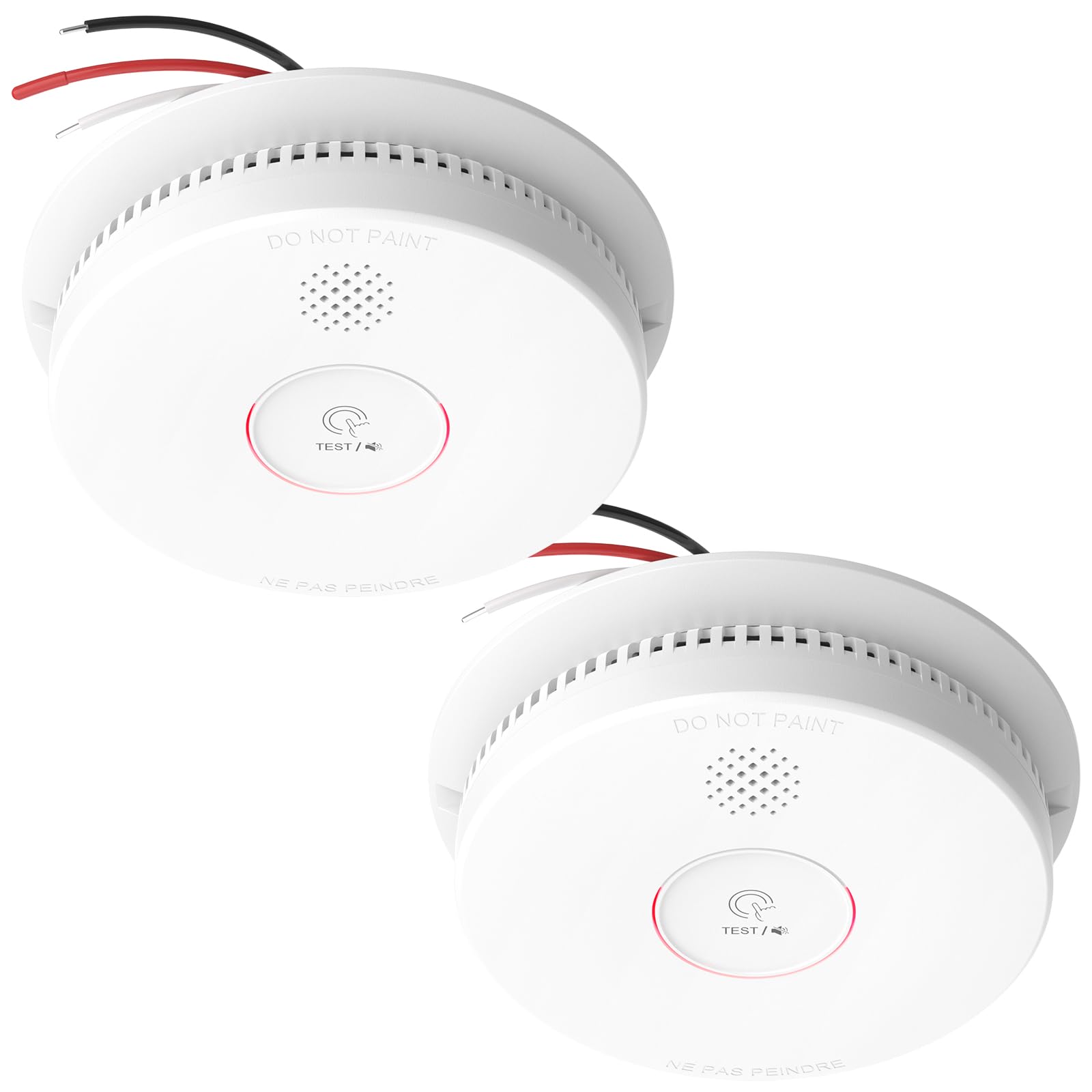
4. Siterlink Hardwired Interconnected Smoke Detectors GS562A, 2 Pack
The replacement pair that turns a retrofit into a one-hour job.
Retrofitting old wired alarms usually means matching connector clips and hoping the bracket lines up. This pair mostly sidesteps that thanks to a system that ties every unit together, so when one sounds, they all sound — and a one-touch silence mode mutes the whole set for up to 10 hours if a cooking alert fires. The photoelectric sensor inside (a light-based sensor that spots smoke particles) is tuned to read the surrounding environment more accurately, which is what keeps cooking smoke from tripping a false alarm.
The design detail that stands out for bedroom installs is the built-in hidden LED indicator. It glows soft and visible without casting light that disturbs sleep, which is why it suits a child’s room. The 9-volt backup keeps the alarm live through a power outage even though it hardwires to 120-volt AC. As one whole-home replacer reported, “Everything you need is included” and the project came together quickly — surprising them with how fast it went.
Here is the part to budget time for: the connector plugs differ from ones used twenty years ago, and the base is different too, so each unit needs rewiring and a new mounting plate rather than a straight clip-in. A careful installer noted the pigtail (the short wiring lead) does not directly connect to an older brand, so they rewired directly using existing wire nuts — and stressed switching the breaker off first, since the circuit is live. Plan on that extra step, and the rest is quick.
what separates it
- Interconnected system means one alarm triggers all, for faster whole-house warning
- One-touch silence mutes a false alarm for up to 10 hours — no repetitive chirping
- The hidden built-in LED glows softly so it does not disturb sleep, ideal for a child’s room
Who should plan ahead
- Old connector plugs and bases usually need swapping, so budget wiring time per unit
- The pigtail may not match an existing brand’s wiring directly — be ready to rewiring
- You must cut power at the breaker before touching the live circuit
Go with it: if you want a linked hardwired pair and can handle swapping connector clips and bases during install.
Think twice: if you would rather clip straight into old hardware with zero rewiring, a base-compatible model is less work.
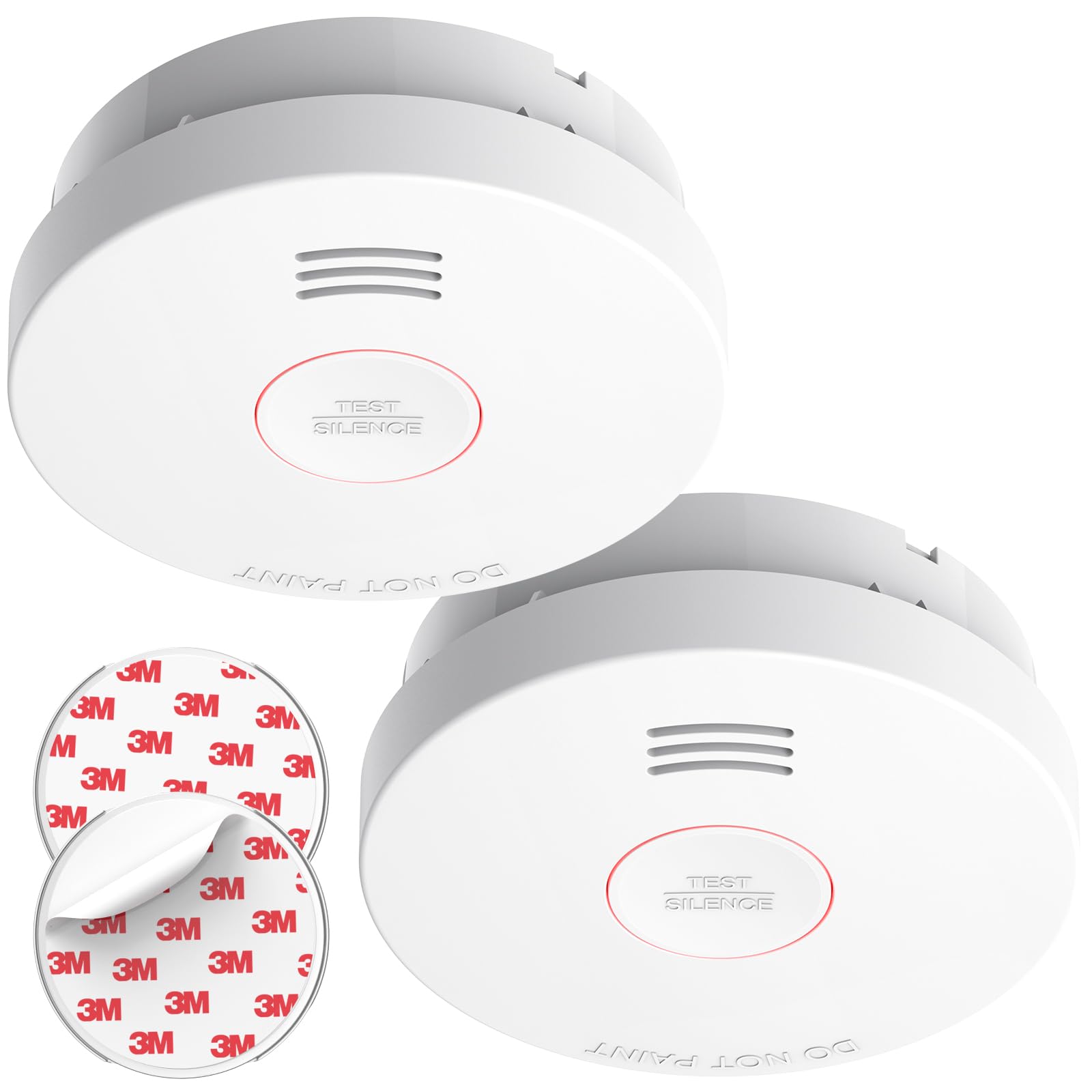
5. SITERLINK Smoke Detectors 10 Year Battery Backup, GS525A 2 Pack
No wiring, no drilling, no ladder work — just mount and forget.
For a high ceiling or a room where running wire is out of the question, this pair does the job without any electrical work at all. The 10-year sealed lithium battery comes pre-installed, so you get a decade of protection before anything needs replacing. Setup is genuinely tool-light: the compact body measures 3.93 inches across and mounts with either magnets or screws, so you can skip drilling entirely.
The sensor is photoelectric, designed to respond fast to slow, smoldering fires while cutting down false alarms from dust and steam. A large front button silences the alarm for 10 hours — the same press shuts off a cooking false alarm before it drives you up a step stool. As owners mention on the mounting side, these “don’t require drilling,” and the alarm sound carries well, with the sealed battery quietly reducing how often you think about replacement.
The recurring honest note on this style is reliability over time. A few units have been reported falling off the wall and some malfunctioning for no clear reason, which is why the durability and mounting ratings read mixed rather than glowing. The 10-year battery life itself is a claim owners take on faith rather than one they have lived out yet. If you want a set of alarms you can trust to hang straight for years, keep an eye on the mounts.
The no-ladder appeal: magnets plus a sealed decade-long battery mean you can place these alarms in minutes and, in theory, not touch them again for ten years — a real plus for vaulted ceilings.
Pick this if: you need protection in rooms with no wiring and want the simplest possible install in a two-pack.
Keep an eye on it: the mixed reliability and mounting feedback means checking that each unit stays fixed to the ceiling over time.
6. First Alert 10 Year Photoelectric Smoke Alarm 2 Pack

A recognized name for a straight drop-in base swap.
The whole reason to choose this pair over the others is the base. If you already have the matching First Alert style mounted in your home, this is the closest thing to a screw-off, screw-on replacement, since the design was built to reuse existing hardware. It runs a sealed alarm rated to last 10 years without battery replacement, uses a photoelectric sensor, and complies with the standards set by NFPA, HUD, and FHA — three bodies whose codes many buyers need to satisfy.
Turns out that base compatibility is the exact reason people hunt this model down. A homeowner who bought an older house “had this style alarm throughout the house” and found that when they tried to replace one, the style had changed — this unit “worked beautifully in the original base.” For anyone in that situation, it is the difference between a ten-minute job and a ceiling repair.
Two things to go in knowing. This is a discontinued model replaced by a lower-priced successor, so the same model number can ship with a new base design that still needs a fresh hole — one buyer ran into exactly that despite ordering the same number. And the promised ten-year lifespan does not always hold, with a small number of units chirping their low-battery warning within months rather than years. Both are worth weighing before you rely on it.
The base-swap advantage: when it fits, it is the easiest replacement in this guide — no new bracket, no new screws, no drilling.
The right call for: homes already using this First Alert base style, where a direct replacement saves the most work.
Skip the bet if: you are starting fresh or expect a decade of untouched service — the discontinued model and occasional early chirp mean less certainty.
Understanding the Specs
Decibels (Alarm Loudness)
Alarm volume is measured in decibels (a unit of loudness), and an 85-decibel alarm is the standard for waking sleepers. That is roughly the loudness of a busy restaurant right at the table. The number matters because a closed bedroom door knocks the sound down — the louder the source, the better the odds the alarm cuts through a wall and a deep sleep. Every pick in this guide runs an audible alarm at or above that level.
Photoelectric vs Ionization
These two sensor types catch different fires. A photoelectric sensor watches for smoke particles scattering a light beam and is quicker on slow, smoldering fires — the kind that produce light smoke and little heat. An ionization sensor detects invisible combustion particles and leans toward fast flaming fires. Some homes install both types to cover each other’s blind spots.
Sealed vs Replaceable Battery
A sealed alarm hides a non-replaceable lithium cell rated for 10 years, so you never run a yearly battery errand — you replace the whole unit when the decade ends. A replaceable 9-volt backup lets you refresh the battery, at the cost of a yearly check. Both keep the alarm live through a power outage.
Interconnect and Coverage
Interconnect means the alarms talk to each other over a wire, so a fire sensed in one room sounds the alarm in every linked unit. That is the difference between local warning and whole-home warning. Wired units in this guide link 12 to 18 alarms, which comfortably covers most single-family houses.
FAQ
Can I hardwire a smoke detector if my ceiling box has no wiring?
How long does the sealed 10-year battery really last?
What does an 85-decibel alarm sound like from another room?
Will a new 2-pack fit the old bracket already on my ceiling?
Why does my smoke detector beep at night?
Which is better, photoelectric or ionization for a kitchen hallway?
Do I need a wired interconnect for a two-pack to work together?
How often should I test a 2-pack smoke detector?
Can I silence a smoke alarm without taking it down?
Is a 2-pack enough to cover a two-story house?
Final Thoughts: The Verdict
For most homes with existing wiring, the 2-pack smoke detectors to beat is the Kidde Hardwired Smoke Alarm with 9-Volt Backup, because an interconnect that reaches 18 alarms plus a Test-Hush button gives you whole-house warning with the widest linked network here. If you would rather skip the electrician entirely, grab the SITERWELL 10 Year Battery Smoke Alarm for a sealed decade of protection and magnet mounting. And for retrofitting old wired bases across a whole house, the Siterlink GS562A pair is the one to reach for. Whichever you choose, test it weekly.
How We Picked
We do not accept paid placement. Every pick is matched to a real buyer and a real use-case; we do not hands-on test units.
Sources & Methodology
Specifications: manufacturer listings and product documentation. Review insights: verified customer reviews, as of September 2026. Pricing: not shown on this page (it changes often); check the current price via the retailer link.
As an Amazon Associate, KitchPrep earns from qualifying purchases. This does not affect which products we feature.
Related Guides
