
Specs are compiled from manufacturer listings and verified buyer reviews and can change over time — please confirm the key details on the product page before buying.
When the power goes out, what you care about is whether your fridge, your router, and your furnace keep running. This guide breaks down the best backup power supply for a home by matching real capacity, output, and recharge speed to the way you actually live — so you pick the unit that fits your outage, not the one with the loudest label. Battery stations, tri-fuel generators (units that run on three fuel types), and full server-rack systems all solve different problems, and the right pick depends on how long you need to run and what you need to run.
I’m Mohammad Maruf — the founder and writer behind KitchPrep. This guide is built by comparing the manufacturers’ published specifications and the patterns across verified customer reviews, so you get each pick’s real strengths and trade-offs instead of marketing spin.
You will see exactly how watt-hours translate to fridge hours, what peak watts mean for motor startup, and which units bridge the gap between an outage and your next hot meal. From a compact 1,024Wh unit to a 30.72kWh whole-home bank, here is honest context for every backup power supply for a home.
Our Picks at a Glance

How To Choose The Best Backup Power Supply for a Home
Buying backup power is not about buying the biggest number on the box. It is about matching three things to your actual household: how long you need to run, how much power your critical appliances draw at once, and how fast you can recharge between outages. Get those three aligned and the right unit almost picks itself. Get them wrong and you end up with a heavy box that quits two hours into a storm.
Capacity and Runtime
Capacity is measured in watt-hours (Wh), which is simply how much total energy the battery holds. A 1,024Wh station and a 3,072Wh station look similar on the shelf, but the larger one runs your fridge roughly three times as long — so a multi-day outage stays covered without rationing. For a standard home fridge, plan on the bigger capacity if you want to ride out a multi-day outage without rationing. The 2,010Wh and 2,073.6Wh class is the balance for most one-to-two-day outages.
Output and Peak Watts
Continuous watts tell you what the unit can run all day. Peak watts (sometimes called surge or lifting power) tell you what it can handle for the few seconds when a motor starts. A fridge compressor, a furnace blower, and a well pump all pull a short spike well above their running draw. If the station cannot cover that spike, it trips and shuts down — even if the running wattage looks fine. Match your continuous needs first, then confirm the peak covers your hardest-starting appliance.
Battery Chemistry and Cycle Life
Nearly every serious home backup unit now uses LiFePO4 (lithium iron phosphate), a battery chemistry that resists heat and holds capacity far longer than older lithium-ion packs. Cycle count is the honest number here: it is how many full charge-and-drain cycles the battery should survive before dropping to about 80 percent capacity. Higher cycle counts mean the unit keeps working through years of outages instead of needing replacement. This is the single spec most buyers overlook and regret later.
Recharge Speed and Fuel Options
A backup that takes ten hours to recharge is useless if the next storm hits in six. Fast AC charging, solar input, and dual-fuel or tri-fuel options all matter here. Battery stations recharge from a wall outlet or solar panel; generators run on gasoline, propane, or natural gas. If you want silence and no fuel storage, go battery. If you want unlimited runtime as long as fuel lasts, go generator.
Quick Comparison
| Model | Best For | Capacity | Output | Weight | Amazon |
|---|---|---|---|---|---|
| EF ECOFLOW DELTA 3 Plus★ Best Overall | Fast-charging home office backup | 1024Wh | 1800W | 27 lbs | Amazon |
| Anker SOLIX S2000Longest Fridge Runtime | Long fridge runtime in a small body | 2,010Wh | 1,500W (3000W peak) | 35.7 lbs | Amazon |
| Westinghouse 13500 Peak WattMost Fuel Options | Whole-home fuel-powered backup | 9.5 gal tank | 10500W running (gas) | 230 lbs | Amazon |
| BLUETTI Elite 200 V2 | High-demand appliances on battery | 2073.6Wh | 2600W (3900W lifting) | 53.4 lbs | Amazon |
| Jackery HomePower 3000 | RV and camper backup | 3072Wh | 3600W (7200W surge) | 59.5 lbs | Amazon |
| DuroMax XP13000HXT | Tri-fuel whole-home generator | — | 13,000W | 240 lbs | Amazon |
| Jackery HomePower 3600 Plus | Rolling 3.6kWh home backup | 3584Wh | 3600W (7200W parallel) | 77.2 lbs | Amazon |
| EF ECOFLOW DELTA Pro | Expandable to 25kWh | 3600Wh | 3600W (4500W X-Boost) | 99 lbs | Amazon |
| Anker SOLIX F3800 | EV and RV direct power | 3,840Wh | 6,000W (120V/240V) | 132.3 lbs | Amazon |
| ECO-Worthy Cubix100 6-Pack | Off-grid whole-home bank | 30.72kWh | 48V 600Ah | 600 lbs | Amazon |
| Generac Guardian 26kW | Permanent standby install | — | 26,000W | — | Amazon |
In‑Depth Reviews
1. EF ECOFLOW Portable Power Station DELTA 3 Plus 1024Wh, 1800W, LFP Battery
Our pick — over 4.5★ from 650+ verified ratings; the strongest balance of quality and price.
The fast-charging UPS in a carryable box that keeps your home office alive.
The DELTA 3 Plus holds 1024Wh of capacity and pushes 1800W of continuous AC output. That combination runs a mini fridge, a laptop, and a router all day. For anyone powering tools or a space heater, that extra headroom is the deciding factor.
What actually wins people over is the recharge speed. With 1500W AC input it hits 80 percent in 40 minutes, and solar gets it to 100 percent in 70 minutes. The 10 ms switch-over UPS mode means your NAS, server, or POS system never sees the lights flicker — it swaps to battery faster than a human blink. Buyers report running a fridge through a multi-hour outage and still having capacity left for phones.
The honest catch is idle draw. Owners measure roughly 15W when the AC inverter sits idle and around 45W with AC live. Leave it switched on for a week and you will find a lower battery than you expect. It is also heavy for a 1kWh unit, and a few buyers find the app has quirks during firmware updates.
Reasons It Earns The Top Slot
- Charges to 80% in 40 minutes via 1500W AC input — class-leading in this size class
- 10 ms UPS switchover protects servers, NAS, and POS systems without a blink
- 1800W continuous beats the Anker SOLIX S2000’s 1,500W output
- LFP cells rated for 4000 cycles to 80%, with IP65 splash, dust, and oil protection
- Expandable up to 5kWh with DELTA 3, DELTA Pro 3, or DELTA 2 Max battery packs
Trade-offs Worth Knowing
- Roughly 15W idle draw with AC off, closer to 45W with AC live
- Heavier than its 1024Wh capacity suggests
- App occasionally shows quirks during firmware updates
- Carries 2,010Wh less total capacity than the Anker SOLIX S2000
Reach for this if: you need a home office or small-business UPS that recharges before the next brownout hits.
Look elsewhere if: you want the longest possible fridge runtime — the larger-capacity Anker SOLIX S2000 stretches that further.
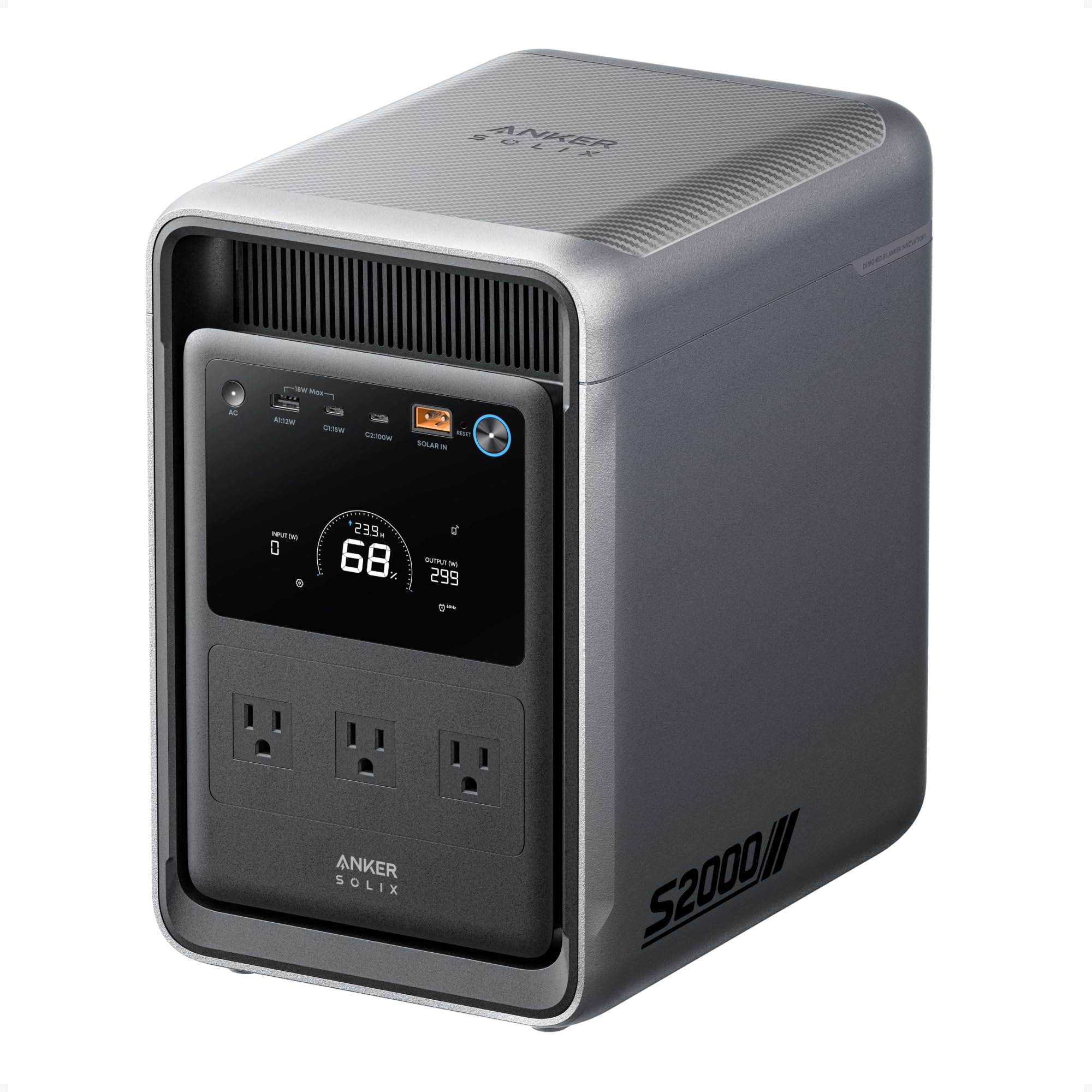
2. Anker SOLIX S2000 Portable Power Station, 2,010Wh, 3,000W Peak, Home Backup
Double the stored energy of the DELTA 3 Plus, in a body small enough to tuck in a corner.
Start with the number that sets this apart: 2,010Wh. That is exactly twice the capacity of the EF ECOFLOW DELTA 3 Plus above, and it is the reason Anker can promise up to 35 hours of fridge backup. Anker rates its 6W idle draw and 10 percent higher efficiency for 20 percent longer runtime than other 2kWh stations. For a real outage, that is the difference between saving the dairy and losing it.
The 314Ah LFP cells are rated for 10,000 charge cycles, about 15 years of daily use. Anker fits that into an 8.2 × 11.1 × 12.7-inch body weighing 35.7 lbs, 25 percent lighter than the industry average at this capacity. You get 1,500W continuous and 3,000W peak output, plus eight outlets split front and rear so always-on appliances stay plugged in the back. UPS mode switches under 10 ms, and the recharge rate is adjustable from 100W up to 1200W.
Buyers who ran this through a 30-hour outage reported charging from 33 percent to full in about 1.5 hours at 1200W. Others used it as a UPS for a basement network rack and got 13 hours of runtime on a 24-hour outage. The recurring gripe is the fan — some find it very quiet, others find it noisy. Rated output opinions split too, and one long-term owner measured closer to 24 hours of fridge runtime rather than the advertised maximum.
Best matched to: households that want the longest possible fridge runtime from a battery they can still lift and move.
skip it if: you need the extra AC headroom for tools — the DELTA 3 Plus above delivers 1800W continuous versus this unit’s 1,500W.
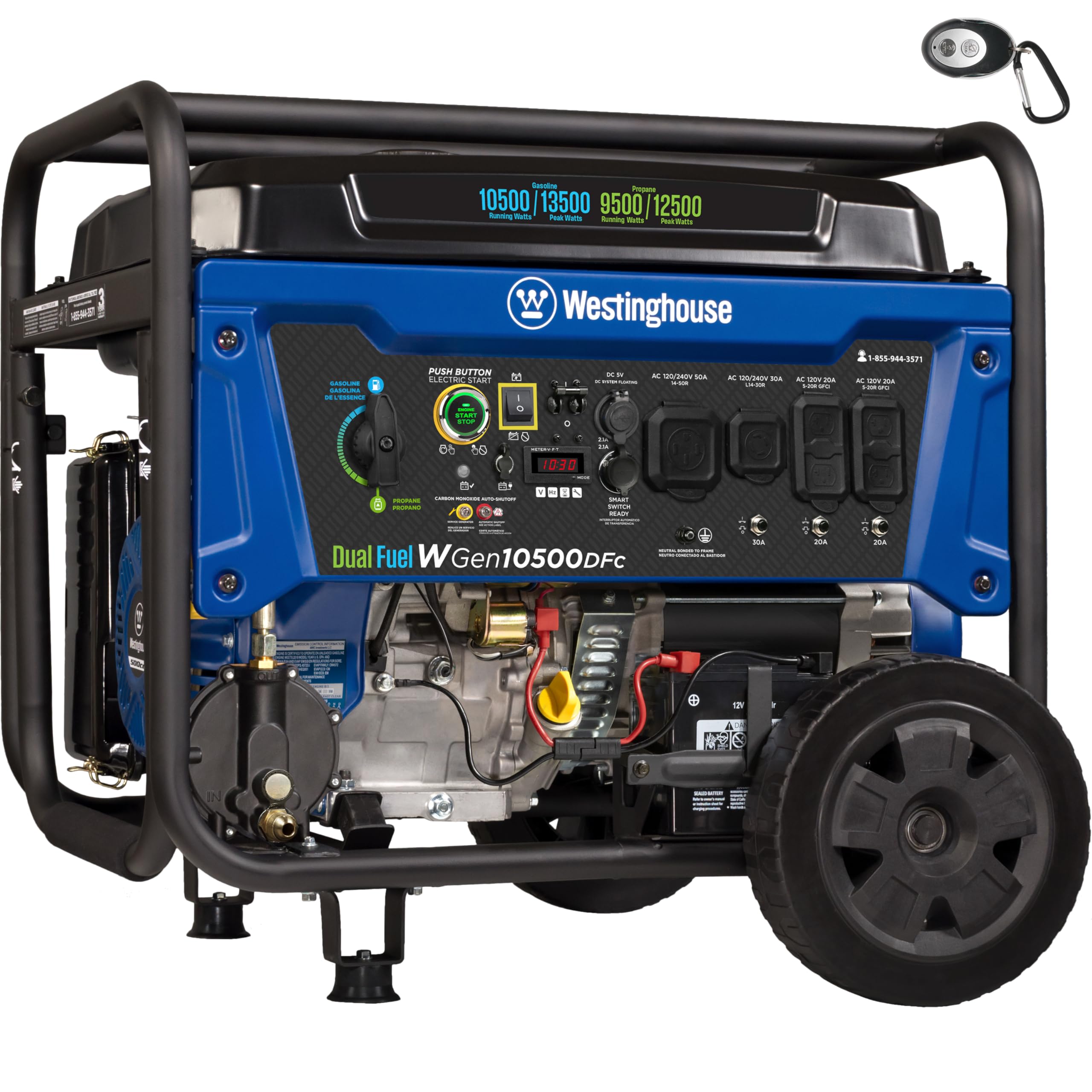
3. Westinghouse 13500 Peak Watt Dual Fuel Home Backup Portable Generator
Gas or propane, key fob start, and enough watts to run a whole household.
This one solves the problem that battery stations cannot touch: unlimited runtime as long as you keep fuel in the tank. It delivers 13500 peak watts and 10500 running watts on gasoline, or 12500 peak and 9500 running watts on propane. The 9.5-gallon fuel tank with a built-in gauge stretches to up to 19 hours of run time. Compare that to any battery unit on this list and the trade-off is clear — you gain endless runtime, but you take on noise, exhaust, and fuel storage.
The 500cc Westinghouse four-stroke OHV engine uses a cast iron sleeve for durability and includes automatic low-oil shutdown plus carbon monoxide shutdown for safety. A remote key fob lets you start it from inside the house, and the front panel gives you two GFCI 120V household receptacles, a transfer-switch-ready L14-30R 30A outlet, and an RV-ready 14-50R 50A outlet. Everything ships with oil, a funnel, a battery charger, and a tool kit, so minimal assembly is required.
Owners describe this as a quality unit that runs an entire home — one mentions running three air conditioners at once. Setup takes some muscle given the 230-pound weight, though the included wheel kit helps. Buyers in hurricane states pick it specifically for storm season, and many note the remote start is the feature they use most. The honest catch: it is loud enough to hear indoors, and it does require periodic oil changes and monthly test runs to stay ready.
Where the watts go: 10500 running watts on gas handles central air, a well pump, and all your major appliances at once — the kind of load no portable battery on this list could touch.
Fuel reality check: it needs fuel on hand before the storm, and the transfer-switch-ready 30A outlet means an electrician visit for true whole-home tie-in.
Pick this when: you want unlimited runtime and are prepared to store fuel and accept engine noise.
Think twice if: you need indoor quiet or cannot lift a 230-pound machine.
4. BLUETTI Elite 200 V2 Portable Power Station 2073.6Wh 2600W Solar Generator

A 2kWh station that runs a hair dryer, an air fryer, and a shop vac without flinching.
The Elite 200 V2 stores 2073.6Wh and delivers 2600W of continuous AC output with 3900W of lifting power — the highest lifting cap in this power-station group. That matters for anything with a motor or a heating element: refrigerators, hair dryers, coffee makers, even a portable AC. Owners have powered an electric skillet, a TCL TV, an induction cooktop, and a shop vac all from one unit. A 10W standby draw keeps idle losses tiny — BLUETTI says three times lower than similar power stations.
The battery technology is the standout. BLUETTI uses CNAS-certified automotive-grade LiFePO4 cells rated for over 6,000 cycles and a 17-year lifespan. Three smart charging modes are available through the app — Turbo hits 0 to 80 percent in one hour at 1800W AC, Standard runs battery-friendly to a full charge in 1.6 hours, and Silent mode drops to 16 to 30dB (about as quiet as a whisper). That silent mode is what makes this a realistic overnight home-backup unit rather than a garage-only gadget.
What buyers mention most is how much this thing can run from a footprint similar to a much smaller station. It is compact for its class and easy to move at 53.4 lbs with strong handles. Two honest caveats show up in owner feedback. First, the weight: some find it heavier in person than the listing suggests. Second, a few owners have hit battery-management glitches where the state of charge will not climb past a certain point until they run a full calibration cycle.
What Owners Consistently Praise
- 2600W continuous and 3900W lifting power runs high-draw appliances most stations cannot
- 6,000+ cycles with a 17-year rated lifespan on CNAS-certified automotive-grade LiFePO4 cells
- Turbo mode hits 0 to 80% in one hour; Silent mode drops to 16-30dB
- Just 10W standby draw keeps idle waste minimal between outages
Where It Presses Back
- 53.4 lbs is heavier than some buyers expect for the size
- Occasional BMS state-of-charge glitches that need a calibration cycle to clear
- Charging speed opinions split between buyers in different modes
Choose it for: a battery station that can drive kitchen appliances and power tools without tripping.
Look past it if: you want the lightest possible pick — several units on this list weigh less.
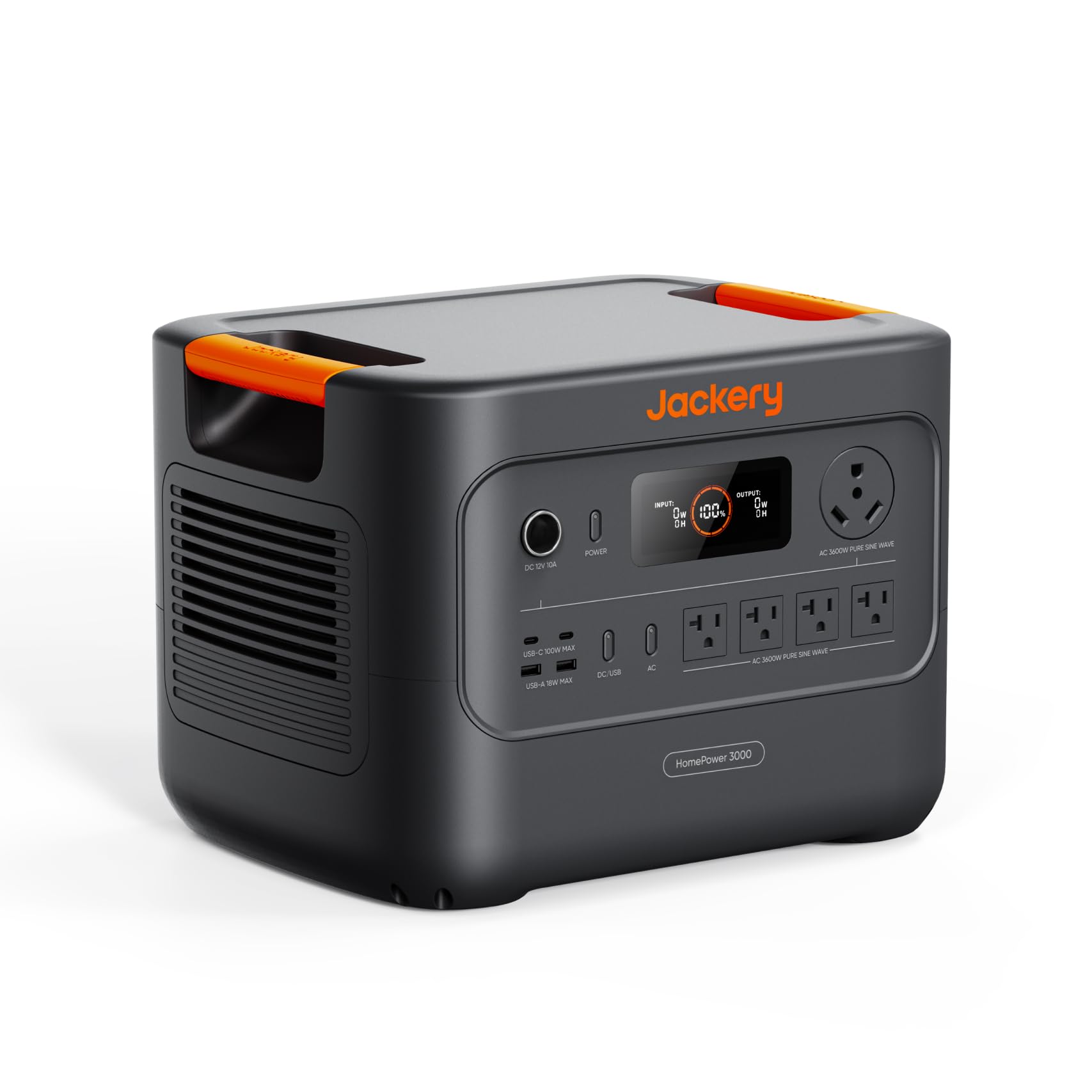
5. Jackery HomePower 3000 Portable Power Station, 3072Wh, 3600W AC Output
A 3kWh powerhouse with a built-in TT-30 port that plugs straight into a camper.
Jackery built the HomePower 3000 with a 30A amperage port — the same connector a travel trailer uses. That means you can plug a 30-foot camper directly into this station without an adapter, which is rare in portable battery backups. The 3072Wh capacity and 3600W continuous output (7200W surge) give you about three days of trailer power even running a fridge, furnace, and microwave. Full recharge takes 1.7 hours via hybrid AC and DC, or 2.2 hours on AC alone. That combo makes it a practical RV unit as well as a home backup.
The UPS circuit is UL-certified and switches in 20 ms or less, which is fast enough to keep security cameras and pet feeders running through a brownout. Jackery’s ChargeShield 2.0 technology layers AI-based charging algorithms on LiFePO4 cells rated for 4,000 cycles to 70 percent capacity. Jackery’s CTB design makes this unit 47 percent smaller and 43 percent lighter than comparable 3kWh stations.
Two things buyers flag repeatedly: weight and noise. At 59.5 pounds this is a two-hand carry, and the internal fan runs around 60dB under any meaningful load — too loud for daily use as a bedroom UPS. Owners love it for camping, hurricanes, and RV trips where that noise does not matter. One buyer did report battery failure below 15°F while trying to run a diesel truck block heater, so cold-weather use in that range is a real limitation.
Why it wins the RV crowd: the 30A direct port means no adapter, no fiddling, and pure plug-and-play for travel trailers.
Plan around this: the 60dB fan and 59.5-pound body make it an outdoor or garage unit, not a bedside UPS.
Right pick for: RV owners and campers who want home-grade backup that doubles as trailer power.
Not the one for: bedroom use or sub-freezing block-heater duty.
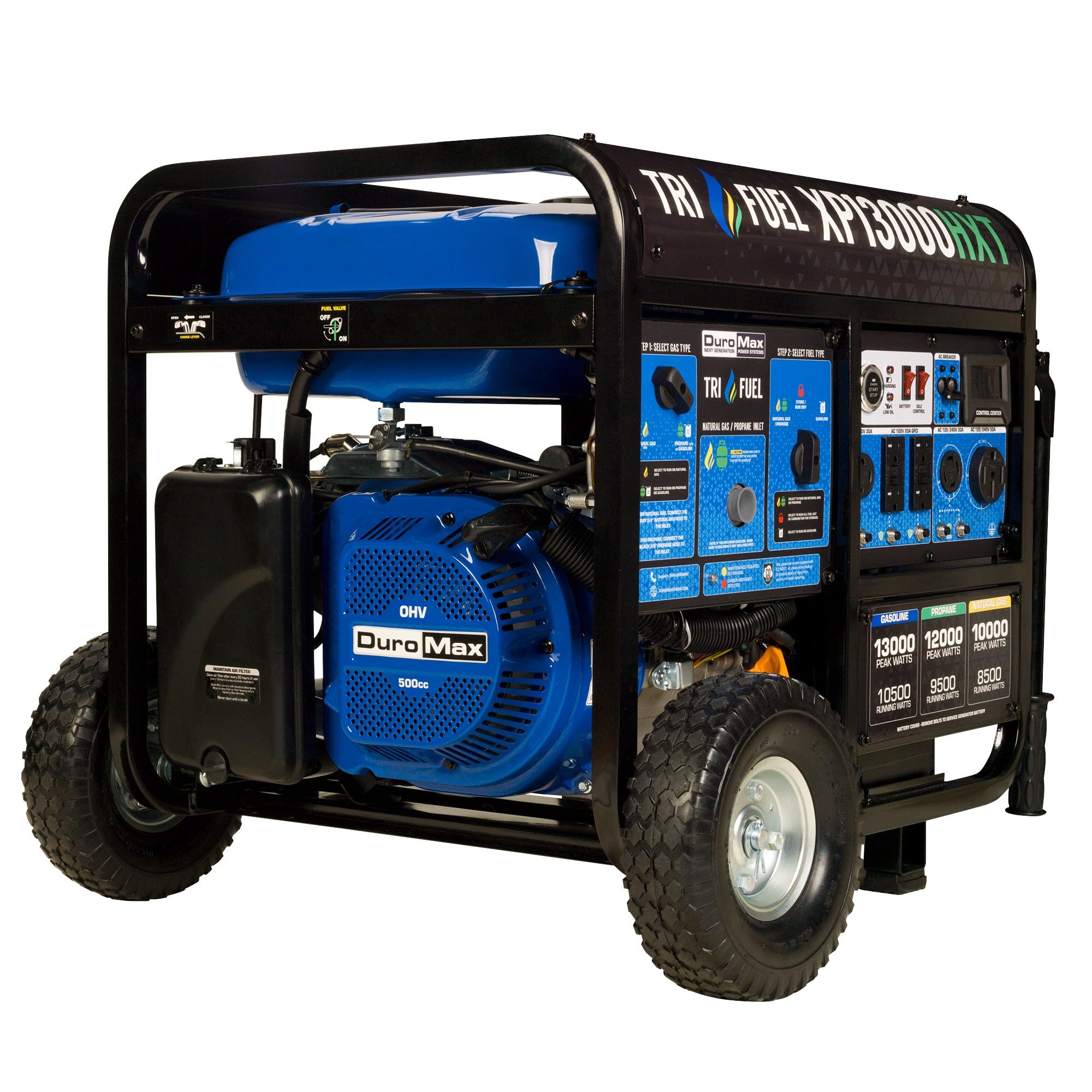
6. DuroMax XP13000HXT 13,000-Watt 500cc Tri Fuel Generator with CO Alert
Gas, propane, or piped-in natural gas — three fuels, one whole-home generator.
Where the Westinghouse above gives you two fuel choices, this DuroMax adds a third: piped natural gas. That is the difference between storing propane tanks and never touching a fuel can again. The XP13000HXT puts out 13,000 watts from a 500cc OHV engine and includes a 50-amp transfer-switch-ready outlet and a 15-foot 3/4-inch natural gas hose. Carbon monoxide alert is built in for safety, and the front-facing interface lets you change fuel type in seconds.
Owners who converted to natural gas say this is the best investment they have made on their home. The 50-amp outlet is a notch above the 30-amp connection many competitors use, and it can start a small AC or furnace blower on its own. Start options include a push button and a remote, giving you control without walking out to the unit in bad weather.
The honest limitations. On natural gas at full load it consumes 225,000 BTU per hour and needs a proper 3/4-inch gas line. Setup is heavy — 240 pounds with wheels — and includes an oil change after break-in plus monthly 15-minute runs to stay reliable. Some owners mention initial start attempts took a few tries, and the field switch knob can feel stiff. A combo kit with the power cord is sold separately.
The natural-gas advantage: once plumbed, you have whole-home power without ever refueling — the biggest practical edge over propane-only generators.
What to prep for: a licensed hookup, an oil change after break-in, and monthly test runs.
Go here if: you have a natural gas line and want the fuel flexibility of three power sources.
Look elsewhere if: you want a simple, low-maintenance battery unit for short outages.
7. Jackery HomePower 3600 Plus Power Station, 3584Wh, 3600W AC Output

The rolling 3.6kWh station with wheels, a telescoping handle, and dual voltage.
This is the unit you actually want to move around your house during a long outage. The luggage-style design with wheels and a telescopic handle lets you roll it from kitchen to garage without lifting — a real advantage over the 77.2-pound weight. It stores 3584Wh and puts out 3600W (7200W in parallel), with dual-voltage 120V and 240V support. That last spec is what lets it run a well pump or a dryer, appliances that most battery stations cannot touch.
Jackery designed the HomePower 3600 Plus for whole-home backup. It is expandable to 21kWh on a single unit or 43kWh with multiple units — enough to power a three-person household for over two weeks according to Jackery. The ceramic membrane cells are tested at 302°F and rated for 6,000 cycles and a 10-year lifespan. Recharging from empty takes 2 hours via hybrid AC and DC, 2.5 hours on AC, 4 hours on solar, or 2.5 hours off a gas generator.
Owners commonly use it as the trustworthy anchor of a hurricane plan. One buyer tested a double induction cooktop and burned only 19 percent of capacity, which left room for the coffee maker and fridge. Another reported the unit powers a gas furnace, fridge, and freezer for up to 12 hours on a charge. The catch is that output caps at 2 outlets on the spec sheet despite the high wattage — so if you want to run many small devices at once, plan your layout.
What Makes It Stand Out
- Dual 120V/240V output runs dryers and well pumps that single-voltage stations cannot
- Expandable to 21kWh per unit or 43kWh with multiple units for extended outages
- Wheels and telescoping handle make the 77.2 lbs genuinely movable
- Ceramic membrane cells tested at 302°F with 6,000-cycle, 10-year rating
Points To Weigh
- Only 2 outlets listed despite the high wattage — plan device connections carefully
- At 77.2 lbs it still needs rolling rather than carrying
- Hybrid recharge is fast, but solar charging stretches to 4 hours
Made for: households that want whole-home coverage they can roll from room to room and expand over time.
Consider twice if: you need lots of AC outlets at once — the port count is tighter than the wattage suggests.
8. EF ECOFLOW Portable Power Station 3600Wh DELTA Pro, 120V 3600W AC Output
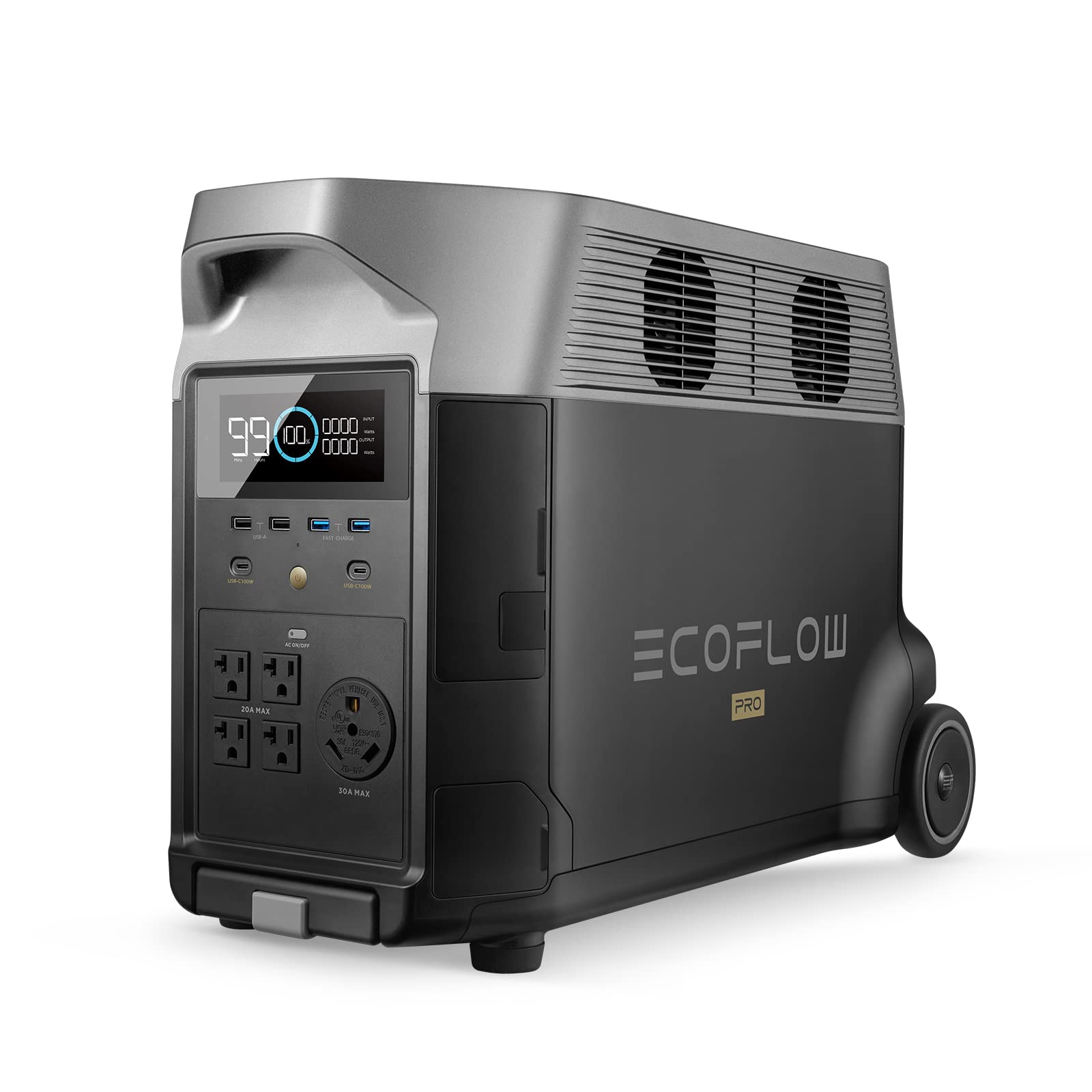
3600Wh of storage today, expandable to 25kWh tomorrow — the modular home backup.
Buy a little now, scale later. The DELTA Pro starts with 3600Wh of LFP capacity and can climb to 25kWh by adding DELTA Pro Extra Batteries or Smart Generators — turning an initial purchase into a whole-home system over time. Output starts at 3600W AC, jumps to 4500W with X-Boost technology, and doubles to 7200W if you pair two units. Fifteen output ports cover nearly every device type, including two 100W USB-C and an Anderson port.
Recharge speed is a signature of this line. X-Stream charging refills the battery in 1.8 hours from a 240V outlet at 3000W, in 2.7 hours from a standard 1800W wall outlet, or 2.8 hours from four 400W solar panels thanks to a conversion efficiency up to 23 percent — so a full top-up fits inside a single afternoon. Five charging methods range from EV station to car outlet, so this station stays fueled no matter where you are. The EcoFlow app connects over Wi-Fi or Bluetooth and gives you live status, temperature, and charge timing.
Buyers value the DELTA Pro as a serious long-run investment. One owner reported running a fridge and lights through an overnight outage and still having 30 percent charge the next morning. Another powers a heat press at vendor markets with zero voltage drops. Two honest points: at 99 pounds this unit is essentially a permanent-parked appliance, and the solar input caps around 15A, which limits how much panel array you can feed it.
The scaling story: 3600Wh today to 25kWh tomorrow means one purchase can grow from a portable station into a whole-home battery.
Where it hits a wall: 99 pounds means this stays parked, and the ~15A solar input cap limits how big a panel array you can build around it.
Ideal for: buyers who plan to build a whole-home battery system over several years.
Pass on it if: you want something you can carry up and down stairs — 99 pounds makes this a fixed unit.
9. Anker SOLIX F3800 Portable Power Station, 3,840Wh

A 3.84kWh station with EV charging and dual-voltage output — for the whole house.
Most portable stations cannot run a dryer. This one can. The F3800 delivers 6,000W of AC output across both 120V and 240V, which covers every household appliance including 240V loads like dryers and well pumps. It starts with 3,840Wh and can grow to 26.9kWh by adding up to six battery packs. For the truly extreme case, pairing a second F3800 with 12 battery packs gets you enough storage for what Anker describes as two weeks of power.
The NEMA 14-50 port lets you plug an EV directly into the station and charge it at 6,000W — no grounding accessories required. The same 14-50 and L14-30 ports handle RV power, and popular RV models are compatible without an adapter. Anker InfiniPower technology, EV-class LFP batteries, and a smart temperature system combine to support a 5-year warranty and 10-year lifespan. Remote control via the Anker app works over Wi-Fi or Bluetooth, giving you visibility on every power source.
What customers note most is how well it performs as a real backup solution. One owner paired it with two expansion batteries and got roughly three days of continuous power. Another powers a window AC in Florida even on cloudy days, recharging from solar in about six hours. The honest caveats: at 132.3 pounds this is a permanent installation, the app does not track usage history, and to reach the max 2400W solar input you really need Anker’s own panels — third-party panels can fall short of that ceiling.
Why It Belongs On The Shortlist
- 6,000W AC across 120V and 240V runs dryers and well pumps other units cannot
- Direct EV charging at 6,000W via the NEMA 14-50 port with no grounding accessories
- Expandable from 3,840Wh to 26.9kWh with up to six battery packs
- 5-year warranty and 10-year lifespan backed by EV-class LFP cells
Honest Limitations
- 132.3 lbs — a fixed installation, not a grab-and-go unit
- Reaching the 2400W solar ceiling often requires Anker’s own panels
- App lacks usage-tracking history that some owners want
- Solar charging and battery life opinions split among buyers
Perfect for: homes with 240V appliances, an EV, or an RV that need one station to serve all three.
Wrong fit if: you want a portable unit — this one stays where you install it.
10. ECO-Worthy Cubix100 48V 600Ah Server Rack Battery LiFePO4 6-Pack 30.72kWh
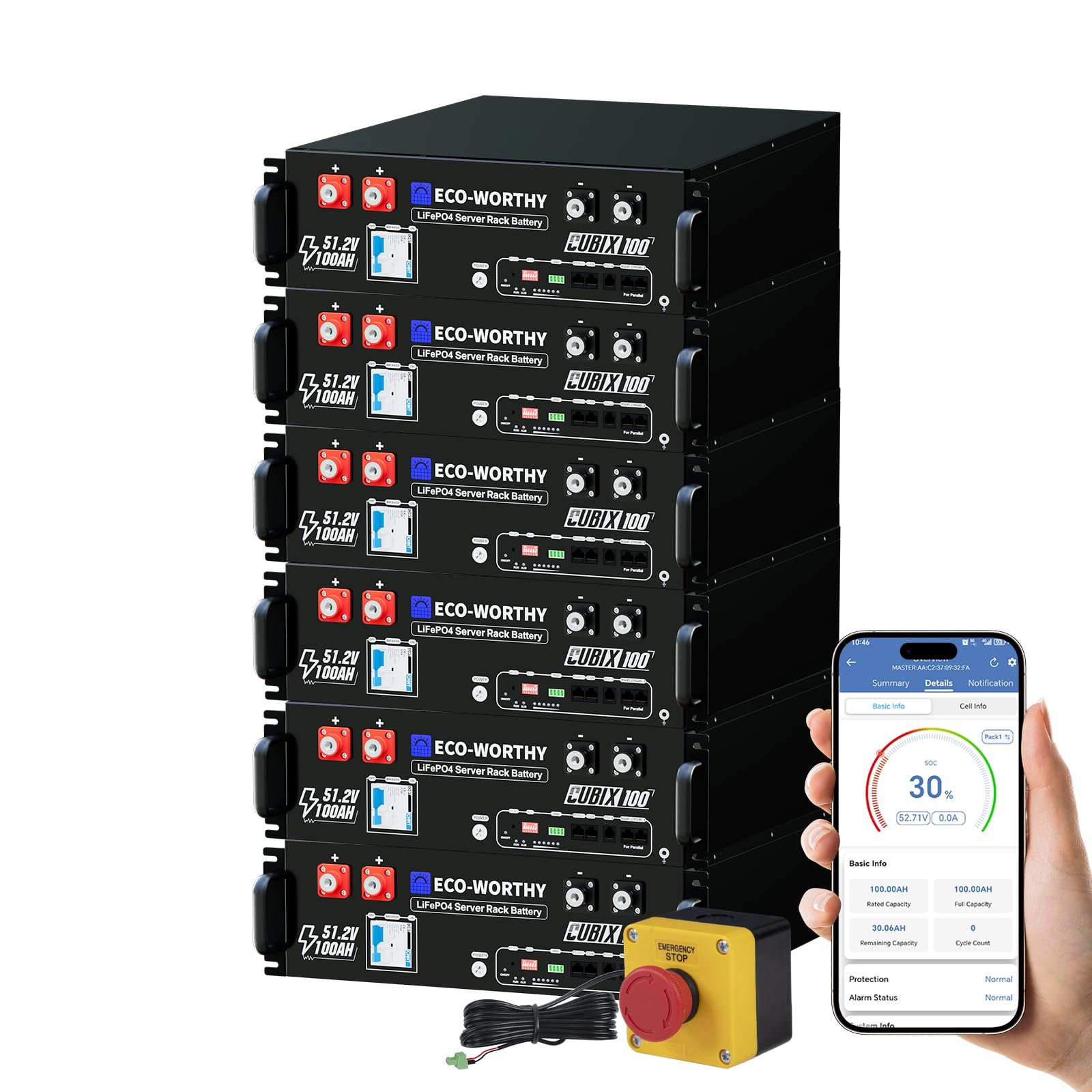
A 30.72kWh server-rack battery bank for true off-grid energy independence.
This is not a portable unit and does not pretend to be. The ECO-Worthy Cubix100 is a six-pack 48V battery bank delivering up to 30.72kWh of storage — enough to cover an entire household’s daily electricity needs when paired with a solar inverter. Each battery is 51.2V and 100Ah, uses Grade A LiFePO4 cells, and supports closed-loop CAN/RS485 communication with leading solar inverters. Built-in Bluetooth and Wi-Fi let you monitor state of charge from the ECO-WORTHY app.
The safety credentials are the headline here. The system is UL9540 and UL1973 listed after testing by Intertek, and it meets California Energy Commission standards. The system also includes thermal runaway management. The whole kit comes plug-and-play with parallel cables, communication cables, grounding wires, terminal covers, screws, and a manual — plus a 10-year limited warranty and a 24-hour support commitment.
Owners using these in off-grid setups report solid performance: one runs a three-bedroom off-grid home with a 10kW inverter with zero issues over a month of use. Compatibility with inverters and expanded battery banks is a common praise point. Where buyers run into friction is initial setup quality — one owner had a unit arrive underperforming on capacity with an unbalanced cell, though ECO-Worthy replaced it under warranty and the replacement worked perfectly. The system weighs 600 pounds total and reaches 163.8kWh if you parallel up to 32 units.
The certification edge: UL9540, UL1973, and CEC listing puts this in a different safety class than uncertified DIY battery banks.
What to expect: a system install, a solar inverter to pair with, and occasional quality checks on arrival — set aside time for a full charge and cycle test on day one.
Best for: off-grid homes and solar installers who want a scalable, certified battery bank behind an inverter.
Not for you if: you want to move your backup around — this is a permanent, wall-mount installation.
11. Generac Guardian 26kW Home Generator with Transfer Switch and WiFi Monitoring
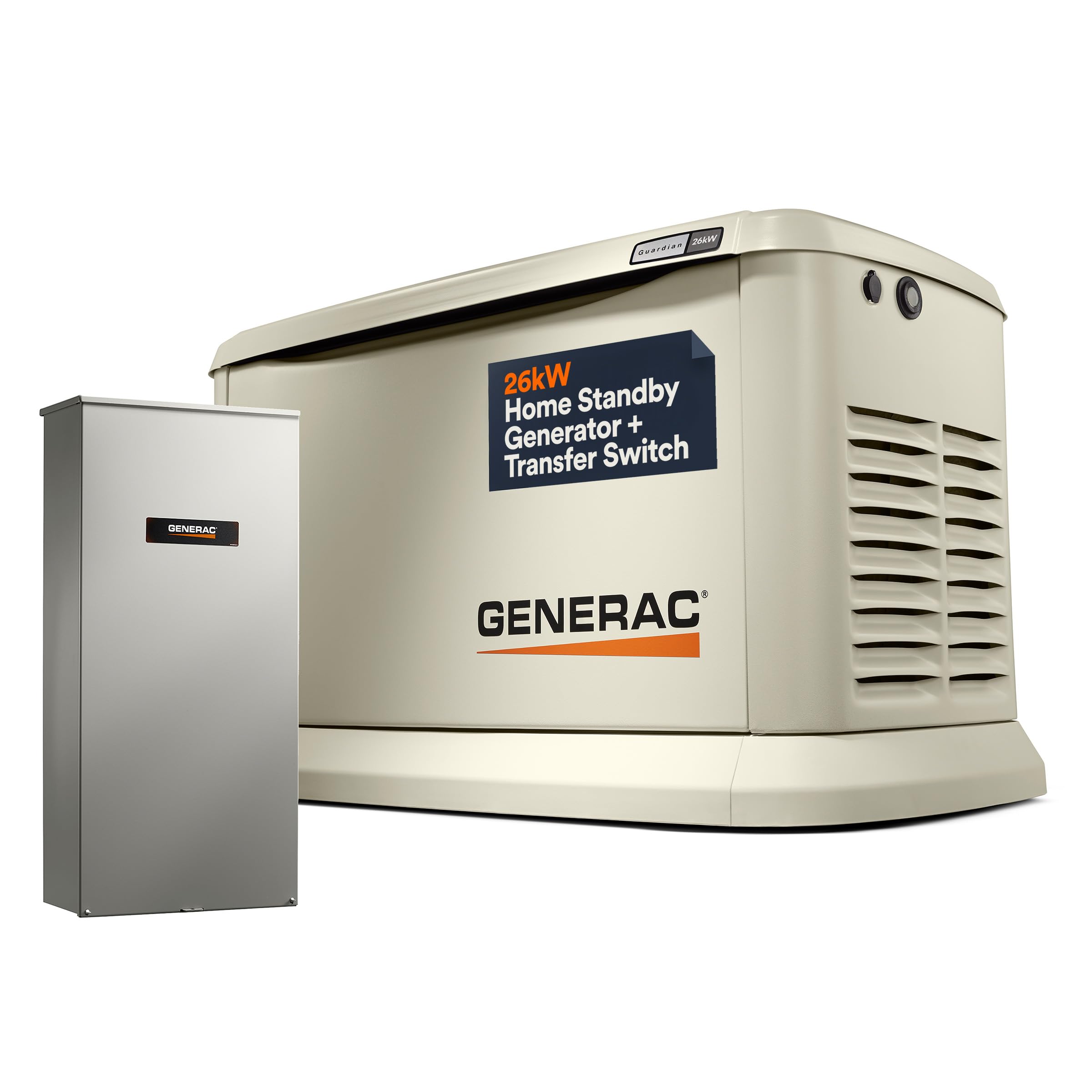
A permanently installed standby unit that starts itself the second the grid drops.
The endgame product for anyone who has been through enough outages. The Generac Guardian 26kW runs on natural gas or LP propane, starts automatically when power fails, and pairs with a 200-amp transfer switch to bring the entire house back online. The G-Force 1000 Series engine is engineered for continuous standby duty with low maintenance, and True Power Technology delivers clean, stable 26,000 watts with under 5 percent harmonic distortion — clean enough to protect sensitive electronics.
Mobile Link Wi-Fi monitoring lets you check generator status and maintenance alerts from anywhere. Owners describe scheduled test runs through the mobile app that keep the engine lubricated without having to be home. The 26kW output is enough to run two central AC systems and every major appliance in a typical home. Generac recommends installing by a certified, licensed electrician, which is the honest reality of this product class — it is not a DIY install.
Where owners hesitate is the surrounding cost. Several reviewers point out paying a considerable amount for professional installation and site prep on top of the unit cost, and Generac markets an extended warranty that many find aggressively priced. Generac builds this unit in the USA with a 5-year limited warranty. The piece buyers love most is the automation — you do not notice an outage at all, beyond the noise of a running engine outside.
Why buyers commit: automatic start, full whole-home coverage, and clean under 5% harmonic distortion power make this the least effort-to-own option on the list.
The real-world prep: budget for a licensed electrician, a concrete pad, and natural gas or propane plumbing before the unit even arrives.
Best if: you want the whole house covered the instant the power dies, with nothing to plug in or flip.
Only consider if: you are ready for a professional install and a permanent concrete pad on your property.
Understanding the Specs
Watt-Hours (Wh) And What They Buy You
A watt-hour is one watt of draw running for one hour. Your fridge cycles on and off all day and averages somewhere in the low hundreds of watts, so a big battery bank keeps it cold for many hours. When you see 1024Wh or 3072Wh, read it as stored energy you can spend. Larger numbers simply stretch how many hours you get before the battery runs dry.
Continuous Watts Versus Peak Watts
Continuous watts are what the unit can push all day long. Peak watts (also called surge or lifting power) cover the brief spike a motor draws when it first kicks on. A fridge compressor or furnace blower can spike well above its running draw for a second. Bigger peak numbers mean fewer frustrating shutdowns when your appliances start up.
LiFePO4 Cycle Life Explained
LiFePO4 is lithium iron phosphate, a battery chemistry that resists heat better and lasts longer than older lithium packs. Cycle life counts full charge-and-drain rounds before capacity drops to roughly 80 percent. Higher numbers mean you replace the battery less often. Look for 4,000 cycles and up for daily-use duty.
UPS Switchover Time And Why It Matters
A UPS (uninterruptible power supply) passes grid power through to your devices and swaps to battery the moment the grid dies. Switchover time is how long that handoff takes. The faster the switch, the less chance a computer, router, or camera notices the outage. Times under 20 milliseconds typically keep sensitive electronics running without a reboot.
Dual Fuel, Tri-Fuel, And Natural Gas
Fuel-powered generators can run on gasoline, propane, or piped natural gas — and the more of those a unit supports, the more flexible your outage plan. Natural gas never runs out as long as the utility pipe is flowing, propane stores indefinitely in a tank, and gasoline is easy to source but spoils over time. Match the fuel to what you can store safely at home.
Solar Input And Recharge Speed
Solar input is how many watts of panel power the unit can accept. Higher numbers mean you can use bigger panel arrays and recharge faster from the sun. If you plan to stay off-grid for days, solar input matters as much as battery capacity. For short outages, fast AC charging from a wall outlet usually does the job quicker.
FAQ
How many watt-hours do I need to keep my fridge running through an outage?
Will a portable power station run my furnace or well pump?
What is the difference between a UPS and a regular power station?
Can I charge a backup power station with solar panels?
How long does a LiFePO4 battery last in daily backup use?
Is a portable power station or a gas generator better for home backup?
Do I need an electrician to install a whole-home standby generator?
What is the difference between peak watts and running watts on a generator?
Can these battery systems be expanded later for more capacity?
Do backup power stations produce carbon monoxide or need ventilation?
Final Thoughts: The Verdict
The winner among these backup power supply for a home picks is the EF ECOFLOW DELTA 3 Plus. It hits 80 percent charge in 40 minutes, protects a home office with 10 ms UPS switchover (a near-instant switch to battery so your computer never blinks off), and pushes 1800W continuous — the best fast-recharge package in this battery-station group, with a crowd-pleasing 4.7 stars across hundreds of owner ratings backing it up. If you want the longest fridge runtime from a portable, the Anker SOLIX S2000 stores roughly twice the energy and stretches a fridge run to 35 hours. And for a whole-home battery that rolls on wheels and handles 240V appliances, the Jackery HomePower 3600 Plus is the one to roll into place.
How We Picked
We do not accept paid placement. Every pick is matched to a real buyer and a real use-case; we do not hands-on test units.
Sources & Methodology
Specifications: manufacturer listings and product documentation. Review insights: verified customer reviews, as of September 2026. Pricing: not shown on this page (it changes often); check the current price via the retailer link.
As an Amazon Associate, KitchPrep earns from qualifying purchases. This does not affect which products we feature.
Related Guides
