
Specs are compiled from manufacturer listings and verified buyer reviews and can change over time — please confirm the key details on the product page before buying.
If you want one machine that can flatten a board edge and shape an inside curve without swapping tools, a belt and disc sander combo is what you are shopping for. The catch is that these combo machines look nearly identical on the shelf but behave very differently on the bench. Some walk across your workbench, some clog their own dust ports, and some have a disc table so thin it flexes under your hand. The picks below sort those differences using published motor specs and recurring owner feedback.
I’m Mohammad Maruf — the founder and writer behind KitchPrep. This guide is built by comparing the manufacturers’ published specifications and the patterns across verified customer reviews, so you get each pick’s real strengths and trade-offs instead of marketing spin.
You will see how belt size, disc diameter, motor amperage, and table adjustability change what each machine can actually do in your shop. The best belt and disc sander for most home workshops turns out to be the one that stays put, swaps abrasive quickly, and does not fight you on dust.
Our Picks at a Glance


How To Choose The Best Belt and Disc Sander
A combo sander gives you two sanding surfaces on one bench footprint. The belt handles long edges, flat faces, and curves on the driven drum. The disc handles end grain, small parts, and squaring up cutoffs. Choosing well means matching the machine’s real numbers to the work you actually do.
Belt Size Sets Your Job Range
A 4 x 36 in. belt is the common home-shop size and covers edge work, flattening, and contour sanding on the drive drum. A 2 x 42 in. belt is narrower and longer, which suits knife makers and anyone working small metal parts or tight radii. A 1 x 30 in. belt is the smallest format, best for detail work and light shaping. Wider belts clear more material per pass but need more motor behind them to avoid stalling.
Motor Amperage And Drive Type
Amperage tells you roughly how much work the motor can sustain before it slows down. A 4.3A to 5A machine is plenty for hobby woodworking. If you plan to press hard on steel or hardwood, look for a direct-drive design, where the motor shaft turns the belt and disc without an intermediate belt to slip. That layout also removes the drive belt you would otherwise need to tension and eventually replace.
Table Movement And Adjustment
Most combos tilt the belt table from 0 to 90 degrees so you can sand flat or against a vertical platen. Disc tables commonly adjust from 0 to 45 degrees for bevels, and a miter gauge in the table slot helps you hold square cuts. A quick tension release lever makes grit changes a one-hand job, while a bolt-and-wrench tensioner adds friction to every paper swap.
Quick Comparison
| Model | Best For | Belt Size | Disc Size | Motor Amperage | Amazon |
|---|---|---|---|---|---|
| WEN 6502T★ Best Overall | Most home workshops | 4 x 36 in. | 6 in. | 4.3 A | Amazon |
| Woodskil 4.5A ComboBest for Contours | Contour and edge work | 4 x 36 in. | 6 in. | 4.5 A | Amazon |
| Woodskil 4.3A ComboBest Budget Combo | Light home projects | 4 x 36 in. | 6 in. | 4.3 A | Amazon |
| SKIL BB9504-00 | Beginners and small projects | 4 x 36 in. | 6 in. | 4.5 A | Amazon |
| BUCKTOOL BD4603A | Smaller shops and metal work | 4 x 36 in. | 6 in. | 5 A | Amazon |
| RIKON 50-161VS | Knife makers and detail work | 1 x 30 in. | 6 in. | 2 A | Amazon |
| VEVOR 5A Combo | Mixed wood and soft metal | 4 x 36 in. | 8 in. | 5 A | Amazon |
| BUCKTOOL BD4801-M | Metal polishing and knife bevels | 4 x 36 in. | 8 in. | 5 A | Amazon |
| JET J-41002 | Serious shops and full-time use | 2 x 42 in. | 8 in. | 6.2 A | Amazon |
In‑Depth Reviews
1. WEN Benchtop Belt and Disc Sander 6502T
Our pick — over 4.5★ from 5,000+ verified ratings; the strongest balance of quality and price.
The most-reviewed 4 x 36 combo here, with a cast iron base that damps vibration and a 4.3 A motor for home shops.
You get two sanding surfaces on one machine: a 4 x 36 inch belt for long edges and flat faces, and a 6 x 6 inch disc for end grain and small parts. The 4.3 Amp motor spins up to 3600 RPM, which is fast enough to flatten a glued-up panel without stalling. At 22 inches long, 11 inches wide, and 12.5 inches tall, it holds a footprint that fits a normal bench without swallowing the whole surface.
The part owners talk about most is the belt system. A single pivot bolt handles belt changes, and the fence is taller and more useful than what comes on most machines at this level. The cast iron base is what keeps it planted — one owner put it plainly: “Great sander for a budget. Doesn’t walk much without it being bolted down, and it’s nice and sturdy. Belt stays in place.” The belt itself tilts anywhere from 0 to 90 degrees, so you can go from flat sanding to work against a vertical platen in one motion.
The honest catch is dust. The port sits split between the belt and disc areas, and a fair number of owners end up sealing the unused side with tape to get real suction. The disc deck can also drift out of alignment over time, and the included miter gauge feels like the cheapest part on the machine. None of that stops it from doing the job, but if you are working in a small closed shop, plan on a shop vac and a plan to run it well.
What earns its keep
- Tilting belt runs 0 to 90 degrees for flat or vertical sanding
- Cast iron base damps vibration so the machine stays planted
- Tension release lever makes grit changes quick
- 4.3 A motor reaches 3600 RPM for steady material removal
Where it asks for patience
- Dust port splits between belt and disc, so suction is weaker than claimed
- Disc deck can shift out of alignment
- Included miter gauge is light duty
Buy this one: if you want the most proven home-shop combo, with thousands of owners behind it and a track record stretching back years.
Look elsewhere: if your priority is a clean shop with strong stock dust collection — the port design will disappoint you before the motor ever does.
2. Woodskil 4.5A Belt Disc Sander Combo
More amps and a wider stance, built for shaping curves instead of just flattening boards.
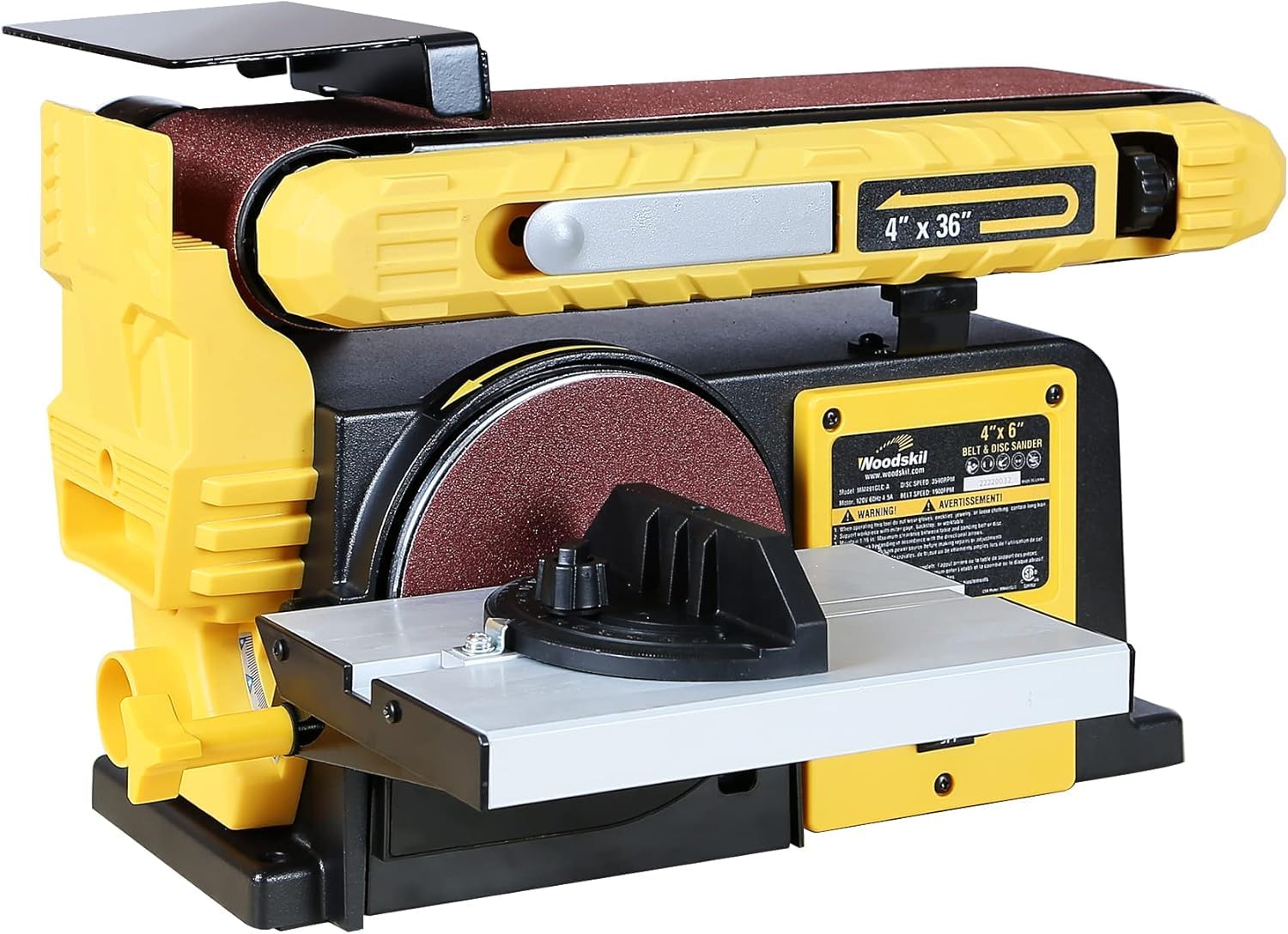
This is the more powerful Woodskil of the pair here. Its 4.5 Amp motor edges past the WEN 6502T’s 4.3 A, and the 3/4 HP direct-drive layout turns the disc at 3590 RPM with a belt speed of 1900 FPM. The footprint runs 18.11 inches long, 14.17 inches wide, and 13 inches tall — wider and lower than the WEN, which spreads the weight out and keeps the machine from hopping when you press into a curve.
What wins people over is how it handles work. Owners describe it as a machine that adjusts easily, feeds material smoothly, and arrives mostly assembled. Belt changes are a two-step routine: loosen the screw holding the dust exhaust, pull the tension lever, and swap the paper. The belt table tilts from 0 to 90 degrees, and the disc table with miter gauge tilts from 0 to 45 degrees — both tables accept the same gauge, so you can bevel on either surface without hunting for a second fixture.
The catch is power at the top of the range. A fair share of owners find the motor a touch underpowered when they lean on it, and belt tension adjustment takes some fiddling to get right. On the balance, the pluses outweigh this, especially given the current price sits close to the WEN while offering that extra half amp.
Two tables, one gauge: the miter gauge works on both the belt and the disc, which saves you from buying or tracking a second fixture.
What to watch for: several units arrive with a cracked belt guard, and owner reports point to shipping as the cause — inspect the box before signing.
Worth it if: you shape curves and bevels more than you flatten panels, and you want the extra half amp without paying more than the WEN.
Pass if: you need dead simple belt-tension setup — this one rewards owners who are willing to dial in tracking before they trust it on a project.
3. Woodskil 4.3A Belt Disc Sander Combo
Portable enough to move around the shop, with two dust ports instead of one shared opening.
The 4.3 Amp motor here runs the disc at up to 3600 RPM and the belt at 1732 FPM through a 3/4 HP direct-drive system. At 25 pounds, it is one of the lighter 4 x 36 machines on this list, which many owners mention as a plus when they roll it between benches. The dual dust port design routes belt dust and disc dust through separate openings, which is a real improvement over the single shared port you find on the WEN 6502T.
Assembly is straightforward — most people report getting it running quickly, and the instructions are clear enough to follow without hunting for a video. Belt changes are quick, tracking stabilizes with a small adjustment, and the tilt range covers 0 to 90 degrees so you can sand flat or vertical. Owners describe it as light, easy to move, and capable of working rough stock down efficiently. Packing gets mentioned favorably, and the disc setup tolerates real pressure without complaint.
The trade-off is where the mass goes. Lighter machines move more when you press hard against the disc, and owners of this one note that the disc table benefits from extra support — a second screw or a firmer mount would eliminate the flex. As long as you are not leaning your body weight into a cutoff, it stays steady. That is the honest split: great for portable home use, less ideal as a permanent high-pressure station.
Built for mobility: at 25 pounds with a compact 19.29 x 16.14 x 14.17 inch frame, it slips onto a shelf and back onto the bench without a second pair of hands.
Good pick for: home woodworkers who move the sander around, want separate dust ports, and value the two-year warranty.
Try something else if: you plan to run it bolted down at a heavy-pressure station — the light frame is the wrong tool for that job.
4. SKIL BB9504-00 Belt and Disc Combination Sander

A straight-shooting combo for first-time owners who want a supported warranty and clear instructions.
SKIL puts a 4.5 Amp induction motor in this one, and induction motors are the ones that keep their speed under load instead of dropping when the paper bites in. The belt table tilts from 0 to 90 degrees, the disc table bevels from 0 to 45 degrees, and the miter gauge rides in the disc slot to keep your crosscuts square. A dust port sized for standard 2 ½-inch vacuum hoses means your existing shop vac hose connects without an adapter hunt.
What stands out to buyers is the build. The tables attach securely, the manual is clear, and assembly takes minutes with the included hex wrench and miter gauge. Owners coming off other combo sanders describe the motor as the stronger of the two, holding speed when they press hard instead of bogging down. The weight is enough to sit on the bench unsecured for light work, and pre-drilled holes in the base let you bolt it down when a project needs real pressure.
Two things to know before you buy. First, the belt and disc both spin at the same time — there is no separate switch — so loose sleeves and cords need to stay clear of the disc side. Second, the base screws into place fine but the machine is not vibration-free at full push, so clamp or bolt it for heavy work. Beyond that, the 3-year limited warranty is the real selling point here, since it is longer coverage than most competitors at this price level offer.
What you are paying for
- 4.5 A induction motor holds speed under load
- 3-year limited warranty, the longest coverage in this group
- Dust port fits standard 2 ½-inch vacuum hoses
- Pre-drilled base holes for easy benchtop mounting
Worth knowing before you buy
- Belt and disc spin together — no independent switching
- Vibrates under heavy push unless clamped or bolted down
- Grit stock is medium 120, so you will likely buy coarser paper separately
Matches you well: if you are buying your first combo sander and want the longest warranty in this bracket plus a motor that does not wilt under pressure.
Time to look past it: if you need independent belt and disc control, or if you plan to run coarse grit day one.
5. BUCKTOOL BD4603A Bench Belt Disc Sander

The direct-drive workhorse that trades a little polish for serious power in a compact footprint.
BUCKTOOL’s approach here is to skip the belt you would otherwise tension and replace. The motor shaft drives the belt drum and disc directly, so there is no drive belt to stretch, slip, or snap — the machine just works until you swap the abrasive. The motor is a 3/4 HP fully enclosed induction unit drawing 5 Amps, and the belt runs at 2161 FPM with the disc turning up to 3200 RPM. Two cast aluminum work tables, one for the belt and one for the disc, plus a cast aluminum base with rubber feet, round out the layout.
Owners describe this thing as a workhorse. It stays planted under heavy pressure, does not slow down when you push into an edge, and holds tracking without constant adjustment. The footprint is compact for the power on tap — 23.82 inches long and 11.61 inches wide, so it fits a smaller shop bench where a bigger machine would crowd you out. Curved work goes on the driven drum with ease, and belt swaps happen on a quick-release design. The CSA certification is note for anyone who cares about electrical safety compliance on the bench.
The gripes cluster around the table mounts. Several buyers report the table wobbles and will not stay square without shimming, especially the disc side. The vacuum ports are also undersized for a standard shop vac, and you may need a hose adapter. Neither problem stops the machine from doing real work, but if you are expecting bolt-together-and-go squareness on day one, budget an evening for setup.
What you save in upkeep: no drive belt to tension, no drive belt to replace. The direct drive also removes a common failure point that older combo sanders suffer from.
Where a wrench helps: the table mount shim job is a known step with this model, and a set of feeler gauges or shim stock makes it a 20-minute fix.
Right for you: if your shop is tight on space but you still need a machine that does not cave under pressure — the direct drive and 5 A motor match that brief.
Look elsewhere: if you want a table you can trust to be square without any shim work, or if you need the dust ports to fit your existing hose as-is.
6. RIKON 50-161VS Belt / Disc Variable Speed Sander

Dial the speed down for fine work, up for bevels — the one combo with a real speed control.
The defining feature here is variable speed. The 3/4 HP motor adjusts anywhere from 2000 to 3400 RPM, and the belt speed moves between 1909 and 3248 SFPM to match. This matters for anyone shaping knife blades or working heat-sensitive material, because you can slow the abrasive down for the final passes instead of scorching or over-cutting. Two sanding surfaces — a 1 x 30 inch belt and a 6 inch PSA disc — cover shaping, smoothing, and small-project work. Both the belt table and the disc table tilt from 0 to 45 degrees, so angled sanding setups are easy on either surface.
Knife makers are the loudest fans of this machine. They run it for blade profiling with heavy pressure, then drop the speed for micro bevels, and the 3/4 HP motor does not bog down even with aggressive grit. The heavier build damps vibration compared to lighter hoppy machines, and the included miter gauge works with the disc-table slot for controlled angled cuts. Belt tracking adjustment keeps the abrasive centered, and the separate belt and disc dust ports make it easy to hook up shop collection. Base mounting holes let you bolt it to a bench or stand when you want it flat, solid, and out of the way.
What you should know: the slower speeds sound louder than expected on this unit — the motor tends to growl at low RPM, and the base plate knobs can be stiff enough that the threads need a cleanup pass. The 1 x 30 inch belt is also the narrow format, so it cannot flatten a wide panel the way the 4 x 36 machines on this list can. If wide-face work is on your list too, this is a specialty piece, not a one-and-done replacement.
The case for variable speed: this is the one machine on the list where 2000 RPM is genuinely useful — slowing down is what separates rough profiling from finished sharpening.
Designed for your shop if: you make knives, shape small metal parts, or do detail work where speed control changes the outcome.
Not the right tool if: you mainly flatten wide boards — the 1 x 30 belt is the wrong size for that, and a 4 x 36 machine like the WEN or Woodskil will serve you better.
7. VEVOR Professional 4 x 36 in. Belt and 8 in. Disc Sander

The biggest disc here — an 8 inch surface paired with a 4 x 36 belt and a 5 A motor.
VEVOR’s combo puts a 5 Amp fully enclosed induction motor behind a 4 x 36 inch belt and an 8 inch disc — the largest disc in this group. The disc spins at 3450 RPM and the belt runs at 2160 RPM, so both surfaces move quickly. The belt table tilts from 0 to 90 degrees, the cast aluminum disc table adjusts 0 to 45 degrees, and a steel plate base with rubber pads anchors everything against vibration. At 36.3 pounds it has real presence on the bench.
Owners who use it for mixed work rate the quality highly. The 8 inch disc handles flattening and soft-metal work that a 6 inch disc cannot cover as easily, and the motor moves hardwood and soft aluminum/copper without much complaint. Setup is quick enough that several owners are sanding within a half hour of unboxing. The dust collection port lets you hook up a vacuum without any adapter hunting, and the enclosed motor runs quieter than open-frame units.
The honest split here is quality control. A handful of owners mention the speed control does not reach running speed under some conditions, and the belt tracking requires more attention than expected — some units arrive with the disc plate slightly out of flat, though customer service has stepped in for those buyers. The table adjustability also draws mixed feedback, with some owners finding the range limited for specific setups. If you want a machine that arrives perfect from the start this might frustrate you; if you are willing to dial it in, the disc size and motor are the real rewards.
Where it shines
- 8 inch disc covers end-grain work a 6 inch disc cannot
- 5 A induction motor runs quieter than open-frame designs
- Cast aluminum table tilts 0 to 45 degrees for bevels
- Steel plate base with rubber pads keeps vibration down
Where it needs attention
- Belt tracking can wander until you dial it in
- Some units arrive with the disc plate slightly warped
- Table adjustability range is narrower than some buyers expect
Strong candidate if: you want the biggest disc surface in this group and you already own a shop vac to pipe into the dust port.
Think twice if: you expect perfection from the start — this one rewards an owner willing to tune the belt tracking and check disc flatness before the first project.
8. BUCKTOOL BD4801-M Pro 1HP Bench Belt Sander

A 1 HP direct-drive machine that eats steel — the step up when wood-only stops cutting it.
This is BUCKTOOL’s upgrade over the BD4603A, and the jump is real: a 1 HP fully enclosed induction motor instead of 3/4 HP, an 8 inch disc instead of 6, and the same direct-drive layout that skips the drive belt. Amperage stays at 5 Amps and the disc turns up to 3450 RPM. The belt table tilts from 0 to 90 degrees for flat or vertical sanding, the disc table adjusts 0 to 45 degrees, and the belt dust outlet is aluminum instead of plastic. Weighing in at 16.5 kg (about 36 pounds), the cast aluminum base with rubber feet keeps the machine grounded when you push into metal.
The upgrade target is knife makers and machinists. Customers note the 1 HP motor grinds through high carbon steel without stalling, and the direct-drive power delivery means no slipping belt to blame when the cut slows. Belt changes are easy with the track control releasing tension, and the knife grinding accessories mount on the belt plate and remove when you switch back to wood. The switch box sits on top of the machine, which sounds like a small thing until you need to reach it mid-cut. A removable dust port extends the sanding area when you are polishing long stock.
The quirks show up around the cast iron and plastic. The cast iron table often needs to be ground square before it sits true, and the machine ships without angle markings or stops on the table. Reviewers point out the plastic disc-side dust guard can melt or catch fire on hot metal; the belt-side guard is metal. Some owners also note the 8 inch hook and loop disc replacements are hard to find locally. None of that changes that the motor is the star here, and it is what you are really buying.
The real step up: every additional 1/4 HP matters when you are facing hardened steel, and this is the machine on the list built around that idea.
Worth the jump if: you work metal, grind knife blanks, or have been holding back on steel because your current sander stalls on it.
Skip past if: wood is your only material — the 6 inch disc machines on this list do everything you need at a lower entry point.
9. JET J-41002 Belt and Disc Sander
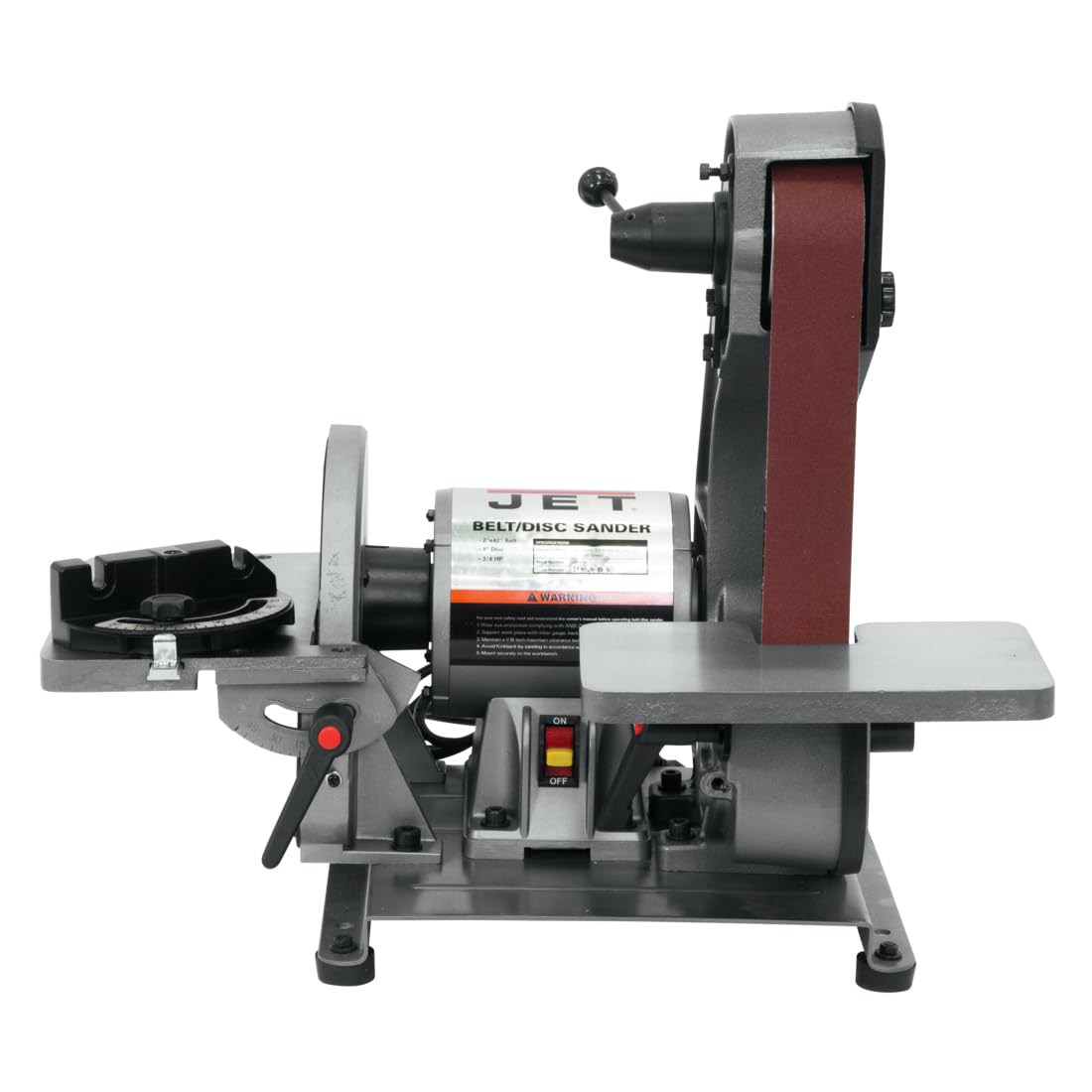
A 60-pound cast iron anchor with the highest amperage draw of any sander here.
JET builds this sander around a 6.2 Amp motor mounted on cast iron and a heavy-duty steel base. It runs a 2 x 42 inch belt and an 8 inch disc, ships with a 100 grit belt and a 100 grit PSA disc, and includes a deluxe miter gauge that turns and locks at common angles, 45 degrees both left and right. The removable platen lets you sand, grind, or finish outside curves and odd-shaped workpieces on the belt, and an adjustable dust deflector and dust chute handle cleanup. At 60 pounds, this is a machine that stays put on the bench by weight alone.
Owners buy this one for two things: reliability and parts availability. The motor has real punch, and multiple users report that they can’t slow it down regardless of material or pressure — with a heavy hand it can bog down, but steady feed does not defeat it. Belts are standard 2 x 42 sizes and easy to find, so there is no proprietary format to fight. An included 2-year warranty against manufacturing defects is backed by nationwide repair centers, and parts remain available even after warranty expires. That service layer is rare in this category and it is why owners planning years of use pick JET.
Two honest notes. The 2 x 42 inch belt is a narrow format built for shaping and detail work, not for flattening wide panels — for that, the 4 x 36 machines on this list are the right size. And the disc-to-motor cover is plastic on this model, which can vibrate noisily at higher RPMs; removing it is a common owner workaround. Belt changes also take a little practice because the work rest sits close to the belt, and a fair number of owners notch the table corner for faster swaps.
Built for the long run
- 6.2 A motor — the strongest draw in this group
- 2-year warranty with nationwide repair centers
- Cast iron and heavy steel construction stays planted
- Standard 2 x 42 belt available anywhere
Where it asks more of you
- 2 x 42 belt cannot flatten wide panels the way 4 x 36 machines can
- Plastic disc cover between the disc and motor can vibrate loudly
- Belt changes take practice and often prompt a small table modification
Reserve a bench for it: if you want a lifelong sander for shaping and detail work, backed by the strongest warranty support on this list.
Not your machine: if you mainly flatten wide boards or want to keep the footprint light — the 2 x 42 belt and 60-pound weight both work against that.
Understanding the Specs
Amperage and Motor Design
Amperage is the amount of electrical current the motor can pull, and it roughly tracks how much cutting force the machine can sustain before slowing down. A 4.3 A to 5 A motor is standard for home-shop work and handles edge sanding, flattening, and contour shaping without complaints. Bigger draws — like the 6.2 A JET — handle heavier stock and metal. The other half of the equation is the drive layout. Direct-drive designs turn the belt drum and disc straight off the motor shaft, so there is no intermediate belt to tension, slip, or replace. Belt-drive designs use a separate drive belt that usually needs attention over time.
Belt Size and Disc Diameter
The belt size is written as width x length — for example 4 x 36 in., 2 x 42 in., or 1 x 30 in. The wider the belt, the more surface area meets the work, which speeds up flattening. The narrower sizes trade material removal rate for maneuverability and access to tight radii, which is why knife makers prefer 1 x 30 and 2 x 42 formats. The disc diameter works the same way: a 6 inch disc is the standard home-shop size, while an 8 inch disc gives you more real estate for end grain and small cutoffs. Most combo sanders tilt the belt table from 0 to 90 degrees and the disc table from 0 to 45 degrees.
FAQ
What is the difference between a belt sander and a disc sander?
Do I really need both a belt and a disc on the same machine?
How do I change the sanding belt on a bench combo sander?
Can I use a belt and disc sander on metal?
What grit sandpaper should I start with on a combo sander?
How do I stop my sander from walking across the workbench?
What does direct drive mean on a belt and disc sander?
Can I sand curves and contours with a bench combo sander?
Is a 4 x 36 belt better than 2 x 42 or 1 x 30?
How much bench space do these machines take up?
Final Thoughts: The Verdict
For most home shops, the best belt and disc sander winner is the WEN 6502T because it delivers the best combination of motor, footprint, tilting belt, and long-term owner satisfaction — four-and-a-half-star-plus territory across thousands of ratings, which is rare for affordable power tools. If you need finer control over speed for knife work or detail shaping, look at the RIKON 50-161VS and its 2000 to 3400 RPM range. And if your work involves steel, aluminum, or serious knife blades, the BUCKTOOL BD4801-M with its 1 HP direct-drive motor is the machine that justifies the extra spend.
One nudge if you are still deciding: the WEN’s review base is genuinely the largest in this group by a wide margin, and the pattern of feedback across those owners is consistent — it does the job, it stays put, and it keeps running.
How We Picked
We do not accept paid placement. Every pick is matched to a real buyer and a real use-case; we do not hands-on test units.
Sources & Methodology
Specifications: manufacturer listings and product documentation. Review insights: verified customer reviews, as of September 2026. Pricing: not shown on this page (it changes often); check the current price via the retailer link.
As an Amazon Associate, KitchPrep earns from qualifying purchases. This does not affect which products we feature.
Related Guides
