
Specs are compiled from manufacturer listings and verified buyer reviews and can change over time — please confirm the key details on the product page before buying.
If you want a bathroom number you can actually trust, the answer is a mechanical balance scale — the kind with sliding weights on a beam instead of a digital display. It runs on gravity, never needs batteries, and holds its zero where cheap electronic scales drift. The picks below cover the whole range: classroom bucket balances for teaching kids, triple-beam lab balances, and full-height physician beam scales for tracking your own weight at home. What separates a good one from a frustrating one is the beam mechanism, the readout increments, and how easy it is to zero.
I’m Mohammad Maruf — the founder and writer behind KitchPrep. This guide is built by comparing the manufacturers’ published specifications and the patterns across verified customer reviews, so you get each pick’s real strengths and trade-offs instead of marketing spin.
The crowd favorite here is the Learning Resources Primary Bucket Balance, which has earned 4.6 stars across 2,000+ ratings. Below you will find a full walkthrough of the balance weight scale options worth your money.
Our Picks at a Glance

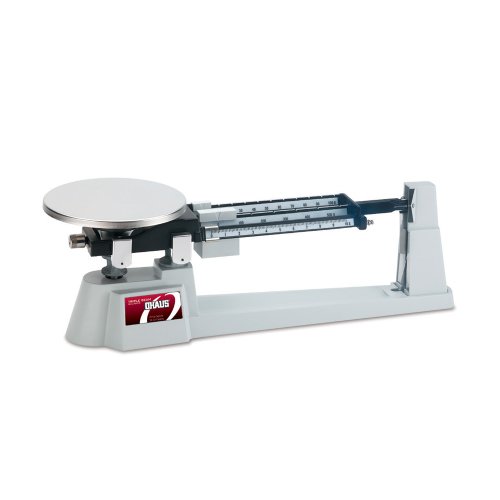

How To Choose The Best Balance Weight Scale
A balance scale compares two sides of a pivoting beam instead of converting pressure into a digital number. With no electronics to age, that pivoting beam holds its accuracy for years. Your buying decision depends on three things: what you are weighing, how fine the reading needs to be, and how much floor or counter space you can give it.
Capacity: how much weight the scale can hold
Capacity is the heaviest load the beam can balance, and it has to clear your heaviest user with room to spare. Classroom bucket balances work in milliliters for liquids and small solids, while physician beam models carry numbers like 390 lb, 400 lb, 450 lb, and 500 lb. If two people share the scale and one is much heavier, buy for the heavier person — a beam pushed to its ceiling gives you a sloppy reading.
Graduation: the smallest change the beam can show you
Graduation is the smallest weight step printed on the beam, so it tells you how precisely you can track a change. Coarse graduations land around 4 ounces or 1/4 lb, while a laboratory triple-beam can resolve down to 0.1 g. For everyday body weight, 1/4 lb is plenty. For teaching density or chemistry, you want the finer number.
Zeroing: the adjustment that keeps readings honest
Every beam scale needs a zero point, and the way you reach it varies. Some use a spring-loaded zero compensator, some use a plain adjustment screw, and a few require a small flathead screwdriver to reach a recessed notch. Check how the zeroing works before you buy, because you will use it far more often than you expect.
Quick Comparison
| Model | Best For | Capacity | Graduation | Build | Amazon |
|---|---|---|---|---|---|
| Learning Resources Primary Bucket Balance★ Best Overall | Teaching kids weight and volume | 400 ml buckets | — | Plastic | Amazon |
| Ohaus 80000012 Triple Beam BalanceLab Standard | Lab and homeschool experiments | 610 g | 0.1 g | Metal and stainless steel | Amazon |
| Health o meter Professional 400KLClinic Grade | Clinic-grade body weight at home | 390 lb / 177 kg | 1/4 lb / 100 g | Powder-coated alloy steel | Amazon |
| DETECTO 439 | Height and weight in one pass | 450 lb x 4 oz | 4 ounces | Powder-coated mild steel | Amazon |
| Health o meter 402LB | Daily at-home monitoring | 400 lb | — | Mechanical steel beam | Amazon |
| Healthometer 77519 Model 402LB | All-metal simplicity, no batteries | 400 lb | — | All-metal construction | Amazon |
| DETECTO 338 | Rolling dual-unit weighing | — | 0.125 inch height | Powder-coated mild steel | Amazon |
| seca 700 | Heavy users and tall frames | 500 lb | 1/8 lb | Steel, no height rod | Amazon |
| Health O Meter 450KL | High-capacity home gym weighing | 500 lb | 1/4 lb | Mechanical beam | Amazon |
In‑Depth Reviews
1. Learning Resources Primary Bucket Balance
Our pick — over 4.5★ from 2,000+ verified ratings; the strongest balance of quality and price.
A balancing act small hands can actually set up and read on their own
If you are shopping for a child aged 3 and up, this is the one to start with. It is a two-pan balance with removable graduated buckets that hold solids and liquids up to 400 ml, so a four-year-old can pour water into one side and stack blocks in the other and watch the beam react. The buckets, lids, and a built-in storage drawer all come apart, which means cleanup after a messy experiment takes seconds. That removable design is the whole reason it holds up to classroom use.
The teaching value is what wins people over — comparing weights and volumes is how kids pick up the ideas behind measurement before anyone puts a number on it. Pairs well with a set of Learning Resources weights for comparing toys or liquids side by side. The plastic body has no glass anywhere, so there is nothing to worry about dropping on a tile floor.
That is a trade-off of the lightweight classroom build, not a defect — treat it as a tabletop learning toy rather than a precision instrument. Also worth knowing: this scale measures in milliliters for liquids, not pounds, so it teaches comparison rather than giving you a body-weight number.
What makes it work in a classroom
- Removable graduated buckets each hold up to 400 ml of solids or liquids
- No glass anywhere, so a drop on tile is not a disaster
- Built-in storage drawer and dual-purpose bucket lids keep counters tidy
- Graduated buckets let kids see which side holds more water or blocks
Where it asks for care
- Buckets can slip off the arms during rough play
- Plastic body flexes, so readings are comparative rather than lab-precise
- Measures in milliliters, not pounds
Built for: parents, preschool teachers, and homeschoolers who want a hands-on measurement tool kids can use unsupervised.
Think twice if: you need a numeric body-weight reading — this one teaches comparison, not pounds.
2. Ohaus 80000012 Specialty Mechanical Triple Beam Balance
Three sliding weights, one magnetic brake, and no batteries to fail mid-experiment
Weighing 610 grams down to a tenth of a gram is a genuinely different job from weighing a person, and this is the tool for it. Three sliding weights ride on notched and tiered beams, so you set the coarse weight on one beam and fine-tune on the next instead of chasing a single slider. A built-in magnetic damper — a magnet that slows the beam so it settles instead of swinging — speeds up every reading. The base and beams are metal, which is what you want under a stainless steel plate.
A spring-loaded zero compensator (a built-in spring that lets you fine-tune the zero point) lets you make fine corrections without hunting for a screwdriver. Compared to the classroom bucket balance above, the resolution gap is enormous: 0.1 g (a tenth of a gram) against a bucket that only shows which side is heavier. For a homeschool setup running density or chemistry experiments, that precision is the reason to spend more here.
Buyers report it arrives calibrated once you pull the protective gaskets, and that the metal base and beams hold up over years of homeschool use. As buyers put it: “Our family uses this for homeschooling lab experiments.” The one thing to plan around is the missing tare bar (a feature that zeroes out a container’s weight) — there is no button to zero out a container, so you subtract the container weight yourself.
The precision payoff: 0.1 g readability on a 610 g capacity is a laboratory-grade resolution, and the magnetic damping means you are not standing there waiting for the beam to stop swinging.
Do the math yourself: without a tare bar, weighing powder into a dish means subtracting the dish weight by hand every time — fine for a patient user, tedious for a hurried one.
Right pick when: you are running real experiments and need tenth-of-a-gram resolution from an instrument that will not need recalibrating every week.
Wrong pick when: you want to press a button and read a number — this one rewards a little patience.
3. Health o meter Professional 400KL Mechanical Beam Medical Scale
The physician-office beam scale that keeps the same answer every single morning
Tracking a weight trend is only useful if the number does not wobble, and that is the entire argument for this scale. It carries a 390 lb / 177 kg capacity with graduations of 1/4 lb / 100 g, so a small change in your body weight actually shows up on the beam. The finish is powder-coated inside and out to resist rust, which matters in a humid bathroom or a busy clinic corner. A non-slip black platform mat keeps your footing steady while you lean over to read.
Setup is genuinely quick — bolt the column to the base, then zero it with a screwdriver — and the counterweight system is simple enough that owners describe it as easy to use right away. This is the same class of scale you step on at the doctor’s office, which is a large part of why people buy it for home.
Just be realistic about the readout position: numbers sit low on the beam, so a taller user has to look down from standing height to read them. It is easier to step off, glance, and step back on. The other consideration is portability — this is a fixed floor unit, and wheels are an optional extra rather than included. Coverage is where it stands out: a 10-year limited warranty backs a mechanical scale that has very little in it to break.
Why it holds its number
- 390 lb / 177 kg capacity with 1/4 lb / 100 g graduations
- Powder-coated inside and out for rust protection in humid rooms
- Non-slip platform mat for stable footing
- 10-year limited warranty
- Optional wheels and counterweights can raise capacity to 490 lb / 210 kg
Worth knowing before it ships
- Numbers read low on the beam, so taller users look down from standing height
- Not portable — wheels are sold separately, not included
- The platform feels heavy to a smaller-framed user
Best matched to: anyone monitoring a health trend at home who wants clinic-grade repeatability and a warranty measured in years, not months.
Look at the 402LB instead if: you would rather have a physical height rod and a taller readout position built into the same frame.
4. DETECTO 439 Mechanical Physician Beam Scale with Height Rod
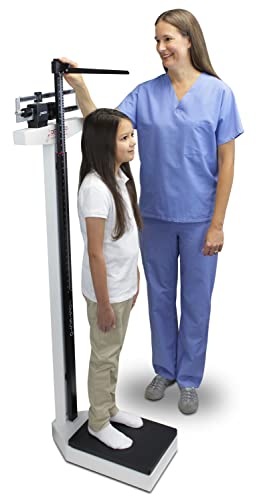
Height and weight in one pass, with a beam you can read from either side
One trip onto the platform gets you both numbers here, because the height rod spans 24-84 inch / 60-212 cm with 0.125 inch / 0.1 cm graduations. The dual-sided weigh beam reads from either side of the scale, so you are not walking around it to check your number. Capacity runs 450 lb with 4-ounce increments on a 14.75 in x 10.75 in platform. Mild steel with a powder coat finish keeps the frame solid without making it awkward to shift around the room.
Compared with the 400KL above, the extra capacity and the built-in height rod are the whole reason to step up — 450 lb against 390 lb, plus a measurement range the other scale simply does not have. Assembly runs about fifteen minutes and most of that is bolting the column down and hooking the beam linkage together.
There is a real quirk to plan for: the height rod does not stop square, which can cost roughly 0.5 inch of accuracy on the height reading. The platform is also narrow at 10.75 inches, and on a unit where the base has been overtightened during assembly the beam can sit with a slight lean. Buy this for the combination of numbers, and treat the height rod as a helpful extra rather than a precision stadiometer.
The dual-format value: 450 lb capacity, a 24-84 inch height rod, and readings viewable from either side of the beam make this the most complete analog package on the list.
The trade-off to size: that narrow 10.75-inch platform and a height rod that does not lock square mean you gain features and give up a little reading confidence on the height side.
Buy it when: a whole household needs both height and weight tracked, and you want to read the beam from whichever side you happen to be standing on.
Pass when: precise height measurement is the priority — the rod’s slight wobble will frustrate you.
5. Health o meter 402LB Mechanical Beam Scale
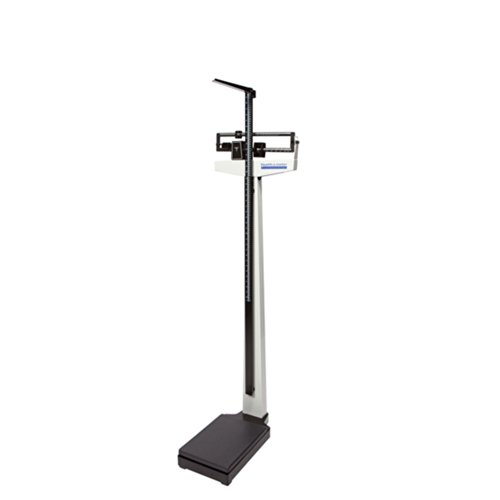
The beam scale people keep coming back to after their digital ones lie to them
Three unreliable digital scales is the usual story that leads someone here, and the payoff is a beam that answers the same way every time you step on. It carries a 400 lb capacity on a 10-1/2 in x 14 in x 3-1/4 in platform, and owners describe readings landing within 1/4 to 1/2 lb of each other. There is no battery compartment, no auto-off, and nothing electronic to slowly drift out of spec.
Accuracy is the headline, and it is backed by a repeatability check that is easy to run yourself: step on and off several times and watch whether the beam returns to the same mark. It also picks up small changes — a matter of ounces rather than pounds — which is exactly what you want when you are watching a trend rather than one snapshot. Assembly is a solo job that takes around ten minutes, and no hand strength is required.
Where it asks for your attention is the poise weight on the upper beam, which is light and must be returned to zero after each weighing. Assembly quality varies slightly from the start, and a steel rod that unhooks in transit can throw the reading off until it is reseated. Neither is a reason to walk away — it is the honest cost of a mechanical linkage you maintain yourself instead of a circuit board you cannot touch.
What owners keep praising
- 400 lb capacity on a 10-1/2 in x 14 in x 3-1/4 in platform
- Repeatable readings within 1/4 to 1/2 lb
- No batteries, no auto-off, no electronic drift
- Solo assembly in around ten minutes
What to expect on setup
- The upper poise weight is light and must be reset to zero after each use
- A steel rod can unhook in transit and needs reseating
- Reading the beam takes a moment of arithmetic rather than a glance
Ideal for: the home user who has given up on digital scales and wants one beam that reads the same on Monday and Friday.
Skip if: you want a number to appear instantly with no sliding weights to set.
6. Healthometer Physician Beam Scale Model 402LB
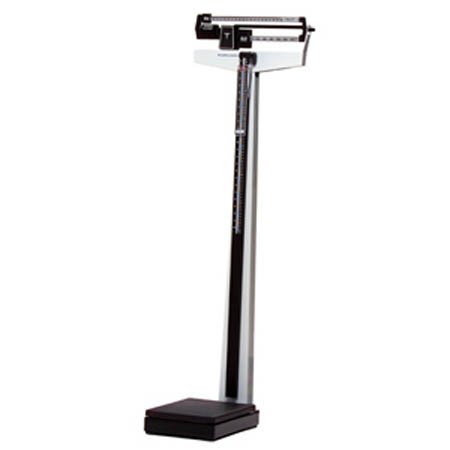
Four nuts, one hook, and an all-metal beam with nothing to plug in
Assembly here is about as simple as a physician scale gets: four nuts and a hook, and most people have it standing in under half an hour. It carries a 400 lb capacity and picks up half-pound changes that a digital bathroom scale tends to smooth over or miss. Everything is metal, including the beam and platform frame, so there is no plastic linkage to crack under a heavy user.
Plain and sturdy is the pitch — one owner well into his eighties assembled it alone using two folding chairs as supports, with no balance adjustments needed once it was upright. If you have a hard, level floor and you want a scale that works without a single battery, this is the straightforward answer.
Two things are worth flagging before it arrives. The zeroing point is a recessed black notch set into the frame, so you need a small flathead screwdriver and a bit of patience to find it. The height bar also takes real effort to raise and lower, and a few owners who tried lubricating it found it did not loosen up much. Neither affects the weighing accuracy, but they do shape how pleasant the daily routine feels.
The simplicity argument: all-metal construction, a 400 lb capacity, and an assembly you can finish solo make this the most forgiving mechanical beam to live with long-term.
The friction points: a recessed zeroing notch that needs a tiny screwdriver and a stiff height bar mean the setup routine takes more fiddling than the weighing itself.
Reach for this if: you want a plain all-metal analog scale and you are comfortable doing a small calibration adjustment yourself.
Look elsewhere if: you would rather not handle a screwdriver to zero the beam.
7. DETECTO 338 Mechanical Physician Beam Scale with Wheels

One beam that answers in both kilograms and pounds, and rolls where you need it
Moving a floor scale is the small daily annoyance nobody plans for, and this one ships with wheels so you can roll it out of the corner instead of dragging it. The dual-reading beam shows kilograms and pounds on the same face and can be read from either side of the scale. A height rod is built in, spanning 24-84 inch / 60-212 cm with 0.125 inch / 0.1 cm graduations. Mild steel with a powder coat finish and a 14.75 in x 10.75 in platform make up the frame.
The kilogram and pound readout is the standout feature here — if you follow any metric-based tracking or work with international measurements, you avoid doing the conversion on paper the way you would with a pounds-only beam. Owners mention the beam settles steady once the scale stands level, and that readings match their doctor’s office scale pound for pound.
The honest caution is that assembly has more moving parts to get right than the simpler beams on this list, and the internal mechanism has arrived scrambled in shipping for some buyers, though the packaging held up and everything was resolvable. The kilogram scale also complicates the readout if you only ever think in pounds. Two-year limited warranty coverage is shorter than what the 400KL carries, so this is a pick for someone who values the wheels and dual units over the longest possible guarantee.
Standout details
- Dual-reading beam shows kilograms and pounds
- Wheels included for rolling it out of a corner
- Height rod reads 24-84 inch / 60-212 cm
- Beam readable from either side of the scale
The effort it asks of you
- More internal mechanism to assemble correctly than simpler beams
- The kilogram side complicates a pounds-only routine
- Two-year warranty, shorter than the 400KL’s 10-year coverage
Choose this if: you want both unit systems on one beam and wheels that make a heavy scale easy to reposition.
Weigh other options if: the shortest warranty on this list is a concern to you.
8. seca 700 Physicians Mechanical Beam Scale
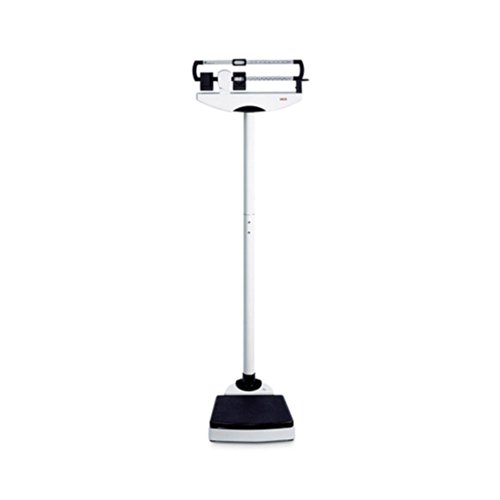
The beam that splits the difference at an eighth of a pound
Two specifications set this apart from everything else on the list: a 500 lb capacity and a 1/8 lb graduation. That graduated beam is the finest body-weight resolution here, and it means a change of a few ounces actually shifts the slider instead of hiding inside a 1/4 lb gap. Capacity at 500 lb also clears most of the heavier-users problem in one stroke. A 5-year warranty backs the frame.
Setup is where it earns repeat buyers — the pictorial instructions are clear and most people have it standing in around ten minutes, and the adjustment screw for zeroing is easy to reach. The overall footprint is larger than the pound-only beams, which is exactly what gives the beam room to travel across a 500 lb span. On a clean, level hard floor, once it is zeroed it tends to stay there.
Two things need saying. This version ships without a height rod, so you add that separately if you need it. And the larger footprint cuts both ways: a tall frame stands comfortably on it, but a shorter or smaller-framed user can find the platform oversized underfoot. Balance is the routine each person maintains rather than a set-and-forget setting, so plan on checking the zero point before a weigh-in.
The fine-resolution edge: a 500 lb capacity paired with a 1/8 lb graduation gives you the widest weight range and the smallest visible step of any scale on this list.
The footprint question: without a built-in height rod and with a platform sized for large frames, this scale asks for floor space and returns nothing in the way of height measurement.
Made for: heavier users and anyone tracking small weight changes who wants the finest graduation on the list.
Not for: anyone who needs a built-in height rod — this version ships without one.
9. Health O Meter 450KL Mechanical Beam Scale

A 500 lb beam built for the garage gym, counterweights already in the box
The counterweights come included here, which is what lifts the capacity to 500 lb without buying anything extra. Graduation is 1/4 lb, and the platform measures 10-1/2 in wide by 14 in deep. That combination of a high ceiling and a familiar yardstick is squarely aimed at a home gym where a 300 lb squat day and a routine weigh-in both need to land on the same scale.
Assembly is mostly done for you — the unit arrives largely pre-built and the last steps are straightforward, though getting the base seated underneath takes some wrestling. The sliding weight is the one part that catches people out at first; it takes a session or two before reaching for the right slider becomes automatic. Owners describe the steel frame as sturdy enough to keep for years.
The recurring gripe is the large weight bar, which you lift up and over to move and which lands with an audible clack. It is also sized for one user’s range, so a household where different people weigh in daily means readjusting the bar each time. And the platform width is narrower than some buyers expect — the depth is fine, the width is the tight spot.
What earns it a spot
- 500 lb capacity with counterweights included
- 1/4 lb graduation on a 10-1/2 in x 14 in platform
- Arrives mostly pre-built
- Sturdy enough that owners expect years of service
Small things that add up
- The large weight bar is loud and requires lifting up and over
- Daily readjustment is needed when different people share the scale
- The platform feels narrower underfoot than expected
Suits: garage-gym owners who need a high weight ceiling and want counterweights included from the start.
Consider a different beam if: several people of very different weights will share it daily — the bar resetting gets old fast.
Understanding the Specs
Graduation and Readability
Graduation is the smallest step the beam can show you, and readability is how finely you can actually read it. A physician beam marked in 1/4 lb lets you see a quarter-pound change; one marked in 4 ounces shows the same size step on the fractional side. A triple-beam balance rated at 0.1 g readability is working in a completely different range — the smallest visible step is a tenth of a gram. Match the graduation to your job: pounds for tracking your weight, grams for anything you would put in a beaker or a mixing bowl.
Capacity and Counterweights
Capacity is the heaviest load the beam is built to balance, and some scales hit their maximum only after you add counterweights. A unit rated at 390 lb can be pushed to 490 lb with the optional counterweight set, and a 500 lb model may arrive with those weights already in the box. Always check whether the headline capacity needs that accessory, because a beam run to its ceiling with the weights badly placed will not settle cleanly.
FAQ
Do balance weight scales need batteries?
How accurate is a mechanical beam scale compared to a digital one?
Will a balance scale work on carpet?
What does tare mean and why do some beam scales lack it?
How do I know if my beam scale is out of calibration?
Can a bucket balance measure liquid volume as well as weight?
How much floor space does a physician beam scale take up?
Is a 1/4 lb graduation fine enough for tracking weight loss?
Do mechanical scales need assembly from the start?
Final Thoughts: The Verdict
For most families, the balance weight scale winner is the Learning Resources Primary Bucket Balance because it turns measurement into something a four-year-old can actually do hands-on, with 400 ml buckets, no glass to break, and a built-in storage drawer for cleanup. It is the strongest combination of durability, simplicity, and teaching value on this list. If you need clinic-grade body weight tracking at home, the Health o meter Professional 400KL is the one to reach for, with 1/4 lb graduations and a 10-year limited warranty behind it.
For a laboratory or homeschool setup, the Ohaus 80000012 Triple Beam Balance is the precise tool on the list — 610 g capacity and 0.1 g readability, with magnetic damping so the beam settles instead of swinging while you wait. And if your household is tracking both height and weight in one pass, the DETECTO 439 covers the most ground with a 450 lb capacity and a 24-84 inch height rod.
How We Picked
We do not accept paid placement. Every pick is matched to a real buyer and a real use-case; we do not hands-on test units.
Sources & Methodology
Specifications: manufacturer listings and product documentation. Review insights: verified customer reviews, as of September 2026. Pricing: not shown on this page (it changes often); check the current price via the retailer link.
As an Amazon Associate, KitchPrep earns from qualifying purchases. This does not affect which products we feature.
Related Guides
