
Specs are compiled from manufacturer listings and verified buyer reviews and can change over time — please confirm the key details on the product page before buying.
You need to punch a clean hole through a stack of 2x10s, a landscape timber, or an exterior wall, and every standard bit in your kit quits after three inches. A short bit forces you to drill from both sides and hope the holes line up. The picks below are all long-reach auger bits in the roughly two-foot class, meaning they run close to 24 inches from tip to shank, so one pass can clear a deep post or a double wall. Note one honest caveat upfront: because bits in this class are sold in metric lengths like 600mm, the picks here are matched by near-size rather than one exact number, and a couple run a hair under a true 24 inches.
I’m Mohammad Maruf — the founder and writer behind KitchPrep. This guide is built by comparing the manufacturers’ published specifications and the patterns across verified customer reviews, so you get each pick’s real strengths and trade-offs instead of marketing spin.
Deep boring is mostly about chip clearance and a straight start, not raw power, so the length, flute count, and shank type do most of the work. Here is a clear look at the best 2-Foot-Long Drill Bits for Wood.
Our Picks at a Glance
How To Choose The Best 2-Foot-Long Drill Bits for Wood
A long wood bit lives or dies on three things: it has to reach the depth you need, it has to pull chips out of a deep hole, and it has to start where you aim it. Everything else is detail. Here is how to read a listing so you buy the right one the first time.
Length and the metric trap
This class is called two-foot because the bits run near 24 inches, but a lot of them are actually sold as 600mm, which lands just under a true 24 inches. If you genuinely need every last fraction of a 24-inch bit, check the metric figure before you buy. If your job only needs about 20 inches of reach, the metric size is plenty. Never assume the big round number on the box is exact.
Flute count and chip clearance
An auger bit bores a deep hole by lifting wood chips up and out along spiral flutes, and the count of those flutes changes how fast it clears. A three-flute bit has three cutting paths, so it typically clears chips faster and runs cooler than a two-flute bit of the same diameter. That matters most in deep holes, where packed chips are what stall a drill. You still back the bit out now and then to let debris drop, but a tri-flute needs it less often.
Shank size and what your chuck accepts
The shank is the plain end that locks into your drill. These bits come in two common sizes: a slim 1/4-inch hex, which fits standard quick-change chucks and smaller drivers, and a beefy 1/2-inch hex, which needs a chuck that opens wide enough and a drill with real torque behind it. Match the shank to your tool, or you will be shopping again. A 1/2-inch bit also grabs more material per turn, so it demands a stronger drill.
Self-feeding tips versus controlled starts
Many of these bits use a threaded lead tip that bites in and pulls itself forward, giving a walk-free start without a pilot hole. That is a real help in softwood and treated lumber. The catch is that a hungry self-feeding tip can bite too hard in dense hardwood or overload a weaker drill, so keep a firm grip and let the tool work at low speed.
Quick Comparison
| Model | Best For | Diameter | Overall Length | Flutes | Amazon |
|---|---|---|---|---|---|
| 1/4″ x 24″ Auger Drill Bit, Hex Shank Tri Flute★ Best Overall | All-round deep boring in soft and hard wood | 1/4 inch | 24 inch | 3 | Amazon |
| 1/4 x 23.6 Auger Drill Bit, 6x600mm Hex ShankBest Reach | Long reach through walls and stacked lumber | 1/4 inch | 23.6 inch | 2 | Amazon |
| 1/4″ x 24″ Auger Drill Bit for Soft and Hard Wood | Clean tri-flute cuts in wood, plastic and drywall | 1/4 inch | 24 inch | 3 | Amazon |
| Horivo 1/2″ x 24″ 3-Cutter Edge Auger Bit | Fast heavy-duty boring in dense lumber | 1/2 inch | 24 inch | 3 | Amazon |
| METOTY 1″×24″ Professional Auger Drill Bit | Big-diameter holes for cable and pipe runs | 1 inch | 24 inch | 3 | Amazon |
| WOBLLMX 6PCS Auger Drill Bit Set | One kit covering six diameters from 1/4″ to 5/8″ | 1/4″ to 5/8″ | 24 inch | 3 | Amazon |
In‑Depth Reviews
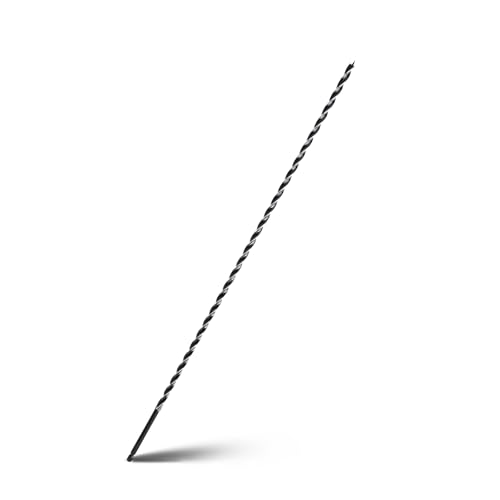
1. 1/4″ x 24″ Auger Drill Bit for Wood, Hex Shank Tri Flute
Our pick — 4.5★ from 300+ verified ratings; the strongest balance of quality and price.
Three flutes, a full 24 inches, and a self-centering tip that bites where you aim.
The headline on this bit is the three-flute spiral, and it is the reason it takes the top spot. A tri-flute auger cuts on three paths per turn and lifts chips out along a hollow-ground channel, so a deep bore stays cleaner and cooler instead of packing up. Compare it to the GRIXLEN two-flute pick further down: three cutting paths here versus two there, which is why this bit clears chips faster on the same deep bore. It is built from 1045 high-carbon steel with triple cutting spurs and a centering point. The point is the quiet hero. It positions the bit accurately and starts safer and smoother than a spade or paddle bit, which is exactly what you want when you are leaning into a 24-inch reach.
The 1/4-inch diameter keeps it friendly. That slim cutting width means most standard drills and quick-change chucks will spin it, and it works across soft and hard woods, MDF, plywood, lumber, landscape timber, and even for installing PVC pipe or boring a tree stump. Just keep it out of metal. Each bit ships in a reusable PVC tube, so it lives in your toolbox without rolling around and nicking a neighbor. In a job where the bit is long enough to flex if it is stored badly, that tube is a small thing that protects a big reach.
What wins people over is the performance, and quality runs a close second. Owners bore through cherry hardwood and rebar-sized holes in 6×6 pressure-treated lumber and report the bit holding up. One verified buyer put it plainly: “I’ve only used in pine; drilled 10” deep holes did a decent job clearing chips had to remove completely from hole about 2 x’s per hole.” That is the honest reality of deep boring with any auger. You still pull the bit to let debris fall. Sharpness and durability draw more split opinions. A fair caveat: a few users note it dulls faster in the hardest woods, so treat hardwood as a slower job and let the flutes do the work rather than forcing it.
Why it earns first place
- Three flutes clear chips faster and run cooler than a two-flute bit of the same reach.
- The self-centering point starts accurately without a pilot hole and beats a spade for control.
- Full 24-inch length, so one pass clears a deep post or a thick double wall.
- Slim 1/4-inch hex shank fits standard quick-change chucks and most drills.
- Reusable PVC tube keeps the long bit protected between jobs.
Where it asks for care
- In the hardest woods a few owners find sharpness fades faster than they would like.
- It is not for metal, so keep it away from screws and nails.
- You still have to back it out to clear chips on very deep holes.
My pick if you bore wood daily: this is the best-balanced two-foot bit here — tri-flute clearance, a true 24-inch reach, and a 1/4-inch shank that fits the drill you already own.
Look elsewhere if: you need a wide hole for pipe or cable, because this one only cuts 1/4 inch.
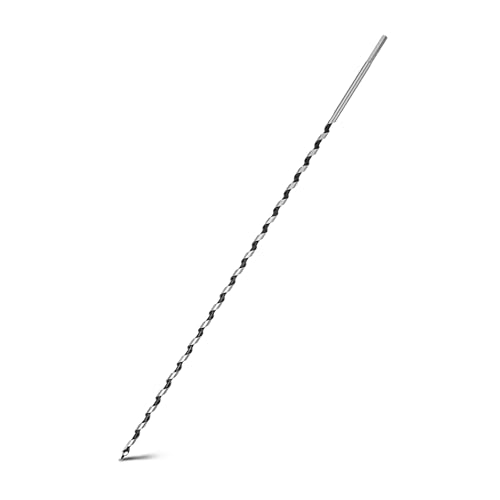
2. 1/4 x 23.6 Auger Drill Bit for Wood, 6x600mm Hex Shank Ship Auger Bit
The wall-puncher: a 600mm shank built from high speed steel for long reach in tight spots.
If your job is running a wire, a conduit, or a lag screw through something thick, this is the bit to picture. At 23.6 inches — the metric 600mm the listing calls out — it reaches through an exterior wall or a stack of landscape timbers in a single bore. The steel here is high speed steel (HSS), a harder, more heat-resistant alloy than the plain carbon steel on several other picks, and it is finished uncoated. That harder edge is the reason it holds up when it gets warm. Two flutes feeding a hollow channel keep the cut moving, though it clears chips more slowly than the tri-flute leader above.
Owners push this bit into genuinely awkward places. It has pre-drilled for 10-inch 3/8-inch galvanized lag screws in H-post horizontal timbers, and it reliably pokes through an exterior wall for a mini-split line set. Buyers report it also bores conduit holes through home walls for EV charger wiring. One owner summed up the deep-boring job: “Did the job – needed to drill several 8mm holes through 6 1/2” treated lumber for bolts and one bit did the job!” The same owner noted they had to clear cuttings to let the bit keep biting — normal for any auger at depth. The kit is simple: the bit, the hex shank, no case. A couple of users wish a leather case were included.
Quality and functionality are the two things people keep coming back to. The trade-off is durability and sharpness in a mixed light — some find it strong and very sharp, while a few report it needing a touch-up after heavy use. The other catch is size honesty: at 600mm it measures 23.6 inches, not a true 24. If you need every fraction of a 24-inch reach, measure before you commit. For the price, though, it is a lot of hard steel for reaching deeper than most short bits ever will.
Where it shines: high speed steel and a 600mm length make it my go-to for punching through walls and stacked timber where other bits fall short.
The trade-off to know: it is a two-flute bit, so it clears chips slower than a three-flute, and it lands at 23.6 inches rather than a full 24.
Reach for this if: you are drilling through walls, conduit runs, or landscape timbers and want HSS toughness at a long stretch.
Think twice if: you specifically need a true 24 inches, since this one measures 23.6.
3. 1/4″ x 24″ Auger Drill Bit for Soft and Hard Wood, 1/4″ Hex Shank
A rigid tri-flute built to bore straight and clean through wood, plastic, and even drywall.
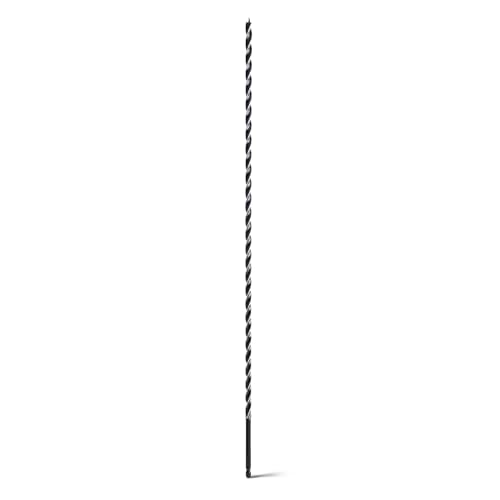
This 1045 high-carbon steel bit runs a tri-flute solid center design, which adds rigidity so the long shaft stays straight as it bores. Its wide lands are the detail that keeps it tracking true, and the flutes are ground behind those lands to funnel chips inward and away from the outside edge. The result is a faster, cleaner cut that resists wandering on a deep hole. If straightness down two feet matters more to you than outright speed, this is the geometry that delivers it. It handles soft and hard woods, MDF, plywood, lumber, landscape timber, PVC pipe installs, and stump boring.
Owners use it for jobs that mix materials. It has drilled eight holes for 4×4 metal post holders through pea gravel and small roots while keeping the pillars square, and it survived two railroad timbers drilled at once without complaint. There is a real grit to it — one user drilled telephone poles and even hit screws and red-hot heating without breaking the bit, though it took strong force and got stuck in one drill before being freed in another. That is the honest limit: this is not a delicate bit. Feed it too much downward pressure and it overheats fast, so let the flutes cut rather than leaning on it. The reusable PVC tube comes standard.
Functionality and durability are the two strengths owners name most, and it does the tri-flute job well. The one thing to watch is size. This bit is sold as 24 inches, but at least one buyer measured it short of even the 23.62-inch metric figure and needed the full 24. If your job only needs reach and not an exact length, that is a non-issue. If you are cutting to a hard dimension, verify before you buy.
Great for mixed-material jobs: wood, plastic, drywall, and landscape timber in one pass, with wide lands that fight wandering.
Check the tape first if: you need a guaranteed 24 inches, because this one has been measured under that mark.
4. Horivo 3-Cutter Edge Wood Auger Drill Bit, 1/2″ x 24″ Heavy Duty Long Ship Auger Bit
Three cutters and a self-feeding 4-hex tip that walks into dense timber and stays sharp.
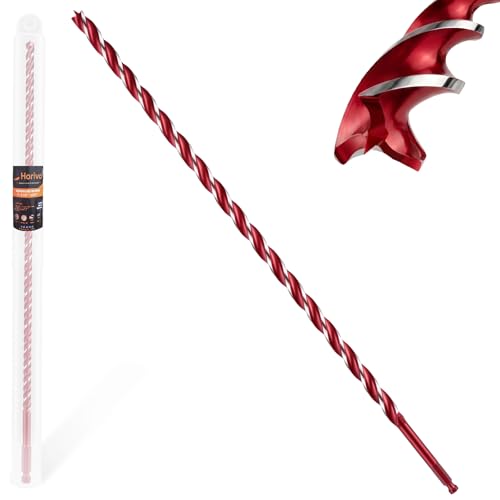
Step up from the 1/4-inch bits and the whole job changes. This Horivo cuts a 1/2-inch hole, double the width of the tri-flute leader, so it removes far more material per turn and needs a drill with real muscle to match. The 3-cutter edge is its party piece — three cutting paths per revolution that clear chips faster and cut with less friction than a standard single- or double-flute auger. Its 4-hexagonal self-feeding lead tip draws the bit into the wood without skating, which is what you want when you are starting a wide hole by hand. The shank is an tune 3/8-inch hex for a secure fit in standard quick-change chucks.
Owners beat on this one and it keeps cutting. It has gone through pressure-treated lumber and even touched ground a few times with no issues, handled everything thrown at it, and bored stumps for removal. One find keeps the 3-cutter geometry front and center, and another notes the bits run sharp and cut cleaner than a spade. The material is a heat-treated carbon steel with reinforced cutting edges built to resist overheating and stay sharp longer through dense woods. The trade-off to know: a 1/2-inch bit needs a strong drill. A standard 1/2-inch hand drill can drive it, but it will work very hard doing so. Feed it slow, keep the RPM down, and let the cutters bite rather than forcing the feed.
This is the pick if your projects lean heavy — boring stumps, running big holes through thick pressure-treated stock, doing serious carpentry work. Every bit is individually quality-controlled and comes in a twist-open plastic tube. For someone moving up from 1/4-inch bits into wide, deep boring, the extra material and stouter tip earn their keep.
What you gain: a 1/2-inch hole with three cutters per turn and a self-feeding tip that starts cleanly in hard lumber.
What it demands: a strong drill — a weak hand drill will strain, so keep the RPM low and let the cutters work.
Suits the heavy-duty carpenter: wide holes in dense stock, stumps, and thick treated lumber all in its lane.
Back away if: you are using a light drill, because a 1/2-inch cut needs torque to drive.
5. METOTY 1″×24″ Professional Auger Drill Bit for Wood with Quick Change 1/2″ Hex Shank

A full one-inch bore for pulling cable and pipe through deep, clean holes.
When one inch is the number you need, this is the pick. That wide cutting diameter makes it the go-to for running a large electrical SER cable or a chunky pipe through a deep wall, where a 1/4-inch or 1/2-inch bit simply will not open enough room. It uses three hardened cutting spurs for aggressive boring, and the triple-cutter geometry shears through wood fibers with less downward pressure than a standard two-cutter bit. The three-flute core runs deep, polished spirals that push chips out of the borehole so it does not clog or bind mid-cut, which keeps the bit from stalling in a deep pass.
The build is 1045 high-carbon steel with a solid center shaft for rigidity, and a threaded point that pulls the bit in for precise, walk-free starts. Wide bearing surfaces keep it boring straight through a long hole. It is meant for hardwood, softwood, pressure-treated lumber, plywood, OSB, plastic, PVC, drywall, and stump boring — a genuinely all-purpose tool for electricians, plumbers, carpenters, and landscapers. Owners put the aggressive edge to work: it drilled two holes for a large electrical SER cable with a clean cut and, notably, a clean exit hole with little tear-out. That matters, because augers can leave a ragged back side.
The honest catch is durability at the top of the range. Functionality and quality win owners over, but a few report the bit breaking within the first use. It is also a big bite for a 1/2-inch hex shank on a lighter drill, so match it to a tool that can turn one inch of wood without stalling. The quick-change shank fits drills and impact drivers, and each bit comes in a heavy-duty PVC tube. For large-diameter cable and pipe runs in deep material, the reach and breadth are hard to match.
Where it wins
- Opens a full 1-inch hole, ideal for pulling large cable or pipe through a deep wall.
- Three cutting spurs and a tri-flute core clear chips and resist binding in deep passes.
- Threaded point gives a walk-free start without a pilot hole.
- 1/2-inch quick-change hex shank fits both drills and impact drivers.
- Handles hardwood, softwood, plywood, OSB, plastic, PVC, drywall, and stumps.
The honest downsides
- A few users report the bit breaking within the first use.
- A one-inch cut needs a strong drill to drive it without stalling.
Built for the big bore: if you are pulling cable or pipe and need a full inch of clearance down two feet, start here.
Not your bit if: your drill is small or you only need a slim pilot hole.
6. WOBLLMX 6PCS Auger Drill Bit Set, Hex Shank 24″ Long
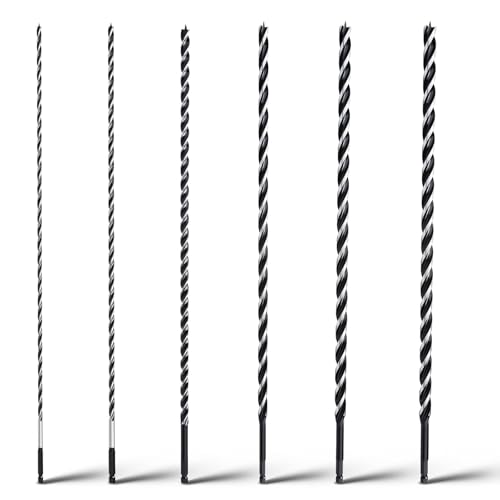
Six 24-inch bits in one tube — every diameter you would reach for, 1/4 inch through 5/8 inch.
If you would rather cover every job than buy one diameter at a time, this is the set. You get six 24-inch tri-flute auger bits in 1/4″, 5/16″, 3/8″, 1/2″, 9/16″, and 5/8″ — a reach for lag screws, cable, dowel stock, and general boring, all in one purchase. Each shares the same 1045 high-carbon steel build, the tri-flute solid center for rigidity, wide lands that keep the shaft straight, and a self-positioning tip for accurate starts. Flutes are ground behind the lands to funnel chips inward for a cleaner cut. Every bit stores in its own reusable PVC tube, so the set stays organized and protected.
The one thing to understand before you buy is sizing. These are labeled in metric, and that trips up buyers who expect standard SAE dimensions. When the hole needs to be exact — say, for a wood dowel that has to fit snug — the metric size can come out tighter than a SAE number would. For driving a stake into the ground, that difference almost never matters. Owners confirm the bits still bore cleanly and easily penetrate landscape timber, so the geometry works; it is the nominal size that catches people out. Read the metric figure, match it to your real need, and you are fine.
Functionality is the clear strong suit across the set — the bits drill well and go through timber without fuss. Quality draws a more even split, which is worth knowing on a set at this coverage. If you want one bag of long-reach bits that handles most of what a home project throws at it, this kit delivers the range in a single box and keeps everything in labeled tubes.
The value read: six tri-flute 24-inch bits spanning 1/4″ to 5/8″ covers nearly any deep-boring job a home project asks for.
Read the label closely: the diameters are metric, so check the exact figure if a hole must match a standard size.
Best for the one-and-done toolbag: grab this if you want six diameters in one shot and do not need a metric-exact hole.
Skip if: a precise SAE diameter is critical to your build, since these are metric-sized.
Understanding the Specs
Auger flute count (2 vs 3)
A flute is one of the spiral channels that carries wood chips up and out of the hole. A two-flute bit has two of those channels, and a three-flute bit has three. More flutes means more cutting edges per turn and faster chip removal, which keeps the cut cleaner and cooler on deep holes. That is why the two-flute GRIXLEN pick clears chips more slowly than the three-flute picks here. It is not about being weaker — it is about how fast the hole empties so the bit can keep biting.
Hex shank size (1/4″ vs 1/2″)
The hex shank is the six-sided end that locks into your drill’s chuck, and its size decides which tools will hold it. A 1/4-inch hex is the slim standard that fits most quick-change chucks and smaller drivers. A 1/2-inch hex is wider and needs a chuck that opens far enough, plus a drill with enough torque to spin a bigger cutting diameter. Match the shank to your tool first, then worry about the rest — a bit that will not seat properly in your chuck is the wrong bit no matter how good it looks.
FAQ
Why do some 24-inch auger bits measure slightly short?
Will a 1/4-inch hex shank fit my drill?
Do I need a hammer drill for a 24-inch auger bit?
Why does my auger bit stop cutting in the middle of a deep hole?
Can these bits drill through nails or screws?
What is the difference between a tri-flute and a dual-flute auger bit?
Is a self-feeding tip better than a standard point?
How long do these auger bits stay sharp?
Which diameter should I pick for running cable or pipe?
Can I use these long bits in an impact driver?
Final Thoughts: The Verdict
For most wood-boring jobs, the 2-foot-long drill bits for wood winner is the 1/4″ x 24″ Hex Shank Tri Flute Auger Drill Bit — three flutes clear chips faster, the self-centering tip starts where you aim, and the 1/4-inch shank fits the drill you already own. If your job means punching through walls or stacked timber, the GRIXLEN 600mm HSS ship auger reaches deepest in treated lumber and exterior walls. And when you need one wide hole for cable or pipe, reach for the METOTY 1-inch bit and pull the run through in a single pass.
How We Picked
We do not accept paid placement. Every pick is matched to a real buyer and a real use-case; we do not hands-on test units.
Sources & Methodology
Specifications: manufacturer listings and product documentation. Review insights: verified customer reviews, as of September 2026. Pricing: not shown on this page (it changes often); check the current price via the retailer link.
As an Amazon Associate, KitchPrep earns from qualifying purchases. This does not affect which products we feature.
Related Guides
