
Specs are compiled from manufacturer listings and verified buyer reviews and can change over time — please confirm the key details on the product page before buying.
If your baseboard heaters run hot and cold all night, the thermostat is usually the culprit, not the heater. The right one holds your room within a degree or two, shuts off cleanly when you want silence, and lets you trim your heating bill without touching a single wire inside the heater itself. This guide sorts nine line-voltage thermostats — the kind built specifically for 120V and 240V electric baseboard systems — into who each one actually suits.
I’m Mohammad Maruf — the founder and writer behind KitchPrep. This guide is built by comparing the manufacturers’ published specifications and the patterns across verified customer reviews, so you get each pick’s real strengths and trade-offs instead of marketing spin.
A thermostat that fights your schedule wastes money every cold month. Pick the wrong wiring type and it will not even power on. Below you get the practical differences spelled out, so you can choose the baseboard heater thermostat that fits your wiring and your routine.
Our Picks at a Glance


How To Choose The Best Baseboard Heater Thermostat
Baseboard heat runs on line voltage, which simply means your household current goes straight through the thermostat to the heater at full wall power. That single fact rules out most of the smart thermostats sold for gas furnaces and heat pumps. Before you buy anything, you need three answers about your setup: the voltage, the pole count, and the total wattage of the heaters on that circuit.
Match the voltage and the pole count first
Look at the heater’s label — you will see 120V, 208V, or 240V. Most homes run 240V baseboard, but garages and small additions sometimes use 120V. Then count the wires in the wall box. A single-pole thermostat breaks one wire; a double-pole breaks both. Double-pole is the safer choice on higher-wattage circuits because it fully disconnects the heater when it cycles off.
Add up the watts before you trust an amperage rating
A thermostat rated for 22 amps at 240 volts can carry a big heater load, while a 16-amp model tops out lower. If you have several heaters chained on one circuit, the combined wattage matters, not the rating of a single heater. Always pick a thermostat rated comfortably above your real load.
Decide between a dial and a schedule
A mechanical dial is the simplest thing you can install — no batteries, no programming, no display to learn. A programmable or smart model costs more but lets you drop the temperature while you sleep or while you are away. If a room sits empty most weekdays, that scheduling pays off in comfort and in lower bills.
Quick Comparison
| Model | Best For | Control Type | Voltage | Max Load | Amazon |
|---|---|---|---|---|---|
| Cadet F Series BTF2W★ Best Overall | Cadet F series heaters | Mechanical twist dial | 120/208/240V | 22 Amp | Amazon |
| Cadet T522-WBest Value | DIY wall-mount swaps | Mechanical twist dial | 120/208/240V | 5,280W at 240V | Amazon |
| Honeywell Home RLV4305Quietest Switching | Weekday/weekend scheduling | Push button, backlit | 240V | 3,500W at 240V | Amazon |
| Stelpro SWT1CC | Commercial and shop heat | Mechanical dial | 240V | — | Amazon |
| LUX ELV4 | Programmable on any voltage | Button, LCD | 120V and 240V | — | Amazon |
| KING K102 | Radiant ceiling and wall heat | Mechanical knob | 120-277V | — | Amazon |
| meross Smart Thermostat | Voice and app control | App, voice, LCD | 120V-240V | 16A, 3840W at 240V | Amazon |
| Aube by Honeywell TH106 | Zero temperature swing | Button, digital | 120V / 240V | 4,000W at 240V | Amazon |
| Mysa Smart Thermostat LITE | Garages and guest rooms | App, touch, voice | 120V, 208V, 240V | — | Amazon |
In‑Depth Reviews
1. Cadet F Series Double Pole Built-In Baseboard Thermostat (Model: BTF2W, Part: 08734)
Our pick — over 4.5★ from 950+ verified ratings; the strongest balance of quality and price.
The built-in dial that mounts straight onto a Cadet heater and skips the wall box entirely.
If you own a Cadet F series heater and want the simplest possible fix, this unit mounts to either end of the heater itself — no extra wiring run to a wall box and no hole to cut in drywall. You get a temperature range of 45º to 80ºF (about 7ºC to 27ºC), set with one large twist dial you can turn without reading anything. That dial runs on a two-wire hookup, and turned fully counterclockwise it acts as a low setting rather than a hard off.
What wins people over here is how reliably the thing just works — functionality is the quality buyers bring up more than any other, by a wide margin. Installation follows close behind as the second thing they praise, and owners upgrading from a baseboard-mounted rheostat describe the swap going smoothly. As one buyer of a 50-year-old heater put it, the dial “fit old unit despite different metal plate shape.” The double-pole version also lets you convert an older single-pole setup so the heater shuts off completely.
Be straight about the fit rule: this is made for Cadet F series electric baseboard heaters only, sold separately, so it is the wrong purchase for a different brand of heater. Anyone who is not comfortable working inside a live 240V circuit will also want help — one veteran buyer of the crowd favorite — 4.6 stars across 900+ ratings — found the wiring “quite complicated for a non-electrician.” Budget accordingly if you plan to hire out the job.
Where it earns its keep
- Mounts to either end of a Cadet F series heater, so no separate wall box is needed
- Large twist dial spans 45º to 80ºF with no display or menus to learn
- Double-pole switching shuts the heater down fully instead of leaving it half live
Where it asks something of you
- Locked to Cadet F series heaters — it will not fit other brands
- Two-wire hookup means live-current wiring work, which some owners find tricky
- No scheduling, no display, no remote — a strictly manual control
The natural fit: a Cadet F series owner replacing a failed built-in rheostat who wants the dial back on the heater face.
Wrong tool for: anyone with a non-Cadet heater, or a buyer who wants to set heat by schedule rather than by hand.
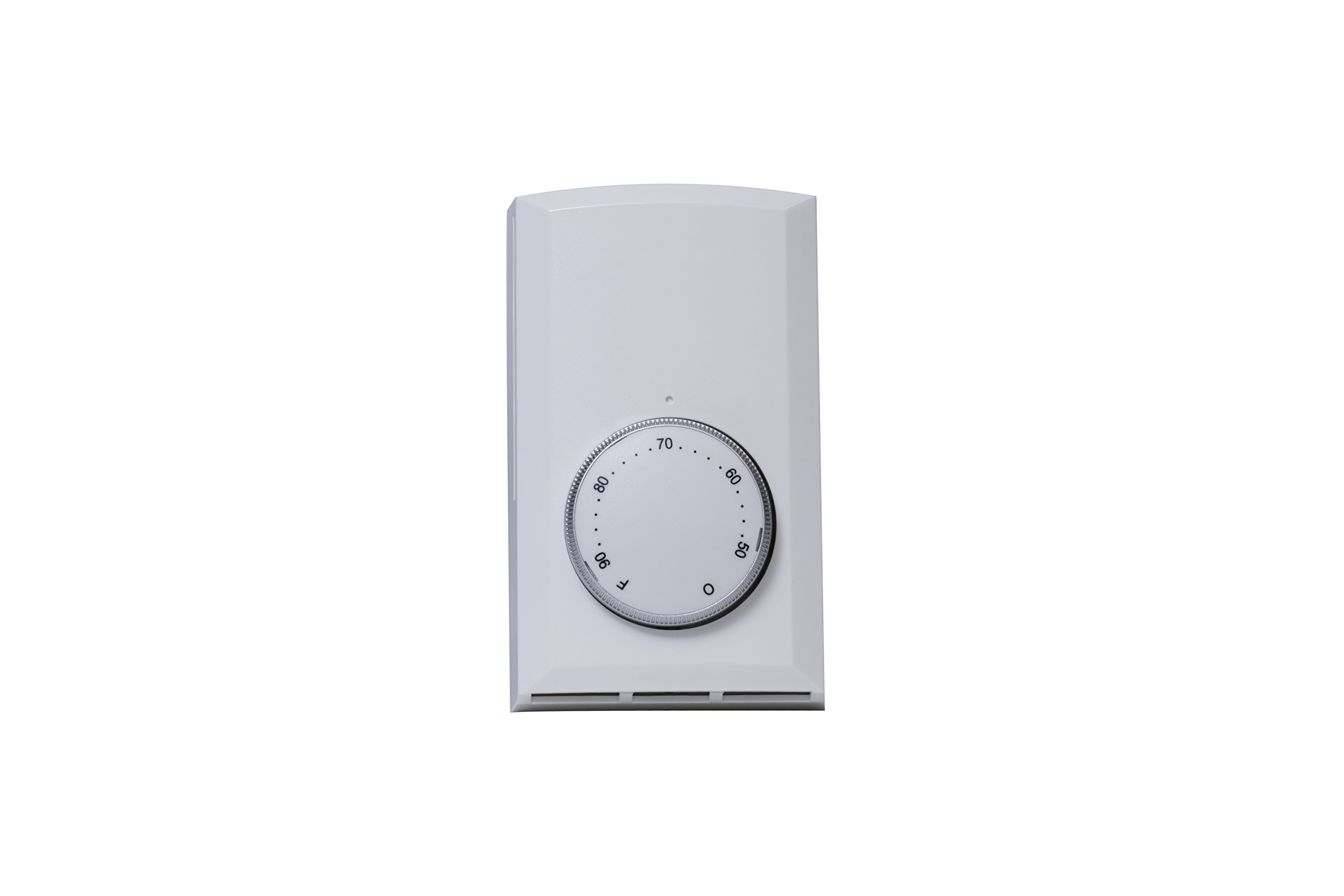
2. Cadet Double Pole Line Voltage Thermostat for Baseboard & Wall Heaters
A four-wire wall thermostat that carries up to 5,280 watts at 240 volts and never needs a battery.
This is the replacement you reach for when an old wall thermostat dies and you just want the same job done again. The double pole, four-wire design switches both legs of the circuit, and it handles up to 5,280 watts at 240 volts or 2,640 watts at 120 volts — enough for a serious heater load on one circuit. The twist dial runs a 40 to 80 degree Fahrenheit range with a 3 to 6 degree comfort band holding the room steady, plus a positive off position that kills the heater entirely.
Mechanically it is about as maintenance-free as a thermostat gets. There are no batteries to swap, no programming to lose after a power cut, and the bi-metal sensor with a snap-action switch keeps things simple. Buyers report swapping dead rheostats on the heater body for this wall unit and never looking back, and one put it plainly: “Four wire mechanical thermostat switch worked exactly the way intended for a 240 V baseboard heater.” Others just call it a good investment and note it is easy to read on the wall.
The honest catch is calibration. Temperature control is the one area buyers flag as the weak spot — you may end up setting the dial higher than the number suggests to hold a comfortable room. The white, non-programmable housing also reads basic and old-fashioned next to a digital unit, and there is no schedule to exploit a cheap overnight rate. It installs in a standard wall electrical box, so check your box depth before ordering.
Who it serves well: renters and owners replacing a dead wall thermostat in homes, apartments, offices, and workshops who want zero upkeep and a low entry cost.
Sized-down truth: it is a manual dial with no schedule, and the room temperature can drift from what the dial claims, so expect some trial and error on the setting.
Buy this if: you want a tough, no-battery mechanical wall thermostat that carries a heavy 22-amp circuit.
Move on if: you need programmable setbacks or you dislike dials that run a few degrees off.
3. Honeywell Home 5-2 Day Programmable Electric Baseboard Heat Thermostat
Silent triac switching and a ±0.15°C accuracy claim for bedrooms where a clicking relay drives you up the wall.
Set your weekday and weekend routines separately, and the unit handles the rest with no clicking as it cycles. The triac switching — a solid-state method that turns the heater on and off without a mechanical click — is the headline. Honeywell rates the accuracy at ± 0.15°C with baseboards and convectors, a precision number that translates to a room that barely wobbles overnight. A backlit display keeps the screen readable in a dark hallway, and a 2-wire non-polarized connection keeps the wiring job short.
Owners who have lived with it describe easy programming and a clean look on the wall, with several buying one and then ordering more for the rest of the house. The temporary override is handy for a cold snap without wiping your schedule. The load ceiling is 3,500 watts at 240 volts and 14.6 amps resistive, with a 2-amp minimum — check that your combined heater wattage sits inside that window before you commit.
Two things deserve a fair mention. First, it only works with line-voltage heating, so it is not an option for a gas or hydronic system. Second, a small number of units have failed badly on first power-up, and those accounts are alarming enough to take seriously — this is one install where you want the breaker off and a qualified hand on the wires if you are at all unsure. For the overwhelming majority, the unit simply works as described.
Right choice when: you want a silent, accurate, schedulable thermostat for a 240V baseboard or convector setup and can live within its 3,500-watt ceiling.
Not your pick if: you are wiring a gas or hydronic system, or you would rather not touch a live line-voltage circuit yourself.
4. Stelpro SWT1CC Line Voltage Thermostat, Mechanical 240 Volts

A compact commercial-grade dial that fits baseboards, wall fan heaters, and forced-air units alike.
Heating a workshop, greenhouse, or commercial space often means living with whatever thermostat the equipment came with — this Stelpro is built to cover more of those cases than most. It works with electric baseboards, wall fan heaters, and commercial fan-forced heaters on a 240V system, so it fits a wider range of heating products than a baseboard-only unit. The mechanical dial gives simple, precise adjustments, and the sleek molded-plastic body integrates neatly into any decor.
Size is the sleeper feature here. It measures 3.54 inches deep, 1.57 inches wide, and 7.87 inches tall — a good deal taller and narrower than the Cadet F series at 30 by 8 by 6 inches, which makes it easy to tuck into a tight wall spot where a broad plate would not sit clean. Owners describe the dial as smooth and the unit as working well from the start, with greenhouse users and commercial installers both reporting success in the same breath.
Because it is a mechanical knob with an analog scale, you will not get a digital readout or a schedule — this is a set-it-by-feel control, and the exact room temperature will depend on where the unit sits and how good the airflow is around it. One buyer who could not find specifications online noted the thermostat handles up to roughly ±5,000 watts. That is a helpful ballpark, but if your heater is near the top of that range, confirm the rating before you install.
what separates it: the narrow footprint and broad compatibility make it a strong fit for hard-to-heat spaces like greenhouses and workshops where the heater brand varies.
Who will want more: anyone who wants a temperature readout or programmable schedules — this is a purely mechanical dial.
Made for: commercial and workshop setups with wall fan or fan-forced heaters, or a baseboard in a spot that needs a slim profile.
skip it if: you want digital accuracy or a programmable schedule rather than a twist dial.
5. ELV4 Programmable Line Voltage Thermostat
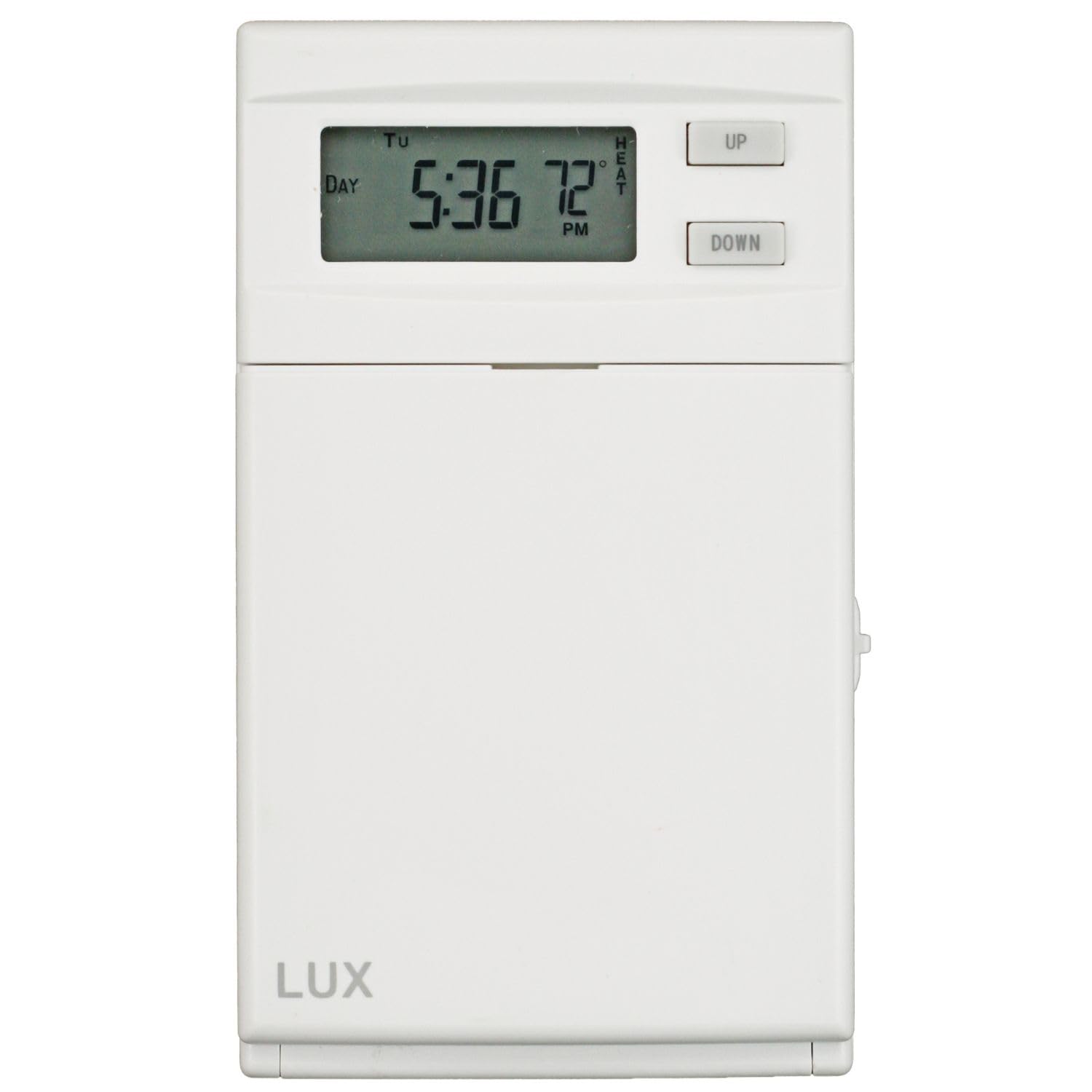
Four scheduling periods a day, separate weekday and weekend programs, and a battery door you reach from the front.
If your weekday and weekend routines look nothing alike, this is the thermostat that respects that. It gives you 4 program periods per day with separate programming for weekdays and weekends, programmed on screen with a backlit LCD. A temporary override lets you bump the temperature for an evening without rewriting your whole schedule, and front battery access means you can swap the two AA batteries without pulling the unit off the wall.
The UL approval covers the safety certification for the assembly. Owners who have run these for years describe accurate performance — one put it within 1°F — and praise how simple the install and setup are. Several have installed multiple units, and one replaced an aging system with a Cadet Com-Pak Twin 4000W paired to an ELV4, reporting satisfaction with the temperature hold, the temporary override, and the accuracy. As one long-time owner summed it up: “No issues, and highly recommended!”
There is one compatibility rule you must respect: this thermostat is not compatible with heating appliances that contain both an electric heating element and a blower fan, so a fan-forced heater is out. It also clicks audibly as the relay cycles — noticeable enough that light sleepers have mentioned it — and the two AA batteries are not included. For a straight baseboard or convector setup, none of that spoils the value.
What it gets right
- 4 scheduling periods per day with separate weekday and weekend programs
- Front battery access makes swaps easy without dismounting the unit
- Low-battery indicator and positive off switch built in
What to weigh
- Not for heaters that combine a resistive element with a blower fan
- The relay clicks audibly when it cycles — a factor in a bedroom
- Runs on AA batteries that are not supplied
Best for: baseboard and convector owners who want real scheduling with a low-battery warning and easy battery changes.
Look elsewhere if: you have a fan-forced heater on the circuit, or the room needs a silent cycle for a light sleeper.
6. KING K102 Double Pole Line Voltage Thermostat, 120-277V

A 120-277V double-pole dial with both Celsius and Fahrenheit scales printed on the face.
Few line-voltage thermostats cover the whole 120-277V spread, and that range is the reason to look here if your heater runs at an unusual voltage. The bi-metal mechanical sensing element tracks temperature from 41° to 90°F (3° to 32°C), with °C and °F control dials both printed so you never have to convert in your head. The improved accuracy spec is stated as ±3°F (1.6°C), and the unit installs inline with an off position for a full shutdown.
Build quality is what most people notice first, with owners describing top-notch fit, finish, and materials and a smooth, precise dial. It is a solid pick for radiant ceiling and wall heat as well as baseboards, and the beveled white face suits most decors. If you already run KING equipment, swapping like for like is straightforward — one owner simply wired up a same-brand replacement and had it running immediately.
The caveats are worth knowing up front. There is no ground wire by design, which some owners find disconcerting even when it is legal for the application, and the dial can read a few degrees off against a nearby wall thermometer — a gap within the documented margin of error. The cover is the most-discussed gripe: it snaps on without a screw, and some worry it could pop loose. A small number of units have also failed well inside their wear cycle, so treat a wildly hot room after a couple of months as a signal to return it.
A fit for: KING-system owners and anyone heating a space that needs the wide 120-277V range with a mechanical dial.
Think twice if: you want a screw-secured faceplate or a grounded three-wire connection — this one offers neither.
7. meross Smart Thermostat for Electric Baseboard and in-Wall Heaters
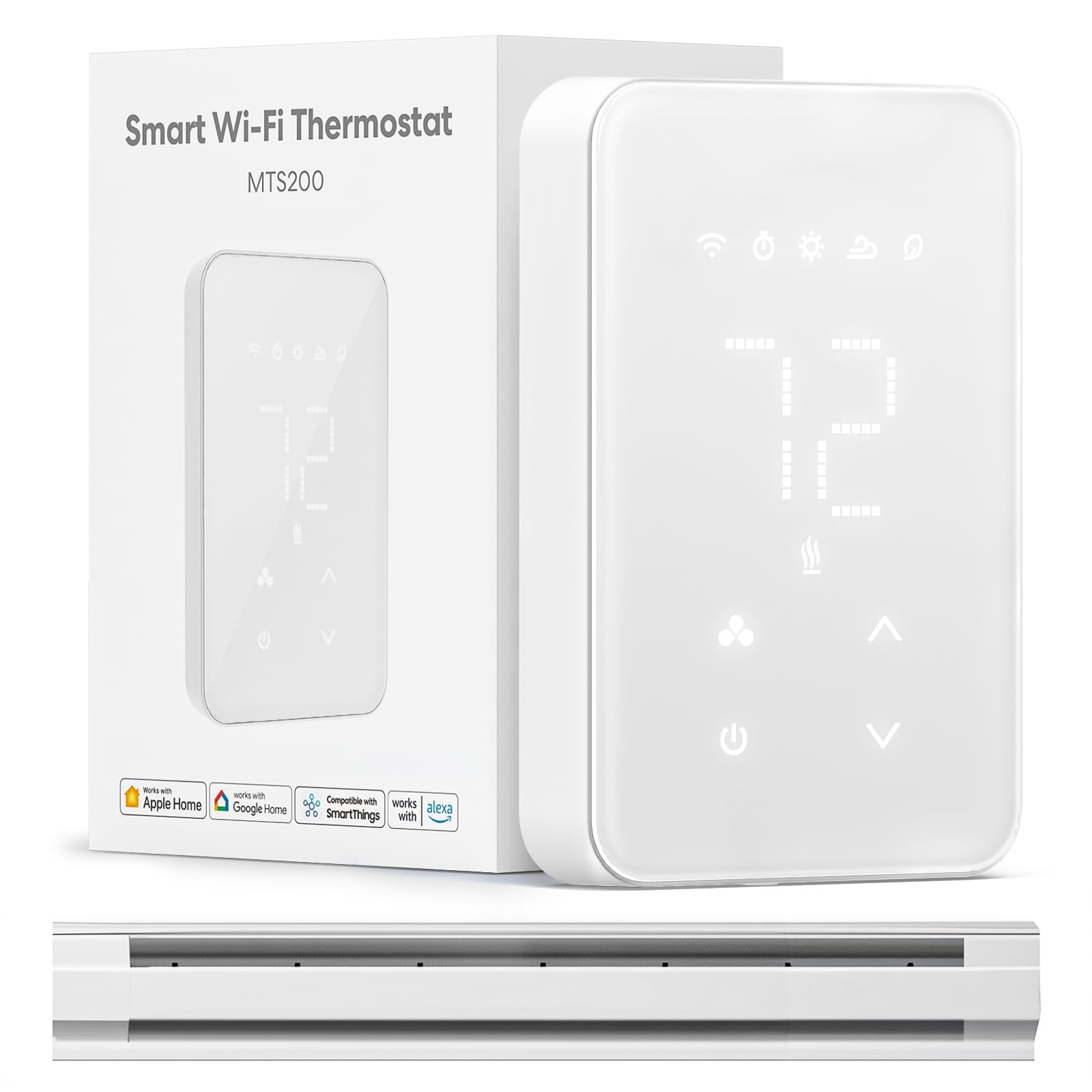
A voice-controlled Wi-Fi unit that speaks HomeKit, Alexa, and Google — and monitors your heating wattage.
Want to warm a room before you get home and check the temperature from your phone? This meross is built for that. It works with Apple Home, Alexa, Google Home, and SmartThings, and it uses Siri, Alexa, or Google voice commands so you can change the temperature without walking over. The 7×24-hour graphic schedule lives in the Meross app, and the internal electricity meter feeds real-time and historical power reports straight back to you.
Two features stand out for anyone paying attention to bills: open window detection, which stops heating for a while when a window opens, and summer mode for systems that also cool. Power-off memory holds your settings through an outage, and the advertised install time is under 30 minutes. The catch on wiring is real, though — it needs 4 or more wires in the electric box to install, so a two-wire box simply will not work. It carries a maximum output of 16A, 1920W at 120V, and 3840W at 240V, and holds temperature within 1°F across a 41°F-95°F range.
The app earns most of the praise — buyers call it friendly and describe pairing as intuitive, even on homes with old wiring conventions. The bright LCD is readable across a room, and one owner in a vacation home loved being able to wake the dark display with a touch and adjust the heat before and after trips. The most-discussed frustration is connectivity: it runs on 2.4GHz Wi-Fi only, and a combined band SSID can stall setup until you disable the 5GHz band. Do that and most pairing headaches vanish.
Why it earns a smart spot
- Works with HomeKit, Alexa, Google Home, and SmartThings, including voice control
- Internal electricity meter reports real-time and historical power use in the app
- Handles up to 16A and 3840W at 240V with 1°F accuracy
What to plan around
- Open window detection cuts heating automatically when a window opens
- Requires 4 or more wires in the box — no two-wire installs
- 2.4GHz Wi-Fi only, so a combined band network needs splitting first
Best for: smart-home households with 4-wire boxes who want voice control, energy tracking, and remote temperature changes.
Not for: older two-wire wiring or anyone unwilling to split a combined 2.4GHz/5GHz Wi-Fi network.
8. Aube by Honeywell Home TH106 Electric Heating 7-Day Programmable Thermostat

TRIAC switching cycles the element every 15 seconds to hold a room within a degree — and it does it in silence.
If your current thermostat lets the room swing several degrees, this is the unit built to flatten that curve. The TRIAC silent switching (a solid-state method with no relay to click) cycles the heater on a tight 15-second rhythm rather than a long on-off lurch, so the temperature barely moves. It runs on 2 wires and SPST with ratings of 2,000W at 120V and 4,000W at 240V, both at 16.7 amps resistive, and battery-free backup means a power outage will not wipe your schedule.
Owners who switched over from bi-metal thermostats describe a marked change — a large room that took hours to warm now does it far faster, and the steady cycling reduces the element clicking that used to be constant. The programmable day/night feature is easy to set, and a 7-day schedule lets you dial in different temperatures for different times. For a single-pole replacement on a big 240V heater, this is among the most capable options around.
Set expectations on the display: there is no backlight, and the programming buttons sit behind a flap, which a few buyers find fiddly. It also carries a 2-amp minimum load, and it is not code-compliant for new construction wiring in some jurisdictions — check your local rules before you buy. A handful of units have shown electrostatic “smoke stains” on the wall from airflow over an internal resistor, which is not a fire but will need cleaning.
The real draw: near-flat temperature control and zero relay noise from a 16.7-amp, 4,000-watt-capable unit with no battery to feed.
The honest trade: no backlight, buttons tucked behind a flap, and a 2-amp minimum that rules out very small loads.
Pick it for: a single-pole 240V baseboard, convector, or radiant ceiling that needs rock-steady heat and silent operation.
Pass if: you are roughing in new construction wiring or you want a lit display for nighttime button pushes.
9. Mysa Smart Thermostat LITE for Electric Baseboard Heaters
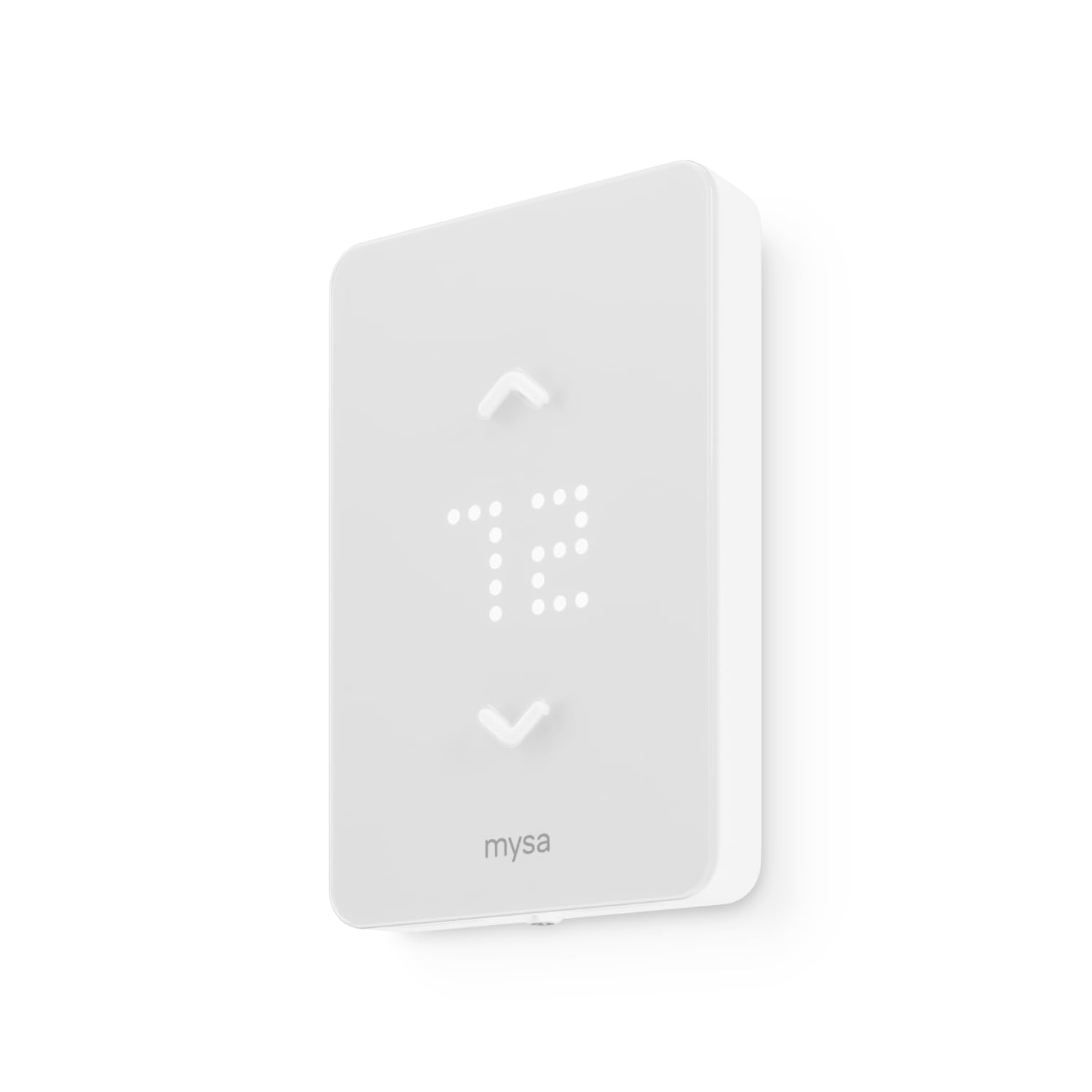
A no-hub Wi-Fi thermostat for garages and guest rooms, with a free app and no monthly fees.
Rooms you forget about — a garage, a sunroom, an in-law suite — are where remote control earns its keep. Mysa connects straight to your home Wi-Fi with no hub required, so you can watch and adjust the temperature from your couch or from another state. It works with Apple HomeKit, Amazon Alexa, and Google Home for voice control, and it supports 120V, 208V, and 240V heaters plus both single-pole and double-pole configurations.
The app carries the experience. Scheduling cuts heat when you are away and warms the house before you return, and Mysa’s published figure for that is up to 26% off heating costs. A monthly per-room runtime report emails you which spaces drew the most energy, and everything — scheduling, remote control, voice control, runtime reports — stays free with no subscriptions or paywalls. The install guide walks you wire by wire, and Mysa says most homes need no electrician, though it does require 4 wires (a neutral or second live wire), so check your existing box before ordering.
Owners used to the low-voltage smart thermostats on the market will appreciate that Mysa handles line-voltage baseboard heat at all — that is the limitation most smart thermostats share. The one concern buyers flag is wireless connectivity during setup, so a stable 2.4GHz network helps. The build quality reads solid rather than cheap, and the 5-year warranty plus free lifetime app access covers the unit if anything goes wrong down the line.
Where it shines
- Connects directly to Wi-Fi with no hub, and the app is free with no subscriptions
- Works with HomeKit, Alexa, and Google Home for voice control
- Supports 120V, 208V, and 240V with single- and double-pole wiring
Worth knowing
- Needs 4 wires in the box — a neutral or second live wire is required
- Connectivity during setup can be fussy on a weak Wi-Fi signal
Ideal for: Airbnb hosts, garage and workshop owners, and anyone who wants app and voice control without a monthly fee.
Check first if: your box only has two wires, or your Wi-Fi signal barely reaches the room you plan to heat.
Understanding the Specs
Line Voltage
Baseboard heaters run on line voltage — 120V, 208V, or 240V — which means your full household current runs through the thermostat to the heater. That is why a normal low-voltage thermostat for a gas furnace will not work here; it operates on a different voltage entirely. When you shop, match the thermostat’s stated voltage to your heater’s label. A 240V unit usually also works at 120V if the amperage rating still covers your load, but always confirm both numbers before installing.
Amperage and Wattage
The amperage rating tells you how much current the thermostat can switch without overheating. Watts measure the actual heating load; the two are linked by voltage, so a 22-amp thermostat at 240 volts carries a heavier load than a 16-amp one. Add up the total wattage of every heater on the circuit and pick a thermostat rated above that figure. Running a thermostat near its ceiling for hours is exactly how units fail early.
Single Pole vs Double Pole
A single-pole thermostat breaks one wire when it cycles off; a double-pole unit breaks both. On a 240V circuit, double-pole is the safer choice because it fully de-energizes the heater, including the wiring beyond the thermostat. If you are upgrading an older single-pole setup, converting to double-pole gives you a complete shutoff rather than leaving one leg live. Always kill the breaker at the panel before you touch any of these wires.
Mechanical vs Programmable
A mechanical dial is the simplest control — a bi-metal sensor opens and closes the circuit as the room warms and cools, with no battery or display. A programmable or smart thermostat uses an electronic sensor and lets you set different temperatures for different times of day, which usually saves money in rooms that sit empty. Mechanical units are cheaper and last longer; digital units give you accuracy and scheduling. Match the control to how you actually use the room.
FAQ
Will a baseboard heater thermostat work with my heater?
Can I install a baseboard thermostat myself?
What is the difference between single pole and double pole thermostats?
Do I need a smart thermostat for baseboard heating?
Why does my thermostat click when the heater turns on?
How many watts can a baseboard thermostat handle?
Will a programmable thermostat save money on electric heat?
Do line voltage thermostats need batteries?
Can one thermostat control more than one baseboard heater?
Is a mechanical dial less accurate than a digital thermostat?
Final Thoughts: The Verdict
For the majority of shoppers, the baseboard heater thermostat winner is the Cadet F Series BTF2W, because it mounts straight onto a Cadet F series heater with no extra wiring and turns the temperature with one clear dial. If you want silent, accurate scheduling, reach for the Honeywell Home RLV4305, which cycles without a click across a 3,500-watt ceiling. And for app and voice control on a high-voltage baseboard circuit, the meross Smart Thermostat is the one to grab. Whichever you pick, match the voltage, pole count, and total wattage to your heaters first — get those three right and the install is straightforward.
How We Picked
We do not accept paid placement. Every pick is matched to a real buyer and a real use-case; we do not hands-on test units.
Sources & Methodology
Specifications: manufacturer listings and product documentation. Review insights: verified customer reviews, as of September 2026. Pricing: not shown on this page (it changes often); check the current price via the retailer link.
As an Amazon Associate, KitchPrep earns from qualifying purchases. This does not affect which products we feature.
Related Guides
