
Specs are compiled from manufacturer listings and verified buyer reviews and can change over time — please confirm the key details on the product page before buying.
The scariest moment in homeownership is standing in a dark basement during a storm, listening for a pump that has stopped running. A backup sump pump system exists for exactly that moment — it kicks in when the power dies or your primary pump jams, so water never gets past the pit. This guide walks you through 11 real backup systems, from battery-powered rigs that handle thousands of gallons on a single charge to a water-powered unit that needs no battery at all.
I’m Mohammad Maruf — the founder and writer behind KitchPrep. This guide is built by comparing the manufacturers’ published specifications and the patterns across verified customer reviews, so you get each pick’s real strengths and trade-offs instead of marketing spin.
You do not need to understand amps (a measure of electrical current), float switches (a sensor that turns the pump on when water lifts it), or head pressure (the vertical height the pump must push water against) to pick the right one. You only need to know whether your pit is wide or narrow, whether your power cuts often, and if you want a full combo kit or a standalone backup pump. The right back up sump pump system is the one that still runs when the power is out.
Our Picks at a Glance


How To Choose The Best Back Up Sump Pump System
Choosing a backup pump is less about brand loyalty and more about three physical facts: how much water arrives at your pit, how high it must be lifted, and how wide your basin is. Get those three right and almost any system on this list will keep your floor dry. Get them wrong and even a strong pump will struggle.
Battery backup or water-powered backup
A battery system stores energy in a deep-cycle battery and uses it to run a 12-volt DC pump when the household current dies. These work during any outage, but the battery needs charging maintenance and eventually replacement. A water-powered backup uses your municipal water pressure instead of a battery, so it never runs flat — as long as the town water supply is still flowing during the storm. If your neighborhood floods and loses power at the same time, water pressure usually stays on.
Match the pump to your sump basin
Preassembled combo systems often need a wide basin. The Wayne combo fits a basin 16 inches across or larger, while the Basement Watchdog Special CONNECT is built for narrow pits. Measure your basin diameter before you buy anything — a pump that does not fit costs you a return shipping label and another weekend.
Think about head height, not just flow
Head height is the vertical distance the pump must push water to reach the discharge pipe outside your house. A pump rated at 25 feet of lift handles a tall basement; a pump rated at 10 feet is meant for a shallow run. Flow drops as head rises, so read the rating at the height closest to your actual installation.
Quick Comparison
| Model | Best For | Flow Rate | Horsepower | Max Lift | Amazon |
|---|---|---|---|---|---|
| Wayne WSS30VN Combo★ Best Overall | Whole-basement protection | 85 GPM | 1/2 HP | — | Amazon |
| Basement Sentry STBB100Compact Pick | Tight-budget add-on | 29 GPM | — | — | Amazon |
| Basement Watchdog Special CONNECTTight-Pit Specialist | Narrow sump pits | 8.33 GPM | 1/4 HP | 10 ft | Amazon |
| Zoeller 507-0005 | Adding a backup pump | — | — | — | Amazon |
| Wayne ESP25n | Long outage endurance | 45 GPM | — | 10 ft | Amazon |
| Liberty Pumps 441 | Fast 12-volt output | — | — | — | Amazon |
| Basepump RB750-EZ | No-battery solution | 15 GPM | — | 15 ft | Amazon |
| Basement Watchdog CITE-33 | Full monitoring combo | 73.3 GPM | 1/3 HP | 10 ft | Amazon |
| Zoeller 508 Aquanot | Quiet integrated install | 40 GPM | 1/3 HP | — | Amazon |
| Superior Pump 92911 | Tall pipe runs | — | 1/2 HP | 25 ft | Amazon |
| Westinghouse WH50BBU | Small pits, big lift | 87 GPM | 1/2 HP | 30 ft | Amazon |
In‑Depth Reviews
1. Wayne Preassembled Primary & Battery Backup Sump Pump Combo System
Our pick — over 4.5★ from 800+ verified ratings; the strongest balance of quality and price.
The preassembled Wayne combo that drops into a 16-inch basin and pumps 85 gallons a minute.
If your basement has flooded before and you never want to mop it again, this is the system to start with. Both the primary and the backup pump arrive already wired and plumbed together, so you drop the whole assembly into a basin 16 inches across or larger and connect one discharge pipe. Reviewers consistently finish the job in about 15 minutes. The primary side is a 1/2 HP AC pump rated at 85 GPM — that is more than ten times the flow of the Basement Watchdog Special CONNECT’s 8.33 GPM, and it empties a standard pit in seconds.
The backup half is what earns this pick its place. It runs on a 12-volt battery you buy separately, and it will move up to 10,000 gallons on a single charge — enough to keep your basement dry through a long outage. Buyers report the DC backup excels — one described emptying an 18″x30″ sump in about 30 seconds against 7 feet of head (the vertical height it pushes water), then running all day and night on a 100Ah AGM battery (a sealed lead-acid battery rated at 100 amp-hours) during a 4-inch rain, cycling every three minutes. The whole unit has been cycle-tested to 1 million runs, and Wayne warrants it for three years. It is also assembled in the USA.
What wins people over is how quiet the thing is for its power — the primary motor runs near whisper level even under heavy spring inflow. The recurring gripe is the plastic-and-rubber check valve, which shows up as a small leak that usually tightens away with a wrench. One longer-term owner also found the backup only activates when the wall-mounted control box has power, and Wayne replaced the control box under warranty when it failed. Durability and battery life both land as mixed in owner feedback, with most complaints tracing back to batteries that were never maintained. The unit weighs 44 pounds and has a large base, so measure your basin first.
Where it earns its keep
- Preassembled and preplumbed — under-15-minute drop-in for a 16″ or larger basin
- 85 GPM primary flow, the highest on this list and more than ten times the Watchdog Special’s 8.33 GPM
- Backup moves up to 10,000 gallons on one battery charge, with owners reporting all-day and all-night runs
- Cycle-tested to 1 million runs and backed by a 3-year manufacturer warranty
What to weigh first
- Battery is sold separately — the Wayne WSB1275 75 AH is the required match
- The supplied check valve has multiple plastic and rubber joints that can weep
- At 44 pounds with a wide base, it barely fits an 18-inch pit
- Backup needs the control box powered to fire, so a dead wall circuit stops the safety net
Straight answer: the best all-in-one for anyone replacing a bare primary pump and wanting two layers of flood defense in a single drop-in.
Think twice: if you only have a narrow 12-inch crock, this base will not seat — the Basement Watchdog Special CONNECT is the small-pit pick instead.
2. Basement Sentry Automatic Emergency Backup Sump Pump System (12V Battery Powered)
A 9.9-pound add-on pump that squeezes into a pit that already has a primary at work.
If you already own a working 115-volt primary pump and simply want a second line of defense beside it, this is the lightest way to get there. The kit includes the 12-volt pump, the controller, an alarm, a battery charger, a float switch, and a battery box. You supply the deep-cycle battery.
Installation is the part owners rave about most — it goes in alongside the main pump and the instructions are detailed enough for a first-timer. The 29 GPM flow rate is honest about its role: it maintains the water level during an outage rather than racing your primary. That is exactly what a backup should do. The polypropylene and stainless-steel body resists rust far better than a cast-iron housing would in a damp pit.
The weak point is the rubber couplings that join the pump to your PVC discharge. The rubber couplings that join the pump to your PVC discharge (the pipe that carries water away) are the weak link — one buyer described them as junk that both failed at two years, and that same owner had the green “OK” light die as well. Add a check valve (a one-way valve that stops water flowing back) close to the pump discharge and the gurgling noise when the main pump shuts off disappears. This is a fit-first purchase: it suits a homeowner who already has a primary pump and wants cheap insurance, not someone building a system from scratch.
Smallest footprint here: at 9.9 pounds versus 44 pounds for the Wayne combo, it is the pump you can install alone in a tight pit.
Watch the joints: the rubber-to-PVC couplings are the one part owners keep replacing, so keep a spare on the shelf.
Right for you if: your primary pump works fine and you just want a light, inexpensive second pump next to it.
Pass if: you need a complete primary-plus-backup kit — this only adds the backup half and assumes a 115-volt pump is already in the pit.
3. The Basement Watchdog Special CONNECT Battery Backup Sump Pump System
A 9-inch-wide backup pump built for narrow pits the big combos cannot enter.
Some sump pits are simply too small for a full combo, and this is the pump that solves that. The Watcdog Special CONNECT measures just 9″L x 5″W x 7.63″H — roughly half the footprint of the Wayne combo, which occupies 13.5″L x 9″W x 15.5″H. It is also much lighter at 12 pounds against the Wayne’s 44. The 1/4 HP copper-wound motor pushes 2,500 GPH at zero feet of lift and holds 1,730 GPH with 10 feet of head, so it keeps up even on a tall discharge run.
The control panel is where this pump feels genuinely smart. A sensor monitors the battery fluid level and the panel lights up with plain-language guidance instead of a cryptic beep. Owners add the optional Wi-Fi module and get email or text alerts for power loss, pump runs, and high water — one long-time user runs exactly that setup. The pump’s history speaks for itself: a buyer who had run the same model for eight years replaced it with another one. Copper-wound motors typically outlast cheaper windings, and the thermoplastic housing will not corrode the way cast iron does in a wet pit.
The 8.33 GPM rating (gallons per minute) is far lower than the Wayne combo’s 85 GPM, but that number reflects a compact backup filling a different job — it maintains level during an outage, not racing to empty a pit that a 1/2 HP primary should be handling. Two things to budget for honestly: the battery is sold separately, and the Wi-Fi alerts are one-way only, so you get notified but cannot trigger the pump from your phone. Owners mention the battery itself needs distilled water roughly every six months and replacing at three to four years.
Why small-pit owners choose it
- At 9″L x 5″W x 7.63″H it fits pits where the Wayne combo will not go
- Copper-wound motor rated 2,500 GPH at 0 ft and 1,730 GPH at 10 ft
- Fluid-level sensor plus a lit, plain-language control panel guide you through maintenance
- One owner ran the same model for eight years before simply replacing it
Points worth knowing
- Battery is not included, so add the cost of a deep-cycle unit
- Wi-Fi alerts are one-way — you get notified but cannot control anything remotely
- Lead-acid batteries need distilled water every six months and replacement every three to four years
Choose it when: your basin is narrow and you want remote alerts about power loss.
Look elsewhere if: you need higher real-world flow — this is a maintenance-level backup, not a primary replacement.
4. Zoeller 507-0005 Basement Sentry Battery Backup Pump

A fully solid-state controller with a built-in 10-amp charger and a self-managing battery box.
Zoeller’s standby backup is the pump for a homeowner who wants zero fuss on the charging side. The control box handles battery burn-out and overcharge protection automatically, and the 10-amp onboard charger tops up the battery without you thinking about it. The battery case is molded from noncorrosive polyethylene and includes a locking strap. A low-voltage float switch triggers the pump, and a solid-state controller with alarms and light indicators tells you exactly what is happening.
Owners upgrading from an older Zoeller backup describe the redesigned charger as smaller, with a front-facing display and text-alert capability. The plastic body sidesteps the rust problem that eventually finishes off cast-iron housings. Installation is straightforward enough for a novice — one buyer hand-cut PVC with a hacksaw following YouTube videos and had it running the same weekend.
The main caveat concerns the supplied hardware. The included check valve is on the cheap side, and several owners swapped it for a quieter aftermarket unit to kill water hammer. One installation note worth heeding: do not drill a weep hole below the main check valve, or water will spray everywhere — a screw plug fixes it. The pump manages roughly 8 feet of lift, so during a serious outage it can only maintain the water level rather than lower it, which matters if you are away during a heavy storm. Zoeller’s own support drew a rare sharp complaint, but the product itself keeps owners satisfied.
Set-and-check design: integrated overcharge protection and a polyethylene battery case mean the only routine job is glancing at the alarm lights.
Real limit: with about 8 feet of achievable lift, the pump holds water steady during an outage but will not drain a rapidly filling pit.
Pick it if: you want Zoeller’s solid-state reliability and prefer the pump to manage its own charging.
skip it if: you need to actually lower water level during sustained rain, not just hold the line.
5. WAYNE ESP25n 12-Volt Battery Back Up Sump Pump
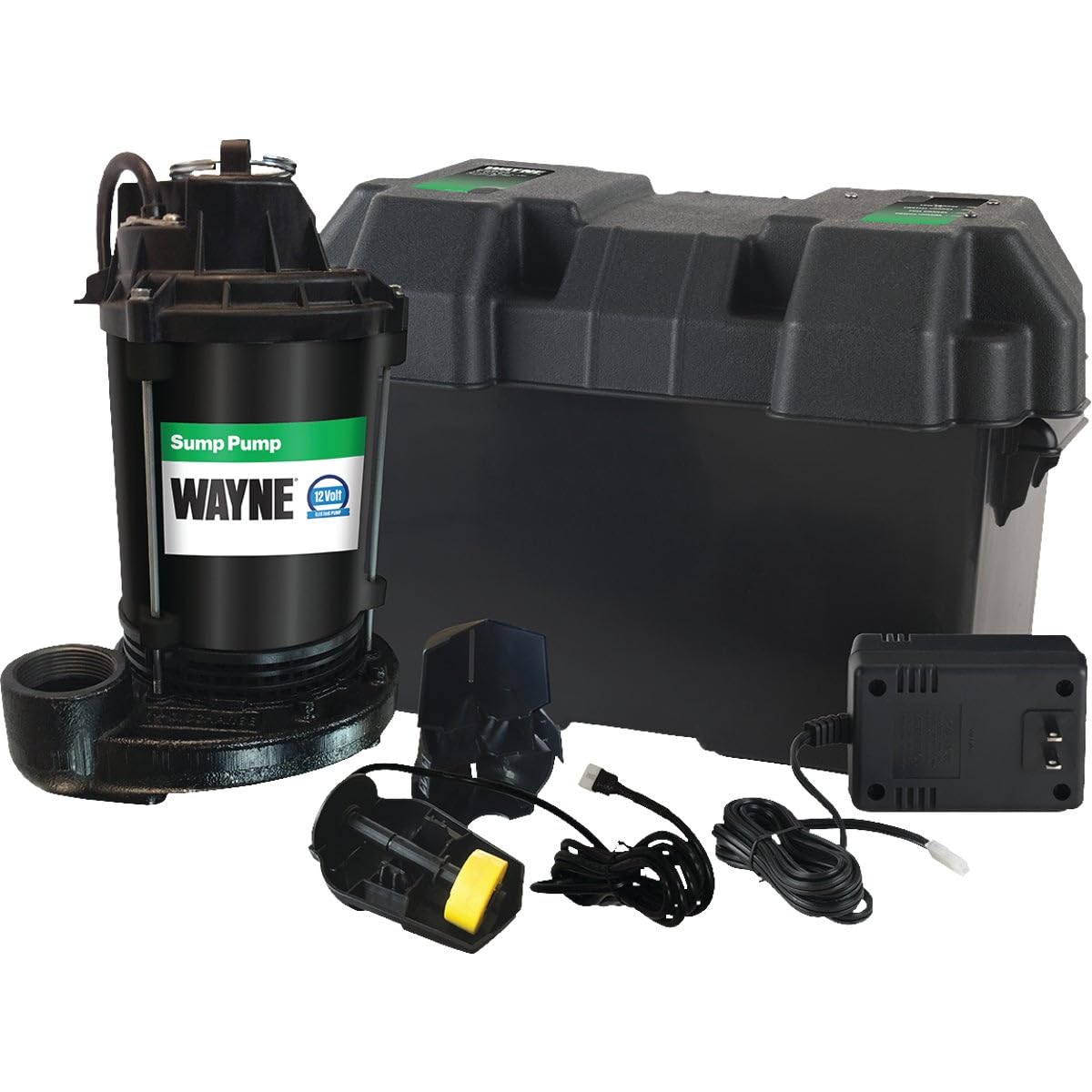
A 45 GPM backup that runs for days when the storm knocks your grid offline.
Wayne’s standalone backup is the pump to pick when you want endurance above all else. It pumps up to 2,700 GPH and removes as much as 10,000 gallons on a single charge, which means it can keep working through a multi-day outage instead of tapping out after one night. It fits a 14-inch or larger basin with no weep hole required, and the body is epoxy-coated steel over a cast-iron base with a corrosion-resistant thermoplastic impeller. The battery box carries its own LED display and audible alarm. Warranty runs two years.
Owners routinely pair it with a large marine or AGM battery and describe running the backup pump alone with the primary unplugged, watching it keep pace with incoming water. The redesigned unit is genuinely improved over the previous ESP25 — one buyer replaced a nine-year-old predecessor that was still operational, treating the swap as preventive maintenance. The 10-foot max lift covers a typical basement discharge.
The charger holds a fixed voltage instead of dropping to a float stage. It holds a fixed voltage rather than dropping to a float stage, so an expensive sealed AGM or gel battery will not survive as long as it should on the stock charger. A buyer who traced the voltage behavior reported exactly that and ended up buying a separate multi-stage charger. Owners get around it by running flooded deep-cycle batteries and topping up the water, or by adding their own charger. The lid of the battery box also just rests rather than locking, a small annoyance rather than a real problem.
Why it lasts through storms
- Up to 2,700 GPH and 10,000 gallons evacuated per charge — customers note running it for days
- Epoxy-coated steel housing over a cast-iron base with a corrosion-resistant thermoplastic impeller
- Fits a 14-inch or larger basin with no weep hole drilling needed
- Battery box carries an LED display and an audible alarm for pump runs and power failure
What owners work around
- Fixed-voltage charger can shorten the life of sealed AGM and gel batteries
- Battery box lid rests in place rather than snapping shut
- Deep-cycle battery and the Wayne WSB1275 75 AH unit are both sold separately
Your pump if: outages in your area stretch for days and you need a backup that will still be running on the last night.
Consider the trade-off if: you plan to run an expensive sealed AGM battery — you will want a dedicated multi-stage charger alongside it.
6. Liberty Pumps 441 Battery Back-Up Emergency Sump Pump System

A submersible 12-volt pump that pushes water almost as fast as a full AC unit.
Liberty builds this backup around a high-output 12-volt submersible pump, and the output surprises people. Owners pairing it with a 27M Interstate battery from a warehouse club report it moves water nearly as fast as a 120-volt Zoeller primary — rare for a battery-powered unit. The kit includes the pump, an automatic mercury-free switch, a control panel, a battery box, and a 12-volt charger. The battery itself is separate. At 13 pounds and 10″L x 10″W x 13″H, it fits an 18-inch basin with a primary pump beside it.
Installation instructions are detailed enough that one buyer tested it with a deep-cycle boat battery and then left it idle for 21 months. When torrential rain hit, the pump ran flawlessly for 2.5 hours right alongside the primary pump and kept the basement dry. That kind of dormant-then-delivered performance is exactly what a backup is for.
The build feel is the trade-off worth flagging. The pump body feels light and the controller housing can arrive damaged in shipping, so inspect the box on delivery. In an 18-inch basin the fit is tight, and there is no pump support bracket in the box — one owner built a PVC stand instead. The alarm is loud when the pump activates, which is helpful if you want to know immediately but might annoy light sleepers, though a silent mode is available. The submersible design keeps the motor under the waterline where it stays cool.
Watch-it-in-action reliability: after almost two years sitting idle, the pump ran 2.5 hours without a hiccup during a violent storm.
Inspect before you install: check the controller housing on arrival and plan for a support stand if your basin is 18 inches.
Suits you when: you want genuine 12-volt output speed and a mercury-free switch, and you are comfortable making small tweaks to the install.
Rethink if: your basin leaves no room for improvising a stand — the pump needs a flat, stable seat to run well.
7. RB750-EZ Premium Water Powered Backup Sump Pump System
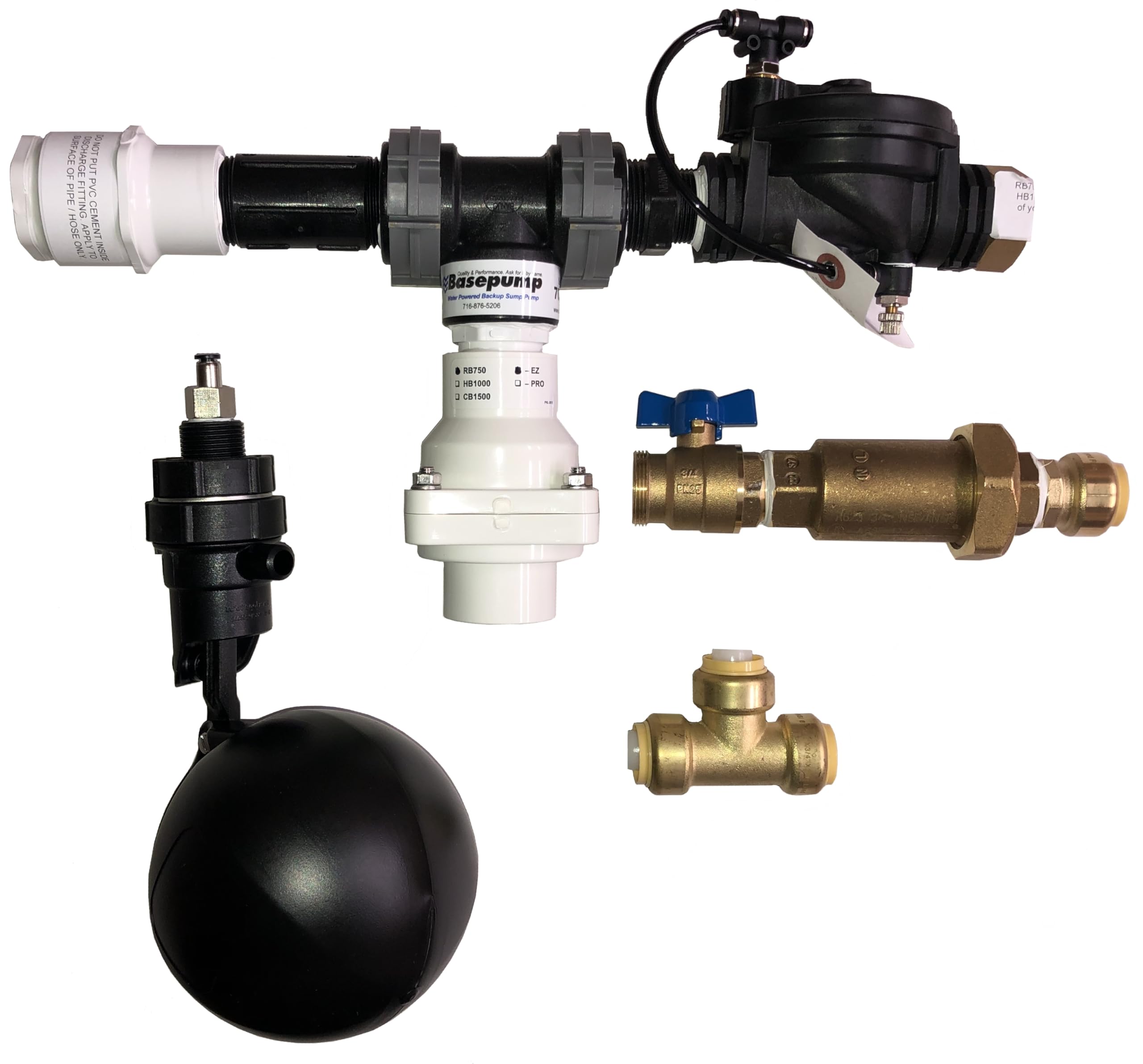
A backup that runs on municipal water pressure instead of a battery, so there is nothing to charge.
This is the answer for anyone who is tired of battery maintenance entirely. The RB750-EZ needs no electricity, no battery, no charger, and no generator. Water from your municipal supply flows through an internal venturi — a narrow channel that speeds the water up and creates suction — and that suction pulls water out of your sump pit. As long as the town water keeps flowing, this pump works. It delivers up to 15 gallons per minute and lifts water as high as 15 feet. At 6 pounds, it hangs from the ceiling on your discharge pipe rather than sitting in the pit.
Installation is the thing owners praise most, and most non-plumbers finish it in three to four hours. There is one important detail: check your water pressure before you buy. Several buyers who skipped that step wished they had, because they would have gone with the higher-output version if they had known their PSI reading. At 50 PSI it runs fine with no adjustment needed. The unit pairs cleanly with a radon mitigation cover, since everything drops through a single PVC pipe.
The trade-off is speed: it removes 14 inches of water in roughly 50 seconds. It removes 14 inches of water in roughly 50 seconds, which is fine for maintaining a level but slower than a battery pump racing a fast-rising pit. You also need a dedicated discharge line in most setups, and local plumbing codes may require a licensed plumber. A few owners saw trace leakage at internal valve fittings that stopped after disassembly and a tighten. Leakage lands as mixed in the owner feedback, so plan on a dry-fit test before final assembly.
The case for water power
- No battery, charger, or electricity — nothing to replace or top up
- Delivers up to 15 GPM and lifts water up to 15 feet
- At 6 pounds it mounts to the ceiling, freeing the pit for the primary pump
- Includes an 85 dB high-water alarm and pairs with radon mitigation covers
Before you commit
- Requires adequate municipal water pressure — check your PSI first
- Most installations want a dedicated discharge line, and codes may require a plumber
- Pumps slower than a strong battery unit — better for holding level than fast draining
- Some units arrive with minor leaks at internal valve fittings until tightened
Built for you if: you want zero battery maintenance and your town water stays on during storms.
Know your limit: this pump cannot run on a private well if the power cuts the well pump too — a battery system is safer there.
8. The Basement Watchdog Combo Preassembled Primary & Battery Backup Sump Pump System (CITE-33)

A preplumbed combo with a 24-hour monitoring brain that never stops watching the pit.
Watchdog’s flagship combo arrives preassembled and preplumbed, so there is no cutting or gluing on install day. Both the primary and the backup sit on dual float switches — the company describes that as 4x the protection, meaning two floats per pump instead of one. The primary is an energy-efficient 1/3 HP copper-wound PSC motor rated at 62 GPM (3,720 GPH) at zero lift and 51 GPM (3,100 GPH) at 10 feet. The backup adds 42 GPM (2,500 GPH) at zero lift and 25 GPM (1,500 GPH) at 10 feet, and provides days of intermittent pumping on one charge. A monitoring controller runs 24 hours a day with diagnostics, lights, alarms, and a test button.
The compact design fits pits as narrow as 12 inches across, which is tighter than the Wayne combo’s 16-inch requirement. Weight runs 27 pounds, comfortably between the lightweight add-ons and the heavy 44-pound combo. Owners who live with recurring water report the preassembled setup saving them a hardware store run — one described dry floors after spring melt in a basement that used to take on 6 inches of water twice a year.
Two honest friction points. The main pump plug is bulky and can block the second plug on a standard duplex or 4-gang outlet, so buy a 6-way adapter. And durability is genuinely mixed — a working unit can serve four to five years, but a small number of units failed early with a main pump bearing, and an intake clogged by rocks and dirt without a protective tray underneath. Put a rubber pan under the intake if your pit collects grit.
Brain included: the 24-hour monitoring controller with diagnostics, floats, and a test button is the feature that keeps you informed before water becomes a problem.
Plug math: two chunky plugs and one outlet rarely coexist — plan on a multi-way adapter.
Suits you when: you want 4x float protection and preplumbed simplicity in a pit smaller than 16 inches.
Consider the trade: a small number of units failed early with a bearing issue, so keep the ~3-year warranty paperwork handy.
9. Zoeller 508-0005 Aquanot 508 Battery Back-Up System
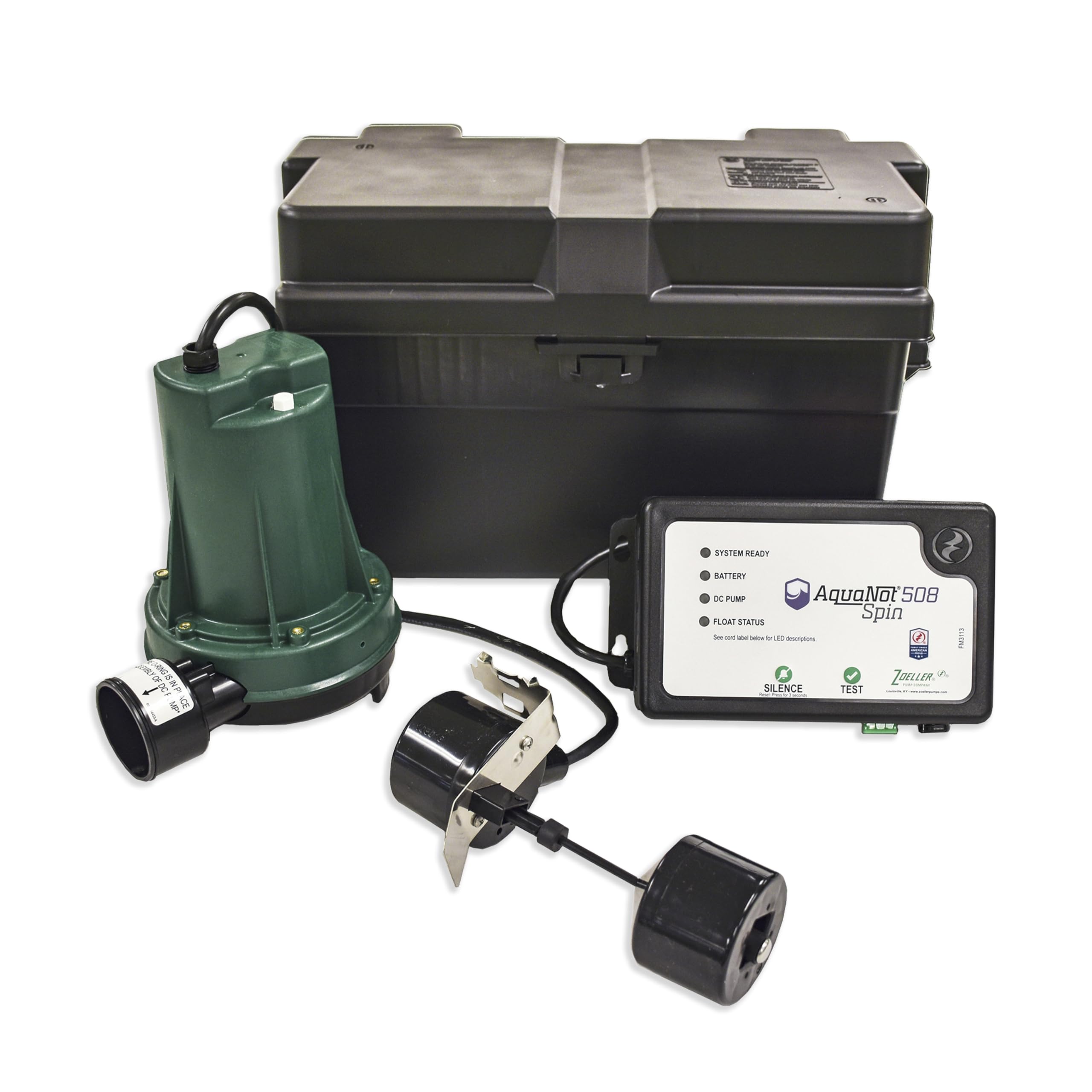
A hand-built American backup with an integrated check valve that saves you a plumbing step.
The Aquanot 508 is aimed at the homeowner who already runs a Zoeller primary and wants the same build quality as a safety net beside it. It pairs cleanly with an M53 primary pump. The 12-volt motor uses a noncorrosive construction, and the housing carries an aluminum seal pocket and a cooling plate. Flow runs at 40 GPM with a 1/3 HP motor, and the integrated check valve plus a quick-disconnect discharge save you from adding those parts separately — one owner noted that combination saved about in hardware. Every unit is hand built and 100 percent tested in the USA. Warranty is 12 months from installation or 18 months from manufacture, and Zoeller extends that to 36 months if you buy a matching Aquanot battery.
The wall-mounted control unit keeps you off your knees during maintenance, and the piercing alarm can be heard a floor above. Owners upgrading from older Watchdog units describe the aluminum control box and LCD screen as a serious step up in build feel. A deep-cycle marine or golf-cart battery keeps it running, with owners reporting three to four years of service from a Trojan-style unit.
The instruction manual is thin — more than one owner called the support hotline for clarification. Spaces are tight if your basin already has a large primary. Durability feedback is mixed, with a few units failing early while most run for years. The pre-drilled relief hole and built-in flapper valve are details that make the install cleaner once you understand them, so read the manual twice before you start cutting PVC.
Details that show up in quality
- Integrated check valve and quick-disconnect discharge save extra hardware purchases
- Wall-mounted control unit with LCD screen keeps diagnostics at standing height
- Hand built and 100% tested in the USA, with warranty extended to 36 months with a matching Aquanot battery
- 40 GPM flow and aluminum seal pocket with cooling plate for motor heat
What to plan around
- Instructions are thin — expect to call the support line for clarification
- Spaces get tight if a large primary pump already fills the basin
- Base warranty is 12 months from install, so buy the Aquanot battery to trigger the 36-month extension
Great fit for: Zoeller owners who want their backup to match the primary’s build quality and stay quiet on the wall.
Not the pick if: you need detailed step-by-step instructions — plan on the support hotline filling the gap.
10. Superior Pump 92911 Backup Cast Iron Primary Sump Pump and Backup Pump Kit, 1/2 HP

A two-pump cast-iron kit that pushes water 25 vertical feet when your discharge run is long.
The primary cast-iron pump moves up to 4,200 gallons per hour and pushes water up to 25 vertical feet — the highest lift on this list outside the Westinghouse unit’s 30 feet. Both the primary and the 12-volt DC backup use vertical float switches (a sensor that turns the pump on when water lifts it), and the kit arrives preassembled with a 2-amp DC charger, an 87 dB alarm (a sound level about as loud as a garbage disposal), an electronic control panel with indicator lights, a battery box, and mounting hardware. You supply a 12-volt deep-cycle battery. The whole kit weighs 39.6 pounds and is warranted for three years.
Owners who replaced two older Watchdog pumps describe the Superior kit as cheaper with better build quality, and setup can take under 20 minutes with immediate, quiet, fast operation. Cast iron holds up well against corrosion in a wet pit and gives the primary pump a solid weight to sit on.
The quirk is that it does not auto-switch back to the primary pump when power returns. After the power comes back, the controller does not auto-switch back to the main pump — you reset it manually. If you are away during a multi-day outage and the utility restores power in the middle, the backup keeps running until you intervene. One owner also notes the smaller backup pump leaves a bit of residual moisture in the pit when they are asleep or traveling. Fit can need adjustment to seat correctly in the basin, and the check valve is sold separately. Longevity is still unknown because this is a newer kit with fewer long-term owners.
Built for altitude: 25 feet of lift means it can handle a discharge run that would stall a standard 10-foot pump.
Remember to reset: after the grid returns, you must manually switch control back from the backup to the primary pump.
Pick it for: tall basements or long discharge runs where a standard 10-foot-lift pump falls short.
pass on it if: you travel during storm season — the manual reset after a power restore is a hassle when you are not home.
11. Westinghouse WH50BBU 1/2 HP Sump Pump with Integrated Vertical Float Switch and 12 Volt Battery Back Up
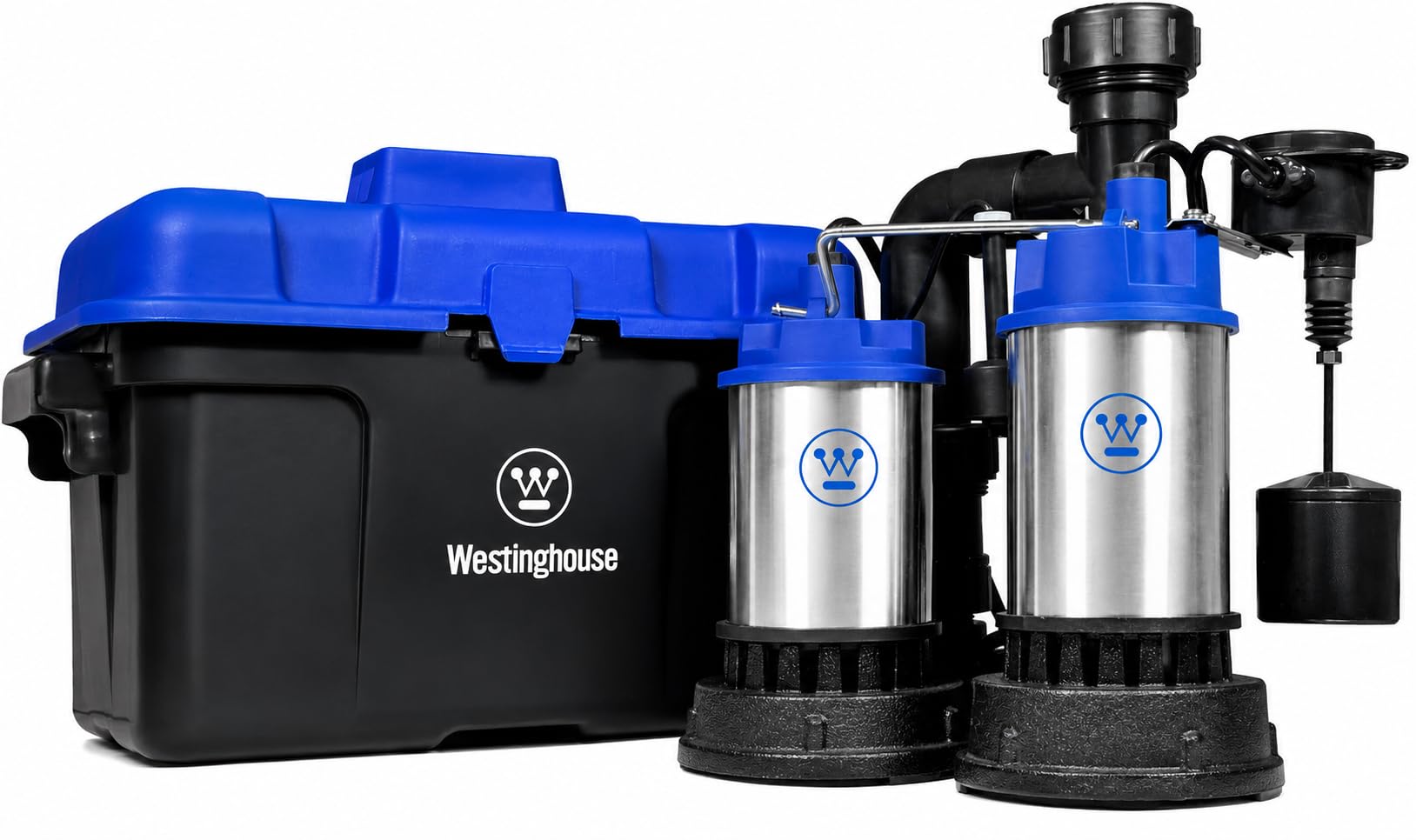
Stainless-steel twin pumps that lift water 30 feet and empty a big pit in about ten seconds.
Westinghouse’s WH50BBU is the combo to look at when your discharge run is especially tall. Its 30-foot max lift is the highest on this list, well beyond the Wayne combo’s typical 10-foot role, so it handles a long vertical run without losing pace. The 1/2 HP primary pump pushes 87 GPM, and both pumps use stainless-steel housings and cast-iron components so corrosion in a damp pit is not the concern it is with untreated metal. The energy-efficient PSC motor includes thermal overload protection, lubricated ball bearings, and a sealed shaft. The motor sits in dielectric oil to improve cooling. The kit includes an alarm system, a backup pump and switch, a battery controller, a charger, a battery box, and the primary pump and switch. The battery itself is not included.
Owners consistently call the build quality out as metal, not plastic, and note that the slightly smaller footprint helps when space in the pit is tight. One buyer describes the pump emptying a large pit in about 10 seconds, paired with a 105Ah AGM Group 31 battery and a check valve. The two pumps have separate float switches, so the backup never takes over unless the primary fails or the power cuts.
The one recurring complaint is the alarm, which will not stay silenced in battery mode. In battery mode the alarm does not stay silenced despite a 24-hour acknowledgement claim, and one owner with two controllers saw the same issue on both units. If your bedroom sits above the pit, that matters. Everything else — install simplicity, quiet running, and cast iron plus stainless construction — gets praised. Longevity data is still thin because this is a newer model, so time will tell how the stainless housings hold up over a decade.
Why it stands out
- 30-foot max lift is the highest here — it handles a tall discharge run without losing pace
- 87 GPM primary flow, the fastest single-pump rate on this list
- Stainless-steel housings and cast-iron components resist corrosion in a damp pit
- Two separate float switches mean the backup only fires when the primary fails or power cuts
What to plan around
- Battery-mode alarm will not stay silenced despite the 24-hour acknowledgement claim
- Battery and check valve are sold separately
- Longevity data is thin because the model is relatively new
Best for: tall basements and long vertical discharges where a 30-foot lift rating actually matters.
If silence is critical: the battery-mode alarm may keep sounding overnight, so plan around it if the pit sits near a bedroom.
Understanding the Specs
Flow rate (GPM and GPH)
Flow rate tells you how fast the pump moves water. Manufacturers list it two ways: gallons per minute (GPM) and gallons per hour (GPH). A high GPM pump empties a pit fast, which matters when water is pouring in during a storm. A 85 GPM primary, like the one in the Wayne combo, empties a standard basin in seconds, while a 8.33 GPM compact backup like the Basement Watchdog Special CONNECT holds water level rather than racing to drain it. Match flow to your job: full removal calls for high GPM, maintenance-level backup only needs enough to keep pace with inflow.
Maximum lifting height (head)
Maximum lifting height, also called head, is how high the pump can push water before it stops moving it. A pump rated at 25 feet, like the Superior Pump 92911, handles a discharge line that climbs more than a single story, while a pump rated at 10 feet is built for a shallower run. Flow drops as the pump works against more height, so the GPM at your actual lift matter more than the number on the box. Measure from the bottom of your pit to the highest point of the discharge pipe outside.
FAQ
Does a backup sump pump need its own separate discharge pipe?
How long will a battery backup sump pump run during an outage?
What size sump basin do I need for a combo backup system?
Is a water-powered backup better than a battery backup?
How do I stop the gurgling noise when my primary pump shuts off?
Will a backup sump pump work if I use a private well instead of town water?
Can I install a backup sump pump system myself?
How often do I need to replace the battery in a backup sump pump?
What is the difference between GPM and GPH on a sump pump rating?
Do I need an alarm on my backup sump pump system?
Final Thoughts: The Verdict
For most basements, the back up sump pump system winner is the Wayne Preassembled Primary & Battery Backup Combo because it delivers a 1/2 HP primary at 85 GPM (gallons per minute), a backup rated for up to 10,000 gallons per charge, and a 15-minute drop-in that fits a 16-inch basin. If you want day-after-day outage endurance, grab the Wayne ESP25n — owners run it for days on a single charge. And for a narrow pit where a combo will not fit, or a setup with no battery to maintain, the Basement Watchdog Special CONNECT and the Basepump RB750-EZ are the ones to reach for. Whichever you pick, measure your basin, check your discharge height, and buy the battery before the storm arrives.
How We Picked
We do not accept paid placement. Every pick is matched to a real buyer and a real use-case; we do not hands-on test units.
Sources & Methodology
Specifications: manufacturer listings and product documentation. Review insights: verified customer reviews, as of September 2026. Pricing: not shown on this page (it changes often); check the current price via the retailer link.
As an Amazon Associate, KitchPrep earns from qualifying purchases. This does not affect which products we feature.
Related Guides
