
Specs are compiled from manufacturer listings and verified buyer reviews and can change over time — please confirm the key details on the product page before buying.
A gate valve is the part that decides whether you can shut off water without draining the whole system — and a 2-inch one lives on hot tubs, koi ponds, pool lines, irrigation mains and spa packs. The wrong pick leaks, splits, or refuses to seal, and that means a second repair in the same season. This guide covers the 2-inch gate valves that hold up, what each one is actually built from, and how the connection type decides whether it ever fits your pipe in the first place.
I’m Mohammad Maruf — the founder and writer behind KitchPrep. This guide is built by comparing the manufacturers’ published specifications and the patterns across verified customer reviews, so you get each pick’s real strengths and trade-offs instead of marketing spin.
Gate valves are built in four materials and three connection styles, and mixing them up is the number one reason a repair job stalls halfway. Everything below is the 2-inch sizing the plumbing trade treats as nominal, so an oddball 1-1/2 or 2-1/2 line won’t fit these parts. If you are replacing a slice valve on a spa pack or a pond loop, this best 2-inch gate valve shortlist cuts straight to the models that seal.
Our Picks at a Glance


How To Choose The Best 2-Inch Gate Valve
Before you compare brands, settle three things about your own pipe: the connection on both ends, the material the existing plumbing is made of, and the pressure it runs at. Get those wrong and no amount of build quality saves the job.
Match the connection end, not just the size
Slip means the pipe slides into the valve socket and gets glued — the standard fix on PVC spa plumbing. Spigot means the valve has a protruding end that slides into a fitting instead, which is what you want when the pipes have almost no give left and you cannot spread them apart. Threaded brass ends screw straight onto NPT fittings but demand clean, correctly tapered threads. Buying a slip valve for a threaded line wastes a part; buying threaded for a glued line is worse.
Material decides pressure and media
PVC and ABS bodies are the low-pressure workhorses for spa and pond water — light, glueable, and easy to cut out later. Brass handles more pressure and takes water, oil and non-corrosive gas, but no plastic pipe ever seals to it without a proper threaded adapter. If your line runs hot or the media is aggressive, material matters more than brand.
Quick Comparison
| Model | Best For | Body Material | Connection | Max Pressure | Amazon |
|---|---|---|---|---|---|
| Valterra 2201X★ Best Overall | Spa and pond replacements | PVC | 2″ Slip | 50 psi | Amazon |
| American Spa Parts Slice ValveEasiest DIY Repair | DIY spa repairs | Plastic | 2″ Street x Slip | — | Amazon |
| Valterra 7201MBest for Shop Lines | Dust collection and shop lines | ABS | 2″ Slip | — | Amazon |
| GASHER Brass Gate Valve | High-pressure water and oil lines | Brass | 2″ NPT Female x Female | 230 psi | Amazon |
| SYWUWV 2″ NPT Gate Valve | Plumbing and HVAC systems | Brass | 2″ NPT | 232 psi | Amazon |
| GUXGUY NPT 2″ Brass Gate Valve | Irrigation and pool lines | Brass | 2″ FNPT | — | Amazon |
| Boltigen 2″ NPT Brass Gate Valve | Air and gas shut-off | Brass | 2″ NPT Female x Female | 200 psi | Amazon |
| Homewerks 170-2-2-2 | Main water service lines | Brass | 2″ Threaded Female x Female | 200 psi | Amazon |
In‑Depth Reviews
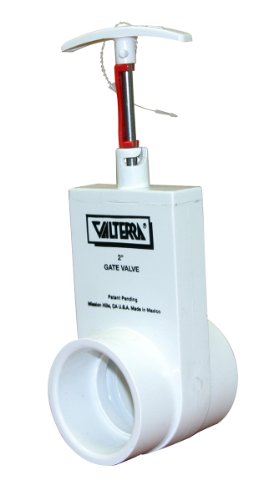
1. Valterra 2201X PVC Unibody Gate Valve, Silver, 2″ Slip w/Gate Keeper
Our pick — over 4.5★ from 550+ verified ratings; the strongest balance of quality and price.
The spa-pack replacement owners keep re-ordering, cut from a single piece of PVC.
Start with the body: this is a one-piece PVC UniBody, meaning the housing is molded as a single part rather than assembled from a separate gate housing and cap. That matters because the joints between parts are where PVC valves leak. Inside, stainless steel shafts resist rust and corrosion, so the gate keeps moving smoothly in a wet spa cabinet. The maximum recommended working pressure is 50 psi, which comfortably covers the low-pressure recirculation loop you find on a hot tub, koi pond or pool filter. The locking handle gives you a positive shut-off position, so you can tell at a glance that the valve is fully closed instead of guessing.
For fit, measure carefully before you order. This body measures 7.5 x 4.05 x 3.2 inches, while the Valterra 2202X runs 4.5 x 11 x 3.5 inches — a 67% more gap along the long axis — so the 2202X is the longer, narrower shape when a spa cabinet offers length but not width. Owners praise the locking handle and drop-in fit above all else. Owners describe cut-out-and-reglue jobs where the old slice valve came out and the replacement dropped straight in. As buyers report, it “replaced leaking valve on hot tub. Works just like the original and seems well made.”
What you get that a ball valve cannot give you is a straight-through bore that shrugs off dirty water. A duck-pond owner describes exactly this: the sliding gate tolerates debris that used to jam a ball valve, and the trick is to keep flushing clean water through while you close it so sediment never parks on the seal. That is also the honest caveat — this is an on/off valve, not a flow-control valve. Half-opening it to throttle a pump will chew the gate. Durability and sealing come up in equal measure as praise and complaint, mostly tied to how well the glue joints were done. A few owners mention a split at the two-month mark, which is worth weighing against thousands of valve-years of quiet service.
What owners rave about
- Functionality is the runaway favorite — far and away the most-praised trait
- Locking handle makes a fully shut-off position obvious instead of guessed
- Stainless steel shafts resist rust and corrosion in a wet cabinet
- Handles debris-heavy water that jams an ordinary ball valve
Where it bites back
- Capped at 50 psi — fine for spa loops, wrong for a pressurized main
- On/off only, so no half-open throttling without wearing the gate
- UniBody jobs live or die on your glue work at both connections
Perfect match: anyone replacing a slice valve on a hot tub, koi pond or pool filter loop who wants the same part the last owner should have installed.
Browse past it: if your line runs above 50 psi or you need to dial flow between open and closed — a brass threaded valve is the right tool.
2. Hot Tub Spa Gate Slice Valve 2″ Street X Slip How To Video
American Spa Parts ships a spa slice valve with the how-to video already filmed.
What sets this one apart is the walkthrough. American Spa Parts publishes a YouTube how-to titled “Hot Tub Professor 2″ Slice Valve Gate Valve How To Spa Parts Part”, and for a first-time spa repair that video is worth more than any spec sheet. The valve itself is a plastic-bodied slice valve with a 2-inch slip side measuring 2 3/8 inches inside and a 2-inch street spigot side measuring 2 3/8 inches outside. Those two numbers are your fit check before the glue comes out, and having them printed on the listing saves you from eyeballing a socket under a dim spa cabinet. It glues to 2-inch unions and plumbing, and the T-handle lock holds the gate where you set it.
The connection layout is the reason this pick exists in a hot-tub context. Street on one side means the valve drops into an existing fitting; slip on the other means pipe glues straight in. That is the combination that makes a slice-valve swap a one-evening job, which is exactly what owners describe — tubs repaired at home without hiring a spa professional, with the old part cut out and the new valve glued back into the loop. As customers note, “Added an additional gate valve in event of another leak. This valve is well built and works well.”
What you trade for the convenience is that this is plastic, not brass, so it belongs on the low-pressure side of a hot tub or pool — not on a pressurized potable main. There is also no pressure rating published on the listing, which means you are trusting the material and application rather than a number. For a spa cabinet at recirculation pressures, that is a normal and accepted trade. For anything feeding the house, it is the wrong part entirely. Fit complaints simply do not appear in this valve’s history; owners consistently describe a part that dropped in and sealed.
The beginner’s advantage: a published installation video turns a daunting spa repair into a watch-once, glue-once job.
The catch worth knowing: no published pressure rating, so keep it on spa and pond loops where pressure is inherently low.
Best suited to: a spa owner attempting their first slice-valve replacement who wants a video to follow and a part that drops into the existing fitting.
Look elsewhere if: you are working on a pressurized domestic water line and need a stated psi ceiling to point at.
3. Valterra 7201M ABS Gate Valve, Black, 2″ Slip, with Metal Handle
The woodworker’s secret — an ABS gate that switches dust instead of water.
Valterra builds this one from Acrylonitrile Butadiene Styrene, the same ABS used in shop ductwork, and that is what makes it the odd useful pick on a water-valve list. Owners run it on belt-grinder and sander dust-collection circuits, where sliding a gate open or shut reroutes suction from one machine to the next. Both ends are 2-inch slip, so it glues into ABS or PVC ducting the same way a spa valve glues into pipe. The handle is metal rather than the plastic paddle on the PVC models, and the paddle inside is deliberately slightly smaller than the opening to ease opening and closing, with the seals covering any gap.
Its two siblings in this list top out at 50 psi, but ABS is the material choice here for air and dust rather than pressurewater. Valterra lists no working pressure for this body, so treat it as a shop and slurry valve, not a pressure fitting. The package measures 8.636 cm long by 18.796 cm wide by 10.16 cm high, which is compact enough to slip between a sander and a blast gate without eating bench space. Country of origin is Mexico. Against the PVC 2201X with its 50 psi rating and stainless steel shafts, this is the rougher, cheaper-built cousin aimed at a very different job.
One thing to be ready for, and it is a real one: installation gets awkward when you are cutting out a broken valve in place. As reviewers point out, “Installation was difficult because I was replacing a broken valve. There was very little slack in the pipes (no fault of the manufacturer) and I was working on my back in a cramped position.” That is a tight-space problem, not a valve problem — cut generously and dry-fit before you glue. Its metal handle takes a firmer grip and more abuse than the plastic paddle on newer air-blast gates.
The unexpected use case: it does double duty on dust-collection circuits, where an ABS body and metal handle are exactly what the machine end of a shop needs.
Know before you glue: no published working pressure, so keep it on air and gravity flow rather than a pressurized water main.
Built for: shop owners routing dust from a sander, grinder or mitre saw who want a manual gate with a metal handle instead of a flimsy plastic paddle.
Better elsewhere if: your job involves water under real pressure — the brass picks below carry a stated psi ceiling for exactly that.
4. GASHER 1PCS 2 Inch Brass Industrial Gate Valve, Heavy-duty Rotary Sluice Valve with Female x Female Threads, with Wheel Handle, For Water, Oil, Gas

Solid brass and a 230 PSI working pressure, with two threaded ports and a wheel handle.
Here is the pressure number that puts the plastic valves in perspective. This GASHER valve carries a working pressure of 230 psi against the 50 psi ceiling on both Valterra PVC models above, and the body is solid brass rather than molded PVC. Both ports are 2-inch threaded female ends, so it screws onto NPT pipework instead of gluing. The gate moves perpendicular to flow and opens fully out of the path, so the full bore design leaves no restriction when it is open. A wheel handle drives it, and the maker describes the operation as light, flexible and labor-saving. It is rated for water, oil, gas and oxidizing media.
Where owners put it to work is upstream of firehose and on small-town plumbing jobs where the local hardware store either does not stock a 2-inch valve or charges double. As shoppers say, “I used this upstream of a 1.5″ firehose and only found a negligible amount of pressure drop, if any.” Owners rate build quality above flow performance. For an industrial sluice valve at this price tier, a full bore with minimal resistance is exactly what you want feeding a hose or a service line.
Two warnings before you buy, and they are important. First, the thread depth is shallower than a standard NPT valve — one owner counted 5 threads deep against 7 on a normal valve — and the tapered NPT pipe can bottom out in the socket before it seals. If you are threading this onto PVC adapters, you will likely need more tape and dope than usual, and in the worst case the joint leaks despite both. Second, this is a full-port industrial valve with a wide brass body, so it is heavier and bulkier than the plastic picks above. If your line has tight bends or a small valve box, measure first.
Why it earns its place: 230 psi of brass is a different class of fitting from the plastic spa valves, and owners use it on firehose and irrigation lines where the extra pressure headroom genuinely matters.
The honest trade-off: shallow socket depth means the thread has less room to bite, so plan on generous tape, pipe dope, and a careful hand-tight plus one turn.
Right choice for: high-pressure water, oil or gas lines where a 230 psi brass body with a full bore is non-negotiable.
Weigh it against: any threaded joint that relies on deep NPT engagement — the shallow socket is the recurring fit complaint.
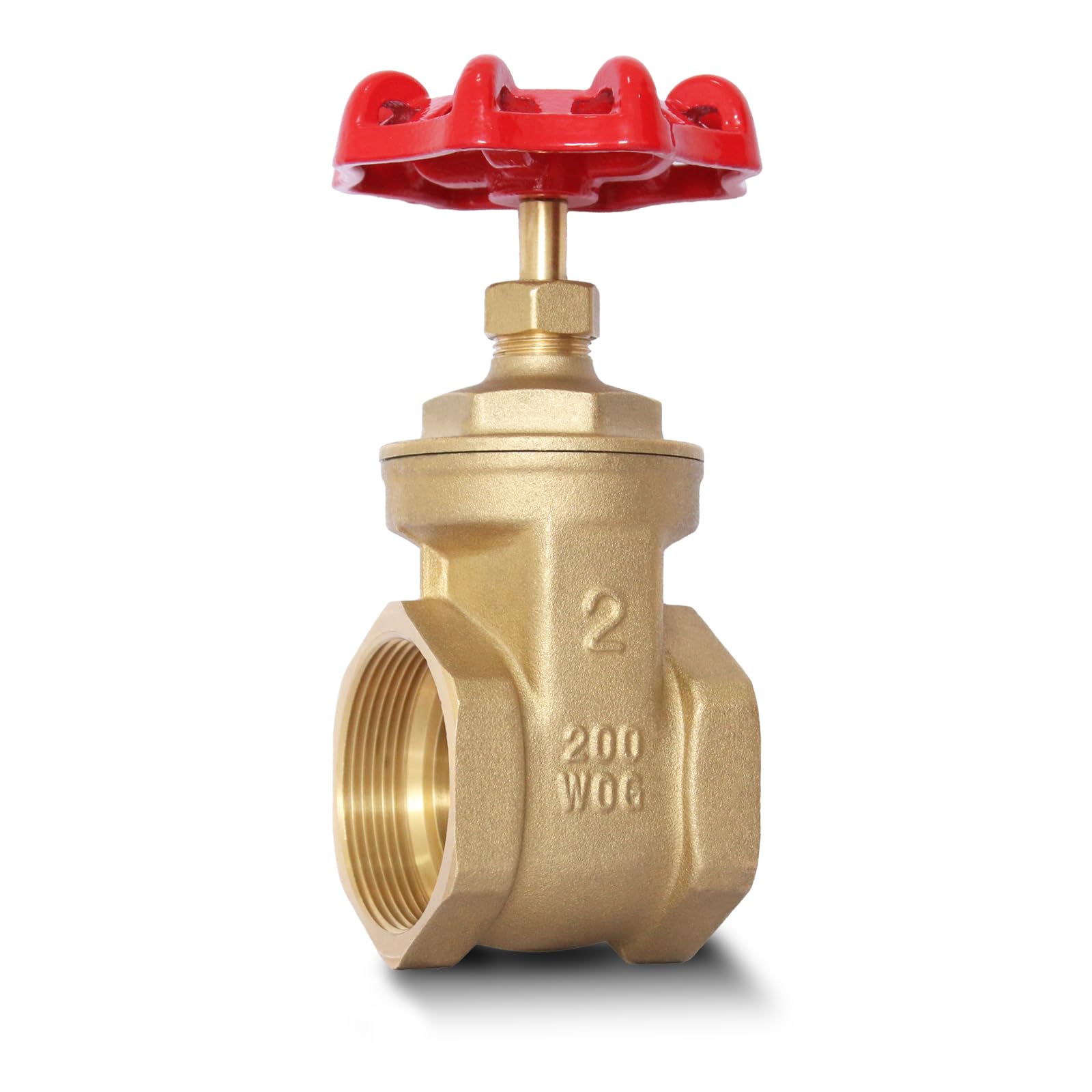
5. 2″ NPT Gate Valve, Heavy Duty, Brass, Female x Female Thread, DN50
Precision NPT threads and a 232 psi ceiling, from -20°C to 150°C.
For a plumbing or HVAC system where the valve lives in a mechanical room, this SYWUWV brass DN50 body is built for the job. The maximum working pressure is 1.6 MPa, listed as 232 psi, and the temperature range is -20°C to 150°C, or -4°F to 302°F. That is a wider thermal window than the plastic picks above can touch. The gate moves perpendicular to the flow for a reliable shutoff, the full bore design keeps flow resistance low, and the polished inner cavity stops scale and debris from parking on the seat and choking the passage. Both ends are 2-inch NPT female threads, and the listing promises a tight connection with good compatibility on threaded piping.
Owners rate build quality above value for money. They describe a valve that threads up cleanly and holds well on a first install. The construction uses a durable brass body with uniform wall thickness, which is the part that gives you stable pressure resistance and wear resistance over the long haul. If you are running a service line and want to stop walking to the meter every time the water needs to come off, this is the size and material for it.
Two honest notes. First, shutoff functionality is a mixed bag in the reviews, with the vast majority of units sealing tight but a minority arriving with a stem that does not close completely. Those cases trace back to a defective unit rather than a design fault, and they show up as steady dripping with the handle turned all the way down. If that happens, it is a warranty conversation rather than a tolerance you live with. Second, NPT is tapered thread, so thread engagement is critical — cross-threading on the install will defeat even a good body.
The spec that sells it: a 232 psi working pressure and a 302°F top temperature make this the only valve here rated for both high pressure and hot fluid in the same body.
What to watch: NPT taper thread needs clean, aligned engagement, and the rare defective stem shows itself as a drip that will not stop.
Fits the bill when: you are plumbing an HVAC line or a hot-water service and need brass plus a stated 232 psi ceiling with a wide temperature window.
Consider the alternative if: you only need spa-loop pressure and cannot justify brass — the PVC Valterra picks cost less and glue in faster.
6. NPT 2” Brass Gate Valve DN50

A polished all-brass interior built to shed scale and keep the passage clear.
Scale and clogging are the slow killers of a gate valve, and the GUXGUY DN50 tackles them at the source: the inner wall of the brass body is polished smooth specifically so minerals have nothing to grip. The NPT threads on both ends are cut to seal against the same tapered thread standard as the piping around it. Flow direction is bidirectional — no upstream or downstream end to worry about — and the listed temperature window is -60°F to 450°F. Both ports are 2-inch FNPT, and the body is all brass with uniform wall thickness.
Owners on irrigation systems report this valve holding steady in a 60-85 PSI window without leaks and with an easy turn, which is right where a domestic sprinkler loop lives. On a main service line, one owner replaced a shutoff that forced a walk to the meter every time the water needed to come off, and describes the change as turning that chore into a handle turn. The pool owners on the listing simply describe a pool that stopped leaking. Owners rate build quality highest, and most install it on pool or irrigation lines.
The two things to know are both threading issues. A recurring note is that the threads on the body do not run deep enough, so a tapered pipe can bottom out before the joint tightens and seals — measure a thread depth against your existing valve if you have one on hand. A separate owner had to apply several wraps of PTFE tape to stop a small weep at the supply junction. Neither is a defect; both are the normal tax on matching tapered threads to a body with less thread running length than some competitors. If your fitting threads are on the long side, budget extra tape and plan to snug it twice.
The standout trait: a polished all-brass inner wall and a bidirectional flow path mean you can install it either way round without worrying about the seat.
Thread-up warning: shallow body threads are the recurring gripe, so dry-fit and tape generously before you commit.
Buy this one if: your line runs hot or the media carries dissolved minerals, and you want brass with a polished bore to keep the gate sliding freely.
Skip the guesswork if: you cannot measure the thread engagement of your existing pipe — the shallow socket needs the extra tape.
7. Boltigen 2’’ NPT Brass Gate Valve, 200 WOG Manual Rotary Sluice Valve with Wheel Handle, Double Female Thread Heavy Duty Water Shut Off Gate for Water, Oil, Gas, Plumbing and HVAC Systems

A red cast iron wheel that grips hard enough for a firm hand on an air line.
The Boltigen is rated 200 WOG, which is the shorthand for water, oil and gas at 200 psi, and it wears a cast iron handwheel rather than a plastic paddle. Both ends are 2-inch NPT female threads, and the body is solid brass. The listing adds a strip of thread tape in the box, which is a small but welcome touch when you are standing over the install with a wrench in one hand.
On a compressed air circuit at 150-165 psi, this valve holds well — that is the pressure band buyers report running through it on shop air with a smooth gate that shows no binding or leaks. The same body works on water supply, irrigation and HVAC pipe runs, so it does the job you would expect across the whole WOG range. As owners put it, the essential review is that the body is real brass, the threads are cut correctly, the size fits, and the gate turns without problems.
The one thing to note is the Spanish-language review mix on the listing, which tells you this valve is selling into a wider market than just the US plumbing trade. That is not a defect in the product itself, just a signal that if you need an English-language datasheet, you may not find one. The size callout in the listing text bundles 3/4 inch, 1 inch, 2 inch and 3 inch options in a single description, so confirm your 2-inch variant is the one you are selecting before you check out.
The wheel that wins it: a cast iron handwheel instead of a plastic paddle means real leverage on a stiff gate or an oily hand.
Listing quirk to expect: the product bullet mentions several thread sizes in one description, so verify your 2-inch variant before you order.
The pick for you if: you are plumbing an air compressor or a small gas line and want a brass valve with a handwheel you can really crank.
Pick differently if: you need a US-imprint datasheet or a valve with a published body thread engagement spec — this listing is deliberately spare on details.
8. Homewerks 170-2-2-2 No-Lead Gate Valve, Female Thread x Female Thread, Brass, 2-Inch

Built for the shutoff on a potable water main, with lead content held below the code limit.
One number changes the buying decision on this valve: complies with 0.25 Percent weighted average lead content on wetted surfaces. That is the line that matters if you are putting a valve on a potable water line, because any water sitting in contact with the inside of the valve contacts the wetted surface. It also meets ANSI / NSF 61 low lead requirements, a standard written specifically for drinking-water system components. The body is brass, the handle is cast iron, and it carries a 200 psi non-shock WOG rating. Both ports are 2-inch threaded female ends.
The design detail worth knowing is the non-rising stem. On a rising stem valve the handle end rises as you open it, so the valve needs room above the handle; on this compact pattern the stem stays put and the handle turns in place. That means it fits in a tighter valve box without the stem poking into a joist or a cabinet back. On main water service, owners describe it as the fit-and-forget shutoff that stops the walk to the meter whenever the water needs to come off. Buyers rate build quality highest.
The honest caveat is that leakage shows up as the one recurring negative across the reviews. A few of those failures surface a full year after installation, not on day one, and that is the pattern that tells you the seat is the long-term concern rather than the body or the threads. The vast majority of units run dry and stay dry for years, but a water main is a set-and-forget position, so treat it as one to check on after the first heating cycle and once a year after that. The brass is genuinely good; the seat is the part to watch.
The code-driven pick: a no-lead design and compliance with 0.25 Percent weighted average lead on wetted surfaces is the specific spec a potable water line calls for.
Where it can disappoint: the recurring leak report is a long-term seat issue, not an install problem — worth an annual check.
Pick this for: a home’s main water shutoff where a no-lead brass body and a compact non-rising stem are the two things you actually need.
Weigh it against: any valve that carries a longer stated warranty cycle — Homewerks is limiting its cover to a standard term, so the seat is your maintenance item.
Understanding the Specs
Working pressure (psi)
This is the maximum pressure the valve is rated to hold when closed, expressed in pounds per square inch. PVC spa valves on this list run up to 50 psi, while the brass models reach 200 to 232 psi. Size it above the pressure your system actually runs at, with room to spare — a valve rated at the exact line pressure is a valve waiting to fail. If your system runs hot fluid, check the temperature rating as well, because PVC softens long before brass does.
Connection type (slip, spigot, threaded)
Slip means the pipe slides into a socket and glues in place, the standard for spa and pond PVC. Spigot means the valve has a protruding end that goes into a fitting instead — the choice when your pipes have no slack. Threaded means it screws onto NPT fittings; it is faster to swap but demands clean, correctly tapered threads to seal. If you mismatch connection types, the valve is unusable no matter how good the body is, so read the spec line twice before ordering.
FAQ
Can I use a 2-inch gate valve on a 2-inch PVC pipe that is already threaded?
What is the difference between a slip and a spigot end on a gate valve?
Is a 50 psi gate valve enough for a hot tub or spa?
Why does a gate valve leak even though it is brand new?
Can I use a gate valve to throttle or control flow rate?
What does WOG mean on a brass gate valve?
How tight should I tighten a threaded brass gate valve?
Will a 2-inch gate valve fit a 2-inch system that uses metric pipes?
Does a gate valve need to be installed in a specific direction?
How do I remove an old glued-in gate valve without breaking the pipe?
Final Thoughts: The Verdict
For most buyers, the <best 2-inch gate valve winner is the Valterra 2201X, because it does one job perfectly: replacing a leaking slice valve on a spa, pond or pool loop with a one-piece PVC UniBody, stainless steel shafts and a locking handle at a 50 psi ceiling. If your pipes have almost no slack and you need the slip-by-spigot ends to complete the repair in one coupling, grab the Valterra 2202X. And for a high-pressure water, oil or gas line where plastic simply will not do, the SYWUWV 2″ NPT Brass Gate Valve is the one to reach for, with a 232 psi ceiling and a temperature range that runs from -4°F to 302°F.
Before you order, double-check one thing above everything else: the connection on both ends of the pipe you are cutting into. Slip, spigot and threaded are not interchangeable, and no brand of body quality saves a job wired to the wrong end. Get that right and the material and pressure rating fall into place from there — PVC for spa and pond, ABS for shop ductwork, brass for mains and machine lines. If you are buying one valve for a hot tub and want the lowest-risk pick on this list, the Valterra 2201X is the crowd favorite among spa owners and the one most likely to drop straight into the fittings you already have.
How We Picked
We do not accept paid placement. Every pick is matched to a real buyer and a real use-case; we do not hands-on test units.
Sources & Methodology
Specifications: manufacturer listings and product documentation. Review insights: verified customer reviews, as of September 2026. Pricing: not shown on this page (it changes often); check the current price via the retailer link.
As an Amazon Associate, KitchPrep earns from qualifying purchases. This does not affect which products we feature.
Related Guides
