
Specs are compiled from manufacturer listings and verified buyer reviews and can change over time — please confirm the key details on the product page before buying.
If your bathroom mirror fogs over before you finish drying off, the fix is almost never a bigger fan — it is the right fan for your ceiling space and your duct run. The picks below are sorted by what actually matters once you crawl into the attic: how much air the fan moves, how loud it sounds in a quiet house, and whether it will fit the hole you already have.
I’m Mohammad Maruf — the founder and writer behind KitchPrep. This guide is built by comparing the manufacturers’ published specifications and the patterns across verified customer reviews, so you get each pick’s real strengths and trade-offs instead of marketing spin.
Two specs decide everything: airflow in CFM (cubic feet per minute, the volume of air the fan pushes outside) and sones (a sound measurement where lower is quieter). A fan rated under one sone is barely audible from the next room, so you can run it at night without waking anyone. A fan near three sones announces itself through the whole house. That gap matters more day to day than almost any other number on the box. Here is how the bathroom roof ventilation options compare.
Our Picks at a Glance

How To Choose The Best Bathroom Roof Ventilation
Most people buy a bathroom fan by size of bathroom alone, then discover the thing will not fit the existing ceiling hole, the duct run chokes it, or it roars loud enough that nobody uses it. Start with three measurements instead: the size of your room, the diameter of the duct already running out of the ceiling, and the depth of the space above the drywall.
Match CFM to the room, then check the duct
CFM (cubic feet per minute) is how much air the fan pushes out of the room. Manufacturers commonly rate a fan for a room up to a stated square footage — 50 CFM for small half baths, 70 to 80 CFM for a standard full bath, and 110 CFM for larger or busier bathrooms. But the fan can only push what the duct allows. A 4-inch duct on a long run with bends restricts airflow, and manufacturers themselves often tell buyers to step up to 6-inch ducting on longer runs for exactly that reason.
Read sones like decibels, not marketing words
A sone is a sound measurement, and the scale is not intuitive. Under 1.0 sone is genuinely quiet — you may forget it is on. A 1.0 to 1.5 sone fan is a soft background hum. Above 2.0 sones you will hear it clearly from the bedroom. If quiet matters to you, treat the sone rating as a hard filter before you even look at airflow numbers.
Measure the hole before you buy
Retrofit fans are sold with a housing size and a matching grille size. If you are replacing an existing unit, the housing needs to slide into the same rough opening, or you are cutting drywall and patching a ceiling. Check the housing dimensions, the duct connector diameter, and the required ceiling depth — a fan that needs six inches of housing height will not drop into a shallow joist bay.
Quick Comparison
| Model | Best For | Airflow | Noise Rating | Duct Size | Amazon |
|---|---|---|---|---|---|
| Panasonic FV-0511VFL1 WhisperFit★ Best Overall | Best all-round full bath upgrade | 50/80/110 CFM selectable | Quiet DC motor fan | 4″ or 6″ | Amazon |
| V2262-50 7 Inch Exhaust FanMobile Home Fit | Mobile home and small-space replacement | 50 CFM | 1.0 Sones | 7″ ceiling fan, 8″ rough-in | Amazon |
| Tech Drive Fan with LightBright Combo | Small bath needing a bright light combo | 70 CFM | 2.0 Sones | 3″ | Amazon |
| Amico Bathroom Exhaust Fan | Tight joist bays with no attic access | 80 CFM | 1.0 Sones | 4″ | Amazon |
| Broan-NuTone LP80 LoProfile | In-wall and shallow ceiling installs | 80 CFM | 1.0 Sones | 3″ or 4″ | Amazon |
| Broan-NuTone 744 Recessed Light Fan | Replacing a ceiling can light | 70 CFM | 1.5 Sones | 4″ round | Amazon |
| Good Housekeeping Yorkshire 90053 | Decorative fixtures in a remodel | 80 CFM | 2.5 Sones | 4″ | Amazon |
| Homewerks 50 CFM with LED | Whisper-quiet small bathrooms | 50 CFM | 0.7 Sones | 4″ round | Amazon |
| Panasonic FV-08VRE2 WhisperRecessed | Recessed lighting look with strong airflow | 80 CFM | Quiet, recessed combo | 4″ or 6″ | Amazon |
In‑Depth Reviews
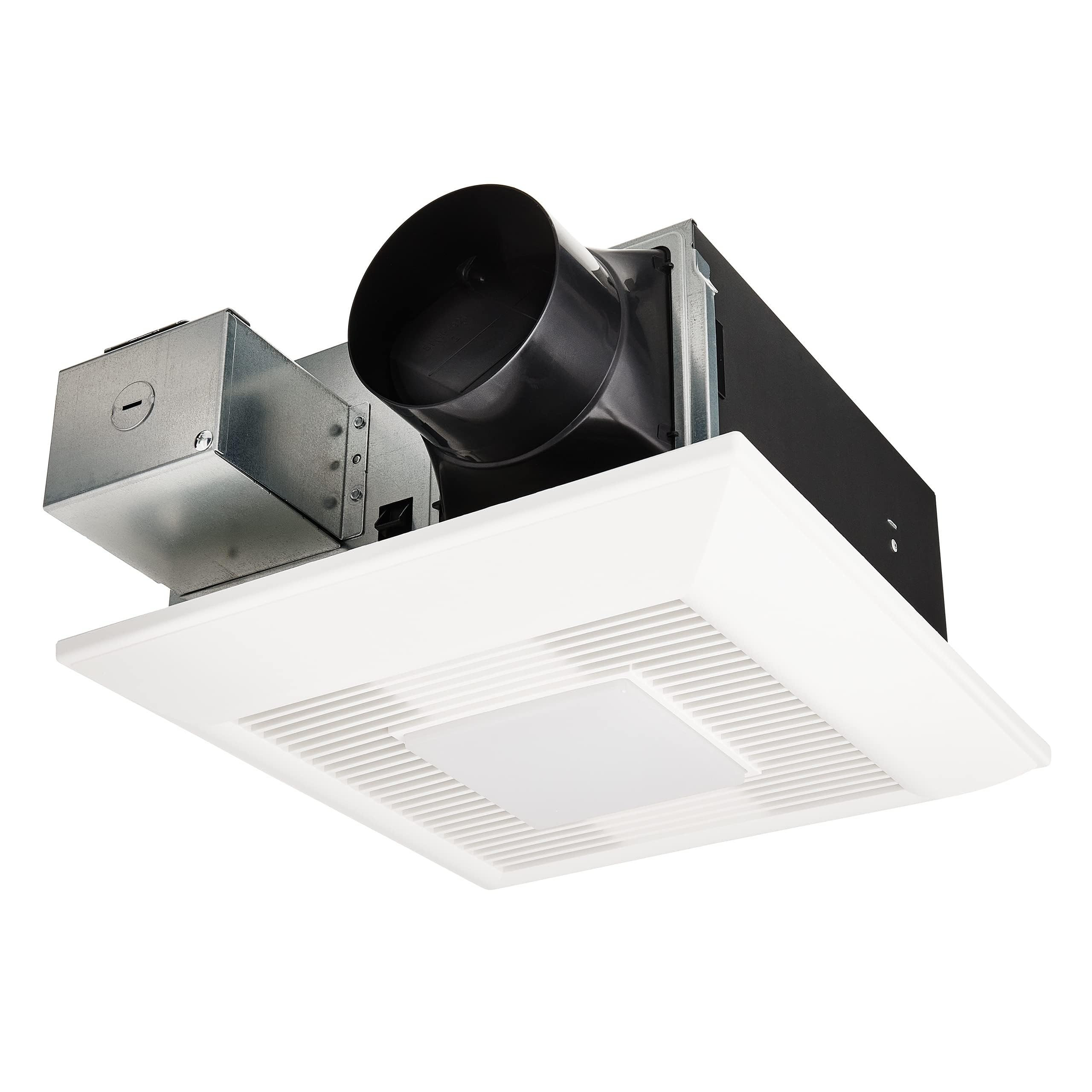
1. Panasonic FV-0511VFL1 WhisperFit Bath Fan + Light, 50-80-110 CFM
Our pick — over 4.5★ from 900+ verified ratings; the strongest balance of quality and price.
One fan that decides its own airflow after you flip a switch — and the crowd favorite across thousands of owners.
You buy once and pick the setting later. Pick-A-Flow lets you choose 50, 80, or 110 CFM at the flip of a switch, so the same unit covers a small half bath today and a big steamy master bath tomorrow. That is roughly double the air movement of the small 50 CFM replacement fan a few picks down — 110 CFM versus 50 CFM — which is the clearest airflow gap in this whole roundup.
The DC/ECM motor (a brushless motor that spins quietly and sips electricity) is what earns the WhisperFit name, and it is paired with a dimmable 10W LED panel plus a night light drawing under 1W. You get three lighting jobs from one fixture: task light, dimmed evening glow, and a faint night light that keeps you off the wall at 3 a.m. The Flex-Z Fast bracket is a single-hinged arm that positions the housing from below, so you do not have to climb into the attic to hang it. The fan takes either 4-inch or 6-inch ducting.
Build quality wins people over — more owners single that out than anything else — with installation the clear second. A professional installer summed it up this way: “WhisperFit is gold standard, beats competitors. Very quiet, 3 selectable speeds, genius bracket for solo retrofit install.” The honest catch is the paperwork: the printed instructions are thin, and several buyers report the job takes longer than expected, so plan on finding the manufacturer’s install video before you start. Also measure first — going from an older, smaller fan to this housing usually means patching drywall around the new footprint.
The strong side of this fan
- Selectable 50, 80, or 110 CFM covers three bathroom sizes with one purchase
- Slim 10.25″D x 10.25″W x 5.6″H housing and a hinged bracket for below-ceiling mounting
- Three light modes built in: dimmable 10W LED, plus an under-1W night light
- 4-inch or 6-inch duct options let you match the run you already have
What to plan around
- Instructions are brief — budget extra time or watch the install video first
- Replacing a smaller old fan usually means drywall patching around the new cutout
- Long duct runs still want the 6-inch connection to move air freely
Reach for this if: you want one fan that adapts to the room and prefer installing from below without attic access.
Look elsewhere if: your ceiling hole is fixed and small, or you want a five-minute swap with zero patching.
2. V2262-50 7 Inch Bathroom Exhaust Fan, 50 CFM, 1.0 Sones
The drop-in answer when your manufactured home has a 7-inch fan opening and nothing else will seat.
Mobile and manufactured homes use odd ceiling fan sizes, which is why owners of them keep landing on this one. It is built for an 8-inch diameter rough-in opening, matches the size and layout of most traditional ceiling fans in North American mobile homes, and moves 50 CFM at a 1.0 sone rating — a soft hum rather than a roar. At 50 CFM it sits at the modest end of this list; the Panasonic above moves 110 CFM on its top setting, so if your bathroom is large or very steamy, this is the wrong tool.
Performance is the consensus here — more owners point to that than any other quality — with fit right behind it, and the fit story is genuinely specific to this fan. One buyer described the outcome plainly: “Exact replacement fits perfectly. Not noisy and really does move the air pretty well. Easy to install and looks like it was meant to be there!” Owners of single-wide trailers and 20-year-old units report the same drop-in experience, and the included 6.5-inch-long motor duct is note before you buy.
The trade-off is noise, and it is genuinely split. Some owners call it not noisy at all, while others hear it down the hall through a closed door. That is a backpressure issue as much as a fan issue — a tight or bendy duct run makes any 50 CFM unit work harder and louder. Check your duct path before you blame the motor. It is also a small-space fan by design, so treat it as the right pick for a half bath, laundry room, or mobile home, not a big tiled master bath.
Where it wins: a purpose-built replacement for manufactured-home ceiling openings, with grounding screw and motor duct included so one person can finish the job.
The size check: confirm you have the 8-inch rough-in and enough ceiling room for the motor duct before ordering.
Ideal for: mobile home and single-wide owners replacing an old 7-inch ceiling fan with a like-for-like unit.
Not for you if: your bathroom is over 50 square feet or your duct run is long and bendy.
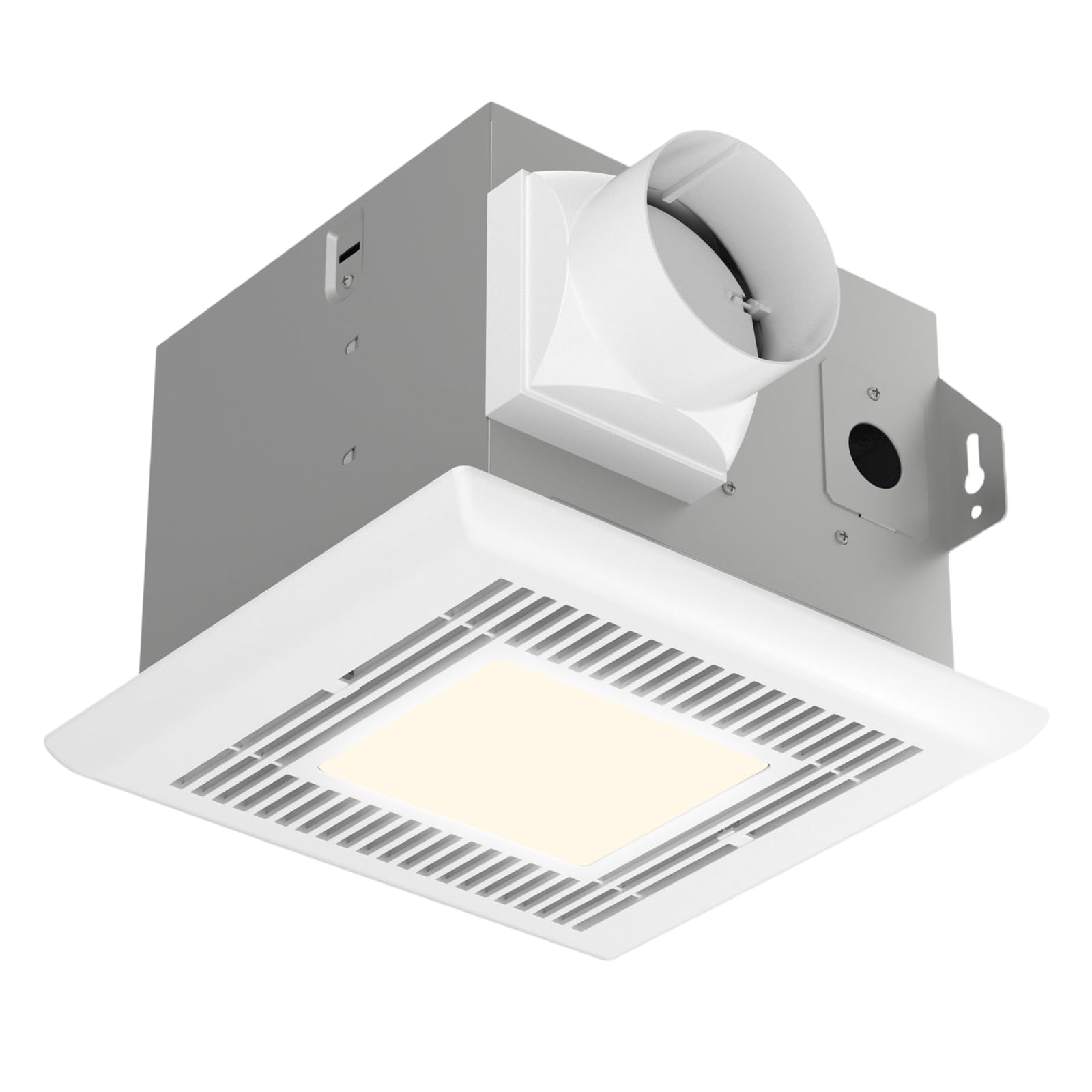
3. Tech Drive Bathroom Fan with Light, Very-Quiet 70 CFM, 2.0 Sone, 3 Inch Duct
A single fixture that lights the room and pulls the steam — with no cutting of a new ceiling opening.
This one is built for the person replacing a tired fan in a small bath who wants light from the same grille. It moves 70 CFM, rated for bathrooms up to 75 square feet, and its integrated LED outputs 600 lumens at 4000K. It replaces most small bathroom fans using the existing ceiling opening, with a housing measuring 7.5 by 7.25 by 6 inches.
Compare it to the Amico further down: same idea, different spec mix. The Tech Drive moves 70 CFM at a stated 2.0 sones, while the Amico moves 80 CFM at 1.0 sones — more air and less noise if quiet matters more to you than the LED module. Wiring can split the light and fan onto separate switches if you want that control, and the unit is UL and HVI certified and listed as acceptable over a tub or shower when installed on a GFCI-protected circuit.
The thing buyers keep praising is the brightness — that is the most-praised quality here — followed by how well it moves air. The honest catch is the noise and quality feedback, which is genuinely mixed rather than uniformly bad. Some owners hear only “a little noise, which is completely acceptable,” while others find it louder than the label suggests. The bigger practical limit is the 6-inch housing height: if your old fan sat in a 4-inch-deep space, you will need to check that the ceiling is deep enough, because one owner had to notch a rafter to make room. Expect a fiddly spring-loaded grille and a trim ring that some owners seal with silicone to sit flush.
Why it earns a slot: a 600-lumen LED plus a 70 CFM fan in one drop-in ceiling fixture, certified for over-tub use on a GFCI circuit.
What to verify first: six inches of housing height and a 3-inch duct connection — a shallow joist bay and a wider duct can both rule this unit out.
Pick this one when: you want light and ventilation from one grille in a bathroom up to 75 square feet.
Skip past it if: your ceiling cavity is only four inches deep or your existing duct is 4 inches wide.
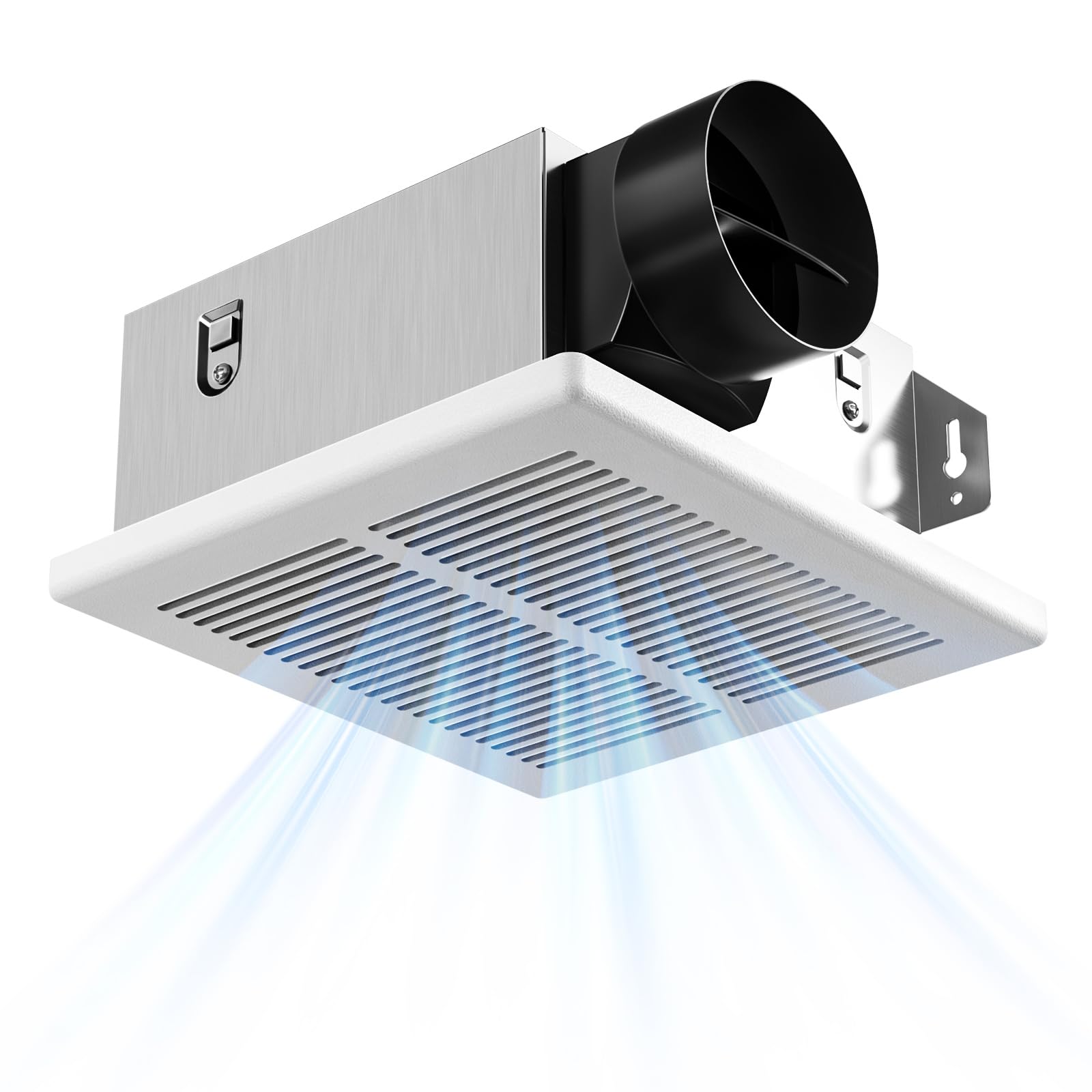
4. Amico Bathroom Exhaust Fan, 1.0 Sones, 80 CFM, No Attic Access Needed
Four inches of housing depth that slides between tight joists without sawing into the ceiling cavity.
Where the Tech Drive needs six inches of height, this one needs four — a housing measuring 7.5 by 7.2 by 4 inches — which is exactly what makes it the practical pick for a shallow 2×6 ceiling bay. It moves 80 CFM at 1.0 sones — enough for a bathroom up to 80 square feet — and owners consistently call it quiet. At 4.3 pounds, it is light enough to hold overhead while you drive the brackets in.
Installation is the second-most-praised quality here, and the details are unusually good: brackets let you mount between ceiling joists or screw straight into one, and there are screwless, wire-nut-free Romex wiring points. Owners replacing existing units frequently note that the compact housing slides into the old space. The 9.4 by 8.6 inch grille covers a 7.6 by 7.3 inch cutout, and the unit takes a standard 4-inch duct. It is UL listed, with a metal and polycarbonate construction.
Quiet is what owners rave about most, and it holds up in a small half bath where a loud fan is unbearable. The honest limit is airflow in a genuinely big bathroom: 80 CFM is rated to 80 square feet, and the 4-inch duct run wants to stay short. There is also a normal spread of opinion on noise — most call it quiet, and at least a few find it a touch louder than expected. Treat it as the quiet, compact, budget-friendly replacement, not a whole-house solution.
The deciding spec: an 80 CFM fan at 1.0 sones in a 4-inch-deep housing — the shallowest in this roundup and the least likely to force a ceiling cutout.
Watch the run: a standard 4-inch duct works best when the path to the outside is short and straight.
Best fit: anyone replacing a fan in a shallow joist bay or a tight 2×6 ceiling who wants quiet above all.
Look at a bigger unit if: your bathroom is larger than 80 square feet or your duct run has several bends.
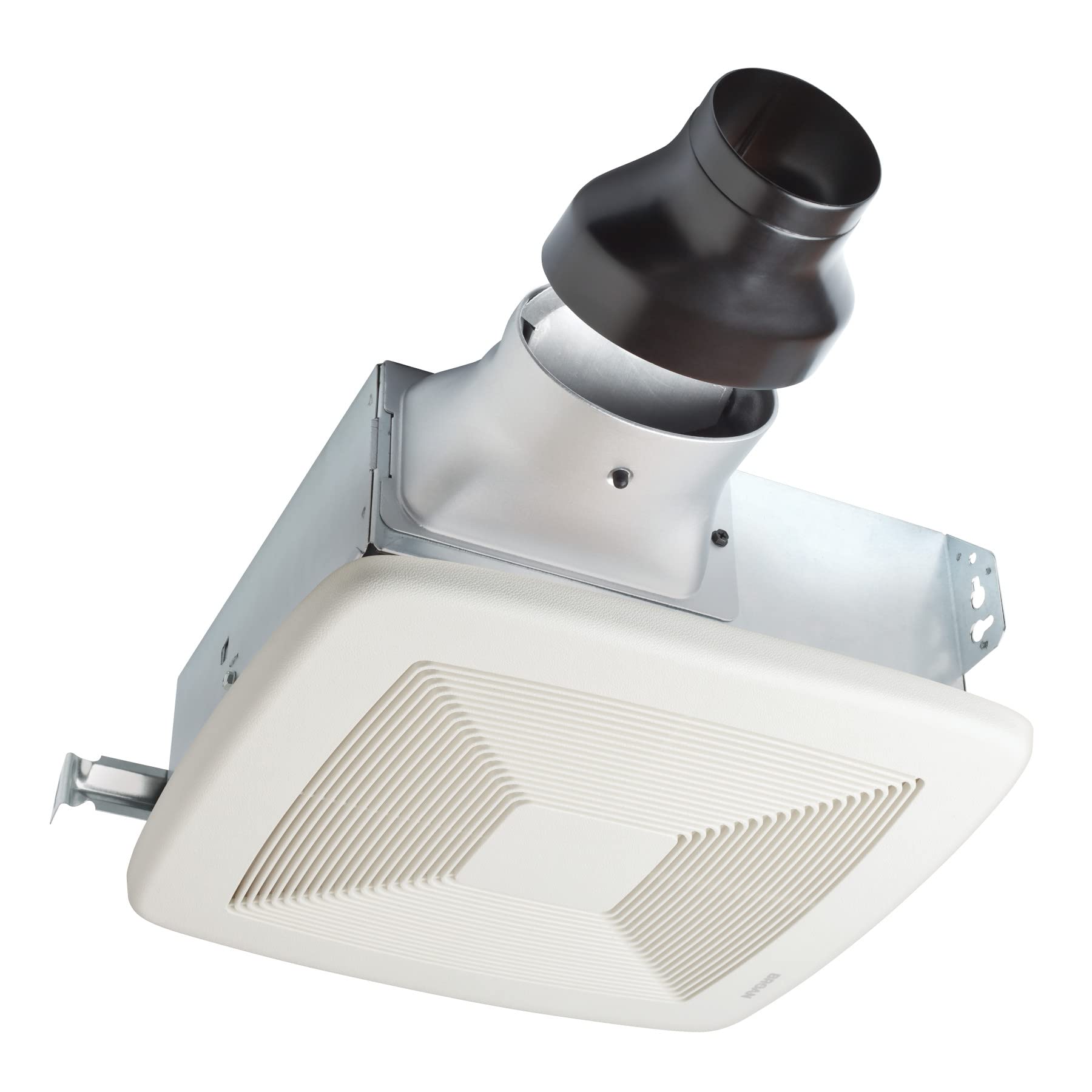
5. Broan-NuTone LP80 LoProfile 4″ Bath Ventilation Fan, 1.0 Sones, 80 CFM
A four-inch-tall housing that tucks into a 2×4 wall — the one to reach for when there is no ceiling room at all.
This is the fan for the awkward job: an interior bathroom with no attic above, or a spot where a ceiling unit simply will not fit. It slides into a wall between 2×4 studs, mounts in the ceiling just as easily, and has a galvanized steel housing measuring 10.5 by 11.38 by 4 inches under a paintable 13 by 14 inch white grille. It moves 80 CFM at 1.0 sones, enough for a room up to 75 square feet or a one-car garage. Duct flexibility comes from both a 4-inch oval and a 3-inch round connection.
Quiet is the overwhelming consensus — it is the most-praised trait by a wide margin — and owners describe it as barely audible in adjacent rooms. The fan uses a permanently lubricated plug-in motor and a dynamically balanced centrifugal blower wheel, which is the reason it stays smooth rather than rattling. It also clears steam and odor well enough that owners mention mirrors staying fog-free, and it carries ENERGY STAR certification.
Real DIY reality lands in one place: retrofit mounting. The unit wants to attach to a single stud, and the brackets above and below the housing mean you may be cutting drywall across the cavity plus several inches beyond if you are not building new. A 4-to-3 inch adapter adds height to the assembly. Install it during a remodel and it is straightforward; install it as a swap-in and bring a drywall saw. There is also a fair debate on size — some find the grille larger than expected for a low-profile unit.
Why owners recommend it: real 80 CFM airflow and 1.0 sone quiet in a four-inch-deep housing that fits a 2×4 stud bay, with both 3-inch and 4-inch duct options.
Honest note: the retrofit brackets are built for accessibility, so installing into a finished wall is more than a screwdriver job.
Reach for this if: you are venting a wall, working in a 2×4 cavity, or need a paintable grille to match your finish.
Think twice if: you want a true drop-in that needs no cutting into finished drywall.
6. Broan-NuTone 744 Recessed Light Ventilation Fan, 70 CFM, 1.5 Sones

It drops straight into the hole where an old recessed light already sits and hides as ordinary ceiling lighting.
If your bathroom ceiling already has a can light, this is the least invasive way to add ventilation. The trim is matched to the designs of major recessed light manufacturers, so once installed it reads as lighting, not a fan. The housing measures 6.87 inches high and fits new construction and 2×8 ceiling joists, with a 4-inch round duct connector.
Quiet is the consensus quality here — owners call it a low hum versus the noisy old units it replaces — and it clears shower steam fast enough that mirrors stop fogging. You can wire the fan and light on one switch or two separate ones. It uses a 75-watt R30 or BR30 bulb, and multiple units can be used in larger rooms. It is a great fit for a shower or tub enclosure and equally at home in a laundry room.
Two real caveats. First, this fan is not for use over cooking surfaces, so it is not a range hood substitute. Second, install detail matters: the metal casing has sharp edges that benefit from a quick deburr, and some owners find the light sits slightly off-center, needing a small patch. There is also a known rattle fix — crimp the hangers to the housing to stop the metal slides vibrating — which some owners skip and then blame the fan. If you want a sleek recessed look with decent airflow and quiet operation, this delivers.
What makes it clever: a recessed-light look that clears 70 CFM of steam from a standard ceiling cutout, with fan and light able to run on separate switches.
Install alert: the metal burrs and off-center fixtures mean the job is manageable but not purely plug-and-play.
Good for: replacing a ceiling can light with a quiet, recessed fan-light combo in a shower or laundry room.
Pass if: you want a fan over a cooking surface — this model is explicitly not for that.
7. Good Housekeeping Yorkshire (90053) Decorative 80 CFM 2.5 Sones Fan, Brushed Nickel

A brushed-nickel fixture you would hang on purpose, not just a grille you tolerate.
This is the pick for a remodel where the ceiling hardware is part of the design. It moves 80 CFM at 2.5 sones through a 4-inch duct, and its flush-mount screwless enclosure lets you re-lamp and clean without tools. The light and fan can run on the same switch or on independent switches, and it is ETL listed for use over shower enclosures and bathtubs on a GFCI circuit.
Appearance and quality are the two things buyers praise most — that is where the goodwill sits — followed by how quietly it runs. Owners describe it as attractive and unobtrusive, and the brushed-nickel finish reads as a design choice rather than a utility part. But there is water in the details: the four-inch outlet sits low on the housing, which means on a thicker ceiling the unit can recess further than expected.
The recurring installation gripe is a short bolt situation. On a thick plaster ceiling, the pre-installed light-fixture bolts can be too short to reach through, and owners have swapped in standard #10-24 bolts to solve it. It is a small fix, but worth knowing before you are on the ladder. The 2.5 sone rating is also the loudest on this list — that is the honest trade for a decorator fixture — so if quiet is your top priority, look at the Amico or Homewerks instead. The 14.17 by 14.76 by 9.33 inch footprint is generous, so this suits a large bathroom where the fixture is meant to be seen.
Where this wins: an HVI-certified 80 CFM fan built into a decorative brushed-nickel flush-mount fixture with a screwless enclosure for easy cleaning.
The catch: at 2.5 sones, it is the loudest option here, and the low-mounted 4-inch outlet makes thick-ceiling installs a tighter fit.
Choose it when: the bathroom is being styled and the fixture needs to look intentional, not industrial.
skip it if: quiet operation is your priority or your ceiling is thin drywall.
8. Homewerks 50 CFM 0.7 Sones Bathroom Exhaust Fan with LED Light

At 0.7 sones, this is the fan you will forget is running — for rooms at or under 50 square feet.
The number that defines this fan is 0.7 sones. On the sone scale, that is genuinely quiet territory — quieter than the 1.0 sone fans above and well under the 2.5 sone decorative pick. It moves 50 CFM, rated for spaces up to 50 square feet — the right size for a half bath, powder room, or guest bath. The round 13-inch grille covers a ceiling opening of 7.5 by 7.25 by 5.75 inches, and it connects to a standard 4-inch round duct.
Quietness and overall performance are what owners call out most — it is the recurring theme across the reviews. The built-in LED is a 4000K cool white that owners describe as bright enough to add real lighting to the space, and the galvanized steel build is designed to be corrosion resistant. The no-cut, ceiling-mount design helps on a swap where the existing opening lines up.
The catch here is that with 50 CFM, this fan is genuinely sized for a small room. If your bathroom is bigger than 50 square feet or has a long duct run, the airflow will feel underwhelming — that is the practical limit of a small, quiet fan, not a defect. Own setup also has some variation: most owners find installation straightforward, but a few report difficulty routing wires because there is not much room to terminate them inside the housing. Replacement of the LED bulb is not straightforward either, so plan on the light being a long-term fixture.
The headline spec: 0.7 sones at 50 CFM in a no-cut ceiling-mount package with a 4000K LED built into the grille.
Sized for: powder rooms, half baths, and small guest baths where quiet matters more than raw airflow.
The right call for: a small bathroom where a silent fan and a decent built-in light are the two things you care about most.
Look at the LP80 or Amico instead if: your room needs more than 50 CFM of pull or you want a replaceable light source.
9. Panasonic FV-08VRE2 WhisperRecessed Bath Fan + Recessed Light, 80 CFM
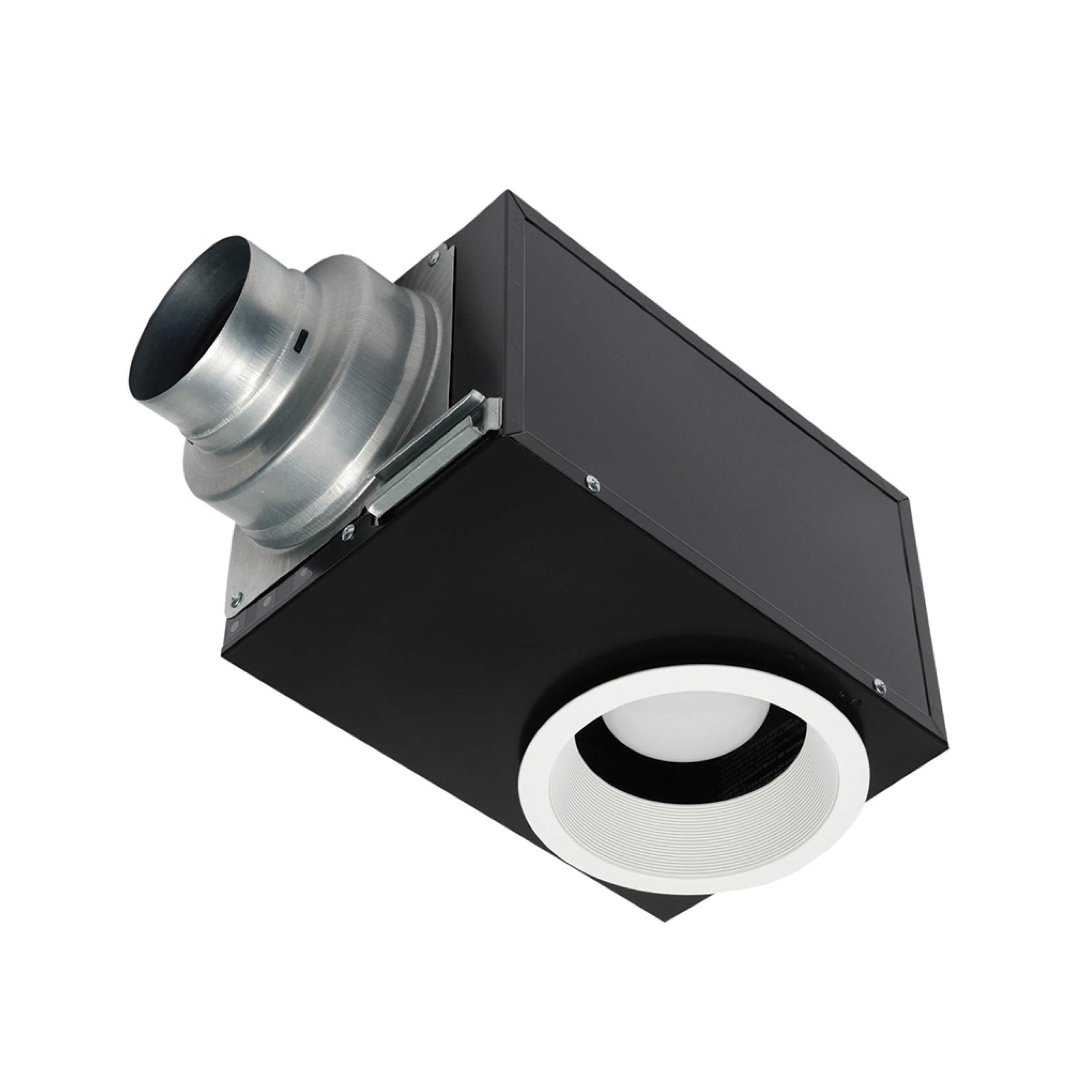
Architectural-grade ventilation disguised as an ordinary recessed light — with the airflow to prove otherwise.
This is the premium upgrade that hides a serious fan behind a recessed dimmable 11W LED. It moves 80 CFM through an integrated dual 4- or 6-inch duct adapter, so it matches the duct run you already have. The double hanger-bar system expands up to 24 inches, which lets you position the housing exactly where the ceiling framing allows, and it is UL listed for tub and shower enclosures. Total weight is 8.2 pounds.
The airflow is strong enough to do something owners find genuinely surprising: it will pull an enclosed shower glass door slightly open as it vents. That is the kind of real-world proof that 80 CFM is not just a number. Quiet is the other defining trait — Panasonic’s recessed line hides the fan behind the light so well that owners say it disappears visually and audibly. One buyer described the wattage trade-off honestly: “8W LED brighter (65W incandescent equiv), economical.”
The catch is the included bulb. It sits on a GU24 base that Panasonic manufactures specifically for this fixture, which means an adapter is often needed to run a standard bulb. It is a small hurdle, but it is a real one. There is also the installation story: without attic access the job relies on a swap into an existing recessed light hole, which is faster, but from above it is time-consuming. If you are installing this new, budget the time.
The upgrade case: 80 CFM of real airflow paired with a recessed dimmable 11W LED in a UL-listed tub and shower fixture that disappears into the ceiling.
Plan around: the GU24 bulb base (an adapter is your friend) and time the install for when you have attic access or an existing light hole.
Perfect when: you want the clean recessed look with strong airflow and quiet operation, and you already have a light-only hole to swap.
Consider a simpler unit if: you do not want to deal with a proprietary bulb base or a time-intensive ceiling install.
Understanding the Specs
Airflow (CFM) — how much air actually leaves
CFM (cubic feet per minute) is the volume of air the fan pushes out of the room each minute. Bathroom fans tend to be sized by room area — manufacturers commonly rate a fan for a maximum square footage, such as 50 CFM for up to 50 square feet, 70 CFM for around 75 square feet, and 80 CFM for larger spaces. But the duct limits the fan: a longer or bendier run can choke a fan that is technically big enough, which is why some manufacturers recommend stepping up to 6-inch ducting on longer runs. Match the CFM to the room first, then confirm your duct can carry it.
Sones — what quiet actually means
A sone is a measurement of perceived loudness, and the scale is steep. Under 1.0 sone is genuinely quiet — a fan you can leave on while you are still in the room. A 1.0 to 1.5 sone unit is a soft background hum you notice briefly. Once you pass about 2.0 sones you will hear it from the next room, and by 2.5 sones it is a clear presence. Quiet fans often cost more because the motor and housing are built to reduce vibration and turbulence — that is the reason the lower-sone models in this list carry a premium. If silence matters, treat the sone rating as the deciding spec and CFM as the second check.
FAQ
How many CFM do I need for my bathroom?
What is a sone and is 1.0 sones quiet?
Can I install a bathroom fan without attic access?
What duct size do bathroom exhaust fans use?
Why is my bathroom fan so loud?
Can a bathroom fan light be replaced separately?
Can I install a bathroom fan over a shower or tub?
Is a wall-mounted bathroom fan better than a ceiling one?
What is the difference between a bathroom fan and a range hood?
How long should a bathroom exhaust fan last?
Final Thoughts: The Verdict
For most bathrooms, the bathroom roof ventilation winner is the Panasonic FV-0511VFL1 WhisperFit because its selectable 50, 80, or 110 CFM airflow matches almost any room size, and its hinged Flex-Z Fast bracket lets a single installer hang it from below without attic access. If your ceiling cavity is shallow or your duct run is short, the Amico Bathroom Exhaust Fan slots its 4-inch-deep housing into tight joist bays at 80 CFM and 1.0 sones, and for a small powder room where silence is everything, the Homewerks 50 CFM runs at just 0.7 sones. Whichever you pick, match the CFM to your square footage, check your duct diameter before ordering, and confirm the housing fits your ceiling depth — those three checks decide whether the install takes an afternoon or a weekend.
How We Picked
We do not accept paid placement. Every pick is matched to a real buyer and a real use-case; we do not hands-on test units.
Sources & Methodology
Specifications: manufacturer listings and product documentation. Review insights: verified customer reviews, as of September 2026. Pricing: not shown on this page (it changes often); check the current price via the retailer link.
As an Amazon Associate, KitchPrep earns from qualifying purchases. This does not affect which products we feature.
Related Guides
