
Specs are compiled from manufacturer listings and verified buyer reviews and can change over time — please confirm the key details on the product page before buying.
If you want hot water at a single sink without tearing open a wall for a 240-volt line, a 120-volt tankless heater is the honest answer — and the Camplux 4.5kW is the one to buy first. It plugs into the wiring most homes already have, it mounts in a cabinet, and at 4.5kW it is the strongest heater in this entire roundup. Everything below explains who each unit actually suits.
I’m Mohammad Maruf — the founder and writer behind KitchPrep. This guide is built by comparing the manufacturers’ published specifications and the patterns across verified customer reviews, so you get each pick’s real strengths and trade-offs instead of marketing spin.
These units warm water at one tap, not a whole house, and the wattage rating tells you how much heat you actually get. That single number is why 120 volt tankless water heater shoppers should start at 4.5kW, not at the cheapest box on the shelf.
Our Picks at a Glance

How To Choose The Best 120 Volt Tankless Water Heater
A 120-volt tankless heater is a point-of-use appliance. It heats water for one faucet, right where that faucet is, and it never runs out. It is not a whole-house replacement, and no 120-volt unit on the market will run a shower the way a tank does. Knowing that limit before you buy saves you a wasted purchase.
Wattage decides your temperature rise
Wattage is the heating muscle, and in the 120-volt world it runs from 2400W up to 4.5kW. More watts means the unit can lift the water temperature further at the same flow. That number, not the box size, separates a unit that only takes the chill off from one that delivers genuinely hot water.
Flow rate and temperature rise work as a pair
Temperature rise is how many degrees the heater adds to the water coming in. Push more water through per minute and the rise drops. A heater rated for a big rise at low flow will only manage a small rise at high flow, so match the unit to how fast your faucet actually runs.
Check your wiring before anything else
Some units come with a plug and some must be hard wired to a dedicated breaker. The Camplux 4.5kW, for example, needs a 40A circuit breaker and 10AWG wire — that is a real electrician job, not a plug-in swap. Confirm what your wall can supply before you order.
Quick Comparison
| Model | Best For | Heat Output | Power / Connection | Item Weight | Amazon |
|---|---|---|---|---|---|
| CAMPLUX 4.5kW Tankless Water Heater★ Best Overall | Strongest single-sink heat | 4.5 KW | 120V, must be hard wired (40A breaker) | 4.5 pounds | Amazon |
| Mini Instant Under Sink 3kW Plug In | Easiest plug-in under-sink install | 3000 watts | 120V plug in | — | Amazon |
| GE Appliances 3.5 kW 120v Tankless Water Heater | Remote temperature control | 3.5 kW / 0.7 GPM | 120V, wall mount | 4.7 pounds | Amazon |
| Chronomite Labs 2400W Electric Tankless Water Heater | Low-draw commercial point-of-use | 2400 watts | 120VAC, 20 amps, 12 AWG | 4 pounds | Amazon |
In‑Depth Reviews
1. CAMPLUX Tankless Water Heater Electric 120V, 4.5kW Point of Use
Our pick — over 4★ from 100+ verified ratings; the strongest balance of quality and price.
The highest wattage in this roundup — 4.5kW, with hot water in about three seconds at one sink.
For a sink that needs to fill a pot or a basin with genuinely hot water, this is the pick. Its 4.5kW heating element is the highest output in this group, and at 1.0 GPM it lifts the water temperature by 50°F. That figure is the whole story: it means a cold kitchen line comes out hot enough to work with, not merely less chilly than before.
Steady hot water is what buyers praise most here, and they praise it more than any other trait. Owners say they replaced a failed unit and found this one simply consistent, with no temperature swings mid-use. One buyer who swapped out a 17-year-old heater said it “heats up pretty well,” and buyers report real repeat-purchase loyalty. It also mounts at multiple angles in tight spaces, and the housing measures a notably slim 7.4″W (7.4 inches wide) — narrower than the GE unit’s 9.9″W footprint, so you get more clearance beside a disposal or a shutoff valve. On weight, the Camplux comes in at 4.5 pounds against the Chronomite’s 4 pounds, so neither is a burden on a cabinet wall.
The honest catch is installation. This unit does not plug in — it must be hard wired, and it needs a 40A circuit breaker with 10AWG wire and a 1/2″ NPT water connection. If your cabinet only has a standard outlet, budget for an electrician or choose the plug-in LECLOC below. Activation also needs at least 0.26 GPM of flow, so a trickling faucet will not fire it. A small number of buyers, including one writing in Spanish, found the output simply not hot enough for their taste.
What earns it the top spot
- 4.5kW is the strongest heat output in this comparison
- 50°F temperature rise at 1.0 GPM — real hot water, not lukewarm
- Heats in about 3 seconds with a self-modulating design
- Slim 7.4-inch width and multi-angle wall mounting
- Touch panel with LED digital temperature display
What to plan around
- No plug — hard wiring and a 40A breaker are required
- 0.26 GPM minimum flow to activate
- Two-year limited warranty only
Reach for this if: your cabinet has a 40A circuit available and you want the hottest single-sink output on the list.
Look elsewhere if: you want a plug-in you can hang today — the LECLOC model below skips the wiring entirely.
2. Mini Instant Under Sink Tankless Water Heater 120V 3kW Plug In, LED Display
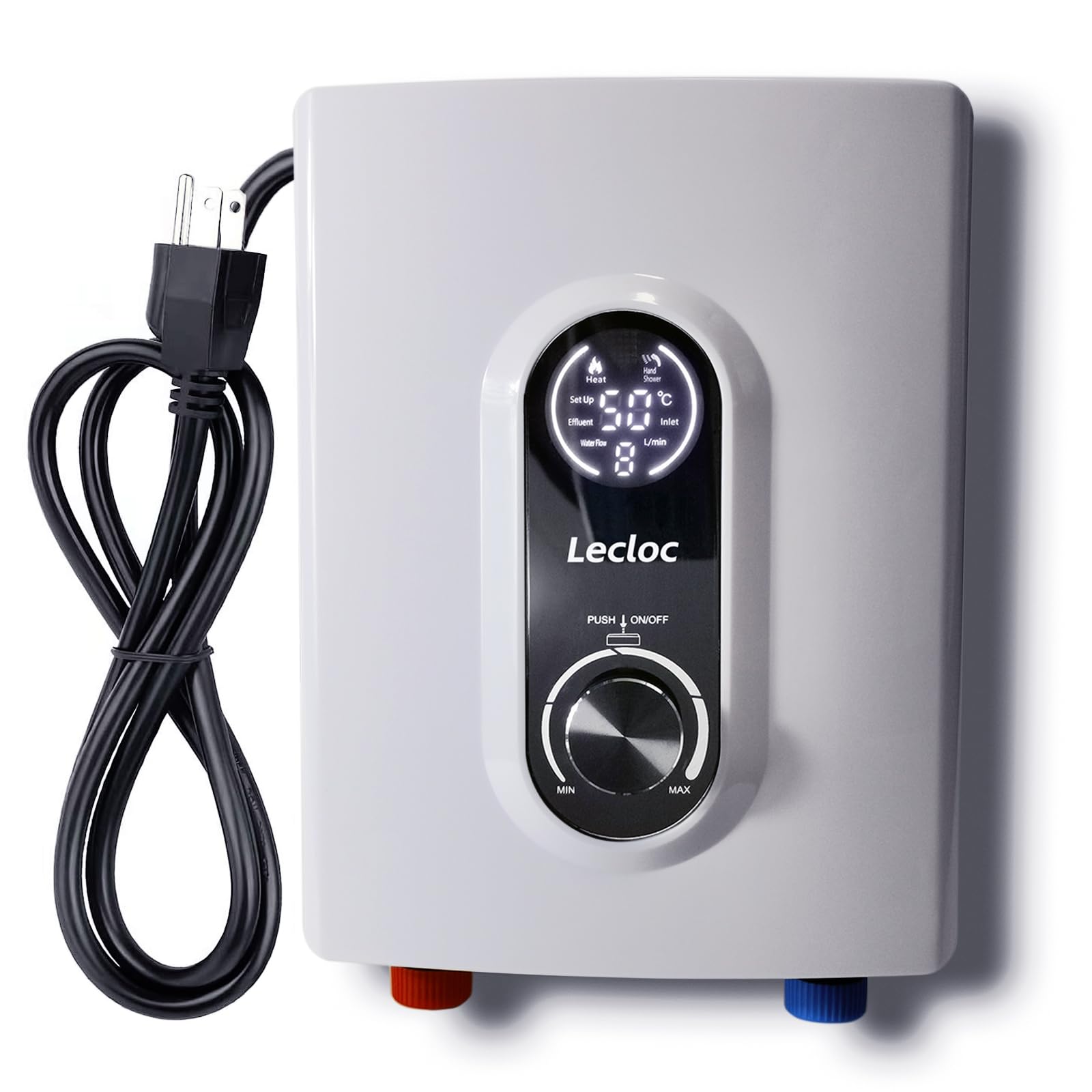
A 3kW plug-in you hang yourself, with a single knob instead of touch buttons.
Its defining number is 3kW at 120 volts, and the listing is refreshingly blunt about what that means. This is a low-flow unit, built for one tap, and the maker itself does not recommend it for showers or multiple faucets at once. Set your expectations there and it does a clean job: 24-hour warm water on demand with no preheating, and the compact 7.1″ x 9.8″ x 2.8″ body slips into a kitchen, laundry, basement, or garage cabinet.
A single big knob controls both power and temperature, which beats pecking at three small touchscreen buttons with wet hands. Safety coverage is thorough for the category — overheat protection, leakage protection, dry-heating protection, over-pressure protection, and IPX4 waterproofing, which simply means it shrugs off splashes. The clock is the weak point. One owner who replaced a 50-gallon tank serving a clubhouse with three sinks reported lower energy costs, and the thread size and small lever fit tight spaces well. But others found only about a second of truly hot water before it settled into warm, and one returned a 3000 and still found the upgraded 6000 only marginally better. For a detached-garage handwashing sink, that is fine. For anything more, it is not.
The narrow use case: this is an under-sink warmer for a single low-flow tap, and it does that job well. Install is genuinely simple when the threads cooperate — a 1/2″ MPT nipple and FPT coupling solved the spacing for one buyer — though a couple of owners found the male threads tricky to seal in PVC.
Facing reality: three kilowatts on 120 volts is a modest heating budget, so the water arrives warm rather than scalding. If your sink sees heavy use or you want real hot water from a cold line, the Camplux at 4.5kW is the better call.
Worth it for: renters and DIY installs where plugging into a standard outlet under the sink is the whole point.
Not your unit if: you expect hot water at high flow — this one is explicitly a low-flow, single-tap warmer.
3. GE Appliances 3.5 kW 120v Tankless Water Heater with Digital Temperature Control

A 30-foot remote and a five-year replacement warranty — the longest coverage here, but not a shower fix.
Where this GE leads is control and coverage. It ships with a remote that adjusts temperature from up to 30′ away, so you can dial in settings from across the room rather than crouching under the cabinet. And the 5-year replacement warranty is the longest protection in this roundup — the Camplux and the LECLOC offer nothing close.
The performance figures tell you who this is for. It flows up to 0.7 GPM, enough for a single faucet, and that rating assumes 72°F inlet water warming to 105°F outlet. In a warm climate or a well-insulated house, that is usable kitchen-sink hot water. In a cold climate with 50°F ground water, the same 3.5kW has to work much harder to reach the same temperature. It is a point-of-use appliance and it installs exactly where you need it, with digital temperature control to fine-tune the output.
The fair caveat is heat. This is the model where owners most often describe wanting more, with several noting it warms rather than truly heats. One buyer in Florida summed it up plainly: “It warms the water, but not hot.” That makes it a poor fit for a shower and a fine fit for taking the chill off a single kitchen tap. The 9.9-inch width is the widest in this comparison — wider than the LECLOC’s 7.1-inch body — so measure your cabinet clearance before ordering.
The long-view pick: a 5-year replacement warranty and remote temperature control are the two things you cannot get elsewhere in this group. If reliable coverage matters more than raw heat, that combination is the argument.
Suits: anyone in a warmer region who wants remote temperature control and the longest warranty here.
Skip if: you need hot water for a shower or you live where the incoming water runs genuinely cold.
4. Chronomite Labs 2400W Electric Tankless Water Heater, 120VAC

At 2400W, the lowest draw here — and the only unit that runs on existing 20A, 12 AWG wiring.
At 2400 watts running on 20 amps and 12 AWG wire, this is the gentlest electrical demand in the roundup, and that is precisely its purpose. If your sink already sits on a modest circuit, this is the unit that may not force a rewire. It connects to a cold water line only and comes without an electrical cord or plug, so expect a hard-wired install — one owner found the support line genuinely helpful and the return process simple.
Read the temperature-rise numbers honestly. At 0.5 GPM it adds 33°F; push to 1.5 GPM and the rise falls to 12°F. That is a hand-washing and rinsing heater, not a dishwashing main. Owners who use it that way are content — it is deployed in hall baths, powder rooms, and office breakrooms where plenty of warm water on demand is the goal. Those expecting real heat are not; the recurring theme in the reviews is water that only warms slightly, and a few units simply failed to perform. The design is genuinely compact at 4 pounds, and it carries a UL listing along with ADA, IAMPO, and HUD standards.
Where it holds its niche
- Runs on 20 amps and 12 AWG wire — lightest draw on the list
- UL listed, plus ADA, IAMPO, and HUD standards
- 4 pounds and a compact point-of-use body
- Installs in hall baths, powder rooms, and breakrooms
The trade-off to weigh
- Only 2400W, so water stays lukewarm at best
- Cold water line only — no cord or plug included
- 33°F rise at 0.5 GPM drops to 12°F at 1.5 GPM
A good match: commercial restrooms and hand-wash stations on existing light-duty wiring, where the goal is warm rather than hot.
Pass on it if: you want dishwashing-hot water — the 4.5kW Camplux delivers that where this 2400W unit cannot.
Understanding the Specs
Kilowatts and temperature rise
Kilowatts measure the heating power, and the temperature rise is how many degrees that power adds to the incoming water. The two are tied together: a larger rise needs more kilowatts or a slower flow. The Camplux adds 50°F at 1.0 GPM with 4.5kW, while the Chronomite manages 33°F at half a gallon per minute with 2400W. Higher wattage buys you hotter water at the same tap speed.
Flow rate and activation
Flow rate is simply how many gallons move through the unit each minute, and every heater has a minimum needed to switch on. The Camplux needs 0.26 GPM and the Chronomite needs 0.40 GPM. Crack your faucet open too gently and neither one will fire — the water stays cold until enough runs through. A point-of-use heater bolted to a sink is matched to that one tap’s flow, so a weak stream is the usual reason a unit seems dead.
FAQ
Can a 120 volt tankless water heater run a shower?
What size circuit breaker does a 120V tankless heater need?
Do these units plug in or do they need hard wiring?
What does temperature rise mean for my water?
Will a 120 volt unit give me truly hot water or just warm?
How much space does an under sink tankless heater need?
Does a tankless heater save energy compared to a tank?
What is the minimum flow to turn one of these on?
Can I use one heater for two sinks at once?
How long should a point of use tankless heater last?
Final Thoughts: The Verdict
For most people, the 120 volt tankless water heater winner is the Camplux 4.5kW because it delivers the highest heat output in this comparison and lifts water by a full 50°F at 1.0 GPM (gallons per minute, the flow rate) — the strongest single-sink performance you can get on 120 volts. If plugging into a standard outlet matters more than maximum heat, grab the LECLOC plug-in 3kW, which installs in minutes with no wiring. And for a low-draw commercial hand-wash station on existing light wiring, the Chronomite 2400W is the one built for the job. The GE 3.5kW rounds out the list with the longest warranty and a 30-foot remote. Whichever you choose, match the wattage to your wiring first — that one decision is what keeps the install simple.
How We Picked
We do not accept paid placement. Every pick is matched to a real buyer and a real use-case; we do not hands-on test units.
Sources & Methodology
Specifications: manufacturer listings and product documentation. Review insights: verified customer reviews, as of September 2026. Pricing: not shown on this page (it changes often); check the current price via the retailer link.
As an Amazon Associate, KitchPrep earns from qualifying purchases. This does not affect which products we feature.
Related Guides
