
Specs are compiled from manufacturer listings and verified buyer reviews and can change over time — please confirm the key details on the product page before buying.
You don’t need a window to cool a garage — you need a unit that vents somewhere else, and only two types do that: a ductless mini-split mounted through the wall, or a portable AC that pushes its hot air out through a hose you run through a drilled wall, a floor vent, or a door gap. That is the whole answer, and everything below is about picking the right one of those two for your space. A mini-split needs a pro to install but runs quieter and cheaper over years; a portable AC you can roll in and set up yourself in an afternoon.
I’m Mohammad Maruf — the founder and writer behind KitchPrep. This guide is built by comparing the manufacturers’ published specifications and the patterns across verified customer reviews, so you get each pick’s real strengths and trade-offs instead of marketing spin.
Sizing comes first, because a unit that is too small for your square footage will run nonstop and never catch up. The picks below span portable and ductless options with the BTU ratings, SEER2 efficiency grades, and real owner feedback you need to match one to your garage. These are the strongest performers among the ac for a garage with no windows options worth considering.
Our Picks at a Glance


How To Choose The Best AC for a Garage with No Windows
A garage with no windows is not a harder job — it is just a different one. You cannot slide a window unit into a frame that does not exist, so your only two routes are a ductless mini-split (an indoor head on the wall connected by pipes to an outdoor condenser) or a portable AC that exhausts hot air through a hose. Almost every mistake buyers make with a garage depends on undersizing the unit or forgetting that garages hold heat far longer than a bedroom of the same size.
Pick your venting route first
A ductless mini-split needs a hole drilled through an exterior wall, roughly three inches wide, for the refrigerant lines and drain. That is the only opening required, and no window is involved at all. A portable air conditioner needs a hose routed outside — most buyers run it through the wall, a floor vent, or an existing door gap with a sealing panel. If you rent and cannot drill, the portable route is usually the practical one. If you own the garage and plan to stay, the mini-split route is quieter and cheaper to run over a summer.
Size the BTU to the garage, not the room type
Garages are usually uninsulated, so they lose cool air faster than a living space. As a general rule of thumb, you want more cooling capacity per square foot in a garage than in a bedroom. A 12,000 BTU unit can handle a smaller single-car garage in a mild climate; an 18,000 BTU unit is the usual pick once you cross roughly 750 to 1,000 square feet or deal with harsh summers. Go bigger than you think you need, and a variable-speed inverter compressor will throttle down on mild days instead of cycling on and off.
Check the vent hose or line-set length against your layout
Portable AC hoses are typically around five feet and often cannot be extended without hurting cooling performance — so plan to place the unit near the wall you will drill through. Mini-split line sets commonly run 16 feet, and if your indoor head and outdoor condenser are farther apart than that, you will need to buy more copper line and have refrigerant added by a technician. Measure the run before you buy anything.
Understand SEER2 and what it does for your bill
SEER2 is a standard efficiency score for cooling equipment — higher numbers mean the unit uses less electricity to produce the same cooling. Inverter compressors sit at the heart of this: instead of shutting off and restarting at full blast, they vary their speed to hold the temperature. That is why two units with identical BTU ratings can run very different monthly costs. If your garage will be cooled daily through a hot season, the higher-SEER2 pick usually pays the difference back over a few years.
Quick Comparison
| Model | Best For | Cooling Capacity | Efficiency Rating | Form Factor | Amazon |
|---|---|---|---|---|---|
| Gasbye Dual Hose Portable AC★ Best Overall | Best balance of power, quiet and value | 14,000 BTU ASHRAE (10,500 BTU SACC) | 13.6 CEER | Portable (dual-hose) | Amazon |
| ROVSUN 11500 BTU Wifi Mini SplitBest Budget Split | Year-round heating and cooling on a budget | 11,500 BTU | 17 SEER2 | Ductless mini-split | Amazon |
| YITAHOME 12000 BTU Mini SplitDIY-Friendly Split | DIY-friendly install in a mid-size garage | 12,000 BTU | 20 SEER2 | Ductless mini-split | Amazon |
| ZAFRO Smart Inverter Portable AC | Quick cooling with self-evaporating drainage | 14,000 BTU (10,000 BTU SACC) | 12.8 CEER | Portable (dual-hose) | Amazon |
| DREO Portable AC 515S | Small single-bay garage, coolest setpoint | 12,000 BTU ASHRAE (8,000 BTU DOE) | 6.1 SEER | Portable (single-hose) | Amazon |
| DELLA Motto 18000 BTU Mini Split | Large garage, cold-climate heating | 18,000 BTU | 19 SEER2 | Ductless mini-split | Amazon |
| Cooper & Hunter MIA 12,000 BTU | Small workshop, sub-zero heating headroom | 12,000 BTU | 21.2 SEER2 | Ductless mini-split | Amazon |
| DELLA Vita 18000 BTU Mini Split | 1000 sq ft garage with heavy insulation demand | 18,000 BTU | 20 SEER2 | Ductless mini-split | Amazon |
| Senville LETO 18000 BTU | Value 18,000 BTU with longest warranty | 18,000 BTU | Not stated | Ductless mini-split | Amazon |
| Pioneer Diamante Pro 18000 BTU | Maximum efficiency, lowest noise | 18,000 BTU | 21.0 SEER2 | Ductless mini-split | Amazon |
In‑Depth Reviews
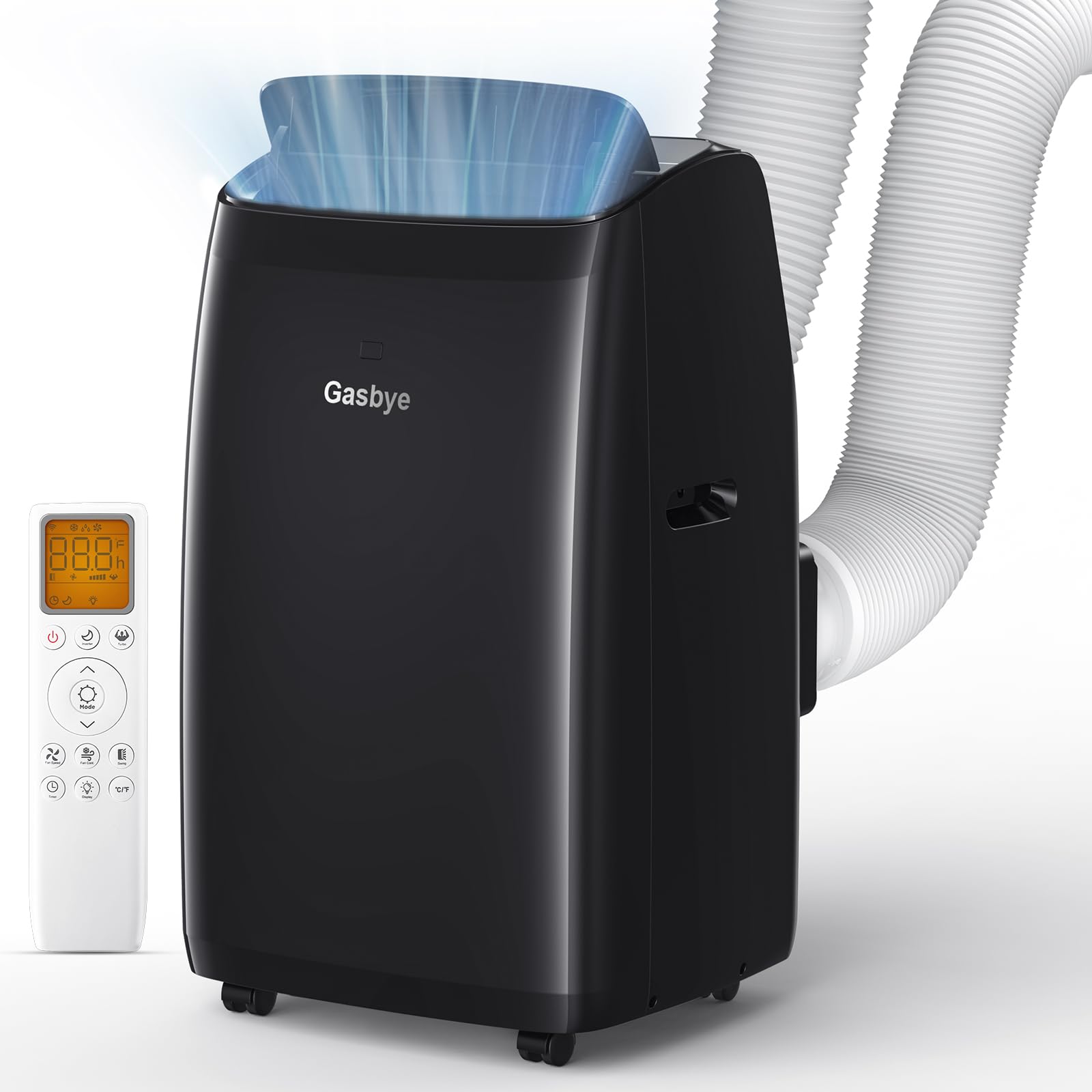
1. Gasbye Dual Hose Portable Air Conditioner, 14,000 BTU DC Inverter
Our pick — over 4.5★ from 450+ verified ratings; the strongest balance of quality and price.
The dual-hose portable that cools a garage without ever stealing its air supply.
Here is the version of the portable-AC story that actually works in a sealed garage: two hoses, one drawing outside air in and one pushing hot air out, so the unit does not fight itself. Single-hose portables tug air from the room they are cooling, and in a closed garage with no window to trickle air back in, that means pressure fighting and warm air creeping in from every gap. This 14,000 BTU ASHRAE unit (10,500 BTU SACC — the stricter rating that reflects real-world cooling) sidesteps that entirely. Its dual-hose design keeps the garage at balanced pressure while it drops the temperature from 61°F to 90°F.
Efficiency is where this one separates from the pack. It is rated 13.6 CEER, a cooling efficiency score that measures how much electricity the unit burns per unit of cooling — high enough that it claims the best-in-market energy efficiency position. Inverter mode draws about 500–800 watts versus around 1,300 watts in Turbo Mode. Inverter mode drops the compressor to 50% load within two minutes, cutting noise to about 45 decibels — quieter than a normal conversation, and the reason buyers report they forget it is running during garage work sessions. The backlit remote and Display Off feature keep the panel from glowing at night.
Owner feedback is the strongest signal here: this is the model buyers return to. Owners repeatedly report it cooling a 1,000 sq ft space to 68°F when it was 103°F outside. The honest trade-off, and it appears consistently, is that the temperature readout can drift 2–5°F from the setpoint, so trust a separate thermometer in the garage rather than the display. Owners in high humidity also report needing to drain condensate manually several times a day.
What earns it first place
- Dual-hose venting means no negative pressure — no hot air pulled back into your garage
- 13.6 CEER and Inverter mode drop power to around 500–800 watts when full cooling is not needed
- 45 dB compressor sound is quiet enough to talk over — a real difference from single-hose units
Where it asks patience
- The thermostat reads 2–5°F off from the actual room temperature — trust a separate thermometer
- In humid regions the reservoir can need draining several times per day
- The vent hoses are uninsulated and thin — sleeves make them tidier if you care about looks
Anchor this one if: your garage has no window and you want portable cooling without a pro installer — the dual-hose block vents through a wall or door gap just as easily.
Look past if: your garage runs over 85% humidity year-round and you would rather not touch a drain pan.
2. ROVSUN 11500 BTU Wifi Enabled Mini Split Air Conditioner & Heater
A wall-mounted split that cools and heats a garage through one small wall hole.
If your garage sees both summer heat and winter cold, a heat pump mini-split earns its keep faster than a cool-only portable. This one runs 11,500 BTU of cooling and 11,500 BTU of heating, and the all-season setup includes defrost, a 24-hour timer, wind swing, sleep mode, and ECO mode. It is wired for 230V and requires professional installation, but the reward is a system mounted permanently through a single wall penetration — no floor space lost, no hose to run, and no window ever needed. Its 17 SEER2 rating beats the basic 14 SEER2 baseline, and ROVSUN rates it at 25% energy savings against that baseline.
Quietness is the headline spec here, and it is a real one: the indoor head runs at just 33 dBa at low speed. For context, a household refrigerator hums around 40 dBa — this is quieter than that. The display on the indoor unit can be switched off entirely at night so nothing glows over your workbench. It draws 1,404 kilowatt hours per year, versus 442 for the Gasbye dual-hose portable above — more annual power for cooling alone. But that comparison flips the moment you use this unit for winter heat, which the portable cannot do at all. You are paying for year-round coverage, not just July.
Owner feedback picks a clear favorite: what buyers value most is raw performance and year-round use — a West Coast user keeps a 16×40 ft building at a stable temperature through all four seasons, and a Massachusetts owner reports steady heating and cooling across record weather with no jump in the utility bill. The most common friction point in reviews is documentation — the install instructions get called incomplete, so plan on a licensed HVAC contractor and have them work from the outdoor unit’s spec plate rather than the printed guide. The value angle holds up well: it consistently gets compared favorably to pricier brands that do the same job.
Year-round math: a heat pump that handles both cooling and heating through a single wall penetration is worth the pro install costs if the garage will be used in winter as well.
What to know before you buy: the install documentation gets dinged in reviews — budget for an HVAC tech who is comfortable working without a clean guide, and pull the outdoor-unit label yourself if anything is unclear.
Strongest match if: you want one system doing summer and winter in a mid-size garage and you are comfortable hiring an installer.
Not the fit if: you want the absolute lowest annual power draw — the portable above runs leaner on cooling alone.
3. YITAHOME 12000 BTU Mini Split AC/Heating System
A 750-square-foot split with five modes and app control for the garage workshop.
When your garage is bigger than a single bay, this is the size to. 12,000 BTU of cooling covers up to 750 square feet on the manufacturer’s rating, and the system includes heat pump capability for winter, five operating modes (auto, cool, dry, heat, fan), a 24-hour timer, sleep mode, energy-saving mode, and an iFEEL mode that reads temperature from the remote rather than the wall unit. The 20 SEER2 efficiency rating is a genuine step up from budget splits — inverter compressors at that grade can cut power draw noticeably versus lower-SEER2 units. Noise stays below 41 decibels, and the unit is rated to operate in outside temperatures from 5°F up to 118°F.
Where this split stands apart from the other 12,000 BTU picks is the add-on set: it includes a washable air filter, “HEALTH” mode with negative ions and electrostatic dust removal plus PM2.5 filtration, and 4D airflow that reaches up to 50 feet from the vent. That last spec matters in a long garage — a bench at the far end still gets air. Included parts cover the indoor head, outdoor condenser, remote, and an installation kit, and it ships in two boxes that may arrive separately; the factory pre-charges the refrigerant. Installation is specified for licensed HVAC installers.
The buyer experience is genuinely split, and it is worth knowing exactly how before you commit. On the positive side, DIYers report installing it in a mobile home with thin insulation and running it happily, and one runs it off a 3,000W generator in a 14×24 sales shed, and other owners mention under 300 watts in milder operation. On the negative side, one buyer bought 15 units for small homes and discovered the manual requires the indoor air handler to sit more than 8 feet from the floor — a genuine problem in an 8-foot-ceiling garage, so read the clearance spec before you drill. Support also shipped the wrong model manual in that case, which delayed the install. Buy for the value and the app control; confirm the clearance numbers yourself before you buy.
What the count says: buyers single out performance the loudest and value follows close behind — this split performs at a level the price does not suggest.
The clearance catch: confirm the air-handler height requirement before install, because in an 8-foot garage ceiling that single number decides whether this system works at all.
Reach for it if: you want a 750-sq-ft split with app control and are OK drilling through one wall for the lineset.
Choose a portable instead if: your garage ceiling is exactly at 8 feet and you cannot verify clearance for the indoor head.
4. ZAFRO Smart Inverter Portable Air Conditioner, 14,000 BTU
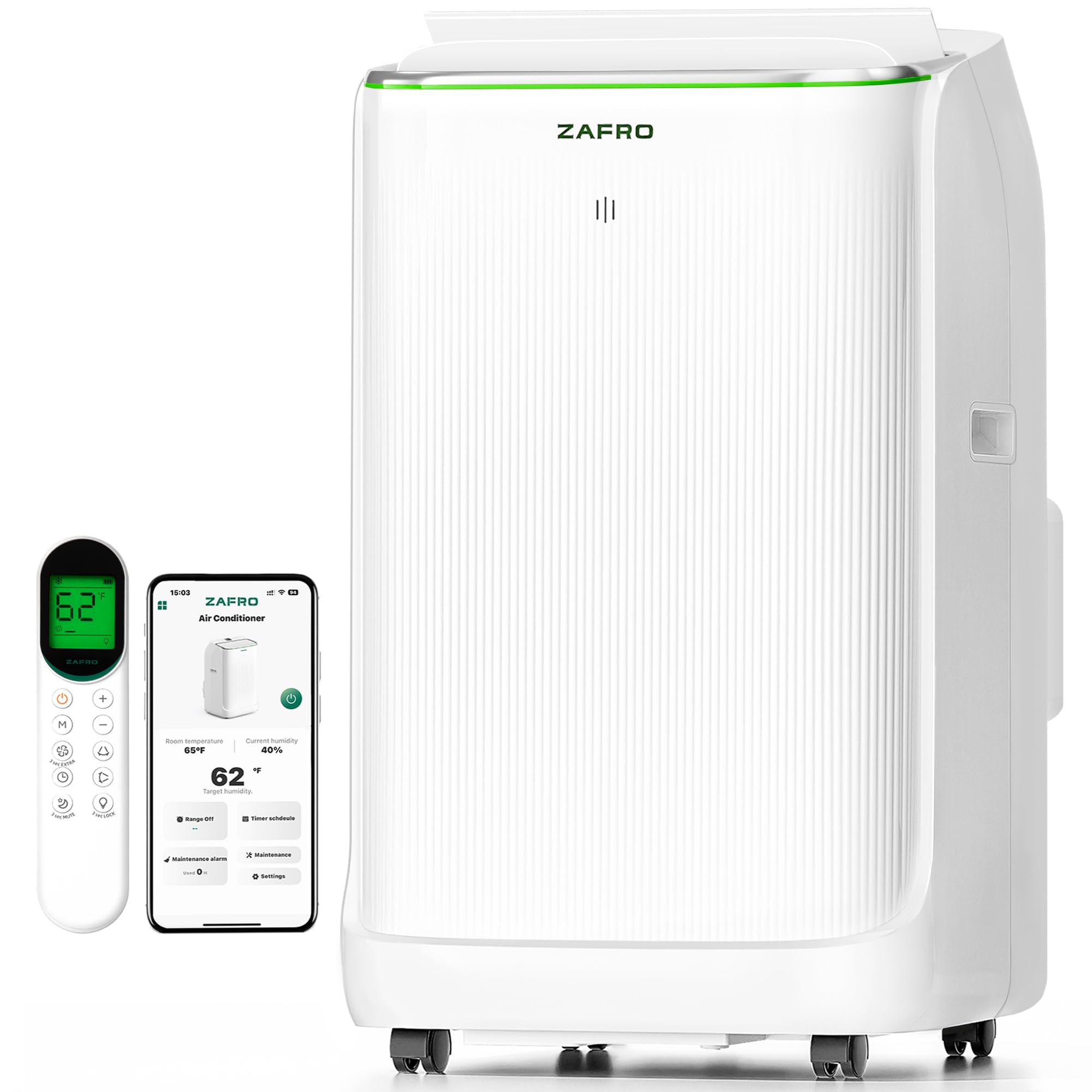
The portable that skips the drain pan for days at a time.
Portable ACs normally mean emptying a water tank, and in a humid garage that chore turns into a daily nuisance. This ZAFRO solves it with a self-evaporating condensate system: a water-slinging wheel throws the collected moisture into the condenser, where it evaporates out with the exhaust. Below 90% humidity it stays drainage-free for 72 hours; above that, the included drain hose handles the overflow.
Cooling is a genuine step up from a smaller single-hose portable: this is a dual-hose 14,000 BTU (10,000 BTU SACC) unit that moves 480 cubic meters per hour of airflow. That airflow number is what fans of this pick reference — it means fresh cool air reaches the far corners of a wide garage, and there is an Extra Mode that locks the temperature at 61°F and runs full power for instant relief on the hottest days. Instead of a fixed-speed compressor, the inverter adjusts speed to hold the temperature steady, and It earns a 12.8 CEER, well above the 7.83 baseline. For background noise, the unit runs as low as 42 decibels, quieter than a normal conversation.
The smart side is where it becomes convenient rather than just capable. App and remote control let you pre-cool the garage before you walk in, the 24-hour timer handles scheduling, and the smart app tracks filter life. Four-way oscillation aims air up-and-down and left-and-right so the whole room balances out. Six modes (cool, dry, fan, sleep, extra, eco) cover just about any working condition. If your garage is damp and you cannot run a permanent drain line, this is the pick that keeps the floor dry without you thinking about it.
Wins out for: garages with real humidity where you would rather not empty a drain pan every day.
The honest catch: above 90% humidity the self-evaporation cannot keep up, and you will be running the included drain hose after all.
5. DREO Portable Air Conditioner 515S, 12,000 BTU
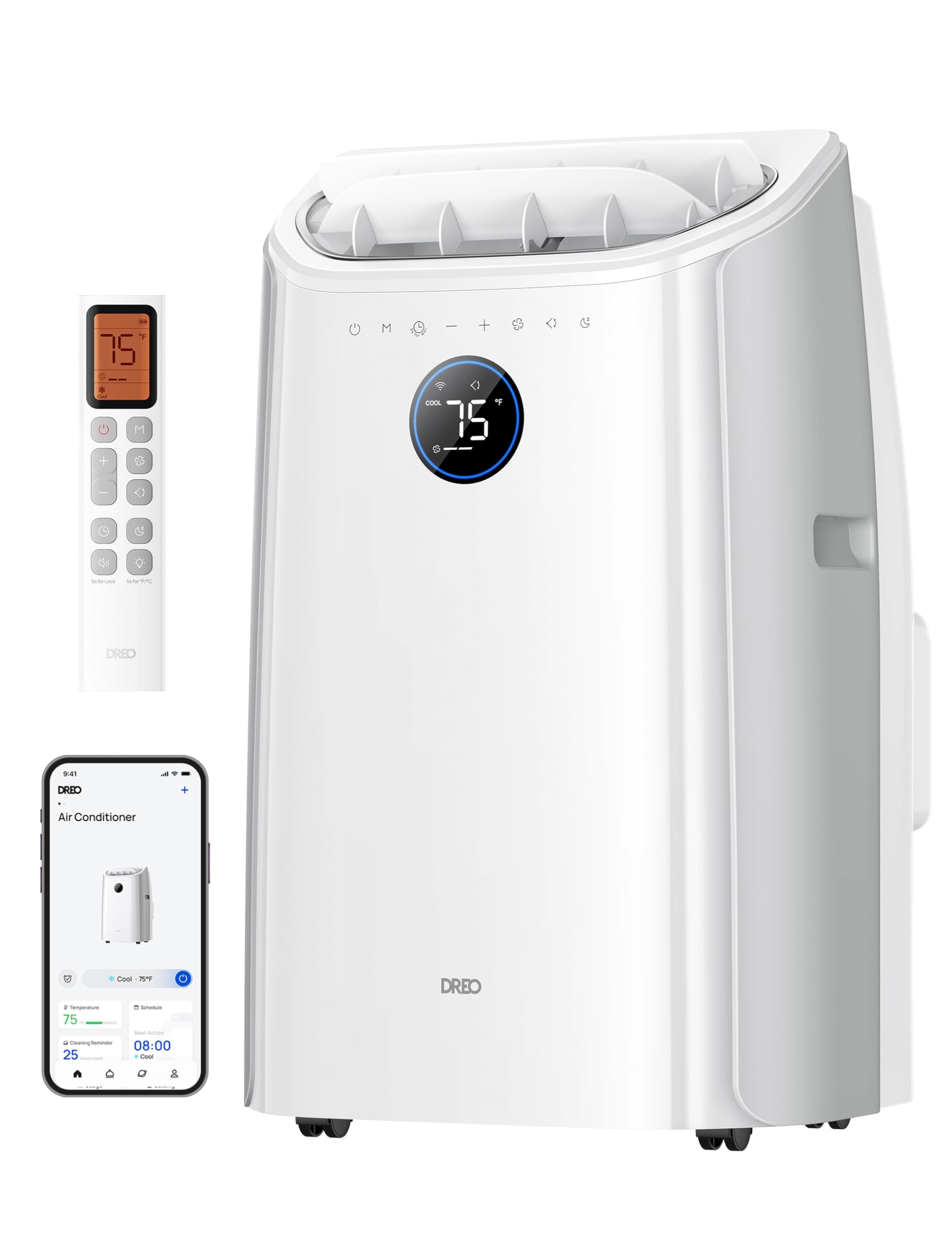
For a single-bay garage that needs quick cooling and voice control, not a permanent install.
This 12,000 BTU ASHRAE (8,000 BTU SACC) portable targets the smaller single-bay garage — the kind with a finished wall and enough power on the circuit. DREO’s patent-pending noise isolation system holds the compressor to around 45 decibels, and the unit runs a genuine drainage-free cool mode using an algorithm that evaporates condensation automatically in humidity below 90%. If you want voice control without a pro installer — the app works with Siri, Amazon Alexa, and Google Home — and you have a garage with a sealing panel, this is the entry point that fits on wheels and takes up a corner of the floor.
The features are where it lands for a lot of buyers. It covers 150 square feet on the manufacturer’s stated figure, and it cools down to 61°F, which is colder than most portables will go. The 3-in-1 role covers Cool, Fan, and Dry modes, with three sub-functions inside each. The 24-hour timer lets you pre-cool before you start work, and the sleep-curve function reduces fan speed gradually if the unit is used in a bedroom-adjacent space. Setup is reasonably quick — the kit includes a window vent assembly with weatherstripping, and buyers who have tried it in a small workshop report installing it in an hour or so.
The honest picture from owner feedback: this unit cools well and runs quietly for a portable of this size, which aligns with the volume of positive performance notes. The catch is ventilation on a standard single-hose setup — with only one exhaust hose, the unit pulls air out of the garage faster than it can be replaced, which is why sealing the door or wall gap around the hose really matters. On the noise front, an owner-measured test put the unit at 63 dB at 6 inches from the unit, 59 dB at 5 feet, and 45 dB only at 13 feet — so the 45 dB headline is a distance-sensitive number, and near-field noise is louder than the spec box suggests. The thermostat has also measured 2–5°F off from a calibrated reference. It is a strong small-garage pick, sized honestly, if you are clear about that single-hose caveat.
Cooling reach: down to 61°F in cool mode — colder than most portables and useful on the worst summer days.
Read the fine print: the 45 dB rating depends on distance from the unit, and near-field noise runs meaningfully higher.
Best for: a single-bay garage or workshop under roughly 150 square feet where you want voice control and a compact footprint.
Pass it if: your garage is a full two-car or larger — you need more BTU than this one carries.
6. DELLA Motto Series 18000 BTU Mini Split, 19 SEER2
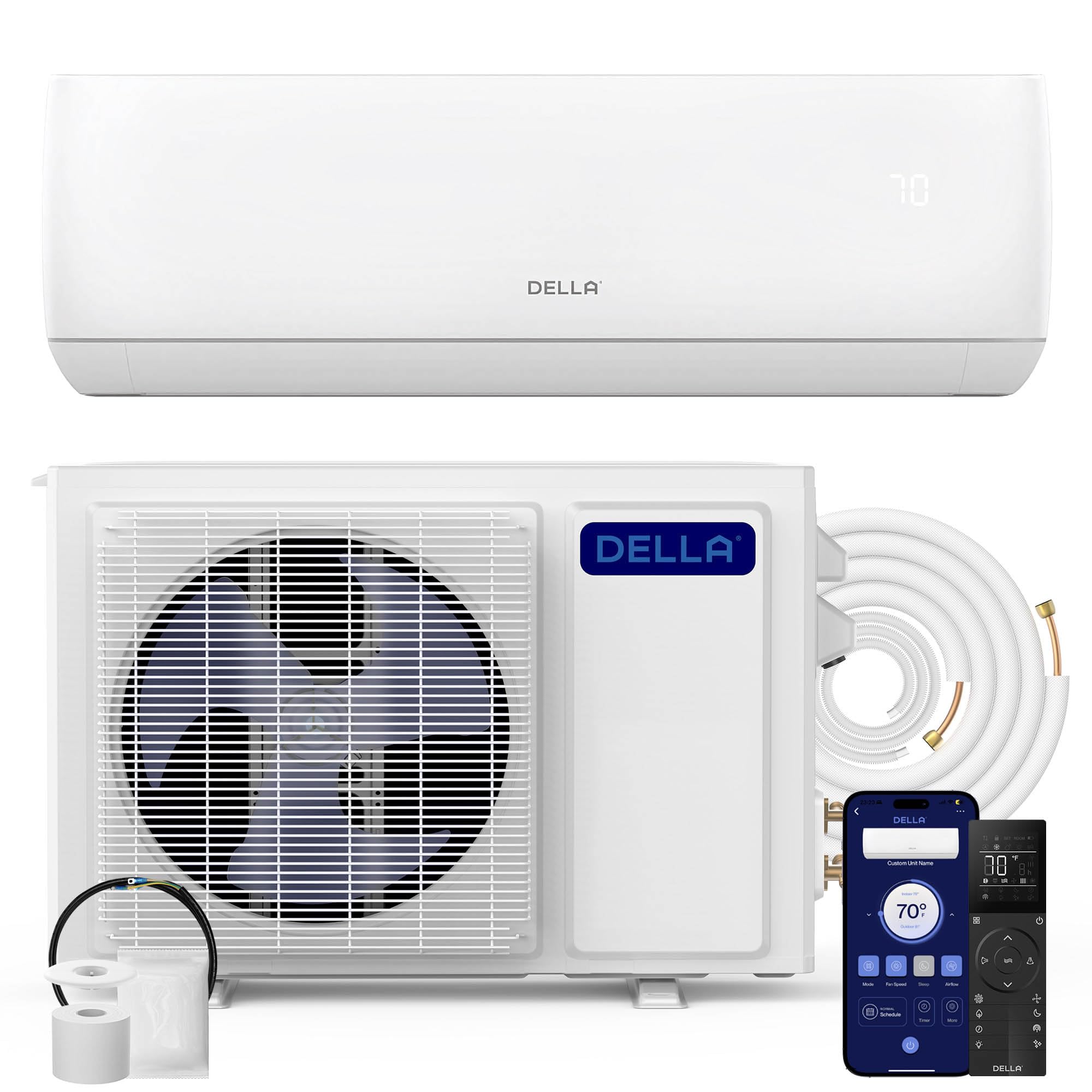
The 18,000 BTU split that heats a Minnesota garage at -20°F.
Once your garage crosses 750 square feet, you need an 18,000 BTU unit, and this DELLA fills the role with a 19 SEER2 efficiency rating and an upgraded bottom heating element in the outdoor condenser. That last feature is what makes cold-climate owners pick it: it produces heat at temperatures as low as -20°F, with the manufacturer claiming effective operation down to 5°F. This is a full-size 230V system that uses the newer R-32 refrigerant, draws a maximum fuse of 15A, and ships with a 16.4 ft pre-charged line kit plus a 6.56 ft drain pipe. It is ETL listed and AHRI certified.
What sets this apart from the smaller 12,000 BTU pick above is coverage: 18,000 BTU handles up to 1,000 square feet, versus 750 for the smaller unit. DELLA includes a smart sensor that reads air temperature at the remote control rather than the indoor unit, so temperature tracking follows you around the garage instead of pinning to the wall. Fan modes, turbo, sleep, eco, 4D airflow, and an 8-mode selection (heat, cool, dehumidify, dry, and more) cover basically any operating condition. The unit is rated ultra silent at 29 dBa — that is quieter than a normal conversation, and it does not sound like a compressor cycling all day.
The reviews here run strongly positive on cooling power, quietness, and efficiency — several owners note the electric bill actually dropped after moving to this system from a portable. The recurring counterpoint in owner reports is durability: there is a pattern of a small number of units failing around the 18-month mark with compressor problems, and a handful of buyers have seen that failure. On the flip side, the same owner group has bought repeat units for other buildings, and DELLA’s customer service is repeatedly noted as responsive. The other honest note is that the line set at 16 ft can be too short for very tall garages with an 8-10 ft ceiling and a condenser mounted far from the indoor head — plan for line extensions if that describes your install. So: strong on performance and efficiency, with the caveat that this is a system you want professionally installed with a proper vacuum and pressure test to extend life.
Where the value lands
- 18,000 BTU covers up to 1,000 sq ft — a genuinely large garage in a single zone
- Rated 19 SEER2 with a bottom-heating condenser, keeps producing heat in cold climates
- Runs at 29 dBa — you can have a conversation right underneath it
What to plan for
- The 16.4 ft line kit can be short for tall garages — measure your run and budget for extensions
- A small minority of owners have had compressor failures around the 18-month mark
- Professional installation is required; budget for a licensed tech
File this under: full-coverage garage climate control for the largest spaces, with year-round heating that cold climates actually need.
Skip past if: your garage is under 500 sq ft — you will pay for capacity you cannot use.
7. Cooper & Hunter MIA 12,000 BTU 115V Wall Mount Mini Split

Runs on a standard 115V circuit and still hits 21.2 SEER2.
Most big mini-splits require a 230V circuit; this one is 115V, which means a standard outlet circuit can power it after a licensed electrician confirms the amperage headroom — a real convenience advantage for garages that do not already have 230V wiring. Pair that with the 21.2 SEER2 efficiency rating — higher than any other mini-split in this list — and it is the pick for small spaces where efficiency is the whole game. It is a 12,000 BTU, 1-ton system that covers 550 square feet, comes with a 16 ft pre-flared copper line set, 16 ft communication wire, and a 16 ft drainage extension already in the box, plus the smart kit for app scheduling.
The 5°F heating floor lets it run through mild-winter colder days, and the compressor is a variable-speed inverter that holds temperature steadily. Quiet operation is the recurring praise in reviews — this unit comes up repeatedly as one of the quietest in its size class. On the practical side, Cooper & Hunter notes that professional installation is required per the manufacturer, and the unit ships via freight to the nearest accessible point. Tech support is domestic. If your garage is roughly 550 square feet and you want the highest-efficiency small split, this is the pick — though the early unit failures reported by a small fraction of buyers are worth knowing about.
Efficiency math: at 21.2 SEER2 this is the most efficient mini-split on this list — if your garage cools for many hours per season, that rating pays back.
One build detail to check: the preinstalled drain-pipe clamp inside the head unit has been reported loose from the factory; inspect it before install and secure it properly to avoid water running down the wall.
Built for: a small garage or workshop around 550 square feet where 115V wiring already exists and efficiency matters most.
Think twice if: your garage is over 600 square feet — you will want the 18,000 BTU picks below to keep up.
8. DELLA Vita Series 18000 BTU Mini Split, 20 SEER2
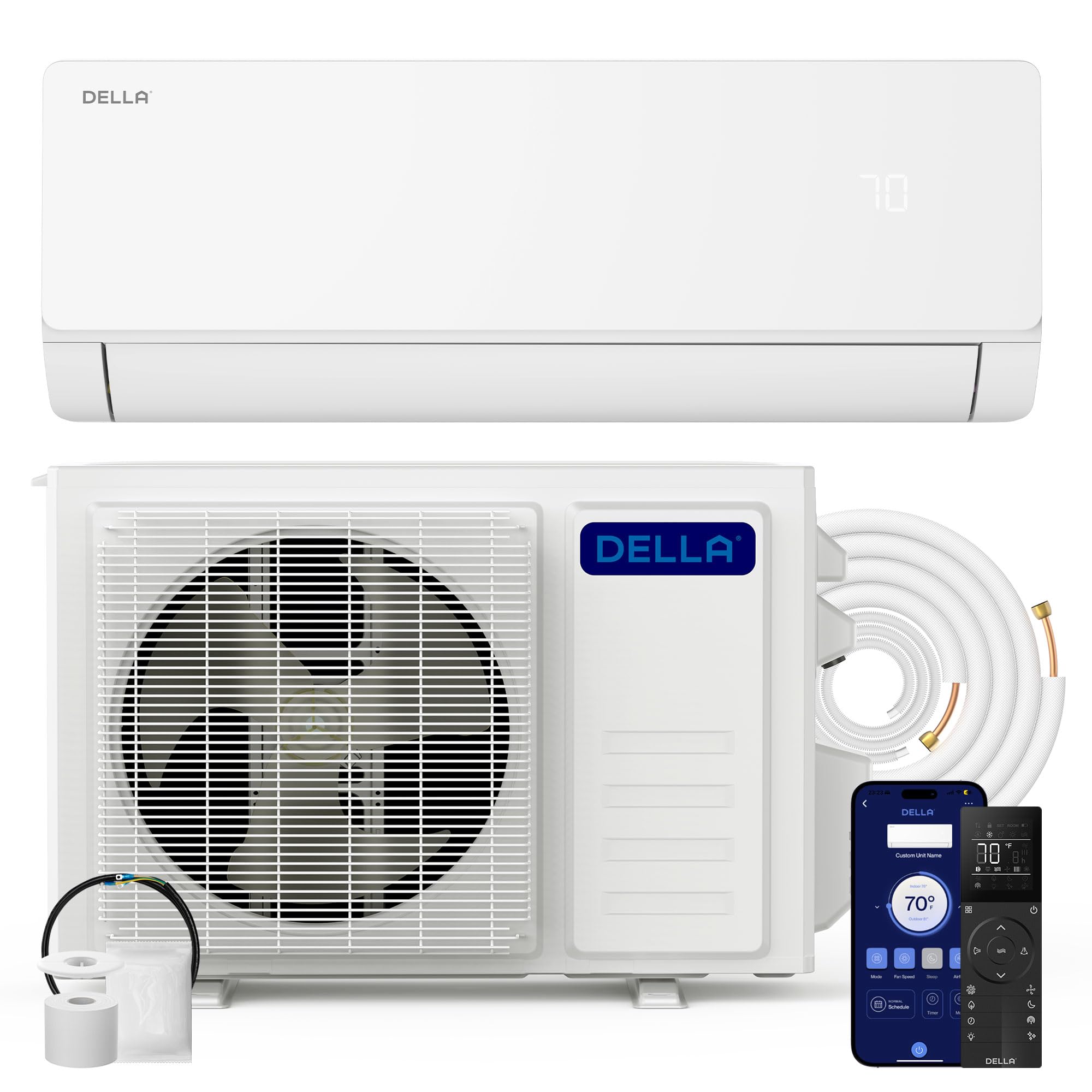
A brand-new 20 SEER2 split with an aggressive headline energy claim.
If you want the largest coverage with the highest efficiency you can find below the premium tier, this is where to look. 18,000 BTU at 20 SEER2 covers up to 1,000 square feet, runs on 230V, and is pre-charged with R-32 refrigerant. DELLA claims up to 40% reduction in electricity consumption — a manufacturer estimate, so treat it as a target rather than a guarantee. The heating spec is what makes it a year-round pick: rated for heating performance down to -4°F, which is a step beyond what the Motto Series above offers for garage use. It ships with a 16 ft copper line set, a 78.7″ drain pipe, and a max fuse size of 20A.
What separates this from the pricier Cooper & Hunter pick above is the feature list per dollar: DELLA includes the “I Feel” sensor that reads temperature at the remote rather than the wall unit, 4D airflow, turbo mode, sleep mode, multiple fan speeds, a 24-hour timer, and full Alexa and Google Assistant control through the DELLA app. Indoor operation is as low as 32 dB, and the balanced airflow distribution helps avoid hot spots in the corners of a large garage. It is ETL listed and AHRI certified. The line set at 16 ft matches most of the pick above, but check your layout — a taller garage may need extensions.
Ratings count is thin, so this is more of a “check back in six months” product than a proven field leader — but the early signal is genuinely strong. What buyers mention most is the perceived build quality, with performance right behind, and the recurring theme is that DELLA competes favorably with more expensive brands. Real-world applications include a 2-ton DELLA unit running a customer’s garage-slash-workshop, controlled through the smartphone app and remote. If you want a brand-new high-SEER2 split with fresh features and you are OK being an early adopter, this is the pick. If you would rather buy a proven unit with years of owner data behind it, the Senville below makes more sense.
Pick this for: a large insulated garage where you want the newest 20 SEER2 system and you are comfortable buying from a young product line.
Go with the Senville instead if: you would rather lean on years of owner feedback and a longer parts warranty.
9. Senville LETO Mini Split Air Conditioner, Heat Pump, 18000 BTU

The 18,000 BTU split with the biggest install base and the longest warranty.
Senville has been building mini-splits long enough to have a deep field of owner feedback, and the LETO line shows it. This 18,000 BTU unit covers up to 1,000 square feet, ships with a 16 ft line set and communication wire pre-loaded with refrigerant for a run up to 25 ft, and includes a DC inverter compressor that is UL listed and AHRI certified. The warranty is where it separates from most of the field: 5 years on parts and 5 years on the compressor, with factory technical support included, and labor not covered. The system is a 4-in-1 (cooling, heat pump, dehumidifier, fan) with turbo mode and Alexa voice control through the app, rated for heating down to 5°F.
Installation follows the same rules as the other mini-splits: professional installation is required per the manufacturer, and running the line set properly matters. Customers note it is a reasonable install for someone comfortable with basic electrical work, and the equipment pairs well with a separately mounted outdoor bracket. What buyers come back for again and again is the combination of quiet operation and moisture removal — the system is repeatedly noted for pulling humidity out of a space effectively in dry mode. That matters in a garage where condensation and rust on tools are real concerns. If you live somewhere hot enough that the air holds serious moisture, this is a genuine functional advantage over a portable.
The reviews here are unusually deep and consistently positive, with a large portion covering long-term reports of the kind no new product can offer: multiple purchases, conversions from older systems, and repeat recommendations. The recurring honest notes are modest. One retired HVAC tech flagged that the bundle includes the correct length of refrigerant line but the power and signal cable runs about 2 feet shorter — plan the routing accordingly. A remote scheduling limitation shows up too: the base remote has no scheduling feature, and Alexa and the remote can work out of sync. Setting the daily schedule through the app instead of the handheld gets the whole thing working smoothly. Long warranty, deep field history, strong value — this is the pick for anyone who wants the safest mid-premium choice.
Why the risk is low: a 5-year parts warranty plus years of owner reports means this is the least speculative premium-adjacent pick in the list.
Plan around: a shorter power cable than refrigerant line and a base remote with no scheduling — set the schedule through the app.
Great fit for: owners who want years of field data, a long warranty, and a 1,000 sq ft system at a mid-premium price.
Not the right size for: garages under 400 sq ft where a smaller split or portable is the smarter cup of capacity.
10. Pioneer Diamante Pro Mini Split, 18000 BTU, 230V
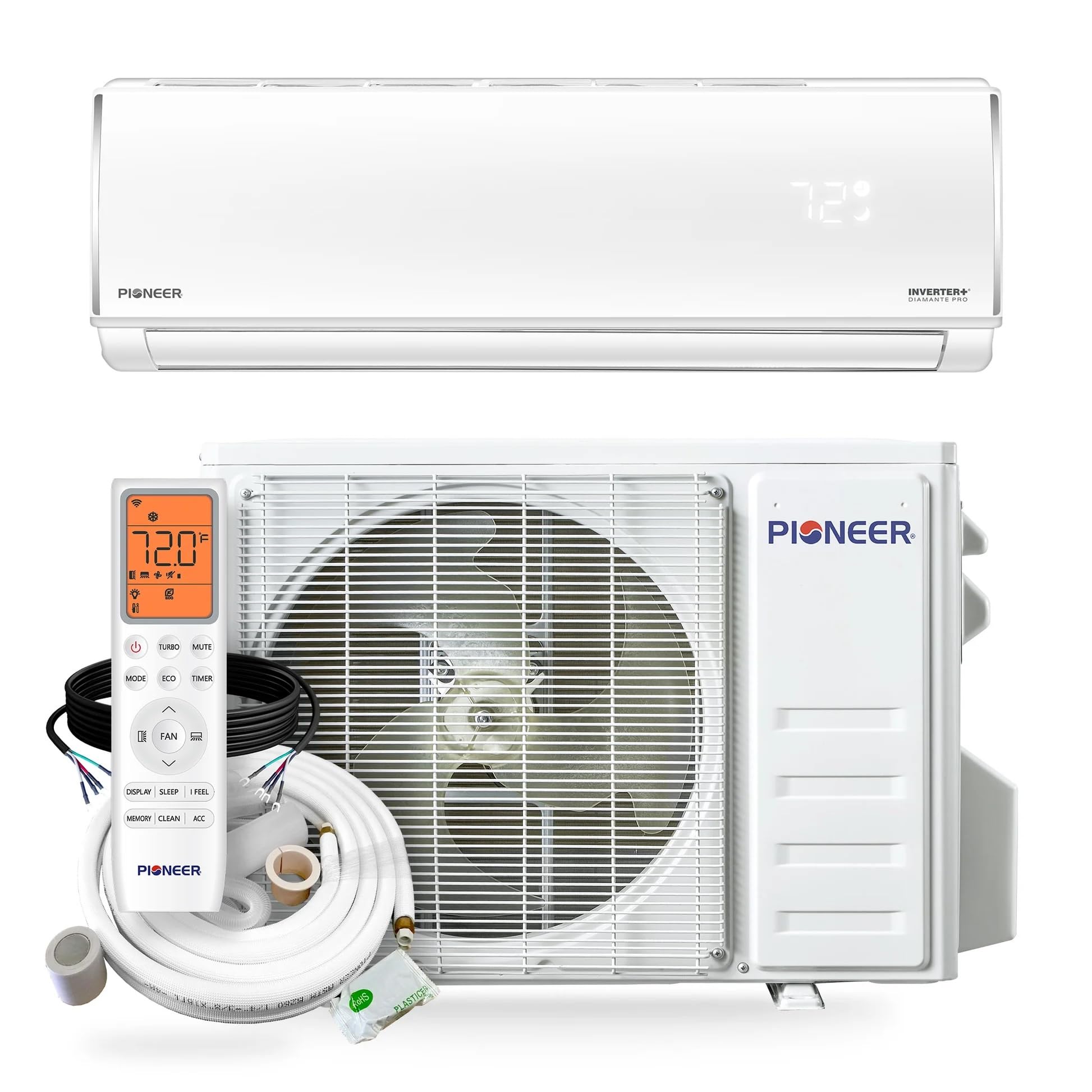
The premium 18,000 BTU split with cold-climate certification and 9.5 HSPF2 heating.
At the top of the range, this Pioneer hits 21.0 SEER2 and 9.5 HSPF2 — the heating counterpart to SEER2, and the highest efficiency figure in the group when you measure heating performance rather than just cooling. It is a 18,000 BTU, 230V system rated for 500 to 750 square feet of space, uses R-454B refrigerant, and is certified by AHRI, ETL, DOE, and ISO 9001, with NEEP ASHP recognition for cold-climate capability. It is designed to cool down to 122°F exterior temperatures and heat down to -4°F. If your garage sees real winter weather and you want the system that holds efficiency through both seasons, this is the pick.
The control detail set is what justifies the premium positioning: dual-axis airflow with motorized up-down and left-right louvers sweeps cool air into the far corners of the room, and the included remote has I Feel temperature sensing at the handheld rather than at the indoor wall unit. Turbo, Mute, Eco, Sleep, Timer, and Memory functions are all present. The self-clean cycle and a washable, reusable mesh dust filter keep maintenance costs low. The full install kit ships with the system — insulated line set, signal cable, drain hose, wall sleeve, putty, sealing putty, wrapping tape, drain spout, and rubber feet. The indoor unit is rated ultra-quiet, making it also appropriate for a garage that sits under a bedroom.
The catch is the same one that applies to any premium new product: ratings count is still low, so most of the owner feedback is recent. What is there reads strongly — buyers describe it as the best thing they have purchased, easy to install for a DIY-capable owner, quiet, and cooling quickly. One workshop owner notes the outdoor unit arrived with bent fins and dented sheet metal (a cosmetic-shipping concern, not a functional one), and one buyer reports the warranty does not require a licensed HVAC contractor on the install — worth confirming directly with Pioneer before you commit, since manufacturer policies differ and most premium mini-splits require licensed installers. The install itself has been done by technically inclined owners in a weekend with rented vacuum equipment.
Where the premium pays off
- 21.0 SEER2 and 9.5 HSPF2 make this the most efficient system here by both measures
- NEEP ASHP recognition for cold-climate capability means winter heating works in real cold
- Complete install kit ships in the box — no add-on shopping for line set or drain hose
What to consider before ordering
- Ratings count is small — most feedback is recent, so long-term durability is not yet proven
- Shipping damage has been reported on the outdoor condenser (cosmetic, not functional)
- Confirm the warranty terms for licensed installers before you start work
Go with this when: your garage isin the cold-climate belt, you want the best efficiency both ways, and a complete install kit in the box matters more than saving on the sticker.
The caveat you should weigh: the review field is small, so you are trusting specs and early reports rather than years of owner history — budget for a licensed HVAC install either way.
Understanding the Specs
BTU Rating and SACC vs ASHRAE Numbers
BTU stands for British Thermal Unit — a measure of how much heat a unit can pull out of a space in an hour. Higher BTU means more cooling capacity. Here is the trap: portable AC makers often list two numbers, the ASHRAE figure (a looser standard that gives a bigger number) and the SACC figure (a stricter, real-world figure that is usually smaller). A 14,000 BTU ASHRAE unit is often 10,000 BTU SACC, and that second number is closer to how it actually cools. Mini-splits usually list only one BTU figure, which makes them easier to compare against each other but hard to compare against portables on paper. When you size a garage, work from the smaller, honest number for a portable, and from the single figure for a split.
SEER2, CEER, and What Efficiency Really Costs You
SEER2 is the efficiency score for cooling equipment — higher is better, and the difference shows up on your electric bill, not in your comfort. CEER is the portable-AC version of the same idea, and 12.8 is considered strong for a portable. Inverter compressors are the reason efficiency varies so much between units with the same BTU rating: instead of cycling on and off at full power, an inverter ramps its speed up and down to hold temperature. That saves energy during mild weather and keeps sound low during the rest of the day. The catch is that a higher-SEER2 or higher-CEER unit costs more upfront, and you only win on the math if you actually run it a lot each season.
Noise in Decibels and What a Rating Actually Means
Decibels (dB) measure sound level, and a rating of 30 dB is roughly a quiet library while 60 dB is a normal conversation. The number on the spec sheet is often taken at a specific distance and fan speed, so a portable that advertises 45 dB may measure closer to 60 dB right next to the unit. Mini-splits separate their indoor and outdoor noise output, so a 29 dBa indoor rating tells you what you hear inside the garage while the compressor sits outside. If you are using the space as a workshop or a home office, weigh the near-field noise, not the best-case rating.
Venting Without a Window: Hose and Line-Set Rules
A portable AC exhausts hot air through a hose that must reach outdoors — a wall sleeve, a floor vent, or a door gap with a sealing panel. A mini-split runs refrigerant lines and a drain through a hole drilled in the wall. Both approaches work without a window, but the practical limits differ. Portable hoses are short (often around five feet) and extending them poorly reduces cooling, so plan a spot near the exterior wall. Mini-split line sets commonly run 16 feet, and going farther means extra copper and added refrigerant, which needs a technician. Measure your run before you buy either.
FAQ
Can you cool a garage that has no windows at all?
What BTU do I need for a two-car garage with no window?
Is a mini-split or a portable AC better for a windowless garage?
How do I vent a portable AC through a wall instead of a window?
Does a portable AC cool a sealed garage effectively without pulling in outside air?
How long does a mini-split typically last in a garage installation?
Do I need a 230V circuit for a garage mini-split, or will 115V work?
How much noise will the unit make inside the garage?
Will a mini-split heat the garage during winter, not just cool it in summer?
Do I need to drain a portable AC in a garage, or do they evaporate the water?
Final Thoughts: The Verdict
For most people shopping the ac for a garage with no windows, the Gasbye Dual Hose Portable AC is the winner because it vents through a wall or door gap with no window and no pro installer, and its dual-hose design is the one thing that keeps a sealed garage from fighting itself. If you own the garage and want year-round heating plus the highest efficiency in this list, the Pioneer Diamante Pro 18,000 BTU is the pick. For a large, tough, uninsulated garage in a cold climate, the DELLA Motto 18,000 BTU handles the load — and if the garage is a small single-bay workspace, the ZAFRO Dual Hose Portable AC skips the drain pan for days at a time. Whatever you pick, size it to the square footage first — a right-sized unit running steadily always beats an oversized one cycling on and off.
How We Picked
We do not accept paid placement. Every pick is matched to a real buyer and a real use-case; we do not hands-on test units.
Sources & Methodology
Specifications: manufacturer listings and product documentation. Review insights: verified customer reviews, as of September 2026. Pricing: not shown on this page (it changes often); check the current price via the retailer link.
As an Amazon Associate, KitchPrep earns from qualifying purchases. This does not affect which products we feature.
Related Guides
