
Specs are compiled from manufacturer listings and verified buyer reviews and can change over time — please confirm the key details on the product page before buying.
A vertical-discharge bathroom exhaust fan pushes moist air straight up through the ceiling and out the roof, so the duct run stays short and steam exits instead of pooling in the joists. The catch most shoppers hit is that “vertical discharge” is rarely printed on the box — you have to read the spec sheet and match the housing depth to your joists before you buy. Here are three fans that vent upward, sized from a compact retrofit to a steam-hungry large bathroom.
I’m Mohammad Maruf — the founder and writer behind KitchPrep. This guide is built by comparing the manufacturers’ published specifications and the patterns across verified customer reviews, so you get each pick’s real strengths and trade-offs instead of marketing spin.
Every pick here vents straight up through the ceiling, keeping the duct run short so moisture exits the room instead of settling in the joists — the difference between a true vertical-discharge bathroom exhaust fan and a side-venting compromise.
Our Picks at a Glance
How To Choose The Best Vertical-Discharge Bathroom Exhaust Fan
Buying a bath fan that vents straight up is mostly about three numbers and one measurement you take yourself. Get those right and the install is a straightforward swap; get them wrong and you are cutting new drywall.
Match CFM to the room, then add headroom
CFM (cubic feet per minute — how much air the fan moves in a minute) is the first number to check. A small powder room or toilet closet clears fine on the lowest setting of a multi-speed fan. A large main bathroom with a long shower needs a higher top speed so the mirror stops fogging. A fan you can set to more than one airflow lets you tune it to the room instead of guessing.
Read the sone rating before the wattage
A sone is a loudness measure where a lower number means a quieter fan. A 1.5-sone fan is quiet enough to talk over; a 3-sone fan is clearly running while you are in the room. If the bathroom sits next to a bedroom, the sone number matters more than any other spec on the page.
Measure your ceiling opening and joist depth
The housing has to fit the hole you already have, or you are cutting a bigger one. Note the listed cutout size and the housing depth, and check it against your joist spacing. On a vertical-discharge unit the duct collar points up, so you also want clearance above the housing for the duct to turn without a hard kink.
Quick Comparison
| Model | Best For | Airflow (CFM) | Control | Housing Depth | Amazon |
|---|---|---|---|---|---|
| Panasonic FV-0511VFC1 WhisperFit★ Best Overall | Retrofit into a low-clearance ceiling | 50 / 80 / 110 | Hardwired push button | 5-5/8″ housing depth | Amazon |
| VIVOHOME with Light & Humidity Sensor | Large bathrooms and laundry rooms | 160 (auto 30 / 110 / 160) | Remote + button | 5.7″ housing depth | Amazon |
| POWERENG Light Combo 175 CFM | Steamy large baths on a budget | 175 | Hardwired push button | 11.8″D x 7″W x 11.8″H | Amazon |
In‑Depth Reviews
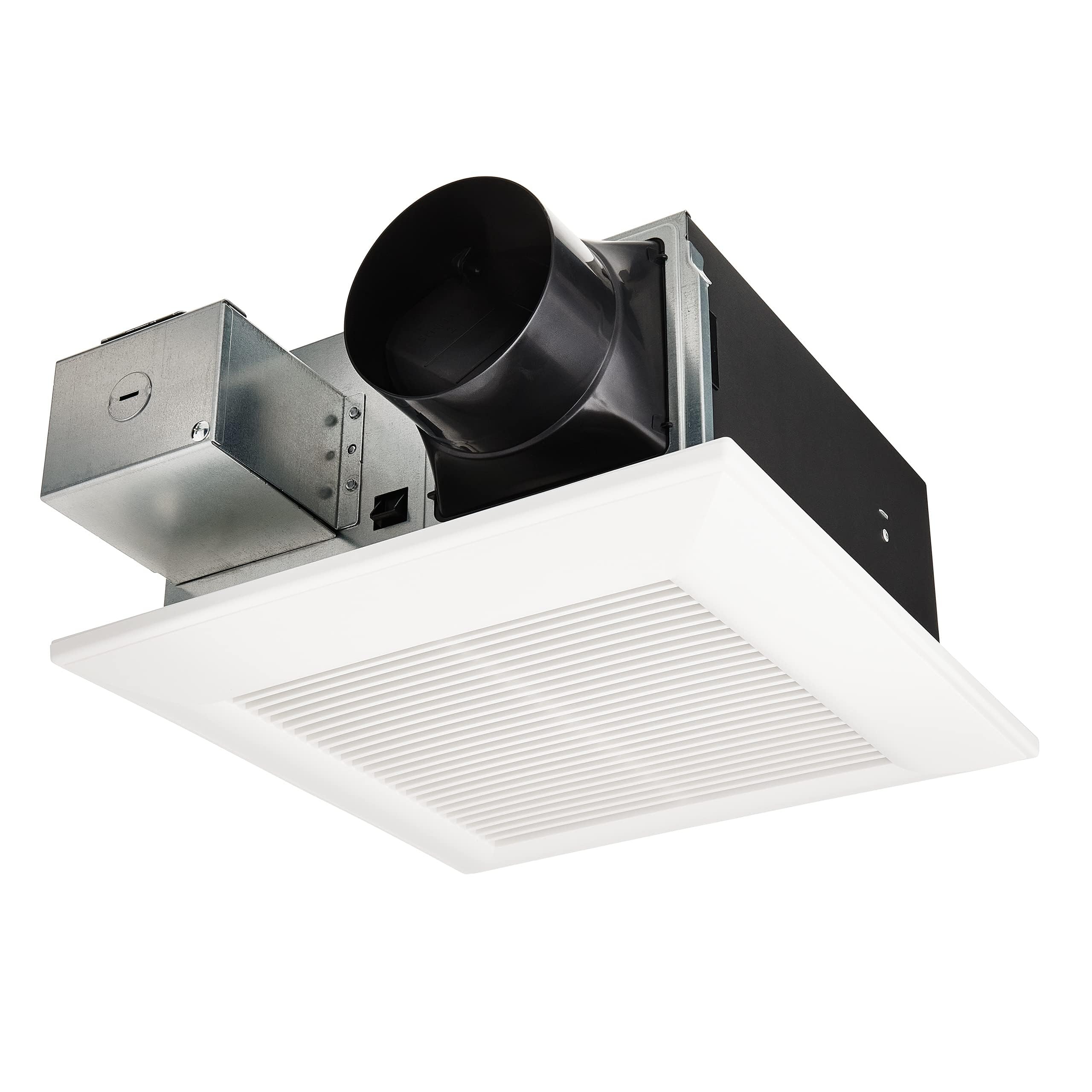
1. Panasonic FV-0511VFC1 WhisperFit Bath Fan + Humidity Sensor, 50-80-110 CFM
Our pick — 4.5★ from 200+ verified ratings; the strongest balance of quality and price.
The quiet retrofit that slips into a shallow ceiling and still pulls 110 CFM.
If your bathroom sits under a low joist space and you want the fan to disappear into the background, this is the one to start with. The housing is only 5-5/8″ deep, so it drops into a 2 x 6 joist size or larger — the kind of ceiling most older homes already have. The Flex-Z Fast bracket pivots on a single hinge so you can position the housing with one hand while the other holds the duct, which is the part of the job people usually dread.
What wins people over is how quietly it runs. It uses a DC/ECM motor (a brushless direct-current motor that spins with less chatter than a traditional AC motor) and is Energy Star certified. Even at its top 110 CFM setting (cubic feet per minute, a measure of how much air it moves), owners describe it as near-silent. The Pick-A-Flow switch on the housing lets you flip between 50, 80, and 110 CFM to match the room, and the built-in condensation sensor turns the fan on when it detects humidity so you do not have to remember a wall switch.
The honest catch is the sensing itself. The humidity logic is a real point of contention — some owners find it spot-on while others watch it trigger when the room is dry. A 35 sq ft bath works best set to 80 CFM with the threshold around 60% RH, since below that the sensor runs sensitive. The other thing to know: the auto timer is fixed at 20 minutes, so there is no dialing it shorter. Wiring is hardwired and needs a proper power feed, and if you want a wall switch override you will be working with the red control wires the unit exposes. Compared with the VIVOHOME below at 160 CFM, this tops out lower on raw airflow, but it is the more compact frame for a tight ceiling.
Where it pulls ahead
- 5-5/8″ housing depth fits shallow 2 x 6 joist ceilings other fans cannot
- Flip-switch choice of 50, 80, or 110 CFM for the room you actually have
- DC/ECM motor runs near-silent even at its 110 CFM top speed
- Built-in condensation sensor turns it on without you touching a switch
What to plan around
- Humidity sensing is inconsistent — sometimes triggers in a dry room
- Auto timer is locked at 20 minutes with no adjustment
- Hardwired install still needs a power feed and switch wiring decisions
Best fit for: older homes with shallow joists where a low-profile housing is the difference between a retrofit and a remodel.
Think twice if: you want the sensor to be the whole story and you would rather not run a wall switch at all.
2. VIVOHOME Bathroom Exhaust Fan with Light & Humidity Sensor (160-110-30 CFM)
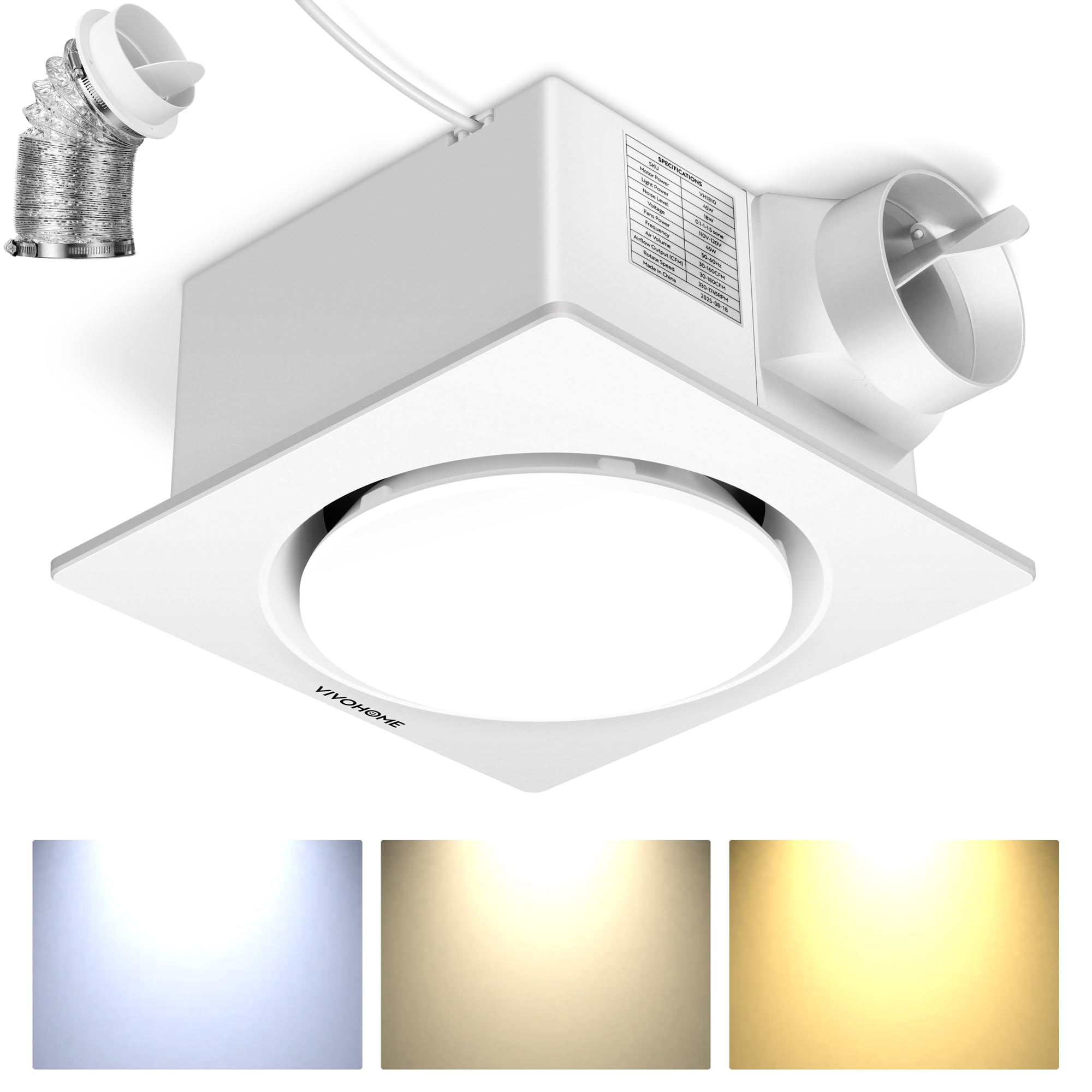
A humidity sensor that ramps itself from a whisper to 160 CFM and a light that changes temperature.
For a big main bathroom or a laundry room that holds steam, this is the fan that does the most jobs at once. It reads the room’s moisture and switches speed on its own: 30 CFM when humidity is under 50%, 110 CFM once it climbs above 50%, and a full 160 CFM when humidity hits 80% or higher. That 160 CFM is a big step up from the Panasonic’s 110 CFM top end, and it is aimed at rooms in the 86–129 ft² range. Owners describe the ramp as flawless — it beeps to life at 30, climbs with the moisture, and clears the room fast, staying near-silent at the low end.
Then there is the light. The integrated LED panel runs three color temperatures — 2700K warm, 4000K pure white, and 5700K daylight — across 6 brightness levels, so a bathroom that never had a proper fixture gets one in the same ceiling cutout. The brushless EC motor carries a rated service life of 20,000–30,000 hours and the maker claims 50% energy savings over traditional AC motors, plus a 1-hour auto shutoff. The 45W motor also self-adjusts to hold airflow against duct bends, so a kinked run does not quietly kill your ventilation. You get a remote for one-touch control, plus a backdraft damper, aluminum duct, and an extended power cord in the box.
Here is the catch: this is not a drop-in swap. The cutout template runs a hair large, so measure the opening yourself before you cut, and the unit is heavy enough that the bracket wants extra wood backing at the joists. It also wants a 4″ duct where many older bathrooms run 3″, so plan on a reducer. The wiring is a pigtail with no electrical box, meaning you supply the junction box. The remote is the other soft spot — most owners get along fine with it, but the control scheme can feel fussy, and it works best on constant power with the remote handling the daily switching. Compared with the POWERENG below at 175 CFM, this sits a step lower on peak airflow but adds the sensor, the color-changing light, and the remote that the other one does not have.
Smartest feature of the set: the auto humidity ramp means the fan handles the shower for you, going from a 30 CFM trickle to a 160 CFM push without anyone touching a control.
Plan the wiring first: it comes with only a pigtail (a short wire lead) and no junction box, and its 4″ duct collar is bigger than the 3″ duct many older bathrooms have. This is a job for someone comfortable working in a ceiling — hire it out if that is not you.
Reach for this if: you want one ceiling unit that vents, lights, and senses humidity on its own in a large bathroom.
Look elsewhere if: you need a same-size swap into an existing opening — this one wants a fresh cut and a junction box.
3. Bathroom Exhaust Fan with Light Combo, 175CFM & 1.5 Sones, 3-Color LED
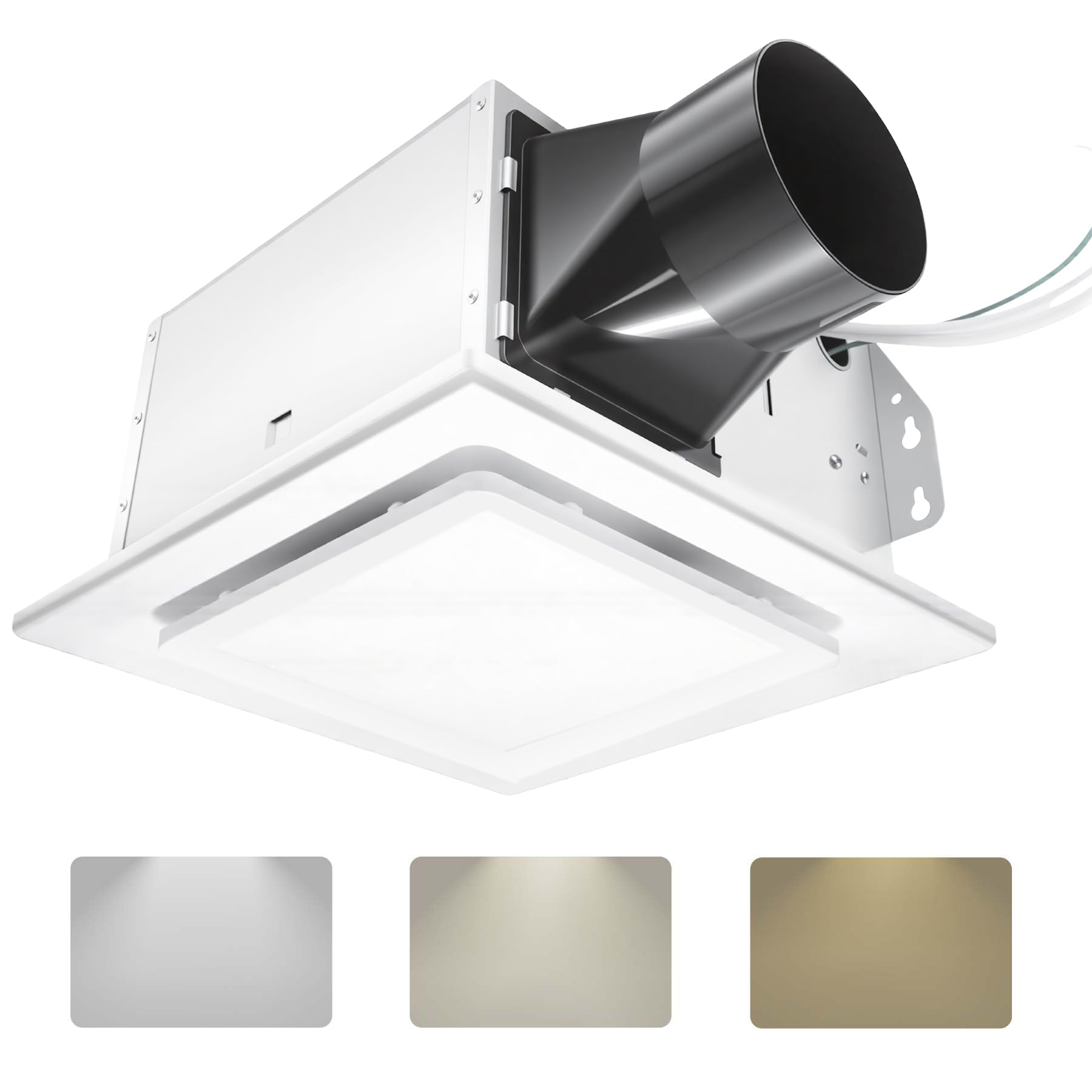
The most airflow here at 175 CFM, yet quiet enough to keep at 1.5 sones.
This is the clear pick when the steam is the problem and you want it gone fast. The 175 CFM here is the highest figure of the three — it beats the Panasonic’s 110 CFM top setting by a wide margin and edges past the VIVOHOME’s 160 CFM. A 45W copper capacitor motor drives that airflow, and the entire unit is rated at just 1.5 sones, which is quiet enough to hold a normal conversation under. Owners confirm the ratings are honest: the fan really does dry the room, and the 1.5-sone claim matches what they hear in the bathroom.
The light is a real upgrade if you are replacing a bare fan. A 12W LED panel gives you three color temperatures — 3000K warm white, 4500K natural, and 6000K cool daylight (K is Kelvin, the unit for light warmth) — and you set the temperature with a manual switch on the power cord before the unit goes up. Buyers keep praising the build quality; it uses a 100% copper motor and a waterproof joint for the damp ceiling environment, and at 9.5 pounds it feels like a solid unit rather than a plastic shell. It fits ceiling openings from 10″ x 11.2″ up to 11.5″ x 11.5″ and supports standard ceiling mount, joist mount, and extended bar mount, so it has more install flexibility than the two fixed-mount fans above.
Two things to know before you commit. First, the color-temperature switch is set on the cord before installation, so changing it later means getting back up to the unit. Second, the wiring colors are not US standard, which throws off anyone expecting conventional color coding — worth flagging to your electrician up front. A handful of buyers also note the warm white does not read as especially warm, and the light could be brighter in a big room. Powered by 120V and hardwired, it is the simplest of the three to mount, just not the most configurable after the fact. As owners put it: “Works like a charm.”
The airflow story: 175 CFM at 1.5 sones (a sone is a sound rating; lower is quieter) is the highest output of the three picks here, and the copper-motor build backs it up — this is the one to reach for when a big, steamy bathroom needs clearing quickly.
One install-day note: the wiring colors run non-standard, so hand your electrician the manual before they touch the connections rather than after.
Pick this one when: you want the most airflow here and the lowest price tier without losing quiet operation.
skip it if: you want to change light color or brightness after the ceiling goes back up — that switch is set on the cord beforehand.
Understanding the Specs
What CFM really measures
CFM stands for cubic feet per minute — the volume of air the fan moves out of the room every minute. More CFM means faster steam removal, which is why a large bathroom benefits from a higher top speed. The Panasonic offers 50, 80, or 110 CFM you pick with a switch; the VIVOHOME auto-selects between 30, 110, and 160 CFM based on humidity; the POWERENG runs a single 175 CFM. Match the figure to your bathroom size and shower habits, and remember that a longer or kinked duct run reduces how much air actually reaches the outside.
Sones, speed, and airflow
A sone is a loudness rating — lower is quieter. The POWERENG lists 1.5 sones, which is roughly the sound of a quiet refrigerator hum, so it will not wake anyone in a nearby room. The Panasonic and VIVOHOME do not list a sone figure in this data, but both are built around quiet DC or EC motors, hence the “Whisper” naming and the emphasis on near-silent low-speed operation in owner reports. If noise is your top concern, weigh the listed sone figure alongside the motor type, since a brushless motor tends to run smoother than a standard AC one.
FAQ
Why does vertical discharge matter in a bathroom exhaust fan?
What CFM do I need for a large bathroom?
Will a 175 CFM fan be too loud for a small bathroom?
Does the VIVOHOME humidity sensor change fan speed automatically?
How deep does the Panasonic FV-0511VFC1 housing need to be?
Can the POWERENG fan fit my existing ceiling opening?
Do these fans include a light or just ventilation?
How long should I run a bathroom fan after a shower?
Is a hardwired fan or a remote-controlled fan easier to install?
What is the service life of these brushless fan motors?
Final Thoughts: The Verdict
For the majority of shoppers, the vertical-discharge bathroom exhaust fan winner is the Panasonic FV-0511VFC1 WhisperFit, because its 5-5/8″ housing fits tight joist ceilings where the others will not, and its selectable 50/80/110 CFM plus condensation sensor make it easy to size to the room. If you want a single unit that also lights the room and ramps its own speed from 30 up to 160 CFM on humidity, grab the VIVOHOME with Light & Humidity Sensor. And for the most raw airflow here at 175 CFM and 1.5 sones, the POWERENG Light Combo is the one to reach for.
How We Picked
We do not accept paid placement. Every pick is matched to a real buyer and a real use-case; we do not hands-on test units.
Sources & Methodology
Specifications: manufacturer listings and product documentation. Review insights: verified customer reviews, as of September 2026. Pricing: not shown on this page (it changes often); check the current price via the retailer link.
As an Amazon Associate, KitchPrep earns from qualifying purchases. This does not affect which products we feature.
Related Guides
