
Specs are compiled from manufacturer listings and verified buyer reviews and can change over time — please confirm the key details on the product page before buying.
Your basement flooding at 2 a.m. is the worst time to find out your pump is undersized. A 1 HP sump pump is the heavy-lifter of residential water removal — it moves thousands of gallons per hour, clears water from deeper pits, and holds up when a storm dumps rain faster than a smaller pump can keep up. This guide breaks down six real 1 HP models by flow rate, switch type, build material, and how owners actually live with them.
I’m Mohammad Maruf — the founder and writer behind KitchPrep. This guide is built by comparing the manufacturers’ published specifications and the patterns across verified customer reviews, so you get each pick’s real strengths and trade-offs instead of marketing spin.
You will see which pumps handle high-volume flooding, which ones shine in shallow pits, and which build materials survive years of submersion. The Superior Pump 92151 is the crowd favorite, rated 4.4 stars by hundreds of owners, but the right pick still depends on your pit depth and discharge setup.
Our Picks at a Glance

How To Choose The Best 1 HP Sump Pump
A 1 HP pump moves 5,000+ GPH, so the wrong pick either wastes money on capacity your pit can’t use or leaves you short when the storm hits. Four specs decide whether your pump keeps up: flow rate at your actual lift height, float switch type, build material, and discharge port size.
Flow Rate At Lift Height, Not Just The Headline GPH
Manufacturers advertise flow rate at zero lift — the maximum the pump can push when water barely needs to rise. Real basement setups involve vertical lift, and flow drops as that number climbs. A pump rated at 6,540 GPH at zero feet may deliver far less at 10 feet of lift, which is why you should look for the flow figure stated at a specific height. Match that to your actual discharge run: a horizontal run to a street drain or storm sewer needs less vertical head than a pipe rising to a high window well.
Float Switch Type And Pit Clearance
The float switch is the part that turns your pump on and off, and it is where most sump pump failures start. Vertical float switches fit tight pits because they slide along a rod rather than swinging. Tethered switches use a floating ball on a cord and need more room to pivot, but they are easier to convert to manual mode. Caged dual float switches use two actuators, so a single stuck float doesn’t leave your basement unattended. Measure your pit diameter before you buy: some pumps require an 11-inch basin or larger to cycle correctly.
Build Material And What Survives Submersion
Cast iron and stainless steel resist corrosion and hold their shape under constant moisture far better than thermoplastic housings. That durability comes with weight — the Basement Watchdog BWSS100 is 36 pounds, which matters when you are lowering it into a pit alone. Lighter pumps in polypropylene are easier to handle and swap out, but the trade-off is in long-term wear. A pump cycling every few minutes during storm season sees far more stress than one that kicks on occasionally, so match the build to your run frequency.
Discharge Port And Solids Handling
A 2-inch discharge port moves more volume per minute than a 1-1/2-inch port and can often pass larger debris. If your pit collects sediment or you pump from a yard catch basin, solids handling matters — the Superior 92151 passes 1/2-inch particles, while the Red Lion RL-SS100T handles 3/4-inch. Match your discharge pipe to the pump’s outlet — the Basement Watchdog requires 2-inch PVC, while the Red Lion includes a 1-1/2-inch adapter — and check whether the pump needs a weep hole or uses a top-suction design that eliminates it.
Quick Comparison
| Model | Best For | Flow Rate (gpm) | Max Lift (ft) | Weight (lb) | Amazon |
|---|---|---|---|---|---|
| Superior Pump 92151★ Best Overall | All-around basement protection | 86 gpm | 10 ft | 17.7 lb | Amazon |
| Taskstar 1 HP Submersible Water PumpMost Versatile | Pools, ponds, and portable draining | 67 gpm | 28 ft | 10 lb | Amazon |
| Basement Watchdog BWSS100 | High-volume sump pits with backup protection | 94 gpm | 22 ft | 36 lb | Amazon |
| Wayne CDU1000ET | Reliable basement workhorse for heavy flow | 101.67 gpm | 25 ft | 20 lb | Amazon |
| Superior Pump 92181 | Utility pumping and large 2″ discharge | 75 gpm | 25 ft | — | Amazon |
| Red Lion RL-SS100T | Flood-prone areas with heavy debris | 88 gpm | — | 31.6 lb | Amazon |
In‑Depth Reviews
1. Superior Pump 92151 1 HP Cast Iron Sump Pump Side Discharge with Vertical Float Switch
Our pick — over 4★ from 200+ verified ratings; the strongest balance of quality and price.
The cast-iron all-rounder that turns a flooded pit into dry concrete without fuss.
The Superior Pump 92151 clears a standard basement pit fast and can still feed a discharge line that rises several feet to a window well or drain, because it moves up to 5,160 gallons per hour and pushes water up to 25 vertical feet. The cast iron and stainless steel body — combined with a continuous-duty, thermally protected split-capacitor motor (a motor built to run nonstop without overheating) — is built to run for extended stretches during a storm instead of cutting out after a few minutes. That 17.7-pound weight is actually a plus here: it is heavy enough to sit steady in the pit and light enough that lowering it in alone is manageable, unlike the 36-pound Basement Watchdog where you want a second set of hands.
The 2-inch discharge handles high-capacity pumping, and it deals with up to 1/2-inch solids, so light sediment and debris won’t jam the impeller. A vertical float switch slides up and down inside the pit — a smart choice for tight sump basins where a swinging tether float would bump the walls and stick. Setup is straightforward: the box includes the vertical float switch, a 1-1/2 inch NPT discharge adapter, and a 10-foot power cord with a piggyback plug. Buyers report this pump empties floodwater to the street with real force — as the more enthusiastic reviews put it, it shoots water 70+ feet like a geyser. What wins people over most is effectiveness: it just moves a serious volume of water, and that is the whole point.
Here is the honest trade-off. Longevity is genuinely unknown on newer units — several owners who installed theirs recently say only time will tell whether it outlasts the pump it replaced. The recurring gripe is the float switch, which on rare units shuts off intermittently when submerged, and one installer using it on a 5-foot rise with a 10-foot drop found the lift came in under the documented figure. Those are fit notes, not dealbreakers: if you need guaranteed high-head pressure or a pump cycling in a very shallow pit, the Taskstar or the Basement Watchdog may suit you better. For a standard basement with a normal-depth pit, the balance here is hard to argue with.
What earns the top spot
- 5,160 GPH flow with 25-foot vertical lift handles real flooding
- Cast iron and stainless steel construction with a continuous-duty motor
- 2-inch discharge and 1/2-inch solids handling resist clogging
- Vertical float switch fits tight pits better than a swinging tether
Where it needs a closer look
- Long-term durability is unproven on recently installed units
- Float switch has been reported to cut out intermittently when submerged
- Actual lift can fall short of the documented figure on long discharge runs
Reach for this if: you need a balanced, well-built 1 HP pump for a standard basement sump pit and want strong flow with a switch that fits tight spaces.
Think twice if: your discharge run climbs high or your pit cycles in very shallow water — the lift performance and switch behavior are worth a second look.
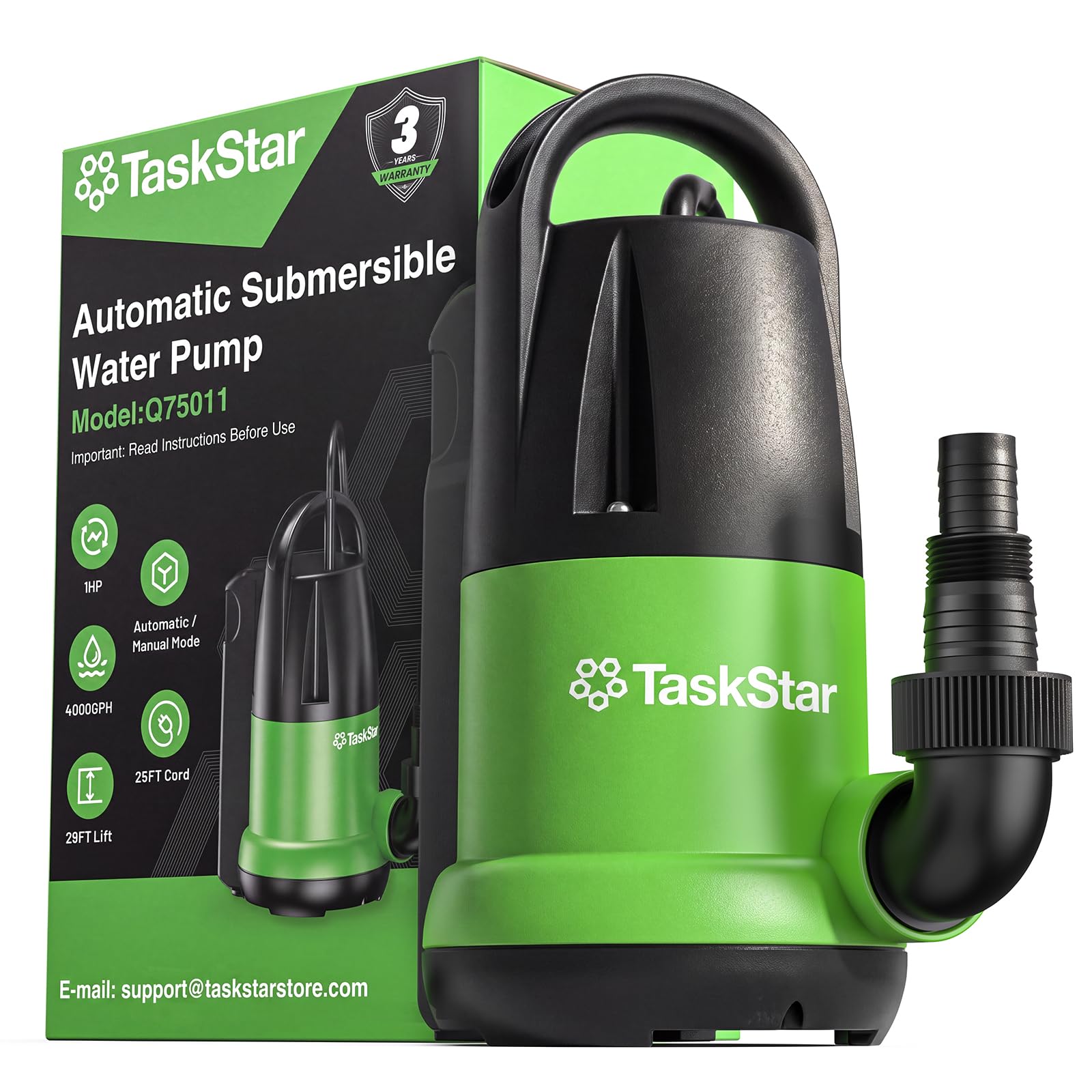
2. Taskstar 1 HP Submersible Water Pump, Auto/Manual Modes for Pool Draining
The lightweight one that climbs 28 feet — where a dedicated sump pump cannot reach.
Most 1 HP basement pumps top out around 22 to 25 feet of vertical lift. The Taskstar reaches 28 feet, and that elevation ceiling is the reason to pick it over the rest: it lifts water out of deep window wells, high-elevation drainage runs, and outdoor pits where gravity-fed setups fall short. Flow runs 67 gpm, lower than the Wayne’s 101.67 gpm, but for portable draining that trade-off buys you reach and easy transport.
The built-in float switch (the part that turns the pump on when water rises) is a genuinely clever design: unlike external tethered switches that snag on the pit wall, this one is integrated into the housing, so it prevents jamming in tight sump pits and keeps automatic operation reliable. It also drains water down to 3/16 inches of residual depth — nearly dry — which standard pumps leave behind. The 25-foot power cord is a standout: it eliminates the extension cord you would otherwise drag across a wet floor, and multi-size adapters fit 1″, 1-1/4″, and 1-1/2″ NPT/barb outlets (standard threaded or slip-on pipe connections) plus a 3/4″ garden hose connector. Owners mention it lives up to the speed claim — pumping 20 gallons in roughly three minutes and clearing a pond impressively fast. What earns the most praise is the build quality; owners describe it as a quiet, high-displacement unit that just plugs in and starts working.
Now the caveats. The included discharge hose is short — about three feet too short for some setups, according to the field reports — so budget for a longer hose if you are draining across a yard. One owner found the remote control flimsy, with short range and a delay, and stuck to manual on/off; another left a review confused about battery life, though this is a corded 1 HP pump with a 25-foot AC cord, not a battery unit. If you want the simplest possible basement-only install, the fixed pump-and-pit options above are more plug-and-play. But if your job is portable — pools, ponds, hot tubs, and awkward high-drainage spots — nothing else here does as much.
Why it earns its place: 28 feet of lift, a 10-pound body, and a built-in anti-jam float switch make this the most flexible 1 HP pump in the lineup for non-basement jobs.
The honest catch: the included hose is too short for big jobs, the remote is unreliable, and 67 gpm trails the higher-flow cast iron pumps when raw basement volume is your priority.
Pick this one for: pool drainage, pond clearing, window wells, and any job where you carry the pump to the water rather than mounting it in a pit.
Look elsewhere for: a fixed basement install where maximum GPH and a long-life cast iron housing matter more than portability.
3. The Basement Watchdog Cast-Iron/Stainless-Steel 1 HP Submersible Sump Pump (BWSS100)

The raw-volume heavyweight with a twin-float safety net built into the design.
If your pit fills fast and you want the most water moved per minute, this is the pump to study. It flows at 94 gpm — the highest here — and the headline specification is striking: 6,540 gallons per hour at zero lift, still managing 4,440 GPH at 10 feet of lift. Customers note it clears the sump pit quickly and keeps the basement floor dry through days of heavy rain. The 6.3-amp permanent split-capacitor motor is built to hold that output under load, and the cast iron and stainless steel construction is meant to survive years of submersion. A 2-inch discharge keeps the flow volume high, matching the pump’s appetite.
What sets this apart from every other pick is the caged dual float switch and controller — two float actuators instead of one, for double the protection against a stuck switch leaving the pit unattended. That redundancy is the reason a sump-pit owner with a finished basement would pay attention: a single float failing is the most common way a pump quietly stops working. Owners describe the output with genuine admiration, and one recurring detail is the sound — a powerful whoosh that one buyer compared to a toilet flushing when it drains. This is a big, heavy 36-pound pump, sitting at dimensions that run tall and narrow, so plan the pit layout before it arrives.
Two honest notes. First, it requires a 2-inch PVC output, so your discharge plumbing has to match — a 1-1/2-inch setup will not bolt up without adaptation. Second, at 36 pounds, this is the heaviest pump in the lineup by a wide margin; the cast iron gives it the durability to hold up in a demanding pit, but you will want help getting it seated and removed. Its max lift of 22 feet is lower than the Wayne’s 25 feet or the Taskstar’s 28 feet, which matters if your discharge climbs high. For a standard-depth basement pit in a flood-prone home, though, that raw flow and dual-float backup are a serious combination.
Built for high-volume basements: 6,540 GPH peak flow, 4,440 GPH at 10 feet, and 94 gpm make this the volume leader of the group.
The double protection: a caged dual float switch and controller guard against the single-float failure that takes most sump pumps offline.
Best fit: a deep, fast-filling basement pit where you want maximum gallons per hour and the reassurance of two float switches rather than one.
Not ideal when: your discharge rises past 22 feet or your setup uses 1-1/2-inch plumbing — this pump wants a 2-inch PVC line and a strong back to install.
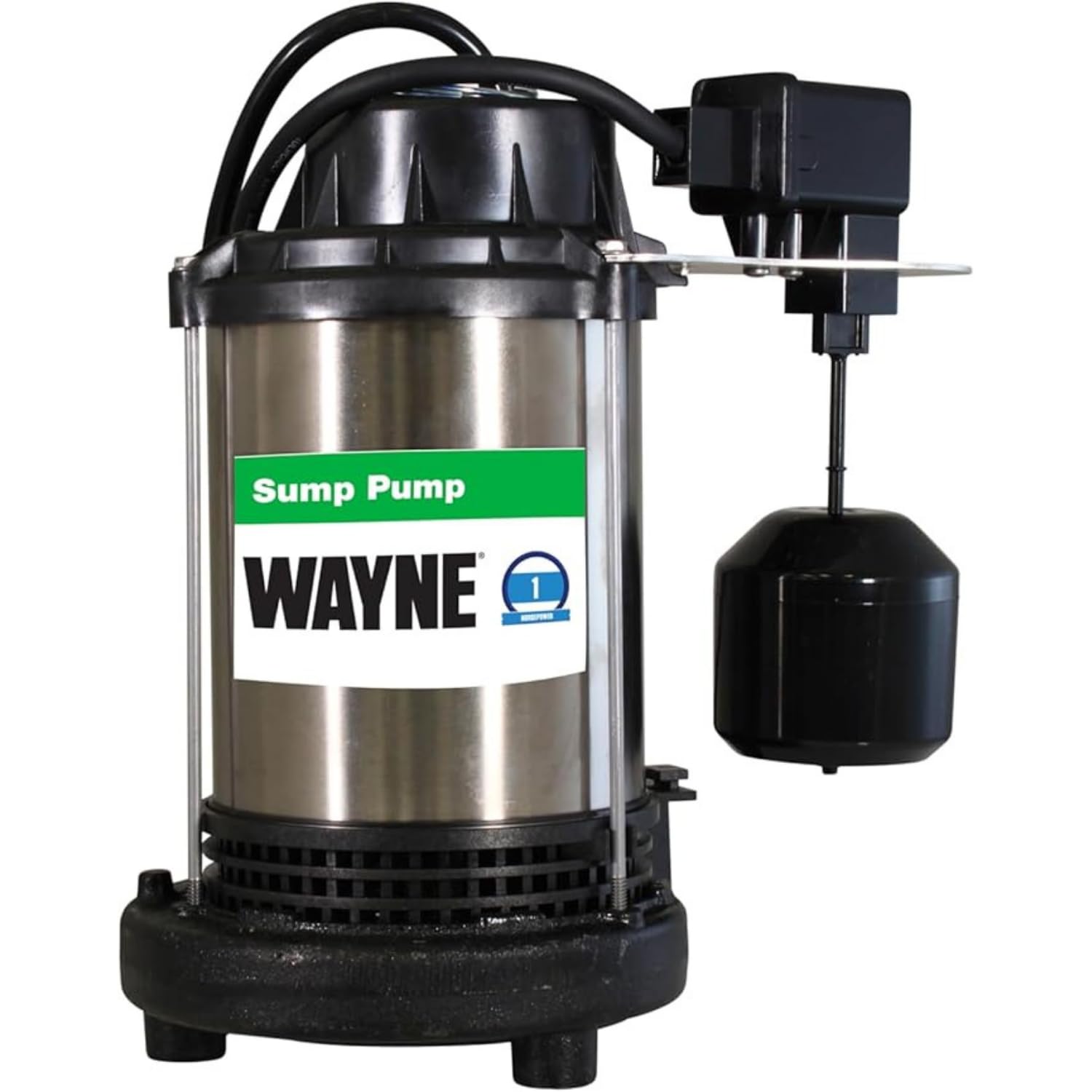
4. Wayne 1 HP Heavy Duty Submersible Cast Iron and Stainless Steel Sump Pump with NEW Switch (CDU1000ET)
The indoor workhorse backed by a five-year warranty and a million-cycle test.
Wayne rates this pump to move up to 6,100 gallons per hour, and it is tested to run over 1 million cycles — the kind of duty claim you want on a pump meant to kick on every storm for years. The 101.67 gpm flow (gallons per minute) is the highest in this lineup, ahead of the Basement Watchdog’s 94 gpm and the Superior 92151’s 86 gpm. Top-suction design eliminates air lock (a trapped air bubble that stops pumping) and minimizes clogging from debris that settles at the bottom of the pit, and the corrosion-resistant stainless steel motor housing and fasteners pair with a cast-iron volute (the pump’s water-channeling housing) for long life. Setup is genuinely quick: roughly 15 minutes, with no weep hole to drill. The 5-year limited warranty is the longest here, and the pump is assembled in the USA.
Owners lean heavily on quality and performance, and the field reports back it up. It empties a 200-to-300-gallon hot tub in under five minutes where an older pump took 25 — a real-world illustration of what the flow rating means once it hits water. The new magnetic switch design is appreciated for being quieter and rarely needing replacement, and an installer eight months in reported no failures despite a few hard jobs. The switch levels are clearly specified too: it turns on at 9 inches of water and off at 4 inches, and it needs a sump basin 11 inches in diameter or larger. Indoor use only — this is a basement pump, not an outdoor utility unit.
The practical catches: you need a separate 1.5-inch threaded discharge hose (it does not come with one), and the pump must be sized to an 11-inch-or-larger basin, so a narrow pit will not work. Its 25-foot max lift lands between the Taskstar’s 28 feet and the Basement Watchdog’s 22 feet — fine for most basement runs, but not the highest reach here. One reviewer noted the unit arrived fast but was still awaiting installation, so no long-term verdict there. Overall, this is the least fussy high-flow basement pump in the lineup, and the warranty gives it a safety net the others match only at three years.
What buyers keep coming back to
- 6,100 GPH and 101.67 gpm — the strongest flow rating of the group
- Tested to over 1 million cycles and backed by a 5-year limited warranty
- Top-suction design resists air lock and bottom-of-pit clogging
- Quick install in about 15 minutes, no weep hole needed
Before you commit
- Indoor use only — not built for outdoor or utility draining
- Needs an 11-inch-diameter sump basin or larger
- Discharge hose sold separately; it does not include one
The confident pick for: a conventional indoor basement sump with an 11-inch or wider basin, where maximum flow and a long warranty matter most.
Skip it for: outdoor pond or utility draining, narrow pits, and jobs where you want a hose in the box — this pump expects you to bring both the basin size and the discharge line.
5. Superior Pump 92181 1HP Stainless Steel and Cast Iron Tethered Float Switch Sump Pump

A 2-inch outlet and a float you can pull off to run it as a plain utility pump.
The headline feature on the Superior 92181 is flexibility: the tethered float switch (a float on a cord that turns the pump on and off) can be removed entirely, converting it into a plain utility pump for jobs where you want to run it dry or control it by hand. When used as a sump pump, it lifts water up to 25 vertical feet and pushes 75 gpm through a large 2-inch discharge for high-capacity removal — the same broad outlet found on the Basement Watchdog but paired with a swinging tether float rather than a caged dual switch. The cast iron and stainless steel construction gives it corrosion resistance for years of submersion.
One owner replaced a 35-year-old pump of the same make and noted the old one’s trouble was a float switch that stuck in the on position — the fresh switch here has run cleanly for months since install. That track record, combined with the 1-1/2 inch NPT adapter included for narrower plumbing, makes this a sensible upgrade for someone whose aging pump still moves water but keeps jamming its switch. The tether float is easier to reach and reset by hand than a vertical switch, which many homeowners prefer.
The caution here is real, though. A tethered float needs room to swing, so it is not the switch for a narrow, tight pit — the integrated and vertical-float pumps handle cramped spaces better. And the durability picture is genuinely split: while the design has a long lineage, a small number of units have arrived dead or failed quickly from the start, leaving the buyer contending with warranty timing. Set it up and test it the day it lands, within the return window, so any problem is caught fast. Owners who get a good unit keep it running for years; the design rewards a careful setup over a set-and-hope approach.
The flexible choice: a removable tether float turns this into a utility pump, and the 2-inch discharge moves serious volume at 75 gpm with 25-foot lift.
Test it early: a few units have shown up dead or failed quickly, so verify it works right away while full warranty coverage and the return window are still open.
Suits you if: you want a convertible pump — sump duty when you need it, utility jobs when you pull the float — with a wide 2-inch outlet for high-capacity flow.
Less ideal if: your sump pit is narrow, since a tether float needs swing room, or you prefer the instant confidence of a pump that has proven itself on the first cycle.
6. Red Lion RL-SS100T, 115V, 1 HP, 5300 GPH Automatic Sump/Effluent Pump

Built to chew through 3/4-inch debris that would choke a standard sump pump.
Most 1 HP sump pumps here pass half-inch particles at best. The Red Lion RL-SS100T handles 3/4-inch semi-solids, which is the reason to choose it for effluent duty or any pit that collects yard grit — leaves, seed pods, and small stones that would stall a finer-impeller pump. It delivers up to 5,300 GPH at 115 volts drawing 8 amps, with a 2-inch FNPT discharge and a 1-1/2 inch FNPT adapter included for narrower plumbing. The stainless steel and cast iron body is built for aggressive water, and the piggyback tethered float switch can be switched to manual mode for testing or emergency water removal. A generous 20-foot cord gives you slack to reach an outlet without an extension, and it is CSA listed in the USA and Canada.
Field performance reports focus on power: it moves large amounts of water quickly and handles major basement flooding. One owner replaced several lower-output pumps with this single unit to deal with driveway flooding and found it easily moved heavy rain to the gutter. The float activation levels are specified too — it turns on at 15-18 inches and off at 7-10 inches, so it wants a reasonably deep pit to cycle correctly. Installed correctly, owners call it well-made and heavy-duty, and it held up over three flood events in one yard-flooding setup.
Two things to respect before you buy. First, it requires a dedicated circuit — one installer specified a 20-amp line — so check your breaker situation before committing, since a shared circuit can trip under load. Second, an out-of-the-box failure has been documented: an O-ring pinched on one unit, letting water in and corroding the connections, so inspect the pump carefully and seat it properly before first use. That is the exception, not the pattern, but it is worth knowing. At 31.6 pounds it is on the heavy side, second only to the Basement Watchdog, so plan the install accordingly.
Where it stands out
- 3/4-inch solids handling beats every other pick for debris and effluent duty
- 5,300 GPH at 8 amps on 115 volts, with a 20-foot cord for reach
- Piggyback tether switch converts to manual mode for testing or emergencies
- Stainless steel and cast iron body built for aggressive water conditions
Worth knowing upfront
- Wants a dedicated circuit, ideally a 20-amp line, so a shared breaker may trip
- Float levels require a deeper pit to cycle correctly
- An out-of-the-box O-ring failure has been reported, so inspect before install
The right match for: effluent pits, debris-heavy catch basins, and flood-prone yards where 3/4-inch solids handling is the deciding factor.
Not the one for: a shallow pit that cannot satisfy its 15-18-inch on-level, or a circuit you cannot dedicate to the pump.
Understanding the Specs
Flow Rate (GPH) And Lift Height
Flow rate measured in gallons per hour tells you how much water the pump moves, but that number only matters alongside the lift height it is measured at. Manufacturers often quote the biggest figure — flow at zero feet — because it looks impressive. In a real basement, water has to rise to the discharge point, and flow drops as that vertical distance grows. A pump rated at 6,540 GPH at zero lift still moves 4,440 GPH at 10 feet of lift, so always compare two pumps at the same height. Match the pump’s lift rating to your actual discharge run: a short horizontal run to a floor drain needs less than a pipe climbing several feet to a window well.
Float Switch Types Explained
The float switch is the sensor that tells the pump when to start and stop, and it is the most common failure point in any sump pump. A vertical float slides along a guide rod and suits narrow pits because it does not swing. A tethered float floats on a cord and needs room to pivot, but it is easier to convert to manual mode or remove for utility use. A caged dual float switch uses two actuators for backup, so one sticking float does not strand the pump. Whichever you choose, check the pit diameter and the on/off water levels: some pumps need an 11-inch basin and activate at a specific depth, so a shallow pit can short-cycle the pump and wear it out early.
FAQ
Is a 1 HP sump pump too powerful for a normal basement pit?
What is the difference between a vertical float and a tethered float switch?
Does a 1 HP sump pump need its own electrical circuit?
How much water can a 1 HP sump pump move per hour?
Can I use a 1 HP sump pump outdoors to drain a pool or pond?
What does solids handling mean on a sump pump?
How long does a 1 HP cast iron sump pump last?
Do I need a 2-inch or 1-1/2-inch discharge pipe for a 1 HP pump?
Why does my sump pump’s float switch get stuck?
Should I get a pump with a backup float switch?
Final Thoughts: The Verdict
For most basements, the 1 hp sump pump to beat is the Superior Pump 92151 — it balances strong flow, a tight-pit-friendly vertical float switch, and cast iron durability better than anything else here. If you need the most gallons per hour with a dual-float safety net, grab the Basement Watchdog BWSS100. And for portable jobs around a pool or pond, the Taskstar 1 HP Submersible Water Pump is the one to reach for, with 28 feet of lift and a carry weight that keeps it easy to move.
How We Picked
We do not accept paid placement. Every pick is matched to a real buyer and a real use-case; we do not hands-on test units.
Sources & Methodology
Specifications: manufacturer listings and product documentation. Review insights: verified customer reviews, as of September 2026. Pricing: not shown on this page (it changes often); check the current price via the retailer link.
As an Amazon Associate, KitchPrep earns from qualifying purchases. This does not affect which products we feature.
Related Guides
