
Specs are compiled from manufacturer listings and verified buyer reviews and can change over time — please confirm the key details on the product page before buying.
You want a cut edge on porcelain that looks factory-finished, not one you have to hide under a trim strip. That is the whole job of a 10 inch wet tile saw blade — a diamond-rimmed disc that spins through hard porcelain while water keeps both the blade and the tile cool. The wrong blade chips the glaze, wanders off your pencil line, or goes dull halfway through a bathroom floor. The right one leaves an edge you can hand-rub smooth.
I’m Mohammad Maruf — the founder and writer behind KitchPrep. This guide is built by comparing the manufacturers’ published specifications and the patterns across verified customer reviews, so you get each pick’s real strengths and trade-offs instead of marketing spin.
Two numbers decide most of these purchases: the rim height, which sets how long the blade keeps cutting, and the arbor size, which decides whether it physically bolts onto your saw. Below you will find the 10 inch wet tile saw blade that fits your saw, your tile, and your patience level.
Our Picks at a Glance

How To Choose The Best 10 Inch Wet Tile Saw Blade
Every blade on this list is a 10 inch diameter disc designed for wet cutting, so the size question is already settled. What separates them is how long they stay sharp, how much material they remove, and whether the center hole matches your saw. Get those three right and you will not be shopping again mid-project.
Match the arbor before anything else
The arbor is the center hole that slides over your saw’s shaft. A 5/8 inch arbor is the common size on most 10 inch wet saws, and several blades here ship with a reducer ring so a 7/8 inch hole can step down to 5/8 inch. If the hole is too big and nothing reduces it, the blade will wobble and cut crooked. Check your saw’s arbor size first — it takes ten seconds and saves a return.
Rim height decides blade life
The rim is the diamond-bearing edge on the outside of the disc, and its height is how much cutting material you have before the blade is spent. A 10mm rim and an 11mm rim look similar on the shelf but the taller one keeps cutting longer before you swap it. If you are tiling one bathroom, rim height barely matters. If you cut daily, it is the number that controls your cost per job.
Kerf width and cut speed
Kerf is the width of the groove the blade leaves behind. A thin kerf removes less material, so it cuts faster and wastes less of an expensive tile — but a very thin disc can flex if you push it. That flex shows up as a wandering line on a bevel or a small tile. Speed and precision pull against each other, and the blade you pick should lean toward whichever one your job demands.
Quick Comparison
| Model | Best For | Arbor / Fit | Rim Height | Blade Weight | Amazon |
|---|---|---|---|---|---|
| DEWALT DW4762 Porcelain Blade★ Best Overall | All-round porcelain cutting | 5/8-Inch Arbor | — | 0.58 kg | Amazon |
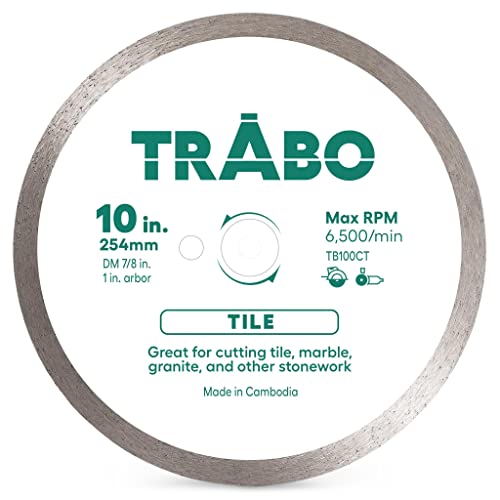
| Trabo 10 Inch Continuous RimBudget Champion | Budget stone and granite work | 1 Inch with reducer | 10mm | 0.73 kg | Amazon |
| OSTEK 10 Inch Super Thin (CB-8)Top Performer | Fast everyday tile cutting | 7/8″ or 5/8″ | 10mm | 0.7 kg | Amazon |
| solidure 10″ Wet Tile Saw Blade | Granite and marble slabs | 10″ diameter | 10mm | 0.87 kg | Amazon |
| Diapro Super Thin Diamond Blade | Precision work on hard stone | 7/8″ or 5/8″ | 3/8″ | 0.87 kg | Amazon |
| Delta Diamond Piranha Premium | Lapidary and stone hobbyists | 5/8″ Arbor | 11mm | 16 ounces | Amazon |
| DEWALT DW4764 Premium Porcelain | High-volume production cutting | 5/8″ Arbor | — | — | Amazon |
| MK Diamond MK-225 Hot Dog | Thin-kerf speed on porcelain | 5/8-Inch Arbor | — | 12 ounces | Amazon |
| Alpha Porcellana 10″ Wet Blade | Exposed edges and luxury finishes | 10″ diameter | — | — | Amazon |
In‑Depth Reviews
1. DEWALT Diamond Blade for Porcelain or Tile, Wet Cutting, Continuous Rim (DW4762)
Our pick — over 4.5★ from 200+ verified ratings; the strongest balance of quality and price.
The blade that keeps cutting clean long after cheaper discs quit
If you are tiling a bathroom or a kitchen backsplash and you want one blade that handles porcelain, glazed ceramic, glass, and engineered stone without swapping mid-job, this is the one to start with. The DW4762 is a 10 inch continuous rim blade with a 5/8 inch arbor — a solid diamond edge with no gaps, which is what keeps the cut smooth instead of choppy. It weighs 0.58 kg, so the disc is light enough that it spins up fast and puts less strain on your saw’s motor.
Where this blade separates from cheaper options is staying power on real jobs. Buyers report it cutting two showers, three backsplashes, and several floors on one disc, and it still handles 24-inch porcelain. What wins people over most is raw cutting performance — it is the strongest thing about this disc, and it shows up whether you are trimming a thin edge or slicing through a full tile.
The honest catch is chipping. Go too slow and you create more chips than going at a steady pace, so it pays to run a few sacrificial test pieces before you commit to the visible cuts. The blade also dulls faster than some users expect — one long job report notes it slowed about 20% after roughly 15 cuts through 2cm porcelain. Buyers still call it good value, and the fix is simple: a dressing stone keeps the diamond exposed and brings the cut quality back.
What Earns Its Keep
- Cuts porcelain, glazed ceramic, glass, recycled glass, and engineered stone on one blade
- 5/8 inch arbor fits the standard shaft on most 10 inch wet saws
- Stays clean through multi-room jobs — showers, backsplashes, and floors on the same disc
- Owners rate the cutting performance as the strongest part of the blade
Where It Asks More Of You
- Feed it too slowly and you get more chipping than at a steady pace — test on scrap first
- Blade life is finite; expect it to slow noticeably after a run of heavy cuts
- Visible edges benefit from a diamond file to re-bevel and clean up
The one to grab: the safest single-blade buy if you are tiling a full room and want porcelain, ceramic, and glass all handled by one disc with a 5/8 inch arbor.
Know before you buy: budget time for a few test cuts — this blade rewards a steady, deliberate feed rate and punishes creeping along.
2. Trabo 10 Inch Tile Continuous Rim Diamond Metal Bond
A carbon steel disc that eats granite and stone for the price of a takeout dinner
Trabo is the name most buyers have never heard of, and that is exactly why this blade lands where it does. It is a 10 inch continuous rim disc with a 10mm rim height, built on a carbon steel body and embedded with diamonds, and it ships with a 1 inch arbor plus a brass reducer ring glued inside the package so you can step it down to fit a more common saw shaft. It fits chop saws, grinders, and wet tile saws — the 4 1/2 inch version of this family drops straight into a Makita angle grinder.
Heft is where the trade-off lives. At 0.73 kg it is a heavier disc than the DEWALT DW4762 at 0.58 kg, and that extra mass shows up in a wide kerf — the groove it leaves is thicker, which means more material removed per cut. On granite offcuts or a stone countertop that costs you nothing to trim, that is fine. On a slab of expensive marble where every millimeter is money, the material loss stings. One buyer put it plainly when they said the thickness was too much for glass at 10mm, and the same logic applies to any thin, precious stock.
What it does well is cut cleanly across a wide material list — granite, porcelain, ceramic, stone, and concrete all fall to it — and long-time buyers rate the cut quality higher than the price would suggest. A dressing stone keeps the diamonds biting if you plan a lot of cutting. For a first blade or a spare to keep in the truck, this is hard to argue with.
Best matched to: stone and granite work where a little extra kerf loss does not matter, and anyone who wants a backup disc for a wet saw without spending much.
Fit note: comes with a 1 inch arbor and a reducer ring, so check that the ring seats properly on your saw before you start cutting — a poorly seated reducer is what causes wobble.
Buy this one if: you are cutting granite, stone, or concrete and want cheap, reliable cuts with a blade that does not ask much of your wallet.
Pick something else if: you are working expensive marble or thin glass where a wide kerf and a heavy blade are the wrong tools for the job.
3. OSTEK 10 Inch Super Thin Wet Diamond Porcelain Saw Blade (CB-8)
Twenty-four teeth for a diamond disc that chews through porcelain fast
The OSTEK CB-8 carries 24 teeth — more than double the 10 on the DEWALT DW4762, which is the clearest head-to-head difference in this whole lineup. That tooth count is what gives it the fast, aggressive cut that buyers describe as slicing like butter on thin glazed ceramic and porcelain alike. It is a super thin disc at 0.7 kg with a 10mm rim height, and it runs either wet or dry on a hand-held machine.
Fitting is flexible. The center hole is 7/8 inch or 5/8 inch, so it drops onto most common wet saws. Two things to know: it fits a Ridgid 7 inch wet saw only with the adapter ring, which needs pressing in, and the blade is known for being fast rather than flawless. One owner cutting at 8,500 rpm called it fast but not a clean cut — so if you are chasing a polished, hand-rubbable edge on exposed trim, slow your feed and accept a little more work afterward.
What earns it a spot this high is genuinely impressive staying power for the money. One owner reports a single blade lasting nearly three full shower installations before a change, and a daily tile user on a Harbor Freight saw calling it a great value that exceeded expectations. For volume work where you are cutting hidden tiles and full-size sheets, this is the speed pick.
Why It Moves Fast
- 24 teeth versus 10 on the DEWALT DW4762 — a big jump in cut aggression
- Super thin body keeps the cut quick through porcelain and ceramic
- Runs wet or dry, on a wet saw or a hand-held machine
- Handles full shower installs before it needs swapping out
What To Plan Around
- Speed over polish — at high rpm the cut is fast but not glass-smooth
- Fitting to some 7 inch wet saws needs the adapter ring pressed in with oil
- Best used where the cut edge stays hidden or gets a trim strip
Go this route if: speed is your priority and most of your cuts end up hidden under cabinets, trim, or a threshold strip.
Not the one for: exposed feature edges where you need a hand-polished finish straight off the saw.
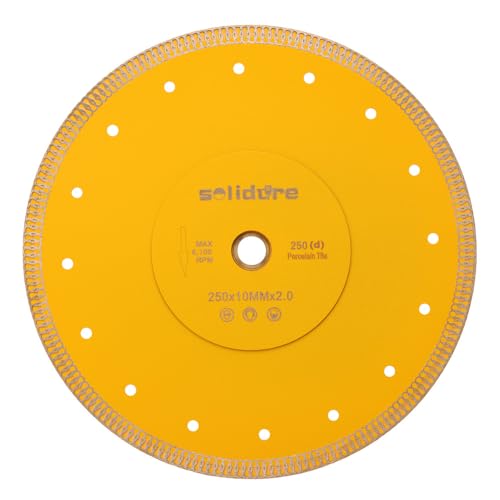
4. solidure 10″ Wet Tile Saw Blade for Granite Marble Ceramic Tiles
Built hot-pressed and sintered to chew through thick granite without stalling
This solidure disc is a hot-pressed sintered saw blade — meaning the diamond grit is baked into the metal rim rather than plated onto the surface, which is what gives it the bite for dense stone. It runs a 10mm rim height with a 2.0mm segment thickness, and it weighs 0.87 kg, the heaviest blade on this list. That weight is a signal: this is a disc built for granite, marble, and sandstone slabs, not for whipping through a stack of thin subway tile.
The evidence backs the build. It swapped in as an upgrade over an older wet saw blade and cut through a 2 inch thick granite piece easily — that is a serious slab, and most budget blades would simply stall on it. It cuts porcelain and ceramic every bit as cleanly, but the granite performance is the reason to choose it. Work it wet where you can, since the maker states the best results come from wet cutting.
Here is the honest note: this blade is prone to rust if you leave it sitting damp between jobs. Dry it after every use and it will not cost you any cutting power. That single maintenance habit is the whole difference between this disc lasting and this disc looking rough.
The standout: a hot-pressed sintered rim with 2.0mm segment thickness takes on 2 inch granite where lighter blades bog down.
The maintenance ask: wipe it dry after wet cutting — this one genuinely dislikes sitting wet, and rust is the one recurring note attached to it.
Reach for this if: you are cutting granite, marble, or sandstone slabs and want a sintered rim that does not flinch at thickness.
Look past it if: you only cut thin ceramic and want a lighter blade that needs zero post-cut care.
5. Diapro 10″ Diamond Tile Saw Blade Super Thin Diamond Porcelain Blade

A super thin disc with a titanium carbide edge for tight, accurate cuts
Cut a clean circle out of a ceramic tile for a shower valve and you understand what a thin disc is for. The Diapro runs a 10 inch diameter with a 3/8 inch segment height and a 2 millimeter body thickness, built from diamond with a titanium carbide layer on the rim. It fits wet saws and tile saws with a 7/8 inch or 5/8 inch arbor, so it mounts on most standard 10 inch machines. At 0.87 kg it feels substantial in the hand.
The thin profile is the whole point. It handles high pressure but deforms if you set it down hard or drop it, which is the flip side of being thin — treat the disc carefully between cuts and it stays true. In return you get a blade that works in tight corners and lets you cut odd shapes and precise openings that a thicker disc cannot reach. Buyers running 2.5 x 8 x 8 mm glazed ceramic report no chipping on any piece, and it cuts smooth and accurate through granite, marble, and stone.
Some find it thicker than they expected once it is from the start, and a few see more chipping than they anticipated on harder tile, so a test cut is worth the two minutes. For detailed work — around plumbing, on a diagonal, or forming a fixture cutout — few blades in this class give you the control this one does.
Where It Wins
- 3/8 inch segment height and a 2mm thin body reach tight spots a thick blade cannot enter
- Diamond with a titanium carbide rim holds up under pressure on granite and stone
- 7/8 inch or 5/8 inch arbor fits common wet saws
- Clean, chip-free cuts reported on glazed ceramic tiles
Where Care Pays
- Thin discs deform if dropped or set down hard — handle it deliberately
- Some find it thicker than expected and see more chipping on dense tile
- Not the blade to leave clattering loose in a bucket of offcuts
The fit for detail work: anyone cutting openings, circles, or odd shapes in ceramic and porcelain where a thick disc simply will not go.
skip it if: you want a blade you can toss loose into a bucket with no thought — this thin body asks for careful handling.
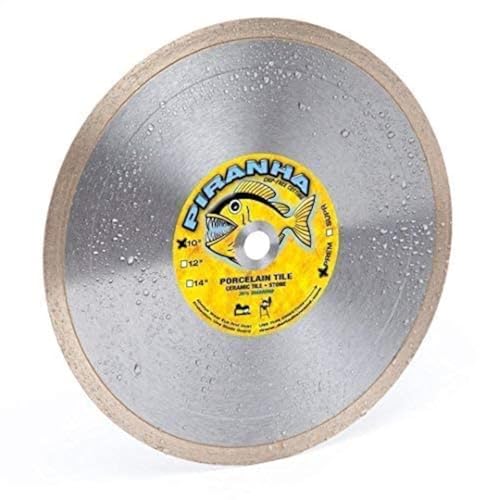
6. Delta Diamond Piranha Premium 10 Inch Tile Saw Diamond Blade
The 11mm rim and.090 cutting edge keep it biting through job after job
If you want a blade that lasts across multiple jobs without a swap, the rim height is where you spend. The Piranha Premium carries an 11mm tall rim — taller than the 10mm on the Trabo and OSTEK — designed to boost blade life, and it is built with higher levels of diamond than a standard disc. It uses a thin.090 inch cutting rim that balances speed against blade life, fits any tile saw with a 5/8 inch arbor shaft, and has a maximum safe speed of 6,115 rpm. It weighs 16 ounces.
The material list is the widest here: porcelain tile, ceramic tile, granite, marble, slate, and terrazzo all fall to it. A lapidary buyer on a trim saw finished several Brazilian agates in about 2-3 minutes each, faster and cleaner than a slab saw. For marble countertops it cut through a 48 inch run of 5/8 inch material on a Dewalt circular saw with minimal dust, and it will take on soft slate and granite as a follow-on job. If your work spans both tile and stone, this blade covers both.
The catch is chipping on porcelain for a first-timer. A new user on an overhead saw opened the blade on the first 10-20 cuts and saw several small chips per cut, then watched the cut stabilize after 20-plus cuts and hold steady. Miter cuts at 45 degrees were the worst offender. Run a break-in set of cuts first and the blade settles in — most failures here are a user pushing a brand-new blade through a finished edge too soon.
The standout spec: an 11mm rim with a.090 inch cut edge makes this one of the longest-lived discs in this lineup, and a lifetime warranty against warping, cracking, and material defects backs it up.
The right blade for: anyone cutting tile and stone across more than one job who wants a tall 11mm rim and a lifetime warranty on their side.
Good to know: break it in on scrap cuts before you cut a visible edge — this blade chips a fresh porcelain edge until it has worn in.
7. DEWALT Diamond Blade for Tile, Wet Cutting, 10-Inch x.060-Inch (DW4764)

A premium porcelain blade built to run all day without a blade change
When you are paid by the square foot, you buy the blade that never leaves the saw. The DW4764 is DEWALT’s premium porcelain disc, a 10 inch blade with 18 teeth, a 5/8 inch arbor, and a very thin.060 inch cutting body. It stays cool on long runs and handles glazed ceramic, porcelain, and brick without bogging down. If you cut production volumes, this is where the money goes.
The teeth tell the story against its sibling. At 18 teeth it sits between the DW4762’s 10 and the OSTEK’s 24, giving it a cut rate that outpaces the DW4762 on thick porcelain while keeping more of the clean edge. It has cut large-format 3/8 inch porcelain 4x faster than a competing blade without needing multi-passes, and it has run 700-plus square feet of ceramic with minimal chipping at slow speeds and no flex at angles.
Two honest notes. First, at.060 inch the blade is very thin and flexible — great for speed on straight runs, but it bends in precision bevels and edge trimming where a thick disc holds true, so slow down on the detail cuts. Second, cutouts clog with dust and the blade needs a periodic sharpening with a dressing stone or a quick pass through brick. Keep it dressed and this disc holds its cut rate across a full production day.
Why Production Crews Reach For It
- 18 teeth — a faster cut than the DW4762’s 10 without giving up much edge quality
- .060 inch thin body stays cool and runs flat on long straight cuts
- Cut 700-plus square feet of ceramic with minimal chipping at slow speeds
- Handles large-format porcelain and brick without needing multiple passes
Where It Needs Finesse
- Flexes in bevels and edge work — slow the feed on precision cuts
- Cutouts clog with dust and need periodic dressing to stay sharp
- Thin body means it will not hold a hard line under pressure the way a rigid disc does
Built for the working pro: a full-floor installer or remodeler cutting hundreds of square feet of porcelain and ceramic who wants one premium blade that holds up all day.
Think twice if: your job is mostly angle cuts and bevels — the thin.060 inch body bends where a stiffer blade would track straight.
8. MK Diamond MK-225 Hot Dog 10″ Continuous Rim Diamond Saw Blade

A 12-ounce thin-rim blade that slices hard porcelain and cuts fast
The MK-225 Hot Dog earns its nickname from a continuous thin rim at just.050 inch and a 12 ounce body — one of the lightest discs in this lineup. It is a 10 inch blade with a 5/8 inch arbor, built for porcelain and vitreous tile, and it runs on power tools with a 0.625 inch arbor shaft. That thin kerf means a fast cut and less material grinding away per pass, which is exactly what you want on dense modern porcelain.
Speed is the reason to buy it. Set against DEWALT’s blades in head-to-head use, one report cut roughly 25% faster than a brand-new DEWALT disc on a DeWalt saw, with finer edges — fast enough to slice 1/8 inch off hard quarry tile without breaking it. On 18×18 porcelain it cut fast and smooth. The catch is what happens on small tiles. The same thin blade flexes too much to hold a straight line on small pieces, so it shines on medium and large-format porcelain but fights you on 2 inch tile.
Blade life is the split opinion here. A long-time lapidary cutter who has run roughly 100 of these says sharpness now fades after about a third of the blade’s life, which is a pattern worth knowing if you cut stone professionally. For tile work, run it wet with plenty of water and this blade stays productive. It is a fast-cutting disc for the right job, and the wrong one for a tile smaller than your hand.
The thin-kerf advantage: at.050 inch, this blade removes less material and cuts faster than any thicker disc in the lineup — one report put it about 25% faster than a fresh DEWALT blade.
Where it wobbles: the same thin body flexes on small tiles and struggles to cut a straight line — set medium and large porcelain in it and let the small pieces go to a sturdier disc.
The blade to buy if: you cut mostly medium and large-format porcelain and want the fastest possible pass with minimal kerf loss.
Pack something else if: your job is a mix of tiny 2 inch tiles and mosaics where a stiff disc will hold the line this one loses.
9. Alpha Porcellana 10″ Wet Diamond Blade
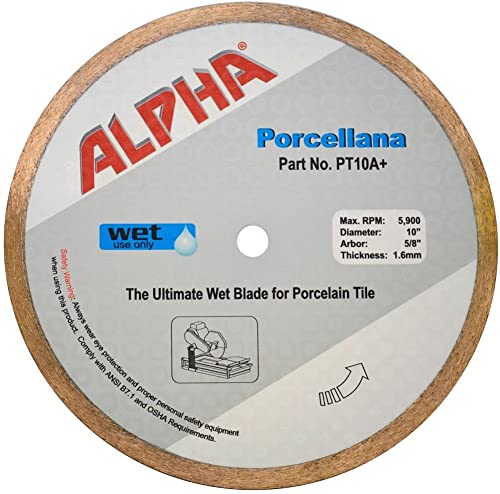
The blade you buy when the cut edge is going to be seen up close
Most tile jobs let you hide the cut edge under a cabinet or behind a shoe. A shower shelf inset, a trim strip, a slab apron — those cuts are always on display, and they are what this blade is built for. The Alpha Porcellana is a 10 inch diamond disc made by Alpha Professional Tools, fitting the AWS-110 and AWS-125 machines, and running on marble, porcelain, and stone. It is the top of this list on price, and it earns the spot on cut quality.
A 20-year luxury tile craftsman calls it the best blade for modern porcelain, getting roughly five baths per disc with edges clean enough to hand-rub. In direct comparison against a DEWALT XP4 on a Dewalt 24000 saw, it cut cleaner at a faster feed rate where the DEWALT needed to slow down and still fell short. That means less time per cut and, with dense porcelain that dulls cheaper blades, less time spent swapping discs mid-job.
No blade is free of compromise. Value splits both ways here — some owners say it is worth every cent, others find the price steep for the amount of cutting they get. It also dulls faster than expected on agatized coral, so rock cutters are better served by a cheaper disc and should save the money. For exposed porcelain edges in high-end work, though, this is the blade that leaves the finish you can sell.
What You Pay For
- Cut quality engineered for edges that stay visible on the finished job
- Handles modern dense porcelain at a faster feed rate than competing premium blades
- No wobble, no walk — clean 12 x 12 porcelain cuts with no chipping
- Fits AWS-110 and AWS-125 machines and covers marble, porcelain, and stone
What Comes With The Price
- Premium tier — DIYers cutting a single room rarely need this much blade
- Dulls on agatized coral; rock cutters are better off with a cheaper disc
- Only worth it when cut quality is the reason you bought it
The premium finish choice: a pro doing luxury tile with exposed edges who needs a hands-off, hand-rubbable cut straight from the saw.
Not necessary if: you are a weekend DIYer cutting one bathroom where the edges are all hidden under trim.
Understanding the Specs
Arbor Size and Reducer Rings
The arbor is the center hole that slides over your saw’s spinning shaft, measured in inches. A 5/8 inch arbor is the common size on most 10 inch wet saws, so a blade with a 5/8 inch hole mounts straight on. Several blades here have a 7/8 inch hole and include a reducer ring — a small metal washer that steps the bigger hole down to 5/8 inch. If the ring slips or seats crooked, the blade wobbles and cuts a wavy line, so press it in firmly before you tighten the nut. A 1 inch arbor blade like the Trabo works the same way with its included brass reducer.
Rim Height and Blade Life
The rim is the ring of diamond metal on the outside edge of the disc, and its height in millimeters is how much cutting material you have before the blade is spent. A 10mm rim and an 11mm rim sit side by side on a shelf and look nearly identical, but the taller rim has more diamond to wear through, so it lasts longer between swaps. This is the number that most directly controls how often you buy a new blade. If you cut once a year, rim height barely matters. If you cut daily, a taller rim like the 11mm on the Delta Diamond Piranha saves you both money and time.
Kerf Thickness and Cutting Speed
Kerf is the width of the groove the blade cuts through your tile, and it is set by how thick the cutting body is. A thin blade removes less material, so it moves faster and leaves more of an expensive tile intact. The.050 inch body on the MK-225 Hot Dog and the.060 inch body on the DEWALT DW4764 both cut quickly because so little material is being ground away. The trade-off is flex: very thin blades bend under sideways pressure on bevels and small tiles, so if your work is mostly precision angles, the extra thickness buys back control.
Continuous Rim versus Segmented
A continuous rim is a solid band of diamond metal around the whole edge, with no gaps. That solid band is what produces a smooth, low-chip cut on porcelain, ceramic, and glass — the material is sheared rather than battered. Every blade on this list is a continuous rim, which is why these discs suit finish tile work. Segmented rims, which have gaps between diamond chunks, cut rough and fast and belong on demolition and concrete, not on the tile that goes on your wall.
FAQ
Will a 10 inch wet tile saw blade fit my saw?
How long does a diamond tile blade last?
Do I really need to run these blades wet?
Will a 10 inch blade fit a 7 inch tile saw?
What causes chipping on porcelain and how do I stop it?
Can I cut granite and stone with a tile blade?
Why do some blades wobble or flex and how do I prevent it?
What is the difference between a continuous rim and a segmented tile blade?
Which blade should I get for cutting tile for a shower?
Do I need a dressing stone for a wet tile saw blade?
Final Thoughts: The Verdict
For most people tiling a full room, the 10 inch wet tile saw blade winner is the DEWALT DW4762 because it handles porcelain, glazed ceramic, glass, and engineered stone on one 5/8 inch arbor disc and stays clean through showers, backsplashes, and floors alike. If your priority is speed on large-format porcelain with hidden edges, grab the OSTEK CB-8, whose 24 teeth outpace the DW4762’s 10. And for exposed feature edges where the finish has to look factory-clean, the Alpha Porcellana is the one to reach for — it cuts porcelain cleanly enough to hand-rub smooth. Whichever way you lean, matching the arbor to your saw and running the blade wet will do more for your results than any single spec on the page.
How We Picked
We do not accept paid placement. Every pick is matched to a real buyer and a real use-case; we do not hands-on test units.
Sources & Methodology
Specifications: manufacturer listings and product documentation. Review insights: verified customer reviews, as of September 2026. Pricing: not shown on this page (it changes often); check the current price via the retailer link.
As an Amazon Associate, KitchPrep earns from qualifying purchases. This does not affect which products we feature.
Related Guides
