
Specs are compiled from manufacturer listings and verified buyer reviews and can change over time — please confirm the key details on the product page before buying.
If you test backflow preventers for a living, a gauge that drifts out of calibration costs you a re-test and a return trip. A kit that drifts out of calibration (loses its accuracy over time) or leaks at a push fitting (a connector you push the hose into) costs you a re-test, a return trip, and an unhappy customer. Nearly every kit on this list will pass a certification check on day one. The real differences show up in three things: five-valve convenience (five separate valves let you run each test without swapping parts), how the gauge survives a year of field abuse, and whether the calibration certificate (the paperwork proving the gauge is accurate) is still current when the box lands on your porch.
I’m Mohammad Maruf — the founder and writer behind KitchPrep. This guide is built by comparing the manufacturers’ published specifications and the patterns across verified customer reviews, so you get each pick’s real strengths and trade-offs instead of marketing spin.
Below you will find a five-valve test kit for every budget tier, from workhorse brass gauges to a digital unit with a backlit screen. Whether you are a certified tester shopping your first kit or a veteran replacing a leaky set, this breakdown of the backflow test kit market covers the five-valve kits, 90 micron filters, and calibration certificates that hold up in the field.
Our Picks at a Glance
How To Choose The Best Backflow Test Kit
A backflow test kit is a buy-once, certify, and lean-on-it-for-years purchase. You buy it once, you get it certified, and then you lean on it for years of daily or monthly work. The choices that matter come down to four things: how many valves you get, whether the gauge holds its calibration, how the kit handles field abuse, and whether the paperwork is valid when it reaches you.
Valve count and what it means for your work
A five-valve kit gives you separate controls for high side, low side, and the two bleed-off ports, plus a bypass. That matters when you are testing a reduced-pressure zone assembly, because you need to isolate each check independently without draining and re-setting the whole rig. A three-valve kit technically works, but a five-valve set cuts the time you spend shutting valves and waiting for pressure to settle. All four picks here are five-valve kits, so you are already on the right shelf.
Gauge accuracy and calibration certificates
What actually keeps you compliant is the calibration certificate, not just the gauge’s headline accuracy number. Most certifying bodies want a certificate dated within the last year, and a kit that arrives with a stale cert is a kit that sits on the shelf. A laminated, waterproof certificate — like the one that comes with the BAC-FLO-5 — survives the inside of a truck bed better than a paper slip. If a kit advertises a one-year calibration window, that tells you the maker expects you to recertify on an annual cycle.
Filters, hoses, and field survival
Debris is what kills a gauge. Scale, sand, and grit from a water main travel straight into the needle valve and ruin the seat. That is why the better kits put a 90 micron filter inline — it stops the junk before it reaches the brass. Hoses get their own vote here too: a stiff, cheap hose kinks under a sink, and a push fitting that leaks at the fitting body is the most common failure across the field reports. Brass valving and replaceable seats cost more upfront but survive years of daily use better than plastic internals.
Quick Comparison
| Model | Best For | Valves / Type | Item Weight | Calibration & Filters | Amazon |
|---|---|---|---|---|---|
| Mid-West 845-5★ Best Overall | The industry-standard reference gauge | 5-valve, brass needle | 16 ounces | 90 micron filters, replaceable seats | Amazon |
| Watts TK9A | Budget-minded testers who need a spare kit | 5-valve, added line gauge | 5.5 pounds | 1-year calibration, polycarbonate case | Amazon |
| Arbiter Backflow Mako MK5 | Testers who want digital capture on the job | 5-valve, digital display | 4.4 pounds | 0.1 psi accuracy, battery powered | Amazon |
| BAC-FLO-5 | The full-time pro who wants everything in the box | 5-valve, brass bleed off | 11 pounds | 1-year laminated cert, 90 micron filters | Amazon |
In‑Depth Reviews
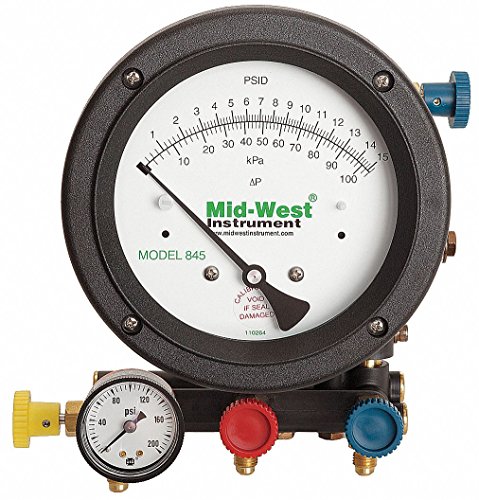
1. Mid-West 845-5 5-Valve Backflow Test Kit
Our pick — 4.5★ from 60+ verified ratings; the strongest balance of quality and price.
The kit other testers treat as the reference standard, and the one your certificate office already knows by name.
The Mid-West 845-5 is the kit bought by people whose test reports go to a municipal water authority — and it earns that job. The gauge set carries the highest overall score on this list at 4.5 out of 5, and reviewers who use it monthly have trusted it since 2017. Five soft-seated brass needle valves sit at the heart of the unit, each with a replaceable valve seat, so a worn seat is a service part rather than a scrapped gauge. Five replaceable valve seats mean a worn seat is a service part, not a scrapped gauge.
What wins people over is function — it is the thing the review pages keep coming back to, and the job reports match. One buyer put it plainly: “Works great! Been using it monthly since 2017. Excellent product.” Another shopper who compared every option they could find described the gauges as very accurate and arriving pristine. In the field, the 90 micron filters are the quiet workhorse here: they catch scale, sand, and grit before the debris reaches the valve seat, and you can clean or replace the element instead of rebuilding the gauge. For anyone testing a reduced-pressure assembly on a regular route, that one design choice saves real money over a service lifetime.
Here is the honest catch. Three buyers specifically mention that the calibration needed attention right from the start, and that is the one aspect of this kit where feedback is genuinely mixed. If you are certified to verify your own gauge against a reference, it is a minor step. If you are not, plan to send it to a lab before your first report. Function and value draw strong reviews, but the calibration certificate is the one thing to verify before your first report.
Why it leads: Fully equipped from the start and accepted by every state one buyer checked — no shipping damage, no missing parts, just a kit you can put to work immediately.
What earns its keep
- Five replaceable soft-seated brass valves mean the kit is serviceable, not disposable
- 90 micron filters stop the debris that plugs gauge internals
- Cleanable filter elements keep maintenance on your bench, not a lab’s
What to weigh first
- Calibration feedback is mixed — factor in a verification step
- Heaviest in the list at 16 ounces for the gauge alone
Buy it if: you need the kit that certification offices across the country already recognize and you can verify calibration on arrival.
Pass if: you want a set that arrives pre-verified and reads digitally.
2. Watts TK9A Backflow Test Kit Upgrade with Line Pressure Gauge and Adapters
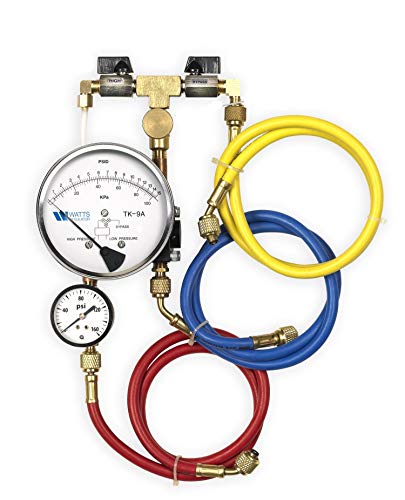
A polycarbonate-cased spare kit at 5.5 pounds, plus a line pressure gauge most basic sets leave you to buy separately.
The Watts TK9A is the kit you buy when your primary gauge finally gives out mid-season and you need to be testing again by Monday. The upgrade adds a line pressure gauge and adapters to the standard five-valve setup, so you are not fighting to find a fitting that matches the assembly on your route. It ships as a seven-piece kit with NPT threads, the standard thread that fits most residential and commercial assemblies. The case is polycarbonate, which shrugs off a bump in the truck bed, and at 5.5 pounds it slips easily into a service bag.
Buyers report a short but clean track record. One buyer ran six backflow tests with it straight from the start and reported no issues and a product that matched the photo exactly. Another called it a sensitive tool that works great with a nice case. The listing includes a one-year calibration, a warranty, and a 30-day trial window — for a replacement or backup kit, that is a workable safety net. If you already own hoses and adapters from a kit you retired, you get more value here than you would expect.
The catch is the hoses. A couple of buyers found a push fitting weeping on the left-side clear hose well under a year in, and the general feeling is that the stock hoses are the weakest link of the whole kit. Swap in a stiffer hose — a number of testers recommend yellow jacket hoses specifically — and you remove the one recurring problem. The gauge holds up; the stock hoses are the part to inspect and replace.
Where it fits in a kit bag: It is the lighter, lower-cost option next to the Mid-West, best used as a second kit or a starting point for a new tester. The 12 x 9 x 5 inch case keeps it compact enough to grab and go.
Best for: testers who want a compact, lower-cost five-valve kit with a line gauge included and hoses they can replace themselves.
Hold off if: a leaking push fitting would end your season — budget for replacement hoses from day one.
3. Arbiter Backflow Mako MK5 Digital 5-Valve Backflow Test Kit with Hoses & Soft Case
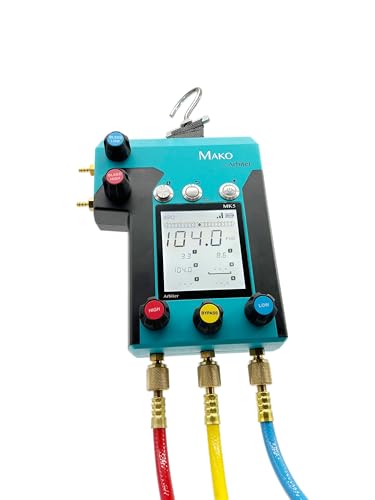
The digital gauge that stops you writing values on your glove — and the lightest five-valve kit here at 4.4 pounds.
If you have ever fumbled for a pen while the pressure was moving, the Mako MK5 is built for you. A capture button stores your readings mid-test, so an interruption no longer means starting over, and the backlit digital display reads the same from any angle, whether you are under a sink or in a bright mechanical room. The gauge is battery powered, rated to 0.1 psi accuracy within its calibrated 0-15 psi range, and it is the only kit on this list carrying USC FCCCHR certification. An all-brass assembly sits inside a hard shell case built for field duty, and all wetted components are made from food-safe, potable-water-safe materials.
Compare it directly to the BAC-FLO-5 below. The Mako weighs 4.4 pounds against 11 pounds, so it is the kit that travels lighter on a long route, and its dimensions of 9 x 7.25 x 2.5 inches make it noticeably more compact in the truck. Owners mention testing 260 backflows without a single failure and saying they would buy it again. The swivel hook hanging the gauge on a pipe or ladder is the kind of detail that only exists because someone got tired of fighting rope.
Know the trade-offs before you order. The digital refresh rate is about one second (how often the screen updates the reading), which customers note is too slow to catch a quick pressure drop. The companion app also charges per report for each submission — a small thing that adds up over a year of jobs. A few buyers find the soft case lighter on protection than a hard case and wish the adapters had their own home. It is the lightest and most modern kit here, but it ships with a soft case, not a hard one.
The value case: You get a digital gauge, five valves, flexible hoses, and a swivel hook at a price below the two brass kits above — and it is the only one with a capture button.
Reach for this if: you work solo, test a lot of assemblies in a day, and want the read-and-store workflow a digital gauge gives you.
Think twice if: you want a hard case and a physical needle you can trust without checking a battery first.
4. BAC-FLO-5 Backflow Test Kit

Everything in one hard case — a laminated calibration certificate, color-coded hoses, adapters, and even the screwdriver.
The BAC-FLO-5 is for the working pro who does not want to buy a single extra part after the box arrives. The kit is a five-valve set made in the USA with a 5-year manufacturer warranty, the longest coverage on this list. The gauge carries a laminated calibration certificate that is valid for a full year and is waterproof, so it survives a season in the truck. Color-coded high-pressure hoses come with 90 micron removable brass filters, and a 1/4-3/4 inch NPT brass adapter set lets you test assemblies of any size without hunting for a fitting. There is even a 6-in-1 stubby screwdriver for tight spaces and a laminated full-page testing procedure sheet.
The sale record backs up the build. One long-time user reports that after a year and roughly a thousand tests, the gauge had survived minor bangs with only scuffs and recertified well within tolerances. Another tester with a few hundred tests on the clock calls both the performance and the service department excellent. For anyone replacing a gauge that wore out early, that is a strong signal: the build holds up under daily use.
Two honest points before you commit. This is the heaviest kit here at 11 pounds, and its larger 18.5 x 9.75 x 9 inch footprint takes up more room in a service bag than the Watts or the Mako. If you swap cases for a smaller bag, keep the included hoses and adapters together — the field reports on this kit specifically flag how important it is that all the accessories arrive with it.
Why the pros reach for it
- Laminated waterproof calibration certificate valid for a full year
- 90 micron removable brass filters on the hoses
- 5-year manufacturer warranty, the best coverage of the four
- Adapter set covers any assembly size without extra fittings
Where it gives ground
- 11 pounds is the heaviest kit here, and the footprint is the largest
- Every accessory arrives together — if you need a smaller case, buy one separately
The verdict: Buy this if you want a complete field kit with the paperwork already handled and the longest warranty covering it.
Skip this if: you want the lightest, most compact kit or a digital display.
Understanding the Specs
Valves and Filter Elements
A five-valve kit has a needle valve for each of the four test points plus a bypass, which lets you isolate and hold pressure without draining the assembly. Soft-seated brass valves with replaceable seats are the durable option — a worn seat is a cheap part, not a dead gauge. Inline 90 micron filters catch the scale, sand, and grit that would otherwise travel into the valve and plug it. Clean or swap the filter element, and the gauge keeps reading true.
Gauge Accuracy and Calibration Windows
The number that matters on a test report is the calibration date, not the resolution. A kit that arrives with a laminated, waterproof certificate valid for a full year is a kit you can put straight to work. Accuracy figures like 0.1 psi tell you how fine the reading is, but the certificate tells you whether the reading will pass your authority’s check. If feedback on a kit mentions calibration needing a nudge from the start, that is a note to verify before your first report — not a reason to skip the gauge.
FAQ
Do I need a five-valve backflow test kit or a three-valve one?
What does the 90 micron filter actually do on a backflow test kit?
How long is the calibration certificate good for on these kits?
Is a digital backflow gauge as accurate as a brass one?
Will the Arbiter Mako MK5’s app work with my water district?
Which kit is best if I want everything in one box?
Why does the Mid-West 845-5 need calibration attention from the start?
Can I use a backflow test kit for both RPZ and double-check assemblies?
How often should I clean or replace the filters on a backflow kit?
Are the hoses that come with a backflow test kit good enough?
Final Thoughts: The Verdict
For most certified testers, the best Backflow Test Kit is the Mid-West 845-5. Its five replaceable brass valves and 90 micron filters (a 90 micron filter traps particles down to 90 millionths of a meter, so grit stays out of the gauge) make it the kit your certification office already recognizes. Just verify calibration on arrival and it is ready to work. If you want digital capture and want to travel light, the Arbiter Mako MK5 reads and stores values on the gauge itself and comes in at 4.4 pounds. And if you want a single kit that includes the certificate, the hoses, the adapters, and the screwdriver, the BAC-FLO-5 covers you with a 5-year warranty behind it.
How We Picked
We do not accept paid placement. Every pick is matched to a real buyer and a real use-case; we do not hands-on test units.
Sources & Methodology
Specifications: manufacturer listings and product documentation. Review insights: verified customer reviews, as of September 2026. Pricing: not shown on this page (it changes often); check the current price via the retailer link.
As an Amazon Associate, KitchPrep earns from qualifying purchases. This does not affect which products we feature.
Related Guides
