
Specs are compiled from manufacturer listings and verified buyer reviews and can change over time — please confirm the key details on the product page before buying.
A 2-drawer wood file cabinet holds the paperwork that would otherwise pile up on your desk, and its wood finish hides the fact that it is a filing cabinet at all. Metal boxes do the storage job, but they look like an office supply closet. Wood buys you the same hanging-file capacity in something guests will mistake for a nightstand or a printer stand. The picks below cover that whole range — from a rolling cabinet you can tuck under a desk to a 44-inch lateral unit with its own power strip.
I’m Mohammad Maruf — the founder and writer behind KitchPrep. This guide is built by comparing the manufacturers’ published specifications and the patterns across verified customer reviews, so you get each pick’s real strengths and trade-offs instead of marketing spin.
By the end you should know which 2-drawer wood file cabinet fits your space, your folder size, and your budget.
Our Picks at a Glance
How To Choose The Best 2-Drawer Wood File Cabinet
Three things decide whether a wood file cabinet works in your room: how wide it stands, whether one drawer locks, and how the drawers travel. Get those three right and the remaining decisions are finish and price tier. Get them wrong and the cabinet arrives, assembles, and then sits awkwardly because it does not fit the gap you measured.
The two body shapes: vertical and lateral
Vertical cabinets fit narrow corners; lateral cabinets need wall width but give you a usable desktop. A vertical cabinet stands narrow and tall, so it slides into a corner or beside a desk without stealing much floor width. A lateral cabinet runs wide and low, which makes it a natural printer stand or a base for a monitor. Widths here range from 16.5 inches on the compact rollers up to 44 inches on the widest lateral — measure your gap before you pick a shape, because a lateral unit will not squeeze into a narrow alcove no matter how good it looks.
Hanging rails decide what actually files neatly
A file drawer only works if its hanging rail matches your folder size. The cabinets here mostly support Letter, Legal, and A4, and a few ship with adjustable bars so you can slide the rail to match whichever size you store. If your drawers are going to hold notebooks and printer paper instead of folders, look for a model where the hanging rods lift out and the drawer becomes a plain storage box.
Locking, slides, and the anti-tip interlock
Some cabinets lock nothing, some lock the top drawer only, and some lock both. Check that line carefully — buyers most often assume both drawers lock when only one does. Slides matter just as much: a full-extension slide pulls the drawer clear so you can reach the folders at the very back, while a partial slide leaves the rear third inside the cabinet. Many of these units also carry an interlock that lets only one drawer open at a time, which is what keeps a top-heavy cabinet from tipping when you lean into a loaded drawer.
Quick Comparison
| Model | Best For | Material | Drawer Size Support | Footprint (W x D x H) | Amazon |
|---|---|---|---|---|---|
| Bonnlo 2 Drawer Fluted Lateral Cabinet★ Best Overall | Style-first home offices | Engineered Wood | Letter, Legal, A4 | 31.5 x 15.75 x 29.53 in | Amazon |
| Simple Deluxe 2 Drawer Rolling CabinetCompact Pick | Tight spaces and renters | Engineered Wood | Letter, Legal, A4 | 16.5 x 15.7 x 27.6 in | Amazon |
| HOMCOM Vertical File CabinetRustic Pick | Farmhouse desks and corners | Engineered Wood | A4, Letter | 15.7 x 15.7 x 27.6 in | Amazon |
| DEVAISE 2-Drawer File Cabinet with Lock | Private documents, small rooms | Engineered Wood | Letter, A4 | 18.9 x 15.74 x 26.65 in | Amazon |
| Halitaa 2 Drawer Lateral with Charging Station | Charging plus storage | Engineered Wood, Metal | Letter, Legal | 31.5 x 15.75 x 30.51 in | Amazon |
| Itaar 2 Drawer Cabinet with Storage Shelf | Small offices needing display space | Wood | Letter, Legal, A4 | 33.8 x 15.7 x 36 in | Amazon |
| SEDETA 44″ File Cabinet with Lock | Printer stations and double monitors | Engineered Wood | Letter, Legal, A4 | 44 x 15.7 in desktop | Amazon |
| T4TREAM 31.8-Inch Fluted Lateral Cabinet | Two rows of letter files | Engineered Wood (P2 MDF) | Letter, Legal, A4 | 31.8 x 22 x 30 in | Amazon |
| Bush Home Salinas 2 Drawer Lateral File | Matching a Bush desk setup | Engineered Wood | Letter, Legal, A4 | 32 x 20 x 30 in | Amazon |
| Sauder Clifford Place Lateral File | Mid-century office styling | Engineered Wood | Letter, Legal | Grand Walnut finish | Amazon |
| Bush Home Cabot 2 Drawer Lateral File | Full office builds and collections | Engineered Wood | Letter, Legal, A4 | Sled base, freestanding | Amazon |
In‑Depth Reviews
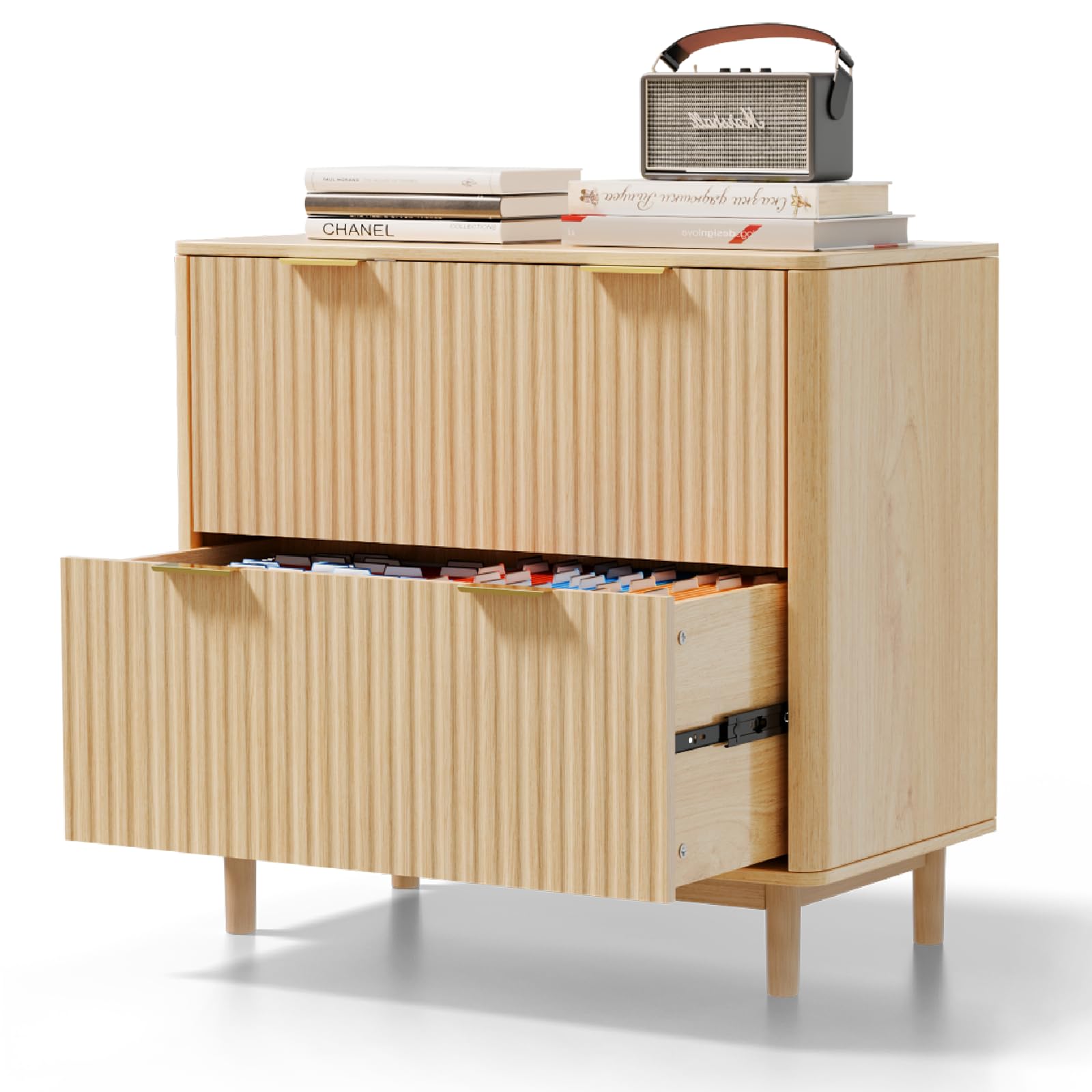
1. Bonnlo 2 Drawer File Cabinet, Home Office Filing Organizer
Our pick — over 4.5★ from 400+ verified ratings; the strongest balance of quality and price.
The fluted-face lateral that looks like a furniture piece and files like a workhorse.
What wins people over here is the build, and it is not a close vote — the quality of this cabinet is far and away the thing buyers talk about most, well ahead of anything else. Part of that comes from the substance underneath: at 71 pounds, the Bonnlo is more than twice the heft of the little Simple Deluxe roller further down this page, which sits at 33.9 pounds. That weight comes with a real footprint, 31.5 inches wide and 29.53 inches tall, so it wants a proper wall or desk end rather than a gap.
The storage logic is the smart part. Both drawers take Letter, Legal, and A4 hanging folders, and the rail can be repositioned into four different arrangements — hang folders, pull the rods out and use the drawer as a plain bin, or split it. The three-section slides pull the drawer completely out, which means you can actually see the folder at the back instead of digging blind. Casters make it mobile, and the front pair lock down so it stops drifting on a wood floor.
The recurring gripe is assembly. Wood pieces are sturdy and every part is numbered, but the step where you separate the drawer slides trips people up, and the manual has been reported as showing a clip that is not there. Budget an evening, not twenty minutes. The other thing worth knowing: one reviewer measured their unit as arriving in a grey-and-white finish and noted the manufacturer stamped on the box is Vingli rather than Bonnlo — same cabinet, different house name.
What earns the top spot
- Both drawers hold Letter, Legal, and A4 hanging folders, with four alternate ways to set the rails.
- Three-section slides extend fully, so rear folders are reachable without lifting anything out.
- At 71 pounds it feels planted, and the front casters lock so it stays put on hardwood.
- Fluted panel front and arc-shaped sides mean it reads as furniture, not office equipment.
Where it asks for patience
- Assembly is genuinely involved — the drawer-slide separation step is the known sticking point.
- At 31.5 inches wide it needs real wall space and will not tuck under a low desk.
- One purchase arrived without some plastic inserts, though spares were included in the box.
Worth it if: you want the cabinet that finally makes your home office look deliberate — solid, mobile, and generous enough for mixed-size filing.
Look elsewhere for: a renter squeezing a unit into a narrow gap under a desk; the width and the assembly time both work against that plan.
2. Simple Deluxe 2 Drawer Rolling Filing Cabinet with Printer Stand
The under-desk roller for anyone whose “office” is a corner of a bedroom.
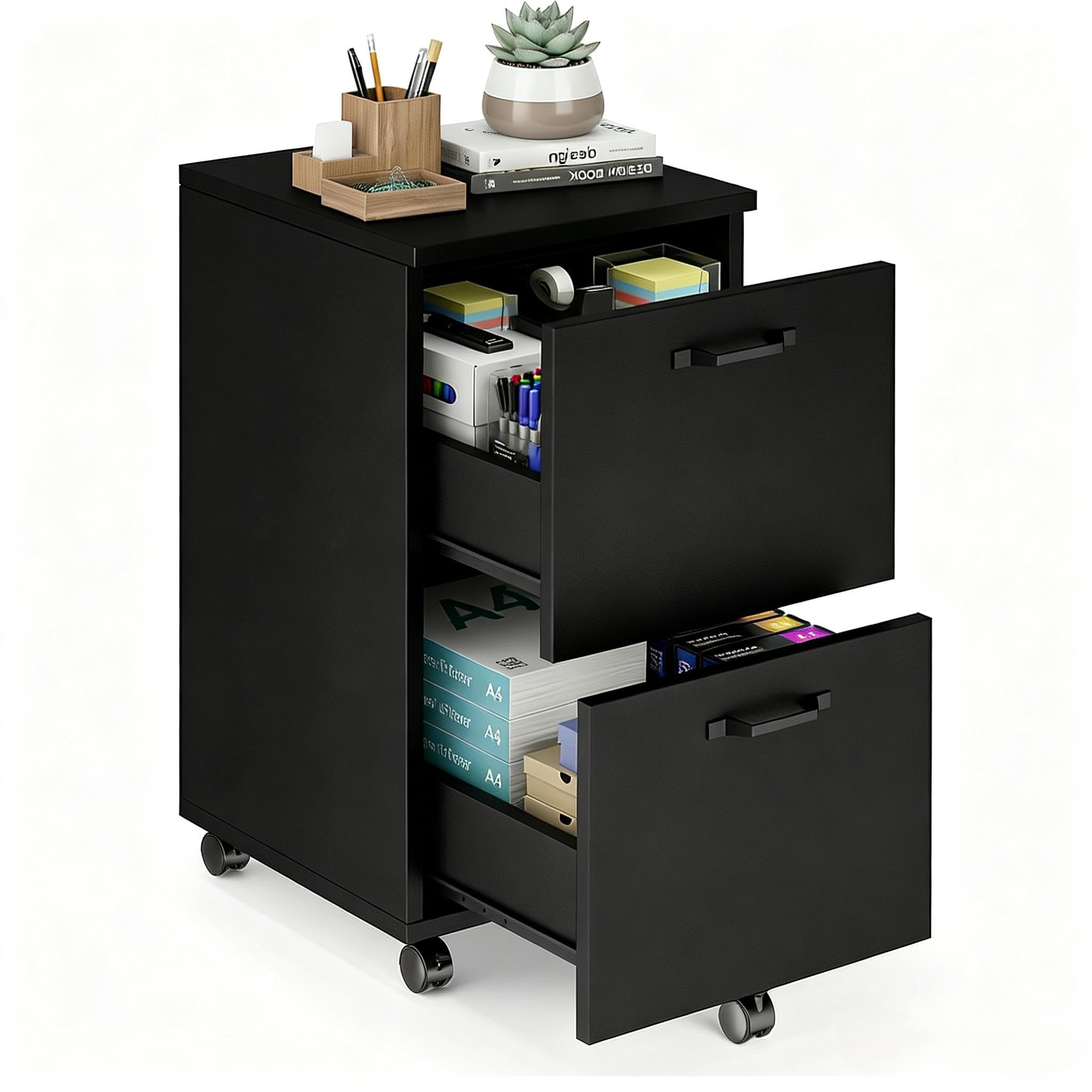
Where the Bonnlo above is a 71-pound piece of furniture, this one is a 33.9-pound rolling cabinet built to disappear under a desk. That is the whole point of the 16.5-inch width and the five casters — they spin a full 360 degrees, so you can pull it out on carpet or hard floor, load it, and shove it back. Two of the wheels lock to stop it wandering once it is parked.
Each drawer is rated to carry 22 pounds, and the top is sturdy enough to hold a home-use printer, which turns the whole thing into a rolling printer stand. The adjustable rails take Letter, A4, and Legal folders. Inside, keep your expectations honest: the drawers are shallow. As one buyer put it, “something the thickness of a pack of copy paper, maybe a little taller is about all that will fit.” Tall binders and standing file boxes are not happening.
Plan for the size before you buy, not after. Buyers repeatedly describe it as arriving smaller than the photos suggest, and the advice in the review pages is blunt: measure the drawer opening, not just the cabinet. Assembly is straightforward with labeled parts and a screwdriver, and the recurring quality note is that it is solid for the tier — comparable to a basic flat-pack desk drawer unit, though it will not survive being taken apart and rebuilt twice.
The value read: you are paying for compact dimensions and mobility, not for heft. If the cabinet only ever rolls between a desk knee-hole and a wall, nothing here is a compromise.
Reach for this if: you need filing that fits a genuinely tight footprint and can move when you rearrange the room.
Skip past it if: you want deep drawers for bulky items or a cabinet substantial enough to anchor a full workstation.
3. HOMCOM Vertical File Cabinet 2 Drawer Silent Slides
Barn-door hardware and a whisper-quiet drawer in a footprint small enough for a corner.
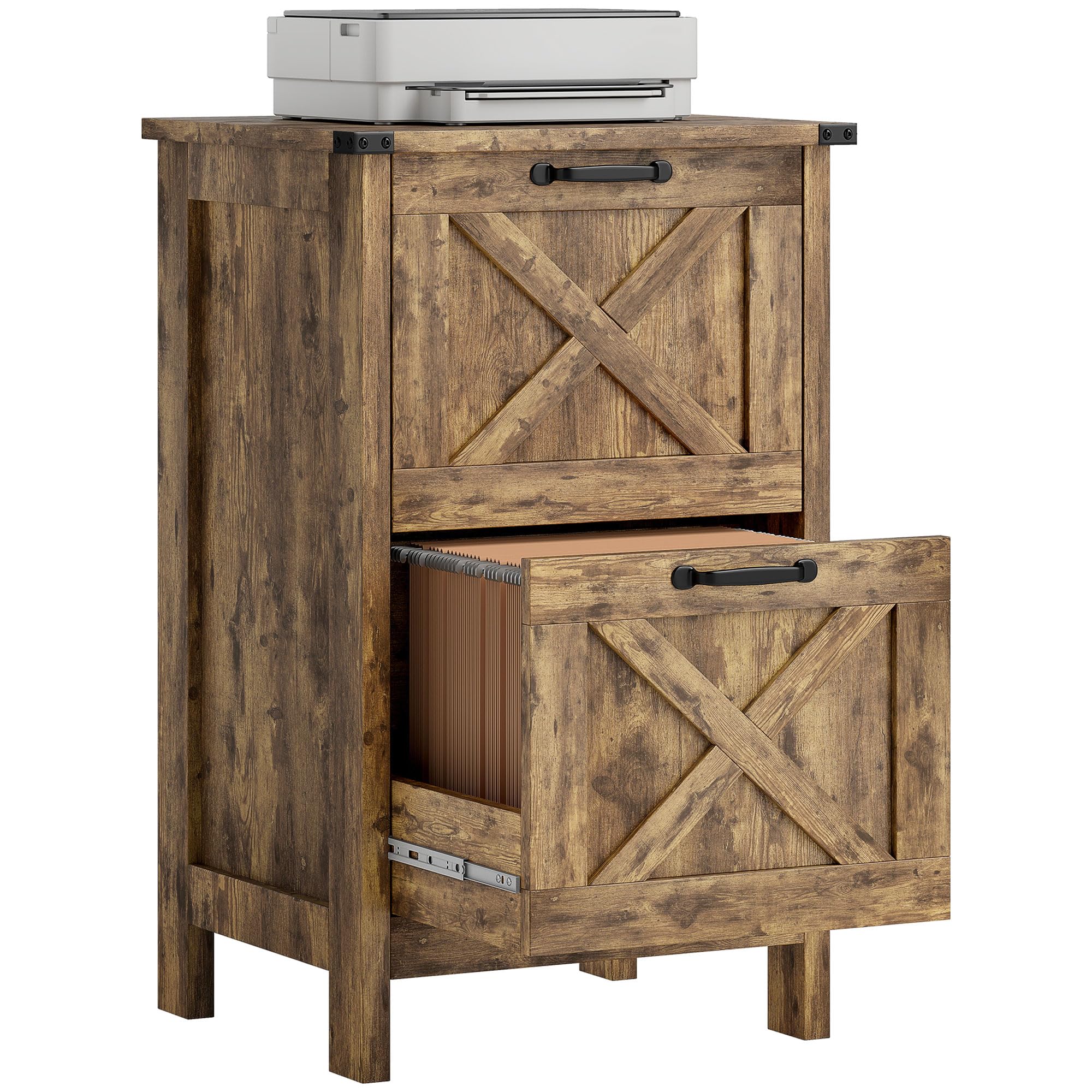
The styling carries this one, and it carries it hard. Shaker-style fronts, black metal accents, and a rustic brown veneer give the HOMCOM the farmhouse look that buyers in this category keep hunting for — appearance is the second-most-talked-about thing in its reviews, right behind overall build. It stands on 3.1-inch legs, which lifts it off the floor and makes wiping underneath less of a chore.
Functionally it is a vertical cabinet: two drawers with adjustable bars sized for A4 and letter files, a particleboard body rated to support up to 77 pounds, and an anti-tipping device that anchors it to the wall. That last piece is the one to actually use if you have kids or pets — a vertical cabinet is tall relative to its base, and the wall bracket is what keeps it upright.
Assembly is the one thing that separates this cabinet from the higher-rated picks on this page. Some buyers had it together easily and call it exactly as described; others hit a wall at step one, where the instruction sheet references a clip that is not on the actual slide, and support calls went unanswered. A separate purchase arrived with two right-side panels and had to wait on a replacement. If you are comfortable improvising through flat-pack furniture, this is a charming cabinet at a friendly tier. If you want the assembly to be simple to use, keep reading.
The style payoff: this is the pick that hides the filing function completely — nobody walking into the room reads barn-door fronts as office storage.
Best matched to: a farmhouse-style room where the cabinet sits on display and the buyer is handy with an Allen key.
Think twice about: a first flat-pack build or a deadline, since the slide-separation step is where this one has historically tripped people up.
4. DEVAISE 2-Drawer File Cabinet with Lock, Gray Oak
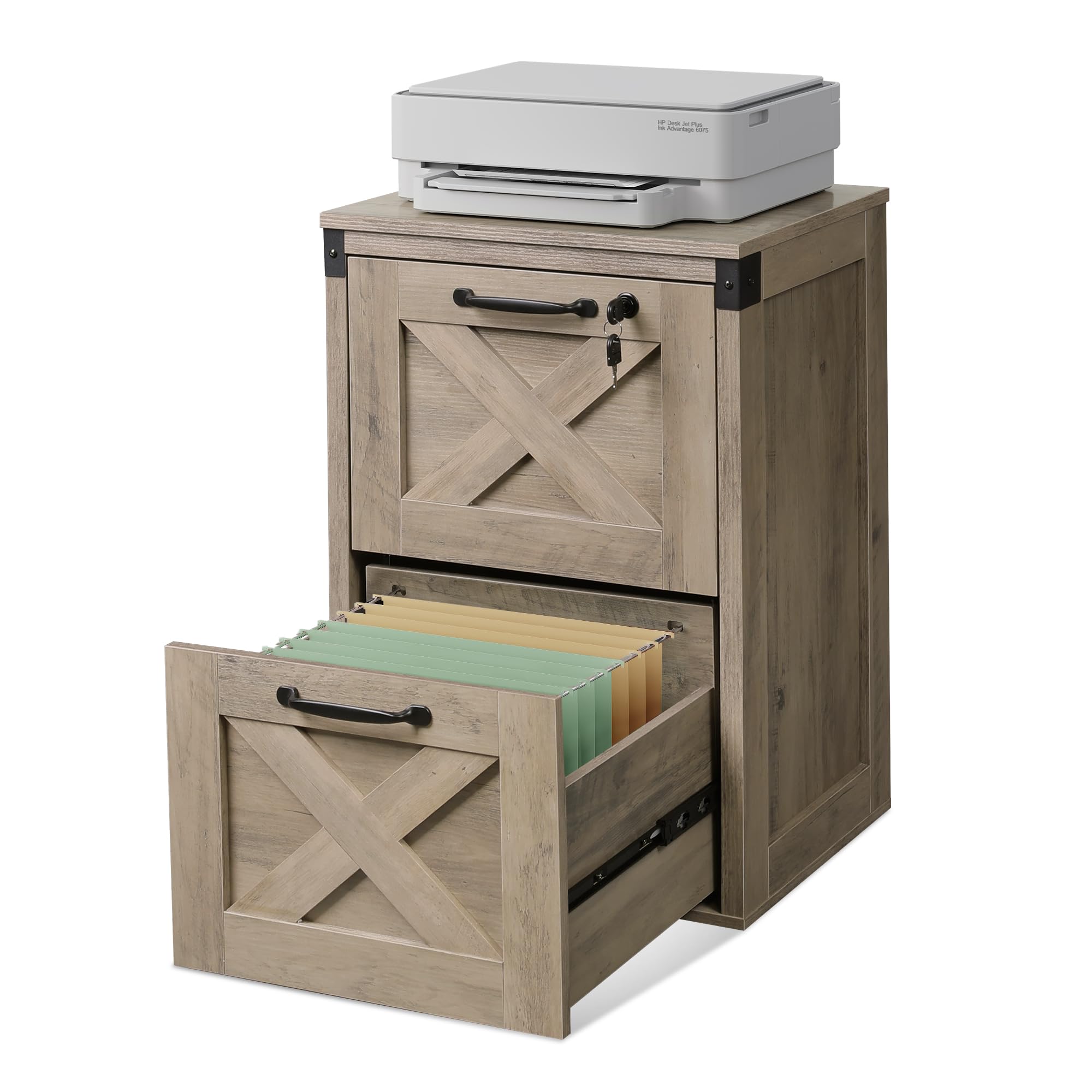
A slim vertical cabinet with an X-pattern front and a key for the drawer that matters.
If your concern is who reads your paperwork, this is the shape of cabinet to buy. The upper drawer carries a locking mechanism and ships with two keys, while the lower drawer stays open for the everyday stuff — folder overflow, stapler, the printer paper you keep restocking. Both drawers run on full-extension slides that pull out silently, so you can reach the folder at the very back even when the drawer is packed. Hanging rods inside take letter and A4 files.
The safety detail is worth calling out separately, and it is the reason this cabinet is the lock pick rather than an also-ran. An interlock lets only one drawer open at a time, which is the mechanism that stops you from yanking the top drawer out while the bottom one is already extended. The top surface is rated to hold up to 66 pounds, putting it in real printer-stand territory rather than decorative-only. Wall-mounting hardware is in the box, and it is optional rather than required.
Two things to plan around. Assembly is described as a lot of pieces — the comparison buyers keep making is to a flat-pack desk drawer unit, though everything is labeled and the pre-drilled holes line up. And only the top drawer locks; the lower one has no key. That is a deliberate design choice on a cabinet this size, but it does mean anything you want behind a lock has to fit in the upper drawer.
The privacy angle: a keyed top drawer plus a 66-pound-capable top surface covers the two jobs a small home office asks for — secure the sensitive pages, then put the printer on it.
The right call for: freelancers and remote workers who keep client paperwork or personal documents in the room where guests wander through.
Not the pick if: you need both drawers under key, since the lower one on this model has no lock at all.
5. Halitaa 2 Drawer Lateral File Cabinet with Charging Station
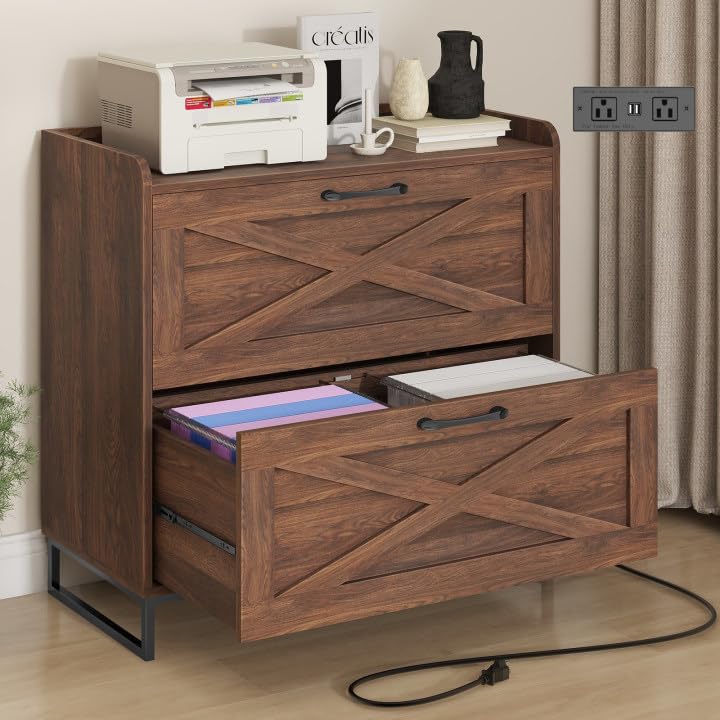
The lateral cabinet that also solves your outlet shortage, one plug at a time.
You can charge your phone and run your printer from the same cabinet, with no extension cord snaking across the floor. Built into this cabinet is a power strip with two outlets and two USB charging ports — so the printer, the scanner, your phone, and a tablet can all sit on top. That is the feature you are buying here, and it is the one no other cabinet on this page offers. The desktop runs 31.5 inches wide, which gives a printer or scanner real room to breathe.
Underneath, both drawers hang letter and legal folders, and the same one-drawer-at-a-time interlock keeps the unit stable when a drawer is loaded and open. The base mixes a steel frame with engineered wood panels, which is where the extra rigidity comes from relative to an all-composite cabinet. Assembly is the strong suit — clear illustrated directions and numbered parts, with the bulk of buyers describing a straightforward build they could handle themselves.
Two honest notes on the finish and the fit. The wood grain is an imitation finish and light in the hand, so if you were expecting a solid-wood feel, adjust expectations — the cabinet is engineered wood over steel, and that is what it feels like. On the fit side, the drawer-to-slide alignment is where a handful of builds went slightly off, with middle drawer pieces not quite lining up. Take the drawer alignment slowly and this is a non-issue; rush it and you will be re-seating slides.
The real-world win: one cabinet replaces your filing box, your printer stand, and the power strip you were going to tape to the desk leg anyway.
Buy this one when: your workspace has more devices than outlets, and the printer deserves a permanent home rather than the floor.
Second-guess it if: you want a heavier solid feel — this is engineered wood over steel, and it reads that way on arrival.
6. Itaar 2 Drawer File Cabinet with Printer Stand and Storage Shelf
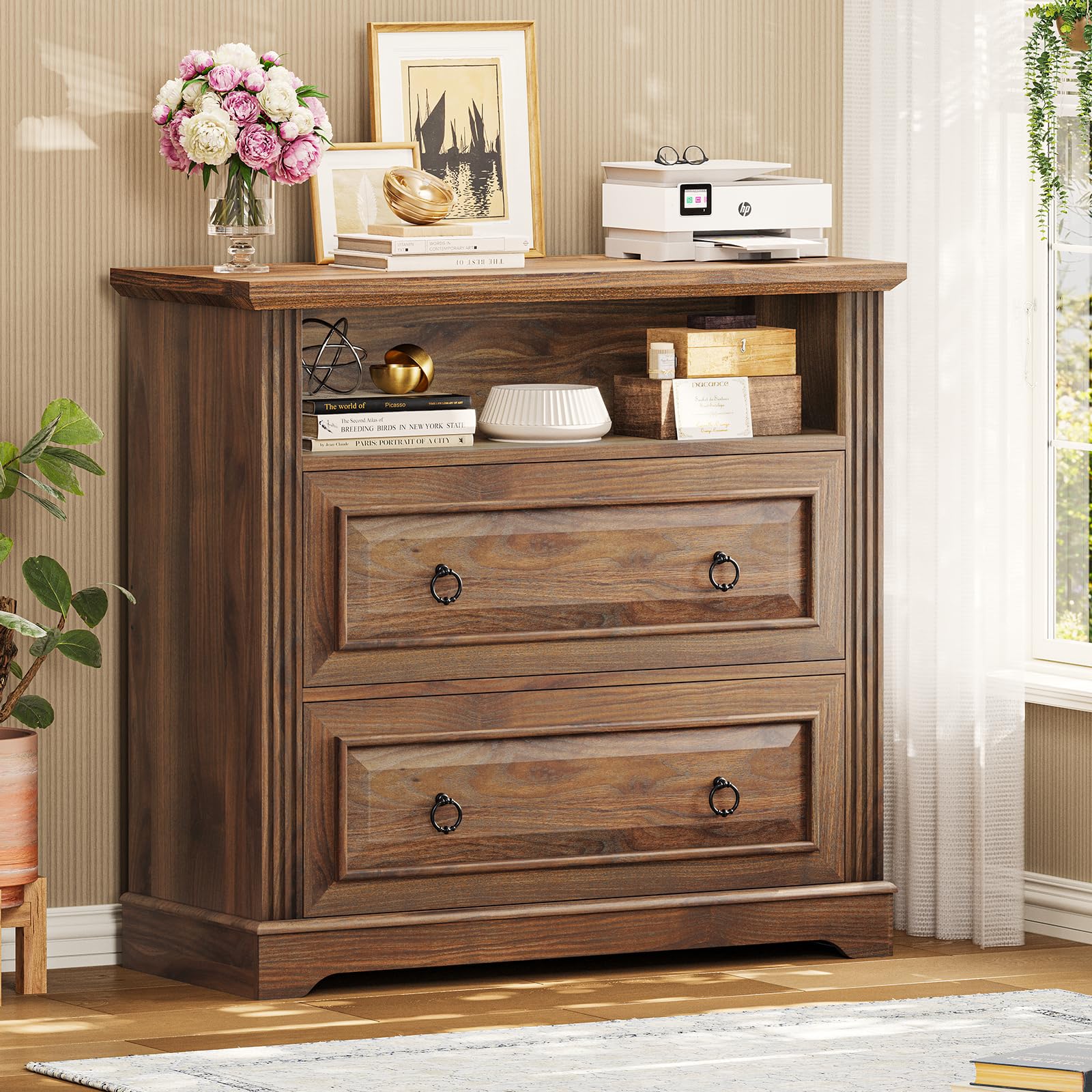
Two file drawers, plus an open shelf that swallows the stuff that never had a home.
This is the tallest cabinet in the lineup at 36 inches, and the extra height buys you something the others do not have: a genuine open storage shelf between the drawers and the desktop. Binders, a paper stack, a decorative box, the tablet you never put away — the shelf takes it, which is what keeps your desk clear instead of merely tidy. Above it, the top handles a printer or a photocopier.
The drawers themselves are flexible. Each holds letter, legal, or A4 hanging folders, and the rail position is adjustable across three settings so you can match whichever size you actually store. Pull the hanging bars out and the drawer works as a plain bin. If you are running mixed-format paperwork — some letter, some legal — that adjustability is the difference between a drawer that works and one that frustrates you twice a week.
Set aside a proper block of time for assembly. Buyers put it in the region of three hours, and the instructions are reported as clear with well-labeled parts, so it is a slow build rather than a confusing one. The other honest note: this is a taller cabinet, so it wants a wall or a corner rather than a gap between two pieces of furniture. Get the space right and the shelf-plus-drawer combination earns its footprint.
Why the height pays off: the open shelf adds display and catch-all space without widening the cabinet, which is the format a small study actually needs.
Ideal for: a home office where you need filing plus a place to put the printer and the things that keep landing on your desk.
Wrong fit if: your only available space is a narrow slot between two pieces of furniture — this one wants breathing room.
7. SEDETA 44″ File Cabinet with Lock, Fits Legal and Letter Size

A 44-inch cabinet that behaves more like a rolling workstation than a filing box.
The desktop is the headline: 44 inches of surface, wide enough for a printer and a scanner side by side, or a monitor with room left over for a desk lamp. Add the six storage shelves, four hooks for a briefcase or umbrella, and four industrial casters, and you have a cabinet that doubles as the base of your whole office setup. It is built to butt up against a computer desk and form an L-shape.
Power is handled on the top shelf with two AC outlets and two USB charging ports, enough for four devices running at once. Down below, two file drawers take legal, letter, and A4 sizes, and a lock on the drawer secures the paperwork worth protecting. The wheels carry a rated load of up to 350 pounds, and two of them lock down so the whole thing stops moving once it is where you want it. The drawers are built from FSC certified wood.
Two caveats read straight off the spec sheet and the review pages. First, only one drawer locks — the other is open. Second, the wheel locks are small and fiddly to reach, so treat the cabinet as mobile furniture rather than something you lock and open up all day. Assembly is reported as running an hour and a half solo, quicker with two people, and the wood panels are on the thin side, which is a fair trade for the mobility and the shelf count.
The space math: this replaces a filing cabinet plus a printer table plus an outlet strip, so it earns its width in a room that needs one anchor piece.
Suits you if: you are building a home office from scratch and want one wide, mobile piece that carries the printer, the files, and the power.
Not for you if: you want both drawers under lock or a solid, immovable cabinet that never rolls an inch.
8. T4TREAM 31.8-Inch Fluted 2 Drawer Lateral File Cabinet, Natural Oak

Widened drawers with two hanging rows each — the cabinet for people who file a lot.
The drawer design is what sets this cabinet apart from every other lateral on the page. Each drawer is widened to hold two rows of letter files at once, running on dual hanging rods, and between them the pair accommodates more than 200 files across Legal, A4, and Letter sizes. Compared with the Halitaa above, which sits at 15.75 inches deep, this one runs 22 inches deep — that is the extra room buying you the second row of folders. The rails glide silently and extend fully, so nothing at the back of the drawer is out of reach.
The desktop gets the same generous treatment: 31.8 inches wide by 22 inches deep, rated to hold up to 50 pounds, which comfortably covers a printer or a monitor without any flex. The body is crafted from P2-grade MDF, described as odor-free, and the fluted front with metal handles gives it a look that blends into living space rather than announcing itself as office equipment.
Be ready for the build. Buyers consistently describe assembly as time-consuming, and the free-form notes on this one include people setting aside the better part of an afternoon — the instructions are the weak link rather than the parts. There is also a report of the internal safety mechanism needing removal before the drawers would close fully, so if a drawer refuses to shut, check the interlock before you force it. Move through the steps carefully and the payoff is the highest file count on this list in a cabinet that still looks like furniture.
The capacity story: two rows per drawer is a genuinely different storage class — this is the pick when your existing box long ago stopped closing properly.
The one to take home if: volume is your problem and you want the extra drawer depth to prove it, in a finish that fits a living room.
Plan around this: the assembly instructions are the clear weak point, so budget an unhurried session with a second pair of hands.
9. Bush Home Salinas 2 Drawer Lateral File Cabinet in Vintage Black
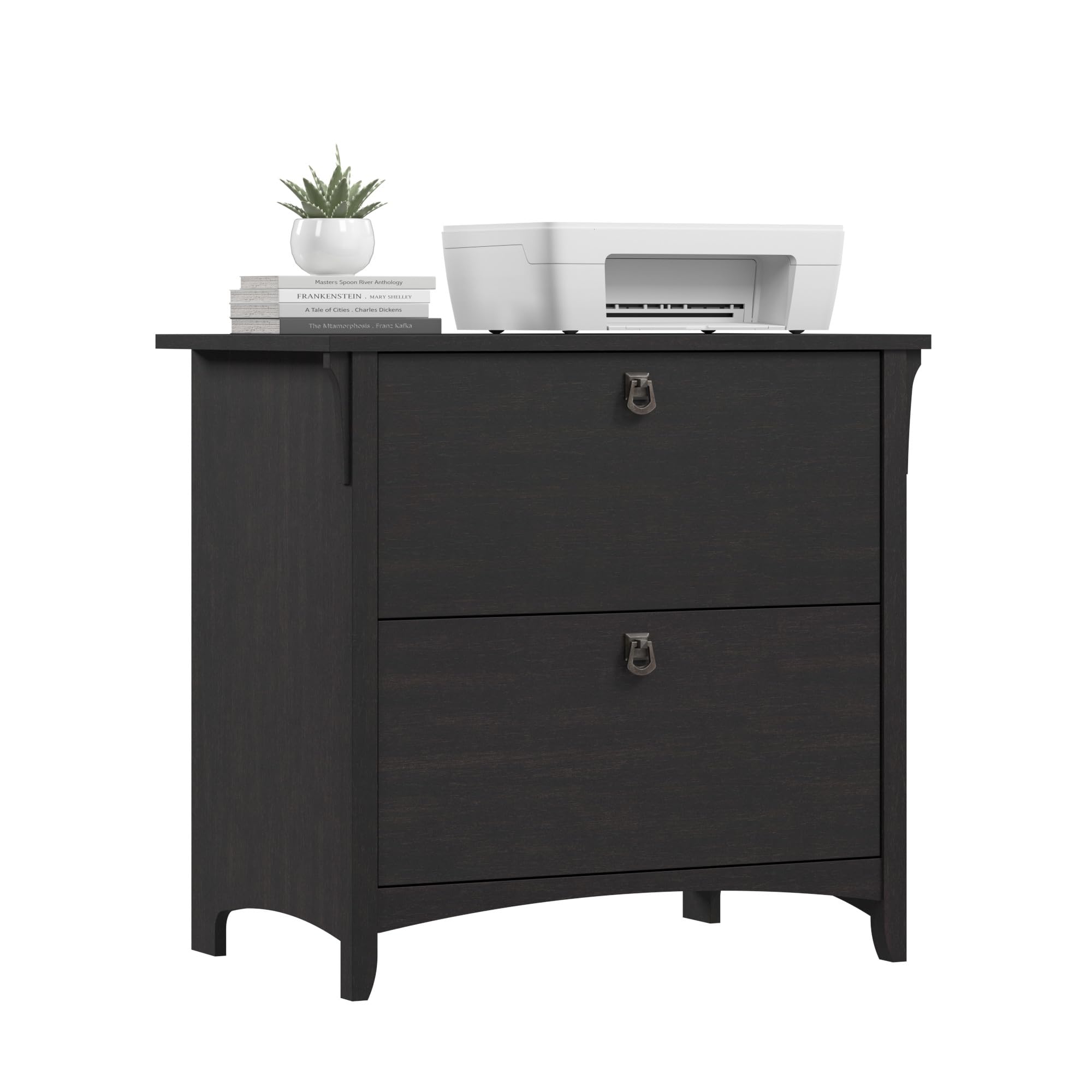
Mission-style curves and a matching desk height — built to sit beside a Bush workspace.
This cabinet matches the height of the Bush L-shaped desk with storage exactly, so when you place the two side by side the work surface extends in one continuous line. That is the reason to choose it, and it is a real one — a filing cabinet that lines up with your desk looks planned; one that sits two inches short looks like an afterthought. Tapered legs, curved base rails, and decorative wood accents carry the Mission styling, finished in Vintage Black with tumbled pewter hardware.
Inside, two drawers take letter, legal, and A4 documents on smooth full-extension ball bearing slides, so the folders at the rear come out with the drawer instead of staying behind. It carries an anti-tip interlock that allows only one drawer open at a time, and Bush tests this unit to meet ANSI/SOHO quality standards for safety and performance. The finish is available across a spread of distressed options, from Antique White through Cape Cod Gray to the Reclaimed Pine and Driftwood Gray tones.
You will spend real time on assembly — four hours is at the long end of what buyers report. The instructions split opinion: some find them clearly laid out with video barcodes for the tricky steps, others say parts of the build left them guessing. It is a hefty cabinet once built, which is why it feels solid rather than rattly, and the drawer bottom panel is on the thin side, so keep the heaviest archives in the file drawer rather than stacking weight on the base panel.
The matching logic: if a Bush desk already anchors your office, buying the coordinating cabinet removes the mismatch problem entirely — same height, same finish family, same hardware tone.
Made for you when: you already own the matching Bush desk and want the second half of a proper office setup.
Worth pausing over if: you are assembling solo with a free afternoon — this is a multi-hour build, and a helper makes a fair difference.
10. Sauder Clifford Place Lateral File, Grand Walnut Finish

A grommet hole and a pass-through for cords — the tidy-desk cabinet for cable haters.
You can hide the cable tangle that collects behind any desk with a printer on it. What separates this Sauder from the other lockable cabinets here is where it deals with cables. A grommet hole in the back panel plus a pass-through channel let you route printer cords and charger lines down and out of sight. Drop the printer on top, run the cable through the hole, and the back of the cabinet stops looking like a power strip exploded.
Both drawers take letter and legal hanging files, and each has its own key and lock — that is a step beyond the cabinets here that key only the top drawer. Mid-century lines, a Grand Walnut finish, and brass hardware give it a look that suits a study or a corporate corner, and the construction is engineered wood, which is what the tier buys you.
The two things to weigh honestly. Assembly runs slower than expected — owners mention anything from a couple of hours to a full afternoon, with the drawer slide separation described as the fiddly part. And the drawer bottoms are a lighter board rather than a thick panel, so keep the heavy archive boxes on the shelf rather than loading one drawer to the brim. Both are manageable, but neither is a surprise you want to find after the box is open.
The clutter fix: that grommet and pass-through solve the single ugliest part of any printer-owning desk — the cord nest behind it.
The obvious pick when: both drawers need to lock and you want the printer cables to vanish.
Reconsider if: the lighter drawer bottoms concern you for very heavy filing, or you want a build you can finish in under an hour.
11. Bush Home Cabot 2 Drawer Lateral File Cabinet in Harvest Cherry
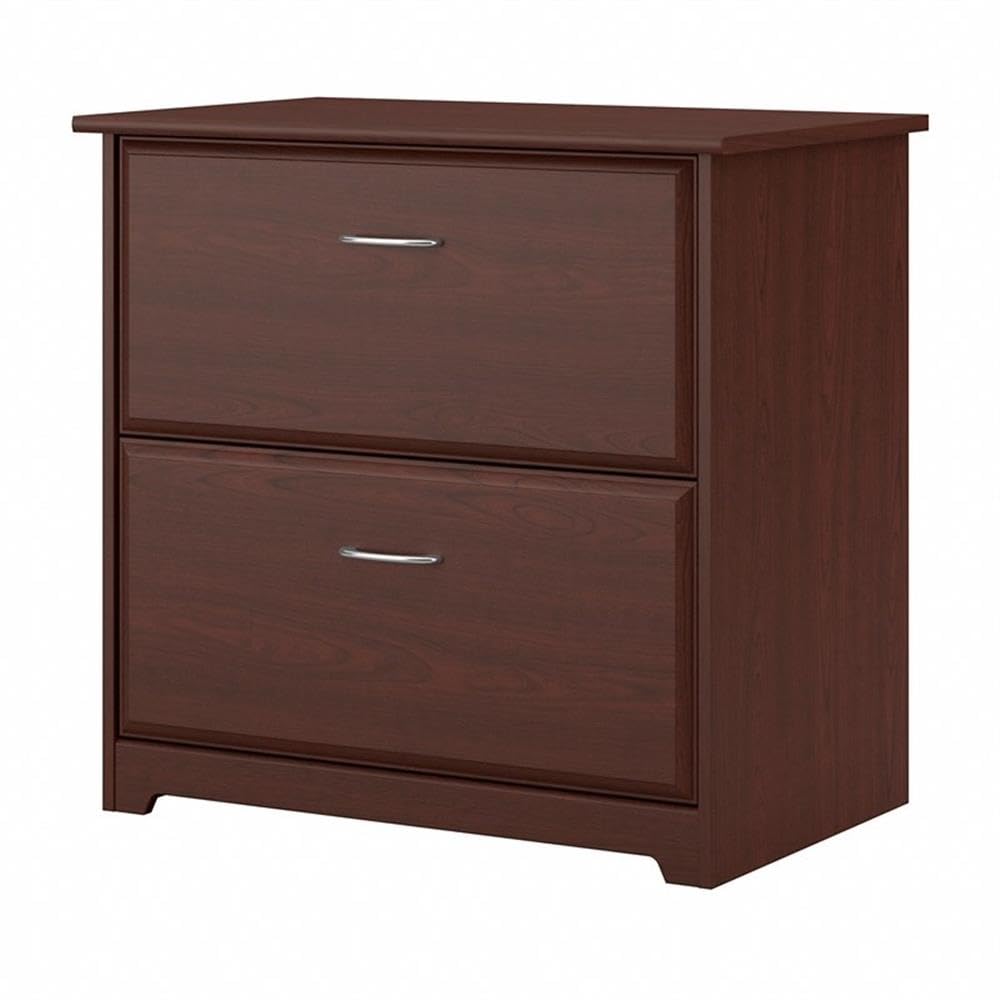
Traditional styling that reads as living-room furniture, not a filing box with a drawer.
Start with what it holds: two drawers sized for letter, legal, and A4 files, running on ball bearing slides that extend all the way out so the documents at the back come to you. The top is finished with a scratch-resistant surface, which makes it fair game for a printer, a plant, or a photo frame without the worry of a permanent scuff. Chrome hardware and a traditional profile in Harvest Cherry give it the look of a proper furniture piece — the standing compliment in its review pages is that guests do not recognize it as a filing cabinet.
You get a cabinet that resists warping and matches the rest of your office furniture. It is built from engineered wood chosen for stability and resistance to warping, and like the other Bush lateral on this page it is tested to meet or exceed ANSI/SOHO quality standards (a set of voluntary industry tests for home-office furniture), then backed by a 1 year manufacturer’s warranty. It also belongs to the wider Cabot collection, so a coordinating desk or bookcase can complete the office in matching finish rather than a patchwork of brands.
Where this cabinet trails the best-overall pick is small but real. There is no lock on either drawer, so anything you want secured belongs in a different cabinet. The drawer pulls are plastic and a few owners swapped them out for metal handles to match the finish better. And the drawers have no detent to hold them closed, so they can drift open if the cabinet is nudged. None of that changes the fact that the drawers are smooth, the safety mechanism works, and the piece looks considerably more expensive than its tier.
The furniture-first angle: this cabinet prioritizes looking at home in a study over looking like office equipment, and it is finished on both the face and the profile to support that.
Choose this one if: you are building out a coordinated office in the matching collection and want the filing storage to look like the rest of your furniture.
Not the match if: you need a lock, or you prefer metal drawer pulls from the start rather than an upgrade later.
Understanding the Specs
Hanging Rails and Document Sizes
A hanging rail is the bar across the drawer that file folders hook onto, and its job is to hold the folder upright so the tabs line up at a glance. The cabinets here mostly support Letter, Legal, and A4 — the three sizes most home offices mix — but a few take only Letter and A4, so check the line before you buy if you archive legal-size paper. Some models, including the Bonnlo and the Itaar, let you move or remove the rods entirely, which turns the drawer into a plain storage bin when your filing days are behind you.
Drawer Slides and Full Extension
You can reach the folder at the very back of the drawer without lifting anything out — that is what a full-extension slide does. The slide is the metal track that lets the drawer move, and the word that matters is “full extension.” A full-extension slide pulls the drawer entirely clear of the cabinet. A partial slide stops short, which means the rear third of the drawer becomes a place folders go to be forgotten. Ball bearing slides are the common type here; the three-section slides on the Bonnlo do the same job with an extra segment for smoother travel.
Anti-Tip Interlocks and Wall Anchors
An interlock is a small mechanism that prevents more than one drawer from opening at the same time. On a loaded cabinet, two open drawers shift the weight forward and the whole unit can pitch toward you — the interlock is what stops that. Several cabinets here also ship with a wall-mounting anchor or anti-tipping device, which bolts the cabinet to the wall stud for a second layer of protection. If kids or pets share the room, use the anchor.
Wood vs Engineered Wood
Most cabinets in this category are built from engineered wood — a composite core with a printed or veneered finish — rather than solid timber. That is not automatically a downgrade: engineered panels resist warping and humidity swings better than many solid boards, and they let a cabinet hold a crisp printed woodgrain. The trade-off shows up at the edges and the drawer bottoms, which are thinner on composite units. Keep the heaviest archive boxes evenly distributed rather than stacking one drawer to capacity.
FAQ
Will a 2-drawer wood file cabinet fit under a standard desk?
Do these cabinets hold legal-size hanging folders or only letter?
What does an anti-tip interlock actually do on a file cabinet?
How long does assembly usually take on a flat-pack file cabinet?
Is engineered wood strong enough for a loaded file cabinet?
Which cabinets here actually lock, and does the lock cover both drawers?
Can I use a lateral file cabinet as a printer stand?
Do the wheels on these cabinets lock so the cabinet does not roll?
How deep do the drawers actually go on a compact file cabinet?
Does a vertical or lateral file cabinet make more sense in a small room?
What is the difference between full-extension and partial-extension drawer slides?
Final Thoughts: The Verdict
For most home offices, the 2-drawer wood file cabinet that earns its place is the Bonnlo Fluted Lateral Cabinet — it takes Letter, Legal, and A4 folders across two full-extension drawers, sits on lockable casters, and looks like furniture rather than a steel box, which is why it stands at the top of this list on quality above everything else here. If you want the storage to pull double duty as a charging station, the Halitaa with its two outlets and two USB ports is the one to reach for. And if your filing volume has outgrown a single row per drawer, the T4TREAM with its dual hanging rods and 200-plus file capacity is the cabinet built for exactly that problem.
How We Picked
We do not accept paid placement. Every pick is matched to a real buyer and a real use-case; we do not hands-on test units.
Sources & Methodology
Specifications: manufacturer listings and product documentation. Review insights: verified customer reviews, as of September 2026. Pricing: not shown on this page (it changes often); check the current price via the retailer link.
As an Amazon Associate, KitchPrep earns from qualifying purchases. This does not affect which products we feature.
Related Guides
