
Specs are compiled from manufacturer listings and verified buyer reviews and can change over time — please confirm the key details on the product page before buying.
If your miter joints keep gapping open, the saw is usually not the problem — the rail system is. A 12 inch double bevel sliding compound miter saw with a stiff forward-rail design holds its square through long crosscuts, while a loose carriage deflects over 8 inches of travel and leaves you sanding every joint flat. This guide breaks down eleven saws that actually deliver the double-bevel sliding format: a blade that tilts both left and right, plus rails that let the head travel forward for wide cuts.
I’m Mohammad Maruf — the founder and writer behind KitchPrep. This guide is built by comparing the manufacturers’ published specifications and the patterns across verified customer reviews, so you get each pick’s real strengths and trade-offs instead of marketing spin.
Double-bevel means the head tilts both directions, so you stop flipping your workpiece for a compound cut. Below, the Makita LS1219L takes the top spot as the Best 12 Inch Double Bevel Sliding Compound Miter Saw for most serious woodworkers.
Our Picks at a Glance


How To Choose The Best 12 Inch Double Bevel Sliding Compound Miter Saw
The saw you pick has to survive repeated compound cuts, not one beautiful test cut. Here is what to weigh before you commit.
Rail travel and footprint
A forward-sliding rail system (where the head travels forward over the blade) lets you push the saw flush against a wall. On a rear-sliding saw you need empty clearance behind the machine or the carriage crashes into your shop wall. If your bench is shallow, this single detail decides which saw you can actually own.
Double-bevel logic
Double bevel means the head tilts both left and right — you set a 45-degree bevel either direction without flipping long trim end for end. This is the feature that separates a true double-bevel saw from a single-bevel one, and it is the whole point of this category.
Miter detents and the plate material
Detent stops are pre-set notches — commonly at 0, 15, 22.5, 30 and 45 degrees on both sides — that snap the table into common angles. What you want to check is whether the numbers are engraved metal or stuck-on decals. A glued sticker peels and leaves a mush of half-labels within months.
Crosscut capacity in real numbers
Vertical capacity is what decides whether you can stand a baseboard up against the fence and cut it in one pass. Anything that nests a 5-1/4 inch or taller board upright saves you lying it flat and recalculating the bevel.
Quick Comparison
| Model | Best For | Blade | Motor (Amps) | Weight | Amazon |
|---|---|---|---|---|---|
| Makita LS1219L★ Best Overall | Top Overall Accuracy | 12″ High Speed Steel | 15 A | 81.6 lb | Amazon |
| DOVAMAN 12-Inch Dual-BevelBest Value | Best Value Double-Bevel | 12″ TCT | 15 A | 53.9 lb | Amazon |
| VEVOR Sliding Compound Miter SawBest Compact Design | Budget Shadow-Line Pick | 30.5 cm Cast Aluminum | 15 A | 46.4 lb | Amazon |
| WEN MM1215 | Compact Wall-Hugging Build | 6.5″ High Speed Steel | 15 A | 24.25 kg | Amazon |
| WEN MM1214T | Budget Laser Guide | 12″ High Speed Steel | 15 A | 56 lb | Amazon |
| Metabo HPT C12RSH3 | Mid-Range Swing-Angle Range | 12″ High Carbon Steel | 15 A | 53.6 lb | Amazon |
| DEWALT DCS785B | Cordless Jobsite Power | 12″ Carbide | 20V MAX | 65.9 lb | Amazon |
| DEWALT DWS780 + DWX723 | Corded Plus Stand Bundle | 12″ Stainless Steel | 15 A | 29 lb (stand) | Amazon |
| FLEX FX7141A-1J | Cordless Runtime King | 12″ Carbide | 24V | 53.6 lb | Amazon |
| TRUPER SINCO-12X | Wide Telescopic Reach | 12″ High Speed Steel | 2 3/4 HP | — | Amazon |
In‑Depth Reviews
1. Makita LS1219L 12″ Dual-Bevel Sliding Compound Miter Saw with Laser
Our pick — over 4★ from 400+ verified ratings; the strongest balance of quality and price.
The shop saw that holds square through the longest crosscut you can throw at it
This is the saw for the buyer who wants a permanent bench station and does not want to re-tram it every month. Its two steel rails run on a single slide-glide carriage, so the head moves forward without lurching. That same design lets the body sit flush against a wall — a genuinely useful trait on a narrow workbench, where a rear-sliding saw needs spare clearance behind it.
The published capacity is what sells the vertical work: up to 8 inches of crown molding nested vertically, 6-3/4 inches of baseboard standing upright, and 15 inch crosscuts at 90 degrees. That means you can stand a tall baseboard against the fence and cut it in one pass instead of lying it down and recalculating the bevel. The in-front bevel lock sits within easy reach, so you are not ducking behind the head to release it. Dual dust ports pull shavings from two points instead of one. And the narrow footprint is the quiet unsung feature — this saw fits a shop that has more urgency than floor space.
Where the trade-off lands: it is heavy. At 81.6 pounds, this is a bench saw, not something you carry to a job site in one hand. The build also has quirks — one unit arrived with a warped kerf that could not be adjusted back, and a couple of owners have flagged the aluminum detent plate as a long-term wear point on a machine you intend to own for years. Take it slow with the angle ring and it rewards you. Force it and you will see the aluminum complain.
bench crew favorite
- Two steel rails keep the head tracking without wobble through long cuts, and the in-front bevel lock saves you reaching around the saw body.
- Vertical capacity handles up to 8″ crown nested and 6-3/4″ baseboard standing up, so tall trim goes through in one pass.
- Dual dust ports pull from two points — fits a shop vac and keeps the cut line readable.
heavy to move
- 81.6 pounds makes it a bench fixture, not a portable saw — a mobile stand is basically mandatory.
- The aluminum detent plate wants gentle handling; a rough hand on the angle ring is what wears it.
shop anchor: bench-dwellers and trim carpenters who cut compound angles all day and want a saw that stays trammed after a hundred cuts.
rolling bench: if you need to move the saw site-to-site weekly, the weight makes that painful — look at the cordless DEWALT instead.
2. DOVAMAN 12-Inch Dual-Bevel Sliding Compound Miter Saw, 15-Amp
A budget slab of a saw that pulls real crosscut capacity for the money
If you are replacing a tired saw on a tight budget, this is the one that earns its place first. A full-width 15 Amp copper motor runs at 3800 RPM, and the maximum cut reaches 4.2 by 13 inches — enough to whack through 4×6 pressure-treated and 1×12 stock in a single pass, which is a lot of plank for the format. Nine angle presets cover 0, 15, 22.5, 30 and 45 degrees on both the left and right sides, so you are not hunting for the common trim angles.
Compare this directly to the Makita: the Makita tips the scale at 81.6 pounds while the DOVAMAN lands at 53.9 pounds — a genuinely lighter bench-load if you occasionally move the saw between the shop and the garage. That lighter body is the trade-off though. The build feels less refined than the pro machines, and a broken plastic handle on one unit after a 20×20 deck build is the kind of footnote you accept on a saw in this segment. The blade lock mechanism also has its skeptics; a few owners say it will not fully lock in place. Blade changes get stubborn, not impossible.
The cut-line control here is a laser guide, and the dual-bevel adjustability is the real quiet win — one owner called it a “huge time-saver” because you do not flip long stock. The upgrade from shipping knocks the angle and blade t-square slightly out, so a few minutes of re-squaring after unboxing is the standard routine.
clean cuts: you get the full 12 inch double-bevel sliding format — 15 Amp motor, 3800 RPM, 4.2×13 cutting capacity, and nine detents on both sides — at a tier far below the pro saws, and a matching stand is available if you want the whole kit.
finish needs care: plastic hardware is not the same as metal hardware, and this saw’s durability gets mixed reactions from the people who push it hard. It is a great bench saw for occasional heavy use, not a daily job-site workhorse.
budget pick: you are a home woodworker or DIY builder who needs real double-bevel sliding capacity and does not use the saw every single day.
rough trim: the saw lives on a truck and gets dropped in and out of it five days a week — the Metabo HPT or the DEWALT cordless are better suited to that abuse.
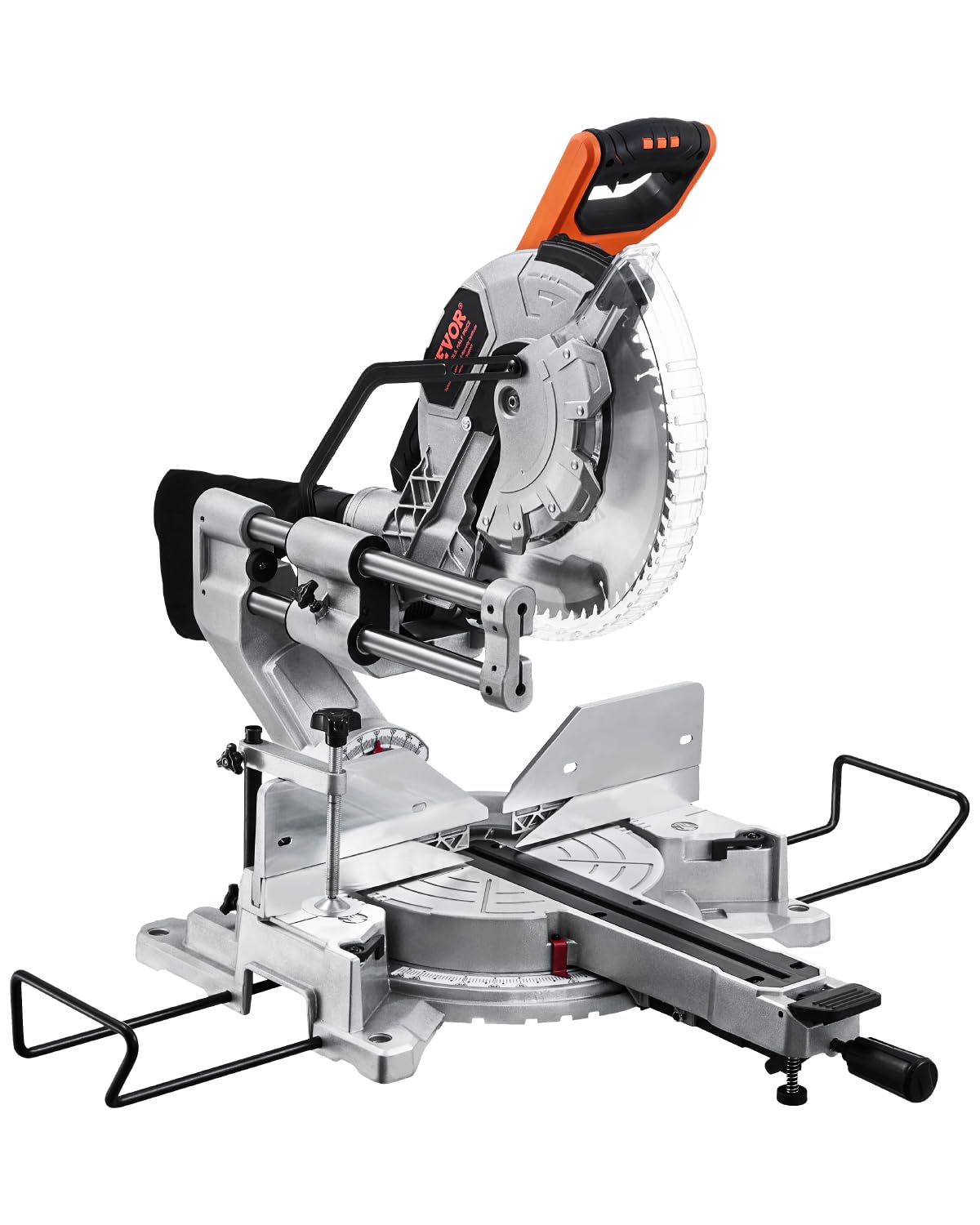
3. VEVOR Sliding Compound Miter Saw, 12-Inch Blade, 15 Amp Motor, 60-Tooth
An axial-slide saw that tucks against the wall and still runs 45 degrees each way
If your shop wall is only nine feet away from your bench and there is no room to push a saw backward, this is the shape you want. The axial sliding system moves the head forward along the rail, so the body lands flush against the wall — the whole point of the design and the most useful feature on a crowded bench. The aluminum base also wins on weight: at 46.4 pounds, this saw is light enough to move between stations without the back strain of a cast-iron-base machine.
Cut control combines an LED guide system with a precision scale, so you set your angle and lock it instead of eyeballing. Beveling works 0 to 45 degrees both left and right, which is what lets you frame picture frames or fussy assemblies without flipping the stock. The 5000 RPM blade speed is the highest in this list; the motor runs 2500W in straight cut and 3000W beveled, and carries through hardwood with the same push. The extension design is for longer boards — if you trim a plank that overshoots your bench, the slide keeps the cut stable rather than sagging on the far end.
What holds it back: the plastic knobs and adjustment hardware will feel soft if you are used to steel detent plates, and the dust bag is small enough that long sessions need a shop vac on the port instead. One owner of a similar VEVOR unit had a shadow LED fail and resolved it through the brand’s direct email support, not the web ticketing. Longevity of the whole platform is unproven; the saw does what a shop saw needs to do, but the track record is short.
light framing: the small-shop woodworker whose bench sits within arm’s reach of a wall and needs a full double-bevel cut capacity without the carriage throwing elbows behind the saw.
fine cabinetry: anyone who plans to run the saw flat-out on cabinet-grade trim where a soft plastic adjuster or a small dust bag becomes a daily annoyance.
4. WEN MM1215 15-Amp 12-Inch Dual Bevel Sliding Compound Miter Saw with LED Cutline

A wall-hugging dual-rail saw with a smooth 80-tooth blade from the start
The MM1215 targets the buyer who works in a garage bay with a wall right behind the bench. Its dual-rail slide system runs the head forward to keep the whole unit compact, and the supplied 80-tooth carbide blade (model BL1280, one-inch arbor) is enough teeth to start cutting trim straight from the start without swapping blades first. The 15 Amp motor crosscuts 13.25 inches wide and 4.5 inches thick — a full 12 inch miter saw capacity with the extra bite for thick stock.
Beveling and mitering both work 45 degrees in either direction across nine miter stops. Onboard LED cutline projects a shadow of the blade on the work, so you align the cut in real light without a laser. Two quick-lock table extension arms and two adjustable support fences handle material longer than the base. The kit ships with a quick-clamp assembly, dust port, dust bag and a carrying handle — a full working setup, no add-ons needed.
The critical caveat here is consistency, not power. A long-cut review from one owner found the saw deflecting past 8 inches on long crosscuts, with the right fence slightly off at 90 degrees on arrival and bevel repeatability drifting over a longer piece. That owner also rated it fine for general building trades and frames the limitation clearly — this is not a fine-furniture instrument. Expect to dial in the fence and recheck the vertical angle once you unbox. Do that and the saw handles decking, framing and general trim cleanly.
reliable motor
- Dual-rail forward slide keeps the machine flush against a wall with no rear overhang.
- 80-tooth carbide blade ships installed — trim-quality cuts without buying a blade first.
- 9 miter detents plus 45-degree bevel both directions gives you the full compound capacity range.
detent slop
- Long crosscuts past 8 inches show measurable deflection; verify fence square and recheck the vertical angle after shipping.
- Repeat bevel accuracy is not a fine-furniture promise — pick a different saw if that is the priority.
home shop: general building trades, deck framing and trim work where compact footprint and a full 13.25 inch crosscut outweigh a polished finish on the machined face.
production line: cabinetmakers and instrument builders who cut compound angles over and over on the same piece — deflection over 8 inches is a real limitation there.
5. WEN MM1214T 15-Amp 12-Inch Dual Bevel Sliding Compound Miter Saw with Laser

The 15-Amp head that handles 7-1/2 inches of crown in a single nested pass
If your projects live in crown and tall baseboard territory, this saw’s numbers land where it counts. The 15 Amp motor cuts boards up to 13-3/8 inches wide and 3-1/2 inches thick, and the vertical capacity nests 7-1/2 inches of crown molding with 6-3/4 inches of baseboard standing upright. That means you can run crown through the saw standing in its natural position instead of laying it flat and redoing your math on the bevel. An onboard class II laser guide teams with an LED work light; you get the cut line and a lit cut zone in one pass.
Bevel and miter both swing 45 degrees either direction across nine miter stops, and the kit ships with a 12 inch 60-tooth carbide blade, two retractable table extensions with work stops, a clamp assembly and a dust bag. On paper the spec sheet is competitive with much bigger-name saws at the same blade size.
Where it gets tricky is tolerances and surface finish. One owner reported that the laser died on the second use, though the saw still functions. A few buyers have pointed to the angle markers as adhesive decals rather than engraved metal — the same weak spot that hits saws in this tier. Another said the miter detent lever is plastic and would not survive job-site abuse, and there is a shipping defect pattern of damaged plastic handles on arrival. If yours arrives with a bent fence or broken lever, return it and the second unit is usually square. When it is right, it cuts perfectly straight.
small garage: you need genuinely tall nested capacity for crown and baseboard but are not ready to spend on a pro-tier saw.
thick stock: you run the saw hard on a job site where a plastic detent lever and a glassy laser will not survive a year of clatter.
6. Metabo HPT 12-Inch Dual Bevel Sliding Miter Saw, C12RSH3
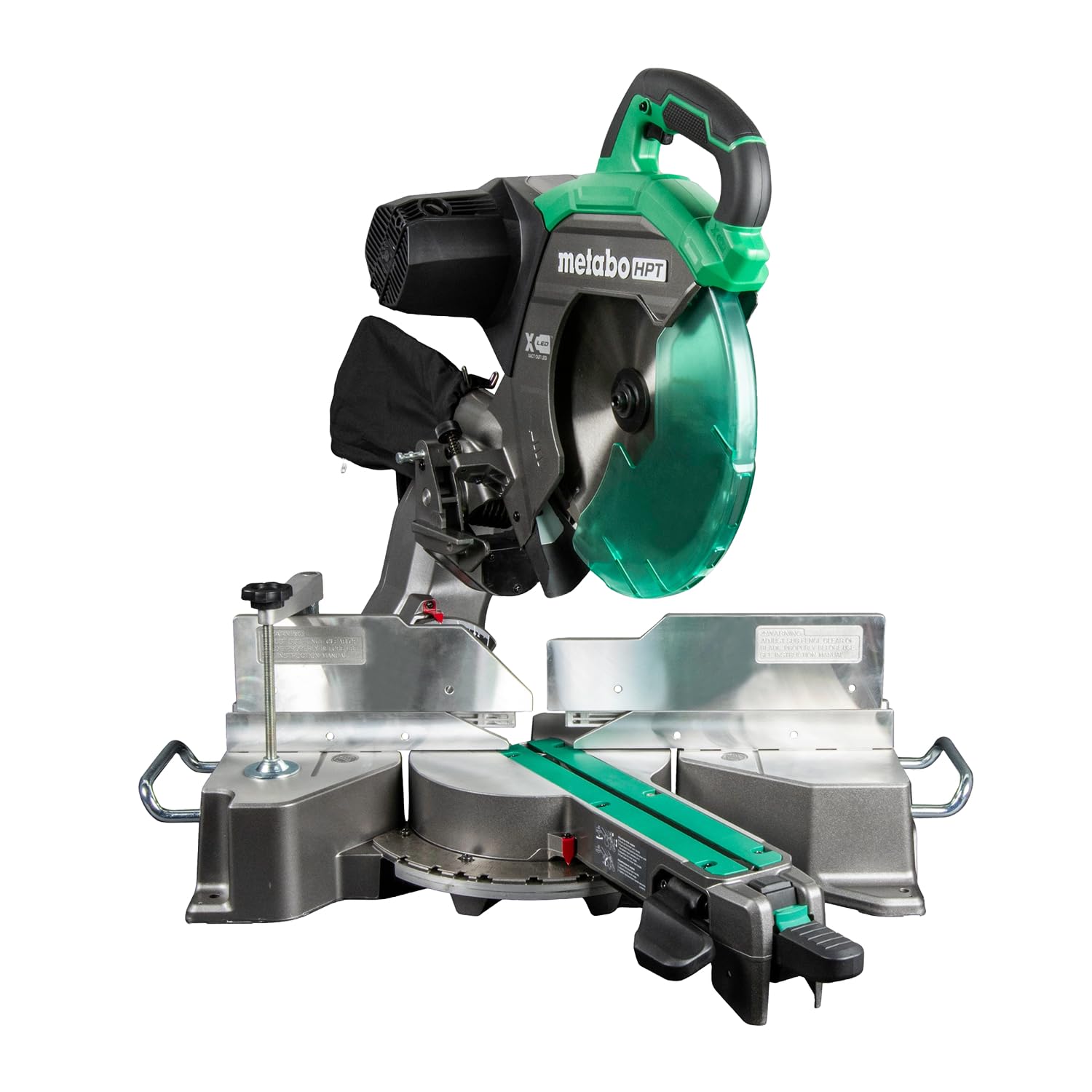
A mid-tier head that swings further right than anyone else and keeps its detents honest
Serious trim carpenters hit a miter angle past 45 degrees more often than the spec sheets suggest — and this saw is the one that goes there. The miter ring travels 0 to 45 degrees left and 0 to 57 degrees to the right, wider than any other saw on this page and genuinely useful when you’re chasing a wall that sits off-plumb. It combines with a 45-degree bevel both ways and 9 miter detents for common angles, so most cuts snap into place without a stopwatch.
The cut-line system is Metabo’s Xact Cut Shadow Line — the saw throws a shadow of the blade on the work instead of a laser, and the payoff is visible alignment in daylight. The one-touch bevel and miter locks handle quick angle changes without wrestling the head. The no-load speed reaches 4,000 RPM, quick enough that it does not bog on a full-capacity cut, and the forward-rail system lets it sit compactly against a wall.
Where the sharp edges are: the sliding action has a real caveat. Several owners note the carriage is not smooth, sometimes dragging with resistance through the travel — check the rails and clean debris off them. It is not a dealbreaker, but if you are chasing the buttery glide of a top-tier machine you will notice. Dust collection is also a daily gripe. The supplied bag works outside, but vacuum hookup needs a coupler and clamps you may not have on hand.
accurate bevels: the angle mechanism. It adjusts cleanly across a wider arc than the rest of this list, and cutting everything square from the start is the norm — one buyer put it simply: “This is a great saw and will easily fit on narrow benches.”
dust control: the slide is the weak link. It is functional, not glossy, and a serious job-site user will want to keep the rails brushed off if they care about a smooth run.
trim work: trim work where 57 degrees of right-hand miter and a daylight-visible shadow line matter more than a polished slide feel.
heavy timber: you need the smoothest carriage possible — the DEWALT or Makita deliver the glide this one does not.
7. DEWALT 20V MAX XR 12 inch Double Bevel Sliding Miter Saw, Cordless (DCS785B)

The battery powerhouse that cuts like a corded saw without a cord running behind you
If you have ever wrestled a 15-Amp cord through a deck frame at the end of a job, you already know why this saw exists. This is DEWALT’s 12 inch double-bevel sliding miter saw that runs on the full range of their 20V MAX and FLEXVOLT batteries — no extension cord, no wall socket, no cutting the power loop between the bench and the homeowner’s outlet. At 51.7 pounds it is light for a 12 inch sliding saw, and the carry handles let you move it around a job site without a second trip.
The cut capacity is where it earns its keep: up to 14 inches horizontally, 6-1/2 inches of baseboard standing up, and 6-1/2 inches of crown nested. That covers most door casings, baseboard runs and decking without a second pass. Regenerative braking helps you stay productive across the day, with the manufacturer quoting up to 371 cuts in 3-1/4 inch MDF base molding and 153 cuts in pressure-treated 4×4 timber per charge. The cutline blade positioning system indicates the cut line without adjustment, and the dust system captures most of the shavings as you cut — up to 97% of dust, per the maker.
The catch is the phrase “tool only.” No battery, no charger in the box — you supply the platform. Owners say that means bumping up to the bigger 20/60 MAX packs for optimal performance, and a lower-rated pack will feel the difference. Dust collection has real limits too: if you run this without a vac, the port and bag can only do so much, and one owner called out the port as the saw’s weakest link. Buy it, but plan the battery in.
jobsite: an existing DEWALT 20V owner who already has batteries on the shelf and wants a 12 inch cordless saw with 14 inch horizontal capacity.
stationary shop: you do not own 20V MAX batteries yet — you would be buying into a whole platform, and the kit version of this saw makes more sense first.
8. DEWALT DWS780 12-Inch Double Bevel Sliding Compound Miter Saw with DWX723 Stand
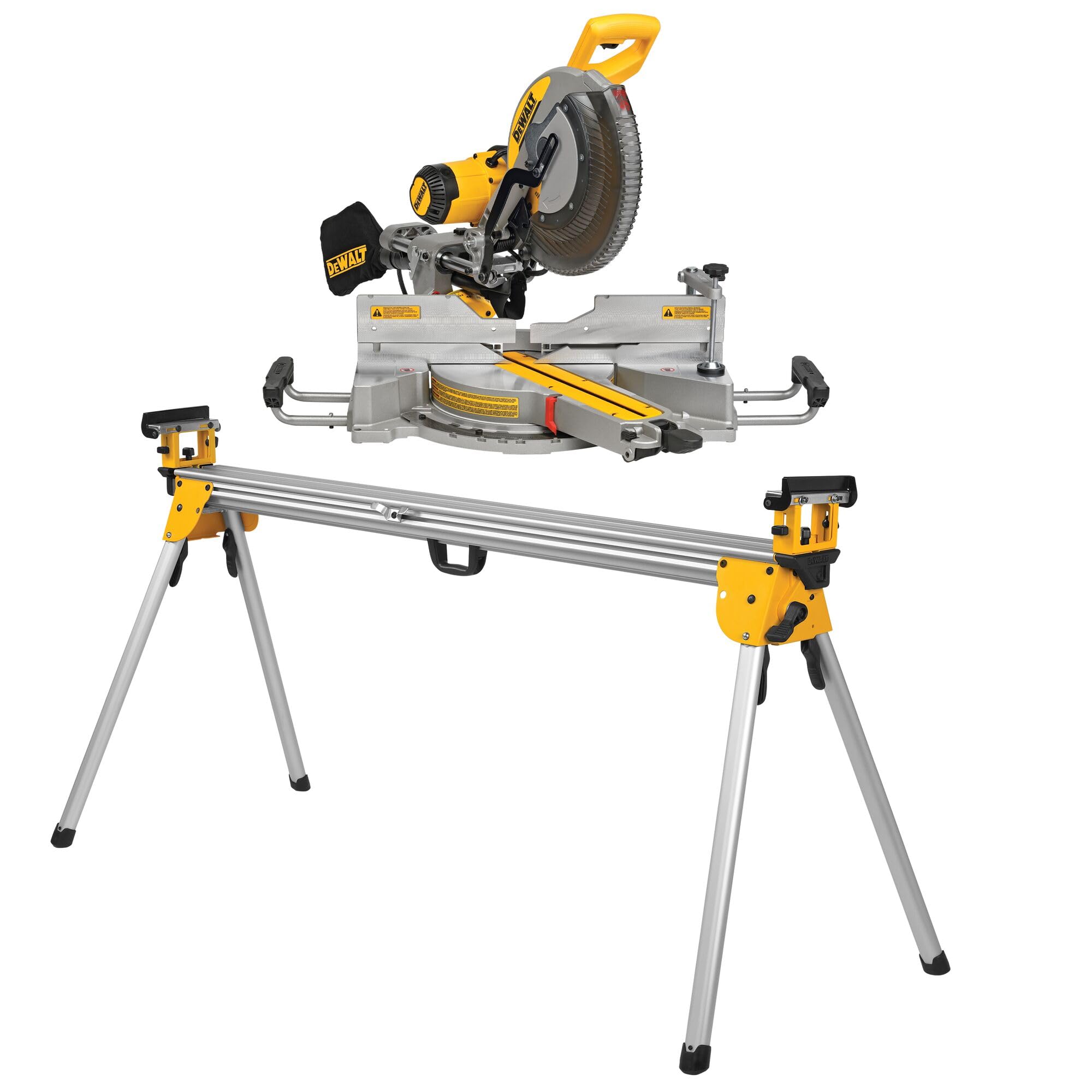
A premium corded saw bundled with a stand you can actually set up on site
If you cut long runs of material and need the saw to go where the work is, this bundle is the answer. The DWS780 is a 12 inch double-bevel sliding compound saw with an integrated CUTLINE blade positioning system — it indicates the cut line without adjustment and stays accurate without the fuss of a laser. XPS technology uses an LED to project light down either side of the blade, throwing a shadow on the cutline the moment the arm lowers, so you see the exact cut kerf as you start.
The double-bevel head works 45 degrees in either direction and the saw runs at 3,800 RPM on a corded electric supply. Its dust collection system captures over 75% of dust, per the maker, and the standalone weight of the saw is not one of the numbers on the spec sheet — the number that matters here is the stand: 29 pounds of lightweight aluminum so you can trundle it out of the shop without a hand truck. The DWX723 stand’s 5-1/2 ft beam extends to support up to 16 ft of material and up to 500 lbs, and the universal design works with all brands of miter saws, not just DEWALT.
What you should plan for: this is a corded bundle, so a power source is part of your setup, same as any 15-Amp bench saw. That is the trade versus the cordless DCS785s above, and you should pick based on which limitation hurts less — a cord in your way all day, or a battery you have to charge and carry. Long-term durability is the better-kept secret: the DWS780 platform is a proven design whose owner comments describe it as simply excellent, with no runtime to worry about at all.
finish carpentry: a serious hobbyist or light commercial shop that runs long trim and decking runs on site and wants the saw and the stand in one purchase.
quick cuts: you cut almost entirely in a fixed bench and would never deploy the stand — the standalone corded saws on this list cost less for the same cut quality.
9. FLEX 24V Brushless Cordless 12-Inch Dual Bevel Sliding Miter Saw Kit (FX7141A-1J)
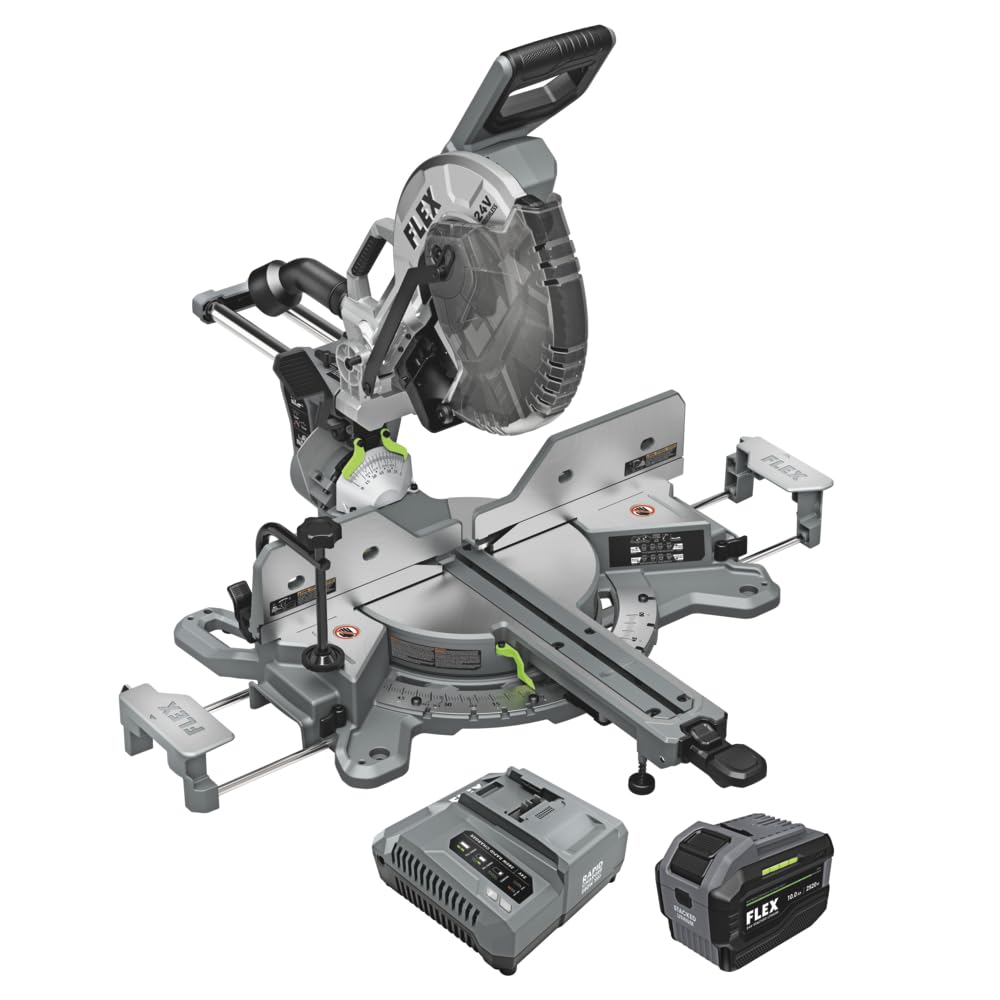
A cordless saw that runs long enough to skip the extension cable entirely
Cutting volume is the yardstick for a cordless saw, and FLEX has the loudest number on this list — a 10.0Ah Stacked Lithium battery delivers up to 630 crosscuts in 3-1/4 inch MDF per charge, per the maker. That is a full trim package without a wall socket. The kit includes the saw, the 10.0Ah stacked battery, a 280W rapid charger and a 60T carbide blade, so nothing waits on a second order.
The bevel system is the standout feature. FastShift bevel lever snaps the head to 0, left and right 22.5, 33.9, 45 and 47 degrees — the extra 47 degree stop matters when you are chasing crown angles that the standard 45 stops cannot reach. A quick miter lock sets your angle precisely, spindle stop shaft lock handles blade changes without loosening anything by hand, and the adjustable depth stop lets you set dadoes and slots without measuring depth every pass. The LED shadow light lights the blade to the cut line in a way you can see in job-site daylight. Table extensions widen the base to support long material.
Where it stings is weight and decibels. Owners say the saw is loud and heavy to move around — that is the cost of a big stack battery and a beefy motor. The 24V platform also locks you into FLEX batteries and chargers if that is your first purchase in the system. The battery light auto-shuts off after a set interval, and the dust bag beats hooking up a vac, but neither reaches the level of an integrated dust system. Then there is the honest price question: it sits at the top of the range here, and one long-time reviewer noted it is roughly double what other 12 inch saws cost. If a cordless saw is the point, that is what the category costs.
battery power
- 10.0Ah stacked battery delivers up to 630 crosscuts in 3-1/4 inch MDF per charge, per the maker.
- FastShift bevel lever reaches 47 degrees — the widest bevel range on this page.
- Spindle lock and depth stop cover blade changes and dado cuts without extra tooling.
runtime limits
- Owners note the saw is loud and heavy to move; it is a bench-fixed cordless saw, not a hand-carry machine.
- The battery light auto-shuts off and the dust bag outperforms vacuum hookup — plan your workspace around both.
remote work: a cordless-platform buyer with a 24V FLEX shelf and a trim-heavy list of jobs who never wants to hunt a wall socket.
continuous use: you rarely leave one bench — the DEWALT DWS780 gives you the same cutting class without the battery trade-offs.
10. TRUPER SINCO-12X 12″ Double Bevel Sliding Compound Miter Saw w/ Laser Line

A telescopic-arm saw built around wide material and steady vertical hold
When the boards getting cut are wider than the machine’s base, the telescopic arm is the feature that decides the job. This 12 inch double bevel sliding compound saw extends its reach with a telescoping arm for increased cutting capacity, and the table extension with rails supports wider workpieces so the far end does not sag as you cut. That combination gives you material support you would otherwise have to build with spare lumber. A transparent retractable guard shields the blade as it drops.
Holding the workpiece is where this saw differs from the others. Vertical and horizontal presses clamp stock firmly to the fence during the cut — no second hand needed to steady the board. The laser line marks your cut on the work, and left/right positive stops land at 0, 15, 22.5, 30 and 45 degrees inward and outward. The motor is rated at 2-3/4 HP with a 12 inch blade and 45-degree cutting angle, and a wood saw blade comes included.
What owners say is almost universally about cut quality. Cutting comments focus on clean, fine cuts, and one reviewer called the quality strong enough to compete with foreign-name brands. Packaging quality earned praise too. There is one recurring shipping problem worth flagging: some units arrive with fewer accessories than the box claims — one buyer returned theirs because the packaging said two blades but only one was inside. Check what is in the box against the printed list on arrival. Beyond that, this is a saw for buyers who understand the price reflects the machine, not a premium brand.
occasional use: the woodworker who cuts wide or long stock often and wants integrated clamps and a telescopic reach rather than a bare base to modify.
daily trade: if accessories matter as much as the saw itself, compare what arrives against the box list — a few units have shipped short on blades.
Understanding the Specs
Blade, Motor Amps, and Cutting Power
A 15 Amp motor is the standard for this saw class and delivers enough torque to power through 4×4 and dense hardwood without bogging. Cordless saws trade amps for battery voltage instead — a 20V MAX or 24V pack carries the same cutting job off a battery. Blade tooth count is the quieter spec: a 60-tooth blade leaves a cleaner cut on trim and crown, while a 40-tooth blade is faster in heavier stock. If you buy a saw with a 60-tooth blade included, you have a trim-ready setup from the start.
Sliding Rails, Cut-Line Guides, and Setup Time
FAQ
What is the difference between double bevel and single bevel on a 12 inch saw?
Do I need a sliding rail system or will a fixed 12 inch saw do the job?
How wide a board can a 12 inch sliding miter saw cut in one pass?
Why does a sliding miter saw deflect on long cuts?
Is a laser guide better than an LED shadow line for cut alignment?
Will a 12 inch sliding miter saw cut crown molding and tall baseboard standing up?
Can a cordless 12 inch miter saw match a corded one on power?
How heavy is a 12 inch double bevel sliding miter saw to move around?
What miter angles and detents should I look for on a 12 inch saw?
Does a compound miter saw cut dadoes and lap joints as well as crosscuts?
Final Thoughts: The Verdict
For most readers buying a 12 inch double bevel sliding compound miter saw, the Makita LS1219L is the honest purchase — it delivers 8 inch nested crown capacity, 15 inch crosscuts, a two-steel-rail slide that holds square, and it earns 4.4 stars from 400+ ratings from a crowd that includes 20-year builders and 40-year carpenters. Pick up the DOVAMAN if double-bevel sliding capacity at a lower tier is your priority and you are not cutting every day. If your shop has no room behind the saw, the forward-slide VEVOR tucks against a wall. And if you cut trim all day without a wall socket in sight, the cordless FLEX kit is the one to reach for. Anything that hangs past 8 inches of crosscut and needs to stay dead square all day is a Makita job.
How We Picked
We do not accept paid placement. Every pick is matched to a real buyer and a real use-case; we do not hands-on test units.
Sources & Methodology
Specifications: manufacturer listings and product documentation. Review insights: verified customer reviews, as of September 2026. Pricing: not shown on this page (it changes often); check the current price via the retailer link.
As an Amazon Associate, KitchPrep earns from qualifying purchases. This does not affect which products we feature.
Related Guides
