
Specs are compiled from manufacturer listings and verified buyer reviews and can change over time — please confirm the key details on the product page before buying.
When the grid drops, the only thing that matters is whether your fridge keeps humming and your router stays lit. This guide cuts straight to the backup batteries that actually hold up during an outage, sorted by what they power, how long they last, and how fast they refill.
I’m Mohammad Maruf — the founder and writer behind KitchPrep. This guide is built by comparing the manufacturers’ published specifications and the patterns across verified customer reviews, so you get each pick’s real strengths and trade-offs instead of marketing spin.
The picks below range from a 288Wh grab-and-go unit to a 3,600Wh whole-room workhorse, so you can match capacity to the appliances you refuse to lose. Choosing the right backup battery for power outages starts with knowing exactly what you need to keep running.
Our Picks at a Glance

How To Choose The Best Backup Battery for Power Outages
Buying outage power depends on three questions: what you refuse to lose, how long you need it, and how fast you can refill. Answer those and the spec sheet sorts itself out.
Start With Capacity, Not Wattage
Capacity is measured in watt-hours (Wh) — think of it as the size of the fuel tank. A 519Wh unit and a 3,072Wh unit can both run a fridge, but the bigger one runs it far longer. Watts tell you how much can flow at once; watt-hours tell you how long it flows. Most people over-buy watts and under-buy watt-hours.
Check Switchover Speed If You Run Computers
A UPS (uninterruptible power supply) hands off to battery power in milliseconds when the wall current dies. Anything under 20ms is fast enough that your desktop or router never notices the blink. Units built purely as camping stations can take longer or lack the mode entirely, so read that line carefully if your home office is the priority.
Battery Chemistry Decides Replacement Cost
LiFePO4 (lithium iron phosphate) is the chemistry to want in an outage battery — thousands of charge cycles and no yearly battery swaps like older lead-acid UPS boxes.
Quick Comparison
| Model | Best For | Capacity | Continuous Output | Weight | Amazon |
|---|---|---|---|---|---|
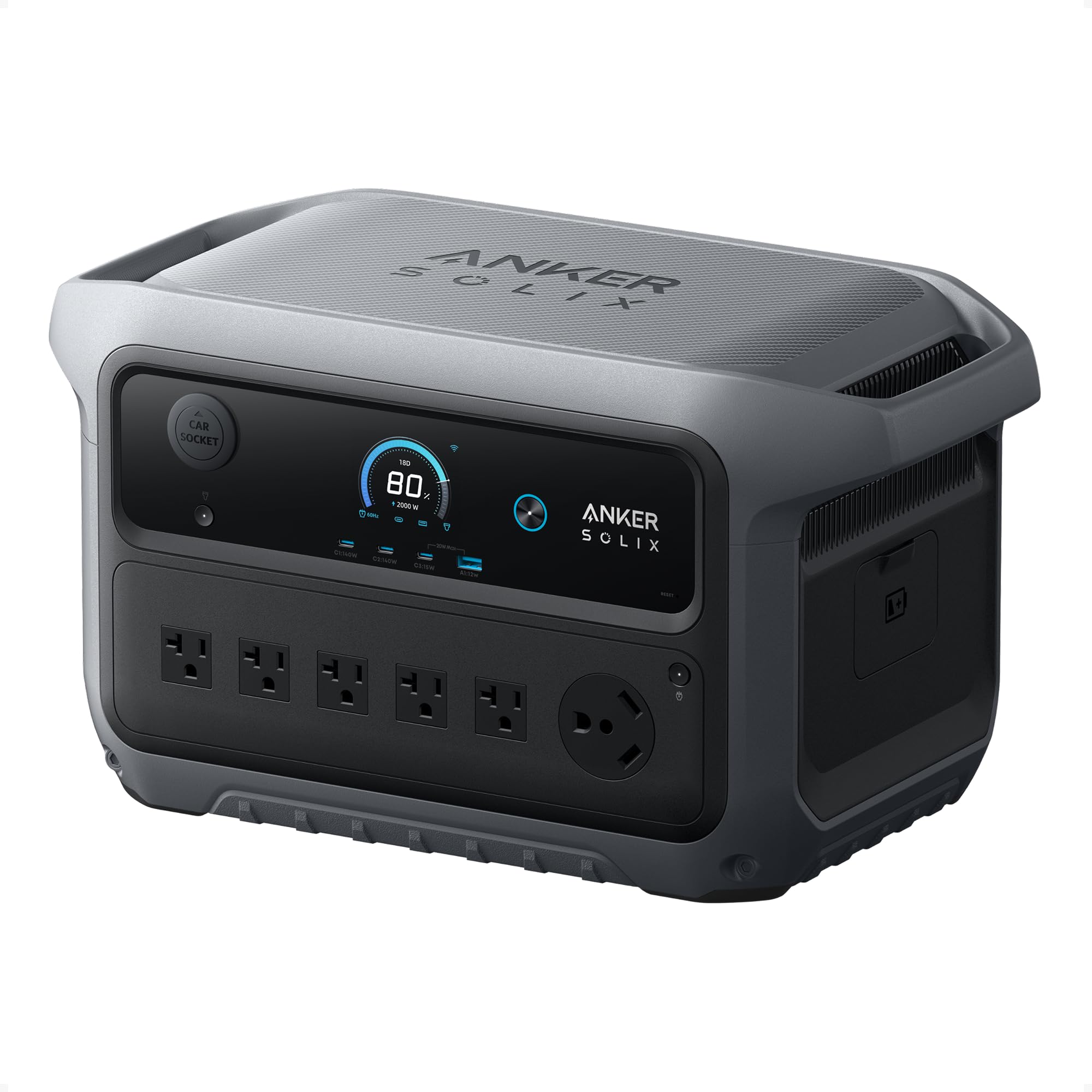
| Anker SOLIX C2000 Gen 2★ Best Overall | Whole-home essentials | 2,048Wh | 2,400W | 41.7 lb | Amazon |
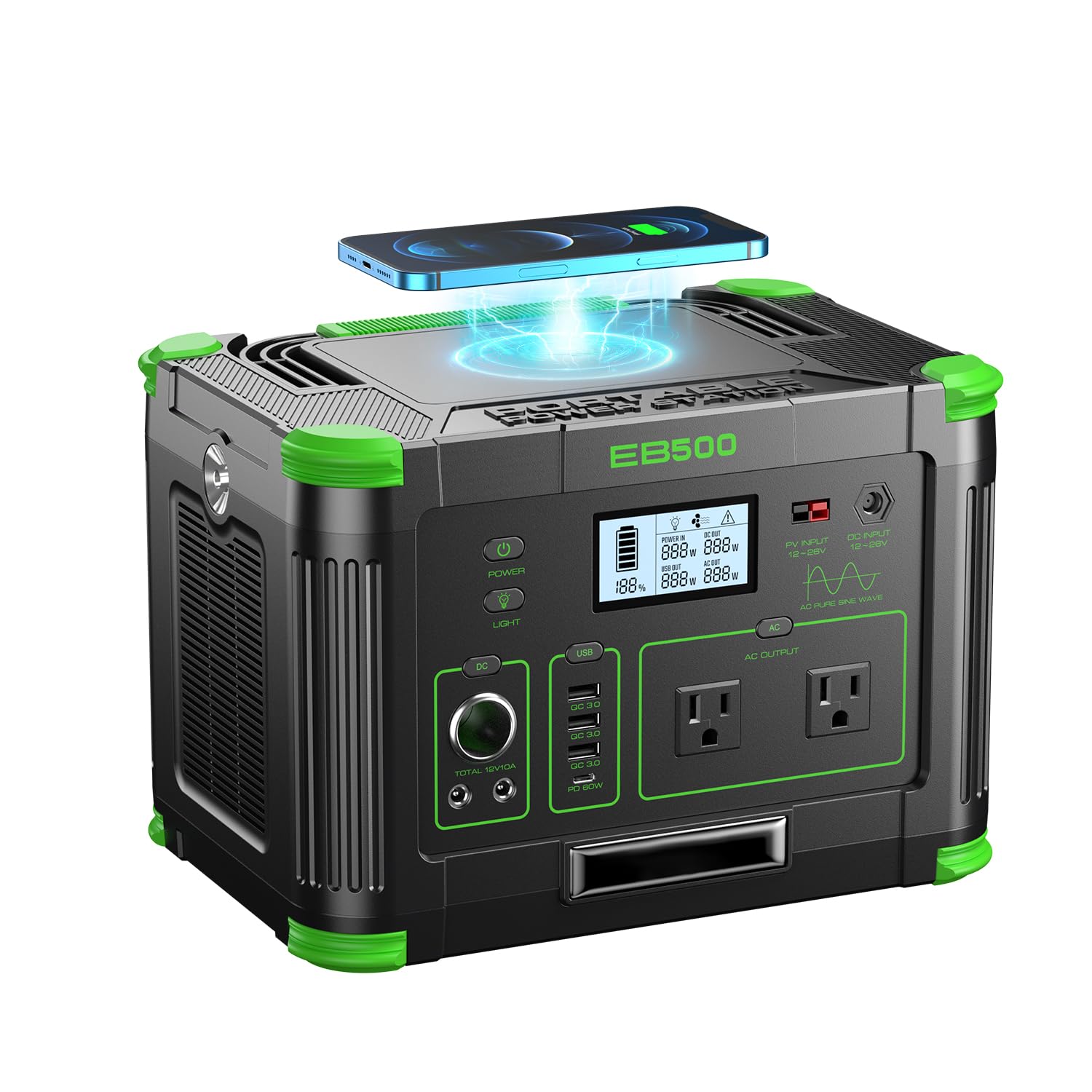
| GRECELL 500W Portable Power StationBest Value | Small appliances and devices | 519.48Wh | 500W | 14.1 lb | Amazon |
| GOLDENMATE 1000VA/600W UPSDesk Champion | Desktops and workstations | 153.6Wh | 600W | 10.6 lb | Amazon |
| CyberPower CP1500PFCLCD | Gaming PCs and networks | Not listed | 1,000W | 24.9 lb | Amazon |
| BLUETTI Elite 30 V2 | Router and CPAP duty | 288Wh | 600W | 9.5 lb | Amazon |
| Anker SOLIX S2000 | Fridge-first backup | 2,010Wh | 1,500W | 35.7 lb | Amazon |
| BLUETTI Elite 100 V2 | Camping and cabin power | 1024Wh | 1800W | 25 lb | Amazon |
| Jackery HomePower 3000 | RV and long outages | 3072Wh | 3600W | 59.5 lb | Amazon |
| EF ECOFLOW DELTA Pro | Whole-home heavy loads | 3600Wh | 3600W | 99 lb | Amazon |
In‑Depth Reviews
1. Anker SOLIX C2000 Gen 2 Portable Power Station, 2,048Wh, 2,400W, Camping
Our pick — over 4.5★ from 650+ verified ratings; the strongest balance of quality and price.
The fridge-first heavyweight that refills before you’ve finished tidying the garage.
The C2000 Gen 2 is what you buy when “keep the fridge and Wi-Fi alive” is the whole point. Its 2,048Wh battery — the total energy it stores — is nearly four times the 519.48Wh in the GRECELL 500W lower on this page. Owners take it through a 10,000 BTU AC overnight, and the standard load here is a fridge, TV and router running past 10 hours.
What keeps it on top is efficiency, not just bulk. Anker rates standby draw at 9W, which is why the C2000 sustains a dual-door fridge for up to 32 hours before you plug anything else in. Add the expansion battery and the spec climbs to 4kWh with up to 64 hours of fridge runtime — enough to sit out a multi-day ice-storm outage without rationing. The 2,400W rated / 4,000W peak output (peak is the short burst used to start a compressor or motor) handles window and RV air conditioners that smaller boxes trip on.
Recharge speed is the second half of the story. From dead to full takes 58 minutes on AC — owners with a dedicated 15A outlet report 27% to full in 1 hour 10 minutes. Solar, car, alternator and generator are the other paths. The 41.7 lb weight is the honest trade-off: two handles and a rollaround case make it livable, but it isn’t a one-hand carry, and it’s noticeably heavier than the 25 lb BLUETTI Elite 100 V2.
What 96 fridge-runtime owners already know
- 2,048Wh runs a dual-door fridge up to 32 hours, expandable to 4kWh / 64 hours
- 58-minute AC recharge, plus solar, car, and alternator paths
- 2,400W rated, 4,000W peak, so compressor-start appliances actually fire
- Front-facing outlets and USB ports, easy to reach behind a counter
The weight question nobody hides
- 6W idle draw on S2000 sibling runs fridge 35 hrs — C2000 relies on its 9W standby spec and 2,048Wh
- 41.7 lb is a two-hand lift, not a grab-and-go
- An app usage estimate is a rough guide, not a meter
- It won’t run a small AC for more than a couple of hours
The C2000 Gen 2 earns its spot with the strongest score-and-volume combination here: 4.7 stars from roughly 600 ratings, ahead of the 4.5-rated GRECELL and the 4.4-rated GOLDENMATE. It costs premium money and it earns it. This is the pick if your outage plan is “protect the fridge, the router and one good AC.” Think twice if one person has to carry it up stairs, because at 41.7 lb you’ll want a second set of hands.
Buy it for: whole-home essentials — fridge, freezer, router, lights — through a 30-hour-plus outage.
Look past it if: 41.7 lb is too heavy for your setup, or you need a one-handed unit.
2. Portable Power Station 500W, 519.48Wh/140400mAh Solar Generator Backup
The carry-handle compact that punches above its weight for small appliances.
For keeping the phones, the router and one small appliance going, this GRECELL is the value play. Its 519.48Wh / 140,400mAh battery is a fraction of the Anker C2000’s 2,048Wh, but at 14.1 lb it’s a genuinely portable 11.57″ x 7.95″ x 7.95″ box — smaller in every direction than the C2000 Gen 2 at 18.1″ x 9.8″ x 10.1″.
The output spread is where GRECELL earns its keep: two pure sine wave AC outlets at 120V/500W, three USB-A QC3.0 ports at 18W, one USB-C PD at 60W max, two DC ports, a car port and a wireless charger — ten devices at once. Pure sine wave means clean power, the smooth wave shape sensitive electronics like laptops and CPAP machines prefer. The 60W USB-C PD refills a phone or tablet more than twice as fast as a standard USB-C charger.
Refill time is honest rather than fast — 6 to 7 hours on a wall outlet, 7 to 8 on a car charger, 6 to 9 with a 100W solar panel. That’s noticeably slower than the Anker C2000’s 58-minute AC fill, but nobody buys a 500W box expecting turbo charging. The one thing to plan for: one owner noted the unit arrived at 58% charge, which means it needs a full top-up before it goes onto the emergency shelf.
The build feel: owners consistently flag the sturdy plastic body and the built-in carry handle as the reason it travels well — the handle is the shape of the case, not an add-on that snaps off.
What to plan around: the Battery Management System (a chip that watches temperature, voltage and current to stop damage) and the pure sine wave inverter are protection features, not capacity — this is a 500W box, and the manual is direct that anything rated over 500W stays unplugged.
The GRECELL holds 4.5 stars from around 230 ratings, which is elite for the money. Best if your load is routers, phones, laptops, fans, and a small fridge or blanket. skip it if your outage list includes a full-size fridge or any AC unit, because 500W continuous won’t carry them.
Reach for this if: you want a light, cheap-to-own 500W box for gadgets, lights and a small appliance.
Leave it on the shelf if: your must-run list is above 500W or needs multi-day runtime.
3. GOLDENMATE 1000VA/600W Lithium UPS Battery Backup & Surge Protector, White
Eight grounded sockets and a lithium heart that outlasts lead-acid replacements.
This is a desk UPS, not a camping station — its 153.6Wh capacity is sized for a workstation, not a fridge. What makes it stand out against lead-acid boxes is the LiFePO4 (lithium iron phosphate) battery inside: rated over 10 years and 5,000+ charge cycles, with the manufacturer claiming it cuts lifetime ownership cost by over 40% versus lead-acid. If your last UPS died because the gel cell needed swapping every couple of years, that is the spec to care about.
Around the back you get eight NEMA 5-15P grounded outlets (the standard three-prong US socket) with surge protection, pure sine wave output, and 1000VA/600W of rated capacity. That’s enough to hold a desktop, monitor, and modem up long enough to save work and shut down clean. Owners who run AV desks and data protection load clear reports on it holding through brief flickers — the reliable behavior is quiet, unglamorous and exactly what you buy a UPS for.
The honest trade-offs land in the details. Switchover is 20ms, which is fine for almost every desktop but slower than the sub-10ms units further down this list. The cooling fan runs only under heavy load but can be heard when it does, and the outlets are packed tightly enough that a wide DC adapter may block its neighbor. Ambitious setups should also stay under the rated 600W load.
Where it earns its keep: the lithium battery and light 145W-capable tower are what most owners call out — it’s the replacement cost that disappears, not the capacity.
Who this isn’t for: if you’re protecting a gaming PC with an ATX 3.1 power supply or you need remote network shutdown, a pure-sine PSU-tuned unit like the CyberPower further down fits better.
GOLDENMATE carries 4.4 stars from roughly 900 ratings. Best as a desktop, printer or small-office protector. The one honest caveat that shows up in a handful of reports is occasional unit failure under power-quality stress, handled via warranty — worth knowing, not worth treating as typical.
Best for: desktop PCs, printers, and small office gear where a 10-year battery changes the math.
Skip if: you need sub-10ms handoff or auto-shutdown software over USB.
4. CyberPower CP1500PFCLCD PFC Sinewave UPS Battery Backup and Surge Protector, 1500VA/1000W, 12 Outlets, AVR, Mini Tower, UL Certified

The year-after-year office pick that pairs a pure sine wave with actual UL proof.
No outage battery in this lineup has been installed and re-installed as often as the CP1500PFCLCD, and the reason sits in three letters: PFC (power factor correction — the technology modern desktop power supplies use; a PFC UPS supplies matching clean output so a gaming rig doesn’t randomly shut off on the switch). The pure sine wave output and 1500VA/1000W rating handle a gaming tower, monitors and network gear at once without the tripping some cheaper stepped-wave UPS units cause.
The port count is genuinely usable: 12 NEMA 5-15R outlets split into 6 battery-plus-surge and 6 surge only, so you can decide whether the desk lamp needs backup or just protection. AVR (automatic voltage regulation — it corrects dirty or low voltage without pulling from the battery) keeps you stable through flickers, and the tilting color LCD shows live watts and load, which turns hardware troubleshooting into a glance. Two USB charge ports (one Type-A, one Type-C) sit on the front for phones and tablets.
Runtime is honest at 5 to 8 minutes at typical gaming load, but network gear runs much further — 40% load stretches past an hour. The battery is user-replaceable behind two screws at the front panel, which is how units this model have stayed in service eight years and running. The trade-offs are real: 24.9 lb is heavy for a desk, the main battery is usually the part that needs replacing first, and the unit itself is not a price leader.
The 1,600-rating track record: no other UPS in this lineup has the same volume of long-term owner praise for keeping systems online through storms — a pure sine wave and clean output is what the pattern reduces to.
The catch nobody hides: battery replacement is a fact of ownership every two or three years, and the whole unit blanks on that task if you don’t plan for it.
CyberPower holds 4.6 stars from more than 11,000 ratings — the highest volume of any pick here by a wide margin. Best if your desk runs a real gaming or editing PC and you want a bulletproof, warranty-backed handoff. Reach elsewhere if pure portability matters more than capacity.
This is your UPS if: you want the tried-and-vetted office unit with UL certification and a 3-year warranty that includes the battery.
Don’t grab it for: on-the-go backup — it’s a desk tower, and at 24.9 lb it stays put.
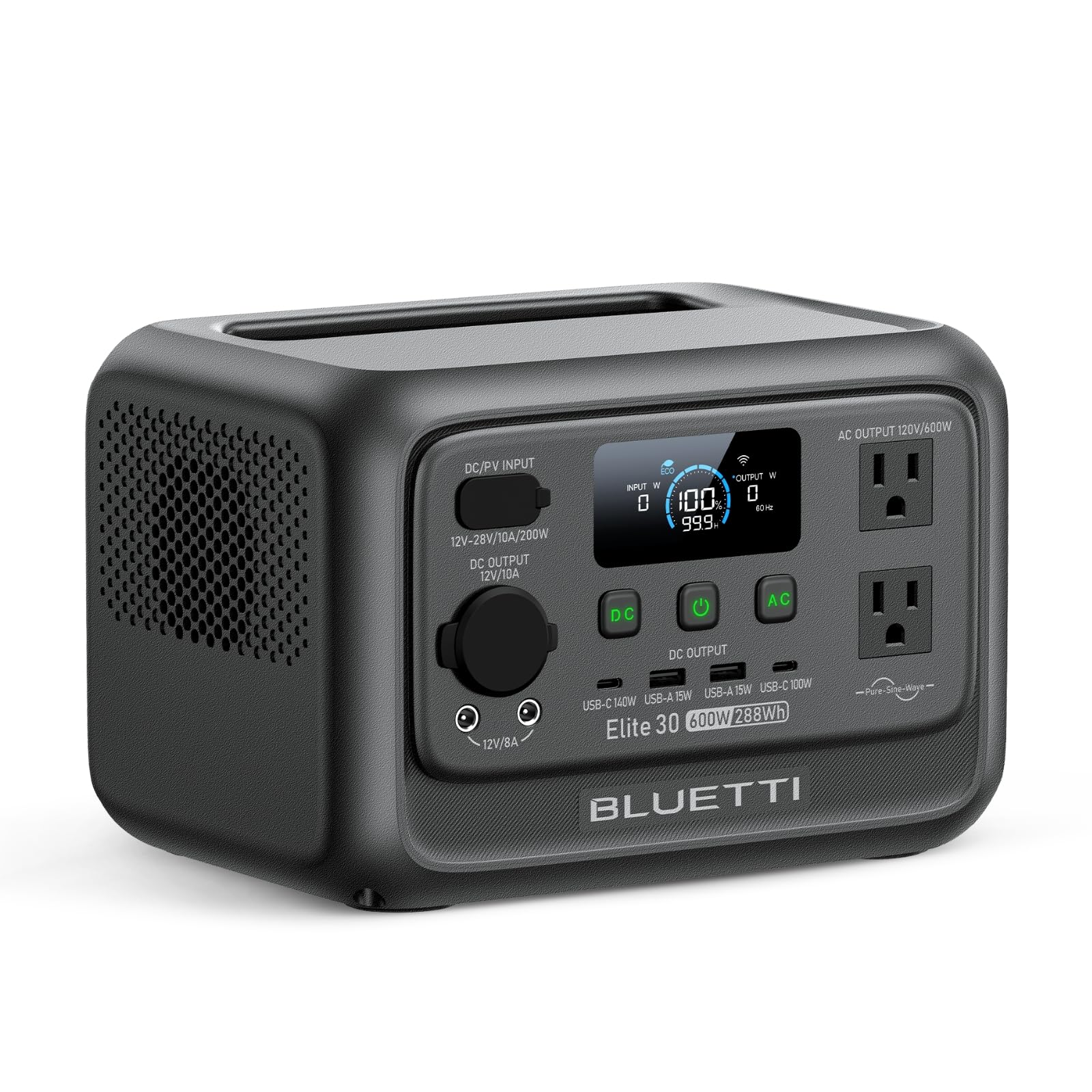
5. BLUETTI Elite 30 V2 Portable Power Station 288Wh 600W LFP Solar Generator
A 9.5 lb power bank that swaps places with your old UPS.
Picture a small power station you can genuinely carry one-handed — the Elite 30 V2 weighs in at just 9.5 lb, or about 30 pounds lighter than the Anker C2000 Gen 2 further up. That’s the defining number: its 288Wh capacity is modest, but you can take it into a closet, a camper, or under a desk without a second thought.
The interesting part is the overlap between camping station and UPS. It delivers 600W continuous with a 1500W surge mode BLUETTI calls Power Lifting, and it offers a 10ms switchover when paired with a live outlet. Owners who replaced their old 1500VA UPS with one report more runtime on a 150W load — hours not minutes. LiFePO4 chemistry, a smart cooling system, and a 4.5W standby draw are what make it viable as an always-on box rather than a battery you charge monthly.
Recharging is where it earns the carry: 0 to 80% in 45 minutes, 0 to 100% in 70 minutes via 380W wall charge, with an adjustable 200W mode for battery friendliness. Solar, car and AC are the three paths, and the 288Wh / 600W spec sheet is rounded out by Wi-Fi app control and a clear on-screen display. The obvious limit is capacity — a fridge or full freezer is out of the question at 288Wh.
Where the 100-rating pattern points: owners using it as a router, switch and mesh-node UPS are the loudest praise group — the 10ms switchover and 288Wh together keep networking gear alive for 15+ hours.
Set it up right: the auto-restart-on-AC-return behavior uses a live mode code in the app; owners who activate it before an outage report zero manual resets, while the default mode sometimes requires a push.
The Elite 30 V2 checks in at 4.4 stars from roughly 800 ratings. Best if your load is routers, CPAP machines, laptops, phones and lights. Look further up the list if you need a fridge covered — 288Wh won’t get you there.
Pick this for: a router-and-CPAP safety net small enough to move room to room.
Choose a bigger box if: your outage list includes a fridge, freezer or any compressor appliance.
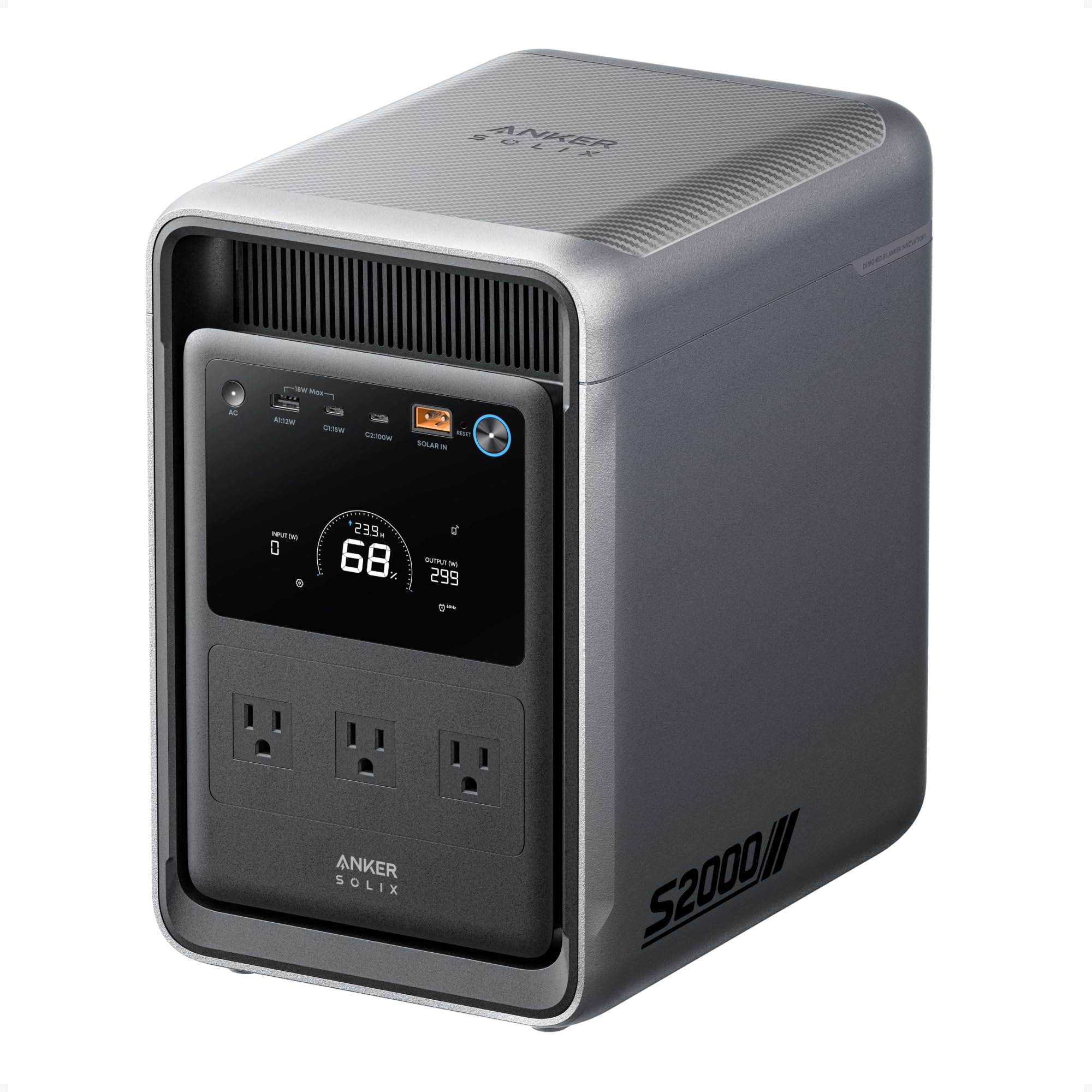
6. Anker SOLIX S2000 Portable Power Station, 2,010Wh, 3,000W Peak, Home Backup
Rated for 35 hours of fridge — and honest about the fan.
Owners who bought this after watching fridge tests want one number, and Anker publishes it directly: up to 35 hours of dual-door fridge runtime from the 2,010Wh battery. The 6W idle draw and 10% efficiency gain are what buy the extra hours; a straight 2kWh system otherwise runs short. The 314Ah LFP cells carry a 10,000-cycle rating and a 15-year claimed lifespan — double what most lithium-phosphate rivals list.
It’s the smallest and lightest 2kWh unit on this list, too. At 35.7 lb and 8.2″ x 11.1″ x 12.7″ it’s 30% smaller and 25% lighter than the industry average, and it fits on a shelf next to the router. Anker’s front-and-rear outlet layout is deliberate — front plugs for phones, USB and desk gear, rear plugs for always-on appliances like the fridge — with 8 outlets total and 1,500W continuous / 3,000W peak output.
Two honest limits buyers should weigh: there’s no 12V DC port anywhere on the unit, so classic car-style DC accessories need an adapter or a different pick, and the fan is divisive — quiet at typical charge rates but audible when it spins up. Recharging runs 6 ways (up to 400W solar), or fast via AC.
What owners run it through: 30-hour and 25-hour outages with the fridge and freezer intact, WiFi app control, UPS mode and live wattage monitoring on the color screen. The pattern isn’t dramatic, it’s just a lot of fridges kept cold.
The efficiency math: the 35-hour fridge figure is what the spec sheet hangs on, and buyers report it landing close to the claim, with the 6W idle draw making the difference across long outages.
Anker SOLIX S2000 sits at 4.7 stars from roughly 240 ratings. Best for fridge-and-router coverage with a manageable weight. The mixed report on fan noise and the missing DC port are the two lines to be honest about before you buy.
Best for: a 2kWh fridge run at a weight one person can move.
Not for: anyone who needs a 12V DC port natively, or who can’t tolerate fan noise during charge.
7. BLUETTI Elite 100 V2 Portable Power Station for Camping 1024Wh 1800W
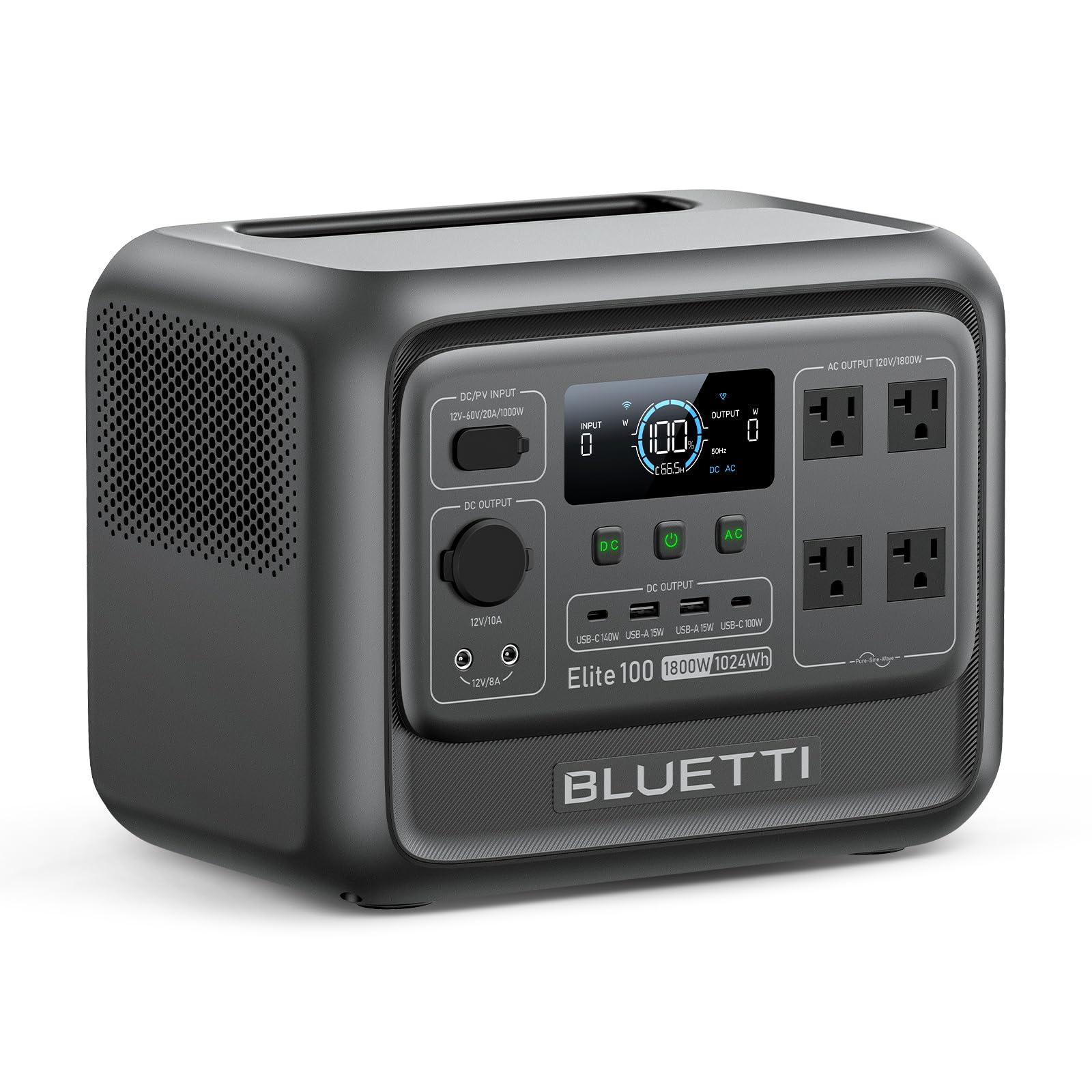
The 25-pounder that hides a 1024Wh fridge plan behind a one-hand handle.
Fifty pounds is where most 1kWh stations live; the Elite 100 V2 comes in at 25 lb and gets its own built-in handle, so it moves between the kitchen, truck bed and cabin without a cart. Inside that frame BLUETTI packs a 1024Wh LiFePO4 battery with a 4,000-cycle rating to 80% and an 1800W rated AC output (3600W surge). That’s roughly double the GRECELL 500W’s 519.48Wh capacity in a body that weighs a little over 10 pounds more.
Recharging is the flex: 1,200W TurboBoost AC fills it in about 70 minutes, or up to 1000W solar input — BLUETTI rates that as the fastest solar charge for a 1kWh station. A 10ms UPS switchover covers routers and desktops if the grid blinks, and a silent mode drops the fan to 30dB — about as quiet as a library hum — which is uncommon at this capacity. Owners running telescopes and remote-location gear clock 6.5 to 7 hours of real-world runtime on light loads.
The honest catch: it’s designed for mobile setups, not a whole-home panel. 1800W rated is plenty for a small AC, a full fridge, or a work setup — but pairing two of these still falls short of the 3,600W single-unit output of the EF ECOFLOW DELTA Pro lower down. And solar charging, while supported, is the slowest of the three methods.
Where the campers land: a consistent thread from owners who use this off-grid is the display and the port count — 11 outputs total, Wi-Fi and Bluetooth app control, and firmware updates over the app keep it current without a computer.
What to set expectations on: this is a 1024Wh station, so fridge runtime lands in the 30 to 48 hour range at best — a two-fridge house in a multi-day outage needs the bigger 2kWh or 3kWh picks.
BLUETTI’s Elite 100 V2 scores 4.5 stars from roughly 650 ratings. Best for camping, cabin and mobile-work duty where light weight matters more than maximum capacity. The weight is real — 25 lb with the handle is manageable but not featherweight.
For: one-handed portability with a real 1024Wh fridge plan.
Not for: whole-home backup — look at the Jackery or DELTA Pro if you’re running a panel.
8. Jackery HomePower 3000 Portable Power Station, 3072Wh, 3600W AC Output
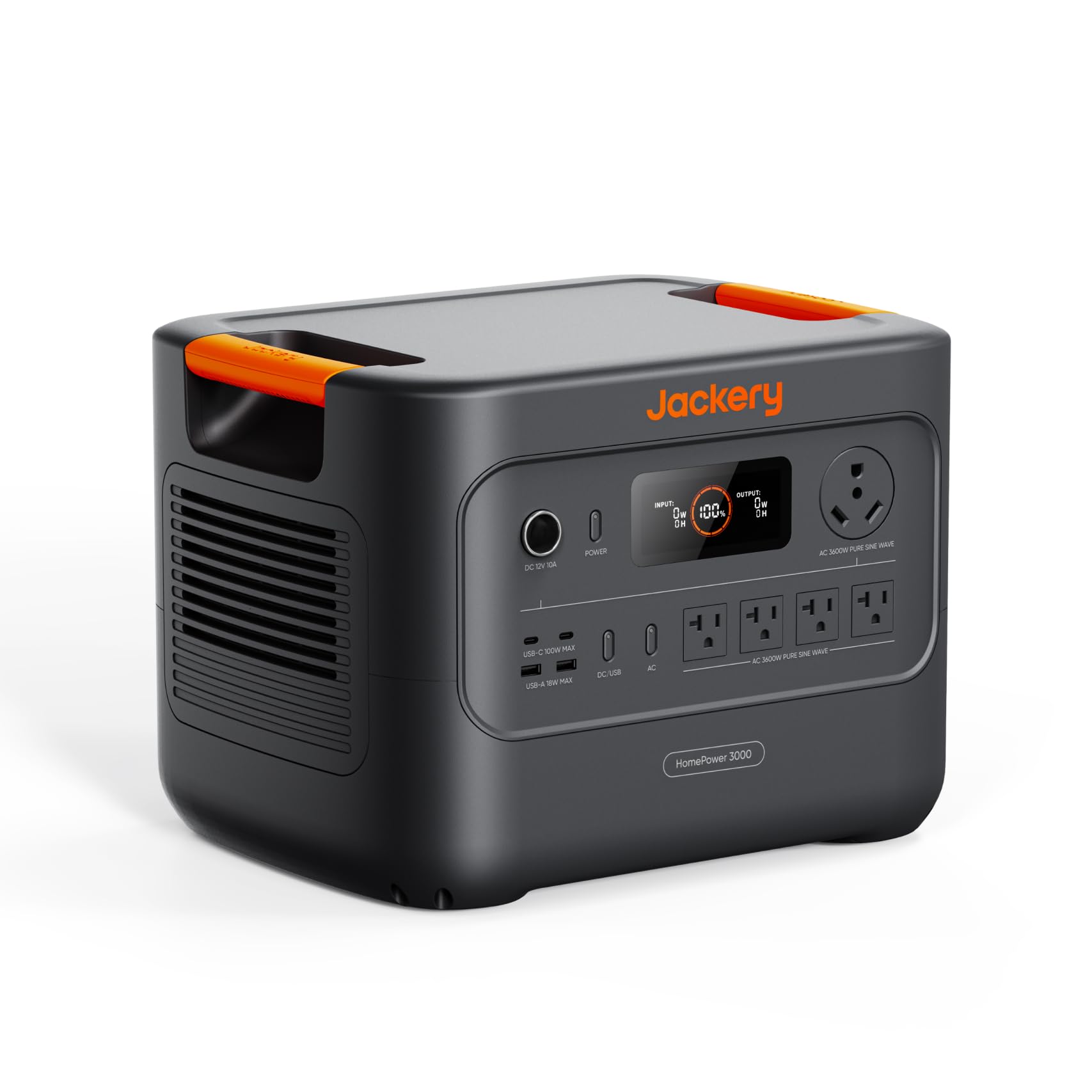
A 30-amp socket that lets your RV plug straight in, no adapter dance.
What separates the HomePower 3000 from every camping-oriented pick above is the 30A TT-30 RV port on the side — you plug a travel trailer in directly instead of daisy-chaining adapters. Combined with its 3,072Wh capacity and 3,600W output (7,200W surge), that makes it the go-to for trailer owners who want a wall-outlet experience off the grid. Jackery rates a modest household for up to 15 hours and a fridge for 1 to 2 days.
Charging is where Jackery’s ChargeShield 2.0 and its AI algorithms do the work — hybrid AC and DC fills it in 1.7 hours, or 2.2 hours on AC alone. The LiFePO4 cells are rated for 4,000 cycles while retaining 70% capacity. A ≤20ms UL-certified UPS keeps security cameras, routers and pet feeders running through the switch, and the dual 100W PD ports handle phones, tablets and drones fast.
The honest number here is 59.5 lb — this is a two-person move, and you’ll want to plan its home in advance. In extended outages, owners running a 30-amp travel trailer for three-plus days keep the propane fridge, furnace, water heater and a Keurig going; a smaller home office runs for days. One performance gap from a truck owner: it cut out below 15°F, so extreme-cold use needs a different plan.
The pattern to bet on: 30+ hours of refrigerator use and household power capacity for outages are the two things most owners write about — this is a box built for the morning after a storm, not for a camping trip.
Facing the weak point: at 60+ lb with side grips the HomePower 3000 is not portable in the “pick it up and carry it” sense, and one owner found it unhelpful below 15°F.
Jackery’s HomePower 3000 lands at 4.4 stars from around 230 ratings. Best if you have an RV, a large home with a multi-day outage risk, or an entire home office that needs to survive the morning. Budget for the two-person lifting if you’re moving it.
Buy it if: you’re running an RV or a large home through multi-day storms.
Pass if: the unit needs to be moved often — 59.5 lb is a two-person lift.
9. EF ECOFLOW Portable Power Station 3600Wh DELTA Pro, 120V 3600W AC Output
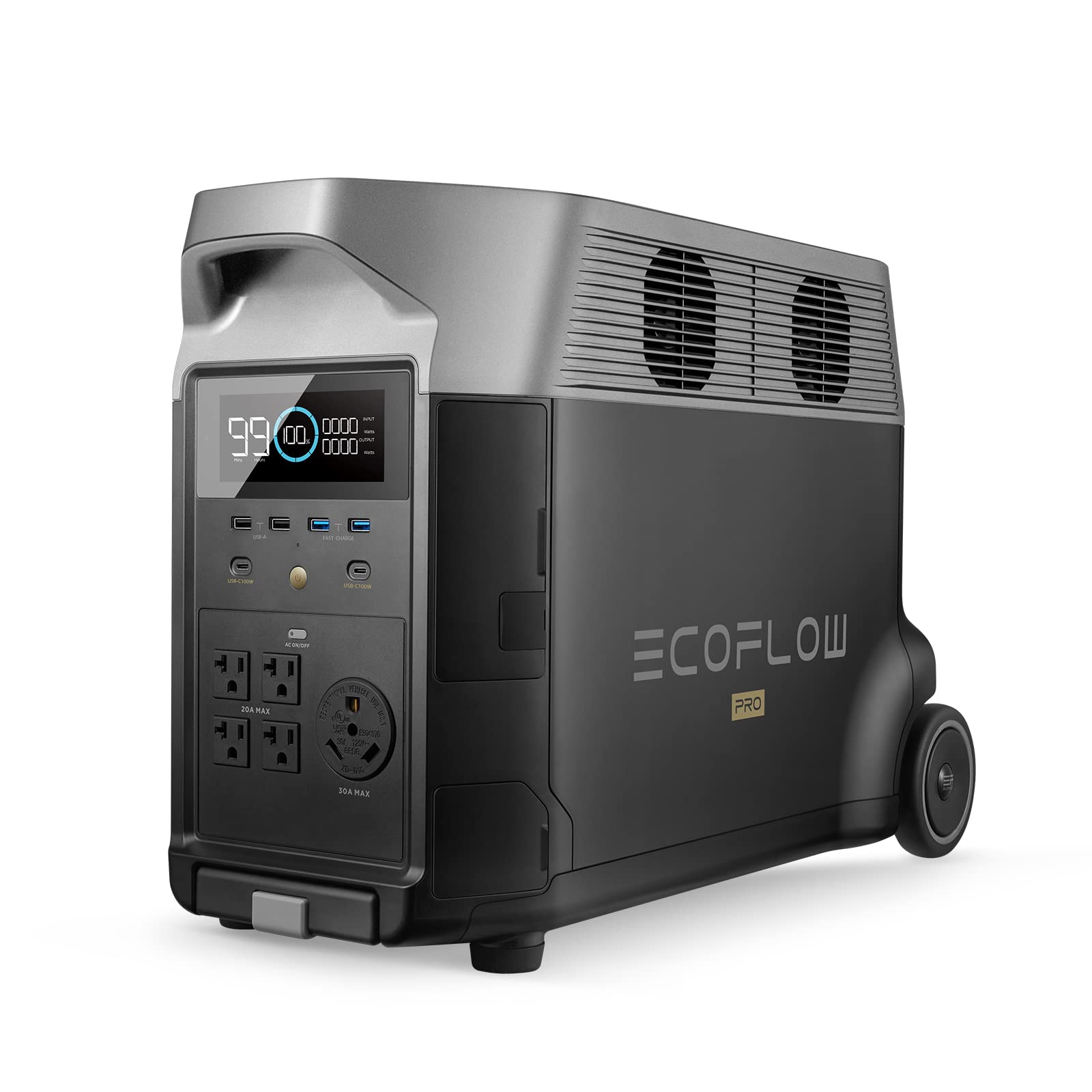
The 3.6kWh anchor that can grow to power an entire house.
The DELTA Pro isn’t a camping box — it’s a home battery that lives on a pallet. Its base capacity is 3600Wh, expandable all the way to 25kWh with extra batteries or smart generators, and its single-unit AC output is 3600W, rising to 4500W with X-Boost and 7200W when two units are paired. That last figure is what separates it from the Jackery HomePower 3000 (3600W single-unit, 7200W surge) — the DELTA Pro’s power scales further with each module you add.
Recharging is where EcoFlow’s X-Stream tech stands out: 1.8 hours from dead on 240V, 2.7 hours on standard 1800W wall outlets, or 2.8 hours with four 400W solar panels thanks to a 23% conversion efficiency. Fifteen output methods cover almost any appliance in the house, and the app monitors charge level, temperature and charge times over Wi-Fi or Bluetooth, with custom input/output controls.
What you trade for that headroom is pure bulk: 99 lb including the box means moving it is a two-person job, and the price tops the lineup. One owner also flagged the solar input cap of 15A as a bottleneck if you’re planning a big array, and the LiFePO4 chemistry that keeps it running for decades is part of why this is the heaviest and most expensive pick here.
When it shines: owners running whole-house tool setups, home offices through extended outages, and small mobile businesses running heat presses never quote flicker, only steady output — 3600W continuous holds up under heavy appliances.
One safety note worth repeating: one owner who connected the DELTA Pro to 110V household wiring advised turning off breakers first, to protect line workers and the unit itself.
ECOFLOW’s DELTA Pro sits at 4.6 stars from roughly 640 ratings. Best if you’re building toward whole-home backup and want a system you can expand instead of replace. Second thoughts if 99 lb and the top-of-list price make it more capacity than you need.
Best for: buyers building a home-battery setup that can grow one module at a time.
Second thoughts if: you want a station you can move by yourself, or your whole-home electrical work isn’t on your plan.
Understanding the Specs
Watt-Hours (Wh) and Rated Watts
Watt-hours measure the size of the tank; watts measure how fast it can pour. A 2,048Wh station running a 100W load lasts roughly 20 hours on paper — that’s the physics, no math required beyond dividing one by the other. Wattage ceilings matter for the appliances themselves: a fridge compressor might pull a 500W spike on start and settle to 100W running, so you need a unit rated for the peak, not the average.
LiFePO4 vs Lead-Acid UPS Batteries
LiFePO4 (lithium iron phosphate) is the chemistry to want in an outage battery — thousands of charge cycles, no memory effect, no yearly battery replacement. Lead-acid UPS units cost less and weigh more, and they typically need a fresh battery every two to three years. Own it five years or more and the lithium premium usually pays for itself.
FAQ
How many watt-hours do I need to run a fridge overnight?
What is UPS mode on a power station and who actually needs it?
Will a portable power station run a window or RV air conditioner?
Is LiFePO4 really worth paying more for than a lead-acid UPS?
Can I chain a power station into my home’s wiring during an outage?
How long does it take to recharge an outage battery from empty?
Can a power station be recharged with solar panels and how long does it take?
Should I run the AC output when the battery is just sitting there?
Can I run a CPAP machine or medical gear on a power station?
What is the difference between a UPS and a portable power station?
Final Thoughts: The Verdict
For most households, the backup battery for power outages winner is the Anker SOLIX C2000 Gen 2 because it holds a dual-door fridge for up to 32 hours, refills in 58 minutes on AC, and expands to 4kWh when one storm isn’t enough. If you want a light, cheap-to-own box for routers, phones and a small appliance, grab the GRECELL 500W. For pure desk protection on a gaming PC or network rack, the CyberPower CP1500PFCLCD is still the safest long-term bet. And if you’re planning a whole-home battery you can grow modularly, the EF ECOFLOW DELTA Pro is the one to reach for. Buy the capacity that matches the appliances you refuse to lose, and top it up every season.
How We Picked
We do not accept paid placement. Every pick is matched to a real buyer and a real use-case; we do not hands-on test units.
Sources & Methodology
Specifications: manufacturer listings and product documentation. Review insights: verified customer reviews, as of September 2026. Pricing: not shown on this page (it changes often); check the current price via the retailer link.
As an Amazon Associate, KitchPrep earns from qualifying purchases. This does not affect which products we feature.
Related Guides
