
Specs are compiled from manufacturer listings and verified buyer reviews and can change over time — please confirm the key details on the product page before buying.
You walk into the laundry room with an armload of clothes, and the light switch is somewhere behind you in the dark. An automatic motion sensor fixes that — it turns the lights on the moment you step in and off after you leave, so you never touch a switch again. The catch is that these switches are not one-size-fits-all: some need a neutral wire in your wall box, some work without one, and the wrong pick means a return trip to the store. This guide sorts the real differences so you can pick the right one the first time.
I’m Mohammad Maruf — the founder and writer behind KitchPrep. This guide is built by comparing the manufacturers’ published specifications and the patterns across verified customer reviews, so you get each pick’s real strengths and trade-offs instead of marketing spin.
Before you buy, the two things that decide everything are whether your wall box has a neutral wire and how much area you need covered. Here is what separates the best automatic motion sensor from the rest.
Our Picks at a Glance


How To Choose The Best Automatic Motion Sensor
An automatic motion sensor switch is a wall switch with a built-in sensor that watches for movement and controls the lights for you. To pick the right one for your home, check three things: what is inside your wall box, how big the room is, and if you want the lights to turn on by themselves or only turn off by themselves.
Check for a neutral wire first
The single most common reason a motion switch gets returned is a missing neutral wire. A neutral wire is the white wire in your wall box that carries current back to your breaker panel. Many older homes simply do not have one run to the switch location. Some switches here require it and some install using only the ground wire when no neutral is available. If you are not sure what is in your box, look before you order.
Occupancy mode vs vacancy mode
Occupancy mode turns the lights on automatically when you enter and off when you leave — fully hands-free. Vacancy mode makes you press the switch to turn the light on manually, then shuts it off on its own after you walk away. Occupancy mode is best for pantries, closets and laundry rooms where your hands are full. Vacancy mode suits rooms where you want deliberate control but still want the safety net of an automatic shutoff.
Match coverage to the room
A sensor’s field of view is the angle it can “see,” and its range is how far out it detects motion. A narrow field of view suits a closet or hallway; a wide one with long range suits a garage or an open basement. If you pick a sensor that is too wide for a small enclosed room, it can trigger from movement in the hallway outside.
Quick Comparison
| Model | Best For | Coverage | Neutral Wire | Current Rating | Amazon |
|---|---|---|---|---|---|
| Simple Motion Sensor Switch by Deako★ Best Overall | Deako-equipped homes | Not specified | Required | 600W max load | Amazon |
| ELEGRP Matte White Single PoleBest Value | Small rooms on a budget | 120° PIR coverage | Required | 5 A | Amazon |
| GE in-Wall Motion Sensing Light SwitchTop Performer | Large rooms, high load | 150° / up to 30ft | Required | 15 A | Amazon |
| Leviton DOS02-LW Motion Sensor | No-neutral retrofits | 180° / 900 sq. ft. | Optional | 2 A | Amazon |
| Lutron Maestro Motion Sensor Switch | Any-bulb compatibility | Not specified | Optional | 2 A | Amazon |
| ECOELER 4Pack in-Wall PIR | Multi-room value packs | 90° cone | Required | 6 A | Amazon |
| BESTTEN 5PK Motion Sensor | Whole-home retrofits | 180° adjustable | Required | 1/6 HP motor load | Amazon |
| Lutron Caseta Wireless Occupancy Sensor | Smart-home systems | 180° / up to 60 ft. | Not required | Not specified | Amazon |
| Leviton Decora ODS10-IDE | Commercial-grade spaces | 180° / 2,100 sq. ft. | Not required | 10 A | Amazon |
In‑Depth Reviews
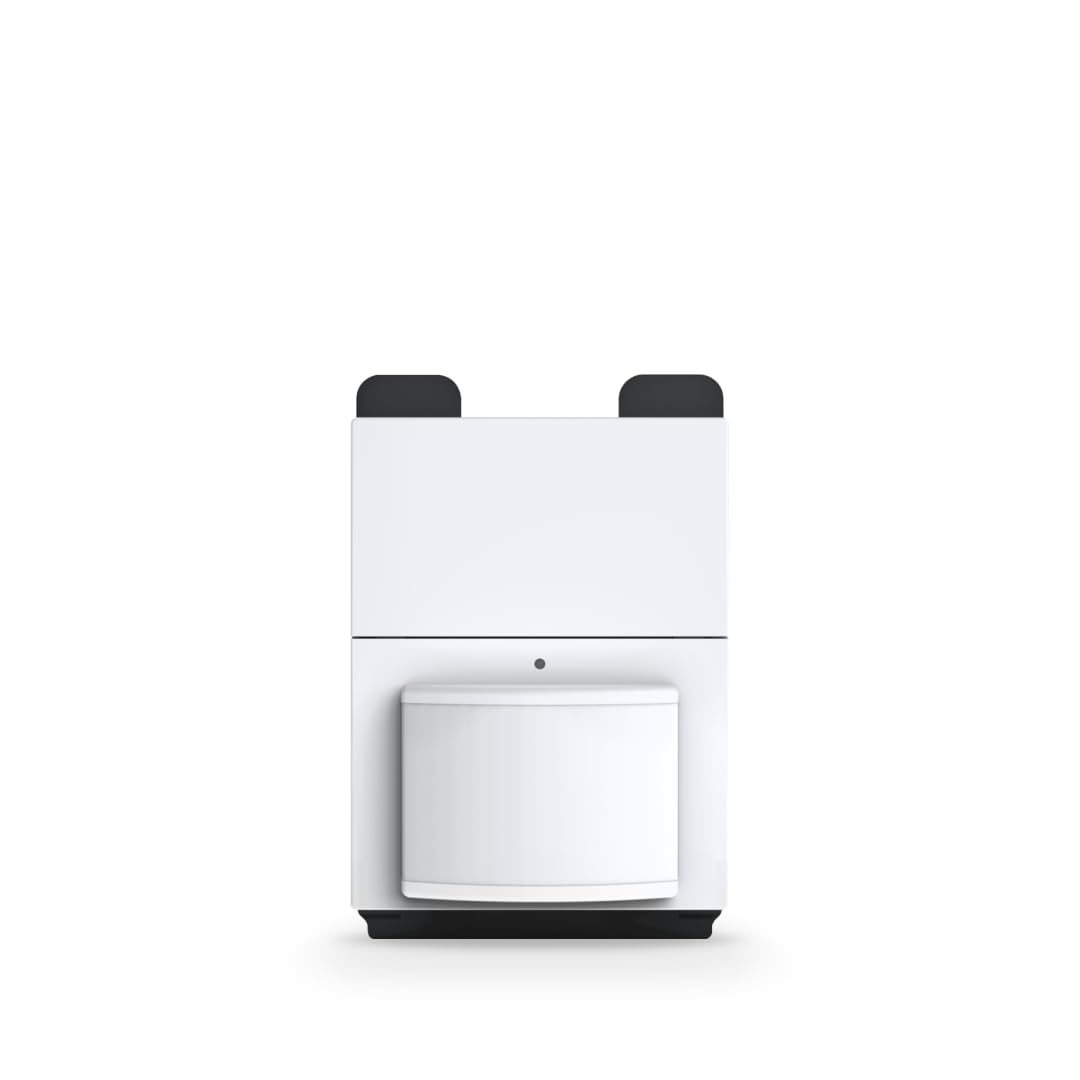
1. Simple Motion Sensor Switch by Deako, Automatic Timer, Occupancy and Vacancy Modes, Auto On and Off, Single Pole, Neutral Wire Required, White
Our pick — over 4.5★ from 450+ verified ratings; the strongest balance of quality and price.
The hands-free closet switch that slides into place in about two minutes.
The Deako Simple Motion Sensor Switch is built for one specific homeowner: someone who already has Deako switches on their walls. If that is you, installation is the closest thing to plugging in a lamp. It holds 4.7 stars across 460+ ratings, the highest score in this lineup.
For everyone else, this switch works on single-pole circuits only, meaning one switch controls the light, and it must connect to a Deako backplate with a neutral wire. It handles up to 600W LED/ELV/MLV and 600W incandescent/halogen, plus a 1/6 HP motor load, so a bathroom vent fan is fair game. The timer is what owners lean on daily: 30 seconds, 5 minutes, or 20 minutes after motion stops, with a physical button to override when you want the light right now.
This switch earns its keep with placement freedom. Owners use it for pantry trips with both arms full and walk-in closets in the dark. Deako designed the sensor to ignore pets. Deako’s motion sensing is immediate, and the switch fires instantly for garage lights the moment the door opens.
What wins people over
- Slides into an existing Deako backplate in about two minutes
- Three timer choices — 30 seconds, 5 or 20 minutes
- Pet-safe detection, so dogs and cats do not trigger lights
- 600W LED/ELV/MLV and 1/6 HP fan support
The honest catch
- Only works with a Deako backplate and neutral wire already in place
- Single-pole circuits only
- Buyers consistently describe it as expensive for what it is
Built for Deako homes: if your panel is already Deako, this is the easiest motion upgrade you will ever make.
skip it if: you are starting from a standard switch box — you would need the backplate and neutral first.
2. ELEGRP Matte White Single Pole Occupancy Motion Sensor Light Switch, Need Neutral Wire, 120° Sensor Coverage PIR Infrared Motion Activated, for CFL/LED/MLV/INC/HAL/Fan, UL,1 Pack
A sleek matte switch that runs the whole room for the price of a couple of bulbs.
What separates the ELEGRP from the pack is its universal load support: 200W LED/CFL, 500W MLV and 500W INC/HAL, plus 5A for ballast and a 1/6 HP fan on 120V. That means almost any fixture in your house can hang off it. The 120° PIR sensor covers a bathroom without dead zones, and owners describe the sensitivity as easy to dial in with simple dial adjustments under the switch.
The matte finish resists fingerprints, and the frameless design is genuinely nicer in person than a basic white switch. The thermoplastic housing shrugs off knocks and scratches, and the flame-resistant material carries a 5VA rating, the highest grade, with UL and CUL listing. Its standby draw is extremely low, so even in a closet that gets used twice a day, you are not wasting power keeping the sensor alive.
Here is the head-to-head that matters: the ELEGRP needs a neutral wire and caps at 5 A, while the GE above carries 15 A and covers up to 30ft. If you are switching a small or mid-size room, the ELEGRP is the better buy on every measure that counts, but for a garage outlet or a heavy load, the GE wins on capacity.
Where it shines
- 120° PIR sensor with easy dial sensitivity adjustment
- Handles 200W LED/CFL, 500W MLV, 500W INC/HAL, and a 1/6 HP fan
- 5VA flame-resistant housing, UL and CUL listed
- IP20 rated with an ultra-slim profile that fits tight boxes
Who it is not for
- Requires a neutral (white) wire in the box
- Single-pole only — no 3-way or multi-way circuits
- Caps at 5 A, less than the heavier-duty GE switch
Reach for this if: you want reliable auto-on lighting in a bathroom, pantry or closet without overspending.
Look elsewhere if: the box lacks a neutral wire or you are wiring a 3-way circuit.
3. GE in-Wall Motion Sensing Light Switch, Occupied & Vacant Modes, 30ft Range
The heavy-lifter for big garages, stairwells and corridors.
Coverage is where this one leaves most rivals behind: a 150° detection zone reaching up to 30ft, plus a 15 A current rating. The GE in-Wall Motion Sensing Switch is engineered for open, spread-out spaces — garages, basements, stairwells, laundry rooms — where a narrow sensor would leave dark corners. That 15 A rating is 3.0x the ELEGRP’s 5 A, which lets it drive heavier loads.
The GE runs two modes: Occupancy, where the sensor turns the lights on and off on its own, and Vacancy, where you tap the rocker on and the switch handles the off. The timer is adjustable up to 30 minutes after motion stops. Owners flag two practical details: the bottom stair sensor tends to pick a person up only a few steps away, and small dogs do not trip the detection. Neutral wire in the box is required.
Where this one earns honest caveats: the documented sensitivity adjustment has drawn mixed notes. Owners find it excellent in corridors and closets but a bit fiddly to tune for short, tucked-in spaces. Once dialed in, the pattern holds, and the package includes everything you need for a clean single-pole install.
Who it is for: the buyer who needs maximum coverage and a high current rating in an open room — a garage or long hallway.
Where it can be fussy: short, tight spaces like a small mudroom or stairwell bottom, where the sensitivity dial takes some patience.
The high-capacity pick: big-room coverage and 15 A load support make this the one to beat where reach matters.
Think twice if: you are fitting a narrow closet — the wide 150° zone may trigger from hallway traffic.
4. Leviton Motion Sensor Light Switch, Motion Activated, Auto-On/Auto-Off or Manual-On, 2A, No Neutral Wire Required, Single Pole, DOS02-LW, White
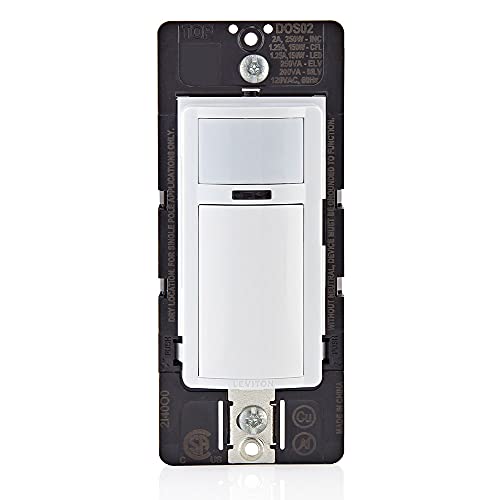
The retrofit-king switch for older homes without a neutral wire.
The defining spec here is flexibility: the Leviton DOS02-LW installs with or without a neutral wire, using the ground if no neutral is in the box. That one detail opens up a hundred older houses that other switches on this list simply cannot serve. It also throws a wide net — 180° field of view covering 900 sq. ft. — and carries 150W LED/CFL, 250W incandescent/halogen, 200VA magnetic low voltage, 250VA electronic low voltage and 2A resistive loads.
The install is slim enough to fit most wall boxes, though the faceplate is not included, so you will want to budget one if the old plate does not match. Programming takes a read of the instructions — owners describe the setup as a bit tricky the first time — but the payoff is a switch that comes on the instant you enter and turns off on an adjustable timer you set once and forget.
Where it fits in the lineup: the DOS02-LW covers 900 sq. ft. and hits 180°, versus the ELEGRP’s 120° slice. If you have been stuck choosing between a bulky 15 A switch and a no-neutral install, this Leviton is the compromise that works — it handles the LED bulbs most retrofits are running anyway.
Why it wins retrofits
- Installs with or without a neutral wire, ground required
- 180° field of view and 900 sq. ft. coverage
- Handles 150W LED/CFL, 250W INC/HAL and 2A resistive
- Vacancy (manual-on) setting available for deliberate control
Worth knowing
- Programming is not intuitive — read the instructions first
- Faceplate not included in the box
- Caps at 2 A, less than the GE or ELEGRP for heavy loads
Pick this for older wiring: if a neutral is missing from your box, this is your cleanest path to automatic lighting.
Only for small loads though: 2 A is comfortable for LED bulbs and small fans, but not for anything heavy.
5. Lutron Motion Sensor Switch & Wallplate, 2 Amp Single Pole, for Any Bulb
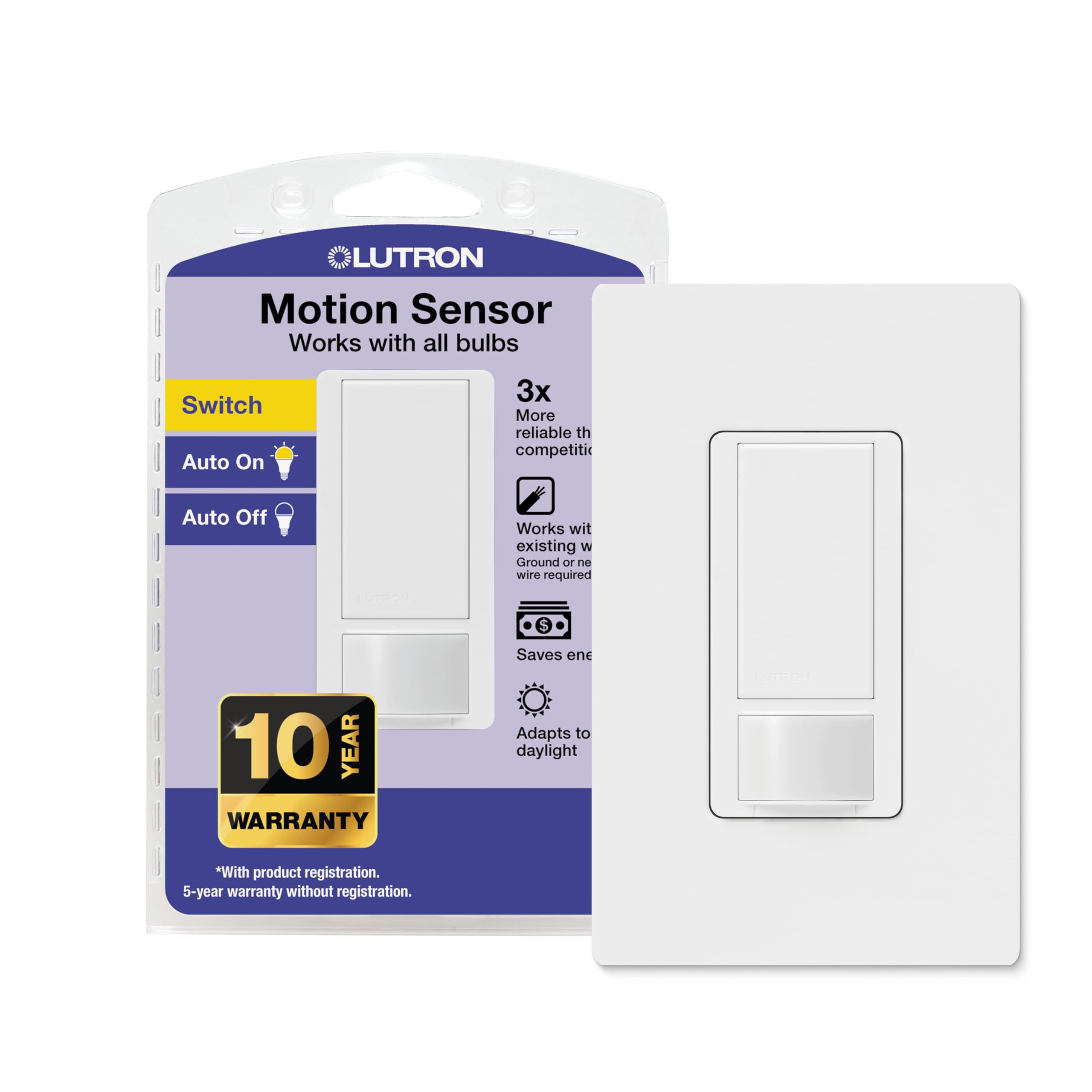
The one switch that plays nicely with LEDs, CFLs, halogen and ballasts alike.
The Lutron Maestro’s headline is bulletproof bulb compatibility. It works with 150W CFL/LED, 250W incandescent, halogen, electronic low voltage, 200W magnetic low voltage, and 2A ballasts — one spec that means you can drop it into any fixture without second-guessing. The ground wire is the only connection it needs when no neutral is present, and the wallplate comes in the box, saving a return trip.
The Maestro also brings a feature the others lack: an ambient light sensor that learns your preferred brightness over time, so the switch keeps the lights off during the day when the room is already bright. Occupancy mode runs auto on/off; Vacancy mode is manual on, auto off. Timeout options land at 1, 5, 15 or 30 minutes after you leave.
A 77-year-old self-described first-timer called the install “Easy Pesy” after watching a video. The Maestro’s sensitivity and responsive trigger make it the pick when hands are full and the room is dark. The trade-off to know: no screw terminals, just stranded leads plus wire nuts, so multi-gang retrofits take a bit longer, and the switch clicks audibly when it fires.
Why it stands apart: the ambient light sensor and any-bulb compatibility make this the least fussy automatic switch in the lineup.
Just one niggle: the audible click at activation is noticeable in a quiet bedroom, and the wire-nut style takes longer to fit in a crowded multi-gang box.
Best for any-bulb confidence: the Maestro’s broad compatibility and daylight sensing make it easy to pair with whatever fixture you already have.
Not the best fit for: a tight multi-gang panel you plan to rewire in one sitting — the stranded leads slow that job down.
6. ECOELER 4Pack in-Wall PIR Motion Sensor Light Switch, Single Pole Motion Activated Switch, On/Off Override, Neutral Wire Required, Vac & OCC Mode Available, Title 24, UL Certified
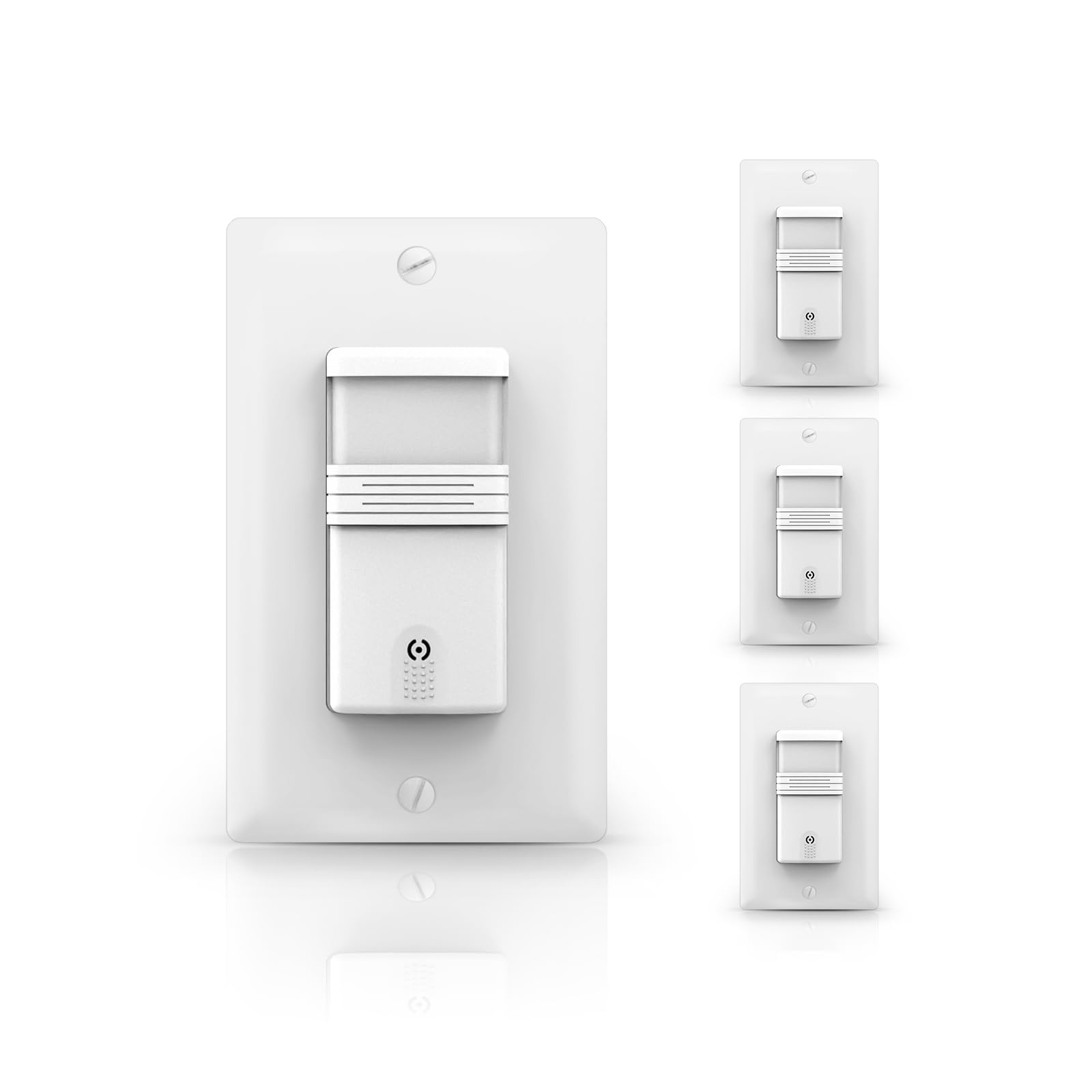
Four switches in one box for the buyer who wants every dark room covered at once.
One purchase covers four rooms here, which is why the ECOELER 4-pack is the value play for a whole-home retrofit. Each switch carries a 90° PIR sensor cone with adjustable sensitivity, light-level sensing and three time-delay dials tucked under the manual switch. Load support tops out at 300W LED, 300W CFL and 600W incandescent. Neutral wire is required, and it is UL certified, FCC listed and California Title 24 compliant.
In real homes, these go into the exact spots where the light is always being left on. The clearest win is the laundry-room and kids’-room case: with the occupancy sensor set, the lights stop staying on forever because nobody turned them off. Owners also note the sensor reliably retriggers — if motion continues, the timer restarts, so you do not get sudden blackouts.
The known area to watch: reliability. Most units work as expected, but the plastic housing is cheap-feeling, and a small share of buyers report a unit in the pack firing randomly with nothing in the room. The vacancy-mode setup can also be fiddly, with an undocumented pause before the switch re-arms. Test every switch as you install it, and any dead one will show itself immediately.
Why the 4-pack wins
- Four switches per pack covers multiple rooms in one go
- 300W LED/CFL, 600W INC, 6 A rating, 90° sensor cone
- UL certified, FCC listed and Title 24 compliant
- Adjustable time delay, sensitivity and light level via three dials
The trade-off
- Neutral wire required in every box
- Housing feels light on the plastic
- Vacancy mode has an undocumented re-arm delay that can confuse first-timers
Buy this to blanket a whole home: one 4-pack replaces the manual switch in pantry, closet, bathroom and laundry at the best per-room cost here.
Only if you have a neutral wire at every location: check each box before you commit to a four-switch upgrade.
7. BESTTEN 5PK Motion Sensor Light Switch, PIR Vacancy & Occupancy, UL Listed

Five switches, five wallplates and enough coverage to rewire an older home’s dark rooms.
If a whole-house swap is on your list, the BESTTEN 5-pack is the option to weigh. Five switches with matching wallplates include adjustable 180° PIR coverage, adjustable sensitivity, and five time settings from 15-second test mode up to 30 minutes. The load capacity is solid: 120V 300W LED, 800W incandescent, and 800W/120V rapid-start fluorescent, plus a 1/6 HP motor. It works on 120V or 277VAC at 60Hz and is UL listed.
The two modes give real flexibility: Occupancy for auto on/auto off, Vacancy for manual on/auto off via the same button. Owners who replaced older, non-sensing switches across the house describe the switch’s value in blunt terms — the same quality for less than what the big-box stores were asking, so they refreshed every bathroom, pantry and closet in one order.
Where to set expectations honestly: reliability is the concern. Some owners mention units working fine, while others describe a switch that works sometimes and not others. Its 197 ratings are fewer than several picks above. For a low-load job like a bathroom exhaust fan left running all day, or a hallway light nobody bothers to turn off, this pack does the job at a value price.
Where it fits: whole-home retrofits where you want to replace five manual switches in one purchase without going broke.
What to watch: reliability has drawn mixed feedback, so test each switch right after installation while you can still return the pack.
Best bulk coverage: five 180° switches with wallplates is the single strongest purchase for a full-house lighting upgrade.
Prefer individual picks instead if: you only need one or two switches and want the widest review base behind your decision.
8. Lutron Caseta Smart Lighting Auto On/Off Wireless Occupancy Motion Sensor

No wires at all — a battery sensor that talks to your Caseta system for a decade.
This is the only pick here that installs with zero wiring. The Lutron Caseta Wireless Occupancy Sensor runs on a lithium battery rated for 10-year typical life and sits freestanding or mounts to a wall or corner. It detects fine motion 3X better than other sensors and covers a 180° field of view. One sensor can turn off any number of Caseta switches, dimmers, fan controls and Serena shades within 60 ft.
What makes it a system piece rather than a switch: the Caseta Smart Hub is required, and the Lutron app open up the Active Hours feature, letting you pick exactly which lights the sensor manages and when they respond. For a garage, laundry room or hallway where you do not want to touch wiring, that setup is the point.
The honest limits: performance and customizability draw mixed notes. Some owners call it flawless; a few can’t build the exact automation they imagined, and the hardware settings beyond the app are limited. This sensor earns its keep where you want motion sensing without a switch, and where the rest of your house runs on Caseta anyway.
Why it steps up
- No wiring — freestanding or wall/corner mount
- 10-year typical battery life on a lithium cell
- Detects fine motion 3X better than other sensors, 180° view
- Controls any number of Caseta devices within 60 ft.
What it asks in return
- Requires the Caseta Smart Hub (not included)
- App controls, not the sensor itself, decide which lights fire
- Battery is lithium, so disposal and replacement need a moment’s care
For Caseta owners: if your house already runs on a Caseta hub, this sensor is the cleanest way to add motion without pulling a single wire.
Skip if: you want a standalone switch that lights a fixture by itself — this sensor only manages lights your Caseta system already controls.
9. Leviton Decora 120/277-Volt Wall Switch Occupancy Sensor, ODS10-IDE, Black
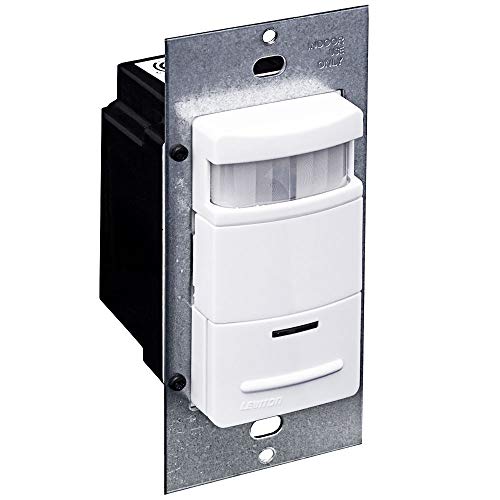
The commercial-grade sensor built to cover a room the size of a small store.
Coverage here is a different class entirely. The Leviton Decora ODS10-IDE throws a 180° field of view across approximately 2,100 sq. ft., and its segmented Fresnel lens keeps sensitivity sharp at the edges. The horizontal field adjusts between a full 180 degrees and a narrow 32-degree arc, so you can aim it away from a doorway where someone keeps walking past. It runs on 120V or 277V and carries a 10 A current rating.
This is a commercial-grade switch: single-pole circuits, push-button manual on/off at any time, and an ambient light override that blocks activation when the room is already bright enough. It works with standard loads — light bulbs, motors, small appliances — and passes neutrally through modern electronic ballast fluorescents, which matters when you are lighting a workshop or commercial space.
Two things buyers should know. First, the physical build quality sits above the average switch here, and the sizing needs match: this is a switch for spaces where coverage area actually matters, not a tight closet. Second, the switch ships in white per the spec, so if you are matching a black plate and want a true black face, confirm before ordering. Where a home installer wants one switch for a wide workshop or deep basement, this is the one to beat on sheer reach.
Why it commands the price: 2,100 sq. ft. of coverage and a 32° to 180° adjustable arc give you control no consumer switch here matches.
Fit-check before ordering: it ships in white, not black as the listing title suggests, so verify the color you actually receive.
Right for big spaces: a warehouse-scale 180° sensor with an ambient light override covers a workshop or commercial room the household switches cannot reach.
Overkill for a closet: 2,100 sq. ft. of coverage and a 10 A rating are far more than any small residential room needs — pick a compact switch instead.
Understanding the Specs
Neutral Wire Requirement
A neutral wire (the white wire) carries current back to your panel; some switches need it in the box, others install using only the ground wire. Check your wall box before ordering — it is the single most common reason a motion switch gets returned.
Sensor Coverage and Field of View
Field of view is the angle the sensor can “see” in degrees, and range is how far it detects. Narrow fields (around 90°) suit closets; wide fields (180°) suit garages and open rooms where a person may be off to the side.
Current and Load Ratings
The amperage or wattage rating is how much the switch can carry. Lighting loads vary, so verify the switch handles your bulb type — LED, CFL, incandescent, halogen or ballast — before you install it.
Time Delay and Light-Level Sensing
The time delay sets how long the light stays on after motion stops, from about 30 seconds up to 30 minutes. Some switches also sense daylight and keep the lights off when the room is already bright enough.
FAQ
Will an automatic motion sensor switch work without a neutral wire?
What is the difference between occupancy mode and vacancy mode?
Can an automatic motion sensor light switch work in a 3-way circuit?
How long should the time delay be set after motion stops?
Will my pets trigger the motion sensor while I am not in the room?
Can a motion sensor switch turn on a bathroom exhaust fan?
Why does my motion sensor light flicker or stay on unpredictably?
Do I need to install a wall plate with my motion sensor switch?
Can a motion sensor switch distinguish daylight from darkness?
How much load can these switches handle before I need to step up?
Final Thoughts: The Verdict
For most homes, the automatic motion sensor winner is the Deako Simple Motion Sensor Switch, because its 2-minute install, pet-safe sensing and 4.7-star track record make it the surest bet if your walls already carry Deako hardware. If you want a switch that installs without a neutral and pairs with any bulb, grab the Lutron Maestro Motion Sensor Switch. And when a whole-house swap is the goal, the ECOELER 4-pack puts four automatic switches in every dark room at once. Any of these three is an honest, well-earned pick — reach for whichever matches the box and the bulbs you already have.
How We Picked
We do not accept paid placement. Every pick is matched to a real buyer and a real use-case; we do not hands-on test units.
Sources & Methodology
Specifications: manufacturer listings and product documentation. Review insights: verified customer reviews, as of September 2026. Pricing: not shown on this page (it changes often); check the current price via the retailer link.
As an Amazon Associate, KitchPrep earns from qualifying purchases. This does not affect which products we feature.
Related Guides
