
Specs are compiled from manufacturer listings and verified buyer reviews and can change over time — please confirm the key details on the product page before buying.
You want one machine that cools your space in July and warms it in January. Here is the quick answer: a 15,000 BTU heat-pump unit (a unit that runs in reverse to heat as well as cool) is the right size for a single large room, an RV coach, or a hotel-style wall sleeve — and the six picks below all do both jobs. Heat mode is the part most buyers get wrong, so every unit here has a real heating function, not a cooling-only box.
I’m Mohammad Maruf — the founder and writer behind KitchPrep. This guide is built by comparing the manufacturers’ published specifications and the patterns across verified customer reviews, so you get each pick’s real strengths and trade-offs instead of marketing spin.
Before you buy, you need to know whether your space needs a rooftop RV unit, a wall-sleeve PTAC, or a full mini-split system, because the wrong form factor will not fit no matter how good the specs look. The picks below cover every install type in the 15000 btu air conditioner with heat class: rooftop RV, wall-sleeve PTAC, and mini-split.
Our Picks at a Glance

How To Choose The Best 15000 BTU Air Conditioner With Heat
The heating half of the machine is where the real decisions live, because cooling at this size is rarely the problem. What separates a great unit from a frustrating one is how it makes heat, how much power it draws, and whether it physically drops into your wall, roof, or room.
Figure out which form factor your space actually needs
A rooftop RV unit replaces an existing roof vent, while a PTAC slides into a 42-inch by 16-inch wall sleeve — the standard opening in hotels, motels, and older apartments. A mini-split hangs on an interior wall and runs refrigerant lines to an outdoor condenser, which means visible hardware but the quietest indoor operation. If you own an RV or camper, only a rooftop model from this list will work for you. If you have a wall sleeve already cut, a PTAC is the drop-in replacement.
Understand how each machine makes heat
A heat pump moves warmth from outside air into your room using the refrigeration cycle — that is efficient, but output falls as outdoor temperatures plunge. A resistance electric heater, usually rated in kilowatts like 3.5 kW, works more like a space heater and keeps producing heat even when the air outside is well below freezing. Many PTAC units combine both: a heat pump for mild days and an electric backup for the really cold ones. The RV and mini-split picks here rely on heat-pump operation, so factor in how cold your winters actually get.
Match BTU to room size, then match power to your wiring
For a large single room, a studio, or a full RV coach, 15,000 BTU is the balance, and the units here cover spaces ranging from 172 square feet up to 835 square feet depending on insulation and climate. The more important number is your power supply. Big PTAC units (packaged terminal air conditioners, the through-the-wall kind used in hotels) need a 208-230V circuit with a 20A plug, RV rooftops want 115V or 110-120V service, and mini-splits use 208-230V with a dedicated breaker. Check your receptacle before ordering anything — a plug that does not fit your wall turns a great unit into a return.
Quick Comparison
| Model | Best For | Mount Type | Noise Level | Heating Type | Amazon |
|---|---|---|---|---|---|
| RecPro RV 15K Quiet AC Heat Pump★ Best Overall | RV and camper owners | RV Rooftop | 55.4 dB | Built-in heat pump | Amazon |
| TURBRO RV Air Conditioner 15,000 BTUBest Value | Budget RV cooling and heat | Rooftop | 52 dB | 1,500W electric heat | Amazon |
| Cooper & Hunter 15,000 BTU PTAC | Hotel and apartment replacement | Packaged Terminal | — | 3.5 kW electric heater | Amazon |
| Klimaire 15,000 BTU PTAC Heat Pump | Commercial and multi-unit use | Stand Alone | — | Heat pump + 3.5 kW electric | Amazon |
| VEVOR RV Air Conditioner 15000 BTU | Budget ducted RV install | Rooftop | — | 10,236 BTU heat pump | Amazon |
| Senville AURA Mini Split 15000 BTU | Quietest year-round comfort | Mini-Split | — | Heat pump to -22°F | Amazon |
In‑Depth Reviews
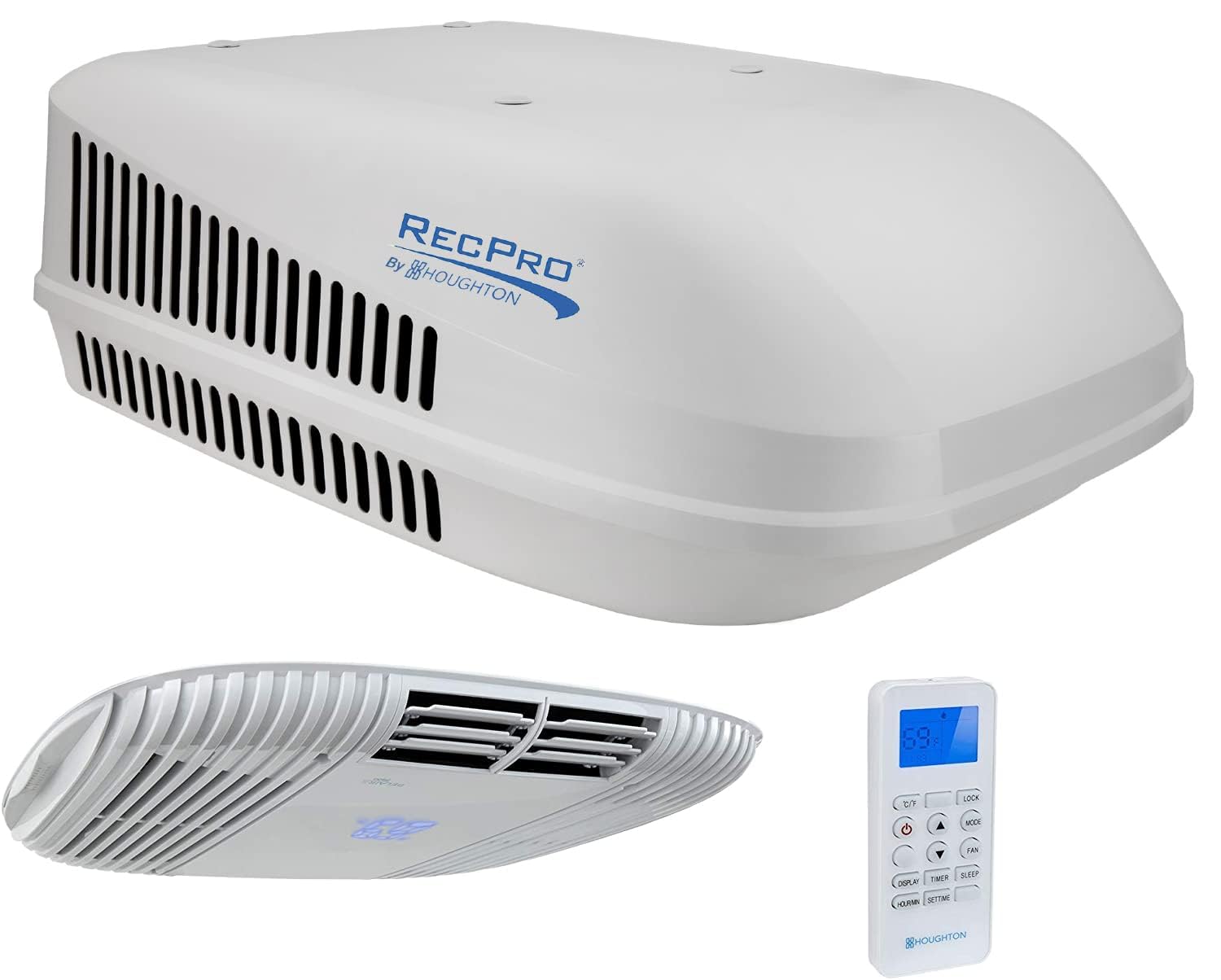
1. RecPro RV 15K Quiet AC Heat Pump Non-Ducted White 110-120V
Our pick — 4.5★ from 300+ verified ratings; the strongest balance of quality and price.
The rooftop unit that keeps your RV cool and warm without waking you up at 3 a.m.
RV owners get one roof opening, so the unit has to earn its spot. This RecPro drops into a standard 14×14 vent opening and runs at 55.4 dB — close to the sound of steady rain, which means you can actually sleep under it. It cools and heats through a built-in heat pump, so chilly evenings are handled without a separate heater taking up floor space.
Reliability is the single most-praised trait in owner feedback on this unit. Owners compare the piping to the Dometic units they replaced, noting the condenser and evaporator use separate fans for less vibration and stronger airflow. It draws a low amp load, which matters if you run a generator or solar setup and want to power other appliances at the same time.
Running it is simple: a wireless remote plus a ceiling touch display, with cool, dry, fan, sleep, and timer modes, and no thermostat wiring to run. For a 36-foot coach in 90-degree heat, buyers report it holds comfortable temperatures without strain. The honest catch is weight and the roof fit — this is roughly a 100-pound unit that needs two people to lift onto the roof, and some roofs are thick enough that the mounting bolts run short and need extensions. The included manual is also thin on detail. Both are manageable with a second set of hands and longer bolts.
Why RV owners keep this one
- Runs at 55.4 dB, quieter than most rooftop units at this size
- Heat pump handles cool evenings without a second appliance
- Fits standard 14×14 roof openings with no thermostat wiring
- Low amp draw plays well with generators and solar setups
What to plan around
- Roughly 100 pounds — plan for two people to roof-mount it
- Thick roofs may need longer bolts than the kit provides
- Some units arrive with minor cosmetic shell cracks
- The printed manual leaves gaps in the install steps
Best if you: tow a camper or fifth wheel and want one rooftop unit that cools and warms without a separate heater.
Think twice if: you are installing solo on a thick roof — this job wants a second set of hands.
2. TURBRO RV Air Conditioner 15,000 BTU with 1,500W Heat 115V AC
The camper unit that cools a hot rig fast and adds app control on a budget.
If you want the lowest entry point into a rooftop RV unit that also heats, this is where the value sits. It puts out 15,000 BTU of cooling and a 1,500W electric heater for fast warmth, with a 9.6 EER rating and an annual consumption figure of 4,905.6 kWh. At 52 dB it runs a touch quieter than the RecPro above at 55.4 dB, which is a real edge on paper — though sound quality and installation both affect what you actually hear.
Setup is the standout here: owners describe getting it mounted and running in about 30 minutes, and it does not require a 12V wire in many installs, which saves a wiring chore. The controls are modern — remote plus a smart app, plus a ceiling lamp that shifts between blue, yellow, and white. Recessed side handles make it easier to lift into place, and it fits the standard 14.25 x 14.25-inch roof opening with a recommended ceiling thickness of 1.02 to 3.93 inches.
Here is the honest part, and it matters more on this pick than the others. Airflow and cooling performance both draw mixed feedback — some owners cool a 32-foot camper within an hour even after it sat in 100-degree-plus heat, and as owners put it, it is “very good for the money.” But others find the airflow weak and the vents fixed, so you cannot aim where the air goes. One buyer also noted the control lights are bright enough to disrupt sleep with no way to dim them. This is a strong budget buy for a smaller rig in a mild-to-warm climate, not a unit to trust for serious heating below 40°F.
The 30-minute install: owners consistently report a fast, simple mount with no 12V wiring needed — a genuine time-saver for a rooftop job.
The cold-weather caveat: the 1,500W heat is meant for mild chills; sub-40°F heating is where this unit falls short of the PTAC picks here.
Right call if: you want app control, a quiet 52 dB rooftop unit, and easy installation without spending big.
Pass if: you need directional vents or dependable heat in freezing temperatures.
3. Cooper & Hunter 15,000 BTU PTAC with Heating & Wireless Smart Kit

The wall-sleeve workhorse built for hotel rooms, dorms, and rental units.
This is a different animal from the RV units, and the difference is the heat. Instead of a heat pump alone, it pairs a compressor with a 3.5 kW electric heater, so it keeps making warmth when the outdoor air is well below freezing. A PTAC — a packaged terminal air conditioner — slides into a wall sleeve, which is why it belongs in apartments, hotel rooms, and dorms. The listed layout here is 21 by 42 by 16 inches, and it runs on 208/230V with a 20A plug that includes a reset breaker.
The cooling side is where owners are happiest. One buyer replaced 26-year-old lobby units and came back to order two more, and the general read is that it cools a room quickly and quietly. A 1940s house owner dropped it straight into an old wall sleeve from a different brand and had it running the same day. The smart kit and remote add app control, and the LED panel plus digital buttons cover anyone who would rather not touch a phone.
Two things to weigh before you commit. First, it does not include the wall sleeve and exterior grille, so a brand-new install needs those parts bought separately. Second, the front cover is the weak point — units routinely arrive with cracks from freight shipping, and the durability record overall is mixed. The smart app is basic too, with no fine energy-usage tracking. This is the sensible replacement unit for a space that already has a sleeve, not a first-time installation project.
Who it suits: property owners and landlords who need a straight swap into an existing 42 by 16-inch wall sleeve.
Who should look elsewhere: a first-time wall install, since the sleeve and grille are sold separately.
4. Klimaire 15,000 BTU PTAC Heat Pump A/C 3.5kW | 20 A

The dual-fuel PTAC that leans on its heat pump first and electric heat when it must.
For a commercial space or a multi-unit building, efficiency drives the math, and this is the most efficient PTAC in the group. It carries an EER of 10.6, which is a measure of how much cooling you get per watt of electricity — a higher number means lower running cost. Listed capacities run 14,700/14,500 BTU/h for cooling and 13,500/13,200 BTU/h when the heat pump is working, with an auxiliary 3.5 kW electric heater as backup. It uses R-32 refrigerant and runs on 208-230V single-phase with a 20A 3-prong plug.
The install convenience is real: it is built to fit most standard 42 by 16-inch slide-in wall sleeves, so it can replace other major brands without cutting new openings. A 900-square-foot house owner runs it with no issues and reports the remote works reliably and the filters are easy to pull and wash. It also supports a 24V wall thermostat if you want scheduled control, and the display switches between Celsius and Fahrenheit.
What you should plan for is bulk. Owners rate this as a two-person job because the unit is heavy, and hiring a handyman is a common route. Quality is the trait that divides opinion most, so treat this as a solid performer backed by a track record that is genuinely mixed — one owner had a unit fail within seven months and hit warranty friction, which is worth knowing before you rely on it commercially. Buy it for the efficiency and the drop-in fit; verify the warranty registration the day it arrives.
Where it wins
- EER 10.6 — the highest efficiency rating among the PTAC picks here
- Heat pump plus 3.5 kW electric heat for cold-weather backup
- Fits most standard 42 by 16-inch wall sleeves as a replacement
- Washable polypropylene filter and optional 24V thermostat hookup
Where it asks more
- Heavy enough that two people are needed to install it
- New installs still need a wall sleeve and rear grille
- Warranty support draws mixed reports — register early
- Not Energy Star rated
The fit: hotels, nursing homes, workshops, and multi-unit buildings where a higher EER pays off over years of running.
The mismatch: a DIY single-room buyer who wants something light enough to handle alone.
5. VEVOR RV Air Conditioner, 15000 BTU, 120V Ducted Rooftop with Heat Pump
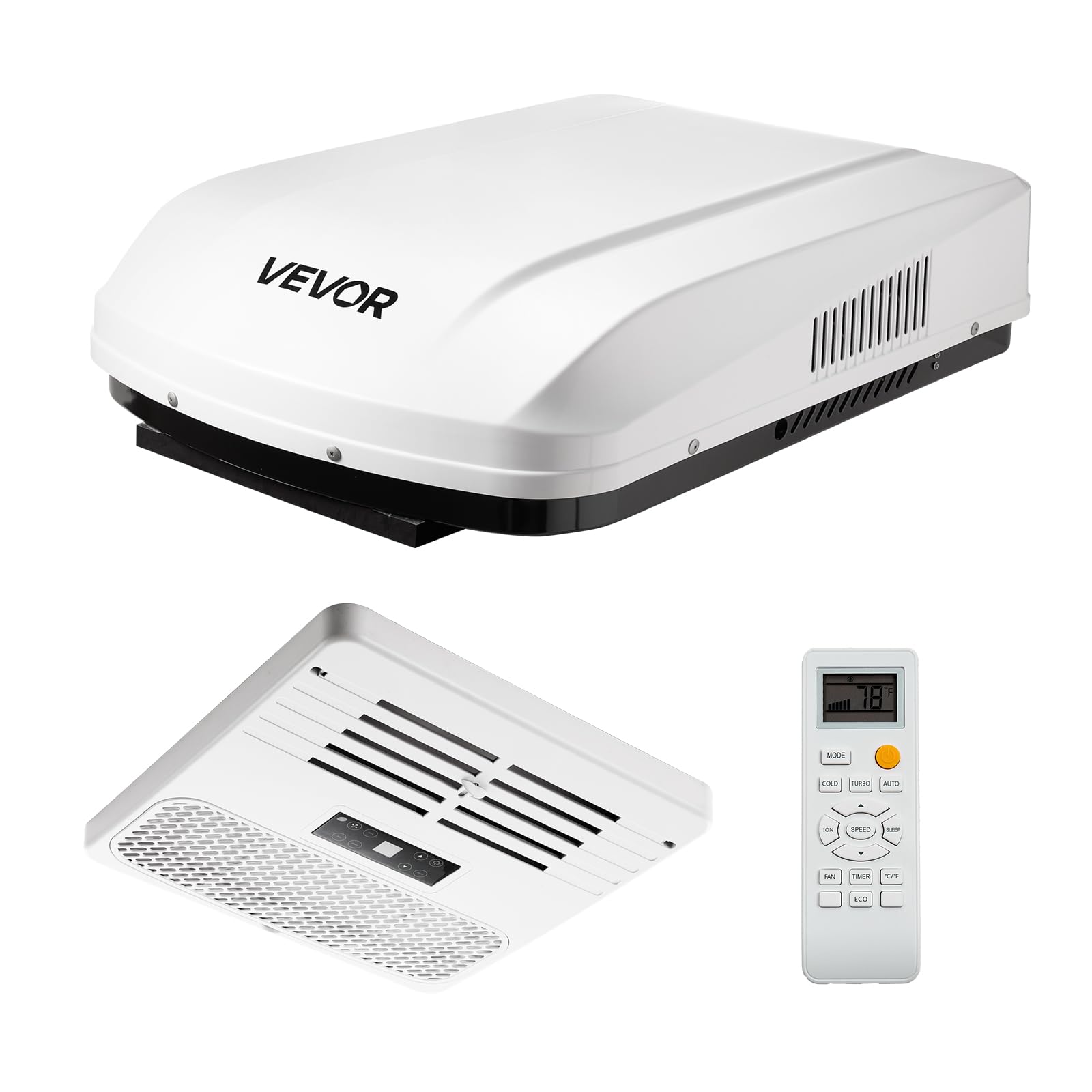
A ducted rooftop unit that pushes air through ceiling vents instead of one blast point.
Ducted is the feature to understand here. Unlike the non-ducted RecPro and TURBRO above, this VEVOR connects to your RV’s ceiling ductwork and spreads air through multiple vents, which keeps one end of the coach from turning into an icebox while the other stays warm. It delivers 15,000 BTU of cooling and 10,236 BTU of heat-pump heating, fits a standard 14 1/4 x 14 1/4-inch roof opening, and sits just 10.6 inches tall to cut wind resistance. The variable-speed compressor is meant to hold temperatures steady while wearing less over time.
Controls cover remote and button panel, with Auto, Ion, Eco, and Dry modes plus Timer and Sleep functions. The coverage rating is 172.2 square feet, so this is a fit for a smaller RV rather than the largest coach in the park.
This is the pick where you should read carefully before ordering, because the reliability record is the weakest in the group. Several units arrived dead from the start or threw error codes and quit shortly after mounting, and the instructions draw consistent criticism for being thin and missing a junction box. When it works, it works well — one owner found it cools extremely well and even holds several degrees below the set temperature. But those failures are frequent enough that this is best for a buyer who is comfortable troubleshooting, or who wants the low-profile ducted design specifically and will test the unit the day it lands.
The ducted advantage: air reaches multiple ceiling vents, so temperature stays even across the rig — the clearest reason to choose this over a non-ducted unit.
The reliability watch: dead-on-arrival units and error codes appear too often in the feedback to ignore, so inspect and test immediately.
Choose it if: your RV is already set up for ducted airflow and you want the slim 10.6-inch low-profile shroud.
Skip if: you want the set-and-forget reliability of the top pick without any risk of a bad unit.
6. Senville AURA Mini Split Air Conditioner, Heat Pump, White, 15000 BTU
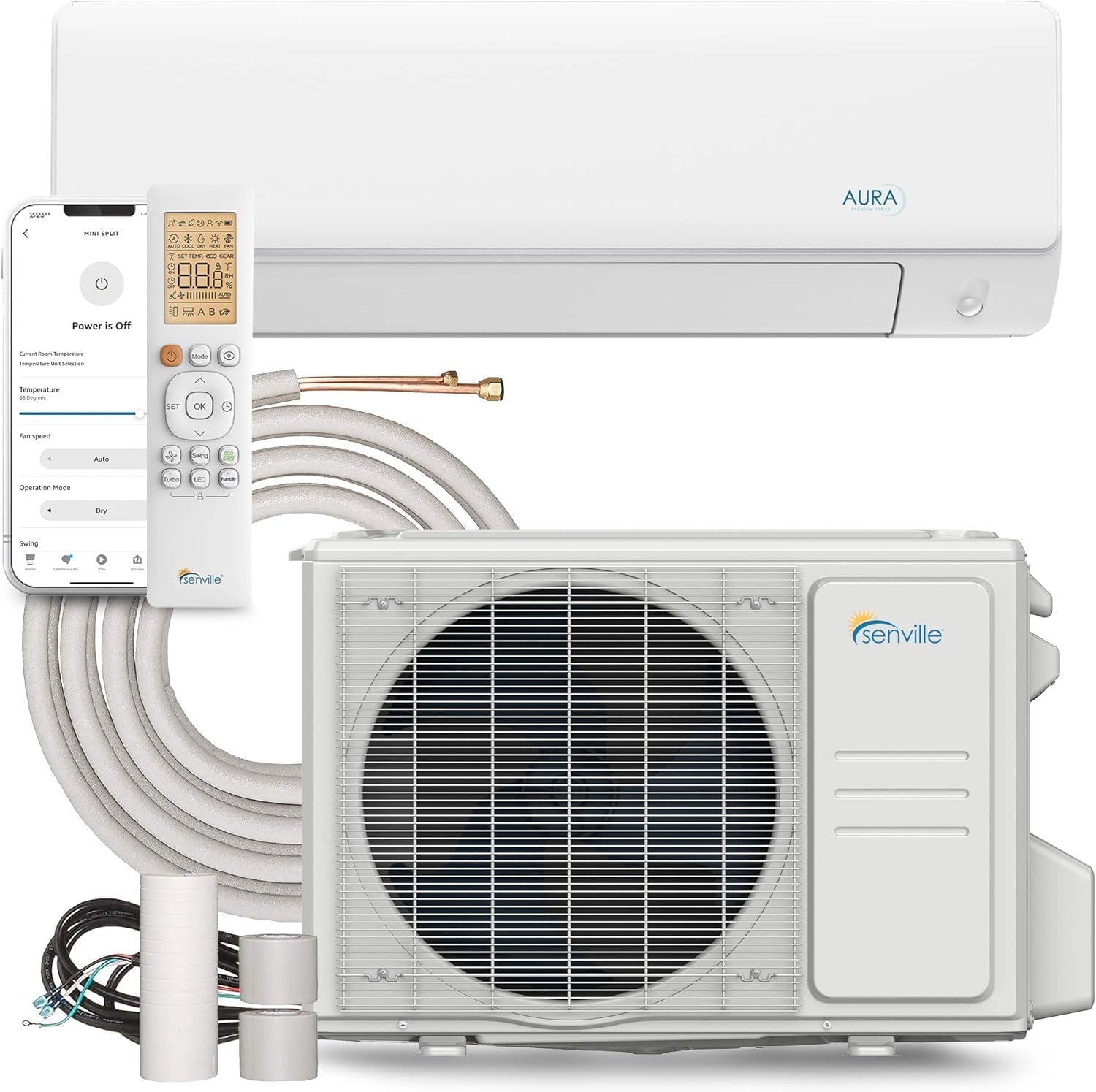
The indoor unit that hums through winter down to -22°F and barely makes a sound.
If quiet and cold-weather heat are your priorities, a mini-split beats every rooftop and PTAC here, and this is the strongest of the bunch. It runs DC Inverter technology on 208-230V and is rated to keep heating in conditions as low as -22°F/-30°C, backed by AHRI certification. It is Energy Star certified with a 4 Star BEE rating and an annual consumption figure of 1,375 kWh, which is the lowest in this roundup by a wide margin. An indoor air handler pairs with an outdoor condenser and a 16-foot line set for installation.
Control is the most flexible option on the list — voice through Alexa, the app, or the remote, with Turbo Mode, Sleep Mode, and Auto Restart. Owners call the AURA series quiet, efficient, and powerful, and the handler and condenser both run quietly enough that one buyer uses it year-round in a garage setup through cold Kansas winters. The build quality and instruction manual earn praise too, with one installer noting they were thorough enough for a confident self-install.
Two things to go in with your eyes open. This is not a DIY unit — plan for professional installation, and budget accordingly. The app setup has one quirk that trips people up: there are two different adapters, one for Alexa and one for the native Senville app, and telling them apart can take time. Owners also note that checking for shipping damage the day it arrives is smart. Set those aside, and it is the quietest, most efficient way to heat and cool a room.
Best if: you want near-silent operation, the lowest running cost here, and heating that works in real winter cold.
Not for you if: you plan a weekend DIY install — this system needs a professional.
Understanding the Specs
BTU and What It Covers
BTU, short for British thermal unit, measures how much heat a unit can move. A higher number means more cooling (or heating) power. At 15,000 BTU, you are looking at a large single room, a studio, or a full RV coach. The picks here cover anywhere from 172 square feet up to 835 square feet depending on insulation and climate, so match the unit’s listed floor area to your actual space rather than guessing.
Heat Pump vs Electric Heater
A heat pump moves warmth from outdoor air into your room, which is efficient but loses power as it gets colder. An electric heater rated in kilowatts (like a 3.5 kW unit) works more like a space heater and keeps producing heat even in deep cold. Many PTAC units use both — a heat pump for mild days and an electric backup for the worst of winter.
EER and Running Cost
EER measures cooling output per watt of electricity, so a higher number means cheaper operation. The Klimaire here rates at 10.6, while the TURBRO list a 9.6 EER. Both are decent figures for this size class, and the difference shows up over a full summer of use.
Power and Plug Types
Voltage and plug shape decide whether a unit can even plug in. The PTAC picks run on 208-230V single-phase with a 20A plug, RV rooftops want 115V or 110-120V service, and mini-splits need 208-230V with a dedicated circuit. Check your receptacle before ordering — a plug that does not fit is the most common reason for a return in this category.
FAQ
What size room does a 15000 BTU air conditioner with heat actually cool?
Will a heat-pump unit keep working in freezing weather?
What is the difference between a PTAC and a mini split?
Can I install a 15000 BTU RV rooftop unit by myself?
What plug does a 15000 BTU PTAC need?
Do these units need a wall sleeve or roof opening?
How loud are these units compared to a normal conversation?
Is a higher EER rating worth paying more for?
Which unit is best for heating a room in a cold climate?
Do I need professional installation for a mini-split?
Final Thoughts: The Verdict
For most buyers, the 15000 btu air conditioner with heat winner is the RecPro RV 15K Quiet AC Heat Pump: it cools and heats at 55.4 dB, fits the standard 14×14 roof opening, and holds the strongest feedback record in this group. If you want app control and the easiest install on a tighter budget, the TURBRO RV unit is the pick. And for the quietest, most efficient year-round comfort with heating down to -22°F, the Senville AURA mini split is the one to reach for. Whichever you choose, check your plug type and mounting opening before you order.
How We Picked
We do not accept paid placement. Every pick is matched to a real buyer and a real use-case; we do not hands-on test units.
Sources & Methodology
Specifications: manufacturer listings and product documentation. Review insights: verified customer reviews, as of September 2026. Pricing: not shown on this page (it changes often); check the current price via the retailer link.
As an Amazon Associate, KitchPrep earns from qualifying purchases. This does not affect which products we feature.
Related Guides
