
Specs are compiled from manufacturer listings and verified buyer reviews and can change over time — please confirm the key details on the product page before buying.
Basement water is usually a specific gap you can find and seal. A coating, sealer, or membrane stops moisture where it enters; the wrong one just paints over the problem. This guide lines up eight real waterproofing materials, from roll-on paints to crack-injection kits and drainage matting, and tells you plainly which one fits your situation.
I’m Mohammad Maruf — the founder and writer behind KitchPrep. This guide is built by comparing the manufacturers’ published specifications and the patterns across verified customer reviews, so you get each pick’s real strengths and trade-offs instead of marketing spin.
You do not need a contractor for every damp wall or weeping floor crack. The trick is matching the material to whether your water comes through the wall, up through the floor, or along a foundation crack, and the picks below cover each of those cases clearly. Here is what actually holds up when you are choosing basement waterproofing materials.
Our Picks at a Glance


How To Choose The Best Basement Waterproofing Materials
Start by asking where the water shows up. A damp stain climbing the wall is a different problem than a wet patch spreading across the floor, and each one has a matching material.
Match the material to where the water enters
For water coming through concrete or block walls, a masonry waterproofer paint is the direct fix — it cures into a coating that resists the push of water behind the wall. For water wicking up through a concrete floor, a penetrating sealer is the right tool, because it soaks in and hardens the concrete rather than sitting on top. For water tracking along a visible crack, a polyurethane injection kit fills the gap from the inside. And for a crawl space where you want to keep ground moisture from rising at all, a vapor barrier or drainage matting does the job underneath.
Check the pressure and coverage numbers
Two specs decide whether a coating can actually handle your situation. Hydrostatic pressure is the force of water pushing against the wall from outside — a coating rated for higher pressure holds up better where the ground stays saturated. Coverage, measured in square feet per gallon, tells you how far one can stretches. A high coverage number means fewer cans for a big wall; a low one means you will buy more than you expected.
Plan your coats and cure time
Most roll-on waterproofers need two coats to seal properly, and some spaces need three. Read the label for the temperature range and the full cure time before you start. If you paint in cold air or rush the second coat, the coating can fail no matter how good it is. Set aside a dry weekend within the label’s temperature range, or the coating will not cure right.
Quick Comparison
| Model | Best For | Type | Coverage | Weight | Amazon |
|---|---|---|---|---|---|
| INSL-X WaterBlock Acrylic Masonry Waterproofer★ Best Overall | Interior and exterior basement walls | Water-based acrylic paint | 75 to 125 sq ft per gallon | 11.1 pounds | Amazon |
| Ames Blue Max Liquid Rubber WaterprooferPremier Favourite | Above and below-grade foundations | Elastomeric liquid rubber | — | 9.5 pounds | Amazon |
| UGL Drylok Basement & Masonry WaterprooferCinderblock Classic | Block walls and cinderblock basements | Latex masonry waterproofer | 75 sq ft per gallon | 8 pounds | Amazon |
| Rust-Oleum 301239 Concrete Moisture Stop Sealer | Concrete floors and workshop slabs | Penetrating floor sealer | Up to 200 sq ft per gallon | 9.1 pounds | Amazon |
| Liquid Rubber Waterproofing and Protective Coating | Roofs, sheds, and RV surfaces | Water-based elastomeric coating | About 32 sq ft per gallon at 40 mils | — | Amazon |
| Purteria Crawl Space Vapor Barrier | Crawl space and basement floors | 10 mil polyethylene sheeting | 1,000 sq ft per roll | 43.6 pounds | Amazon |
| Hydra Stop 300 Fast Set Crack Injection Kit | Foundation wall crack repair | Polyurethane injection foam | Covers 10 ft of crack | 6 pounds | Amazon |
| Whitecap Dimple Drainage Matting | Crawl space and foundation drainage | High-density polyethylene matting | 4 ft x 50 ft roll | 30.2 pounds | Amazon |
In‑Depth Reviews
1. INSL-X WaterBlock Acrylic Masonry Waterproofer Paint, White, 1 Gallon
Our pick — over 4.5★ from 250+ verified ratings; the strongest balance of quality and price.
The wall paint that holds its ground when the outside ground is soaked.
If your basement walls weep after heavy rain, this is the material to reach for first. It is a water-based acrylic coating that cures into a waterproof skin on vertical interior and exterior concrete walls — the kind of block and poured-concrete surfaces found in most basements. One gallon covers 75 to 125 square feet, so a typical wall section takes one or two cans depending on how rough the surface is.
what separates it from cheaper wall paints is its hydrostatic pressure rating (a measure of how much water pressure it can resist from behind): it withstands up to 12 psi of water pushing against it from behind the wall. That 12 psi means it can handle a saturated hillside, not just a damp patch. It also resists alkali up to pH-13 (a measure of how alkaline a surface is), which matters because fresh concrete and block tend to be alkaline and can eat through lesser coatings. And it is lighter to handle than some competitors — at 11.1 pounds a can, it is 3.1 pounds heavier than the Drylok waterproofer, so if you are lugging buckets down steep stairs, budget for the extra load.
The honest catch is the humidity question. Drying air is the win here, not a cure for a wet foundation — the wall-and-floor leakage this handles is the minor-to-medium kind, and footer water or major structural moisture is a different job entirely. You also have to paint inside a set window: surface and air temperatures need to sit between 50 °F and 90 °F (10 °C and 32.2 °C) or the coating will not cure right. Most buyers who prep the wall and roll on two coats get a dry basement, and the long heavy rains after that second coat are where the coating earns its keep.
Where it stands out
- Withstands 12 psi of water pressure pushing from outside — real protection for saturated walls
- High alkali resistance up to pH-13 handles fresh concrete and block without breaking down
- Covers 75 to 125 square feet per gallon, so one can handles a full wall section
- Water-based formula rolls on with a long-nap roller and cleans up with water
What to plan around
- Needs two coats to seal properly, and brushing leaves thin spots — use a roller
- Will not fix footer water or major foundation moisture, only wall and floor leakage
- Must be applied between 50 °F and 90 °F, so cold snaps force a delay
Grab it if: your basement walls show damp after storms and you want a coating rated for real water pressure.
Think twice if: the water is coming up through the footer or the whole foundation — that needs the injection kit further down this list.
2. Ames Blue Max Liquid Rubber Waterproofer, 1 Gallon, Blue
The coating that stretches with the wall instead of cracking off it.
Ames Blue Max is the pick when your foundation moves a little and you need a coating that moves with it. It is an elastomeric liquid rubber — a rubbery, paint-like coating that cures into a flexible membrane — and its headline number is 1200% elongation. That means the cured film can stretch to twelve times its original length before it tears, which is why it resists the cracking and peeling that stiff paints suffer on settling walls.
It goes onto concrete, wood, and metal, and you can brush, roll, or spray it on vertical or horizontal surfaces. The formula is non-toxic, VOC compliant in all 50 states, and made in the USA by a Veteran founded company. For a leaky basement wall, the win is that it keeps its seal through the freeze-and-thaw cycle rather than flaking off in sheets. The one rule you cannot skip is for exterior sun exposure: it is UV sensitive and must be top coated if the sun hits it, so budget a second product if the wall faces daylight.
Durability is where opinions split. Some buyers report the coating lasting over six years on a sealed wall; others say it failed sooner. That spread depends on surface prep — clean the wall first and it sticks beautifully to block, and skipping that step is where the complaints come from. Where it does bond, it stays put: heavy rains against a coated block wall ran off with no leakage at all.
The 1200% case: For a foundation that shifts or a wall with mild cracking, an elongation of 1200% beats any rigid paint — the film bends where the wall bends.
Before you buy: If the surface faces direct sun, you must add a UV top coat, and if the wall is dirty, the bond fails — prep is the whole game with this one.
Reach for this if: your wall flexes, cracks, or sits below grade and you want a rubbery membrane that stretches with it.
Look elsewhere if: the surface is exposed to sunlight — without a top coat, this coating breaks down.
3. UGL Drylok Basement & Masonry Waterproofer, Gray, 1 Gallon
Built for rough cinderblock, the surface a smooth paint cannot grab.
Drylok is the name most homeowners already know, and it earns that on cinderblock. The latex formula carries a sandy texture that fills the pores and pits of rough block walls, so it grabs where a slicker coating slides right off. One gallon covers 75 square feet, and it cures with a gloss finish in about 24 hours. The gray color is tintable, so you can match it to the rest of the room if the basement wall is visible.
Application is where this coating shines. Buyers roll the second coat on easily with a rough-surface roller, and the thick body holds the block texture without sagging. It handles both interior and exterior masonry, and for a garage or basement wall that sees harsh winters, the tough bond keeps loose block in place and the finished wall looks like a pro did it. It is also the lightest of the roll-on picks here at 8 pounds a can — 3.1 pounds lighter than the INSL-X WaterBlock, which helps if you are carrying it down a tight stairwell.
The trade-off is simply that a gallon does not stretch far. Rough cinderblock drinks the coating, and you will likely need more than one can for a full wall, so measure before you commit. That said, the fact so many repeat buyers come back to it — that they used it before and it worked — says plenty about how it holds up.
Why block walls take to it: The sandy texture and thick body fill rough block pore s and hold on where smooth coatings fail, and the gloss finish is easy to wipe clean.
Count your cans first: At 75 square feet per gallon with a thirsty texture, a full cinderblock wall usually needs a second can — buy it the first trip.
Built for: cinderblock and rough masonry walls where a smooth paint cannot get a grip.
Skip if: you are coating a smooth poured wall and want maximum square footage per can — the texture and 75-square-foot coverage make it a shorter-reaching choice.
4. Rust-Oleum 301239 Concrete Moisture Stop Fortifying Sealer, Gallon

The soak-in sealer that dries invisible and hardens a whole floor.
When the problem is a wet concrete floor rather than a wet wall, this is your material. Unlike a coating, this sealer soaks into the concrete for about 45 minutes and hardens it from the inside out — it does not sit on the surface or change how the floor looks. One gallon reaches up to 200 square feet, the longest reach of any pick on this list, so a garage or basement slab takes a single can.
It works by bonding and sealing the concrete while it penetrates, which is why it can also block damage from water, salt, and radon gas. Buyers use it as a base coat before painting a concrete floor with a Rust-Oleum coating, and it dries quickly with no fumes — two or three coats are common where the floor stays damp. A garage slab that kept throwing up a wet spot after rains finally dried out once this went down.
Be honest about what a penetrating sealer can and cannot do. It resists moisture trying to rise through the concrete, but where the source is groundwater pushing in from outside, it may not stop it — buyers who fixed a second cause at the same time, like a nearby roof gutter, were never fully sure the sealer was the fix. A few also find a residue left on the surface after it cures, so wipe any film and let the floor dry fully.
What works
- Up to 200 square feet per gallon — a garage or basement floor in one can
- Dries fast with no fumes, so basement work does not choke up the house
- Dries clear and keeps the floor’s original look instead of coating it
- Penetrates and bonds the concrete, so it strengthens the slab as it seals
Keep in mind
- Resists rising moisture but may not stop groundwater pushing in from outside
- Can leave a residue on the surface that needs wiping before it dries
The one for: a damp or sweating concrete floor you want sealed without changing its appearance.
Not the fix for: a foundation crack or wall — those need the injection kit or a wall coating instead.
5. Liquid Rubber Waterproofing and Protective Coating, 1 Gallon, Gray

A washable gray membrane that hides dirt and stretches over hairline cracks.
This gray elastomeric coating (a flexible, rubber-like paint) is the value pick for surfaces beyond the basement wall. It cures into a flexible, smooth rubber membrane — one that bridges hairline cracks and moves with the surface underneath — and applies water-based, low-VOC (low volatile organic compounds, meaning fewer fumes), low-odor, cleaning up with plain water. The neutral dark gray hides everyday dirt, and while wet it can be wiped and rinsed clean.
Coverage is the number to know here: about 32 square feet per gallon at 40 mils (a mil is a thousandth of an inch, so this is a thicker wet film than a roll-on wall paint), so plan more cans than coverage figures on a waterproofer would suggest. It holds up against rain and temporary standing water and bonds strongly to prepared concrete and masonry. Buyers use it on RV roofs, shed roofs, and a trailer top, and the practical rule that comes through is to apply it in the shade and let it cure in sun — it goes on thin and wants multiple coats to build the film.
The trade-off: for a pond, pool, or any spot where water stands permanently, this is not the max-duty version — the brand points those jobs to its Rubberseal Black membrane instead. And because it goes on thin, one coat rarely covers; owners mention two or three coats are normal for a full seal. For a weeping basement floor or a damp shed roof, it is a solid and budget-friendly choice.
What buyers like: It goes on like paint, cleans up with water, and once cured it can be washed off — one buyer’s outside catio floor and walls sealed up without fuss.
Where it stops short: 32 square feet per gallon means a wide surface takes several cans, and standing water jobs call for the brand’s Black membrane, not this gray one.
Pick this for: shed floors, trailer roofs, and damp surfaces where you want an easy, water-cleanup coating.
Move up if: water stands on the surface permanently — that job wants the strongest rubber membrane instead.
6. Purteria White Crawl Space Vapor Barrier, 10 mil, 10×100 ft
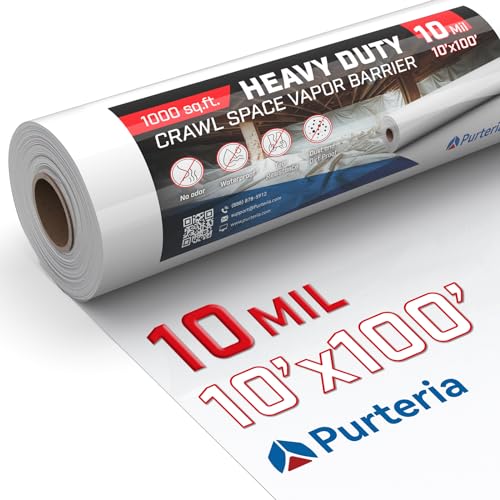
One roll that covers a thousand square feet and brightens the dark.
If your crawl space floor is bare dirt, this is where to start — no coating stops ground moisture better than blocking it outright. The roll measures 10 feet wide by 100 feet long at 10 mil thick (a mil is a thousandth of an inch), which fully deploys to cover 1,000 square feet, and the 10 mil polyethylene is a true new-material film, not recycled, so it resists tearing under foot traffic. Homeowners lay it down over gravel or limestone and get a dry, clean space underneath.
The white color is a genuine plus, not a cosmetic one — it reflects light and makes a low crawl space look brighter to work in, which owners notice right away. The material is thick enough to walk on with shoes without poking through, and the roll unrolls, cuts, and tapes without a fight. It is also reusable and odorless, so leftovers can double as a tarp or painter’s cloth.
Two things are worth knowing before you buy. First, at 43.6 pounds the roll is heavy, so getting it into a tight crawl opening takes two people. Second, the folded roll ships white-side-out, which means the clean white face touches the dirt as you unfold it and picks up dust that makes the seams harder to tape — a black-side-out fold would have been smarter. A few rolls also arrive with tiny pinholes in a fold, so give it a quick look before installing.
Why it earns its spot
- 10 ft x 100 ft roll covers 1,000 square feet of crawl space in one purchase
- True 10 mil new-material polyethylene resists tearing and stands up to foot traffic
- White surface lightens a dark crawl space so you can actually see to work
- Odorless and reusable — leftovers work as a tarp or painter’s cloth
Worth a heads-up
- 43.6 pounds means a two-person job to move under a low access hatch
- Folds white-side-out, so it picks up dust while unrolling and can be harder to tape
- An occasional roll shows tiny manufacturing pinholes in a fold
Made for: sealing a bare-dirt crawl space floor in one roll without hiring a crew.
Give it a pass if: you only need a small patch of sheeting — a 1,000-square-foot roll is more than most single projects call for.
7. Hydra Stop 300 Fast Set Crack Injection Kit, 10ft
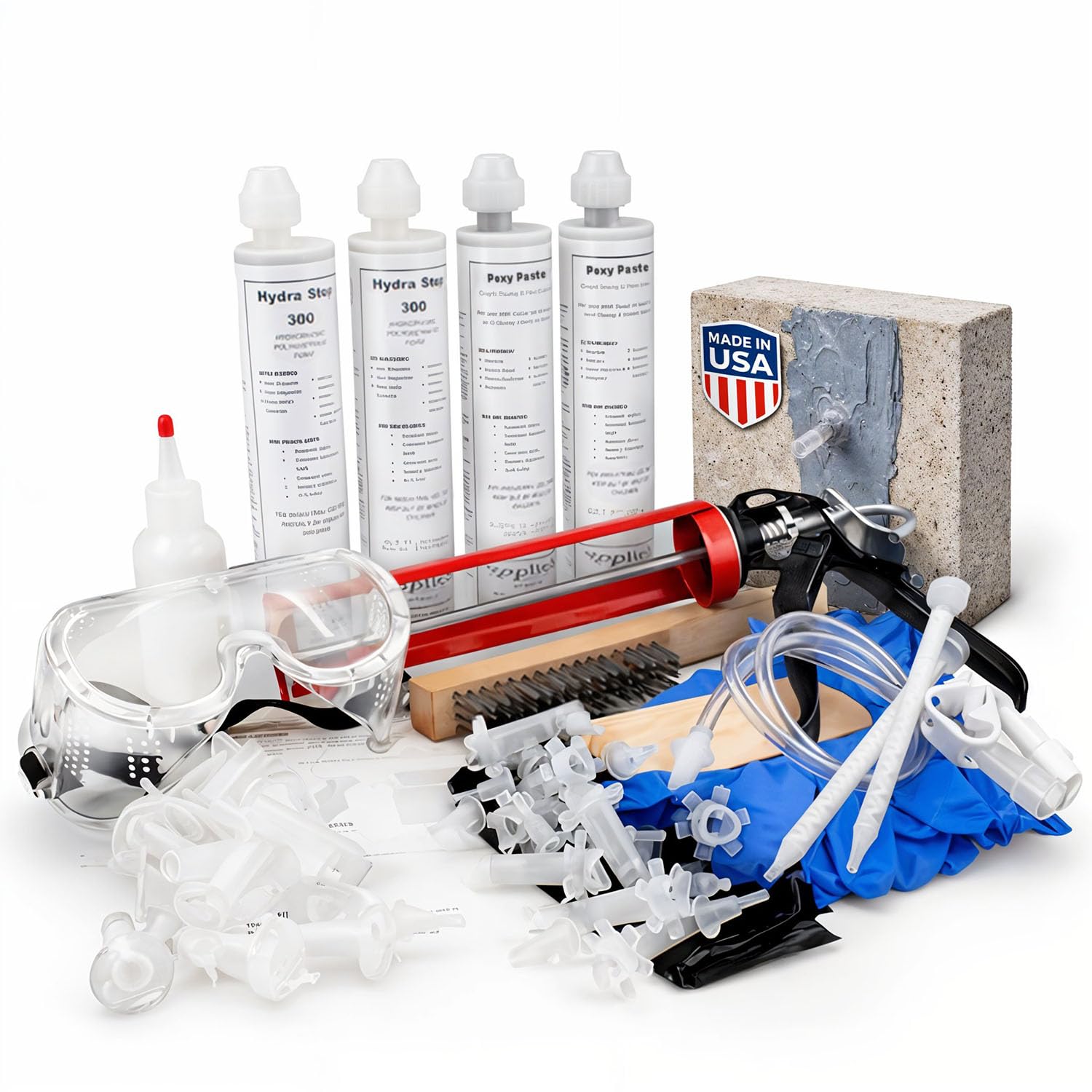
Fills a foundation crack from the inside so you never dig outside.
When water tracks along one visible wall crack, no coating is going to fix it — the crack itself is the leak. This kit injects a two-part polyurethane foam (a plastic that expands as it cures) that fills the gap from the inside, running through the crack to the exterior without any digging. It handles everything from hairline cracks up to about 3/16 inch wide, and the box includes two foam tubes, epoxy paste sealant, surface ports, corner ports, a caulk gun, gloves, safety glasses, a drop cloth, wooden sticks, and a flexible injection hose.
The kit covers 10 feet of crack, and the instruction set — both written and video — is what owners single out as the reason it works. The prep steps matter: align the ports properly and move slowly, and the foam seals the crack cleanly. Done right, it fixes a foundation leak for a fraction of a professional quote, and one owner’s repair held for 14 years with no leaks.
Two honest limits keep it from being a magic fix. The corner injectors are hard to stick onto cracks that sit in a corner, so a non-corner crack is an easier job — a design quirk that has not changed over the years. And the material does not go as far as the tube size suggests: the tubes ship only half-filled, and the included caulk gun can slip or break under pressure. Buyers routinely find they need a second kit when a leak migrates along the crack. Prep carefully, use your own gun if you have one, and the leak gets sealed.
The proof it works: Leak-proofing is the number-one thing customers note, with the instructions coming in close behind — the process is spelled out well enough for a first-timer to follow.
The honest caveat: Tubes arrive half-full, the supplied caulk gun can slip, and corner cracks are tricky to inject — budget a second kit for a leaking crack that runs long.
Choose it for: a single foundation wall crack that weeps, especially if you want to fix it from inside without digging.
Plan ahead if: the crack is in a corner or runs longer than the kit covers — you may need a second box or a different approach.
8. Whitecap Dimple Drainage Matting, 4′ x 50′
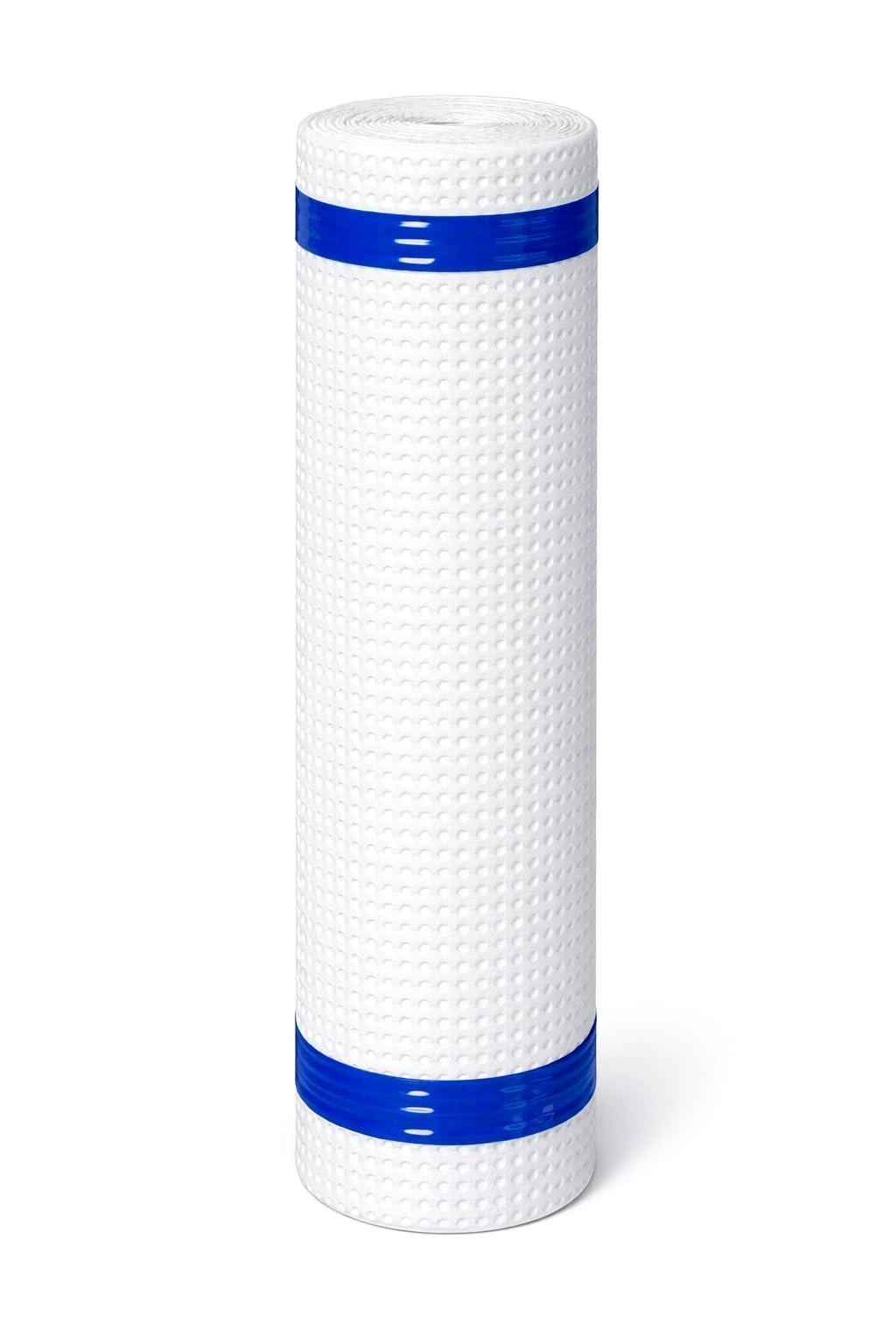
The dimpled layer that gives trapped water somewhere to go.
Water that cannot drain pools, and that is exactly what this matting prevents. The 4 ft x 50 ft roll is made of high-density polyethylene (a stiff, hard plastic with a bit of give), and its raised dimple pattern creates a continuous air gap that channels water toward a drain or sump. It carries the ICC-AC114 certification (a building-code approval for drainage products), and it is built to protect a vapor barrier from punctures on rocky soil while letting water move underneath it.
It is heavy-duty but kind on your knees. The roll keeps its shape and is best unrolled, cut to length, and left to relax and flatten before you install it. The dimples add a cushion layer over dirt or concrete, and one owner saw a crawl space humidifier pull humidity below 40% once the mat sat under the barrier.
The stiffness is the one thing to plan around. This matting does not bend well around tight corners, so a crawl space with lots of obstacles takes more careful cutting, and the 4 ft x 50 ft roll is on the larger side for a small job. Join seams by mating the dimples with tape or by taping edge to edge. For an encapsulation job where standing water and a punctured barrier are the risk, it is the layer that makes the whole system work.
Where it does its job: The raised dimple design keeps a gap open so water reaches the sump, and it protects the vapor barrier from being punctured on rocky ground.
The trade-off: It is rigid, so tight corners resist it, and you should let the roll relax flat before install to get the seams to lay down.
Right for you when: you are encapsulating a crawl space and want drainage plus a barrier protector in one layer.
Overkill if: you have a small, dry crawl space with no standing water — a barrier alone may be enough.
Understanding the Specs
Hydrostatic Pressure
Hydrostatic pressure is the force of water in the ground pushing against your wall from the outside. A coating rated for higher pressure — like the 12 psi rating on the INSL-X WaterBlock — can hold that push back where a plain wall paint would blister and peel. If your basement sits below a slope or a high water table, look for a high pressure rating and skip thin decorative paints.
Coverage Per Gallon
Coverage, in square feet per gallon, tells you how far one container spreads. A wall waterproofer usually covers 75 to 125 square feet per gallon, while a penetrating floor sealer can reach up to 200. Rough or porous surfaces like cinderblock soak up more, so a thirsty wall often needs more product than the label promises. Measure your wall or floor area first, then check the coverage number before you buy.
Elongation and Flexibility
Elongation is how far a cured coating can stretch before it tears. A rubber-type coating rated at 1200% elongation — like Ames Blue Max — stretches to twelve times its length, so it moves with a wall that shifts instead of cracking off. In areas with freeze-and-thaw cycles, a flexible membrane usually outlasts a stiff paint.
Vapor Barriers and Drainage
A vapor barrier is a thick plastic sheet that blocks ground moisture from rising into a crawl space; 10 mil polyethylene is a common heavy-duty thickness. Drainage matting goes under or over it with a dimpled surface that keeps an air gap so water flows to a drain instead of pooling. Together, they form the below-grade layer that protects a crawl space floor.
FAQ
Do I need a coating or a crack injection kit for my basement leak?
Can I paint a wet basement wall right away?
How many gallons will a cinderblock basement wall need?
Is a vapor barrier better than a coating for a crawl space?
Will an elastomeric coating crack when the wall moves?
Can I put a coating straight over an existing wet floor crack?
Do I need a drainage mat if I already have a vapor barrier?
How long should I wait between coats of waterproofing paint?
Does a waterproofing coating need a top coat in the sun?
Will a moisture sealer stop water coming up through a concrete floor for good?
Final Thoughts: The Verdict
For most damp basement walls, the basement waterproofing materials winner is the INSL-X WaterBlock Acrylic Masonry Waterproofer — it holds up against 12 psi of water pressure and covers 75 to 125 square feet per gallon, the strongest all-around answer for wall seepage. It holds 4.6 stars across 298 ratings, and it earns that score on real rainy-day results. If your wall flexes or sits below grade, step up to the Ames Blue Max Liquid Rubber Waterproofer for its 1200% elongation membrane (it stretches to 12 times its original length without breaking). For a single weeping foundation crack you want to fix from the inside, reach for the Hydra Stop 300 Fast Set Crack Injection Kit, and for a bare dirt crawl space floor, lay down the Purteria Crawl Space Vapor Barrier to block ground moisture at the source.
How We Picked
We do not accept paid placement. Every pick is matched to a real buyer and a real use-case; we do not hands-on test units.
Sources & Methodology
Specifications: manufacturer listings and product documentation. Review insights: verified customer reviews, as of September 2026. Pricing: not shown on this page (it changes often); check the current price via the retailer link.
As an Amazon Associate, KitchPrep earns from qualifying purchases. This does not affect which products we feature.
Related Guides
