
Specs are compiled from manufacturer listings and verified buyer reviews and can change over time — please confirm the key details on the product page before buying.
If you are replacing a valve on a pool line, a well pump, or an irrigation manifold, the biggest risk is not pressure — it is a handle that cracks or a ball that freezes up after one season. A 1 1/2 inch ball valve has to match your pipe exactly, handle the pressure your system actually runs at, and keep turning smoothly years from now. This guide covers nine real options — the proven socket-and-glue pick, the stainless workhorse, the brass full-port favorite, and the budget two-packs that keep spare parts on the shelf. The crowd favorite is the HYDROSEAL Kaplan, rated 4.8 stars across 290+ ratings.
I’m Mohammad Maruf — the founder and writer behind KitchPrep. This guide is built by comparing the manufacturers’ published specifications and the patterns across verified customer reviews, so you get each pick’s real strengths and trade-offs instead of marketing spin.
You are about to see which connection type fits your pipe, which material survives your water, and why the cheapest two-pack is sometimes the smartest move. This breakdown of the 1 1/2 inch ball valve covers socket, threaded, stainless, and brass options side by side.
Our Picks at a Glance


How To Choose The Best 1 1/2 Inch Ball Valve
The single decision that matters most is the connection type. A socket valve (also called slip or glue-on) has smooth female ends that you prime and cement onto PVC pipe. A threaded valve has female NPT (National Pipe Taper) threads that screw onto male pipe fittings. Buy the wrong one and it will not connect no matter how much tape you use. Before you order anything, look at the end of your existing pipe or fitting and match it exactly.
Pressure rating is headroom, not bragging rights
A valve rated for 150 PSI at 73°F handles the vast majority of home water systems, pool loops, and sprinkler manifolds, which typically run well below that. The number to watch is your system’s actual working pressure — a well system at 50 PSI leaves a PVC valve with a comfortable margin, while a 1000 WOG-rated stainless valve is built for water, oil, and gas lines that ask for much more. Higher ratings also usually mean thicker walls, which resist cracking when a pipe shifts or freezes.
Full port versus standard port changes what flows through
A full port valve’s internal opening matches the pipe’s inside diameter, so water passes without a bottleneck. A standard port valve has a narrower bore, which is fine for on/off shutoffs but can starve a high-flow demand appliance or an irrigation zone. If you are feeding a tankless water heater, a pool pump, or a large sprinkler run, full port is the safer choice — it is why so many buyers specifically hunt for a full port 1 1/2 inch valve instead of grabbing whatever is on the shelf.
Quick Comparison
| Model | Best For | Connection | Max Pressure | Material | Amazon |
|---|---|---|---|---|---|
| HYDROSEAL Kaplan PVC 1 1/2″ True Union★ Best Overall | Pool lines and serviceable plumbing | 1.5″ Socket (glue-on) | 200 psi | PVC | Amazon |
| YADIAN 2 Pack 1-1/2” PVC Ball ValvesBest Value | Spare valves on a budget | 1.5″ Socket (slip) | 150 psi | PVC | Amazon |
| DAN SPEED 1.5″ NPT Full Port Ball ValveTop Performer | Gas and high-pressure water lines | 1.5″ Female NPT | 1000 psi | 316 Stainless Steel | Amazon |
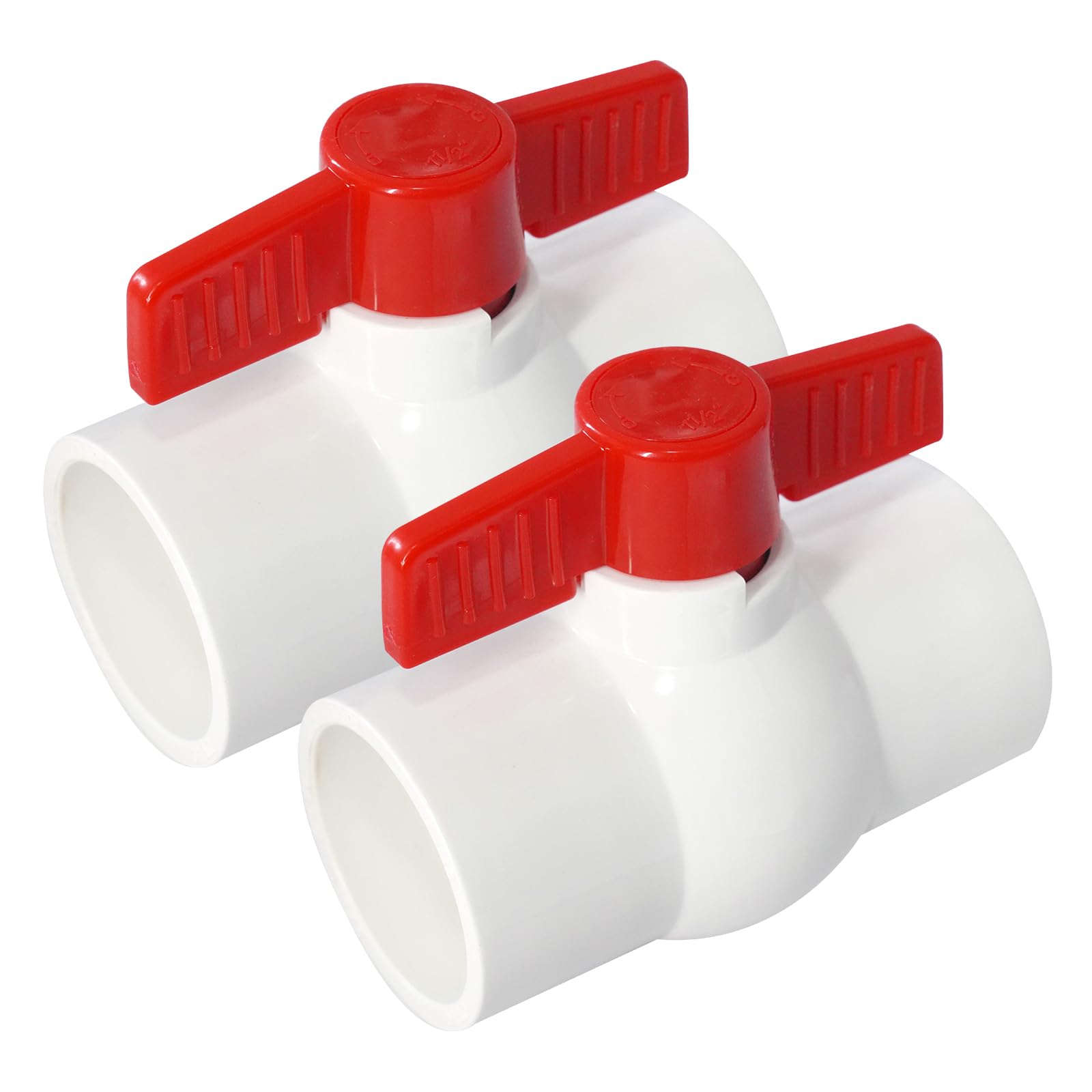
| FANOVO PVC Ball Valve 1-1/2 inch 2-Pack | Above-ground pools and sprinkler upgrades | 1.5″ Slip | 150 psi | PVC | Amazon |
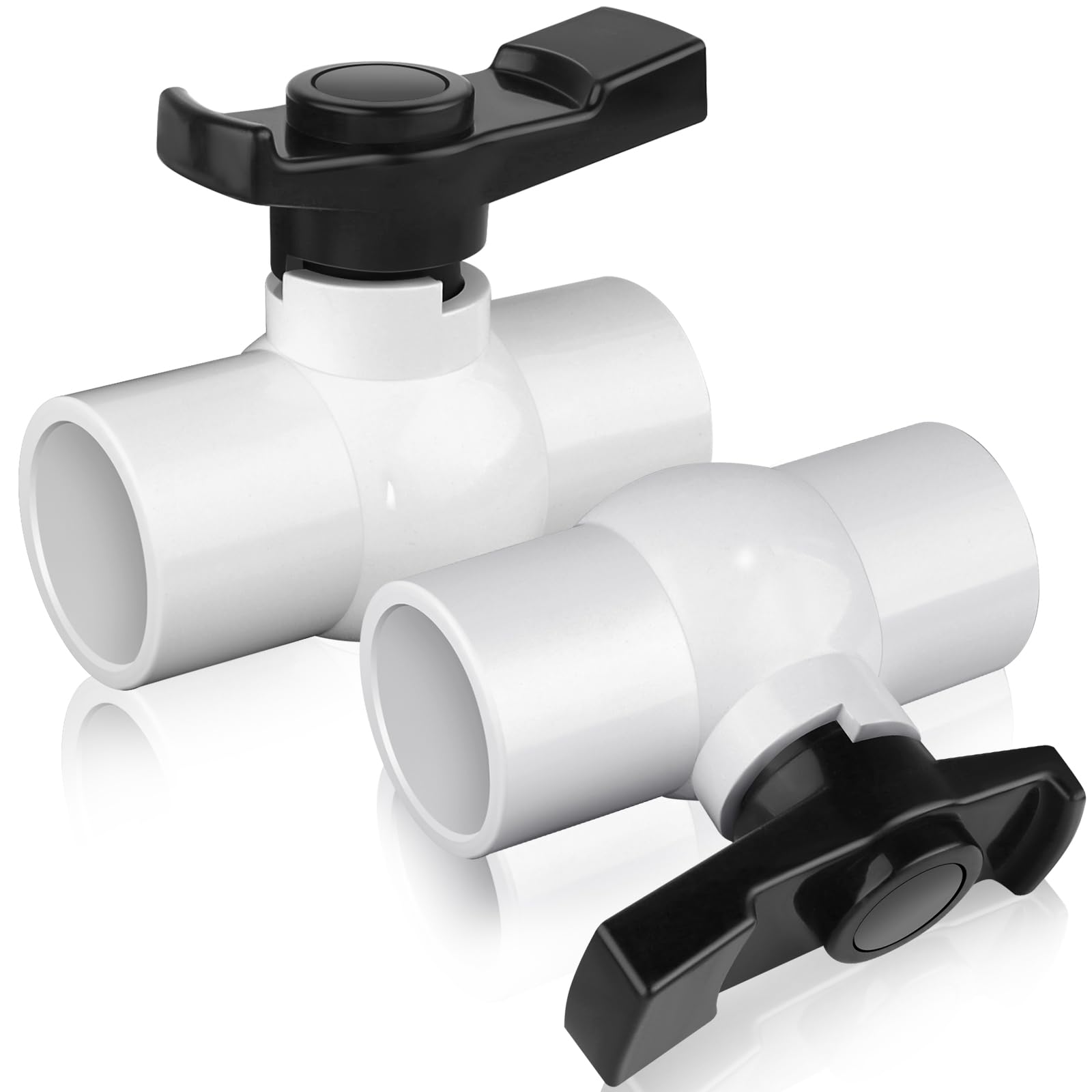
| AIPOR 2Pcs 1-1/2″ PVC Ball Valve | High-pressure irrigation and pool lines | 1.5″ Socket | 150 psi | PVC | Amazon |
| DERNORD Stainless Steel Ball Valve 1PC Type | Car wash and chemical lines | 1.5″ Female NPT | 1000 psi | 304 Stainless Steel | Amazon |
| DERNORD Full Port Ball Valve 1.5 Inch | Auto detailing and DEF/converter lines | 1.5″ Male x Female NPT | 1000 psi | 304 Stainless Steel | Amazon |
| REVALVED Full Port 1-1/2″ Brass Ball Valve | Potable water and gas shutoffs | 1.5″ Female NPT | 600 psi | Lead-Free Brass | Amazon |
| Eastman 1-1/2 Inch IPS Heavy Duty Full Port | Main water shutoffs and water heaters | 1.5″ IPS | 150 psi | Brass | Amazon |
In‑Depth Reviews
1. HYDROSEAL Kaplan PVC 1 1/2″ True Union Ball Valve with Full Port, ASTM F1970
Our pick — over 4.5★ from 250+ verified ratings; the strongest balance of quality and price.
The pool-line valve that unscrews for service instead of forcing you to cut pipe.
For anyone running a pool skimmer line, a main drain, or any plumbing you’ll need to service without a saw, this HYDROSEAL Kaplan is the one that solves the job. It is a true union valve, meaning both ends are threaded collars you can unscrew rather than glue joints you cut out forever. That single design choice is why you can replace the ball inside without redoing the surrounding plumbing — you loosen the collar, swap the internals, and tighten it back by hand. The full port opening means water flows without a restriction, so your pump isn’t fighting a bottleneck. Rated at 200 psi at 73°F, it sits comfortably above most home pool and irrigation pressures.
The construction is where owners stay loyal — 2 EPDM O-rings (rubber seals that stay pliable instead of drying out) and 2 PTFE seats (low-friction plastic rings that let the ball turn easily) sit inside a thick PVC body. This is a glue-on socket valve, so it fits 1.5 inch pipe with PVC primer and cement. The quarter-turn handle opens and closes with one twist, and it is actuator-ready if you ever want to add automated control. Buyers report it still turns as easily as install day after four Minnesota winters of chlorine and sun exposure. The valve carries ASTM F1970 certification, an industry standard for PVC valves in this class.
The trade-off is the install curve: a first-timer can spend two and a half hours on a single valve if they haven’t worked with true unions before. Sand and bevel the pipe, clean with acetone or alcohol, use primer and glue, put the collar on the pipe before gluing, align the flow arrow, and hand-tighten the collars only — over-tightening is the most common way to introduce a leak. Price is higher than a basic PVC ball valve, and it’s the one place opinions split. The payoff is a valve that you can repair without cutting, which is why pool service techs reach for this class of valve over cheaper alternatives.
What makes it the top pick
- True union design lets you replace the ball without cutting pipe — service without a saw
- Full port opening avoids flow restriction on pool and pump lines
- 2 EPDM O-rings and 2 PTFE seats for smooth turning and reliable sealing
- 200 psi rating at 73°F gives real headroom over typical home pressures
- Quarter-turn handle, actuator-ready, ASTM F1970 certified
Where it demands respect
- True-union install takes patience — a first-timer can spend 2.5 hours per valve
- Higher cost than a basic PVC ball valve; value opinions are split
- Glue-on socket only — no threaded option for existing NPT fittings
Reach for this if: you want a serviceable valve on a pool, aquarium, irrigation, or commercial line and you’re willing to learn the true-union install once.
Look elsewhere if: you need a threaded NPT fit or the lowest possible price on a simple shutoff.
2. YADIAN 2 Pack 1-1/2” PVC Ball Valves, T-handle Water Shut-Off Ball Valve
Two valves for the price of one, with the fit that matches what’s already on your shelf.
If you’re building a watering manifold out of old UV-rated PVC or replacing a shutoff and want a spare ready, this YADIAN 2-pack is the practical choice. You get two 1.5 inch socket valves with T-handles (the lever you turn to open or close the flow) and female slip ends that prime and cement onto Schedule 40 pipe just like the standard fittings you already know. Both carry a 150 psi maximum pressure rating at 73°F, which covers typical home irrigation, sprinkler, sewage pump, and above-ground pool loops with real margin. Both valves meet ASTM and ANSI standards, so the dimensional specs are predictable — no guesswork on whether the fitting will seat on your pipe.
Owners tend to describe the same thing: this is the same fit and durability as the local hardware type, but you get two valves for the price of one. The T-handle turns easily and holders report no leaks on install. Functionality reads strong here — valves work as shutoffs on sprinkler zones, watering manifolds, and pump lines without fussing. The plastic is quality PVC, not a cheap filler material. In terms of what people rave about most, quality comes first, and it earns its reputation on the basics: it seals, it opens, and it doesn’t crack under normal working pressure.
The honest caveat is handle feel — some owners find the T-handle easy, others want more leverage for a stiff quarter turn. That’s the variable on any T-handle valve; if you need finger-tip control with a bigger grip, look at the AIPOR or FANOVO picks above and below. The physical footprint on the YADIAN is larger than most valves in this class — 5.32 x 4.92 x 3.74 inches — so confirm your mounting spot has clearance before you commit. For jobs where you just need reliable shutoff and a spare in the toolbox, this pair delivers the most valves for the least money on this list.
Best fit for: the DIY project that needs two valves, a spare, and no drama — sprinkler manifolds, above-ground pool loops, sewage lines.
Pass on it if: you need a threaded NPT end, a stainless or brass body, or a larger handle for leverage-heavy quarter turns.
3. DAN SPEED 1.5″ NPT Female Threaded Full Port Ball Valve with Blue Vinyl Lever Handle, 316 Stainless Steel
The 1000 psi stainless workhorse for water, oil, and gas lines that play rough.
When you need a threaded valve engineered for gas or oil service — not just water shutoff — the pressure ceiling matters most. This DAN SPEED valve is rated to 1000 psi, versus the YADIAN 2-pack’s 150 psi limit. The 316 stainless steel body (a marine-grade alloy that resists corrosion better than the 304 grade used elsewhere) holds up against water, chemical, and gas exposure that eats through PVC. The full port design means your flow is not restricted at the valve, and the temperature range spans -60°F to 450°F for hot and cold service lines alike. PTFE seals inside add corrosion resistance and prolong valve life.
The 1.5 inch female NPT threads (tapered threading that cinches tighter as it screws on) connect to male pipe fittings going the same direction. You get one valve per order — a single-piece unit, not a two-pack. When it works, it works well: owners on gas shutoff duty at a ranch describe it holding up better than the PVC and brass valves it replaced, and anyone whose valve seemed stuck often finds debris jamming the ball and a handle-removal-and-rotation fixes it. Anyone who has bought several of these knows to tear down and lubricate before install — the ball is stiff from the start on some units.
The main caution is thread quality. This is where a significant portion of reviews split: some owners get a clean fit with no tape issues, others report poor threads that don’t allow adapters to seat deeply. On a home well-water system at ~50 psi, one owner had 6 of 7 valves leak at the fittings despite tape, sealant, PVC cement, and epoxy. That’s the honest picture — with clean threads, this valve is a reliable stainless pick with a crushing 1000 psi ceiling; with rough threads, chase the fittings before you give up. A thread chaser or extra tape gets most of these seated correctly.
Why stainless buyers choose it
- 1000 psi WOG rating — 6.7x the YADIAN PVC pair’s 150 psi ceiling
- 316 stainless body resists corrosion in water, oil, and gas service
- Full port design avoids flow restriction; PTFE seals extend life
- Wide -60°F to 450°F range for hot and cold lines
What the fittings demand
- Thread quality is inconsistent — some units need a thread chaser or extra tape
- Ball is stiff from the start on some units; a lubricating teardown helps
- Sold as a single valve, not a multipack
Choose it for: gas, oil, or high-pressure water lines where 316 stainless and a 1000 psi ceiling matter more than a low entry-level price.
skip it if: your system runs at low pressure and you’d rather have a PVC body with no thread-fit surprises.
4. FANOVO PVC Ball Valve 1-1/2 inch, 2-Pack with Double Socket Full Flow Port, Schedule 40
The oversized handle that finally ends the “can’t turn it off by hand” problem.
Anyone who has wrestled a stuck sprinkler valve knows the pain: the handle is small, the ball is stiff, and you can’t cut the zone off without a tool. This FANOVO pair solves it with oversized anti-slip handles that give you real grip — one owner specifically called out the “good gripping power” after years of replacing valves that wouldn’t close. The 2-pack covers two zones or one zone plus a spare. Slip ends comply with ASTM D2466 (a Schedule 40 fitting standard), and the valves carry ANSI/NSF 14 certification for plastic piping components. The internal EPDM O-ring sits inside a one-piece body for a claimed leakproof seal.
Working pressure is 150 psi with a maximum temperature of 140°F, plenty for sprinkler systems, above-ground pools, and irrigation lines that rarely see anything close to that ceiling. Owners upgrading 32-year-old sprinkler systems praised these for a true 100% full-flow opening rather than a restricted bore. The smooth operation is what earns repeat praise — the handle turns decisively instead of fighting back. They also fit for above-ground pools and pool loops.
The honest limitation is durability, where opinions split. A handful of owners worry about long-term performance on the plastic stem — one notes that a previous valve’s stem snapped when reopening a closed valve, and advises regularly actuating ball valves so they don’t lock up from disuse. That’s good practice on any plastic valve, not a flaw unique to this pair. If you keep the valves working (open and close them a few times a season) rather than leaving them untouched for years, they hold up.
Grip is the differentiator: oversized anti-slip handles give you real leverage, and that alone ends the annual “when did I last turn this?” panic.
Worth knowing: the plastic stem is the long-haul question mark — exercise these regularly so they don’t seize from disuse.
Best for: sprinkler and above-ground pool owners with aging shutoffs who want a valve they can actually turn by hand.
Not the pick for: stainless or brass service lines, or any job requiring 1000 psi headroom.
5. AIPOR 2Pcs 1-1/2″ PVC Ball Valve, Shut-Off Valve with Easy-to-Rotate Handle, Rated 150 PSI

A one-piece body, a larger handle, and quarters that turn without a fight.
If your pool valves are rusted in place and you want easy replacing without calling a tech, this AIPOR pair is the one to look at. The one-piece body has no redundant joints to leak, and owners specifically note the larger handle makes operating easier than the stock short T-handle it replaced. The valve fits 1.5 inch Schedule 40 PVC pipe with socket ends, works at 150 psi with a 140°F maximum temperature, and comes as a 2-pack — one for the pool line, one for a spare. Owners with old hands find it comfortable to operate, which is high praise for a plumbing valve.
Functionality covers real jobs: high-pressure irrigation lines, replacing rusted in-ground pool valves, and isolating A/C condensate drain lines for periodic blowouts. The body feels heavy and well-made, and the handle turns firmly without being stiff. When everyone agrees on the easy operation and sturdiness, that’s a strong signal. It also fits a range of jobs — sewage pipe, sprinkler irrigation, agricultural systems, and pool loops are all in the intended use.
The honest caveat is a size note — some owners mention the fit being off, which usually traces back to mismatched pipe schedules rather than a manufacturing defect. Confirm your pipe is Schedule 40 before ordering. One owner also had a valve become extremely hard to turn after six months, but they replaced with the same model in case it was a one-off. That’s the fair picture: reliability is high, but a rare unit can stiffen. Exercise the handle through its full quarter turn periodically so the ball doesn’t seize.
The pattern owners describe
- One-piece design eliminates redundant joints — fewer leak paths
- Larger handle is noticeably easier to turn than a stock short T-handle
- 2-pack covers a main shutoff plus a spare
- 150 psi rating, 140°F max, fits 1.5″ Schedule 40 PVC
What to check before you buy
- Confirm pipe is Schedule 40 — size mismatch drives most fit complaints
- A rare unit can stiffen after months of use; exercise the handle
- PVC body won’t handle stainless-level pressures or chemical service
Match it to: anyone replacing rusted or stuck pool, sprinkler, or condensate-line valves who wants easy-turning quarter turns without hiring out the job.
Don’t force it if: you’re on threaded NPT ends, high-pressure gas service, or 1000 psi demand.
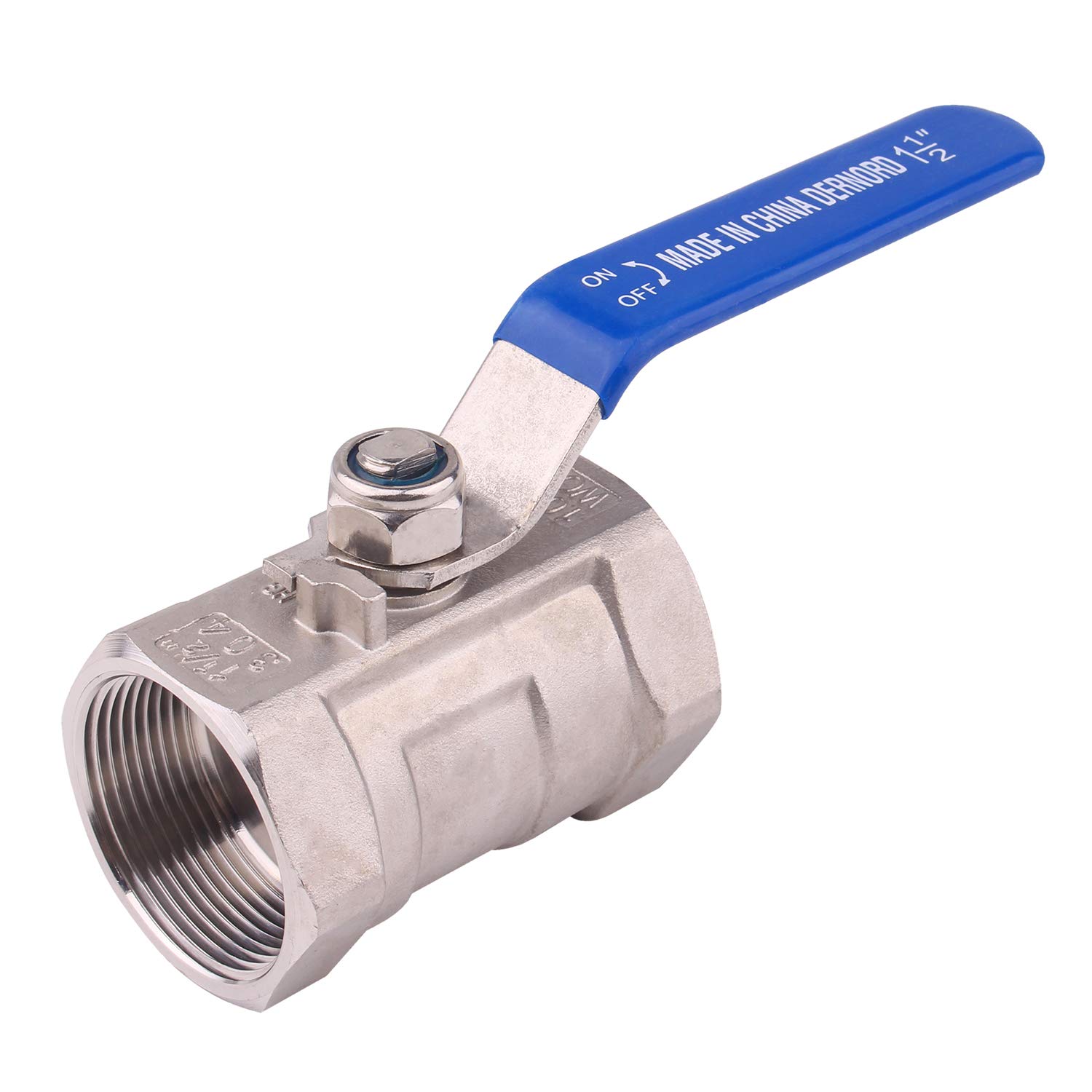
6. DERNORD Stainless Steel Ball Valve 1PC Type NPT Standard Port (1.5 Inch)
Stainless that outlasts brass and plastic on chemical-heavy car wash and ranch lines.
For hard-use crews running car washes, chemical service, or ranch ranch water lines where brass and plastic keep failing, this DERNORD 1PC is the value play. It’s a 304 stainless steel body (corrosion-resistant but a step below the 316 grade on the DAN SPEED above) with a serviceable design — the valve unscrews for maintenance instead of getting tossed. The threaded female-to-female NPT connection fits standard 1.5 inch pipe fittings, and the blue vinyl-insulated handle gives you grip on a dirty job site. Nominal working pressure is 1000 WOG for water, oil, and gas, and the temperature range runs -60°F to 450°F. Serviceability and functionality are the two things owners consistently stand behind.
The most important spec to note: this is a standard port valve, not a full port one, and DERNORD is explicit that the 1.5 inch number refers to the thread size, not the internal bore. If you need full-bore flow, buy a full port model (the DERNORD 1.5″ Full Port below is the direct match). On car wash chemical lines, customers note the stainless outlasting brass and plastic versions — these hold up when brass and plastic have all failed, and the handle joints don’t leak the way brass units do.
The word of caution is that quality is mixed — some owners call it high-quality and good value, others call it disappointing. Leakage is the split point: some report no leaks at all over years of service, others had leaks at the fittings. It’s a threaded valve at a moderate mid-range price, and the experience tracks with the install quality and thread prep on your end. Put in the time with tape and tightening, and this is a reliable, serviceable stainless valve at a value price.
For the work crew: 304 stainless plus 1000 WOG pressure rating makes this a sensible replacement for brass and plastic valves on car wash, ranch, and chemical lines where repeated replacement costs more than the valve.
Read the fine print: this is standard port, not full port — the 1.5 inch spec is the thread size, not the bore. If flow matters, buy the full port version.
The right call when: you want a serviceable stainless valve at a working-man’s price and you can prep NPT threads carefully.
Not the one for: high-flow demand lines that need full-bore internals or potable-water-specific use.
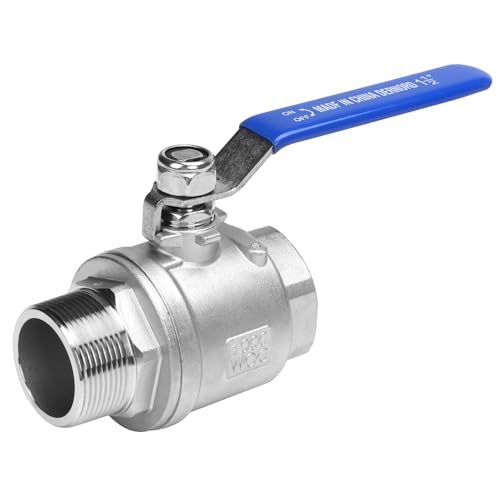
7. DERNORD Full Port Ball Valve 1.5 Inch, Male x Female Stainless Steel 304 Heavy Duty, 1000 WOG
The full-port stainless valve that keeps up when a restricted bore would choke the flow.
Auto detailers building spotless-water filter rigs and diesel owners feeding DEF tanks ask for one thing: unbroken flow through the valve. This DERNORD is a full port 1.5 inch valve (versus the standard port 1PC above), meaning the internal bore matches the pipe so water, DEF, or chemical moves without a bottleneck. The 304 stainless body handles 1000 WOG pressure, and the temperature range covers -60°F to 450°F — but DERNORD separately lists fluid temp range at -20°F to 410°F, so plan for the tighter window on real service. The connection is 1.5 inch Male x Female NPT (one male and one female end), which is unusual and lets you plumb without an adapter on one side. The valve is also serviceable — it unscrews for repairs.
Owners describe it as leak-free under pressure in spotless-water filter setups, with clean threading and no need for pricier fittings. That’s the whole point — a stainless valve that does the job without a premium price. Its on-DEF-tank duty holds up well, and it fixed a broken drain cock on a portable compressor in one reported swap. The main caution is fit on replacement jobs: the compressor swap needed a retapped tank thread and depth adjustment for handle orientation, so measure before you install. Leakage and sealing show split opinions overall — some jobs seal on the first try, others need more thread prep — but the value-for-money read is clearly positive.
Why detailers and DEF users pick it
- Full port bore keeps flow unrestricted — critical for spotless-water and DEF lines
- 304 stainless body rated for 1000 WOG pressure
- Male x Female NPT ends let you plumb without an adapter on one side
- Serviceable — unscrew to repair instead of replacing
What to plan around
- Fluid temp range is -20°F to 410°F — tighter than the -60°F to 450°F body spec
- Leakage/sealing opinions split; thread prep matters
- Retapping or depth adjustment can be required on replacement jobs
Go with this if: you need full port flow on a DEF, spotless-water filter, or chemical line and want stainless serviceability at a mid-range price.
Reconsider if: your fitting is female NPT on both sides — this one has a dedicated male end and a female end.
8. REVALVED Full Port 1-1/2″ Lead-Free Brass Ball Valve, Female NPT, 600 PSI WOG

Lead-free forged brass for drinking-water lines, with a chrome-plated ball that seals tight.
If you are plumbing a residential water line that feeds drinking water, air, or gas, the material in the valve matters as much as the pressure rating. This REVALVED is forged brass, free of lead — the key qualifier for potable-water plumbing — and it holds 600 psi WOG (water, oil, gas) with a 150 psi WSP limit for saturated steam. The full port design keeps flow unrestricted, which is the whole reason buyers specifically hunt for it on tankless hot-water heaters and high-flow gas appliances: a restricted bore can starve the appliance. The female NPT threaded ends connect to standard male pipe fittings, and the 90-degree grip-coated handle gives you reliable manual control.
Owners describe smooth operation, tight ball seals, and quality fit and finish right from the start. On a typical water-line job — blue thread tape, plumber’s sealant, proper tightening — this valve installs clean and holds with no leaks. It also fits gas-service applications where full flow is required. Chrome-plated ball and forged brass body mean the valve stays corrosion-resistant across years of service on potable water, and the metal body doesn’t degrade like plastic. It’s a single valve per order, not a pack. A 30-day money-back guarantee sits behind the brass construction.
One honest limitation: this valve is physically larger than some owners expected. On low-clearance jobs, one buyer switched to a smaller stainless mini valve once they discovered the brass housing was bigger than the space allowed. The other common surprise is packaging — brass is malleable, and a couple of units have arrived with light dings in transit; the brass works fine regardless, but if you’re particular about cosmetics, inspect on arrival. Both valve bodies are lead-free, which is exactly what potable-water jobs demand, and both seal tight once broken in.
Built for drinking-water lines: lead-free forged brass, 600 psi WOG rating, full port flow, and a chrome-plated ball that seals reliably once the tape and plumber’s sealant go on right.
Measure before ordering: the brass housing is bigger than many plumbing students expect — check clearances, and inspect for transit dings since brass is soft.
Pick it when: potable water, gas, or tankless hot-water service demands lead-free brass with full port flow and a real pressure rating.
Pass when: you need a compact valve for a tight space or a plastic body at a budget-tier price.
9. Eastman 1-1/2 Inch IPS Heavy Duty Full Port Ball Valve, Brass Plumbing Fitting, 20053LF
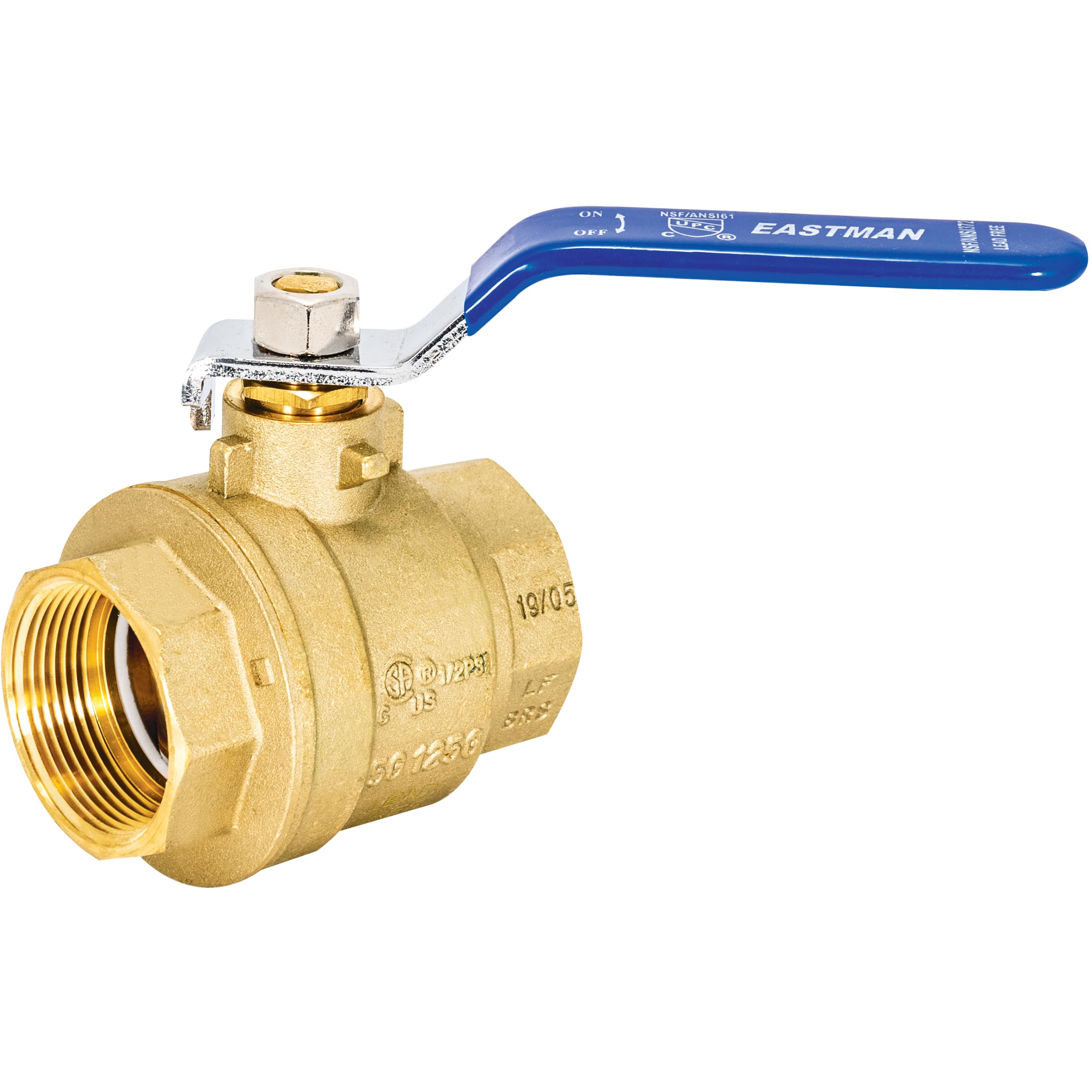
The certified main shutoff valve plumbers reach for on water heaters and whole-house lines.
For a main house shutoff or a water-heater swap where the local code requires a certified valve, this Eastman is the one that shows up in the plumbing aisle. It’s the premium end of the brass picks — a heavy-duty full port valve with a 1.5 inch IPS connection on each end, meaning both ends are the same iron-pipe-size fitting you need for iron-based or transition plumbing. The Teflon seal inside is built for high-temperature and high-pressure service, and the stamped steel handle is vinyl coated so you can grip it even with wet hands. The valve is rated 600 WOG and 150 PSIG for saturated steam, holds potable water standards, and carries both UPC approval and CSA certification — the certifications that matter when an inspector looks at your install.
Owners who have replaced old sediment-packed shutoffs report the swap was needed simply because the old valve wouldn’t drain the tank anymore. Once installed with tape and pipe dope, this one seals clean and holds — the tank drains and flushes the way it should. Then it’s rock-solid on well systems and gas-shutoff duty too. What stands out is the durable brass body with a Teflon seal, which is what keeps it operating reliably at high-temperature and high-pressure extremes. The valve handles both hot-side and cold-side installs without complaint.
The honest trade-off is that ease of operation is split — some owners find it opens and closes smoothly, others note it needs significant force. Break-in helps: many stiff valves loosen up after a few full open/close cycles. On outdoor installs, one owner found the fastening nut rusting within a year and replaced it — the small hardware is where you may need to keep an eye, not the brass body. The valve weighs 454 g (about a pound), which makes it feel solid in hand. For anyone who wants the strongest brass service-plumbing valve on this list, this is the one.
Why plumbers and inspectors like it
- Full port brass body with Teflon seal for high-temp and high-pressure service
- UPC approved, CSA certified, meets potable water standards
- 600 WOG rating; 150 PSIG for saturated steam
- Vinyl-coated stamped steel handle for grip
Real-world notes
- Ease-of-operation opinions split — some valves need significant force
- The small fastening nut can rust on outdoor installs
- At around a pound, this is a heavier valve than plastic alternatives
The strongest brass choice for: main water shutoffs, water-heater replacements, and any install where UPC and CSA certifications matter.
Overkill for: simple irrigation zone valves or above-ground pool loops where a budget PVC valve would do the job.
Understanding the Specs
Connection Type: Socket vs Threaded NPT
A socket valve has smooth glue-on ends — you prime and cement it to PVC pipe, and it becomes permanent unless you cut it out. A threaded NPT valve has tapered female threads that cinch onto male fittings as you tighten. Mixing the two is the number-one reason a valve won’t fit. Read the actual pipe end on your job before ordering, and if you’re unsure, threaded NPT is the one with visible screw threads inside the opening.
Full Port vs Standard Port Bore
A full port valve’s internal hole matches the pipe’s inside diameter, so water passes without restriction. A standard port valve has a narrower hole, which is fine for a shutoff but can starve a high-demand appliance. DERNORD is explicit that its standard port 1PC model’s 1.5 inch number refers to thread size, not bore — a detail worth remembering anytime you see “standard port” on a valve listing.
Pressure Ratings: 150 PSI vs 1000 WOG
150 psi PVC valves cover most home water, pool, and irrigation uses with margin to spare. Higher-rated stainless and brass valves like 600 or 1000 WOG are built for gas, steam, or industrial service lines. The rating is a ceiling, not a target — a home well system running at 50 psi leaves a huge buffer under a 1000 WOG valve, so pick to your system, not to the biggest number on the page.
Material: PVC vs Stainless Steel vs Brass
PVC is the budget material — it handles water, resists corrosion, and glues on fast, but it won’t handle chemical or high-temperature service. Stainless steel (304 or 316) survives car wash chemicals, ranch water, and gas service; 316 resists corrosion even better. Lead-free brass is the standard for potable water and gas — it’s forged, it holds high pressures, and it carries the certifications (UPC, CSA) an inspector looks for. Match the material to what flows through the valve, not just the pipe size.
FAQ
Will a 1 1/2 inch ball valve fit my Schedule 40 PVC pipe?
What is the difference between full port and standard port on a ball valve?
Do I need 150 PSI or 1000 PSI for a home water system?
Can I use a PVC ball valve indoors on my main water shutoff?
Why does my stainless ball valve handle feel stiff?
Do brass ball valves need thread tape to seal?
Which material is better for a pool valve, PVC or stainless?
How do I know if my valve is a socket or a threaded type?
Can I use a 1 1/2 inch ball valve on a gas line?
What size valve do I need if my pipe says 1.5 inch IPS?
How long do 1 1/2 inch ball valves typically last?
Final Thoughts: The Verdict
Across the board, the 1 1/2 inch ball valve winner is the HYDROSEAL Kaplan PVC True Union Ball Valve because its true union design lets you service the ball without cutting pipe, its full port body avoids flow restriction, and its 200 psi rating gives real headroom on pool loops and irrigation. If you want a stainless valve for water or gas service with high pressure capacity, grab the DAN SPEED 1.5″ NPT Full Port Ball Valve. And for a main water shutoff or water-heater replacement where UPC and CSA certification matter, the Eastman 1-1/2 Inch IPS Heavy Duty Full Port Ball Valve is the one to reach for. Any of these three starts a plumbing job on solid ground — the rest of the list exists to fit the pipes and pressures you actually have.
How We Picked
We do not accept paid placement. Every pick is matched to a real buyer and a real use-case; we do not hands-on test units.
Sources & Methodology
Specifications: manufacturer listings and product documentation. Review insights: verified customer reviews, as of September 2026. Pricing: not shown on this page (it changes often); check the current price via the retailer link.
As an Amazon Associate, KitchPrep earns from qualifying purchases. This does not affect which products we feature.
Related Guides
