
Specs are compiled from manufacturer listings and verified buyer reviews and can change over time — please confirm the key details on the product page before buying.
If you are buying a 2-inch backflow preventer, the thing that matters most is simple: a valve that shuts water off cleanly every single time, even when your whole street’s plumbing is pushing back. Get that right and your annual inspection passes without a fuss. Get it wrong and you are staring at a flooded irrigation pit, a failed cross-connection test, and a repair bill. This page breaks down four real assemblies so you can pick the one that matches your line, your climate, and your local code.
I’m Mohammad Maruf — the founder and writer behind KitchPrep. This guide is built by comparing the manufacturers’ published specifications and the patterns across verified customer reviews, so you get each pick’s real strengths and trade-offs instead of marketing spin.
The four assemblies below are all 2-inch, all genuine backflow preventers, and each one earns its spot for a different kind of job — from a frost-prone irrigation line to a high-hazard fixture that demands the strictest protection. Read on for the honest breakdown of the 2-inch backflow valve.
Our Picks at a Glance

How To Choose The Best 2-Inch Backflow Valve
A backflow preventer is a one-way gate for your water line. It stops dirty water from being pulled backward into the clean supply when pressure drops — a real risk during a main break, a fire hydrant draw, or a sudden surge. For a 2-inch line, the stakes are higher because the volume moving through it is larger, so the assembly has to be built for real flow, not just a trickle.
RPZ versus double check: pick by hazard, not by price
An RPZ (reduced pressure zone assembly) gives you the highest level of protection. It has two check valves plus a relief valve that dumps water if pressure goes wrong, so it can guard against health hazards. A double check valve has two checks and no relief valve, so it is meant for lower-risk, non-health-hazard jobs like irrigation. Your local water authority decides which one you are allowed to install, so check that first before you buy anything.
Match the connection exactly
Every assembly here uses a 2-inch inlet and outlet, but the thread style matters. NPT (National Pipe Tapered — a standard tapered thread that seals as it tightens) is the common choice for threaded pipe. Flange connections bolt to a matching flange instead. Buying the wrong one means a trip back to the supplier or an adapter you did not budget for, so confirm what your existing line uses.
Lead-free rules decide potable versus non-potable
If the valve sits on a drinking-water line, it has to be lead-free compliant. Some assemblies are built for non-potable use only and clearly say so. Installing a non-compliant valve on a potable line is a code violation waiting on your next inspection, so read the spec sheet before you commit.
Serviceability and freeze protection
Look for a design with a single access cover and modular check construction. That lets a technician service the unit in line instead of pulling the whole assembly. If you live somewhere cold, a freeze sensor that signals when temperatures near freezing is worth having — frozen water expands, and that is what cracks brass housings.
Quick Comparison
| Model | Best For | Type | Connection | Item Weight | Amazon |
|---|---|---|---|---|---|
| Zurn Wilkins 2-975XL2★ Best Overall | High-hazard potable lines needing top protection | RPZ | 2″ Flange | — | Amazon |
| Watts LF007 Double Check | Irrigation and non-health-hazard systems | Double Check | 2″ NPT | 22.5 pounds | Amazon |
| Watts 009M2 RPZ | Non-potable irrigation and fire sprinkler lines | RPZ | 2″ Inlet | 27 pounds | Amazon |
| Zurn 2-950XL | Compact double check installs where space is tight | Double Check | 2″ Inlet | 25.1 pounds | Amazon |
In‑Depth Reviews
1. Zurn Wilkins 2-975XL2 2″ 975XL2 Reduced Pressure Principle Backflow Preventer
Our pick — over 4.5★ from 300+ verified ratings; the strongest balance of quality and price.
The RPZ that clears high-hazard potable-line inspections on the first try.
This is the assembly to reach for when your water authority demands the strictest level of protection on a 2-inch line. It is an RPZ — a reduced pressure zone assembly, which means it carries two independent check valves plus a relief valve that opens and dumps water if pressure goes wrong. That relief valve is the difference between a valve that guards against health hazards and one that only handles low-risk jobs. It holds 4.6 stars across hundreds of ratings, and owners credit the same thing: it does its job.
Owners consistently praise its straightforward, no-fuss operation. It arrives pre-assembled with the backflow components, pressure regulation, and strainer already fitted, so you are not hunting down extra parts for a basic install. The first check is built for easy access, which means clearing debris is a quick job rather than a full teardown. It is also fully serviceable in line, and a repair kit lets you swap the worn parts instead of replacing the entire valve — a real saving over the life of the unit. On the compliance side, it carries low-lead law compliance along with ASSE and IAPMO listings, CSA certification, AWWA compliance, and approval from the Foundation for Cross Connection Control and Hydraulic Research at the University of Southern California. If your inspector checks those boxes, this one is ready.
The honest caveat is weight and climate. At 27 pounds this is a heavy chunk of brass, and its footprint of 11.8 x 19.75 x 10.25 inches needs real clearance — compare that to the Zurn 2-950XL’s slimmer 9.8 x 12 x 20-inch body and the difference in space demand is obvious. There is also a frost warning worth taking seriously: water left sitting in any brass housing through a hard freeze can crack it, and this is no exception. Insulate or drain it before winter and it will treat you well. A few buyers have reported leakage on arrival, but with a 4.6-star average across hundreds of ratings, the overwhelming majority are happy with what they unboxed. If you need a high-hazard potable-line valve that will clear inspection the first time, this is the one. If your line is non-potable irrigation with no health hazard, the Watts LF007 below is simpler and cheaper.
Why it holds the top spot
- RPZ design with two checks plus a relief valve for the highest protection level
- Arrives pre-assembled with pressure regulation and strainer fitted
- Serviceable in line, with a repair kit for quick fixes instead of full replacement
- Carries ASSE, IAPMO, CSA, AWWA and USC Foundation listings
Where it asks more of you
- At 27 pounds and 19.75 inches long, it needs generous clearance and two hands
- Like any brass housing, it will crack if left to freeze — winterize it properly
- An occasional unit shows up with a leak from the start
Reach for this if: your water authority requires an RPZ on a potable or high-hazard line and you want the assembly most likely to sail through inspection.
Look elsewhere if: your 2-inch line feeds only irrigation or a sprinkler system and carries no health hazard — a double check valve is the simpler, cheaper answer.
2. Watts LF007 Lead-Free Double Check Backflow Preventer Assembly 2″ NPT
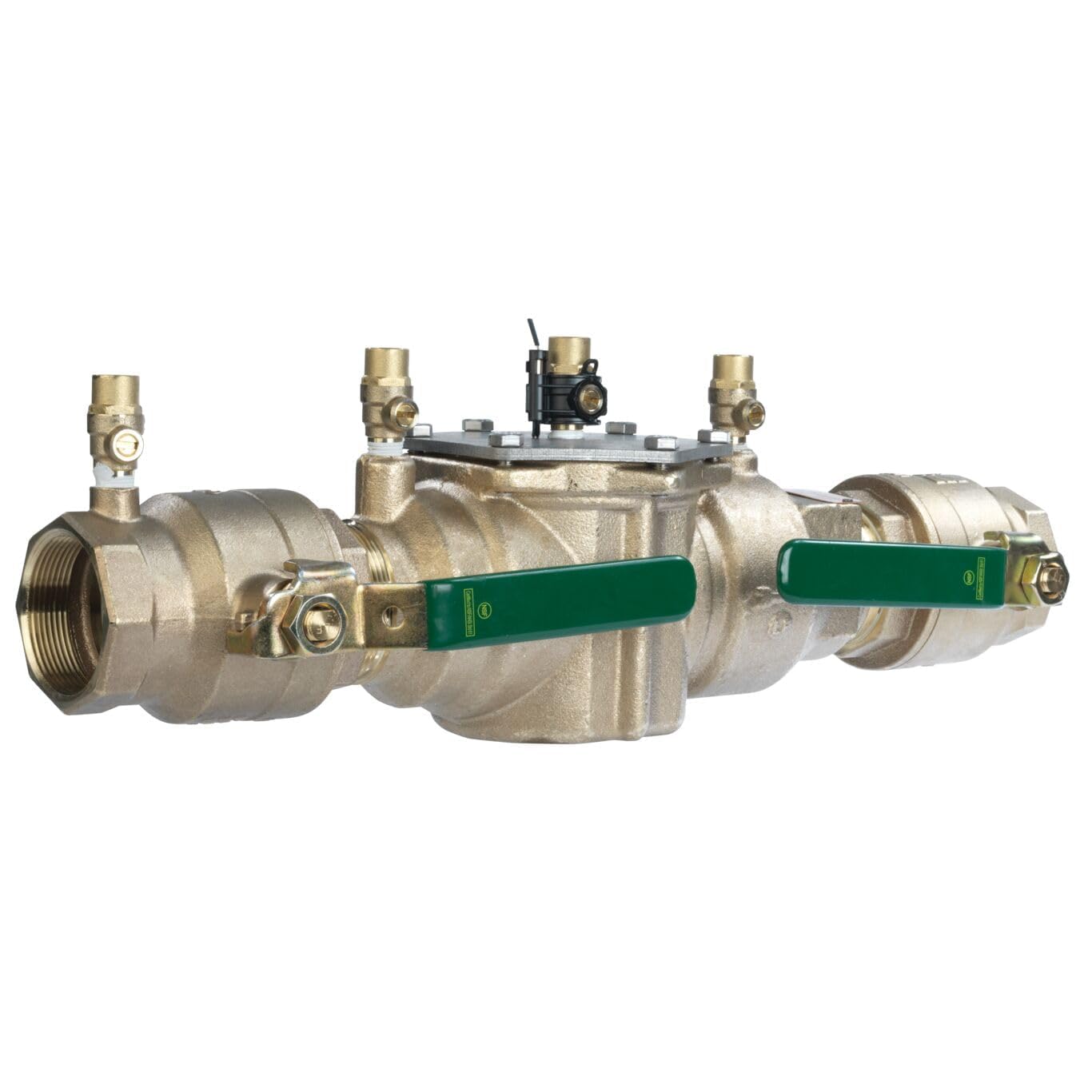
The double check that brings a non-health-hazard irrigation line up to code.
A double check valve is the right tool for a non-health-hazard line, and this Watts assembly is a strong example of the breed. It uses two in-line independent positive seating check modules to stop polluted water from being pulled back into your potable supply through back-siphonage or backpressure. Because it is designed for non-health-hazard applications in continuous-pressure piping, it fits the job most homeowners actually face: an irrigation system or service line that needs to satisfy code without the cost and bulk of an RPZ. Buyers report it does exactly that — one put it plainly: “Works great, functions perfectly. Brought my irrigation system the the prior home owners installed up to code.” That phrase, “up to code,” is the whole point of buying one of these.
The build is lead-free copper silicon alloy, a durable material that complies with industry standards for potable-adjacent service. It comes with NPT connections — the standard tapered thread that seals as it tightens — along with quarter-turn ball valve shutoffs, top-mounted test cocks, and captured springs. At 22.5 pounds it is the lightest assembly in this lineup, roughly a fifth less to heft than the 27-pound Watts 009M2. The single access cover and top-entry modular design mean repairs happen in line, and the check discs and seats are replaceable, so you are not scrapping the whole unit when one part wears.
Two features push this above the typical double check. First, the freeze sensor works with SentryPlus Alert technology to signal facility or building personnel when temperatures approach freezing, so a cold snap does not catch you off guard. Second, it handles up to 175 psi maximum pressure. The honest limit is certification: this is a double check, not an RPZ, so it is not the valve for a health-hazard connection — and if your authority requires RPZ-level protection, this will not pass that grade of inspection no matter how well it is built. Buyers praise its reliability and value, and it holds up year after year. For a frost-prone irrigation line that needs a smart early warning and easy annual service, this is the pick.
The case for it: lead-free copper silicon alloy body, 175 psi maximum pressure, and a freeze sensor that warns you before the cold does damage — all in the lightest 2-inch assembly here at 22.5 pounds.
The honest limit: it is a double check, not an RPZ, so it belongs on non-health-hazard lines only — confirm your code before buying.
Best for: the homeowner with a 2-inch irrigation or service line who needs code-compliant protection and a freeze warning in one package.
Think twice if: your water authority requires RPZ-level protection for a health-hazard connection — step up to the Zurn Wilkins 2-975XL2 instead.
3. Watts 2″ 009M2 Backflow Preventer Reduced Pressure Zone Assembly RPZ 2 009M2-QT 0063010 63010

An RPZ for fire sprinkler and irrigation lines only — non-potable use, no lead-free compliance.
Here is the spec that matters most on this one, and it is a hard line: this assembly does not conform to the lead-free act and is for non-potable use only. That single fact decides whether it belongs in your project. If you are feeding irrigation, a fire sprinkler system, or any line that never touches drinking water, it is a capable RPZ. If you are on a potable line, skip it — no exceptions. It is the heaviest assembly in this group at 27 pounds and the bulkiest by footprint at 22.1 x 10.2 x 8.1 inches. Compare that to the Zurn 2-950XL’s 12-inch-wide, 9.8-inch-tall body and this Watts unit clearly takes up more room in the pit.
For service, the design is genuinely thoughtful. A single access cover and modular check construction make maintenance manageable, and the manufacturer states no special tools are required for servicing — a real convenience when a technician is on site. It has ball valve test cocks, plus quarter-turn, full port, resilient seated bronze ball valve shut-offs with renewable seats. The bronze exterior gives it a solid, substantial feel in the hand. Maximum pressure is rated at 12.1 bar.
Most owners mention it performs as expected, though leakage comes up repeatedly. But there is a recurring gripe about leakage, and at least one buyer’s warranty experience went badly, with a report of a leak and a seller who would not cooperate on the claim. That is worth knowing going in: buy from a source with a clear return policy, and pressure-test the unit before you bury it in a wall. This is the assembly for a non-potable RPZ job where you want substantial bronze construction and easy service access, and you have already confirmed lead-free does not apply to your line.
What it does well
- Single access cover and modular checks make in-line service straightforward
- Quarter-turn, full port bronze ball valve shutoffs with renewable seats
- No special tools required for servicing, per the manufacturer
What to weigh first
- Non-potable only — it does not conform to the lead-free act
- At 27 pounds and a 22.1-inch footprint, it is the bulkiest here
- Leakage is a recurring note, and one warranty claim reportedly stalled
Pick this one when: you are protecting an irrigation or fire sprinkler line where lead-free compliance does not apply and you want a hefty bronze RPZ with easy service access.
Do not pick it when: your line carries drinking water — the non-potable restriction rules it out entirely.
4. Zurn 2-950XL Backflow Preventer, Gold
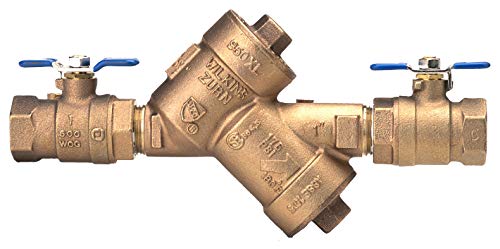
The short lay-length double check that fits valve pits the bigger RPZ units cannot.
When your valve pit is cramped, this is the assembly that fits. Its defining trait is a short lay length in a wye pattern, set in a bronze body — so it takes up less linear run than the bulkier RPZ assemblies above. At 25.1 pounds it sits between the Watts LF007’s 22.5 pounds and the two 27-pound units, and its 9.8 x 12 x 20-inch dimensions keep it slimmer and shorter than the Watts 009M2’s 22.1-inch span. For a retrofit where every inch of pipe run counts, that compactness is the whole argument for buying it.
It is a 2-inch double check assembly, so it is built for non-health-hazard jobs. It ships pre-assembled, which buyers appreciate — the install is quick, and the notes they share point to adding a couple of male adapters for PVC or, if you want a quick disconnect without cutting the line, a couple of unions and threaded close nipples. The replaceable Noryl seats and silicone seal rings let you refresh the wear parts rather than replace the unit. The recurring caution in owner feedback is simple and important: this valve is not for potable water. That matches its double check design, and it needs to be the first thing you confirm before you buy.
One more thing to know going in: a buyer reported cracking after a freeze at 20°F, despite the claim it could stay on all winter. That is the physics of water in an unheated brass assembly, not a manufacturing defect — any valve left full through a hard freeze is at risk. Drain or insulate it before the temperature drops and that problem disappears. For a compact, non-potable double check on a tight layout, this Zurn does its job well and sits in the space where the larger RPZ units simply will not go.
The compactness advantage: a short lay length in a wye pattern makes this the easiest fit where valve-pit space is at a premium.
Read before you buy: it is a double check for non-potable use, and like any brass body it will crack if left full through a freeze.
Space-tight installations suit this one: a non-potable 2-inch job where the short lay length gets you into a pit the bigger assemblies cannot reach.
Skip if: you need potable-water protection or RPZ-level hazard control — this double check covers neither.
Understanding the Specs
RPZ versus Double Check
An RPZ (reduced pressure zone assembly) is your top-tier protection: two check valves plus a relief valve that releases water if pressure fails, making it suitable for health-hazard connections. A double check valve has the two checks but no relief valve, so it is for non-health-hazard work like irrigation. Choosing the wrong type usually means a failed inspection — the hazard level of your connection, not your budget, decides which one you need.
Lead-Free Compliance
Assemblies that touch drinking water must be lead-free compliant, and that status is printed on the spec sheet. Some valves are explicitly for non-potable use only and will say so. Installing a non-potable assembly on a potable line is a code violation, so treat this as a firm filter rather than a nice-to-have.
Inlet Connection and Thread Style
Every valve here is a 2-inch assembly, but the connection type varies: NPT (a standard tapered thread that seals as it tightens), flange (bolts to a matching flange), or a straight 2-inch inlet. Match this to your existing piping before purchase, or budget for adapters you did not plan on.
Freeze Sensor and Serviceability
A freeze sensor signals when temperatures reach freezing, giving you time to act before water expands and cracks the brass. Serviceability matters too — a single access cover and modular checks let a technician work in line, and replaceable seats and discs save you from replacing the whole assembly when one part wears out.
FAQ
Do I need an RPZ or a double check valve for my 2-inch line?
Will a 2-inch assembly fit my existing pipe threads?
Can I install a backflow preventer myself?
Which 2-inch backflow valve is best for irrigation?
How often does a backflow preventer need testing?
Does a backflow preventer need a freeze sensor where I live?
Can a double check valve be used on drinking water?
How much does a 2-inch backflow preventer weigh and does it matter?
Is a strainer or pressure regulation included on these assemblies?
What happens if I install a non-potable valve on a potable line?
Final Thoughts: The Verdict
For most buyers on a 2-inch line, the 2-inch backflow valve that earns its place is the Zurn Wilkins 2-975XL2 — it is an RPZ assembly, so it delivers the highest protection level, arrives pre-assembled with a strainer and pressure regulation, and carries the full stack of listings an inspector looks for. If your job is irrigation or a non-health-hazard service line, the Watts LF007 is the smarter, lighter choice at 22.5 pounds, with a freeze sensor and 175 psi maximum pressure. And when the valve pit is short on room, reach for the Zurn 2-950XL and its short lay length. The single honest nudge worth giving: whichever you pick, confirm your hazard level and lead-free status with your water authority before the box arrives — that one check prevents every wrong purchase in this category.
How We Picked
We do not accept paid placement. Every pick is matched to a real buyer and a real use-case; we do not hands-on test units.
Sources & Methodology
Specifications: manufacturer listings and product documentation. Review insights: verified customer reviews, as of September 2026. Pricing: not shown on this page (it changes often); check the current price via the retailer link.
As an Amazon Associate, KitchPrep earns from qualifying purchases. This does not affect which products we feature.
Related Guides
