
Specs are compiled from manufacturer listings and verified buyer reviews and can change over time — please confirm the key details on the product page before buying.
A 12,000 BTU heat pump is the one upgrade that can cool a bedroom on a July afternoon and warm the same room through winter, without ductwork and without a furnace running behind it. This guide covers eleven ductless mini-split systems that all deliver both heating and cooling at the 12,000 BTU class, so if one of them falls slightly above or below the exact number you typed into the search bar, that is normal — a 12k system in this category typically runs somewhere around 11,000 to 12,500 BTU and serves the same room size. Here is what separates a great pick from an expensive mistake.
I’m Mohammad Maruf — the founder and writer behind KitchPrep. This guide is built by comparing the manufacturers’ published specifications and the patterns across verified customer reviews, so you get each pick’s real strengths and trade-offs instead of marketing spin.
Mini splits live or die on two numbers: how many watts they burn per hour of comfort, and how low the outside temperature can drop before the heat fades. The picks below are ranked by how well they handle both, and you will see exactly where each one lands in the 12000 btu heat pump field.
Our Picks at a Glance


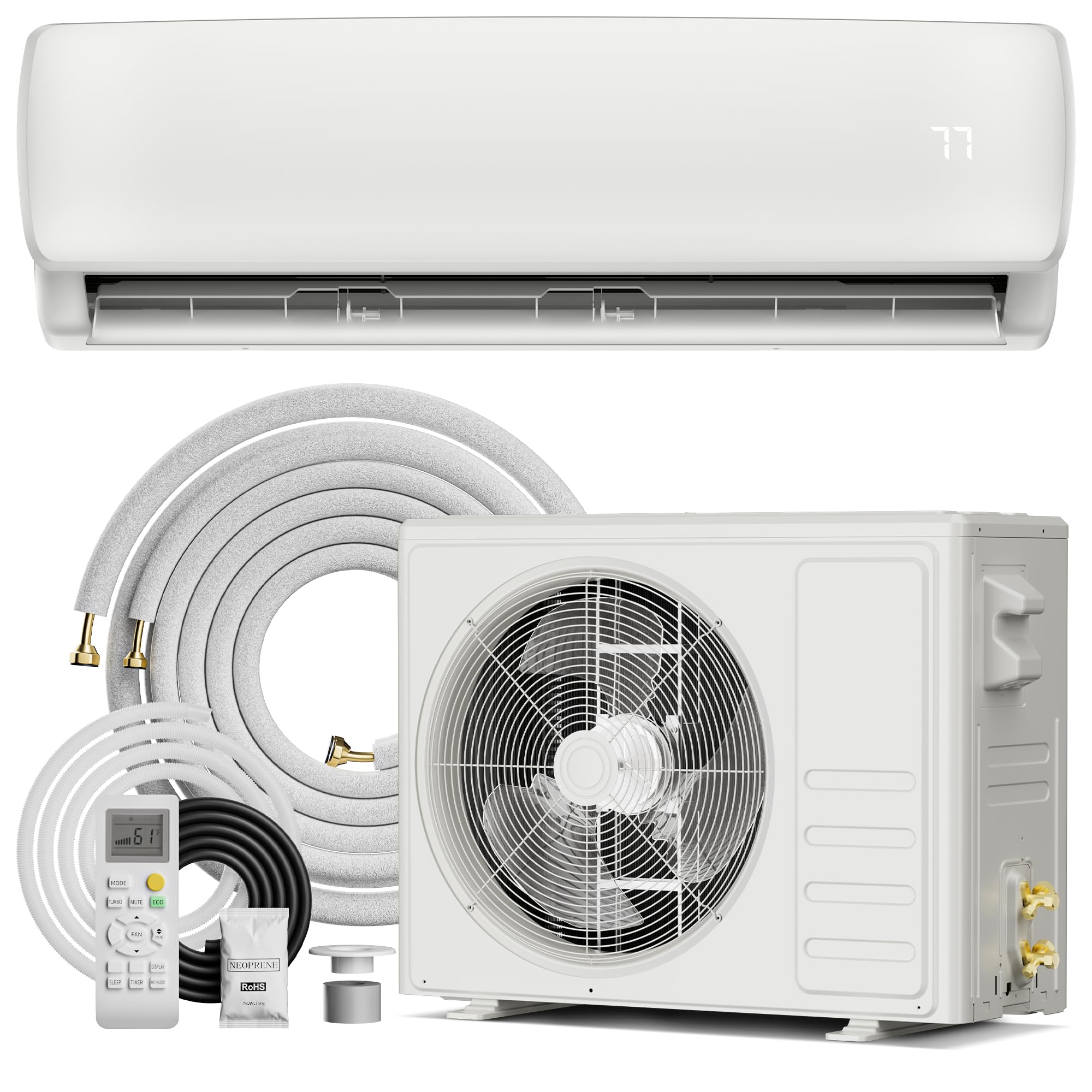
How To Choose The Best 12000 BTU Heat Pump
Two systems with the same 12,000 BTU label can cost wildly different amounts to run and can behave completely differently in January. What you are really shopping for is efficiency at the compressor, honesty about cold-weather heating, and an install path you can actually complete in your home.
SEER2 and HSPF2: the ratings that decide your power bill
SEER2 is the updated efficiency score for cooling — think of it as miles per gallon for air conditioning, where a higher number means more cooling for every watt pulled from the wall. A 25.5 SEER system like the Senville AURA sits near the top of this group, while an 18 SEER2 unit is still solidly efficient for a budget build. HSPF2 is the matching score for heating season. Both numbers come from the same government test, so they are the fairest way to compare brands side by side.
Cold-weather heating: how low can it go
Every heat pump in this group works well in mild weather. The split happens below freezing. If you live somewhere with single-digit winters, that rating is the single most important line on the spec sheet — it decides whether the system can carry your house or whether you keep a backup heat source running.
DIY vs. professional install
Some systems ship pre-charged with quick-connect lines so a handy homeowner can handle the mechanical side in an afternoon, though almost all still need a vacuum pump and a licensed electrician for the final hookup. Others require a licensed HVAC tech by the manufacturer’s own terms, and skipping that step can void the warranty entirely. Read the install section before you buy, not after.
Quick Comparison
| Model | Best For | Efficiency (SEER2/SEER) | Heating Capacity (BTU) | Room Size | Amazon |
|---|---|---|---|---|---|
| Senville AURA 12000 BTU★ Best Overall | Whole-home primary system | 25.5 SEER | 12000 BTU | 750 sq. ft. | Amazon |
| ROVSUN 12000 BTU WiFi Mini SplitBest Value | Budget-first energy savers | 20 SEER2 | 12,600 BTU | 750 sq. ft. | Amazon |
| Mountman 12000 BTU Mini SplitTop Performer | Garage and workshop cooling | 19 SEER2 | 12000 BTU | 750 sq. ft. | Amazon |
| TOSOT Cosmo 12,000 BTU | RV and mobile home use | 22 SEER2 | 12000 BTU | 550 sq. ft. | Amazon |
| Albott Easy DIY 12,000 BTU | Fastest self-install | 18 SEER2 | 12000 BTU | 750 sq. ft. | Amazon |
| DELLA Serena 12000 BTU | Smart-home integration | 22 SEER2 | 12300 BTU/h | 550 sq. ft. | Amazon |
| ACiQ Essentials 12000 BTU | RV, attic, and shed installs | 20 SEER2 | 12000 BTU | 600 sq. ft. | Amazon |
| DELLA Optima 12,000 BTU | Cold-climate rooms | 23 SEER2 | 12400 BTU/h | 550 sq. ft. | Amazon |
| Cooper & Hunter MIA 12,000 BTU | Recording studios and quiet rooms | 21.2 SEER2 | 12000 BTU | 550 sq. ft. | Amazon |
| Daikin Entra 12,000 BTU | Long-term reliability buyers | 18 SEER2 | 11,300 BTU | 550 sq. ft. | Amazon |
| MRCOOL 12000 BTU Mini Split | Remote schedule control | — | 12000 BTU | 550 sq. ft. | Amazon |
In‑Depth Reviews
1. Senville AURA Mini Split Air Conditioner, Heat Pump, White, 12000 BTU
Our pick — 4.5★ from 650+ verified ratings; the strongest balance of quality and price.
The single-zone workhorse rated to -22°F, so it carries a whole home through January without a backup heat source.
If you want the lowest running cost in this entire group, this is the one. The Senville AURA carries a 25.5 SEER rating — the highest efficiency score of any pick here — and that number translates directly into smaller power bills every month. It runs on 208-230V with a DC Inverter compressor and is rated for operation down to -22°F, which is colder than most of this list can handle. For a home in a genuinely cold climate, that combination is the whole reason it sits at the top.
The practicality is just as strong. The 12,000 BTU rating covers up to 750 square feet, so it handles a large bedroom, a living room, or a small commercial space in one head. Buyers report the system simply keeps going: one wrote “After about 18 months installed (2 summers in Phoenix AZ) my 12kbtu Senville Aura still works perfectly.” It arrives as a complete kit — indoor air handler, outdoor condenser, a 16 ft. line set, communication wire, and a remote — and it is Energy Star Certified, UL Listed, and AHRI Certified. For the efficiency-first buyer, nothing here beats it on paper.
The trade-off is honest and worth knowing up front: this is not a DIY unit, and the manufacturer says so plainly. Professional installation is required, which means paying an HVAC tech on top of the unit itself. The remote control also draws mixed reactions — some owners find it less intuitive than the app. If you are handy and want to skip the labor cost, the Albott Easy DIY or ROVSUN picks below are built for exactly that. If you want the best efficiency and longest cold-weather reach, the Senville is the one to beat.
What earns it the top spot
- 25.5 SEER — the highest cooling efficiency score in this entire lineup
- Rated down to -22°F, colder than most 12,000 BTU mini splits here
- Covers up to 750 sq. ft. from a single indoor head
- Ships as a full kit with 16 ft. line set, wire, and remote included
What to budget for
- Not a DIY system — professional installation is required per the maker
- Runs on 208-230V, so an electrician needs to handle the circuit
Buy this if: running cost and genuine cold-weather heating matter more to you than saving on labor — this is the most efficient and most cold-capable pick here.
Think twice if: you planned to install it yourself, because the maker requires a licensed tech and the 208-230V wiring is not a plug-in job.
2. ROVSUN 12000 BTU Wifi Enabled Mini Split Air Conditioner & Heater
The 20 SEER2 budget pick that runs on 115V household voltage and uses 1488 kWh per year.
Here is the number that surprises people: this ROVSUN uses 1488 kilowatt hours per year, compared with the Senville AURA above at 2100 kilowatt hours per year. That gap is the kind of thing you feel on your utility statement. It manages that on a 20 SEER2 rating with an inverter compressor that automatically adjusts its speed to the room, and ROVSUN rates the energy savings at up to 35% through that adjustment. For a budget-tier system, the running-cost story is genuinely competitive.
Two details make it easy to live with. First, it runs on 115V — standard household voltage — so it is friendlier for a garage, shed, or older home without a dedicated 230V circuit. Second, it is quiet: 28 dB in mute mode, which is about as close to silence as this category gets. It cools and heats up to 550 sq. ft., includes dehumidification, 4-way swing, turbo and auto-defrost, and works with Alexa and Google Assistant through the app. It handles outdoor temperatures from 61°F to 88°F across its comfort range and holds a 12,600 BTU heating capacity. Owners mention long-haul reliability: “Runs 24/7 since Feb 2024 in AZ garage at 77F, no efficiency loss.”
What you accept at this price is a bit more effort on the install and a couple of small design quirks. Setup wants a vacuum pump and a 2.4GHz WiFi signal, which is fussy to connect, and it ships in two separate boxes that may arrive on different days. The condenser also has to sit upright for 24 hours before you start. None of that is a dealbreaker — it is the standard trade for a value-tier system — but plan the install day around it.
The efficiency math: 1488 kWh per year against the Senville’s 2100 kWh makes this the cheaper system to run of the two, despite the lower SEER2 score.
Reach for it if: you want the lowest running cost without a 230V circuit, and you are comfortable with a weekend DIY install.
Look elsewhere if: you need a system that works below freezing, because this one is rated for mild-to-moderate climates, not deep winter.
3. Mountman 12000 BTU Mini Split AC/Heating System, 19 SEER2
Four modes, four fan speeds, and a self-cleaning cycle for the buyer who wants the unit to look after itself.
What the Mountman does better than almost anything else here is day-to-day livability. It gives you four modes — Cool, Heat, Dry, and Fan — plus four fan speeds with Auto, a Sleep Mode that runs down to 26 dB, an ECO Mode rated at up to 30% energy savings, and a Turbo Boost for when you walk in and the room is already hot. The remote display shuts off after 10 seconds, so nothing glows at you at night. That is a lot of control for the money, and it runs on 110/120V.
The maintenance design is the real standout. A high-temperature self-clean cycle dries out the indoor unit so you are not fighting damp air, and the washable anti-dust filter just needs a monthly rinse. An automatic defrost kicks in on its own to keep heating steady when it is cold outside. It is also pre-charged with R32 refrigerant, a newer, lower-impact formulation, and the compressor is built to avoid constant start-stop cycling — which extends service life and keeps the temperature steady. It covers up to 750 square feet and uses a rotary scroll compressor with inverter control.
The honest catch is the manual. Some owners find the instructions thorough with torque specs and wiring diagrams, while others call them poorly written and lean on YouTube walkthroughs instead. Set aside time to watch a guide before you start. The included lines run short at 9 feet and are metric, so think about routing before you drill anything.
Why it works for garages: one owner took a 450 sq. ft. garage from 95°F and 70% humidity down to the mid-70s, which is exactly the hot-box cooling this unit was built for.
The honest limit: long-term durability is the open question at this price, and the short 9-foot metric lineset gives you little slack on routing.
This suits you if: you want maximum features and modes without paying premium-tier money, and the install is going in a space you can plan carefully.
skip it if: you need long factory line runs or a plug-and-play setup from the start.
4. TOSOT 12,000 BTU Mini Split AC Heating Pump, 19 SEER2 230V, Cosmo Series

The 22 SEER2 system rated to heat down to -13°F and cool up to 122°F, built for full-time RV living.
TOSOT is Gree under a different name, and this Cosmo Series shows it. The efficiency rating climbs up to 22 SEER2, and the maker puts the energy savings at up to 27% versus a standard system. It cools in outdoor heat up to 122°F and heats down to -13°F, which is a genuinely wide operating window for the size and covers a full-time RV or a small home through real seasons. It runs on 230V and is controlled through the Gree+ app with voice support.
The quietness is a headline feature here. TOSOT rates it from 22 dB to 36 dB — 22 dB is quieter than a whisper, which is why it turns up in bedrooms and offices where noise matters. Here is what a long-term RV owner found: the heat pump kept up in single-digit winter weather, though it struggled slightly with no auxiliary heat to lean on. They also noted no condensation leaks when the indoor unit is mounted with a slight tilt toward the drain. One build note worth flagging: the condenser sometimes arrives dented in shipping, so inspect the box on arrival.
Installation is DIY-friendly in the sense that many owners pull it off themselves, but the factory instructions are widely called poor, and YouTube becomes the real manual. The wiring diagram inside the manual is also reportedly incorrect — mirror the indoor connections to the outdoor unit instead. Budget for a torque wrench and the right vacuum pump adapter, and confirm both the indoor and outdoor boxes actually arrive before you schedule the install day.
Where it shines
- Heats down to -13°F and cools up to 122°F — a wide working range
- Rated as low as 22 dB, among the quietest in this group
- Up to 22 SEER2 with app and voice control included
Install realities
- Manual wiring diagram is reportedly wrong — mirror indoor to outdoor instead
- Units can arrive with a dented condenser, so check the carton
- No auxiliary heat, so extreme cold may need a backup source
Best for: RV owners and small-home users who need quiet operation and honest cold-weather heating in one system.
Not ideal for: anyone who wants clear factory instructions — plan to learn the install from video guides instead.
5. Albott Easy DIY Series 12,000 BTU 115V Mini Split AC & Heat Pump, 18 SEER2
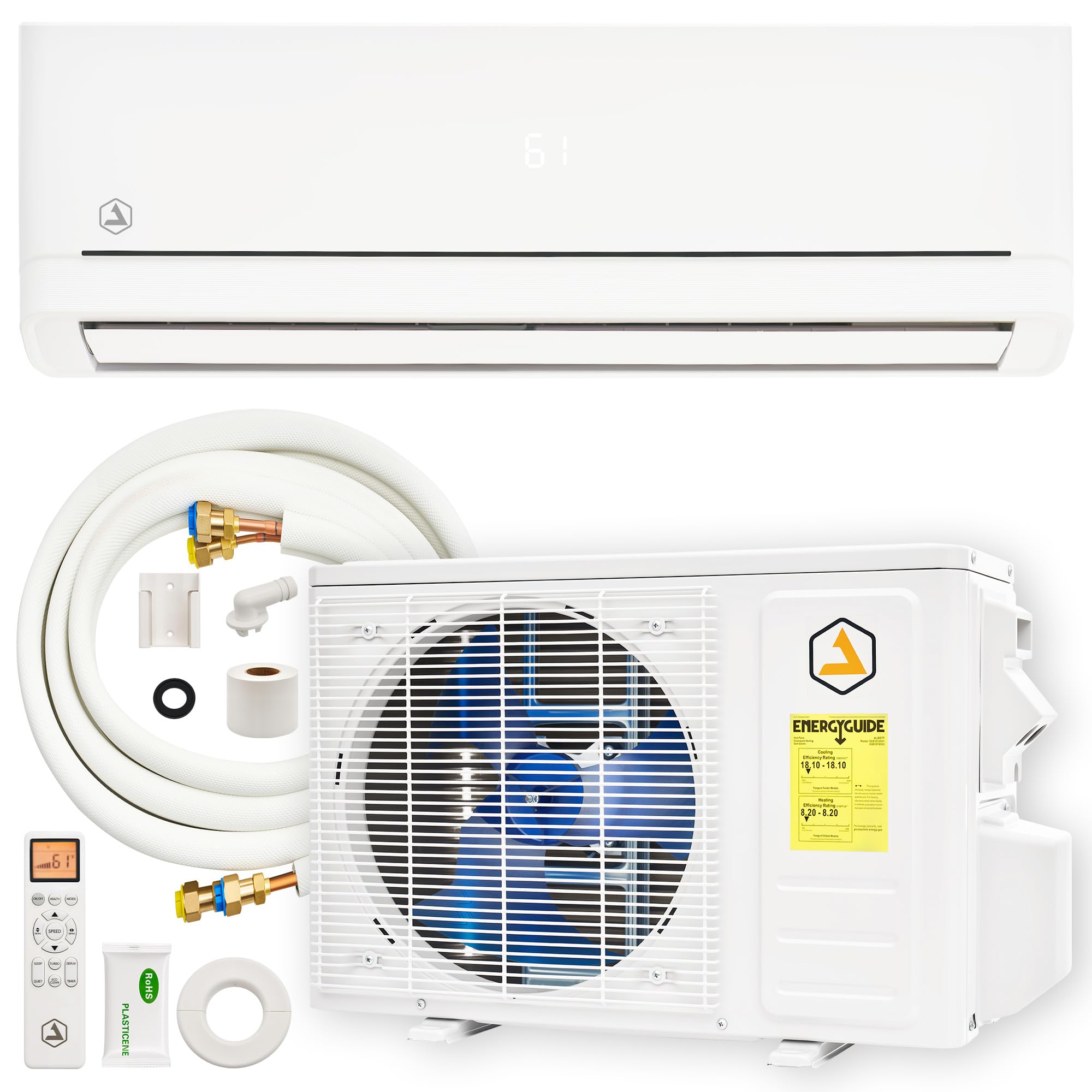
The pre-wired indoor unit with a no-vacuum outdoor unit, so a handy homeowner can finish the install in an afternoon.
Albott took the friction out of the install on purpose. The indoor side comes pre-wired so you skip a chunk of the on-site wiring, and the outdoor unit needs no vacuuming at all — two steps where most mini splits stall a first-timer. The listed annual energy consumption is 750 kilowatt hours per year, the lowest figure in this roundup, on an 18 SEER2 inverter heat pump that runs on 115V. It cools and heats up to 750 square feet and adjusts from 61°F to 90°F.
What makes this a genuinely comfortable system is the small stuff. Sleep mode and a 24-hour timer handle overnight comfort, there is a self-cleaning cycle, and the filters and air blades come off for easy washing. It runs between 5°F and 122°F outdoors, so it handles most of the country. The warranty is worth noting: a 5-year compressor and a 7-year parts warranty, one of the longer coverage terms in this group. Owners describe the install as a 2-hour job for someone reasonably handy. As one buyer put it simply, “I love this unit, its priced right, it cools down the room in minutes, very quite you cant tell its running.”
The two honest gripes are worth knowing. The automatic mode temperature is reportedly fixed at 77°F and cannot be changed, which limits how much you can fine-tune in auto. And this is the lowest efficiency rating in the roundup at 18 SEER2, so it costs more to run per hour than the Senville, ROVSUN, or TOSOT picks above. The parts are also lighter duty than a premium system — thinner copper lineset and a bendable bracket — but the savings land in your pocket up front.
Where the money goes: the pre-wired indoor unit and no-vacuum outdoor unit are the whole pitch — they turn a two-person weekend into a solo afternoon.
Pick this if: speed and simplicity of install matter most, and your climate stays above 5°F in winter.
Consider upgrading if: you want top-tier running efficiency — at 18 SEER2 this is the least efficient pick on the list.
6. DELLA Serena 22 SEER2 12000 BTU Mini Split Heat Pump Works with Alexa

Geo-location smarts that warm the house before you pull into the driveway.
The Serena’s party piece is genuinely unusual. Beyond Alexa and Google Home voice control and the DELLA app, it uses geo-location to adjust the temperature based on where you are — it eases off when you leave and has the room ready when you are on your way home. It carries a 22 SEER2 rating with a 5-star BEE score, is Energy Star certified, and the maker puts the power savings at up to 57% on this inverter system. It runs on 208-230V and comes pre-loaded with R32 refrigerant for line runs up to 25 feet.
The build is strong too. You get 4D airflow — up and down plus left and right — along with I Feel mode, a 24-hour timer, sleep mode, eco mode, turbo, and dry mode, and it handles rooms up to 550 square feet. It runs cool and heat down to 5°F with a bottom heating element on the outdoor unit that prevents ice buildup in winter. The 16.4 ft. installation kit is included, with standard 1/4-inch and 3/8-inch copper pipes and a 78.7-inch drain line. In mute mode it drops to 22 dBa, and the unit won a 2025 Red Dot Design Award.
What keeps it from the top tier is temperature control consistency. Some owners find it holds a building at a perfect temperature, while others report it does not heat quite as described — a gap that shows up most in very cold conditions. Set expectations for soft shoulder seasons and moderate winters, and it performs as advertised. Installation is professional-only per DELLA, and line-set vacuuming is required, so a licensed tech handles the final steps.
The smart angle: the geo-location feature is the one thing here no other pick on this list offers, and it is a real convenience if you commute.
The consistency question: heating output is reported as strong but variable in cold weather, so lean on it as a shoulder-season heater or pair it with backup.
Ideal for: tech-forward owners who want app, voice, and location control in one efficient package.
Not the pick for: deep-freeze climates where heating consistency needs to be absolute.
7. ACiQ Essentials 12000 BTU 115V 20 SEER2 Mini Split AC/Heating System, White
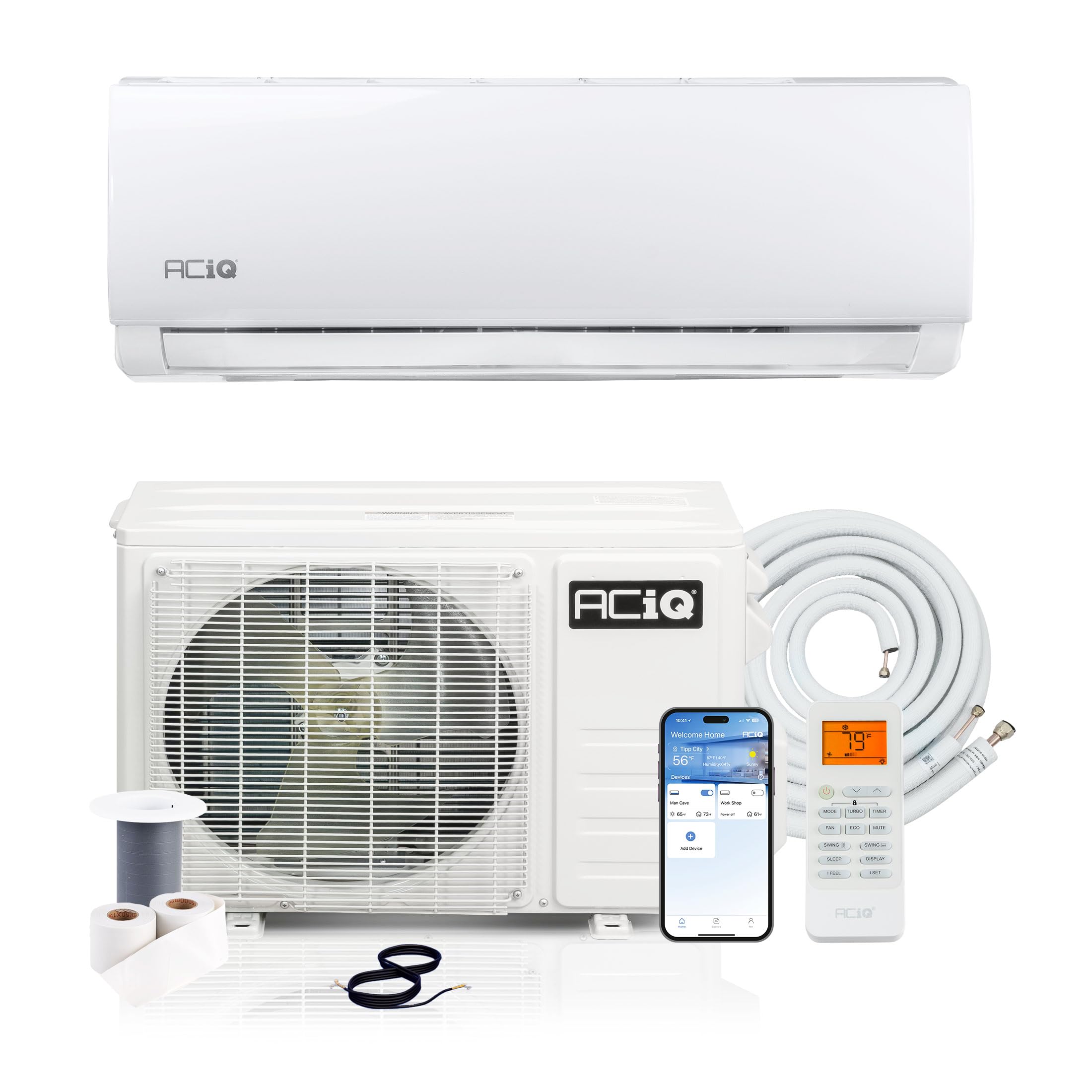
The 20 SEER2 kit sized for a 400-600 sq. ft. garage, attic, or shed, with the full line set and mounting hardware included.
ACiQ built this for spaces that are not the main house. The 12,000 BTU unit is aimed at rooms around 400 to 600 square feet — an RV, bedroom, office, attic, shed, or small garage — and it is a heat pump, so it works both directions. It is AHRI rated at 20 SEER2 and 10 HSPF2 for year-round efficiency, with reliable cooling from 5°F to 127°F and heating within -4°F to 75°F outdoor temperatures. The rotary DC inverter compressor adjusts output up to 12K BTU and keeps it quiet while it does.
The feature list is longer than the size would suggest. You get timers, I Feel, Sleep, Eco, Mute, Turbo, Fan Only, and Dry modes in a wall-mounted white unit, and it is Wi-Fi ready through the SmartLife-SmartHome app on iOS or Android. The outdoor unit comes pre-charged with enough R32 refrigerant to fill the included line set with no top-up needed — vacuuming is still required. The kit is complete: a 16 ft. line set, remote with mount, power cable, indoor mounting plate, outdoor rubber feet, wall cap, drain elbow and line, plasticene, and screws with anchors. Register online and you get 4 years on parts and 6 years on the compressor at no extra charge.
Two honest notes. The air handler body is described as somewhat flimsy in the hand, though it works quietly and effectively once mounted. And the instructions are vague, especially on the wiring — plan to have a pro pull the vacuum lines regardless. This is a system that rewards a careful, patient install over a rushed one.
Why the kit matters: nearly every small bracket, drain, and mounting piece is already in the box, so the shopping list before install day is short.
Choose it if: you are conditioning a garage, attic, or shed and want generous mode options plus a long registered warranty.
Steer clear if: you need detailed factory instructions or a beefier-feeling air handler.
8. DELLA Optima Series 12,000 BTU Mini Split AC, Hyper Heat Down to -13°F

The 23 SEER2 hyper-heat pick rated to -13°F, with gold-plated fins and a bottom heating element to fight ice buildup.
When the forecast goes negative, this is the DELLA you want over the Serena. The Optima is rated for hyper heat down to -13°F, carries a 23 SEER2 rating with 10 HSPF2, and runs on 115V — standard household voltage — with a 1-ton pre-charged heat pump. It covers rooms up to 550 square feet and ships with a 16.4 ft. pre-flared and insulated copper line set plus a 6.56 ft. drainage extension. That 23 SEER2 rating puts it among the most efficient picks here, behind only the Senville AURA and the ACiQ on the cooling side of the ledger.
DELLA put real effort into cold-weather engineering. The outdoor unit uses gold-plated fin technology to resist freezing and rust, which the maker says speeds up defrosting and boosts heat efficiency. There is a bottom heating element to stop ice buildup, a reusable filter for easy seasonal cleaning, and the indoor panel has a textured finish that blends into living space. Controls include six modes — cooling, heating, dry, dehumidifying, auto, and fan — plus 4D airflow, eco mode, sleep mode, a timer, and I Feel mode, all reachable through the Della+ app or Alexa. In mute mode it runs as low as 30 dB(A).
The one thing to go in knowing: durability is the soft spot in the owner feedback, with warranty claims and occasional outdoor-unit rattling coming up more than you would like at this price. That does not sour the pick — most customers note strong performance and quiet indoor operation — but read the registration terms carefully, because coverage depends on registering the system correctly. Professional installation is required, and the line set must be vacuumed.
Why cold climates like it
- Rated hyper heat down to -13°F with gold-plated fins to fight freezing
- 23 SEER2 and 10 HSPF2 for strong year-round efficiency
- Runs on 115V standard household voltage
Keep an eye on
- Warranty registration must be done correctly or coverage can be denied
- Some reviewers point out occasional rattling from the outdoor unit over time
Made for: northern homes and outbuildings where heating through a real winter is the whole point.
Less suited to: buyers who want rock-solid long-term durability guarantees — register the warranty the moment it is installed.
9. Cooper & Hunter MIA 12,000 BTU 115V Wall Mount Mini Split AC, 21.2 SEER2

The 21.2 SEER2 system quiet enough for a recording studio, with a smart kit for app scheduling.
Cooper & Hunter’s MIA Series leans hard on the word quiet, and the owner reports back it up. It runs on 115V with a 21.2 SEER2 inverter compressor, signed off as UL Listed and AHRI Certified, and it works for both residential and small commercial spaces. This is the pick for a recording studio, a bedroom, or a living room where any compressor whine would be noticed — one buyer runs one inside a recording studio on silent mode and finds the noise floor acceptable.
The smart side is well covered. A smart kit is included, so you can set schedules, adjust temperature, and control the system remotely through a phone app. The full install kit comes with a 16 ft. pre-flared and insulated copper line set, 16 ft. of communication wire between the two units, and a 16 ft. drainage extension. It works for heating with outdoor ambient temperatures up to 5°F, and Cooper & Hunter runs U.S.-based technical support for the life of the system. It cools up to 550 square feet, and several owners buy multiples for a whole house.
Two spots to watch. Durability reviews land as mixed — a few shoppers say issues within the first few months, though plenty of long-running units tell a very different story, including one that qualified for an energy rebate and then added three more of these to a property. And the preinstalled drain connection inside the head unit has been reported as loose on some units — that is fixable with a better hose clamp but worth checking before you button everything up.
The noise story: owners put this in bedrooms and recording studios specifically because it stays quiet on both the indoor and outdoor side, which is rare in this price range.
Worth checking on arrival: give the internal drain connection a snug-up before you finish the install to avoid a drip into the room.
Suits you best if: low noise is non-negotiable and you want app scheduling plus U.S. tech support behind the unit.
Not your pick if: you want the longest track record — a handful of owners have hit early reliability snags.
10. Daikin 12,000 BTU 18 SEER2 Entra R32 Series Heat Pump Mini Split A/C

The contractor-grade brand with a 4,400 BTU turndown that resists short-cycling and lasts for years.
Daikin is the heavyweight name in this roundup, and the Entra series is pitched squarely at buyers who plan to keep the system for a decade or more. It hits 12,000 BTU of cooling and 11,300 BTU of heating, both over wide modulation ranges — cooling down to 4,400 BTU minimum and heating up to 16,400 BTU peak. That turndown range is the technical trick that keeps the unit from short-cycling and lets it match the load exactly, which is why contractors consider it a longer-life machine. It rates at 18 SEER2, 9 HSPF2, 8.5 EER2, and 3.30 COP on DC Inverter tech, and covers up to 550 square feet.
The comfort feature set is contractor-grade. You get customizable air direction, Powerful Operation for a quick temperature swing, ECO+ efficiency mode, Blue Fin coil protection, and a Titanium Apatite Photocatalytic Air Purifying Filter for air quality. It runs on R32 refrigerant and ships with a 15 ft. Maxwell line set, interconnecting cables, and a wall mounting bracket. Cooling works from 50°F to 115°F outside, heating from 5°F to 65°F. It is the pick for a sunroom, basement, attic, garage, or any space where ducts are impractical. Owners who bring in HVAC contractors report clean installs and minimal fuss.
Two hard truths to weigh. Daikin commands a premium price, and owners consistently say the warranty and longer life justify it — with the caveat that this is a professional-install system and a self-install can void that warranty entirely. One owner who went the DIY route said if they had it to do over, they would pick something with a warranty that covers self-installation. The value-for-money reviews land as mixed, which mostly reflects that premium price tag rather than the hardware itself.
The long-game argument: contractor-backed build quality and an R32 platform are what you are paying for, not the efficiency score, which lands mid-pack at 18 SEER2.
The catch: professional installation is effectively mandatory, and skipping it puts the warranty at risk.
Buy it if: you want a recognized premium brand and plan to keep the system for many years with proper installed service.
Look at the Senville or ACiQ instead if: efficiency or upfront cost matters more than the label on the box.
11. MRCOOL 12000 BTU Ductless Inverter Mini Split Air Conditioner & Heat Pump
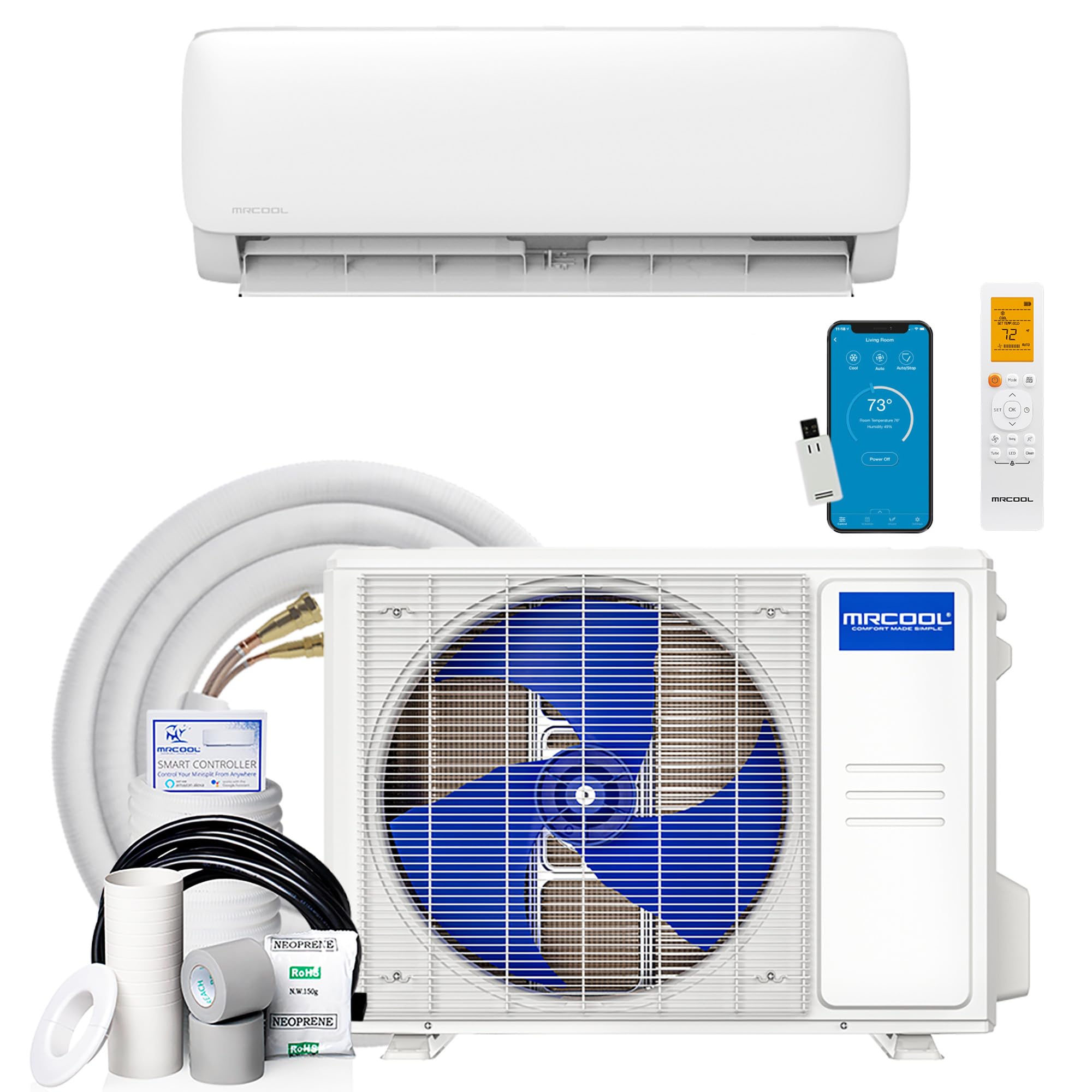
Preheat the house from the car and skip the mess of a hands-on install.
MRCOOL built this system for the buyer who values scheduling over everything else. It is 12,000 BTU with both heating and cooling, sized for up to 550 square feet, and it is ductless, so installation is streamlined with less mess than a ducted system — the maker bills it as a lower-cost route than traditional HVAC. The standout is control flexibility: you can run it by app, remote, push button, or voice, which lets you preheat or precool and set schedules from anywhere. Buyers call that out directly: “Super easy install. I especially love that it is Wi-Fi enabled, so we can preheat/cool and set schedules remotely.”
It is genuinely easy on the install too. The kit includes the system and its lineset, and the ductless design keeps the footprint small. For a kitchen, living area, or a room where you want comfort to arrive before you do, the connected feature set is what this pick does best. It is a solid, straightforward system that does its job without asking a lot of you.
The honest catch is the electrical. The DIY-friendly install extends up through the mechanicals, but the final electrical hookup still needs a professional — so price that before you commit, because it changes the true cost. And durability reviews land as mixed: owners mostly describe an awesome, easy system, but a few report the copper line breaking at the weld points. Size the system correctly, as one owner advises, and the performance stories are positive — “Great at both heating and cooling! Very quiet!”
What makes it easy to own
- App, remote, push button, and voice control in a single system
- Schedules and remote preheat/cool make it very convenient to live with
- Ductless design keeps installation simple and clean
Where to plan ahead
- Electrical hookup still needs a licensed pro, so price it before buying
- Some buyers report line-set weld failures over time
Great fit if: remote scheduling and preheat/cool convenience matter, and you want the ductless install kept simple.
Think hard if: you want rock-solidlong-term durability — a few owners mention weld-point failures on the line set.
Understanding the Specs
SEER2 and HSPF2 explained
SEER2 is the efficiency score for cooling — think of it as how much cold air you get for every watt of electricity you pay for, so a higher number means a smaller bill in summer. HSPF2 does the same job for heating season, and the two together tell you how expensive a system will be to live with all year. A 25.5 SEER unit like the Senville AURA and a 20 SEER2 unit like the ROVSUN are both efficient, but the higher score uses less power for the same cooling. Always compare SEER2 to SEER2 and HSPF2 to HSPF2 — never mix an old SEER number with a new SEER2 figure, because the tests changed.
Inverter compressors and why they matter
An inverter compressor is a motor that can spin at many speeds instead of only on or off, so it slows down to hold a temperature rather than blasting cold air and shutting off. That steady running is why these systems stay quiet, keep the room temperature even, and cost less to run than an old window unit that cycles hard. The Daikin Entra, for example, can throttle its cooling output all the way down to 4,400 BTU when the room is nearly satisfied. In practice, an inverter system feels less drafty and holds a set temperature within a degree or two instead of swinging hot and cold.
Cold-climate heating ratings
The temperature rating on a heat pump tells you how cold it can get outside before the unit stops producing useful heat, and it is the single biggest reason two 12,000 BTU systems behave so differently in January. The Senville AURA is rated to -22°F, the DELLA Optima to -13°F, and many budget picks like the ROVSUN work in moderate climates but are not built for deep freezes. If you live where winters drop below zero, pick a system with a rated low-end that matches your worst week, not your average one. That rating is a hard limit, so treat it as the deciding factor.
Room sizing in square feet
Sizing a ductless system by square footage is the fastest way to get it right. This group of 12,000 BTU units covers anywhere from about 550 square feet to 750 square feet, depending on the model and how well your space is insulated. A single well-insulated bedroom sits well under 400 square feet, a living room may need the full 550, and a garage, attic, or converted space often runs larger with weaker insulation. Oversizing wastes money and short-cycles the compressor, while undersizing leaves the unit running flat out and never quite catching up.
FAQ
What size room does a 12000 BTU mini split heat pump actually cool and heat?
Do I need a licensed HVAC technician to install a 12000 BTU mini split?
Can a 12000 BTU heat pump run on standard household 115V power?
How low can the outside temperature drop before these units stop heating?
Is a 25.5 SEER system worth it over a cheaper 18 SEER2 unit?
What does the annual energy consumption figure tell me before I buy?
Do these mini splits work in a garage, RV, or attic?
How quiet are these systems at night in a bedroom?
What refrigerant do these 12000 BTU heat pumps use?
Can I make a 12000 BTU mini split a DIY install and keep the warranty?
Final Thoughts: The Verdict
For most buyers, the strong all-around winner is the Senville AURA 12000 BTU — it pairs the highest efficiency in this group at 25.5 SEER with the deepest cold-weather rating at -22°F, so it earns its place at the top for anyone who wants a system to run through real winters without a backup heat source. If you want the lowest running cost on a 115V circuit and do not mind doing the install yourself, the ROVSUN 12000 BTU uses 1488 kilowatt hours per year against the Senville’s 2100 and keeps the upfront cost down. And for a cold-climate room where heating matters more than anything else, the DELLA Optima is the one to reach for with its -13°F hyper heat rating and 23 SEER2 efficiency. Whatever you pick, size it to your room and match the rated low temperature to your worst winter week, and it will serve you for years.
How We Picked
We do not accept paid placement. Every pick is matched to a real buyer and a real use-case; we do not hands-on test units.
Sources & Methodology
Specifications: manufacturer listings and product documentation. Review insights: verified customer reviews, as of September 2026. Pricing: not shown on this page (it changes often); check the current price via the retailer link.
As an Amazon Associate, KitchPrep earns from qualifying purchases. This does not affect which products we feature.
Related Guides
