
Specs are compiled from manufacturer listings and verified buyer reviews and can change over time — please confirm the key details on the product page before buying.
If you are running a winch, an inverter, or a second battery bank, the wire you pick decides whether the job runs cool or cooks itself. Two-gauge copper is the size most serious 12-volt and 48-volt builds land on, and the difference between a good roll and a bad one shows up fast: stiff jackets that fight every bend, undersized strands that run warm, and copper-clad aluminum sold as “copper.” This guide walks through eight 2-gauge wires that real buyers have put through automotive, marine, and solar work, and it tells you plainly which one fits which job.
I’m Mohammad Maruf — the founder and writer behind KitchPrep. This guide is built by comparing the manufacturers’ published specifications and the patterns across verified customer reviews, so you get each pick’s real strengths and trade-offs instead of marketing spin.
A quick way to frame the decision before the deep dive: match the strand count and jacket material to your environment, then buy the length that finishes the job. Strand count tells you how willingly the wire bends, the jacket tells you what it survives, and length mistakes are the ones people pay for twice. That is the whole logic behind this breakdown of the 2-gauge wire options worth your time.
Our Picks at a Glance

How To Choose The Best 2-Gauge Wire
Choosing a 2-gauge wire is really three separate decisions: how the copper is built, what the jacket has to survive, and how long the run needs to be. Get those three right and you will not think about the wire again for years.
Strand count decides how the wire feels in your hand
Two-gauge wire is not solid rod, it is a bundle of thin copper strands twisted together, and the number of those strands changes everything about handling. A cable built from a very high strand count drapes into tight corners and pulls around an engine bay without fighting you. A lower strand count stays stiffer, which is fine for a straight shot but annoying when you are routing through a frame rail. If your run bends sharply, prioritize the higher strand figures.
Jacket material is your real durability spec
The insulation is what decides whether the cable survives oil, salt spray, engine heat, and sunlight. EPDM (a rubber-style jacket that resists solvents) and PVC both work, but they behave differently under heat and abrasion. Tinned copper strands add corrosion resistance for boats and damp environments, while bare copper keeps cost down for dry automotive builds. Match the jacket to where the wire actually lives, not to the spec sheet you like best.
Buy the right length once
Cutting a run short forces a splice you did not want, and buying a coil twice as long leaves expensive copper sitting on a shelf. Measure your route, add the slack for corners and terminals, then commit. Multi-length and multi-color kits spread across red and black are the simplest way to get everything in one order.
Quick Comparison
| Model | Best For | Gauge | Length & Color | Strands / Build | Amazon |
|---|---|---|---|---|---|
| WindyNation 2 AWG Kit (Red + Black + Lugs)★ Best Overall | One-order complete installs | 2 | 10 ft red + 10 ft black | Multi-strand, annealed copper | Amazon |
| WindyNation 2 AWG 20 ft BlackLongest Run | Long single-run power feeds | 2 | 20 ft black | Single strand build, EPDM jacket | Amazon |
| EWCS Premium Welding Cable 25 ft RedMost Flexible Strand Count | High-current winch and starter feeds | 2 | 25 ft red | 636 strands, 30 gauge stranding | Amazon |
| Kimbluth 2 Gauge Cable (5 ft Red + 5 ft Black) | Audio and general 12V wiring | 2 | 10 ft total (5 ft + 5 ft) | 0.256mm strands, 90 mil PVC | Amazon |
| YDDECW Marine Tinned Wire (5 ft Red + 5 ft Black) | Boat, RV, and damp installs | 2 | 5 ft red + 5 ft black | 665 tinned strands, 1.52mm PVC | Amazon |
| KEDAKEJI 2 AWG Cable 3/8 in Lugs (4 ft) | Parallel battery bank bridges | 2 | 4 ft red + 4 ft black | Oxygen-free copper, tinned lugs | Amazon |
| KEDAKEJI 2 AWG Cable 5/16 in Lugs (4 ft) | Compact inverter hookups | 2 | 4 ft red + 4 ft black | Oxygen-free copper, tin-plated lugs | Amazon |
| Spartan Power 2 AWG DIY Bulk 10 ft Black | Custom-length DIY cable builds | 2 | 10 ft black | 651 strands, EPDM jacket | Amazon |
In‑Depth Reviews
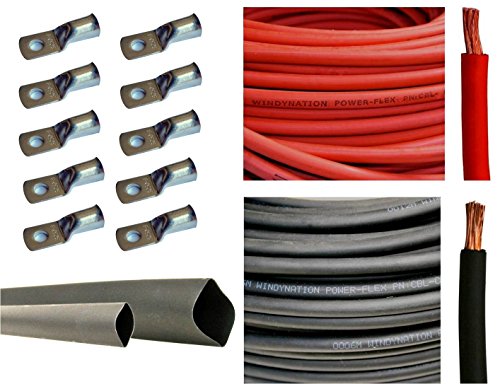
1. 2 Gauge 2 AWG 10 Feet Red + 10 Feet Black Welding Battery Pure Copper Flexible Cable + 10pcs of 3/8″ Tinned Copper Cable Lug Terminal Connectors + 3 Feet Black Heat Shrink Tubing
Our pick — over 4.5★ from 800+ verified ratings; the strongest balance of quality and price.
One order that ends the parts run: two colors of 2-gauge copper plus every connector you need.
What makes this the pick at the top is the packaging, not just the wire. You get 20 feet of 2-gauge cable split evenly into 10 feet of red and 10 feet of black, and the listing ships 13 pieces in total. That count matters because the box also holds ten tinned copper lugs with 3/8-inch holes and 3 feet of black heat shrink tubing. For anyone wiring a winch or a house battery, that is the whole shopping trip in one delivery rather than three.
The copper itself is fully annealed, which is a heat treatment that softens the metal so it bends instead of springing back. WindyNation pairs that with an EPDM jacket (a rubber-style insulation that shrugs off solvents), and the cable is rated to 600 volts. What owners walk away talking about is exactly this: the fit and finish of a real welding-grade cable. It holds 4.8 stars across 800+ owners, who rate the copper quality first and the smooth install second. It is, as one condensed buyer account describes it, “highly flexible, tightly packed wire” that shrugged off a 2800-amp test burst before the jacket finally gave up.
There is one honest wrinkle to plan around. The heat shrink in the kit is real and rated from -55 to 125 Celsius with a 600-volt maximum, but project builders have found there is less of it than the listing suggests, and some swap in their own brand for a stickier adhesive hold. Buy the kit for the copper and the lugs, and treat the tubing as a bonus rather than a full-length solution.
Why This Kit Earns The Top Spot
- 13 pieces in one box: 20 feet of cable, 10 tinned lugs, and 3 feet of heat shrink
- Fully annealed pure copper that stays supple instead of kinking
- 3/8-inch closed-end tinned lugs resist corrosion for outdoor and marine work
- 600-volt rating with a solvent-resistant EPDM jacket
What To Know Before You Order
- Heat shrink runs shorter than the listing implies; some buyers supply their own
- 3/8-inch lugs only — check your stud size if you need 5/16 inch
- At this price it is the premium end of the mid-tier, not a throwaway roll
Buy this one: if you want a winch, inverter, or dual-battery job finished in a single order with no missing hardware.
Keep looking: if your project only needs raw wire by the foot and you already own lugs in the size you need.
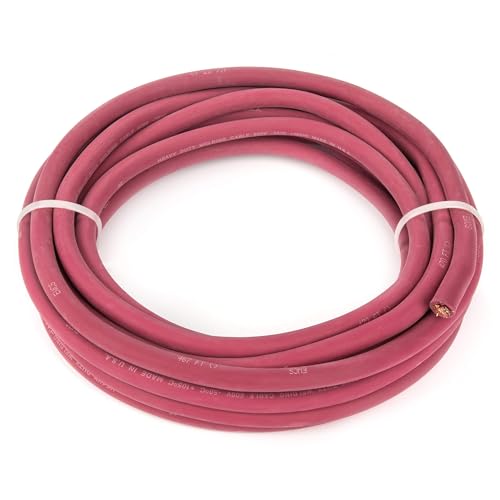
2. 2 Gauge 2 AWG 20 Feet Black Welding Battery Pure Copper Flexible Cable Wire – Car, Inverter, RV, Solar
Twenty uninterrupted feet of annealed copper for the one long run nothing else reaches.
When a build calls for a battery-to-rear power feed, this is the roll that solves the problem in a single piece. Ten feet of the same family’s kit cable runs out around 10 feet; this one keeps going for 20, and it is the longest single-length option on this list. Longer still sits the EWCS coil at 25 feet, but that roll is red — for a black ground-side run, this is the one. The copper is fully annealed per ASTM standards and complies with SAE J1127, and the EPDM jacket shrugs off solvents and heat the way the rest of the WindyNation line does.
The temperature window is the part worth repeating before you buy: -50 to +105 Celsius, which is -58 to +221 Fahrenheit, and the cable carries a 600-volt rating with IEC and RoHS compliance. What wins people over on this specific roll is how eagerly it flexes — the wire is the most-praised trait in its own reviews, and the value per foot lands right behind it. One buyer ran a 22-foot boat amp feed at 1300 watts without complaint, and another pulled it along a truck frame through repeated rerouting with the insulation intact.
The catch is volume. One 20-foot black coil is not a red-and-black set, so if you are running a paired positive and negative you will either buy two rolls or step back to the kit up top. Some buyers have also flagged the material description as inconsistent, so if absolute purity certification matters to you, verify before the cut. Note the listing prints gauge as 8 in one field; the model number and title both read 2-AWG, and every buyer description centers on true 2-gauge performance.
Where it shines: a single 20-foot unbroken run is the reason to buy — no splices, no wasted red you will never use, and the same annealed copper people keep reordering for truck and boat power feeds.
The trade-off: one color only, so paired runs cost double, and mixed material feedback means the value hinges on how much you trust the spec.
Reach for this if your install is one long black ground or power leg and you want it cut from a single piece.
Look elsewhere if you need matched red and black in the same box for a two-cable job.
3. EWCS 2 Gauge Premium Extra Flexible Welding Cable 600 Volt – Red – 25 Feet – Made in The USA
Fine-strand copper that folds into tight corners and still feeds a winch under load.
The number that defines this cable is 636 strands of copper wound from 30-gauge wire, and that fine construction is precisely what makes it drape like rope. It ships as a 25-foot red coil with a sunlight-resistant and water-resistant jacket, and it carries a 600-volt rating. Alongside the Kimbluth roll’s handling and the YDDECW marine cable’s flexibility, this one sits at the top of the handling ladder for raw pulls — a rubber-like jacket that stays pliable while resisting abrasion and heat.
The most-praised trait in its own reviews is that flexibility, and it earns the description through real work. Buyers rewired golf carts with soldered and crimped ends and reported the cart running better, and one used it for a trunk-mounted battery conversion where the pliable jacket handled a full starting load. Another built quick-disconnect leads for a 12,000-pound truck-mounted winch and said the wire supplies the high current needed when the winch is under full load. Soldered and crimped terminations both seat well on this jacket.
Two honest notes. The first is length — 25 feet of red is far more than most jobs need, so plan your cut before you buy. The second is a fit question some buyers raise: the wire can slide loosely into 4-gauge eyelets, which makes a snug crimp on the correct 2-gauge terminal something to check yourself rather than assume. Neither is a reason to pass if you want maximum flexibility on a big current run — just measure first and crimp with conviction.
What Buyers Praise Most
- 636 fine strands from 30-gauge copper for a rope-like drape
- Jacket resists sunlight, water, and abrasion for outdoor routing
- Handles full winch and starter loads, per condensed buyer accounts
- 25 continuous feet — the longest single length here
Where It Falls Short
- Red only, so a matched ground side means a second purchase
- Fits into 4-gauge eyelets loosely, so verify your terminal size
- 25 feet is overkill for short battery links
Best fit: trunk-mount battery conversions, golf cart rewires, and any winch feed where the cable has to snake through narrow space.
Think twice: if your run is short or you need both colors from one order.
4. 2 Gauge Battery Cable Copper Wire, 5FT Red + 5FT Black

A red-and-black pair of 2-gauge copper that punches well above its price tier.
Kimbluth’s roll is what a budget-minded build should start with: 5 feet of red and 5 feet of black of 2-gauge cable made from 99% pure oxygen-free copper, and the pair arrives ready to route. The copper is twisted from high strands of 0.256mm wire, wrapped in a 90 mil PVC jacket that resists oxidation, gasoline, battery acid, and abrasion. It carries a 600-volt rating and works across a healthy temperature band from -40 to 105 Celsius, which covers engine bays and cold garages alike.
What stands out across its many owners is the value and how genuinely flexible the insulation feels on tight routes. The wire is real copper rather than the copper-clad aluminum that trips people up in this category, and buyers describe it cutting and stripping cleanly. A common theme is exactly how it performs for power blocks and general 12V work — one owner fed an auxiliary power and ground block in a truck and reported it perfect for the job with a bit of spare left over. Handling is a real strength here, with the jacket bending to a maximum diameter of about 1.75 inches.
The one thing to watch is length. The listing reads as 10 feet total, and while most buyers confirm the black and red both measure true, some report a shortfall against a 20-foot reference — so measure your route before you commit. If your job runs longer than about five feet per side, step up to the 10-foot WindyNation kit and you will not come up short.
Why it wins on value: a matched red-and-black pair in true 2-gauge OFC copper with a chemical-resistant PVC jacket — the entry point that still does real electrical work.
Caveat to weigh: roughly 5 feet per color limits you to compact runs, and length expectations deserve a double-check before ordering.
Pick this for car audio, auxiliary power blocks, and short battery links where every foot counts against the budget.
Skip it if your run needs more than five feet per side or you need pre-crimped lugs attached.
5. 2 Gauge Marine Wire, 2 AWG Tinned Copper Electrical Wire, Boat Cable for Automotive, Solar, Car Audio, Trailer, Camper & Marine Wiring (2 AWG, 5FT Red + 5FT Black)
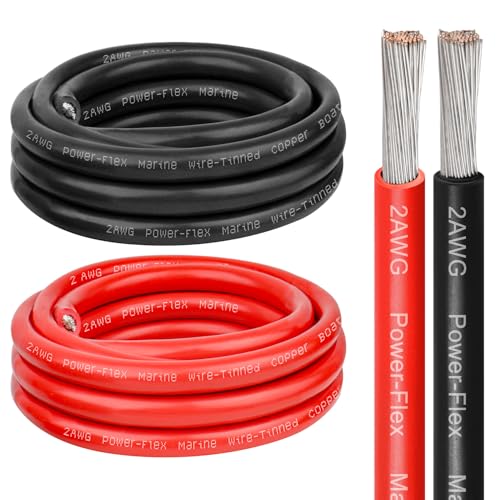
Every strand is tin-plated, so salt spray hits the jacket instead of eating the copper.
Tinned copper is the whole reason to own this one. Each of its 665 strands is coated in tin before the wire is bundled, which is what keeps saltwater from corroding the copper from the inside out on a boat, dock, or camper. The bundle measures 11.7mm in diameter, and it is wrapped in a 1.52mm PVC jacket rated from -10 to 105 Celsius with a 600-volt rating. The listing describes it as built for marine, automotive, and solar wiring projects and rated to 600V and 105 Celsius in dry conditions and 75 Celsius wet conditions, with lead-free, RoHS-compliant construction.
The strength here is real-world pliability under harsh conditions. Buyers repeatedly note the wire handles a 110-watt CB radio without complaint and that it feels more pliable than other 6-gauge options they have used. One built multiple solar setups and valued not having to worry about the corrosion bare copper would demand. The gauge itself is consistently reported as dialed in, which is not something you can take for granted when ordering wire online.
An honest note for the sun-baked crowd: the red jacket on this wire fades toward pink fairly quickly under direct UV, so if the run sits exposed on a deck, sleeve it or plan to live with the color change. It is a cosmetic gripe, not a performance one, and the electrical work stays solid. Choose this over the bare-copper options if your build touches water.
Where It Beats The Bare Copper Options
- 665 individually tinned strands for genuine saltwater corrosion resistance
- 1.52mm thickened jacket with a 600-volt rating for engine-bay and marine use
- Lead-free and RoHS-compliant construction for marine, auto, and solar wiring
- Reported bright and easy to work on solar and audio builds alike
The Honest Trade-Offs
- Red jacket fades toward pink under direct sun
- 5 feet per color suits compact runs, not long ones
- No heat shrink or lugs included; budget for your own ends
Choose this if your cable touches salt water, a dock, an RV exterior, or anything that sees repeated moisture.
Pass on it if your build stays bone-dry and you would rather save the tin-plating cost.
6. 2AWG Battery Cables – 3/8 in Lugs Set with Terminals (2pcs Red + Black) for Car, Marine, Solar, ATV – Oxygen-Free (4ft)
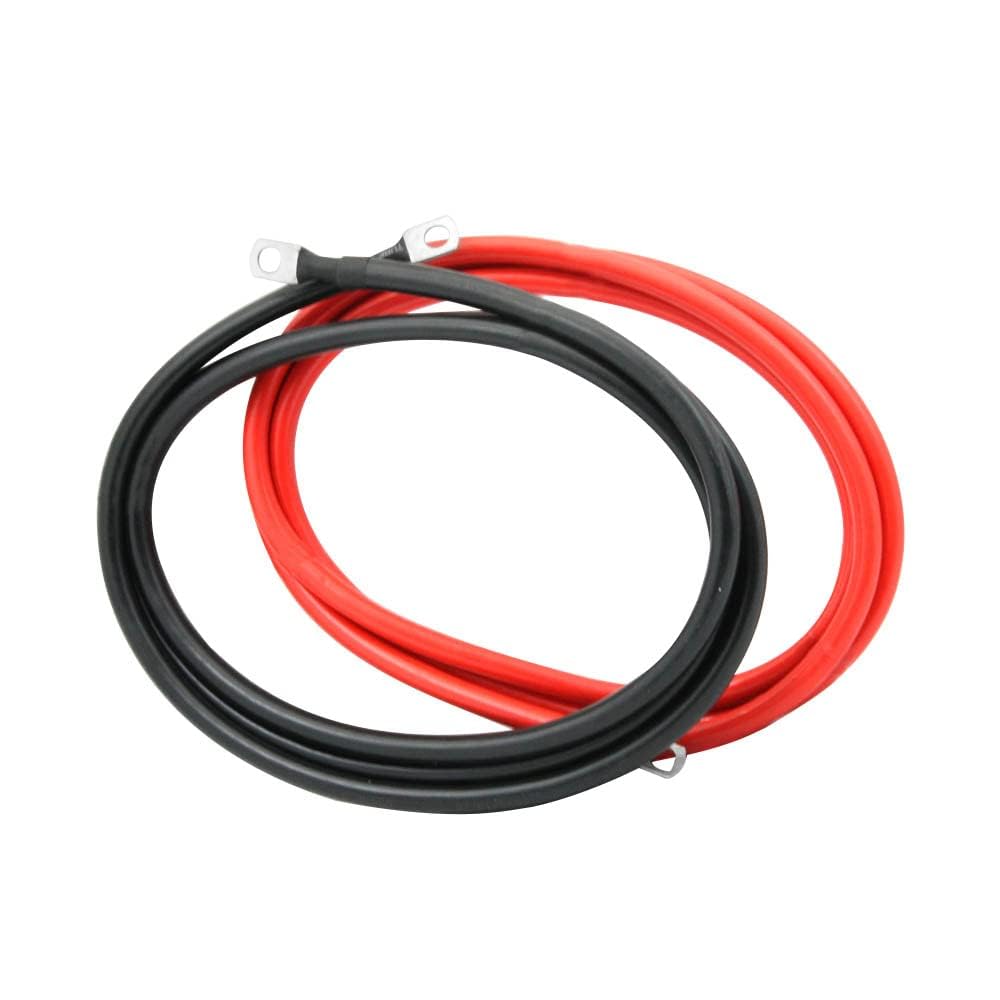
The 3/8-inch lugs are already on the wire, so it bolts straight onto your stud.
KEDAKEJI’s 4-foot pair comes out of the bag ready to mount. Both the red and black cables arrive with pre-attached lugs drilled with 3/8-inch holes, and the jacket is built to resist oil, gas, salt water, battery acid, heat, abrasion, and sunlight. The internal wire is oxygen-free copper, and the lugs are tinned for corrosion resistance with heat shrink applied over the joint to seal it against the weather. For a parallel battery bank or a solar array that lives outdoors, that sealing detail is the difference between a clean build and a corrosion problem down the line.
Owners consistently report the cable being the right size for the job with quality ends and shrink wrap ready to go. One ran it in a solar battery setup and reported the end connectors working perfectly; another bridged two 100Ah lithium batteries in a tracker with no complaints. Others have reordered it several times across different products, which tells you the fit-and-finish is consistent rather than a one-off.
There is one sizing trap worth flagging. The referenced pole for this class of cable turns up a 3/8-inch lug here, while the 5/16-inch variant elsewhere on this list suits tighter posts. Confirm your stud diameter before you buy a pair, because a lug that does not match means a return. As for length, 4 feet per cable is ideal for closely grouped batteries but tight for any run across a chassis, so plan your layout against the wire length first.
Best for: bridging parallel batteries, marine and ATV battery links, and solar arrays that need bolt-on 3/8-inch connections with no crimping required.
Not for: long-distance runs — the 4-foot cables stop short unless your components sit close together.
7. 2 AWG Gauge Battery Cable Red Black Pure Copper Battery Cables Power Inverter Wire Set for Solar RV Car Boat Automotive Marine Motorcycle with 5/16 in Lugs (4FT)

Two 4-foot cables with 5/16-inch rings that drop straight onto an inverter post.
This is the 5/16-inch version of the 3/8-inch KEDAKEJI pair, and that lug size is the whole choice between them. Both ends of the red and black cable carry a 5/16-inch ring, the wire is pure oxygen-free copper for maximum conductivity, and the terminals are tin-plated to hold off corrosion. The outer skin is a 105-degree flame-retardant PVC jacket designed to resist wear, water, moisture, and heat — the details that matter when the cable sits in a hot engine bay or an exposed marine environment.
Between this set and its 3/8-inch sibling, the lug hole is your only real decision, so match it to your stud and you are done. Buyers commonly report strong quality and correct fit on inverter and solar jobs. One noted the 2 AWG being the recommended gauge for connecting batteries in series or parallel, and that the length is just right for a tidy install with no wire hanging over the battery top. Another paired it with a 200-amp DC breaker on a 48-volt battery bank and reported it stayed cool.
Two things to plan for. The listing advertises tinned internal copper strands, but at least one buyer opened the cable, found the strands were not individually tinned, and still rated it four stars because it worked fine. For a dry, non-marine job that is a non-issue; for a boat, weigh that against the marine cable at position 5, which guarantees the tinning. Also give yourself a spare inch at the lug — one buyer had to file the hole slightly to clear a larger post.
Why It Belongs In Your Inverter Kit
- 5/16-inch pre-attached lugs bolt on with no crimping tools
- Oxygen-free copper wire with tin-plated terminals
- 105-degree flame-retardant PVC jacket resists wear, water, and heat
- 4-foot length keeps the layout tidy on dual-battery and solar builds
Plan Around This
- Strand tinning is not always as described — check yours before a marine install
- 5/16-inch lugs only; wrong-size posts will need filing or a return
- 4 feet per cable is tight across a full chassis run
Good match: inverter hookups, dual-battery setups, and solar rigs with 5/16-inch studs that reward a short, clean, tangle-free run.
Wrong call: if your posts are 3/8 inch — reach for the sibling cable with the larger lug instead.
8. Spartan Power Welding Lead & Car Battery Cable – DIY Bulk Automotive Grade Copper Wire – 600 Volt, 2 AWG, 10 Foot, Black

Bulk wire with paper separators, built for people who make their own cables.
This roll exists for the builder, not the plug-and-play buyer. It is a single 10-foot black length of 2-gauge cable made from 651 strands of pure copper with a 600-volt rating, wrapped in an ultra-flexible EPDM jacket that resists heat, abrasion, tearing, moisture, and oil. What separates it from the others here is the paper separators inside the jacket, which make stripping the insulation clean when you are crimping your own ends. Spartan Power manufactures this cable in the USA in Reno, Nevada. Note that it is listed in the 10-foot format; be sure to select the length you need when ordering.
The most-praised trait in its own reviews is the same flexibility that defines the raw wire — buyers describe it bending smoothly without kinking, which is exactly what you want when you are dressing a custom run. The strand size itself draws favorable attention, and one owner routing a battery-to-rear power run through a frame in an F150 confirmed it was real copper rather than copper-clad aluminum, delivering ample amperage headroom. Another replaced EZGO golf cart cables with it and reported minimal voltage drop and better cart responsiveness.
Before you commit, size-check against the actual wire. Buyers consistently report this rolls small — one who ordered a 4 AWG found it measured closer to 6 AWG, while a 2 AWG build ended up fitting 4-gauge terminals with a tight crimp. The copper is real and the jacket is tough, so it is not a quality problem, but it is a false-label trap; if you need a true 2-gauge fit, measure and adjust the size you order. That one caveat aside, for anyone building custom cables this is the roll to beat.
The DIY angle: paper separators plus a flexible EPDM jacket make this the friendliest raw cable here to strip and terminate by hand, and the 600-volt rating covers truck and motorhome DC work.
Size it carefully: it runs small, so buyers routinely size up to land a true 2-gauge fit.
For you if you solder and crimp your own terminals and want a single 10-foot black run you can cut to exact length.
Not the one if you want pre-attached lugs or a matched red-and-black set in one box.
Understanding the Specs
Strand Count
A high fiber count of very thin copper strands, often hundreds of them, drapes easily and resists fatigue from repeated bending. The EWCS cable at 636 strands and the YDDECW cable at 665 show what a fine bundle feels like. A lower count stays stiffer — the trade-off is less kink resistance on tight routes.
Jacket Material
EPDM is a rubber-style insulation that resists solvents, heat, and oils, while PVC is a plastic jacket that handles abrasion and chemicals at a lower cost. For damp or saltwater use, added tin-plating on the strands further resists corrosion.
FAQ
Can I use 2-gauge copper wire for a car battery?
What is the difference between 2-gauge welding cable and battery cable?
How do I know if my 2-gauge wire is really 2-gauge?
Is tinned copper 2-gauge wire better than bare copper?
What size lugs fit 2-gauge wire?
Can 2-gauge wire handle a 48-volt battery bank?
Do I need heat shrink on a 2-gauge cable install?
Will 2-gauge copper wire survive inside an engine bay?
How long should I cut a 2-gauge battery cable?
Can I splice two lengths of 2-gauge wire together?
Final Thoughts: The Verdict
For most builds, the 2-gauge wire winner is the WindyNation 2 AWG kit because it puts the cable, the lugs, and the heat shrink in one order — and the crowd backs it, with 4.8 stars from a deep pool of owners. If your priority is pure flexibility for a long, snaking run, the EWCS 25-foot roll folds into corners like few others. And for anything that touches salt water, the YDDECW tinned marine wire is the sensible reach — the tinning is doing the work that bare copper cannot.
How We Picked
We do not accept paid placement. Every pick is matched to a real buyer and a real use-case; we do not hands-on test units.
Sources & Methodology
Specifications: manufacturer listings and product documentation. Review insights: verified customer reviews, as of September 2026. Pricing: not shown on this page (it changes often); check the current price via the retailer link.
As an Amazon Associate, KitchPrep earns from qualifying purchases. This does not affect which products we feature.
Related Guides
