
Specs are compiled from manufacturer listings and verified buyer reviews and can change over time — please confirm the key details on the product page before buying.
You want a wall that looks like real bamboo without paying a carpenter. The trick is picking the right roll width and coverage for your space, because a 48-inch-wide panel and a 16-inch wrap solve completely different problems.
I’m Mohammad Maruf — the founder and writer behind KitchPrep. This guide is built by comparing the manufacturers’ published specifications and the patterns across verified customer reviews, so you get each pick’s real strengths and trade-offs instead of marketing spin.
You will see what each roll actually covers, how it cuts, and where owners hit snags. By the end you can pick a panel that fits your wall on the first order — this breakdown of best bamboo wood planks covers coverage, thickness, and installation tools.
Our Picks at a Glance

How To Choose The Best Bamboo Wood Planks
Bamboo planks are sold by the roll, and every roll covers a fixed patch of wall. Get that number wrong and you either run short halfway up an accent wall or you overspend on material you never unroll. Two numbers decide almost everything: the coverage in square feet, and the panel’s width.
Start with coverage, not length
Coverage is the real number you are buying, because it tells you the wall area one roll can dress. A long roll that is narrow gives you plenty of height but little width. Measure your wall in feet, multiply height by width, then divide by the coverage per roll. Round up, because seams eat a little material.
Match the width to the job
A wide panel is built for large flat surfaces like a full accent wall or a ceiling. A narrow wrap is built for columns, kitchen islands, and pole details, where you need the material to bend. Buying a 48-inch panel to wrap a curved island post wastes most of the sheet; buying a 16-inch wrap to cover a bedroom wall means many more seams to line up.
Think about how you will attach it
Bamboo slats arrive on a mesh or bonded backing. Straight runs on drywall usually take construction adhesive, while smaller pieces go up fast with a staple gun. Thin slats can be damaged by aggressive fasteners, so a light touch with brad nails or glue is the safer route. Check the manufacturer’s stated application method before you buy your supplies.
Quick Comparison
| Model | Best For | Coverage | Panel Width | Color | Amazon |
|---|---|---|---|---|---|
| Art3d 48 x 96 in Natural Bamboo Wall Panel★ Best Overall | Full accent walls and ceilings | 32 square foot | 48″ | Light-carbonized | Amazon |
| FONUNO Bamboo Wall Panel Pole Wrap Roll | Wrapping islands and furniture | — | — | Carbonized | Amazon |
| Natural Bamboo Wall Panel Pole Wrap | Kitchen walls and shelf edges | 11 sq ft | 16″ | Light-carbonized | Amazon |
In‑Depth Reviews
1. Art3d 48 x 96 in Natural Bamboo Wall Panel, 1-Pack, Light-Carbonized
Our pick — over 4★ from 650+ verified ratings; the strongest balance of quality and price.
One roll covers a whole accent wall, which is why this is the pick that finishes projects.
The number that decides it for most people is coverage: 32 square feet from a single roll measuring 96 inches long by 48 inches wide. That is three times the width of the 16-inch wrap further down this list, so where that narrow roll needs three passes to cross a wall, this one crosses in one. Hanging a bedroom feature wall or a ceiling panel becomes a weekend job instead of a week of seam-matching.
You can cut this material with tools you already own. Buyers slice it with sharp scissors, a mitre saw (a saw with a guided blade for angled cuts), or a utility knife run along a seam, and outlet cutouts come out clean with a razor or a rotary tool (a small spinning hand tool). It is light enough that one person can hold and position a full sheet while the glue sets. The finish is what wins people over most — the light-carbonized tone (heat-treated for color) reads as warm natural bamboo rather than a printed pattern. That waterproof, wear-resistant surface suits a kitchen backsplash as easily as a home office wall.
The honest catch is thickness and adhesion. The slats are thin, so staples and nail guns can crack them; construction adhesive or finishing nails placed carefully near the ends work far better. Expect to spend the bulk of your time on trim work rather than the panels themselves. A rare roll arrives scuffed or dirty from packaging, so give the roll a quick look before you start gluing.
What earns it the top spot
- 32 square feet from one 48-inch-wide roll
- Cuts clean with ordinary scissors or a utility knife
- Lightweight enough for one person to hang
- Waterproof and wear-resistant surface for kitchens
Where it tests your patience
- Thin slats can split under a staple gun or nail gun
- Trim work around outlets and corners eats a full day
Take this one home: buy it if you are covering a large flat wall or a ceiling and want to finish in a single pass.
Think smaller instead: wrapping a curved post or island leg? A wide flat panel is the wrong tool — reach for the narrow wrap below.
2. FONUNO Bamboo Wall Panel Bamboo Pole Wrap Roll for Interior Decoration
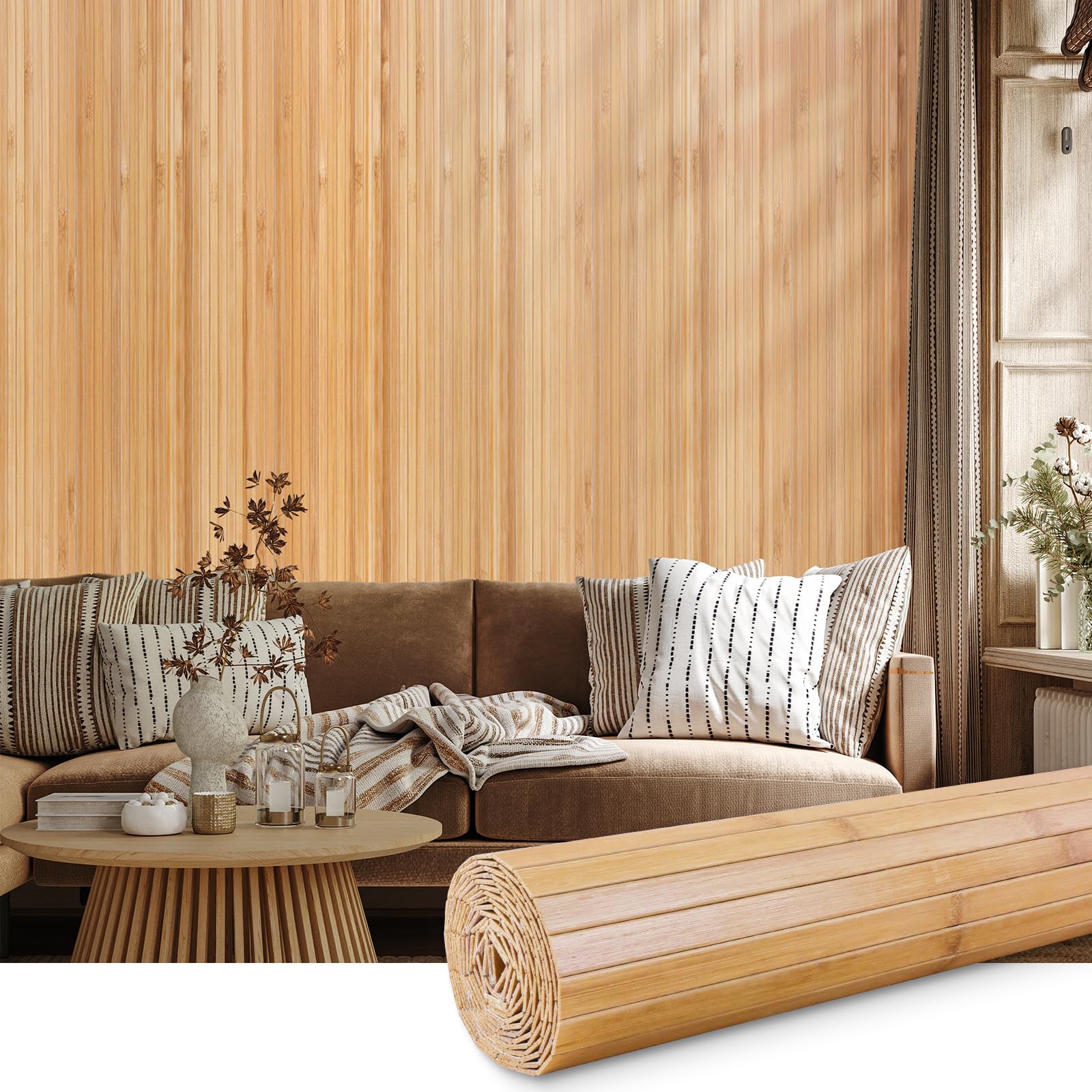
Built to bend around the awkward shapes a flat panel simply cannot follow.
Kitchen islands are the reason this roll exists. The mesh backing lets it wrap clusters of slats onto curved or irregular surfaces, so a bare island front or a post stops being an eyesore. It is an indoor-only roll with an oval slat profile and an unfinished, solid-pattern carbonized finish that sits comfortably alongside modern, minimalist, and industrial kitchens.
The look is what everyone gravitates to — a natural, clean texture that reads far more expensive than a painted panel. As one owner put it: “I used this to wrap my island, and it was perfect! Easy to work with, looks great, and it has seemed pretty durable, especially for among the most heavily trafficked spots in the kitchen!” The carbonization treatment (a heat process that darkens and hardens the bamboo) makes it water-resistant, so a damp cloth wipes off cooking splatter inches from a sink.
Here is the trade-off worth knowing before you order. The roll leans thin, and a buyer looking for more heft may wish it were a touch beefier. It is also unstripped, meaning the mesh backside shows in the gaps between slats if you mount it flat, so plan your orientation around that. No coverage figure is published for this roll, so size your order by hand rather than by the math.
The island answer: for wrapping curves, columns, and furniture fronts, the mesh backing does the job a stiff sheet cannot, and it cleans up with a damp cloth after cooking splatter.
Reach for this if: your project curves, bends, or wraps — islands, planters, and pole details are its home turf.
Look elsewhere if: you are covering a straight bedroom wall; a wider sheet cuts your seam count dramatically.
3. Natural Bamboo Wall Panel Pole Wrap for Interior Wall Decoration
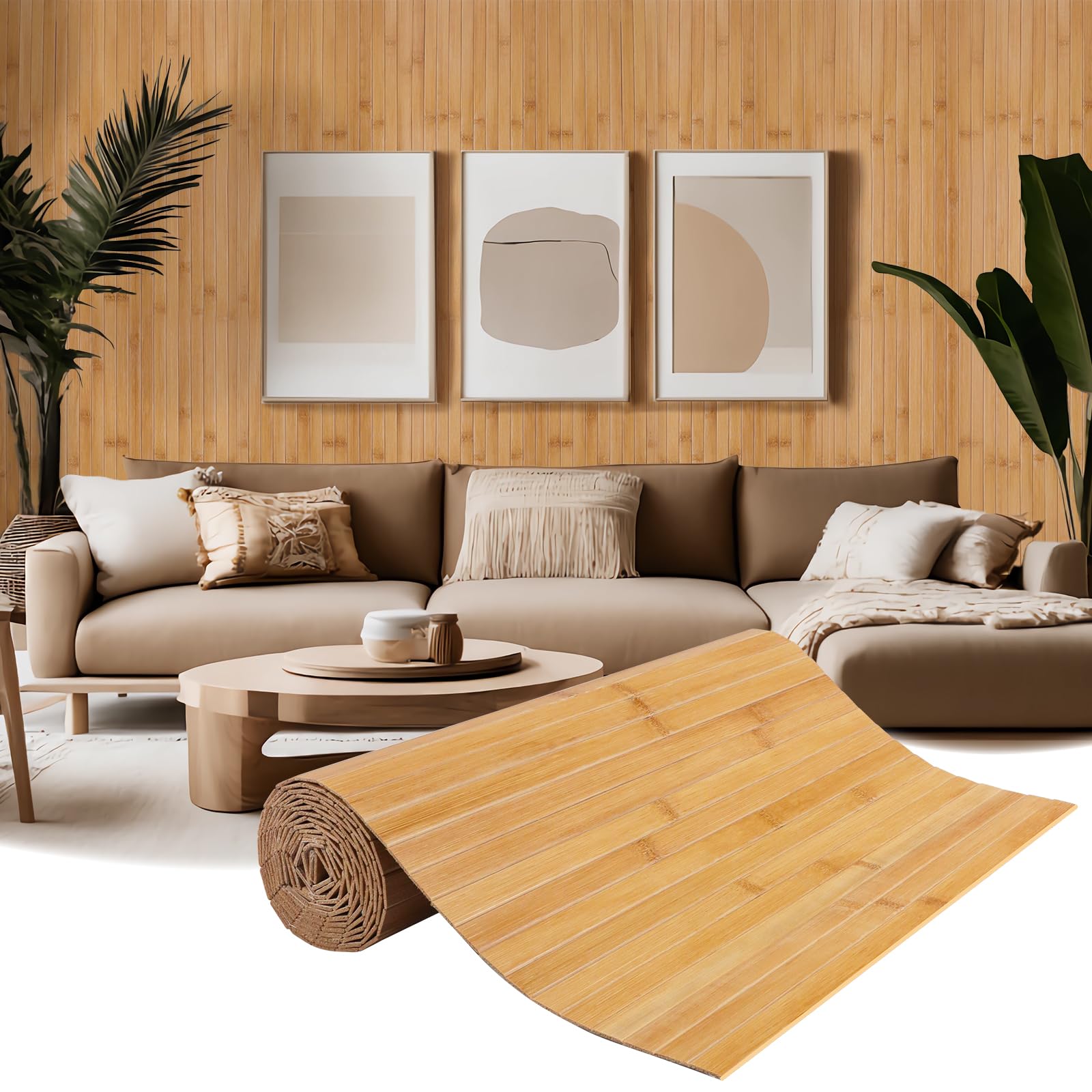
The narrow roll that turns a splashback or shelf edge into a warm focal point.
At 96 inches long by 16 inches wide, this roll covers 11 square feet and weighs 1.02 kg, which makes it the lightest, most maneuverable option here. That size is a feature, not a limitation: small vertical runs behind a sink, above an oven, or along a shelf edge go up in minutes with almost no waste. Cut it with heavy-duty scissors and you barely need a saw at all.
Buyers bring up ease of use first, then how well it cuts. One thing to plan for is adhesive placement. Where the roll is not pre-stripped (no peel-and-stick backing), glue seeps up between the slats; squeeze the excess out with a toothpick and a damp cloth. So work in small sections and keep a rag handy. Owners describe it as moisture resistant, so it holds up behind a sink or along a shelf edge.
Two caveats come up consistently. The color runs darker than the listing photos, and it can be fragile right at the cut edges. Some pieces arrive split at the ends when you try to line them up on a long wall. On short runs and shelf projects those issues rarely surface, which is exactly where this roll shines.
Reasons it earns a place
- 11 square feet in a nimble 16-inch-wide roll
- Just 1.02 kg — easy to hold one-handed while positioning
- Cuts with heavy-duty scissors
- Moisture resistant for kitchen and bath-adjacent spots
Plan around these
- Darker in person than the product photos suggest
- Cut edges can split — reserve it for small detail work
Best for detail work: splashbacks, shelf edges, and short accent strips where a wide panel would be overkill.
Not for long spans: a full wall means matching many narrow rolls, and that is where the darker tone and fragile ends start to show.
Understanding the Specs
Coverage in Square Feet
Coverage tells you how much wall one roll will dress, and it is the single number that prevents a half-finished wall. A 48-inch-wide, 96-inch-long roll covers 32 square feet in one piece. A 16-inch-wide, 96-inch-long roll covers 11 square feet. If your wall is 8 feet tall and 6 feet wide, that is 48 square feet, so two wide rolls cover it with room for trim cuts. Always round up.
Panel Width and Bending
Width decides whether the material goes flat or curves. A wide sheet is stiff and rewards a flat, straight wall or a ceiling. A narrow 16-inch wrap bends around islands, columns, and pole details far more easily, at the cost of more seams on a long span. Match the width to the surface, then let coverage tell you how many rolls to order.
FAQ
How much wall does one roll of bamboo plank actually cover?
Can I cut bamboo wall panels with scissors or do I need a saw?
What is the best way to attach bamboo planks to a drywall wall?
Will bamboo wall panels hold up behind a kitchen sink or near an oven?
Why does the bamboo look darker than the pictures?
Are these planks real bamboo or a printed imitation?
How do I stop the ends of the slats from splitting?
Can I stain or paint bamboo wall panels a different color?
What is the difference between a 48 inch panel and a 16 inch pole wrap?
Do I need to remove the panels to clean them?
Final Thoughts: The Verdict
For most projects, the bamboo wood planks winner is the Art3d 48 x 96 in Natural Bamboo Wall Panel. One 48-inch-wide roll covers 32 square feet, so it finishes a full accent wall or ceiling in a single pass, and its stain-resistant, waterproof surface stands up to kitchen splatter. If your project curves — a kitchen island, a column, a furniture front — grab the FONUNO Bamboo Wall Panel Pole Wrap Roll, whose mesh backing bends where a stiff sheet will not. And for splashbacks, shelf edges, and small accent strips, the Natural Bamboo Wall Panel Pole Wrap is the light, nimble roll that covers 11 square feet without waste. Order a single roll of whichever fits your surface first, live with the tone for a week, then finish the wall — the material is easy enough to work with that one test run will tell you everything.
How We Picked
We do not accept paid placement. Every pick is matched to a real buyer and a real use-case; we do not hands-on test units.
Sources & Methodology
Specifications: manufacturer listings and product documentation. Review insights: verified customer reviews, as of September 2026. Pricing: not shown on this page (it changes often); check the current price via the retailer link.
As an Amazon Associate, KitchPrep earns from qualifying purchases. This does not affect which products we feature.
Related Guides
