
Specs are compiled from manufacturer listings and verified buyer reviews and can change over time — please confirm the key details on the product page before buying.
If your wall thermostat has gone blank and the HVAC tech wants a small fortune to run a new wire through finished walls, the fix is usually simpler than you think. A battery powered thermostat runs on ordinary AA or AAA cells, so it needs no dedicated power wire at all. That makes it the no-brainer swap for older homes, campers, cabins, and fireplaces where the wiring is only two thin strands. This guide walks you through the nine models that consistently hold up in real homes, what actually matters when you pick one, and which one fits your exact system.
I’m Mohammad Maruf — the founder and writer behind KitchPrep. This guide is built by comparing the manufacturers’ published specifications and the patterns across verified customer reviews, so you get each pick’s real strengths and trade-offs instead of marketing spin.
Battery power means no C-wire and no new cable run, and a programmable model can trim your heating bill through automatic setback. Read on for the full rundown of the Best Battery Powered Thermostat.
Our Picks at a Glance
How To Choose The Best Battery Powered Thermostat
Before you buy anything, count the wires poking out of your wall. That single step decides half your options. A thermostat that runs on batteries skips the need for a “C-wire” (the common wire that carries 24-volt power to newer smart units). That is the exact reason so many older houses and trailers cannot run a modern smart model in the first place.
Match the thermostat to your system type
Heat-only covers fireplaces, wood and pellet stoves, in-floor radiant heat, and RV furnaces. Those systems usually run on just two wires, and a plain two-wire heat-only unit is the right tool. If you have a single-stage furnace or air conditioner, you need a model rated for single-stage heating and cooling. Heat pump owners need a unit built for a heat pump, and if the pump has a backup or auxiliary stage, look for a model that explicitly says it handles that. Buying the wrong match here is the number-one return reason.
Decide how much scheduling you actually want
A non-programmable unit is nothing more than an on/off dial with a digital readout — you set a temperature and it holds it. A programmable unit lets you set separate schedules, usually for weekdays and weekends. Programming saves energy because the house drifts cooler while you are at work or asleep, but it also adds setup time and a small learning curve. If you want zero fuss, non-programmable is not a downgrade; it is a deliberate choice.
Check the display and terminal layout
A backlit display matters far more than it sounds, because unlit LCDs go nearly invisible in a dark hallway at night. Terminal layout matters too: some brands use small screw terminals that need a precision screwdriver, while others use push-in connectors that hold the wire with a pin. Both work, but the push-in style is faster for a first-timer.
Quick Comparison
| Model | Best For | System Type | Programming | Power Source | Amazon |
|---|---|---|---|---|---|
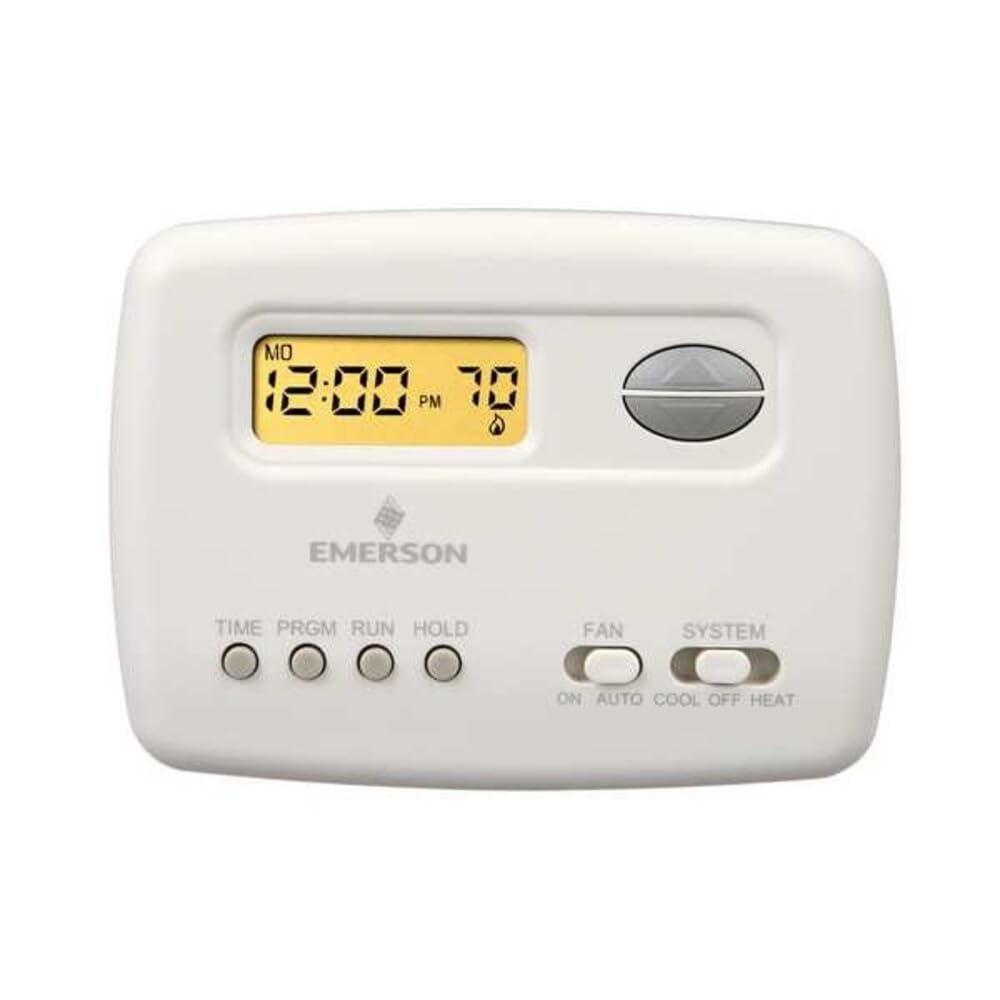
| White-Rodgers 70 Series Classic 1F78-151★ Best Overall | Whole-home heat and cool with a set schedule | Single-stage heat, cool, and heat pump (no aux) | 5-2 day programmable | 2 AAA batteries | Amazon |
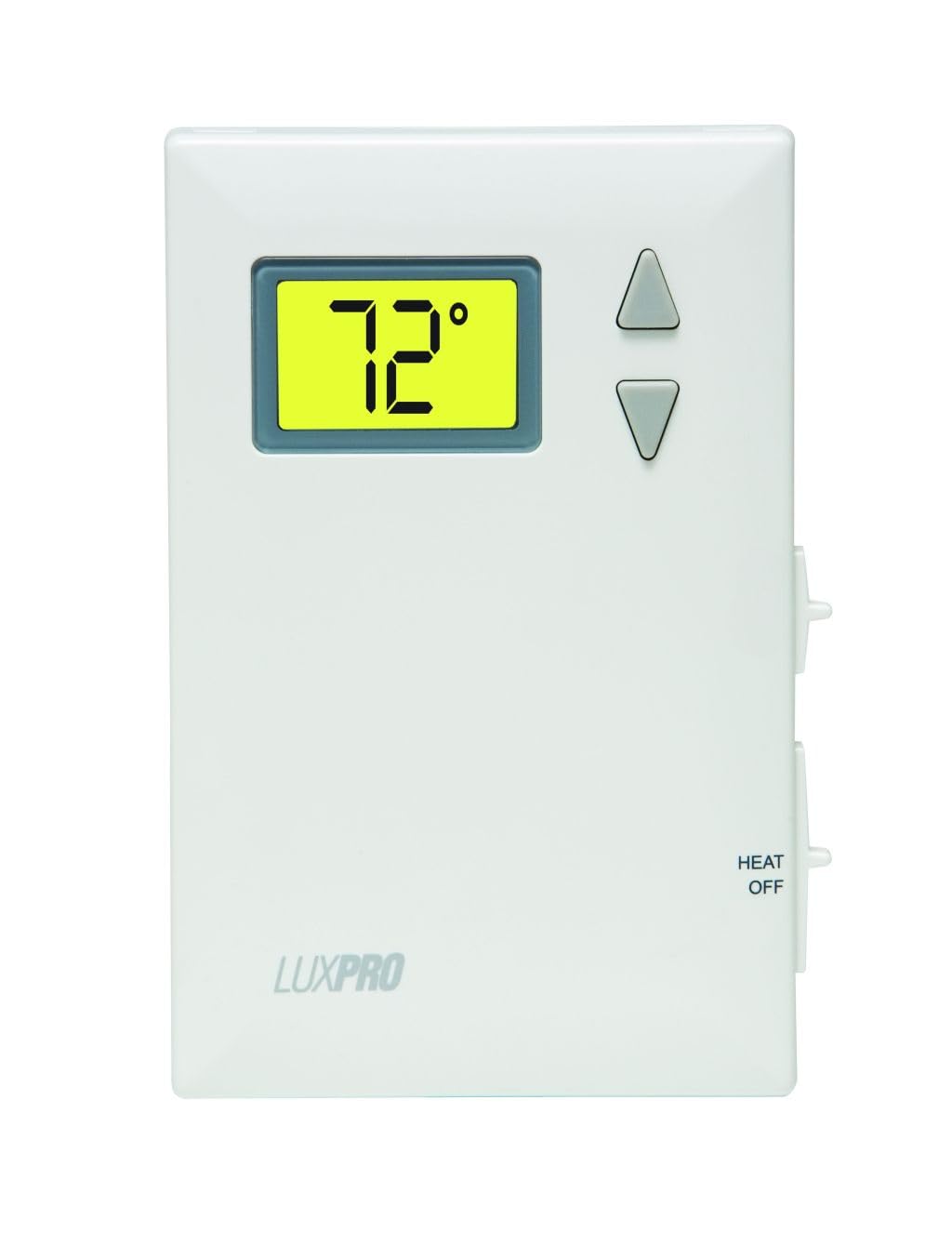
| PSD010B Non-Programmable Heat-OnlySimplest Swap | Fireplaces, stoves, and in-floor radiant heat | Heat-only, no fan switch | Non-programmable | 2 AA batteries | Amazon |
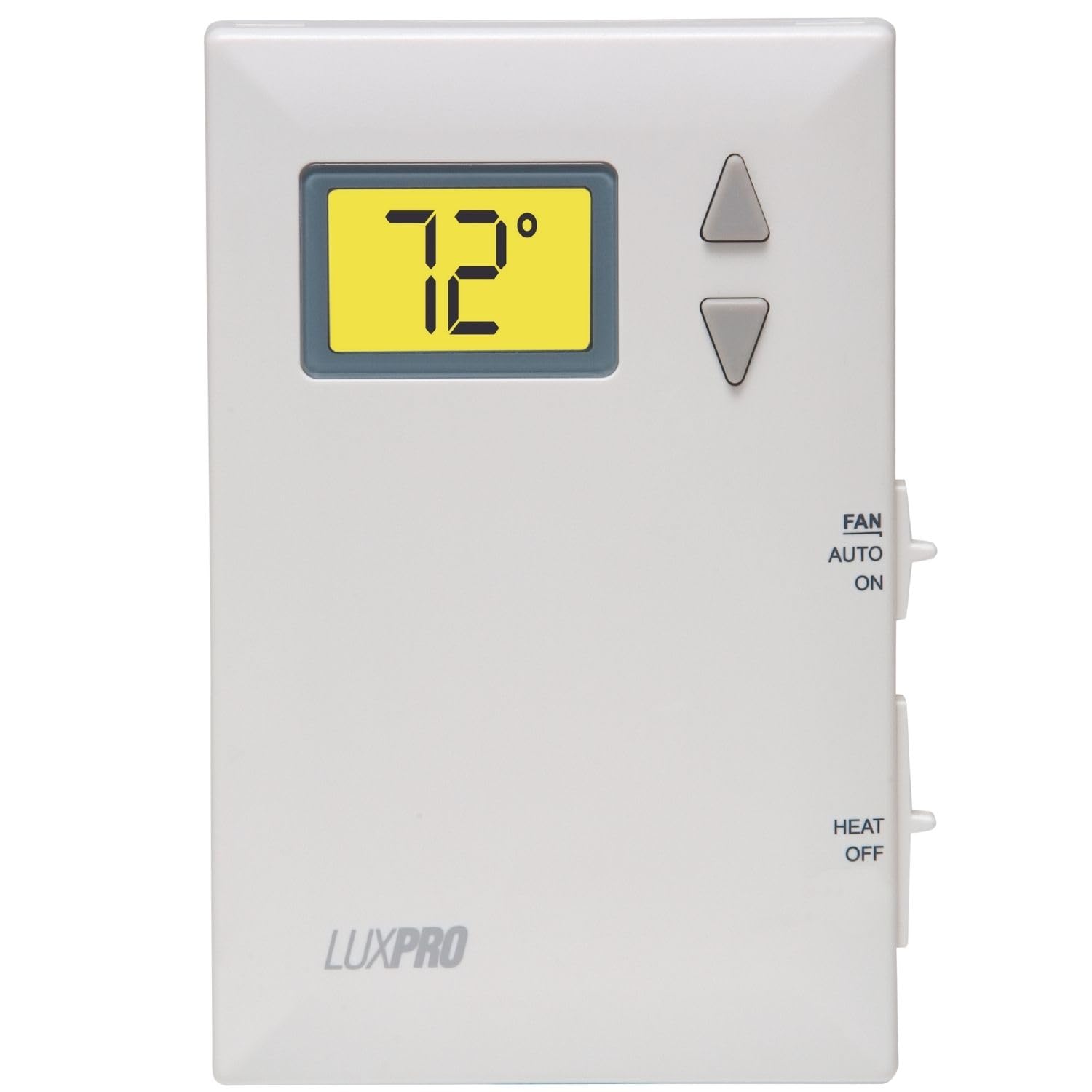
| PSD010BF Vertical Heat-Only with FanBest with Fan Switch | Heat-only systems that need a blower fan switch | Heat-only with fan switch | Non-programmable | Battery only | Amazon |
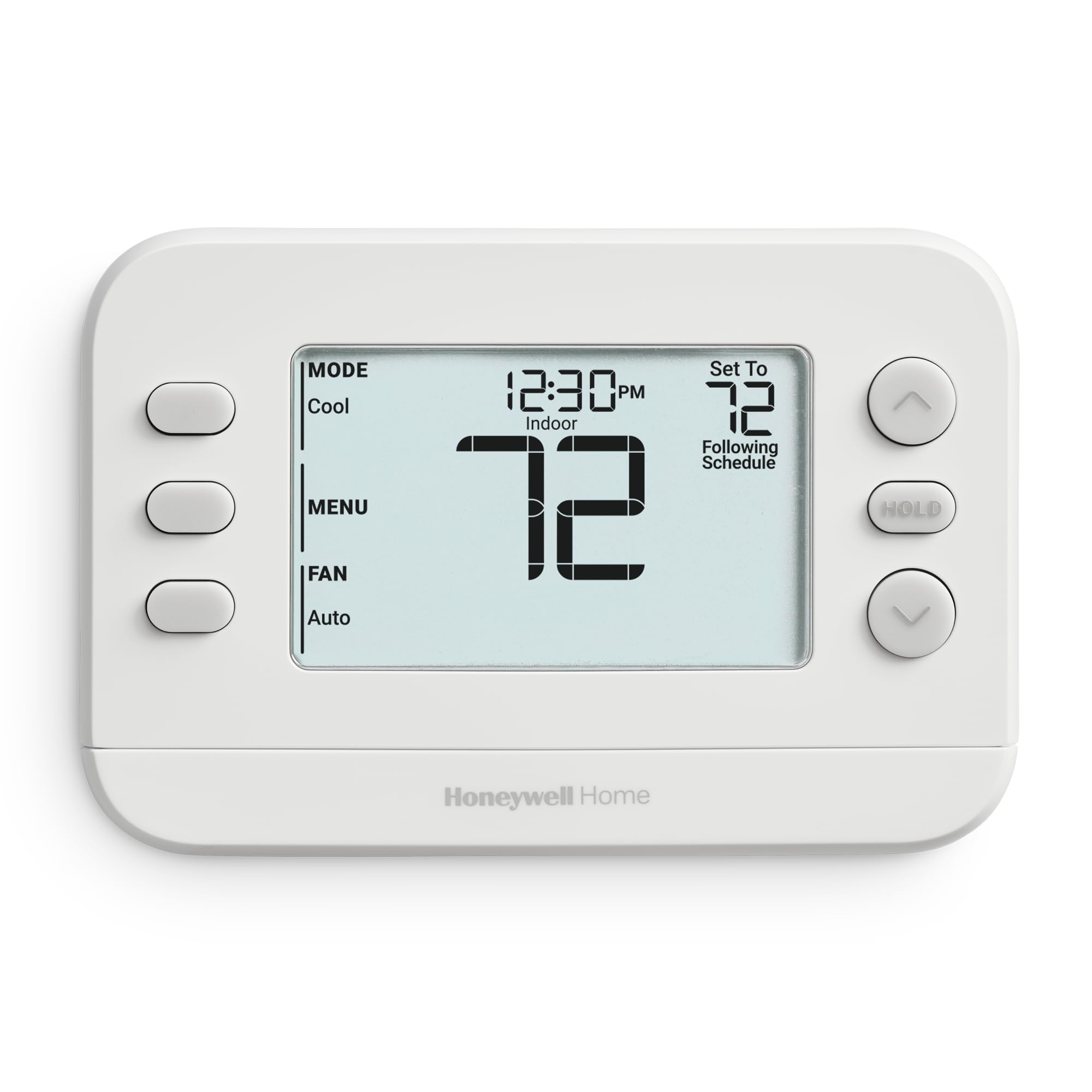
| Honeywell Home X2P | Two-wire setups and heated floors | 1 Heat / 1 Cool, 750 mV, hot water, forced air | 5-2 day programmable or non-programmable | 2 AA batteries (not included) | Amazon |
| VEMER VE718300 THALOS | Boiler and heat pump rooms needing lockable control | Heating and air conditioning, on/off or proportional | Non-programmable with proportional mode | 2 AAA batteries (1.5V) | Amazon |
| White-Rodgers 3562416 Emerson 80 Series | Heat pump and dual fuel systems | 2 Heat / 1 Cool with dual fuel option | Selectable 7-day, 5-1-1, or off | 2 AA batteries | Amazon |
| ICM Controls SC1600L Simple Comfort | Toy haulers, trailers, and simple heat-only rooms | Non-programmable heat only, no fan output | Non-programmable | Battery powered | Amazon |
| GoControl GC-TBZ48 Smart Thermostat | Z-Wave smart-home owners who want to control the logic themselves | Standard HVAC 2H/2C, heat pump 3H/2C | Via Z-Wave hub app | 4 AA batteries or C-wire | Amazon |
In‑Depth Reviews
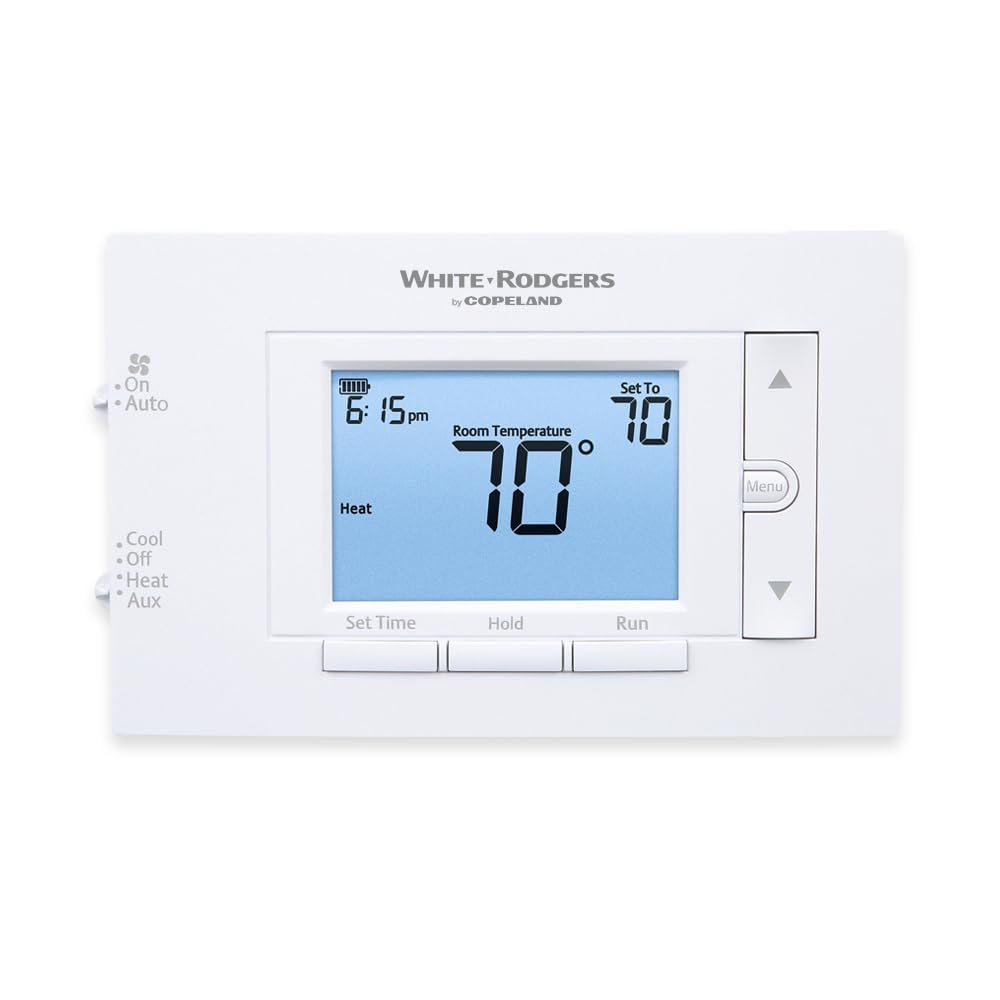
1. White-Rodgers 70 Series Classic, Programmable Thermostat, 1F78-151
Our pick — over 4.5★ from 700+ verified ratings; the strongest balance of quality and price.
The straightforward weekday-and-weekend scheduler that quietly trims your energy bill.
For the widest spread of homes — a single-stage furnace and AC, or a heat pump without a backup stage — this is the safest first pick. It runs on two AAA batteries and holds your room to plus or minus 1 degree F (about half a degree Celsius), so the house stays where you set it instead of swinging. The 5-2 day programming (one schedule for Monday through Friday, another for the weekend) lets the house drift while you are at work and warm back up before you get home.
You wake up to a warm house instead of waiting on it, thanks to the startup feature that earns its keep in cold months. A built-in Energy Management Recovery routine (it learns how long your furnace takes to reach the target) kicks the heat on early — buyers report it starts roughly 5 minutes per degree early for heat and 15 minutes per degree for cool. The amber-backlit LCD (a screen lit from behind in amber) shows current and set temperatures at once, and a low-battery indicator warns you before the screen dies.
Two things to know before you buy. The display needs its button pressed to light, so in a blacked-out hallway you will want a quick tap. And there is no 7-day or 5-1-1 custom scheduling — the weekday/weekend split is the whole menu. There is a physical footprint advantage too: at 1.75″D x 6.25″W x 4.25″H it carries a bigger body than the compact heat-only PSD010B (1.1″D x 3.3″W x 5″H), which matters if you are covering a large old opening.
What owners keep praising
- Consistently accurate — holds temperature to plus or minus 1°F of your set point
- Straightforward two-wire install with screws, anchors, and both AAA batteries in the box
- Low battery indicator means the screen never just quits on you in January
- Works with single-stage heating and cooling plus heat pumps without aux heat
Where it asks you to compromise
- Terminal screws are cramped and demand a small precision screwdriver
- Display only lights when you press the button — no always-on glow
- Scheduling stays at weekday/weekend only, with no 7-day granularity
Buy it if: you want one thermostat that handles both heat and cool on a weekday/weekend schedule without touching a single new wire.
Think twice if: your system needs day-by-day programming or a permanently lit screen — the 5-2 split and button-press backlight will feel limiting.
2. PSD010B Non-Programmable 2-Wire Heat-Only Thermostat
Two wires, two AA batteries, and a fireplace that finally holds a steady temperature.
If you have a gas fireplace, a wood or pellet stove, or in-floor radiant heat, this is the unit that replaces the crude on/off switch you have been fiddling with. It runs on two AA batteries and needs no fan switch, so the wiring stays dead simple: red and white, in and out. Owners consistently report getting the whole job done in a few minutes with nothing but a Phillips screwdriver, which makes it the least intimidating install in this roundup.
Your room stays where you set it, which is the quieter selling point. Buyers describe the temperature holding within about 1 degree of the set point, and the large lit LCD shows the current and target temperatures side by side. The dimensions sit at 1.1″D x 3.3″W x 5″H — notably more compact than the White-Rodgers programmable above (1.75″D x 6.25″W x 4.25″H) — so it covers less wall and swaps into the same screw holes as older manual units. It also handles millivolt systems (low-voltage signals from fireplaces and some stoves) alongside standard 24-volt setups, which a lot of basic digital stats will not do.
What you give up is flexibility. There is no programming whatsoever — no schedule, no app, no hub. Just on/off and up/down buttons. One recurring note is that the electric connector screws could be larger, which makes tightening the thin wires a little fussy. One long-running owner replaced four failed Honeywell T87F thermostats with this unit and stayed with it.
Built for simplicity: a two-wire, battery-powered heat-only stat that swaps straight into fireplace, stove, RV furnace, and radiant-floor setups without a single programming screen.
The trade-off: if you want a schedule or Wi-Fi, this is the wrong tool — it only does on/off and up/down, and the connector screws are small enough to want patience.
Reach for this if: your heat source has just two wires and you want a dial-level job upgraded to a digital readout in fifteen minutes.
Walk past it if: your house runs heat and cool on one system — you need a combined control, not a heat-only stat.
3. PSD010BF Non-Programmable Vertical Heat-Only with Fan Thermostat
Same easy install as the two-wire stat, plus a fan switch for blower-equipped systems.
This is the sibling to the PSD010B above, but with the one feature that unit lacks: a fan switch. That matters if your heat source has a blower you want to control from the wall, or if the original thermostat had an auxiliary fan button. It runs solely on battery power, keeps the same slim physical profile (1.1″D x 3.3″W x 5″H), and uses a large LED-illuminated display that stays readable when the lights are off.
One buyer replaced an analog trailer thermostat and cut the temperature swing from more than 7 degrees to 1 to 2 degrees. The digital readout shows room temperature and your set point together, and the fan button gives you direct control instead of relying on the furnace’s own logic. Install notes stay simple: a few wires (red, white, green) and the heat coming back in under a minute in some cases.
Two honest caveats. Owners mention a small temperature swing, on the order of 1 degree, between the off and on states — normal for a non-proportional stat, but worth knowing. And the slim housing is wall-mounted; there is a report of a camper unit dropping off the wall during travel, so if this is going in an RV, secure it well before you roll.
Best for: blower-equipped heat systems where you want wall control over the fan, not just the temperature.
skip it if: you need app control or scheduling — it is a strictly non-programmable on/off stat with a fan button.
4. Honeywell Home X2P Programmable Thermostat, White
A big-screen flagship that programs in three minutes and never asks you to tighten a screw.
You get it on the wall fast, which is Honeywell’s whole pitch here, and it holds up. The wiring uses push-in toggles instead of screws — the wire slides in and a pin closes the circuit, so there is no fiddly tightening. Customers note the mount taking about five minutes and the wiring just a couple more. Programming walks you through with guided questions, and the schedule lands in around three minutes if you want 5-2 day or a fully non-programmable mode.
Two features put this a step above the basics. First, the display is genuinely large and legible from across the room — the kind of screen you can read from the doorway without squinting. Second, it learns your system’s heating and cooling rates to pre-heat or pre-cool for the target temperature, since it is doing more than reading a number and clicking a relay. It also handles a wider compatibility list than most stats in this group: 1 heat / 1 cool, 750 mV millivolt systems, hot water heat, and gas, oil, or electric forced air. The one hard limit is electric baseboard heat at 120-240V, which it does not support.
Two AA batteries run the unit — and note they are not included, unlike the White-Rodgers picks above that ship with cells. Buyers sum it up as “smart enough without being smart,” meaning it schedules and learns, but needs no Wi-Fi, no app, and no account. The change-air-filter reminder and the extended 32°F low-heat setpoint round out the package. A 1-year warranty covers the unit.
Standout feature: screwless push-in wiring and a guided setup that together shrink a thermostat swap to well under twenty minutes.
Worth the extra: the wide-system compatibility list (heat pumps excluded) and the learning pre-heat make it a fit for more homes than a plain programmable unit.
Pick this if: you want a large readable display, screwless wiring, and set-and-forget scheduling without Wi-Fi or an app.
Look elsewhere if: you have electric baseboard heat or a heat pump — this specific model is not rated for either.
5. VEMER VE718300 THALOS Key Digital Room Thermostat

A two-button Italian-made stat that locks down settings for public spaces and shared rooms.
Most battery stats assume you want to program something. This one assumes you want precise control and then want nobody to touch it. It runs on two AAA batteries (1.5V), needs no cable connection at all, and is compatible with standard boilers and heat pumps. Two raised buttons do everything; there is no menu tree, no schedule, and no app. The keyboard can be locked with a password so the setpoint cannot be changed without permission — the reason this one suits offices, rentals, and public buildings where other people share the thermostat.
Your bedroom stays dark, because the blue backlit LCD lights only when you press a key, and you can turn the light off if you would rather not have it glowing. There is a nice extra that most home stats skip: a configurable digital input that lets you hook up an external temperature probe or a device to knock the set value down by 3°C, which is exactly what you want if you are reading temperature at the far end of a cold room. It also does proportional control (motorised valve systems) alongside plain on/off, so it can drive any type of boiler or AC.
The honest catch is response speed. One reviewer measured it about 1.5°C off a second thermometer, with the boiler shutting off at 20°C while the far side of the room sat near 18°C. That is a small but real precision limit worth knowing if your rooms are large. The keyboard is intentionally minimal: you get two buttons and one purpose.
Where it wins: password-protected controls and a lockable two-button layout, perfect when strangers or tenants share the room.
Where it asks you to accept: response time is slower than the digital home stats above, and the minimal menu means no day-by-day scheduling.
Best fit: rentals, offices, and boiler rooms where the setting needs to stay put.
Reach past it if: you want a programmable home schedule — this is deliberately a simple proportional or on/off controller.
6. WHITE-RODGERS 3562416 Emerson 80 Series Programmable Heat Pump Thermostat
A battery-powered heat pump stat with selectable 7-day scheduling and built-in dual fuel.
If a heat pump sits outside your house and you cannot run a C-wire to the wall, this is the pick. It works with heat pumps and standard systems, runs on two AA batteries (included), and needs no dedicated power wire to operate. It also handles 2 heat / 1 cool (a primary and a backup heat stage) plus a dual-fuel option for setups that switch between a heat pump and a gas furnace — no extra sensors needed.
Scheduling is flexible. You can run a 7-day program with each day on its own schedule, a 5-1-1 split (weekdays, Saturday, Sunday), or turn programming off entirely. The 4.5-inch display reads easily in low light, and the installation is built for DIY: a level indicator in the housing, pluggable terminals, and a streamlined configuration menu keep the process simple. Reviewers point out finishing in about fifteen minutes with just the printed directions and a phone photo of the old wiring for reference.
Notes from the field: the pluggable terminals are easier to wire than screw terminals, but a couple of buyers mention the programming menu takes some getting used to. Shoppers say two AA cells lasting six months or longer. Compatibility tops out at 1 cooling stage, so a system with dual-stage cooling needs a different model.
what separates it
- Handles heat pumps, dual fuel, and 2 heat / 1 cool — a wide system match for a battery stat
- Selectable 7-day, 5-1-1, or off programming gives you the schedule shape you actually want
- Pluggable terminals plus a built-in level indicator speed up DIY install
- Big 4.5-inch display that is readable in dim lighting
What to weigh
- Programming menu takes some learning — one buyer called it “funky”
- Single cooling stage only, so dual-stage cool systems are out
- No Wi-Fi or app control — it is a self-contained programmable stat
Choose it if: your home has a heat pump and no C-wire, and you want day-by-day scheduling on batteries.
pass on it if: you need Wi-Fi control or your AC system runs two cooling stages.
7. ICM Controls SC1600L Simple Comfort Non-Programmable Heat Only Thermostat
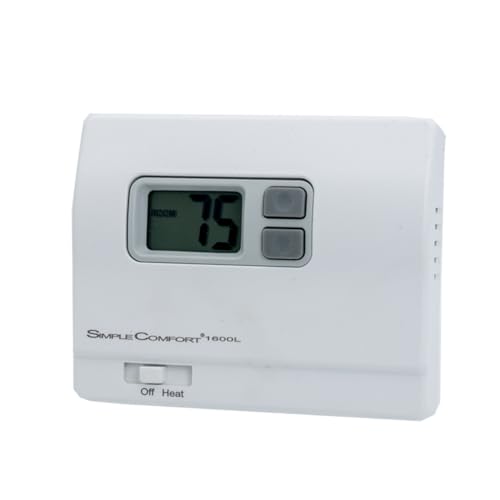
A no-fan-output heat-only stat that upgrades an old RV slide dial to a big backlit display.
This is the pick for toy haulers, travel trailers, and Sundowner-style living quarters where the old thermostat is either invisible or sliding around on a knob. It is heat-only, non-programmable, battery-powered, and has no fan output, so it stays in the plain two-wire (red and white) lane. Buyers report it dropping in with the usual two-wire ease and working on the first try when the batteries go in.
The display is the feature people notice. It is large, backlit, and shows both the current temperature and your heat setpoint together, so you can read it from across a small cabin. Accuracy is described as typically within about 1 degree of the actual temperature — good enough that you stop thinking about it. The plastic housing is simple and unobtrusive, which is what you want in a camper wall panel. Buyers swap in this unit after the original Atwood analog stat gave up the ghost, and it does exactly what a heat-only RV stat is supposed to do: keep the rig warm.
The obvious limit is the lack of fan control (that is why the PSD010BF above exists) and no scheduling. This is a plain heat-only stat. And with fewer total ratings than the mid-pack picks, it is more of a niche pick for trailer owners than a broad home recommendation. But for that trailer-specific job, the price-per-job value is strong and the reviews are consistent.
What it solves: an unreadable or unreliable RV/trailer heat stat, swapped for a clear backlit display at a low price.
What it leaves out: no fan output and no programming — if your trailer blower needs wall control, step up to the PSD010BF instead.
Ideal for: toy hauler, camper, and trailer heat-only installs where a backlit display is the whole point.
Not the one if: your system has a blower you want on a wall switch — that fan control is simply not here.
8. GoControl GC-TBZ48 Smart Thermostat
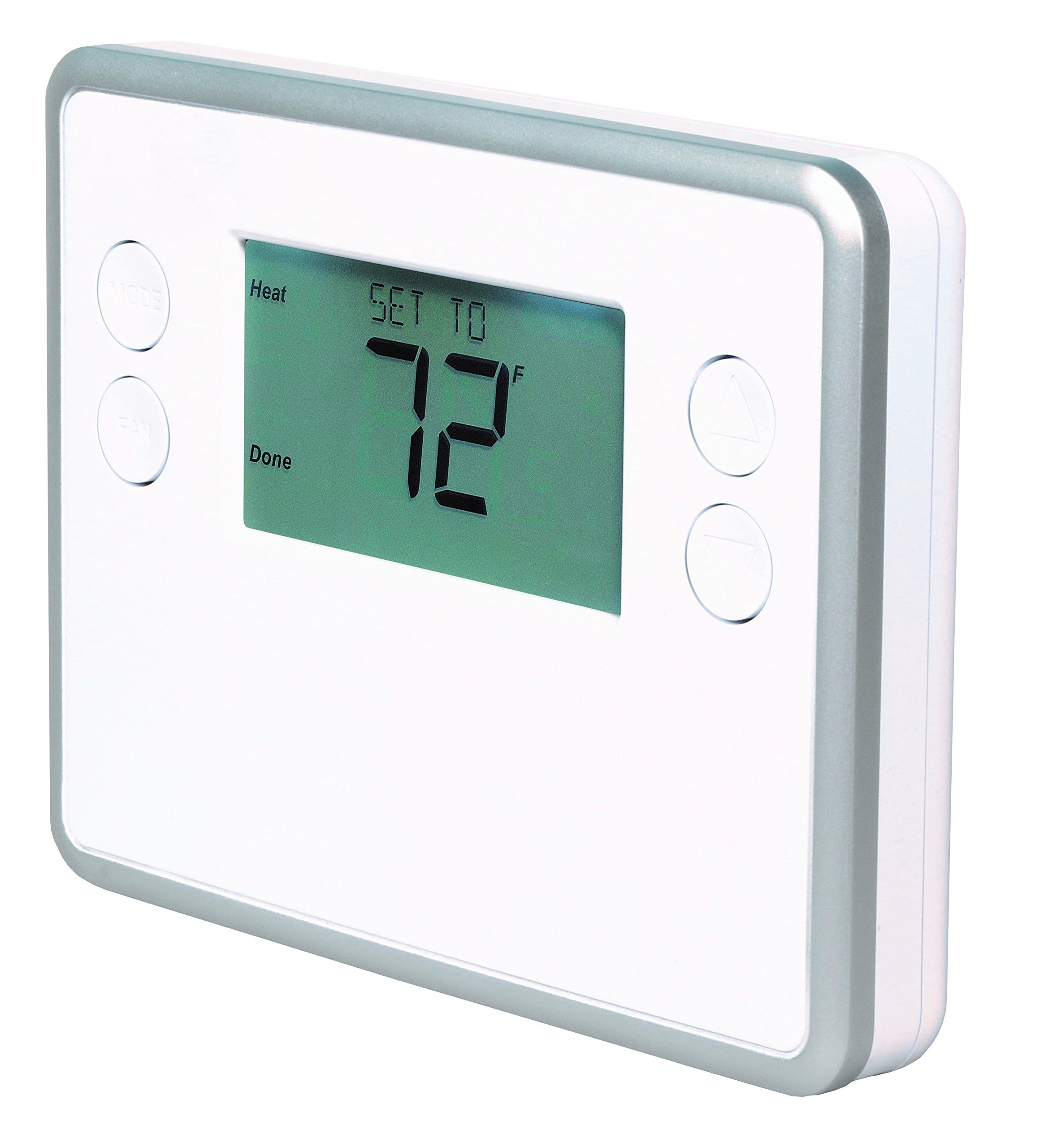
The smart stat for Z-Wave owners who would rather bring their own brain.
This one is different from every other pick here. The GoControl GC-TBZ48 runs on four AA batteries but programs through a Z-Wave hub (Z-Wave being a low-power wireless standard for smart-home devices) rather than on the device itself. You supply the hub — SmartThings, Vera, HomeSeer, Wink, or a 2GIG Z-Wave panel — and the automation logic happens there. The thermostat is the radio and relay; the hub is the brain. Wall-mount or fit it to a single-gang junction box, and it will work on standard HVAC systems (2-stage heat and 2-stage cool) or heat pump systems (3-stage heat and 2-stage cool), with USB firmware upgrades for future needs.
Two versions of how to power it exist, and the choice is yours. Wire in a C-wire and the thermostat will act as a Z-Wave repeater and skip batteries entirely; Go battery-only and four AA cells give roughly a year of runtime at 20% remaining. Owners who run it with Home Assistant or a Vera Edge hub report easy pairing and full local control, including battery-percentage readouts, minimum run times, and calibration to match another thermometer. It works with Alexa, but only through a supporting hub — the voice command has to pass through the controller first.
Two honest expectations worth setting. First, the manufacturer will not walk you through install wiring on the phone, so you need some comfort reading a manual. Second, this specific unit had some reports of lockups when paired with certain hubs, clearing with a battery pull — worth knowing if a dead stat mid-winter would be a problem for you. And like any Z-Wave device, it is only as smart as the hub you connect it to.
What makes it different
- Z-Wave open standard means it works with SmartThings, Vera, HomeSeer, Wink, and 2GIG panels
- Runs on 4 AA batteries (roughly a year of runtime) or on a C-wire with repeater function
- Handles standard 2H/2C and heat pump 3H/2C systems with USB firmware updates
- All the deep automation — schedules, min run times, calibration — lives in your hub, right where tinkerers want it
Where it needs care
- Not a standalone thermostat — no hub, no programming
- Manufacturer support stops at the manual; install wiring is on you
- Some hubs have shown lockups that clear with a battery pull
Made for: Z-Wave smart-home owners who want a cheap, open, battery-capable stat they can program however they like.
Wrong tool if: you want a self-contained stat with a screen and a set schedule — this one needs a hub to do anything remotely clever.
Understanding the Specs
Programming type: 5-2, 7-day, and “non-programmable”
A 5-2 day thermostat holds separate schedules for weekdays and weekends, which is what most people actually want. A 7-day or 5-1-1 model lets every day run its own plan. Non-programmable skips schedules entirely and just holds a temperature. More programming usually means lower energy bills through automatic setback — but also more setup time and a greater chance of confusing someone else in the house. If you would rather not think about it, non-programmable is the right call, not a compromise.
Power source: batteries, C-wire, and what “works without a C-wire” really means
Every thermostat on this list can run on AA or AAA batteries. A “C-wire” is the fifth wire that supplies 24V power; without it, some modern smart stats cannot run. A battery-powered stat skips that problem entirely, which is why these work in older homes with only two wires. C-wire fact vs. fiction: on models with a C-wire terminal, wiring it in means the thermostat no longer needs batteries and often acts as a Z-Wave repeater (a device that passes a wireless signal along); if you do not have a C-wire, batteries carry the load and you may see a low-battery indicator when it is time to swap them.
Terminal wiring: how to match a stat to your system
Two-wire heat-only thermostats serve fireplaces, stoves, and radiant floors. Single-stage stats serve a basic furnace and AC. Heat pump stats handle a heat pump, and dual-fuel stats also manage a backup furnace. Always check the manufacturer’s compatibility line before you buy: a basic single-stage stat will not control a heat pump, and a heat-only stat cannot switch an air conditioner. Match terminal codes on your old stat to the new stat’s labels — the standard ones (W for heat, R for power, Y for cooling, G for fan) are consistent across brands.
Accuracy and backlighting: degrees of swing and dim-room visibility
Look for a stated accuracy, typically plus or minus 1°F on the digital stats above. Cheaper units can have a 1 to 2 degree swing between the on and off states — fine for a garage or trailer, but noticeable in a bedroom. Backlighting matters too: some LCDs glow on demand (press a button), while others stay lit. A press-to-light stat saves battery; a permanently lit one is easier to read at a glance, especially for anyone with low vision.
FAQ
Can I use a battery powered thermostat without a C-wire?
Will a battery powered thermostat work with my heat pump?
How long do the batteries actually last in these thermostats?
Do I need an HVAC technician to install one?
What is the difference between a programmable and a non-programmable battery thermostat?
Why does my thermostat screen go blank in the middle of winter?
Can I use these thermostats on electric baseboard heat?
How do I replace my old thermostat without mixing up the wires?
Should I choose a smart thermostat or a simple programmable one?
What does “auto changeover” mean and do I need it?
Final Thoughts: The Verdict
For most homes, the battery powered thermostat winner is the White-Rodgers 70 Series Classic 1F78-151 because it combines plus or minus 1°F accuracy, a 5-2 day schedule, and simple two-wire install on two AAA batteries — the right fit for the widest spread of systems. If you have a heat pump and no C-wire, grab the White-Rodgers 3562416 Emerson 80 Series with its 7-day programming and dual-fuel support. And for a fireplace, stove, or RV heat-only system, the PSD010B is the one to reach for — two AA batteries, two wires, done. It handles single-stage heat and cool on two AAA batteries with no Wi-Fi, no app, and no C-wire.
How We Picked
We do not accept paid placement. Every pick is matched to a real buyer and a real use-case; we do not hands-on test units.
Sources & Methodology
Specifications: manufacturer listings and product documentation. Review insights: verified customer reviews, as of September 2026. Pricing: not shown on this page (it changes often); check the current price via the retailer link.
As an Amazon Associate, KitchPrep earns from qualifying purchases. This does not affect which products we feature.
Related Guides
