
Specs are compiled from manufacturer listings and verified buyer reviews and can change over time — please confirm the key details on the product page before buying.
If your room turns into a sauna every summer and the AC bill makes you wince, a proper air-circulating fan is the cheapest fix you will find. The catch is that most fans on the shelf move almost no air, rattle all night, or fall apart inside a season. This guide cuts straight to the models that actually push air where you need it, so you can sleep cool without guessing.
I’m Mohammad Maruf — the founder and writer behind KitchPrep. This guide is built by comparing the manufacturers’ published specifications and the patterns across verified customer reviews, so you get each pick’s real strengths and trade-offs instead of marketing spin.
Some are slim towers that whisper on low and roar when you need them, others are window units that pull cool night air through the whole house. Every pick below was chosen on measurable airflow, real-world noise, and how well it holds up over time — here is what to look for in an ac fan.
Our Picks at a Glance


How To Choose The Best AC Fan
The biggest mistake buyers make is picking a fan by looks or price alone. A fan sized to your room and your window opening cools better than a bigger one that fights your setup. Here is what to check before you commit.
Airflow: The Number That Actually Cools You
Every fan moves air at a rate measured in CFM (cubic feet per minute) — think of it as how much air gets shoved past you every minute. A whole-house window fan rated at 3560 CFM moves roomfuls of air and can cool several rooms at once. A slim single-room unit with a lower CFM figure still feels great if it is pointed right at you. Match the number to the job: a bedroom wants a gentle, steady push, while a big open living space needs raw volume.
Noise: How Loud Is It When You Are Trying To Sleep
Fans make noise, and that is fine — what matters is the type of sound. A DC motor (a brushless motor built for low-noise running) tends to stay near silent on its lower speeds. Standard AC motors often produce a hum or buzz you can hear across a quiet room. If you sleep light, look for a model where the lowest setting is genuinely quiet, and treat the highest setting as a daytime-only option.
Window Fit: Measure Before You Buy
Window fans are not one-size-fits-all. Most come with expander panels — sliding or accordion pieces that stretch to grip the sides of your window frame. You want a stated fit range that covers your actual opening. A fan listed for 23.5″ to 37″ will not lock into a 20-inch window, no matter how good the reviews are.
Reversible Airflow: Intake, Exhaust, Or Both
Reversible blades let you pull outdoor air in or push indoor air out, usually at the flip of a switch. Intake mode drags in cool evening air; exhaust mode dumps hot, stuffy, or smoky air outside. Some twin fans even split the difference, running one fan in and one out to keep air moving through a closed-up room.
Quick Comparison
| Model | Best For | Airflow | Speed Settings | Fit Range | Amazon |
|---|---|---|---|---|---|
| DREO Tower Fan for Bedroom★ Best Overall | Bedroom cooling | 1397 cfm | 9 Speeds | Freestanding | Amazon |
| Bionaire Window FanHands-Off Comfort | Hands-off temperature control | — | 3 Speeds | 24″ – 36″ | Amazon |
| Genesis Twin Fan High VelocityVentilation Workhorse | Whole-room air exchange | 706.21 cfm | 3 Speeds | 24″ expandable | Amazon |
| BLACK+DECKER 9″ Dual Window Fan | Small windows, camping | — | 2 Speeds | 22.5″ – 33″ | Amazon |
| shinic 3-Speeds Window Fan | Vertical sliding windows | 450 cfm | 3 Speeds | 21.65″ – 33.27″ | Amazon |
| COMFORT ZONE Window Fan | Remote convenience | 431 cfm | 3 Speeds | 23.5″ – 37″ | Amazon |
| shinic 9″ Twin Window Fan | Bug-free ventilation | 350 cfm | 3 Speeds | 23.5″ – 37″ | Amazon |
| Vornado PORTAL Window Fan | Slim low-profile fit | — | 3 Speeds | 24″ – 38″ | Amazon |
| Air King 20″ Whole House Window Fan | Whole-house circulation | 3560 cfm | 3 Speeds | 20″ frame | Amazon |
In‑Depth Reviews
1. DREO Tower Fan for Bedroom, Upgraded DC 28ft/s Velocity, 9 Speeds
Our pick — over 4.5★ from 22,000+ verified ratings; the strongest balance of quality and price.
The slim tower that throws a wall of air across the room without a single rattle
For a bedroom or living room where floor space is tight and you want the fan to disappear into the corner, this freestanding tower is the pick. It stands 42 inches tall on a 13-inch footprint, so it barely touches your room layout while still pushing a listed 1397 CFM of air volume. That is roughly double the airflow of the Genesis twin window fan’s 706.21 CFM, and it does it without feeding off your window.
You get fine control over the breeze: 9 speeds and 4 modes let you nudge the airflow up one notch at a time, instead of jumping between “barely on” and “gale.” That 9-speed spread is a big step up from the 2 speeds on the BLACK+DECKER window fan and the 3 speeds most twin units run. A built-in temperature sensor (a small chip that reads the room’s warmth) quietly bumps the wind up or down as the room warms, so you stay comfortable without touching a button. Sleep mode dims the display and trims the noise when you are drifting off.
This fan stays near-silent on the lower settings thanks to its DC brushless motor (a motor type that runs with less friction and noise), and only becomes a low rumble at the top end. As owners put it: “Barely audible to level 4, audible at 5, loud at 9.” That low-end quiet is the whole reason this works in a bedroom — at speed 1 you barely register it is running, and the 90-degree oscillation (side-to-side sweep) moves air around without the clunking that plagues cheaper towers.
The case for the DREO
- 1397 CFM of airflow from a 13-inch-wide footprint
- 9 speeds and 4 modes give you fine control
- DC motor stays quiet through the low and mid settings
- Temperature sensor adjusts speed on its own as the room changes
- Sleep mode dims the display and softens the airflow for bedtime
Where it asks a little patience
- At speed 9 it is genuinely loud — best for daytime use
- It does not pull in outside air the way a window unit does
- Freestanding towers take up a spot in the room a window fan never touches
Best for: anyone who wants quiet, adjustable airflow in a bedroom or living room and does not want to give up window space.
Think twice if: you need to exhaust hot or smoky air out of the room — that job belongs to a window fan.
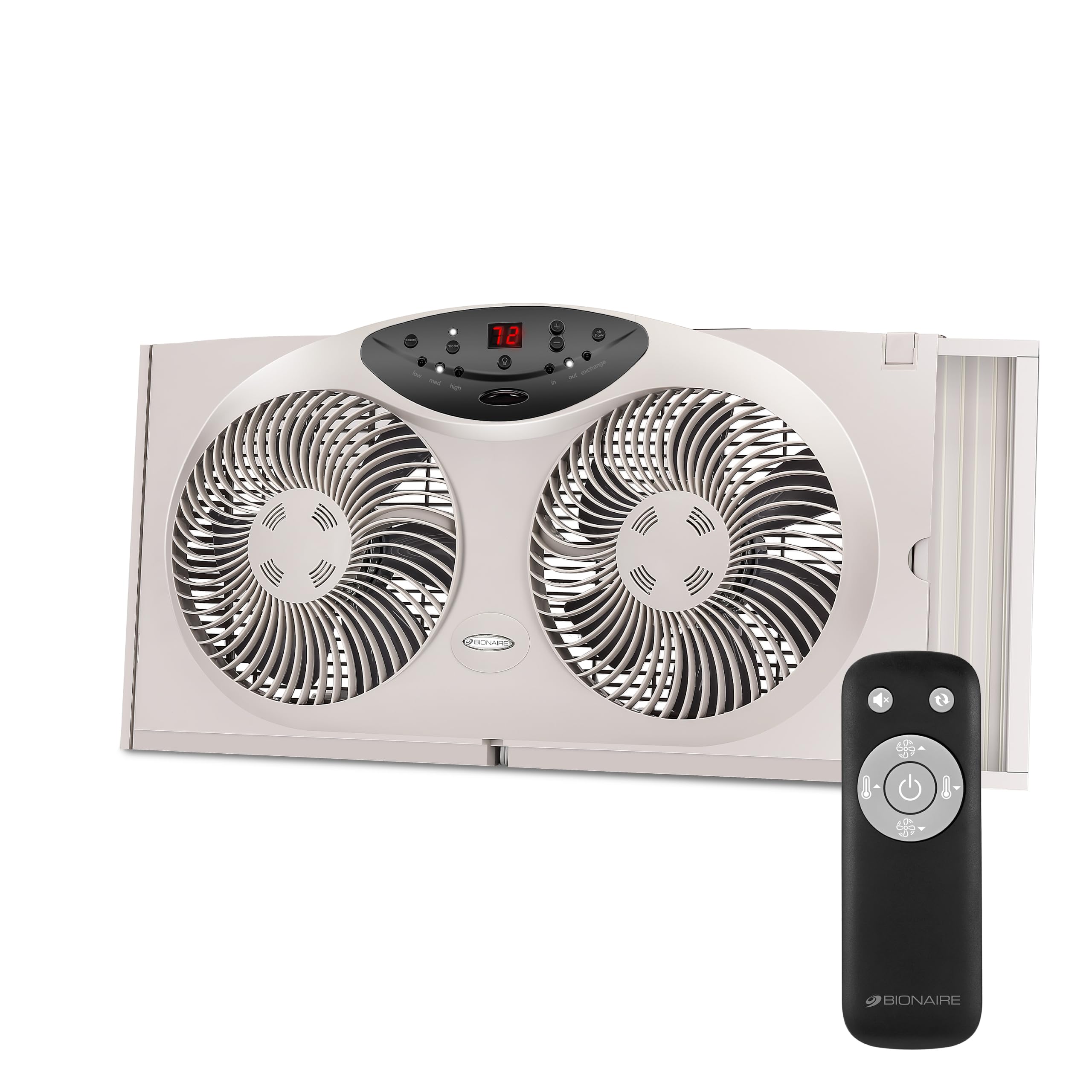
2. Bionaire Window Fan with Reversible Airflow Blades – 3-Speed Settings, Programmable Thermostat, LED Display, Remote Control
Set the temperature once and let the fan decide when you need moving air
Most window fans make you walk over and flip a dial. This one runs itself. You pick a target temperature on the digital LED screen, and the programmable thermostat switches the fan on and off as the room warms and cools. The display even has a dimmer so the light does not glare across the room at night. For a bedroom or a kitchen where you do not want to babysit a switch, that single feature is worth the upgrade.
It fits most double-hung, vertical slider, and casement windows using a built-in accordion extender plus an extra panel, covering a range from 24 to 36 inches. The reversible blades can draw in outdoor air, push indoor air out, or exchange both directions at once. There is a remote for adjusting things from across the room, and it arrives fully assembled — no tools, no build-out. A 3-year limited warranty backs it up.
The honest catch is reliability, and it is worth saying plainly: a portion of buyers report units that stop working after a week or break inside the first month. That is a real risk on a fan this long-lived in most homes. If you get a good one, the payoff is a fan that quietly moves a lot of air on low and medium settings and cools a room noticeably faster than a plain box fan. The auto mode also resets when power reconnects, so you may need to reselect your temperature after an outage.
The do-it-all angle: a programmable thermostat, remote, reversible airflow, and a 24-to-36-inch fit range put it ahead of most window fans for hands-off comfort.
The reliability risk: durability complaints are common enough that you should buy knowing it might not last, and that the auto-temperature setting forgets itself after a power blip.
Reach for this if: you want a fan that cools on its own schedule and you value the remote and temperature control over longevity.
Look elsewhere if: you need a fan you can install once and trust for years without thinking about it.
3. Genesis Twin Fan High Velocity Reversible AirFlow Fan, LED Indicator Lights, Adjustable Thermostat & Max Cool Technology, ETL Certified
Twin 9-inch fans that swap a whole room’s air in either direction
If you want to drag cool night air through the house or push hot kitchen air out the window, this is the unit that does the heavy lifting. It moves 706.21 CFM (cubic feet per minute, a measure of airflow) through two 9-inch fan heads, each on its own copper motor. That is about half the airflow of the DREO tower at 1397 CFM, but it drops that air into a window opening where it can ventilate a whole space rather than just cooling the spot you sit in.
The reversible-blade design is the standout. You can run both fans to pull air in, both to push air out, or one in and one out at the same time — a real trick for keeping air moving through a closed-up room. The button-controlled reverse means you flip direction without physically turning the fan around. Built-in expandable side panels add up to 6.5 inches on either side to help it lock into the window.
The trade-off everyone hits is noise. On high it is genuinely loud, though plenty of owners say the steady hum actually helps them sleep. There is also no remote and no per-fan speed control, and a few buyers mention an electrical buzz on the two lower speeds. The built-in thermostat lets you set a target between 60 and 80 degrees, and the LED lights track that setting — though the brightness bothers some people enough to tape over them.
What earns its keep
- 706.21 CFM of ventilation from twin copper-motor fans
- Reversible blades switch intake to exhaust without flipping the unit
- Side panels expand 6.5 inches each way for a wider fit
- Thermostat adjusts operation between 60 and 80 degrees
The rough edges to expect
- Loud on the high setting
- No remote and no separate speed control per fan
- Bright LED indicators can be distracting at night
The right buy for: anyone who wants serious air exchange in a garage, kitchen, or bedroom window and does not mind noise on the top speed.
A skip if: you want silent operation and remote control at your fingertips.
4. Air King 20″ 1/6 HP Whole House Window Fan with 3-Speeds and Storm Guards for Circulation and Exhausting Air, 9166
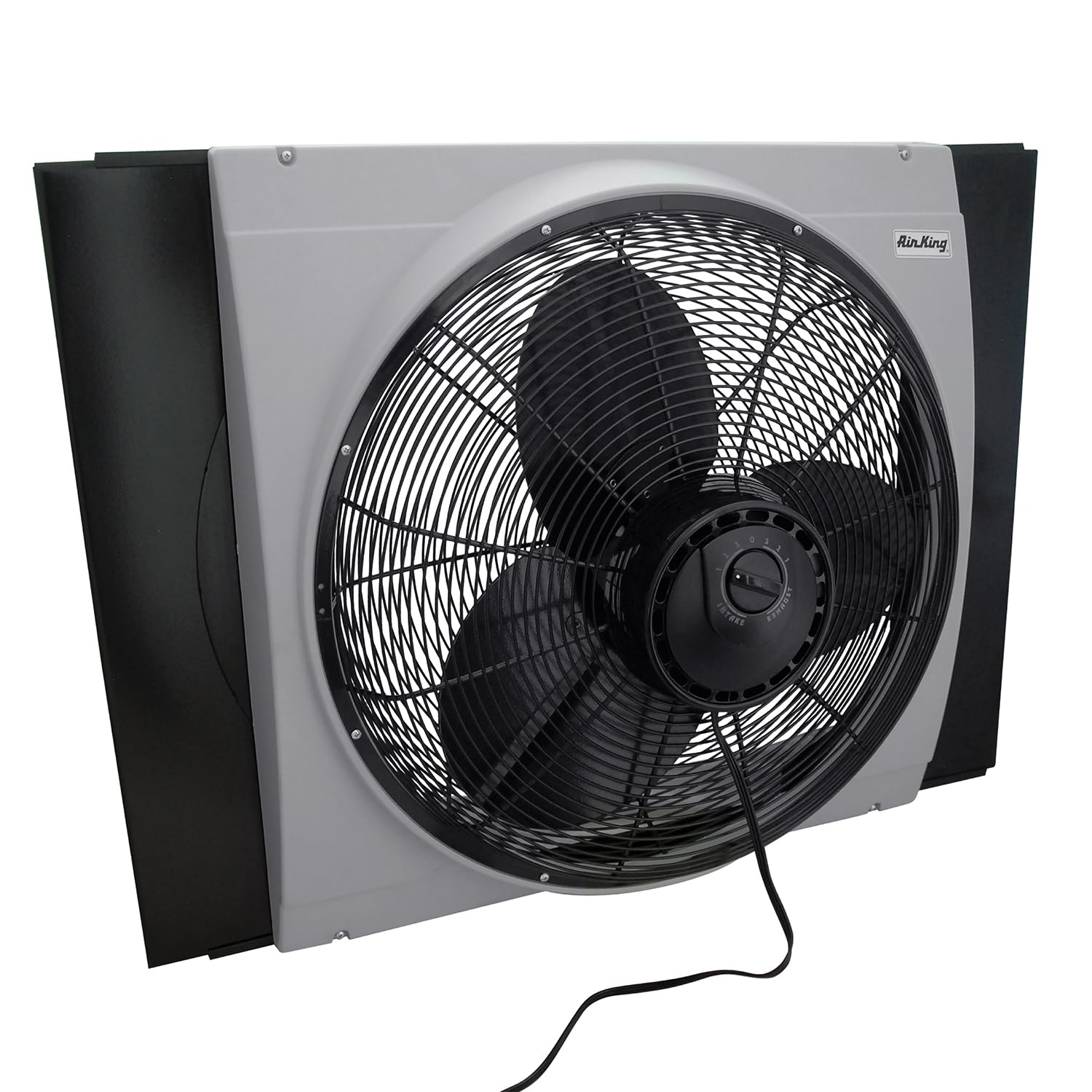
A 20-inch steel brute built to move air for an entire floor, not just one seat
This is the fan you buy when a single-room unit is not enough. It is rated at 3560 CFM — several times the airflow of any window fan above it on this list, and the kind of volume that pulls cool air through an entire downstairs. The 20-inch frame is built with powder-coated steel blades and grill set in an ABS body, so it feels like a permanent appliance rather than a seasonal gadget.
Two details separate it from the pack. First, the Storm Guard feature lets you close your window behind the fan, so you can leave it mounted through weather instead of pulling it out every time it rains. Second, the permanently lubricated motor needs little to no maintenance — the maker states it keeps its power over the long haul. A 1-year limited warranty covers it.
The clear trade-off is noise and size. Owners describe it as large and heavy, and high speed clears a first floor in minutes but is loud while doing it. There is a real-world note here too: a small number of buyers had a selector switch fail almost immediately, and Air King replaced the whole fan within a couple of days without asking for the old one back. If you can live with the hum and want the airflow, few window units come close.
Where it shines: at 3560 CFM it is the volume leader here, ideal for venting a whole floor or creating negative pressure that draws cooler air through the house.
What you pay in trade: it is big, heavy, and loud at full tilt — and you will want to leave a door or window open somewhere so it has air to pull.
Built for: homeowners who want to cool an entire level and can mount a heavy permanent fan in a window.
Not the one if: you need something light you can move room to room or run quietly beside the bed.
5. Vornado PORTAL® Window Fan, White, 3 Speeds, Reversible Exhaust Mode

The slim window unit that seals tight and disappears into the frame
For a modern window with a shallow opening and no room for a bulky fan, the Vornado PORTAL is designed to sit low and out of the way. It is built for horizontal mounting in windows from 24 to 38 inches wide, using a modular block system to reach a snug fit, and it needs at least an 8-inch-tall opening. That slim build is the whole point — it tucks into the frame instead of dominating the sill.
You get a little adjustability with three speed settings, and the reversible exhaust mode flips between pulling fresh air in and pushing stale air out with a touch. It is built for indoor window mounting and handles air exchange rather than raw cooling. This fan earns its keep on exhaust duty — owners who use it to clear out a smoking room or a stuffy kitchen report it pulls air out of the space better than fans that came before it, and it runs quietly enough to leave on overnight.
Be honest with yourself about fit before buying. The modular foam system seals beautifully in newer trimless windows, but buyers with older, silled, or sash windows often find it does not seat well, and a few note there is no exterior grill to keep bugs out. The three speed settings also feel close together to some owners, so do not expect dramatic jumps between low and high. If your window matches the design, it is a clean, quiet, well-built choice.
Why it works
- Slim profile fits windows 24 to 38 inches wide
- Reversible exhaust mode pulls or pushes air on demand
- Quiet enough to sleep through on overnight exhaust duty
What to watch
- Foam sealing system can misfit older or silled windows
- Speed settings stay similar rather than scaling up sharply
- No exterior grill means bugs can come through
Best for: homes with modern, low-profile windows where a slim, quiet exhaust fan is what you need.
A poor match if: your window is older, deep-set, or has thick trim the foam system cannot grip.
6. shinic 9″ Twin Window Fan with Remote, Reversible Airflow, Fits 23.5″–37″
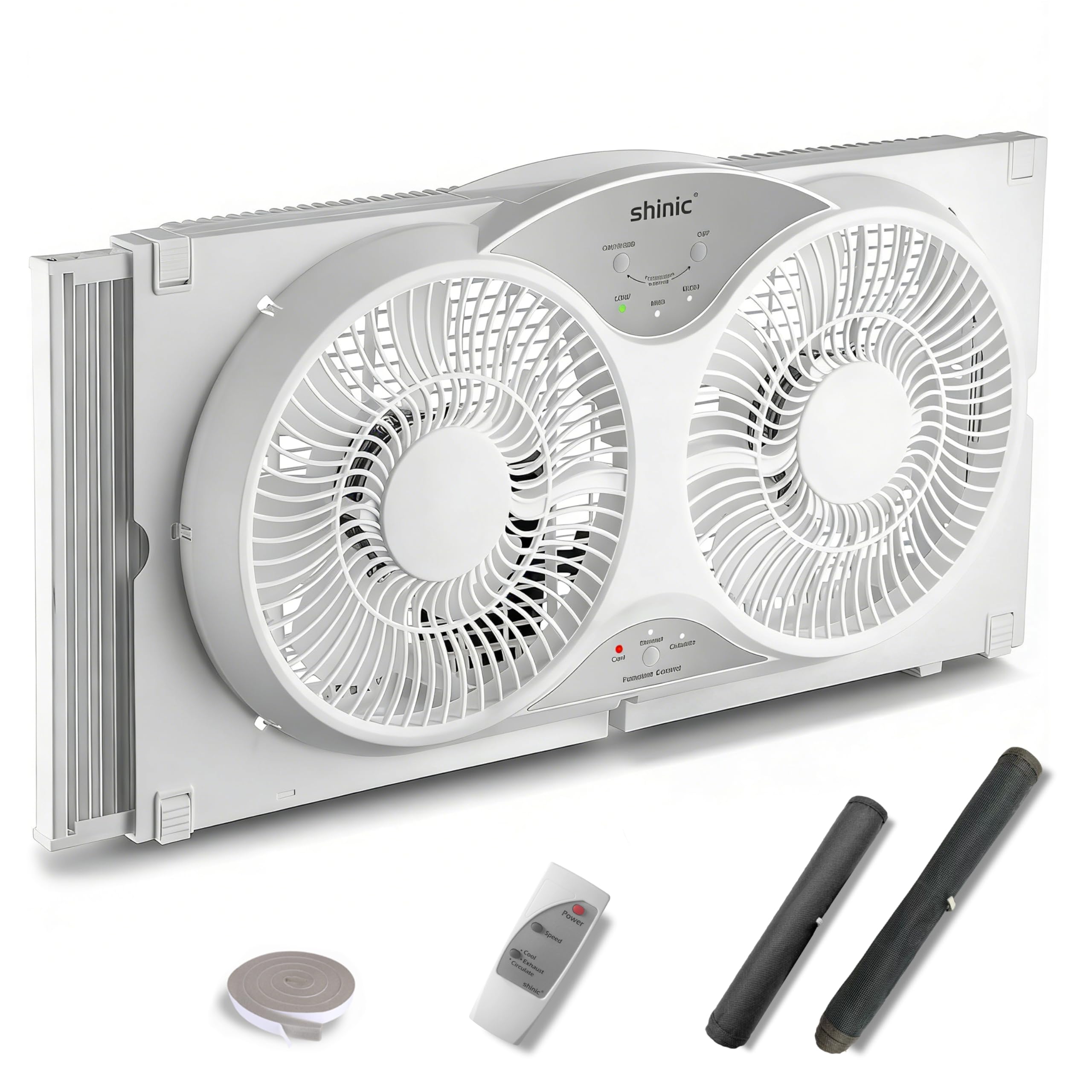
Fresh air through the window without the flies tagging along for the ride
This shinic twin fan is built around a simple idea: let fresh air in without letting pests in too. A removable front cover makes the blades easy to clean, and a detachable back screen acts as a barrier against mosquitoes, flies, and debris. For a bedroom or a small kitchen where you want the window open all evening, that bug screen does a lot of quiet work.
It runs three speeds and three modes — intake to pull cool morning air in, exhaust to push out cooking odors or humidity, and circulate to run the fans in opposite directions for balanced airflow through the room. A remote controls power, speed, and mode from up to 20 feet away, which is handy when you are already in bed. It is ETL certified and arrives with a 6-foot cord for a standard 120V outlet.
The listed airflow is 350 CFM through its dual 9-inch blades — modest compared to the 706.21 CFM Genesis twin, so treat this as a small-room unit rather than a whole-house mover. It also runs a loud humming motor at all speeds, which is the main gripe from owners. The upside is flexibility: adjustable expandable panels fit openings from 23.5 to 37 inches, and it can mount horizontally, vertically with the included adhesive tape, or stand free on its built-in feet.
The smart details: a removable cover for cleaning, a bug screen, a remote good for 20 feet, and three-way mounting make it more flexible than most small window fans.
The honest limit: at 350 CFM it is a compact-room fan, and the humming motor stays audible no matter which speed you pick.
Pick this when: you want bug-free airflow in a bedroom, bathroom, or small kitchen and value the remote.
Move on if: you need to cool a large room or want a fan you can barely hear.
7. shinic 3-Speeds Window Fan with 180°+90° Rotatable Fans, Manual Reversible, Vertical Window Fan with Rigid & Accordion Expanders

Two fans you can angle anywhere, set to pull in or push out by hand
What makes this shinic stand out is that you can point each fan head where you want it. The dual fans rotate 180 degrees and tilt another 90 degrees, so instead of one fixed blast of air you can aim one stream across the room and the other up at the ceiling.
It handles three manual functions by simply adjusting the angle of the two heads: dual cooling to bring air in, dual exhaust to push air out, and a mix of one in and one out for circulating. Auto-locking expanders on one side and two additional rigid panels on the other stretch the fit from 21.65 to 33.27 inches. Those rigid panels add stability, especially when it is mounted vertically for a sliding window. At 70 watts and 120 volts, with ETL certification and helpful carry handles, it is easy to move and install.
The thing to understand before buying is what “manual reversible” really means: you flip the fans by hand rather than pressing a switch, and if your window has a screen in place, changing direction means removing screens first. A couple of owners also mention the speed knob can be stiff and the plastic body heats up in direct sun. But for a bedroom, kitchen, or workshop where you want custom airflow, the aimable heads are a genuinely useful trick.
what separates it
- Each fan head rotates 180° and tilts 90° for direction control
- Manual intake, exhaust, or a mix of both
- Expanders stretch from 21.65″ to 33.27″
- Rigid side panels add stability for vertical mounting
What to know first
- Reversing direction means physically flipping the fans
- Screens must come out to change airflow direction
- Plastic body warms up in direct summer sun
The fit for: anyone who wants to aim airflow exactly where they need it and mount a fan vertically in a sliding window.
Not ideal if: you want one-button reversing or the fan has to stay behind a fixed screen.
8. COMFORT ZONE Window Fan for Bedroom, 9 inch 3 Speed Dual Fans with Auto-Locking Expanders, 3 Modes, Remote Control

A twin window fan you can control without ever getting out of bed
The feature buyers love here is the remote. It lets you change speed, switch modes, and power the fan on or off from across the room, which matters a lot when this fan is the thing keeping a bedroom bearable at night. It runs three speeds and three modes: COOL brings air in on both fans, EXHAUST pushes stale air out, and CIRCULATE runs one fan in and one out for balanced airflow.
The accordion expanders adjust from 23-1/2 to 37 inches and lock in place once set, so it grips most standard windows. At 70 watts and 120 volts it draws standard household power, and a fabric cover with a bug screen is included to keep insects out. It also arrives with the pop-in feet so you can rest it on a surface if you are not mounting it in a window.
Two honest notes. Airflow is a real question mark — some owners find it moves a nice amount of air, while others say it barely does. And this is the model where reliability catches the most attention, with a recurring pattern of units failing within weeks. If ventilation and a handheld remote are your priorities and you accept the durability risk, it performs well in that first stretch, running for long stretches without overheating on a summer day.
What owners reach for it for: the remote and the three modes make daily control easy, and its expander panels lock down to fit most standard windows.
The two risks to weigh: airflow is inconsistent from unit to unit, and the durability record here is the weakest of the window fans on this list.
Good fit for: someone who wants a remote-controlled window fan for the bedroom and is okay replacing it down the line.
Look past it if: you want the longest-lasting fan you can buy, or the strongest air mover.
9. BLACK+DECKER 9″ Dual Window Fan with 2 Speed Settings, BFW9M, White

A light, simple window fan you can pull out and drop into any frame
This BLACK+DECKER twin window fan is the simplest unit here: a dial, two speeds, no remote. It uses two mechanically controlled speed settings — low and high — turned by a dial rather than a digital panel. There are no modes to learn and no remote to lose. It is made of rust-resistant material, weighs 4.5 pounds, and comes with accordion expanders that range from 22.5 to 33 inches plus removable legs, so it seats into a typical window quickly.
The design lets you set both fans one way to draw fresh air in, or flip the whole unit around to push air out of the room. That physical flip is the whole exhaust mechanism — a few owners found the idea of turning it around annoying at first, then realized it was not a big deal in practice. As one puts it, the fit lands right for standard windows, and the airflow on high does its job in hot weather.
Keep expectations in line with the price. With only two speed settings, this is the most basic fan on the list — the DREO tower gives you 9 speeds by comparison. The bigger themes in owner feedback are mixed: some find the airflow strong, others find it weak, and a handful call it a bit loud. A few units arrive less sturdy than expected, so treat it as a light-duty helper for a small room rather than a serious whole-house mover.
Why it earns a spot
- Rust-resistant build at just 4.5 pounds
- Expanders stretch from 22.5″ to 33″ for a wide range of windows
- Simplest possible setup with a mechanical dial
- Flip-around design switches between intake and exhaust
The honest trade-offs
- Only 2 speeds versus the 9 on the DREO tower
- Airflow and noise get mixed feedback
- Light-duty build is not built for heavy daily use
Suits you if: you want an inexpensive, lightweight window fan for a small room and value simple controls.
Skip if: you need fine speed control or the most airflow for your money.
Understanding the Specs
Airflow (CFM) and Room Size
CFM stands for cubic feet per minute — how much air the fan pushes in one minute. A higher number means more air moved, which matters most in larger or open rooms. A small bedroom fan around 350 to 450 CFM handles a single room, while a whole-house window unit at several thousand CFM can ventilate an entire floor. In a tight room, a lower-CFM fan aimed at you can feel just as cool and run quieter.
DC vs AC Motors and What You Hear
A DC motor (a brushless type built for low-noise, efficient running) typically stays near silent on its lower settings. A standard AC motor is simpler and cheaper, and it often produces a hum or buzz you can notice in a quiet room. For silent overnight cooling, a DC motor with a wide speed range wins. For maximum daytime airflow on a budget, an AC motor costs less.
FAQ
What does “reversible airflow” actually mean on a window fan?
How do I know what window fan size fits my window?
Do I need a fan with a remote control?
Is a tower fan or a window fan better for cooling a bedroom?
Why is my window fan so loud on high speed?
Can a window fan lower my power bill versus running the AC?
Do window fans come with bug screens?
What is a programmable thermostat on a window fan, and is it worth having?
Can I mount a window fan vertically, or only horizontally?
How long should a window fan last?
Final Thoughts: The Verdict
For most people, the ac fan that does the most good is the DREO Tower Fan, because it moves 1397 CFM of air, gives you 9 speeds and 4 modes, and stays quiet on the low settings that matter at night — all without eating your window. If your priority is exchanging air rather than cooling one spot, the Genesis Twin Fan at 706.21 CFM is the one to reach for, and if you want to cool an entire floor, the Air King 20″ whole-house fan at 3560 CFM is in a class of its own. Match the CFM and the fit range to your room and window, and you will stay cool without overspending.
How We Picked
We do not accept paid placement. Every pick is matched to a real buyer and a real use-case; we do not hands-on test units.
Sources & Methodology
Specifications: manufacturer listings and product documentation. Review insights: verified customer reviews, as of September 2026. Pricing: not shown on this page (it changes often); check the current price via the retailer link.
As an Amazon Associate, KitchPrep earns from qualifying purchases. This does not affect which products we feature.
Related Guides
