
Specs are compiled from manufacturer listings and verified buyer reviews and can change over time — please confirm the key details on the product page before buying.
You want a porch awning that still looks straight and solid after a few winters of wind, snow and driving rain — not one that sags, drips on your head or rusts at the bracket. That is the whole decision here. The picks below all use metal you can trust, and the differences between them come down to how much width you need, how they drain water, and whether the sloped panel stays where you set it. If you want the short answer, the Awntech Houstonian leads the pack on build quality, the polycarbonate-and-aluminum panels win on price, and the Kozyard’s four tilt positions handle sun and ventilation better than anything fixed.
I’m Mohammad Maruf — the founder and writer behind KitchPrep. This guide is built by comparing the manufacturers’ published specifications and the patterns across verified customer reviews, so you get each pick’s real strengths and trade-offs instead of marketing spin.
Below you will find the specs that actually matter — panel width in inches, projection depth, material gauge, wind and snow ratings, and how the panel sheds water. Every pick earns its place on real owner experience, not marketing copy, so read on for the metal awning for a porch.
Our Picks at a Glance

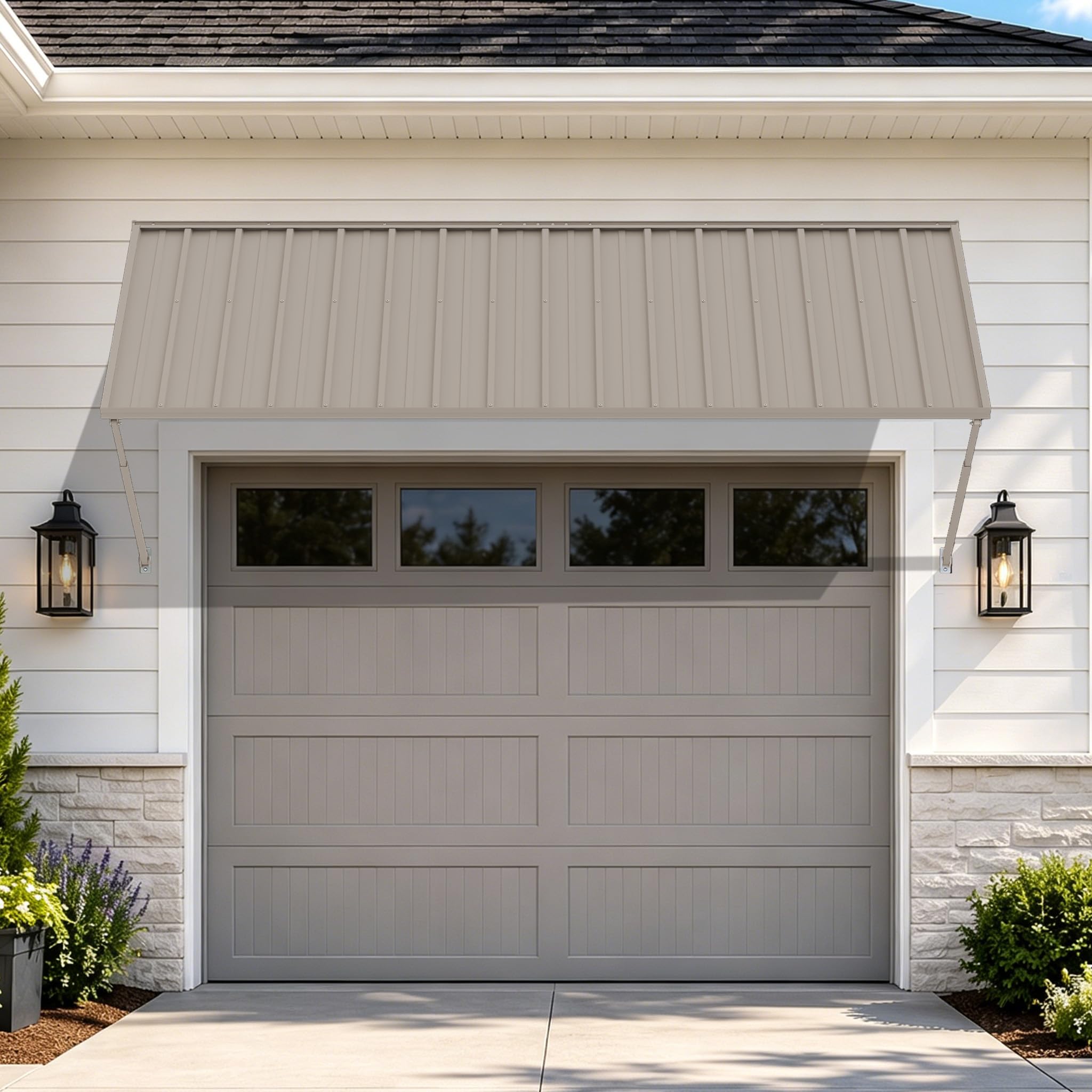

How To Choose The Best Metal Awning for a Porch
An awning is a permanent hole in your wall, so the choices you make before buying matter more here than in almost any other outdoor purchase. Work through these five things in order and you will land on the right panel the first time.
Steel, Aluminum Or Polycarbonate Panels
Galvanized steel with a powder-coat finish is the heaviest-duty option and the one to pick if your porch takes real snow. Aluminum is lighter, so you can mount it on siding or a wooden fascia without extra bracing. Polycarbonate panels over an aluminum or ABS frame are the budget route — they let daylight through, which keeps the entry bright, but they flex more in gusty weather. Whichever you choose, look for a painted or powder-coated finish and rust-resistant hardware, because untreated screws are the first thing to fail on an outdoor canopy.
Width And Projection Explained
Width is the measurement across your doorway — a 40-inch panel suits a single door, while a 108-inch panel spans a wide porch or a double opening. Projection is how far the canopy reaches out from the wall, and this is what actually keeps your steps dry. A deeper projection catches more rain before it reaches the threshold, but it also catches more wind, so match the depth to how exposed your wall is.
Wind Ratings And Snow Load
A wind rating in miles per hour tells you how much lateral force the panel and its brackets were tested to handle, and a snow-load figure in pounds per square foot tells you how much weight the roof can carry before it bows. Coastal and hilltop porches need the higher wind figure; northern inland porches need the snow number. Ask yourself which one your worst week of weather actually looks like.
Mounting Surfaces And Hardware
Brick, concrete and block take masonry anchors; wood takes lag bolts; stucco over wood needs both. Almost every awning here ships with hardware for one or two of those surfaces, not all of them, so check your wall before the box arrives. A flat surface is far easier than lap siding, which leaves brackets sitting on an angle.
Installation Effort
Anything over about 60 inches wide realistically needs two people to lift into place, and the wider panels want three. Assembling the canopy flat on the ground first and then hoisting the finished unit is the method most owners settle on, and it saves far more time than trying to build overhead.
Quick Comparison
| Model | Best For | Material | Panel Size (W x Projection) | Wind / Snow Rating | Amazon |
|---|---|---|---|---|---|
| Awntech Houstonian Open-Side Fixed Awning★ Best Overall | Overall build quality | Powder-coated galvanized steel | 104″ W x 24″ D | 115 MPH / 40 PSF | Amazon |
| Kozyard Adjustable Door Window AwningMost Adjustable | Adjustable shade and airflow | Powder-coated iron panels, aluminum frame | 108″ W x 42″ D | 60 MPH / 20 in fresh snow | Amazon |
| 1500 Series Aluminum Door Canopy with SidewingsBuilt To Last | Lightweight, no-rust aluminum | Aluminum, two-coat baked-on finish | 48″ W x 42″ D | — | Amazon |
| HIAPES Door Awnings Exterior | Compact entry canopy | Polycarbonate panels, aluminum brackets | 40″ W x 40″ D | 220 lbs load capacity | Amazon |
| VEVOR Fixed Metal Awning 80 x 36 in | Steel panels on a tight budget | 0.8mm metal tiles, steel frame | 79.92″ W x 40.94″ D | — | Amazon |
| VEVOR Aluminum Awning 60 x 42 in | Curved drainage on a wide span | 0.6mm aluminum, 22mm support rods | 59.84″ W x 41.73″ D | — | Amazon |
| GGNEBAI 40″x60″ Door Awning Exterior | Wide doorway on a budget | Polycarbonate sheet, aluminum bars, ABS brackets | 59.5″ W x 39.5″ D | — | Amazon |
| JYJNHOME 40×48 Inch Window Door Awning | Bright, light-passing coverage | 5mm twin-wall polycarbonate, PP+glass-fiber brackets | 47.5″ W x 39.5″ D | UPF 50+ | Amazon |
In‑Depth Reviews
1. Awntech Houstonian Open-Side Fixed Awning, 104″ W x 24″ H x 24″ D, Black
Our pick — over 4.5★ from 150+ verified ratings; the strongest balance of quality and price.
Powder-coated galvanized steel tested to 115 MPH winds and a 40 PSF snow load.
If your porch faces open ground where wind and snow arrive together, this is the panel to start with. It is built from powder-coated galvanized steel — steel that has been dipped in zinc so it resists rust — with a sloped standing-seam roof that pushes rainwater off the front edge rather than letting it pool. The join lines are raised, which is what “standing seam” means, and that shape is why water finds its way off instead of sitting on top. It has been tested to hold up under 115 MPH winds and a 40 PSF snow load, so the framing was built for the kind of weather that bends cheaper canopies.
The open-side design leaves the ends uncovered, which keeps airflow moving and gives the awning a slimmer look than a boxed-in style. The whole unit weighs 8 pounds and the brackets carry four welded tabs, so you can drive lag bolts straight into a stud without adapters. Buyers report it “withstood 2 years of high winds/snow below Mt Rainier,” and the same theme runs through the wider feedback. What wins people over most is the quality itself, with appearance running a close second — it reads as an architectural feature rather than a bolted-on utility panel, and it has shown up in front of EV chargers as happily as it has over a front door.
The honest catch is the paperwork, not the steel. Assembly runs about 60 to 90 minutes solo, but the printed instructions and the video are dated, the mounting hardware can come up short, and the lid wants two or three people for the final lift. The supplied bolts also tend to oxidize, so swapping in galvanized ones up front saves you grief in year two. At 24 inches of projection this panel covers a doorway well, though a deeper reach would shelter more during a sideways storm.
What earns the top spot
- Powder-coated galvanized steel with 115 MPH wind and 40 PSF snow testing behind it
- Welded bracket tabs take lag bolts directly — no adapter plates needed
- Sloped standing-seam roof sends rain off the front instead of pooling
- At 8 lb, one person can hang it once the panel is built
Where it stumbles
- Instructions and video are dated; some kits arrive with hardware missing
- Open sides let wind-driven rain and snow through the ends
- Included bolts oxidize — swap for galvanized before mounting
- Plan on two or three people for the final lift
The right call for: anyone whose porch takes real weather and who wants a permanent steel fixture rather than a seasonal cover.
Worth knowing first: you are paying for the panel, not the manual — budget an evening for assembly and a trip for better bolts.
2. Kozyard Adjustable Door Window Awning – 4-Level Tilt, Aluminum Frame
Four tilt settings mean the shade changes with the season, not the other way round.
Most awnings lock in one angle the day you bolt them up. This one does not — the panel tilts through four positions, so you can drop it low to block a summer sun that hits your door, or raise it in cooler months to let light and air back in. The canopy is powder-coated iron with an aluminum frame, and it carries a rating of up to 20 inches of fresh snow and up to 60 MPH of wind resistance, with the manufacturer noting those figures hold only when it is installed firmly to their guidelines.
The width is the headline number: a 108-inch panel across, with a sloped panel depth of 43 1/2 inches and adjustable projection between 31 and 42 inches. Compare that to the 24-inch depth of the Awntech above, and you are getting a considerably deeper reach for keeping an entire porch landing dry. A built-in front gutter directs water away from the doorway rather than letting it drip off the lip. Assembly is where this awning quietly shines — pre-drilled holes line up, the hardware is decent, and the rail-mount system lets you build the panel flat on the ground and slide it into place from either side, which cuts down on time spent up a ladder.
Two things to plan for. The final lift still takes two people at this size, and one owner found that mounting the anchor strip and struts to the wall before sliding the panel in works better — though that trick needs a clear wall measuring at least twice the panel width. The colour runs warmer than the name suggests, closer to a dark bronze than a true grey, so check it against your trim before ordering. Drainage draws a mixed reaction, and it installs on siding as readily as on flat wood, brick or concrete, which is rare at this width.
The seasonal argument: fixed awnings shade one angle for a decade. This one lets you tune the panel four ways, which matters if your porch is sunny in July and gloomy by November.
The one you plan around: budget a second pair of hands for the final hoist, and factor in vinyl mounting blocks if your wall is sided.
Reach for this if: your porch needs serious width and you want to control how much sun gets through.
Look elsewhere if: a one-angle install keeps your life simpler and sliding rails are more fiddling than you want.
3. 1500 Series Aluminum Door Canopy with Sidewings
Mill-finish aluminum with a two-coat baked-on finish the maker says will never rust.
Aluminum gets overlooked next to steel, and that is a mistake on a porch where you are hanging the panel onto siding or a wooden fascia. This canopy is mill-finish aluminum with a two-coat baked-on finish — a coating cured in an oven rather than air-dried, which is why it holds its colour outside. The manufacturer states it will never rust, and the sidewings close off the ends so rain cannot drift in sideways the way it does on an open-side awning. A built-in front gutter channels water away from the door in one clean line.
The size is a compact 48 inches wide by 42 inches of projection, which suits a single door rather than a wide porch span. That combination — narrow width, deep reach — is the opposite trade-off from the 104-inch Awntech, and for a standard entry it is usually the better shape, because depth keeps the threshold dry while the modest width keeps the bracket load low. Assembly is genuinely simple: owners describe it as straightforward for an amateur with the instructions in hand. One owner ran into a replacement unit that arrived roughly a quarter inch too wide and trimmed the opening to fit, after which it took a storm without trouble.
The trade-off will not surprise you at this weight — the panel is very light, which is brilliant for a one-person lift on a flat wall and less forgiving against a stucco surface. Uneven stucco can bow the aluminum mounting bar, and finding studs behind it is fiddly, turning a solo job into a three-person one. The manufacturer’s warranty covers five years against manufacturing defects. For a flat wall with good framing, the installation is close to easy.
Best for: a single-door porch on a flat or lightly sided wall where a lightweight, rust-proof panel wins over raw size.
skip it if: you need more than four feet of width or your wall is bumpy stucco that will fight the mounting bar.
4. HIAPES Door Awnings Exterior, Awning for Door Entrance
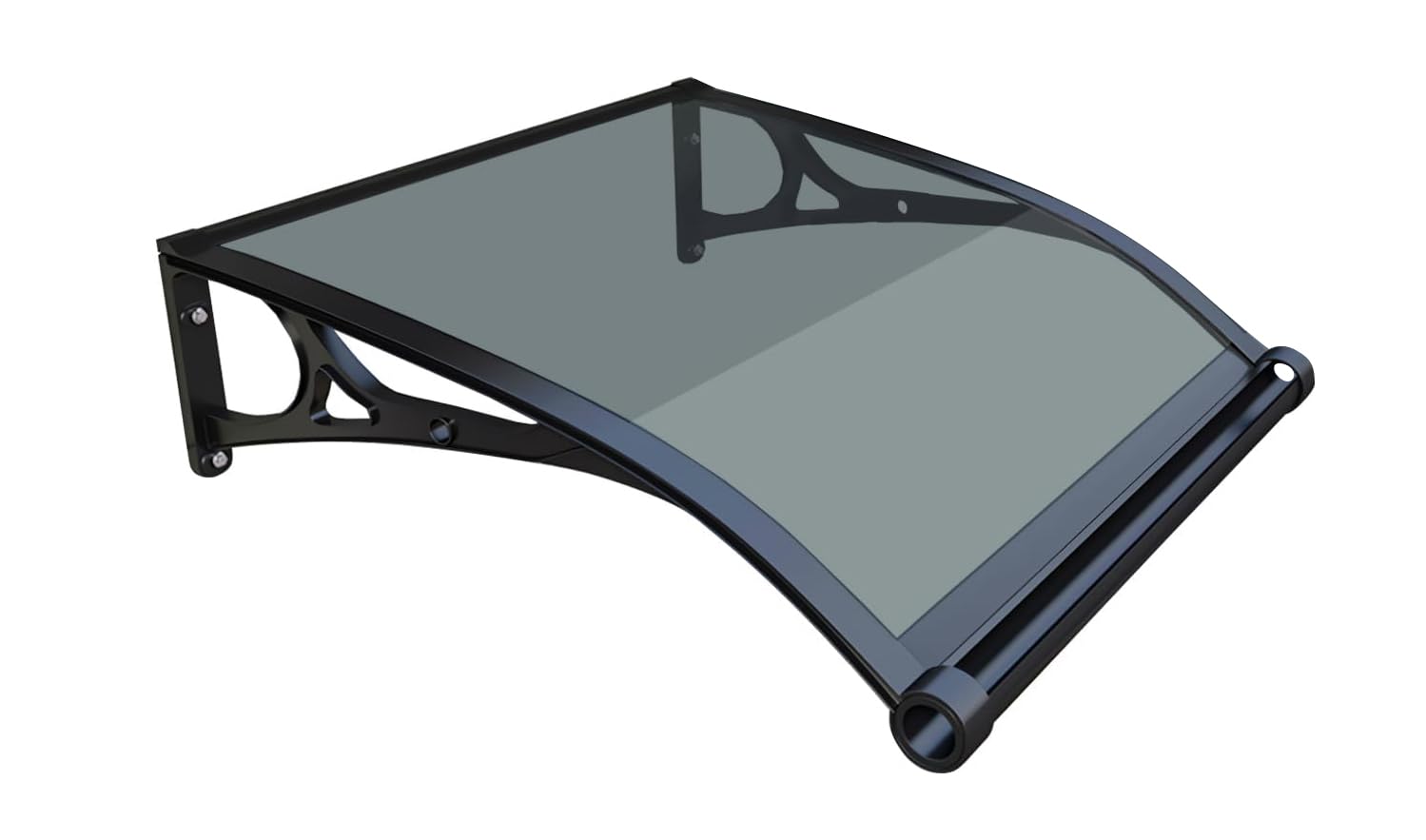
A 40″ x 40″ aluminum-and-polycarbonate panel rated to carry 220 lb.
Forty inches square, and rated to carry up to 220 pounds — that is the number that makes this one punch above its footprint. The frame is aluminium alloy with transparent polycarbonate panels, which means you get a canopy that stands up to weight without feeling heavy on the wall. Polycarbonate is the tough, clear plastic used for impact-resistant glazing rather than the thin sheets you see on budget kits, and it has the added bonus of staying quiet when rain hits it — no tin-roof drumming over the doorway, and it is fire-resistant.
The sun blocking is a genuine draw where a west-facing door bakes in the afternoon. It carries UPF 50+ protection, which is the highest sun-protection rating a fabric or panel can reach, and one family with bright living room windows found it cut the glare enough that they stopped needing blinds while still being able to see outside. It also copes with high winds without moving. On the assembly side, the aluminium components are solid and the instructions include illustrations, though the maker recommends two people for the canopy, and the forty-inch square is the one size an owner managed solo.
Plan your hardware before you order. The kit ships with masonry anchors and the brackets need a flat mounting surface, so stucco over wood or lap siding calls for a separate trip to the shop for lag bolts and shields. The brackets slots also run narrow, which makes threading weatherstrip through them awkward. Owners describe the printed instructions as sparse, with hand-drawn diagrams and no hardware list, so a video walkthrough is worth queuing up beforehand. It is note this is the smallest awning here — sized for an entry, not a porch span.
Why the small one holds up
- 220 lb load capacity in a 40″ x 40″ panel
- UPF 50+ sun blocking and quiet in rain
- Fire-resistant and shock-resistant under impact
- Aluminium alloy brackets and hardware included
What you will need to sort yourself
- Hardware suits masonry only — siding and stucco need extra bolts
- Bracket slots are tight for adding weatherstrip
- Instructions are sparse with no hardware sizes listed
- Forty-inch square suits a single entry, not a wide porch
Choose this if a compact, load-rated canopy for a bright, sun-baked doorway fits your porch better than a wide, shallow panel.
Know before you buy: the mounting surface needs to be flat, and you will likely need to supply your own siding-ready screws.
5. VEVOR Fixed Metal Awning 80 x 36 in Heavy-Duty Window Awning Door Canopy
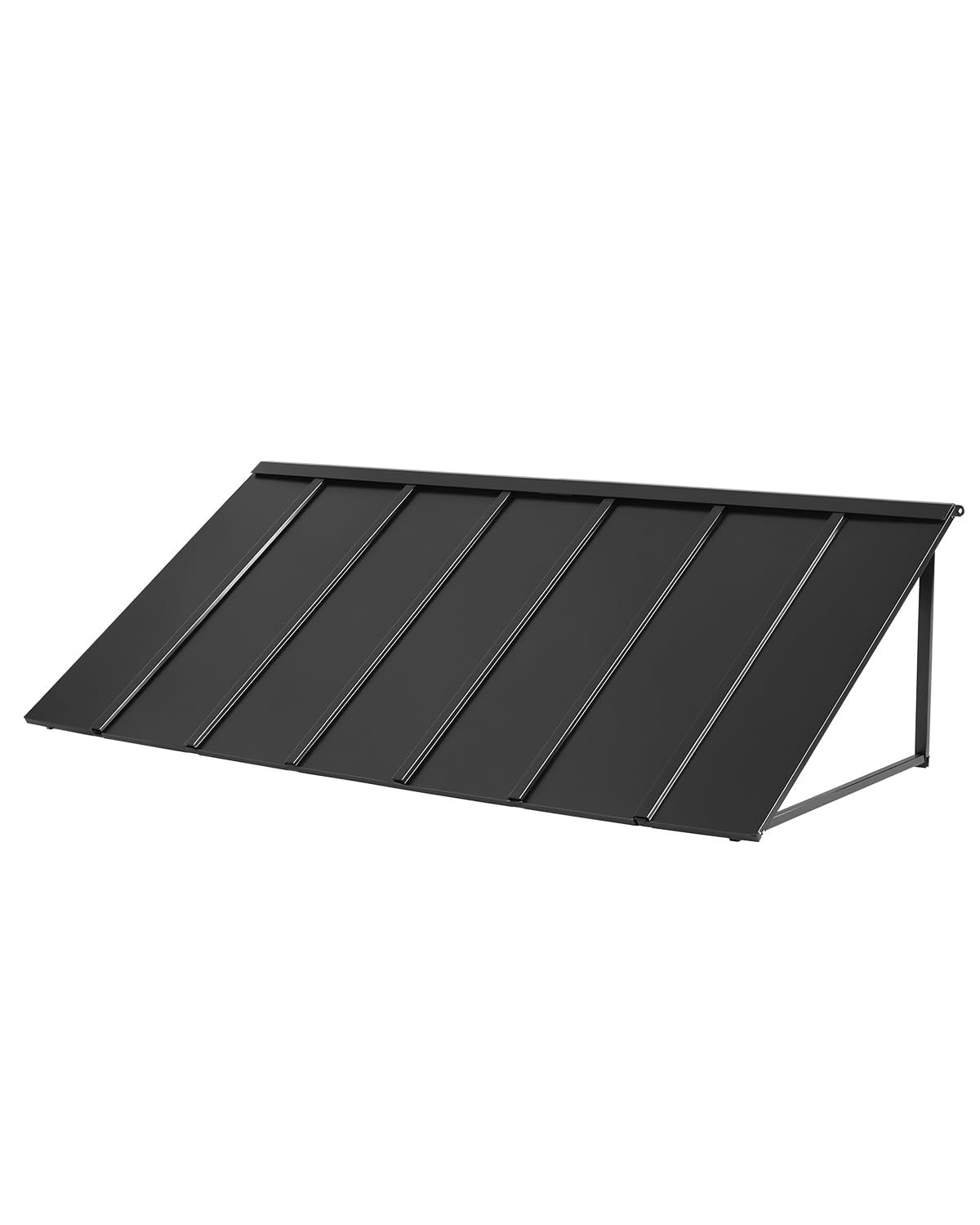
0.8mm steel tiles on a triangular support frame, 44.1 lb and 79.92″ wide.
At 44.1 pounds and built from steel and iron, this is a solid fixed canopy rather than a thin sheet. The 0.8mm metal tiles sit on a triangular support structure, which is the geometry that keeps a roof from folding under wind pressure — three points brace in two directions where a simple bracket braces in one. It spans 79.92 inches wide with 40.94 inches of projection, and the sloped design carries rainwater off the front edge rather than letting it pool and press on the panels.
The appearance is the strongest card after the size. The black finish reads like far more expensive models, and owners find their neighbours assume it cost a great deal more. Sun and shade coverage is well covered in the feedback — one owner mounted theirs over a window and found the screen and sill stayed bone dry in a downpour and held firm in real wind. Value for money is what people talk about most with this panel, and the black frame suits a garage, storefront or garden wall as readily as a front door.
The watch-out is durability and fit, not shade. Paint has started to fail on some units, and the centre braces can run half an inch to three-quarters off, which leaves a slight sag you will want to take out during assembly. A few kits arrive with scuffed frame parts, and the protective film on the panels is thin enough that removing it properly takes patience. It also wants a genuinely flat surface — sidings and uneven walls need fabricated blocks behind the frame. One buyer ordered the wider 104-inch version and found it would not line up with the studs, so measure your stud spacing before choosing the size.
Where the money goes: a heavy steel panel with a proper triangular frame that handles sun and rain without complaint, for buyers who judge an awning by how it looks from the street.
Fair warning: the paint and the panel alignment are the two things to inspect on arrival, and the provided screws are worth replacing with painted outdoor ones.
Pick this when you want a wide steel canopy and are happy to spend an afternoon truing up the frame before it goes up.
Think twice if your house has siding you would rather not drill extra blocking into.
6. VEVOR Aluminum Awning 60 x 42 in
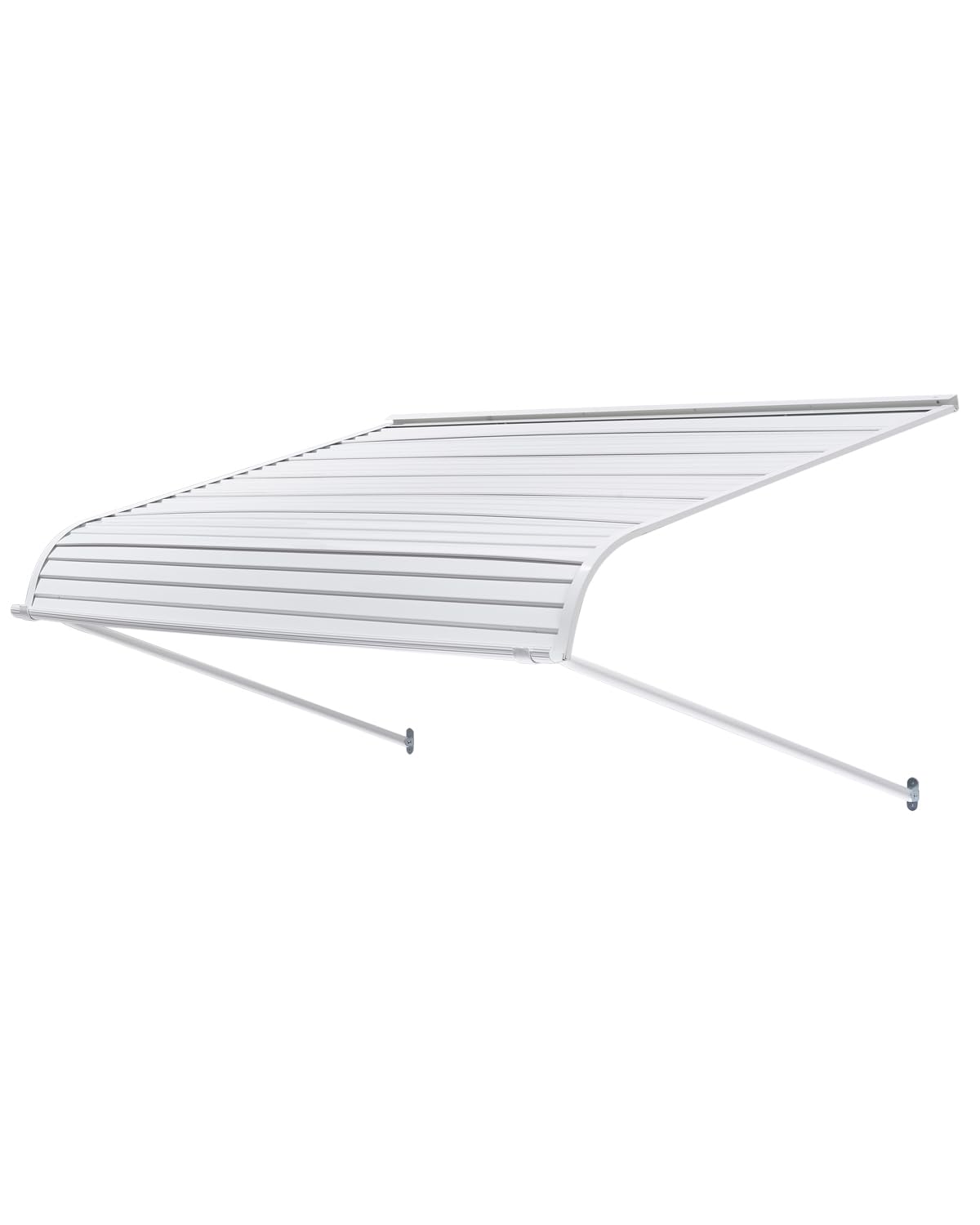
7.87-inch interlocking ripple panels with curved edges and a drainage channel.
If a leak over the doorway is what drove you to shop in the first place, this one is engineered around exactly that. The 0.6mm aluminum sheets use 7.87-inch wide ripple panels — the corrugated profile — that interlock tightly along their length so nothing seeps through the seams on a wet day. Curved edges and a drainage channel then carry the water away instead of letting it collect, which is why the maker can claim no leaks even in steady rain. The frame is aluminium with 22mm thick support rods, so the panel is rigid without adding much weight.
At 59.84 inches wide and 41.73 inches of projection, this fills the gap between a single-door canopy and a full porch span, and the white finish suits a painted house front. It weighs 17.9 pounds, which is light enough that the lift is manageable for two people without a hoist. One owner replaced an older metal awning over a back door with this one and found it covered the stairs better than the original did, with the built-in assembly instructions adequate and no parts missing — the video on the listing filled in the gaps. The curved profile gives it a shape that reads as considered rather than utilitarian.
Build quality is the honest caveat. The panel is light until it is fully screwed together, which means the sections want to shift around while you are aligning them, and the instructions run to pictures rather than written steps, so a couple of owners found the order of assembly unclear. Detailed window-by-window sizing made one installation awkward, and the whole job can stretch to two people over two days if you are working alone on a ladder. Follow the words in the manual that say to START ON THE GROUND — the assembly gets dramatically simpler.
The case for it: a leak-focused aluminum panel that covers a wide doorway and sheds water properly, once you build it flat on the ground first.
The trade-off: instructions are diagram-only, so allow more time than the job looks like it should take.
7. GGNEBAI 40″x60″ Door Awning Exterior, Polycarbonate Window Canopy ABS Bracket
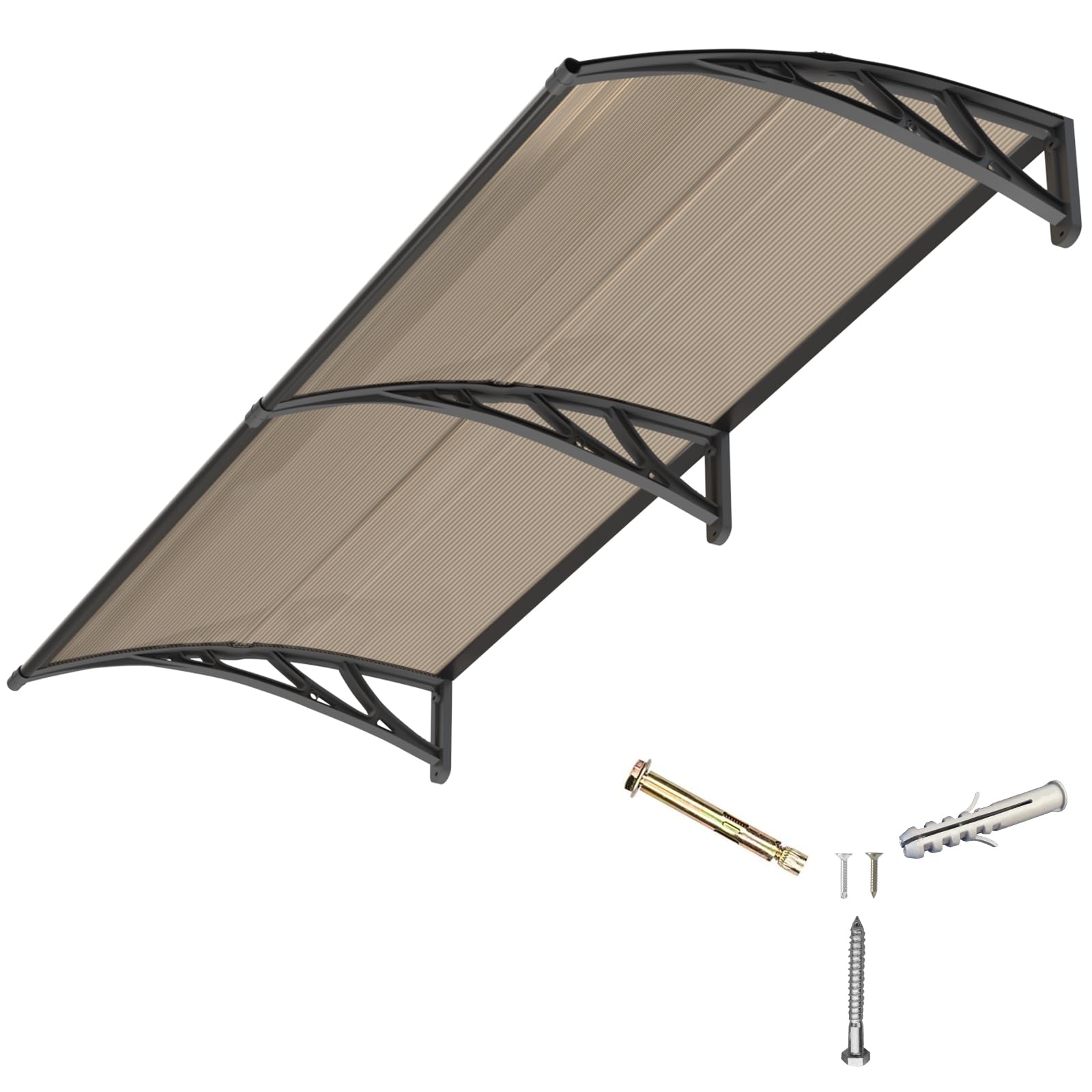
A 59.5-inch polycarbonate canopy that blocks UV while letting daylight through.
Here is the pattern most people miss: an awning over a door takes more rain than one over a window, and this one is sized for exactly that job. At 59.5 inches wide with 39.5 inches of projection, it covers a wide doorway without darkening it, because the hollow polycarbonate panels pass natural light while still blocking UV rays. The frame pairs corrosion-resistant aluminum rods with reinforced ABS brackets — ABS is the same tough plastic used in car trim, which is why it survives outdoor temperature swings better than thinner plastics.
Owners mention the panel “survived Oklahoma wind” without trouble and “fits porch perfectly” across a wide run, and the appearance is what gets talked about first, followed closely by how simple the install is. Five types of screws ship in the box, covering concrete, brick and wood, so you are not hunting down masonry anchors on a Saturday morning. It is also easy to recommend for a small structure — one owner fitted theirs over the outside door of a tiny home and had it up without fuss.
The leak-proof design relies on sealing every joint, and the maker suggests applying glass glue at the seams during assembly — a step worth taking seriously, because the panels fit snugly and they want to be worked in together rather than one at a time. That snugness makes solo assembly genuinely hard. The furnished lag screws also run oversized, and the plastic rails are light enough to feel fragile in the hand, so the overall sense is of a canopy that does the job while asking you to handle it gently.
What it does well
- 59.5″ wide coverage that keeps the entry bright
- Five screw types included for concrete, brick or wood
- Corrosion-resistant aluminum rods with reinforced ABS brackets
- UV blocking with natural light passing through
What to plan for
- All panels want to go in together — solo assembly is tough
- Furnished lag screws run oversized for most fascia
- Light plastic rails need careful handling
- Seam glue is effectively required for a dry doorway
Go for this if you want wide, light-passing coverage over a doorway and have a helper on hand for the panel alignment.
Leave it if you are installing alone or want a panel you can manhandle without worry.
8. JYJNHOME 40×48 Inch Window Door Awning Exterior
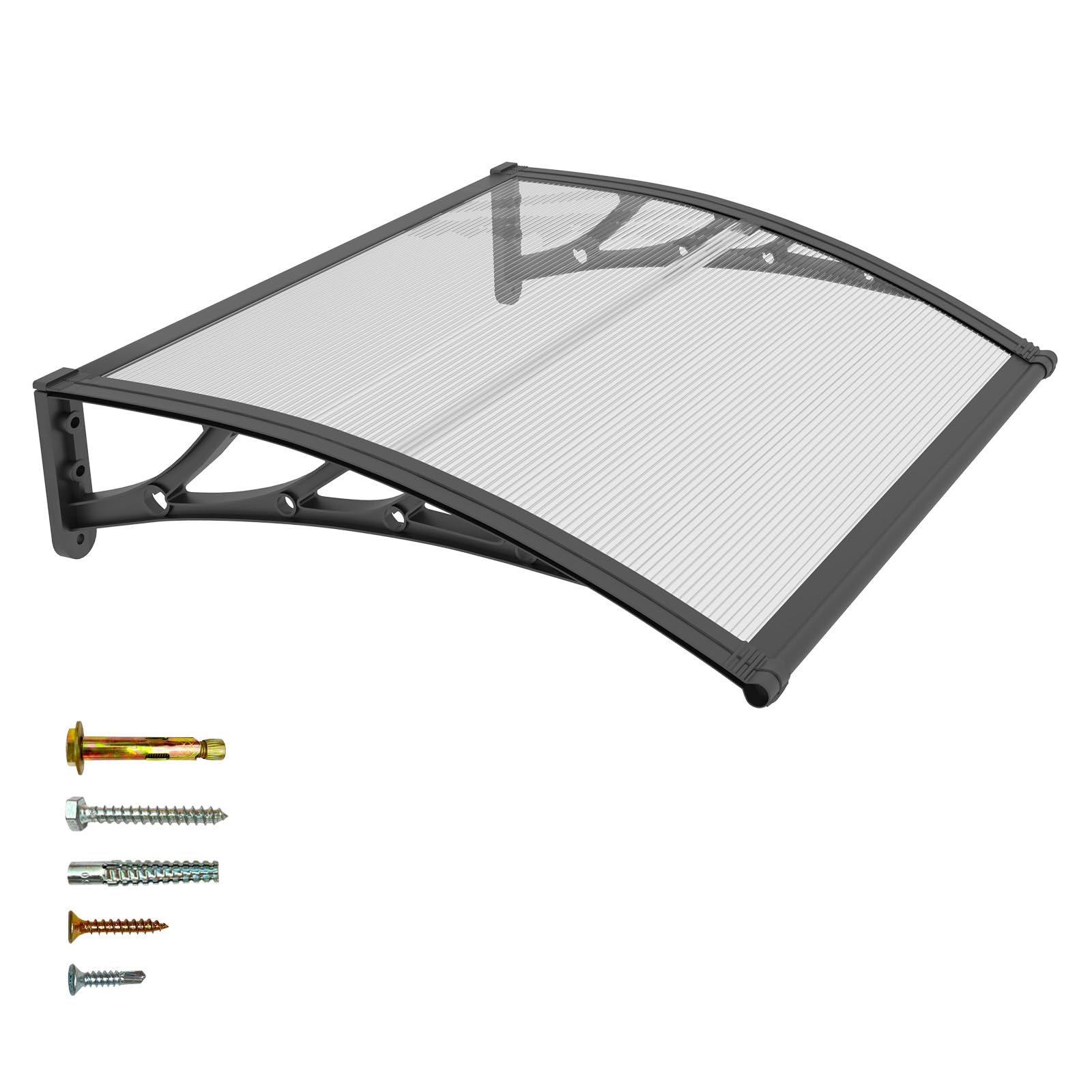
5mm twin-wall polycarbonate panels with I-beam connectors and UPF 50+ blocking.
Two details lift this above the other budget panels. The first is panel thickness — 5mm twin-wall polycarbonate, which is two layers of polycarbonate with a gap between them that insulates and stiffens the sheet — and the second is the I-beam connectors that seal the joint between spliced panels so water cannot creep through. Same-size brackets also mean you can butt two of these awnings together for a longer run, which is a rare bit of forward planning at this price. It carries UPF 50+, the top sun-protection rating, and the rust-resistant aluminum bars sit over reinforced PP+glass-fiber brackets — PP with glass fiber in it is the same recipe used for structural plastic parts, stronger than plain plastic.
At 47.5 inches wide by 39.5 inches of projection, it suits a single door or window and keeps the doorway shaded and dry in every season. All the screws are stainless steel so they will not pit the way cheaper fixings do. Owners describe the coverage as generous for the size and the install as straightforward with the step-by-step instructions in hand — the maker recommends two people for the larger sizes, and one reviewer who fitted it solo noted that a plank of wood behind the bracket helped.
Durability is the one place opinion splits. The panel has a lightweight feel, and one owner found the material lighter than expected in the hand — which is worth knowing if you are after a thick, heavy canopy or need opaque shade, because sunlight does filter through rather than being fully blocked. In high wind the frame can flex when it is knocked, so fixing the brackets firmly to solid framing matters more here than with a steel panel. It is also worth testing it through a monsoon or snow season before judging the long-term, since that is unproven at this point.
Worth it for: a compact doorway where you want thicker panels, stainless fittings and room to extend later without paying steel prices.
Not quite right if you need the panel fully opaque or want something that shrugs off an unsecured high wind without flexing.
Understanding the Specs
Material And Finish
The material decides how the awning behaves in weather, and the finish decides how it looks after two or three seasons. Galvanized steel has been dipped in zinc so it resists rust, and a powder coat on top seals it further — this is the heaviest-duty build, and it suits snowy, gusty porches. Aluminum is lighter and never rusts, which makes it easier to mount on siding or a wooden fascia. Polycarbonate over an aluminum or ABS frame is the lightest build of all, and it lets daylight through to keep an entry bright. Look for a baked-on or powder-coated finish rather than bare metal, and check that the hardware is described as rust-resistant or stainless.
Wind And Snow Ratings
These two numbers tell you what weather the awning was built to handle. The wind rating, given in miles per hour, is the lateral force the panel and brackets were tested under — higher is better on exposed, open-ground porches. Snow load, given in pounds per square foot, is how much weight the roof can carry before it bows. Where a rating is given as a fresh-snow depth in inches, that is the depth of loose snow it is stated to support. Both figures assume the awning was fixed firmly following the maker’s own installation instructions, so the mounting matters as much as the panel.
Projection And Width
Width is the run across the doorway; projection is how far the canopy reaches out from the wall. Projection does the real work of keeping your threshold dry, because a deeper panel catches rain further out from the door. A wide, shallow panel suits spanning a porch; a narrower, deeper panel suits a single entry where the bracket load wants to stay low. Match the projection to the weather — a long overhang beats a wide one in driving rain, but it also collects more wind pressure.
Drainage And Sealing
Water pooling on top of an awning is what eventually loosens a mounting and stains the panel. Standing-seam roofs have raised joint lines so water runs off rather than sitting in low spots. A built-in front gutter channels it away from the doorway in one line. Ripple panels interlock tightly along their length so nothing seeps through the seams. Curved edges direct runoff to where you want it. Some polycarbonate kits rely on the installer sealing joints with glass glue — check the listing for whether that step is required before you buy.
FAQ
Can I mount a metal porch awning on vinyl siding or stucco?
How much snow can a metal awning on a porch actually hold?
What does a wind rating in MPH mean on an outdoor canopy?
Polycarbonate or steel panels, which is right for a porch?
How far should a door awning project from the wall?
Can I install a metal porch awning by myself?
Will an aluminum awning rust over time?
Does the awning need sealing where the panels join?
Can I link two awnings together for a longer porch run?
What should I check on the awning when it arrives?
Final Thoughts: The Verdict
For most porches, the metal awning for a porch that earns its place is the Awntech Houstonian Open-Side Fixed Awning — galvanized steel, tested to 115 MPH winds and a 40 PSF snow load, and built on welded bracket tabs that take lag bolts straight into a stud. If you want to control shade and airflow as the seasons turn, the Kozyard Adjustable Door Window Awning gives you four tilt positions across a 108-inch panel. And if rust is the worry on a coastal or wet-climate porch, the 1500 Series Aluminum Door Canopy stays light on the wall with a finish the maker says will never rust. Measure your studs before ordering, build the canopy on the ground before you lift it, and any of these will outlast the trim you hang it on.
How We Picked
We do not accept paid placement. Every pick is matched to a real buyer and a real use-case; we do not hands-on test units.
Sources & Methodology
Specifications: manufacturer listings and product documentation. Review insights: verified customer reviews, as of September 2026. Pricing: not shown on this page (it changes often); check the current price via the retailer link.
As an Amazon Associate, KitchPrep earns from qualifying purchases. This does not affect which products we feature.
Related Guides
