
Specs are compiled from manufacturer listings and verified buyer reviews and can change over time — please confirm the key details on the product page before buying.
For most decks, fences, and outdoor furniture, the oil that earns its place fastest is Cabot Australian Timber Oil in Jarrah Brown — it is the highest-rated pick here and the one that makes tired wood look rebuilt. Everything below explains why, plus which of the other seven fits your specific wood, climate, and patience level.
I’m Mohammad Maruf — the founder and writer behind KitchPrep. This guide is built by comparing the manufacturers’ published specifications and the patterns across verified customer reviews, so you get each pick’s real strengths and trade-offs instead of marketing spin.
Oil-based penetrating finishes sink into the grain instead of sitting on top of it, which is why they resist peeling where film-forming stains crack and flake. The rest of this page covers coverage, drying windows, wood species, and pricing tiers so you can pick confidently. This breakdown of the australian wood oil market separates the penetrating winners from the film-formers that fail.
Our Picks at a Glance


How To Choose The Best Australian Wood Oil
Australian wood oil works differently from paint or film-forming stain. Instead of coating the surface, it soaks into the wood fibers and protects from the inside. That is why it does not peel, blister, or flake the way a surface film can. But not every oil suits every project, so here is what actually separates one from another.
Oil-Based vs Water-Reducible
Oil-based formulas penetrate deeper into dense, resin-rich woods like teak, mahogany, and ipe. They also take longer to dry and need warmer, drier conditions to cure properly. Water-reducible versions clean up with soap and water and dry faster, but they may need more coats to build the same level of protection. If your wood is a tropical hardwood, lean toward oil-based. If you are working with cedar, pine, or pressure-treated lumber and want an easier cleanup, a water-reducible option can work well.
Coverage and How Much To Buy
Coverage tells you how far a can will stretch, and it varies widely. Some products cover 100–150 square feet per quart, while a gallon can cover up to 600 square feet. Thirsty woods — especially dry, weathered decking — can soak up far more than the label suggests, often requiring two or three times the listed amount on a first application. Always buy more than you think you need for the first coat on bare wood.
Color, Finish, and Transparency
Translucent oils let the grain show through while adding warmth and depth. Clear matte formulas add protection without changing the wood’s natural tone. Tinted options like Jarrah Brown, Mahogany Flame, or Honey Teak shift the color toward reds and ambers. If you are matching existing stain or trying to warm up grey, weathered boards, a tinted oil does more work than a clear one. If you love the wood exactly as it is, go clear.
Quick Comparison
| Model | Best For | Base | Coverage | Volume | Amazon |
|---|---|---|---|---|---|
| Cabot Jarrah Brown 1 Qt★ Best Overall | Decks and furniture that need rich color | Oil-based | — | 1 quart | Amazon |
| Cabot Natural 1 QtBest Value | Restoring faded finishes on benches and rails | Oil-based | 100–150 sq ft | 1 quart | Amazon |
| Owatrol D1 1LBest for Hardwoods | Teak and boat decks that need deep saturation | Oil-based | — | 1000 ml | Amazon |
| WOCA Denmark Exterior Oil 2.5L | Low-VOC exterior projects on any wood species | Water-based | 325–400 sq ft | 2500 ml | Amazon |
| Cabot Jarrah Brown 5 Gal | Whole-deck jobs that need bulk volume | Oil-based | High coverage | 640 fl oz | Amazon |
| Aust Tmbr Natural 5 Gal | Pine and cedar decks that need repeat recoating | Oil-based | 250–600 sq ft/gal | 640 fl oz | Amazon |
In‑Depth Reviews
1. Cabot Australian Timber Oil Wood Stain and Protector, Jarrah Brown, 1 Quart
Our pick — over 4.5★ from 150+ verified ratings; the strongest balance of quality and price.
One quart of Jarrah Brown that turns tired teak and acacia back into furniture you want to sit on
Reach for this quart first when you want a warm reddish-brown tone that makes weathered teak and acacia look finished again. The formula is oil-based and built on a 3-way oil blend designed to penetrate deep into dense, resin-rich woods rather than sit on the surface. That matters because dense hardwoods like teak and ipe are notoriously hard to coat — surface films crack and peel on them, but a penetrating oil works from the inside out. At 2.2 pounds for the can, it is easy to carry around a deck or patio while you work.
Buyers report stretching one quart (about 0.95 liters) across a full furniture or tile project without running out. As the review pages sum it up: “Great coverage that allows me to not do it every year.” One buyer applied it to 10×10-foot teak patio tiles in about two hours using one quart and a rag, and the tiles looked revived for another summer. Another refinished weathered IKEA acacia chairs with one light coat, getting a warm reddish tone and a satiny finish that preserved the wood character. Brush application works well for tight spots between slats, and a foam throwaway brush keeps cleanup simple. Water beading off the surface is the sign the oil has penetrated and sealed properly.
The catch is color consistency. Jarrah Brown reads differently across batches and different wood species — some owners love it, others find it darker or redder than expected. Coverage also varies with how dry and thirsty the wood is. The can is a quart, so for a large deck you may need several. If you want the richest, most consistent result, apply two thin coats rather than one heavy one, and always test on an offcut first.
jar format convenience
- Coverage is the standout — a single quart stretches across a full furniture or tile project
- 3-way oil blend penetrates dense hardwoods that reject film-forming stains
- Water beads off the surface once cured, signaling real sealing
- Warm Jarrah Brown tone revives weathered teak, acacia, and patio pieces
smaller volume
- Color reads inconsistently across batches and wood species
- One quart may not cover a large deck in a single pass
- Bare, dry wood absorbs far more than the listed coverage suggests
one-can projects: anyone finishing teak, acacia, or patio furniture who wants a rich reddish tone and proven coverage from a single quart.
big decks: you are matching an existing stain color exactly or coating a very large bare deck in one go.
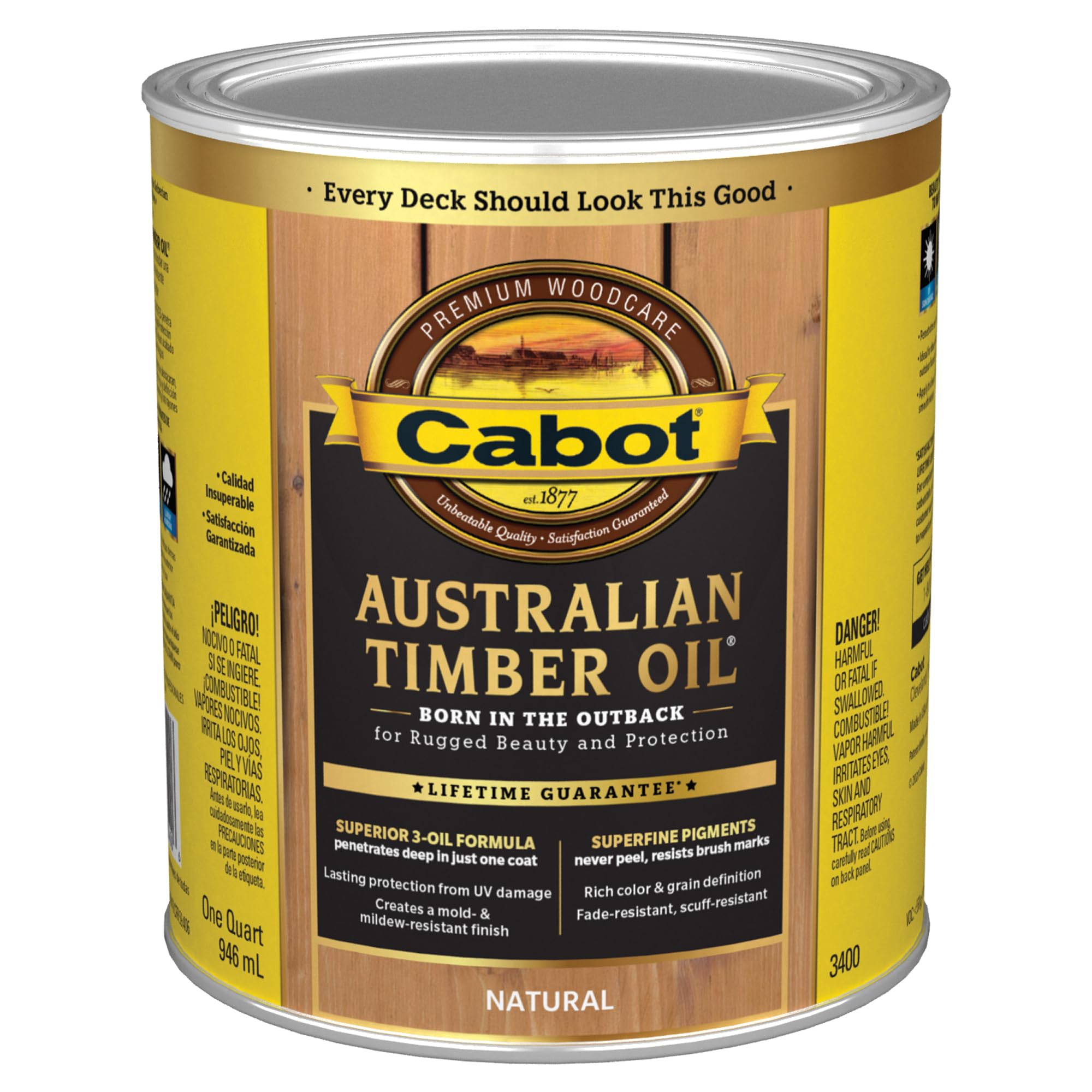
2. Cabot Australian Timber Oil, Natural, 1 Quart
The clear choice when you want protection and depth without shifting the wood’s own color
The Natural version seals and enriches the wood while leaving the original tone unchanged, which tinted oils cannot do. Coverage runs 100–150 square feet per quart, which is enough for a bench, a railing run, or a small set of outdoor furniture. The feel is a translucent oil finish that deepens grain contrast without adding a varnish-like gloss. It is a popular size for refinishers who want to try a small project before committing to a gallon.
Owners keep coming back to this one for restoration work. One buyer wrote: “I’ve been a big fan of this product for years. I bought this to rejuvenate a wood bench that had been finished with dark oil, but is now faded. Worked quite well.” Another cedar planter owner reported it went on with a nice look, and a woodworker praised how quickly it dries while enhancing grain. The quart size is appreciated because it is harder to find in other lines. Cleanup needs detergent and water, and the surface wants two warm, dry days to cure properly before rain hits.
natural clear finish: you are paying a premium for a quart, and some owners feel the price per volume is steep compared with larger budget containers. It is also a hazardous-material product, so check the return policy before ordering if you are unsure about quantity. The oil is sticky during application, so gloves are worth wearing.
needs recoating: the natural-tone workhorse — buy it if you love the wood as-is and want to protect what is already there. The 100–150 square foot coverage per quart means you should measure your project before ordering; a full-sized deck will need more than one can.
light wood tones: you are restoring a faded finish on a bench, railing, or cedar piece and want the wood to look like itself again, only healthier.
heavy traffic: you want a color shift toward red or brown, or you are covering a large bare deck in a single pass.
3. Cabot Australian Timber Oil, Mahogany Flame, 1 Quart
A clear, ultra-thin oil that saturates teak and boat decks so deeply it never builds a film to peel
Owatrol D1 is the specialist’s pick for teak, tropical hardwoods, and boat decks where surface films fail fast. The formula is ultra-thin and clear, meaning it soaks into the wood fibers instead of sitting on top, and it dries to a matte finish that does not darken or discolor. It replenishes natural oils that weathering strips out, which is why teak that has gone silver-grey responds so well. The 1-liter can (1.06 US quarts) is sized for furniture, small decking sections, and boat trim. Full protection specs include UV resistance and moisture resistance, and it is rated for marine environment use.
Owners who have used it on teak keep coming back. One wrote: “I’ve used other products in the past, but found that the rich color faded away within a few days as the teak absorbed the oil. This works great, by contrast.” The same owner applied one coat and the table absorbed it without losing its rich color, making an old piece look new again. A long-time oiled-teak owner described the finish as having “real oiled teakwood color and feel, and it is never slippery, even wet” — a meaningful detail when the surface is a boat deck or wet patio. The maintenance routine is simple: scrub clean, then two coats in spring, and reapply as needed without sanding or stripping.
The trade-off is price per volume. Owners note it is not cheap, and the 1-liter can is the smallest here. It is also a slow, multiple-coat process: on very weathered wood, keep reapplying until the surface stays saturated. If you want a one-and-done tinted result, this is not that product. If you want the truest natural teak finish, it is tough to top.
fine furniture: you own teak furniture, boat decks, or tropical hardwood and want the natural color restored without adding a film or tint.
quick turnaround: you want a tinted color shift or a single-coat finish on a large weathered surface.
4. WOCA Denmark – Exterior Wood Oil – Water Based Penetrating Stain – 2.5L – Natural

A plant-based, low-VOC oil that seals from the inside without film buildup or peeling
WOCA Exterior Wood Oil suits buyers who want a plant-based, low-VOC formula without giving up protection. The composition is plant-based, water-dilutable, and low VOC, and it seals the wood from the inside out without forming a film — which is why it will not peel or chip the way a resin or paint can. Coverage runs approximately 325–400 square feet per 2.5-liter container. The formula is designed to work on both exotic species (Ipe, Mahogany, Teak, Cumaru, Jarrah, Bamboo) and domestic woods (Redwood, Pine, Cedar, Cypress), so you do not have to second-guess whether it suits your project. After a thin even coat, it fully hardens in 24 to 48 hours. For exterior use only.
Owners who follow the directions report good results. One wrote: “Applied per the directions on the can and it went on very nicely. Still looks great after 2 months and a few rain days.” Another called it “amazing stuff,” with the only note being that the thick consistency takes some work to spread evenly into a uniform finish. The 2-month weather test is a useful real-world data point for a water-based exterior product.
The catch here is volume. Multiple owners warn that the can does not go as far as the label suggests — on dry new decking, the liquid absorbs fast and can require two to three times the listed amount to cover the stated square footage. A separate owner reported using a different penetrating-oil method after finding this one lifted the grain and left a dull finish. Both are honest caveats, not universal verdicts: the results depend heavily on wood preparation, temperature, and how evenly you spread the coat. If you are working with a variety of wood species and want a low-VOC option, this is the pick. If you need a can that covers every square foot the label promises, buy extra.
water based formula
- Plant-based, water-dilutable, low-VOC composition
- Penetrates from the inside without film buildup or peeling
- Works on exotic and domestic woods alike — no species guesswork
- Hardens in 24 to 48 hours after a thin even coat
multiple coats
- Can runs small relative to listed coverage — dry wood may need 2–3x the stated amount
- Thick consistency can be tricky to spread into an even finish
- Some users report a duller finish compared with other penetrating oils
low odor: you want a low-VOC, plant-based oil that works across exotic and domestic species and offers an easy water cleanup.
deep color: you need a container that stretches to every square foot the label claims — buy extra or size up.
5. 5 gal Cabot 19460 Jarrah Brown Australian Timber Oil Water Reducible
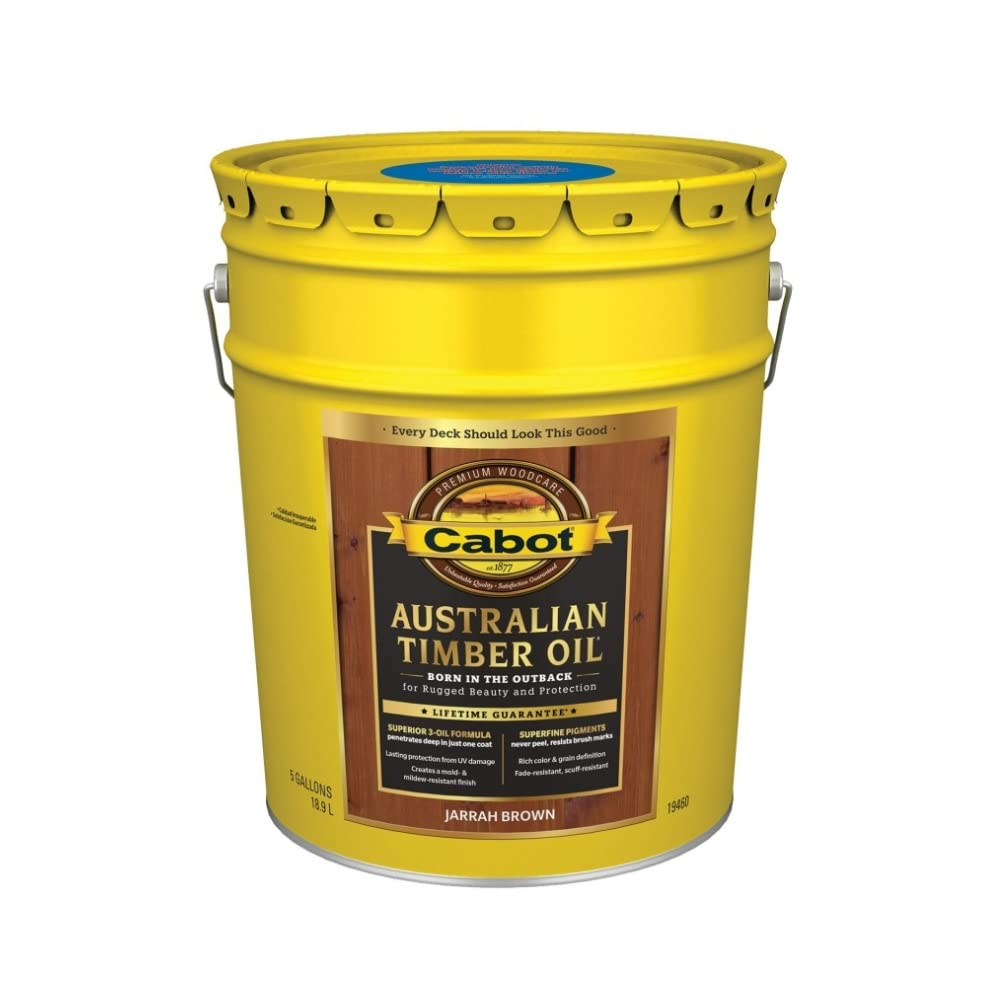
Five gallons of Jarrah Brown built for whole-deck jobs where running out mid-project is not an option
This is the same Jarrah Brown tone and 3-oil formula as the quart version, scaled up to a 5-gallon container holding 640 fluid ounces. The formula is oil-based with a semi-gloss finish, and it delivers lasting protection from UV damage while creating a mold- and mildew-resistant finish. It is designed for decks and outdoor furniture, and the semi-gloss protects both the color and the grain definition. If you are staining a large deck, this container means fewer trips and a consistent tone across the whole project.
The color is what owners love most about it. One wrote: “I bought the Jarrah brown, is a very dark stain but covers imperfections well! Looks great!” Another called it a great stain that seals the deck, pergola, and fence all in one product. A separate owner reported good coverage with one coat. Cleanup is described as a breeze, which matters on a big job.
The trade-off is the application method itself. This is a semi-gloss oil that shows brush strokes and overlap marks if you are not careful — one owner found that no matter how skilled the application, dark and light spots appeared where strokes overlapped. Another reported visible overlap and darker spots leaving three-quarters of a deck needing redo. Those are honest warnings about a high-solids oil, not universal outcomes; the fix is thin, even coats applied with a consistent method, ideally working in sections and back-brushing overlap areas while the oil is still wet. This is not a maintenance-free finish either — one long-term owner noted it fades faster in direct-sun areas on flat surfaces. Buy this if you are coating a whole deck and want a dark, rich Jarrah Brown with one container. If you are new to staining, start with the quart to learn the application rhythm first.
large areas: you are staining a full deck, pergola, or wraparound fence and want one large container with a deep Jarrah Brown tone.
small jobs: you are new to applying high-solids oil — overlap marks are a real risk with this semi-gloss formula.
6. Aust Tmbr Natural Wf 5gl

A 5-gallon Natural Wood jug with deep-penetrating protection and the widest coverage range here
The Natural Wood tone keeps your deck looking like wood, just a richer and better-protected version of it. Coverage is listed at 250–600 square feet per gallon, the widest range of any pick here, which reflects how much the wood’s condition drives consumption. The formula is oil-based with deep-penetrating oil protection and water cleanup, which is a rare pairing — most oil-based products require solvent cleanup. It comes in a 640 fluid ounce (5-gallon) container weighing 46.3 pounds, so plan for two hands and a helper when you move it.
Owners who use it on pine and cedar repeat that it is the best they have tried. One owner reported: “Absolutely the best product I’ve used for deck refinishing.” That same owner had tried other finishes over the years and described the result as needing about a day to soak in before reaching its final look — worth knowing so you do not judge the finish in the first hour. Another owner noted it makes a deck look like new and has a honey color sheer enough to still show plenty of wood grain. Power washing first is a good prep step before application.
The main thing to plan for is reapplication frequency. Owners note that on an exposed, uncovered deck you should expect to reapply roughly every six months to keep the finish looking fresh. That means consistent upkeep, though the process itself is described as easy to apply. Water cleanup keeps the job manageable. If you want a natural wood look with an easier cleanup routine and you accept the reapplication rhythm, this 5-gallon jug is an efficient way to buy. If you want a set-and-forget finish that lasts years without recoating, look at a clear matte oil instead.
big projects: pine and cedar deck owners who want a natural wood look, deep-penetrating protection, and water cleanup after the job.
tiny touchups: you want a finish that holds its look for years without recoating — plan on roughly every six months outdoors.
Understanding the Specs
Coverage (Square Feet Per Can)
Coverage tells you how far a can stretches and is often the biggest surprise for first-time buyers. A quart covers around 100–150 square feet, while a gallon can stretch to 600 square feet. But weathered, dry wood acts like a sponge — owners regularly find they need two or three times the listed amount on a bare, thirsty surface. Always buy more than the label math suggests for the first coat on untreated wood.
Base Material: Oil vs Water-Reducible
Oil-based formulas penetrate deepest into dense hardwoods and resist peeling because they soak in rather than form a film. They need warmer, drier conditions and solvent cleanup. Water-reducible or water-based formulas clean up with soap and water and dry faster, but may need more coats. Some products — like the Natural Wood 5-gallon pick here — pair oil-based protection with water cleanup, which is the best of both worlds.
Finish Type: Translucent vs Clear Matte vs Semi-Gloss
Translucent oils add warmth and depth while letting grain show. Clear matte formulas protect without changing the wood’s tone or adding shine. Semi-gloss options build a richer surface and protect grain definition more aggressively, but they show brush strokes and overlaps more easily and require a steadier hand. If you are new to application, start with a matte or translucent oil and work up to a semi-gloss.
UV and Weather Protection
UV protection is what prevents sunlight from breaking down the wood’s natural color and turning it grey. Products rated for marine environments or described as UV-resistant hold up better on exposed boat decks and full-sun patios. But UV protection is not permanent — it depletes over time, which is why even the best exterior oils typically need recoating annually on fully exposed surfaces. Shelter is your friend: covered decks hold their finish far longer.
FAQ
How much Australian timber oil do I need for my deck?
What is the difference between oil-based and water-based Australian wood oil?
Will Australian timber oil work on teak furniture?
How long does Australian timber oil last on a deck?
Do I need to sand or strip before applying Australian wood oil?
Can I use Australian timber oil on a fence?
How long does Australian timber oil take to dry before rain?
Is Australian timber oil better than regular deck stain?
Which wood species work best with Australian timber oil?
Does Australian timber oil stop wood from turning grey?
Final Thoughts: The Verdict
For most people shopping for the australian wood oil, the Cabot Australian Timber Oil in Jarrah Brown is the pick that covers the widest range of jobs — it has the strongest combination of a rich translucent tone, proven coverage in a single quart, and an oil-based formula that penetrates dense hardwoods instead of sitting on the surface. If you are working on teak or a boat deck, grab the Owatrol D1 Penetrating Wood Oil — its clear matte finish and marine-rated UV and moisture resistance make it the specialist choice. For large fences or whole-deck jobs, the Cabot Honey Teak Water Reducible gallon stretches the furthest at up to 600 square feet, while the Cabot Natural quart is the one to reach for if you want to restore faded wood without changing its tone. Whichever you choose, apply thin coats, wait for two dry days, and recoat annually — that rhythm is what keeps outdoor wood looking finished instead of forgotten.
How We Picked
We do not accept paid placement. Every pick is matched to a real buyer and a real use-case; we do not hands-on test units.
Sources & Methodology
Specifications: manufacturer listings and product documentation. Review insights: verified customer reviews, as of September 2026. Pricing: not shown on this page (it changes often); check the current price via the retailer link.
As an Amazon Associate, KitchPrep earns from qualifying purchases. This does not affect which products we feature.
Related Guides
