
Specs are compiled from manufacturer listings and verified buyer reviews and can change over time — please confirm the key details on the product page before buying.
A 2 1/2-inch drill bit is not a small purchase, and the wrong one wastes an afternoon and a lot of money. The right bit depends on what you are drilling: metal sheets take a carbide cutter, concrete walls take a diamond core bit. This guide sorts nine real options by the material they actually handle, so you can match the bit to your material before you buy.
I’m Mohammad Maruf — the founder and writer behind KitchPrep. This guide is built by comparing the manufacturers’ published specifications and the patterns across verified customer reviews, so you get each pick’s real strengths and trade-offs instead of marketing spin.
Cutting a vent hole through brick and boring through stainless steel need different bits. The picks below are grouped by material, not by price. To choose the right 2 1/2-inch drill bit, know your material and your drill first.
Our Picks at a Glance

How To Choose The Best 2 1/2-Inch Drill Bit
A 2 1/2-inch bit is a large-diameter hole tool, and large holes behave differently from the small twist bits you keep in a case. The bit that sails through a stainless steel sheet will be destroyed by a concrete wall, and the bit that eats through brick will not touch sheet metal. So the first decision is never about brand — it is about matching the cutter to the material.
Match the cutter type to the material
Carbide-tipped cutters, like the Klein Tools and Drill America options here, are built for steel, iron, and copper. Diamond core bits, sold by brands like SALI and Drilax, are built for concrete, brick, block, and stone. Mixing these up is the most common and most expensive mistake.
Check your shank before anything else
A bit only works if it physically locks into your drill. SDS Plus, SDS Max, 5/8-11 thread, and 3/8-inch hex are the main connection types, and a bit with the wrong one simply will not mount. Match the shank type to your drill first, then compare everything else.
Decide wet or dry drilling
Many diamond core bits are designed for dry drilling but perform far better with water, while others are wet-only. Water cools the cutting teeth and flushes chips out, which directly affects how long the bit survives. Know which type you are buying before you start.
Confirm the depth you actually need
Depth of cut is the maximum thickness the bit can bore through in one pass. A bit rated for 1 inch of depth cannot cut through a 4-inch brick wall without flipping the workpiece. Measure your wall or plate thickness and match it to the depth spec.
Quick Comparison
| Model | Best For | Cutting Diameter | Drilling Depth | Shank / Thread | Amazon |
|---|---|---|---|---|---|
| Klein Tools 31870★ Best Overall | Steel and stainless sheet | 2.5 inches | 3/16-Inch sheet thickness | Split-point pilot drill | Amazon |
| 2-1/2″ Concrete Hole Saw (DKIBBITH)Best Value | Cinder block and brick | 2.5 inches | 220mm SDS Plus rod | SDS Plus | Amazon |
| Drilax Diamond Hole SawMost Popular | Concrete, brick, block | 2.5 inches | 2 inches | 3/8 Inch Shank | Amazon |
| VEVOR Core Drill Bit | Concrete and red brick | 2-1/2 inch | 9-1/2 inch | 5/8-11 Internal Thread | Amazon |
| LCubro Core Drill Bits | Block walls and asphalt | 2 1/2 inch | 10in/254mm | 5/8-11″ Thread & SDS Plus | Amazon |
| SALI Dry Diamond Core Drill | Occasional concrete jobs | 2 1/2″/63.5mm | 10″/254mm | 5/8-11″ Thread | Amazon |
| DaduoRi Dry Core Drill Bit | Brick, block, and masonry | 2.5 inches | 9.5 inches | SDS Plus, SDS Max, 1/2″ Hex | Amazon |
| SALI Wet Diamond Core Drill | Deep concrete with rebar | 2-1/2″/65mm | 14.5″/380mm | 1-1/4-7″ Thread | Amazon |
| Drill America CTH2500 | Steel plate and cast iron | 2-1/2″ inches | 1″ Depth of Cut | 1/2″ Shank | Amazon |
In‑Depth Reviews
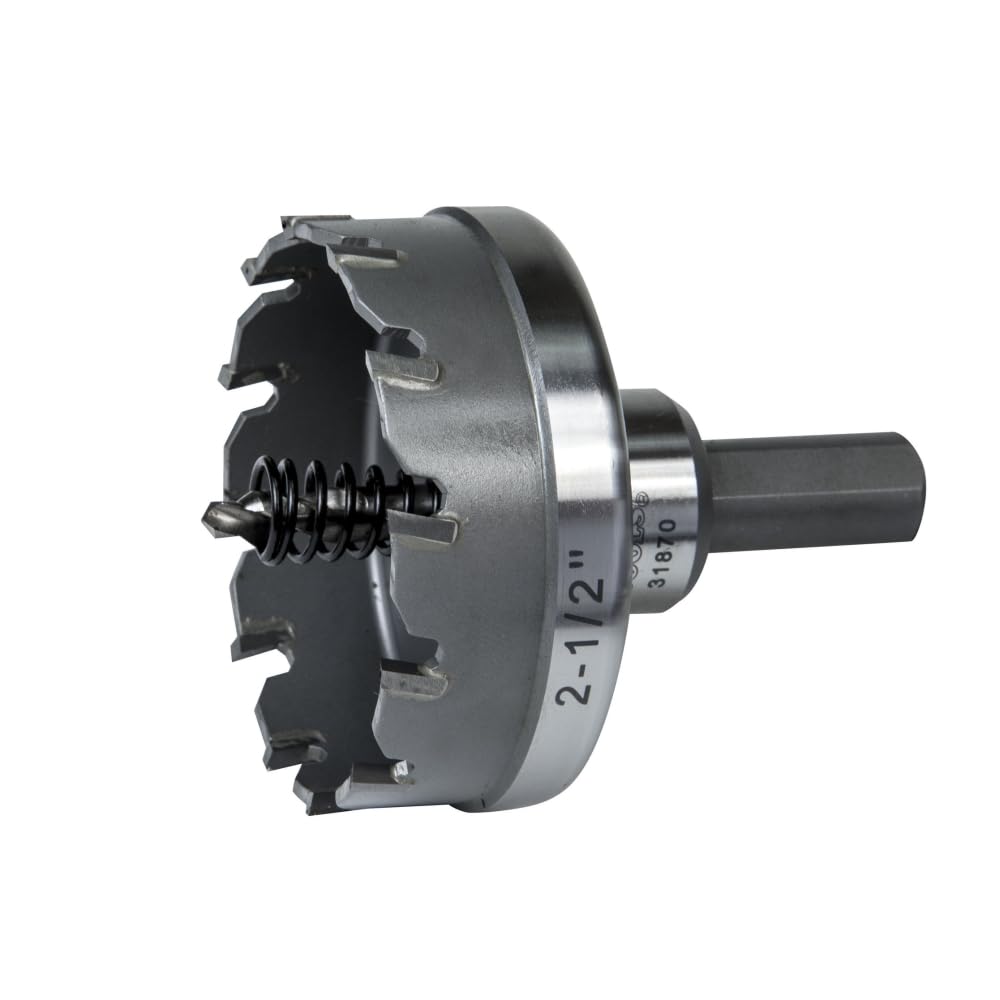
1. Klein Tools 31870 Heavy Duty Hole Cutter, 2-1/2-Inch Carbide Hole Cutter
Our pick — over 4.5★ from 550+ verified ratings; the strongest balance of quality and price.
The carbide cutter that plows through steel sheets and stays sharp to the last hole.
If you are cutting clean 2 1/2-inch openings in stainless steel, mild steel, iron, copper, or brass sheets, this is the one to reach for. It is built to slice through sheet metal up to 3/16-inch (0.5 cm) thick, and the carbide construction is what gives it the edge over a plain hole saw. For electrical work, panel knockouts, and metal fabrication, that combination of a 2.5-inch bit hole diameter and a 3/16-inch sheet capacity covers the majority of real jobs.
The detail that keeps this bit accurate is the split point pilot drill, a center guide that stops the cutter from wandering across a smooth metal surface before the cut starts. There is also a built-in flange that stops you over-drilling past the sheet so the teeth do not bite into whatever sits underneath. When the pilot eventually wears, it is compatible with a replacement pilot bit (Cat. No. 31874), so you are not throwing away the whole cutter. It also handles 2-Inch (5.1 cm) conduit and pipe sizes, which matters if you are running electrical or plumbing.
What keeps this cutter at the top is how it performs in steel specifically. The cutting action is the headline — this is a genuinely heavy-duty tool that owners describe as cutting through thick steel with ease. The recurring note worth knowing is that the teeth can break off for some buyers over time, so feeding it steadily with cutting oil rather than forcing it protects your investment. The consensus from the review pages is summed up neatly: “Quality tool, just don’t forget the cutting oil when you use it.” Fed steadily with cutting oil, its carbide teeth outlast several cheaper cutters.
Where it wins
- Cuts stainless steel, mild steel, iron, copper, and brass sheets up to 3/16-inch thick
- Split point pilot drill prevents wandering on smooth metal surfaces
- Built-in flange stops over-drilling past the sheet
- Replacement pilot bit (Cat. No. 31874) available, so the body is not disposable
What to watch for
- Teeth can break off if you force the cut instead of using cutting oil
- Only cuts sheet metal, not solid concrete or masonry
- Pilot bit wears and needs a separate replacement over time
Get this if: you need clean, accurate holes in stainless or mild steel sheet and want a cutter built to last.
Look elsewhere if: your job is concrete, brick, or block — a diamond core bit is the correct tool for that.
2. 2-1/2″ Concrete Hole Saw, Tungsten Steel Core Bit for Cinder Block, Brick, Rock, Plank Walls
The brick-and-block specialist that bores clean holes for pipe and mini-split lines.
For drilling through cinder block, brick, rock, Hardy Plank, drywall, fiber cement siding, backer board, air brick, stucco, and plasterboard, this core bit is the honest workhorse of the group. It uses a 2-1/2-inch tungsten steel body built with high-frequency welding, which is the process that fuses the cutting teeth to the barrel for heavy-duty drilling. It works with SDS Plus tools from all major manufacturers, the most common shank type on rotary hammers, so most buyers will find it mounts without an adapter.
The kit is genuinely complete for the money. You get a 220mm SDS Plus connecting rod and two 110mm center positioning drill bits, which are the guide pins that keep the large bit from skating on a rough wall. The cutting head uses triple-edged teeth with internal and external grooves that push chips outward instead of letting them clog the barrel. The maker warns clearly: avoid marble, pebbles, and rebar, and start at low speed to prevent tooth breakage.
The place this bit earned its reputation is the cutting itself — it bores through brick and mortar steadily and cleanly, and buyers report drilling through an 8-inch thick wall in 2-inch increments, chiseling between passes. The recurring gripe is the fit: the center drill bit can work loose during use, though it ships with two bits and two set screws as backup. It is the smart pick when you have a handful of holes to make in walls for AC lines or exhaust systems and you want solid results without premium pricing.
Solid for the price: with triple-edged teeth, a 220mm connecting rod, and two center positioning bits included, this kit punches well above what its price tier suggests for brick and block work.
The honest catch: the SDS Plus fitting frustrates buyers whose drills use the larger SDS Max system, so confirm your hammer’s shank before ordering — and keep the set screws tight so the center bit stays put.
Best matched to: homeowners and installers drilling AC, exhaust, or pipe holes through brick and cinder block with an SDS Plus hammer.
Think twice if: you are cutting reinforced concrete or marble, both named as no-go materials in the manufacturer’s own guidance.
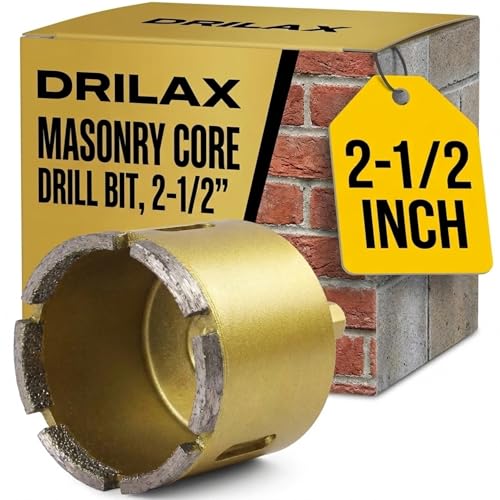
3. Drilax 2-1/2 Inch Diamond Hole Saw for Concrete Brick Block
Sintered diamond teeth that grind through masonry without cracking the surface.
This is the bit for people who want to cut a clean hole in brick or concrete with the drill they already own. It uses sintered diamond teeth — diamond grit fused into the metal edge so it grinds rather than chips — to bore a 2.5-inch hole without cracking the surrounding surface. The 2-inch cutting depth handles basement walls, exterior surfaces, and floor penetrations, and the 2-1/2-inch diameter lines up with dryer vents, electrical conduit, HVAC lines, and plumbing openings.
What makes it easy to live with is the 3/8-inch shank, which fits the common cordless and electric drills most people already have in the garage. There is no need for specialized equipment or a proprietary arbor. Used correctly — water, low speed, and light pressure — it grinds smoothly even in dense material, and the low-heat technique is what extends the life of the diamond edge.
The functionality is what wins people over: it does the job for far less than renting a professional rig, and it cuts through stucco and concrete alike. The mixed note is durability — the bit wears faster when pushed hard or run dry, and a few owners mention teeth breaking off. Run it slow with water and clear the dust as you go, and the sintered diamond edge keeps grinding far longer. It is a strong DIY answer for the homeowner drilling conduit or vent holes without hiring a contractor.
What it does best: cuts clean, round holes in brick and concrete without cracking the surface, at a price that undercuts a contractor call-out.
Use it right: water, low speed, and light pressure are not optional here — running the diamond dry is what wears the teeth out early.
Reach for this if: you are a DIYer drilling vent or conduit holes through brick or stucco with a standard 3/8-inch chuck drill.
skip it if: you need to bore dozens of holes in dense concrete — this bit is built for occasional use, not production work.
4. VEVOR Core Drill Bit, 2-1/2 inch Diameter, 9-1/2 inch Drilling Depth
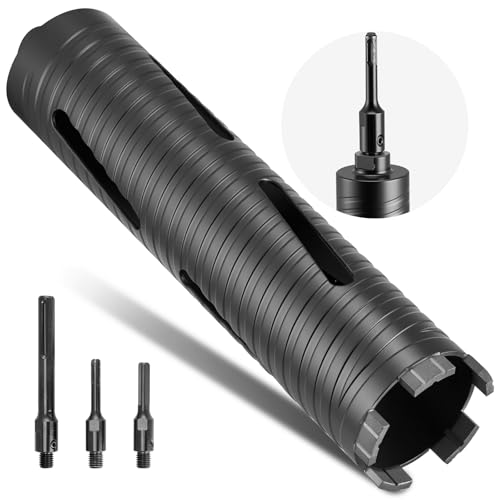
A deep-boring dry core bit with three adapters and a pilot drill in the box.
When the wall is thick and you need to go all the way through, the depth matters more than anything else. This core drill bit runs 9-1/2 inches deep at a 2-1/2-inch diameter, sized for concrete, red bricks, and masonry. It is built from quality carbon steel with high-precision welding and rated at 95HRB hardness, a measure of how well the steel resists wear, which helps it handle heat during high-speed or dry drilling without the blade detaching.
The set is built for convenience: you get the core bit, three adapters, and one pilot drill. The pilot drill means no pre-drilling is required — the sharp tip bites into the surface first to position the cut accurately. Compatible with most standard drills and hammer drills thanks to the adapters, and the internally threaded shank is a 5/8-11 internal thread. The tooth center aligns with the installation axis to resist wobbling at high speed, which is the difference between a clean hole and a wandering one.
This bit wins on price: customers note it is the cheapest diamond bit they could find that still got the job done, and one buyer reports it went through a foot of rock wall with all teeth intact. The catch is the pilot bit length. Several buyers find it too short to start easily on uneven surfaces, so the bit walks before it bites.
The strong points
- 9-1/2 inch drilling depth reaches through thick walls in one setup
- 3 adapters and a pilot drill included, compatible with most standard and hammer drills
- 95HRB hardness carbon steel resists heat buildup without blade detachment
- Tooth center aligned to the axis to reduce wobbling at speed
The trade-offs
- The pilot drill is short, which makes starting on uneven surfaces harder
- Performance and durability are split — treat it as occasional-use value, not a pro rig bit
- Needs careful technique (water, steady feed) to get its best results
Chosen by: buyers who need maximum depth for thick concrete or rock walls and want the adapters and pilot included rather than bought separately.
Consider the next step up if: you are running daily commercial coring — the pilot length and mid-tier durability suit occasional heavy jobs better than constant use.
5. LCubro Core Drill Bits, 2 1/2 inch Diameter, 10in/254mm Drilling Depth
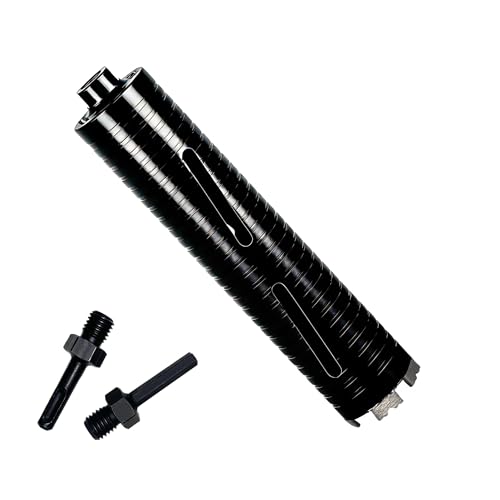
A dry-drill diamond core bit with two adapter options for maximum drill flexibility.
This diamond core drill bit covers a wide spread of materials — concrete, red brick, tile masonry, brick and cinder block walls, asphalt, marble, rock, and stone — with a 10-inch (254mm) drilling depth. That depth is what makes it useful for deep penetrations like air conditioner lines, pipes, and range hood venting. The sharp diamond coring teeth are laser-welded to the barrel, the process that joins the cutting segments to the body for aggressive dry cutting.
The adapter package is the practical highlight. It ships with two adapters, an SDS Plus shank and a 3/8-inch hex shank, giving you compatibility across different drilling tools. That flexibility means the bit works with a wide range of core drilling machines without you hunting down a separate arbor. For a professional or a serious DIYer with more than one drill, having both fit options in the box is a real convenience.
The straightforward positive here is that it works — reviewers point out it handling a block wall successfully. The one recurring issue to watch is adapter fit: a few buyers received adapters that did not match the bit hole, forcing a return. Check that both adapters thread onto your bit securely as soon as it arrives, before you start a job. Sized and priced as a capable dry-drill core bit, it is a sensible choice for someone who wants depth and adapter flexibility without the premium tag.
Standout feature: two adapters included — SDS Plus and 3/8-inch hex — so the bit mounts to a wider range of drills straight from the start.
One thing to check: a small number of buyers received adapters that did not fit the bit hole, so verify the threads before your first cut to avoid a return.
Well suited to: buyers who switch between SDS Plus and hex-chuck drills and want one 2 1/2-inch bit that fits both.
Not the pick if: you need wet-only coring performance for the densest reinforced concrete — that calls for a dedicated wet bit.
6. SALI Diamond Core Drill Bits 2 1/2″ Diameter 10″/254mm Drilling Depth

The dry-drill diamond bit that owners say zips through concrete in minutes.
This is the bit that earns its spot on raw cutting performance. The 2 1/2-inch (63.5mm) diamond core drill has a 10-inch (254mm) inside barrel drilling depth and an industry-standard 5/8-11 thread, so it mounts to the common core-drill arbor. The laser-welded turbo segments are built with premium stainless components and high-quality diamond grits, designed for longer coring life with chip removal holes, regular sawteeth, and a concentric axis. It is meant to be used dry, starting vertical.
The kit includes a 3/8-inch hex shank adapter and a 5/8-11 thread male-to-SDS Plus adapter, so it fits both standard drills and SDS Plus rotary hammers. It is rated for concrete, red brick, tile masonry, brick and cinder block walls, asphalt, and rock — a genuinely wide material range for installing air conditioners, pipes, and range hoods.
Reviewers keep praising the cutting power: this bit drills cleanly through heavy concrete with the right pressure and cooling, and it holds its edge well for a budget-priced diamond core. The recurring caveat is durability under constant use. It is built for occasional or homeowner jobs, not heavy daily commercial coring. A few shoppers say it can bind, which a feather trigger on the drill solves. Start it with a plywood guide and wear PPE, and the concentric-axis design keeps the hole true.
The case for it: fast, clean cuts in concrete at a value price, with both an SDS Plus and hex adapter included so it fits the tools most buyers already own.
Temper expectations: this is a light-commercial and homeowner bit — buyers report it lasts one or two serious jobs, not a full production schedule.
Pick it if: you have plumbing or HVAC holes to bore in concrete or block and want the best cutting speed for the money.
Pass it over if: you are coring all day on a jobsite — the durability is sized for occasional projects.
7. DaduoRi 2 1/2″ Dry Core Drill Bit, 5/8″-11 Thread, with 3 Adapters Included
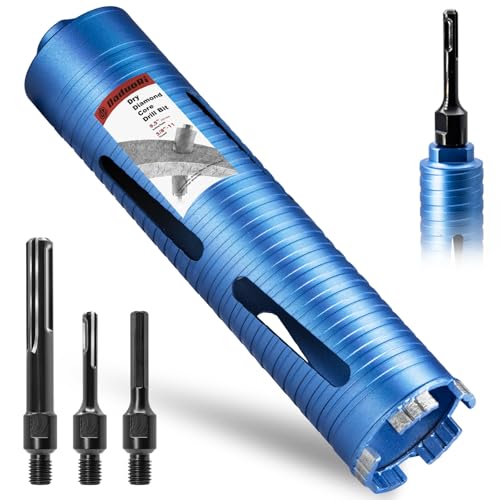
One bit, three adapters, and a pilot-free dry cut for brick, block, and stone.
If you own more than one kind of drill, this bit refuses to be the bottleneck. It ships with adapters for SDS Plus, SDS Max, and 1/2-inch hex shank — the three most common connections — plus a 2.5-inch dry core drill bit with a 5/8-11 thread and a maximum working depth of 9.5 inches. That adapter set is the reason to choose it: it fits rotary hammers and standard drills, fixed or handheld, with much less risk of buying the wrong arbor.
The cutting design emphasizes high concentricity, which means the bit stays centered so you get a uniform, precise cut rather than an egg-shaped hole. It is rated for brick, block, stone, and masonry, and it is meant for dry drilling but the maker recommends water when you hit concrete that is not reinforced, to prevent tooth breakage. The operating rule is clear: never use hammering mode. Coverage here suits HVAC, electrical, and plumbing installations, and the bit is designed for a vertical start and steady downward feed.
Buyer experience splits where you would expect. On the plus side, it makes quick work of cinderblock, brick, and mortar for running cable or wires. One buyer running a Fios cable through a brick wall found it far easier than a regular drill bit attempt. The caution is durability: the piece can break on some buyers, and the bit needs a pilot bit for easier starting. On occasional brick and block jobs it holds up; forced through dense concrete, it wears faster.
Why buyers choose it
- Includes SDS Plus, SDS Max, and 1/2-inch hex adapters for broad drill compatibility
- 9.5 inch maximum working depth at a 2.5-inch diameter
- High concentricity keeps the cut centered and uniform
- Handles brick, block, stone, and masonry for HVAC, electrical, and plumbing
Before you buy
- Durability is a real gamble — the piece can break for some buyers
- No pilot bit included, which makes starting the cut harder
- Must run wet on concrete and never in hammering mode
Made for you if: you want a single dry core bit that adapts to whichever drill you grab, for occasional holes in brick and block.
Keep looking if: you need a reliable pilot bit and rock-solid durability for repeat use — the missing pilot and split reliability reports are the reasons to pause.
8. SALI Wet Diamond Core Drill Bits 2-1/2″/65mm Diameter, 15″/380mm Drilling Depth
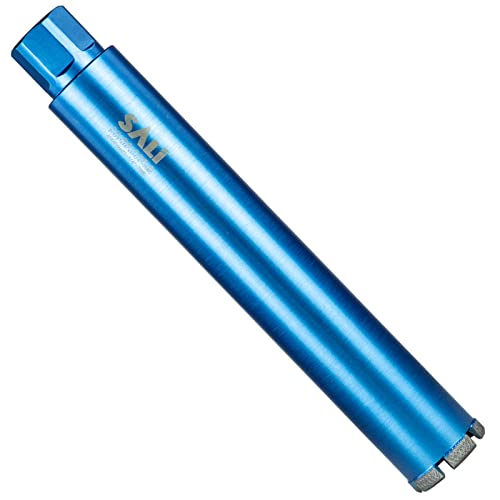
The deepest diamond bit here, built for wet drilling through concrete with embedded rebar.
When the wall is thick and reinforced, depth and cooling decide whether the job completes. This wet diamond core bit runs a 2-1/2-inch (65mm) diameter with a 14.5-inch (380mm) inside barrel drilling depth, the deepest in this lineup. It uses the industry-standard 1-1/4-7 thread for dedicated core drill rigs or handheld core drills. Premium aluminum alloy components and high-quality diamond grits are paired with chip removal holes, regular sawteeth, and a concentric axis for long coring life.
This is a wet-only bit — the water is not a suggestion, it is the cooling and flushing that keeps the diamond edges alive. It is rated for concrete, red brick, tile masonry, rebar-reinforced concrete, asphalt, marble, rock, and stone, covering air conditioning, pipes, stair railings, highways, and airports. The broad material list and the deep barrel make it the pick for the hardest, thickest jobs here.
What earns it the top performance slot is speed on tough material. Owners mention it cutting through six inches of concrete in a few minutes and handling embedded rebar where even name-brand hammer bits slow down. The honest limits are weight and control — a bit this deep wanders on startup without a stand, and it needs slow speed, water, and patience. Buy the correct 1-1/4-7 arbor, and it stays true and durable enough that one reviewer noted it paid for itself after two holes.
Its defining strength: the 14.5-inch (380mm) drilling depth and wet-laser-welded diamond segments let it go through thick, rebar-reinforced concrete in minutes.
The honest limit: this is a heavy, wet-only bit that wants a stable stand and the correct 1-1/4-7 arbor — it will wander on startup in a shaky hand.
Best for: serious coring through deep, reinforced concrete — pool railings, manhole floors, and thick foundation walls.
Not for you if: you want a light, dry-drill bit for a couple of block holes — this one is heavier and demands water and a steady setup.
9. Drill America 2-1/2″ Carbide Tipped Hole Saw/Cutter with 1″ Depth of Cut, CTH Series
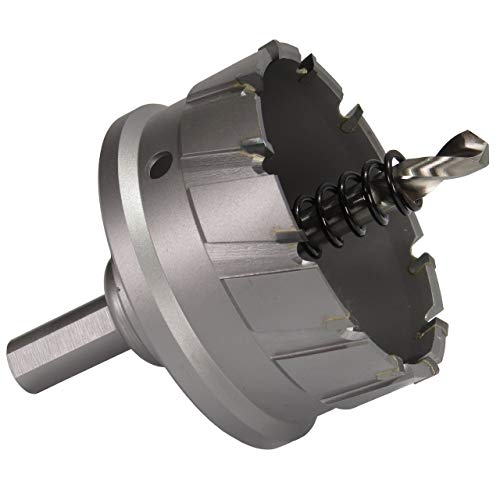
A heavy-duty carbide cutter for plate steel, cast iron, and dense metal stock.
For thick metal rather than sheet, this carbide-tipped hole cutter is the specialist. It cuts a 2-1/2-inch diameter hole to a 1-inch depth of cut in stainless steel, cast iron, iron, sheet metal, and copper, and it also handles abrasive materials like high-density resin and metal plates. The 1/2-inch shank fits a standard chuck, and the tool drills large-diameter holes without requiring the extra-large chucks that solid drill bits of this size would demand.
The kit comes with a pilot drill, a hex key, and an auto-ejecting slug — a spring-loaded feature that pops the cut metal disc out of the barrel so you do not have to pry it free after every hole. The pilot drill keeps the cutter from wandering when you start on a smooth metal surface. The 4-flute carbide-tipped design is why it holds up in cast iron and plate steel where a plain hole saw would dull quickly.
The one recurring gripe is the set screw, which can work loose early — a drop of thread locker and a shaft relief fix it permanently. Run it at low RPM with plenty of cutting oil, and it holds up on the toughest metal in this lineup.
What you get
- 2-1/2-inch diameter with a full 1-inch depth of cut in thick metal
- Cuts stainless steel, cast iron, iron, sheet metal, copper, and dense resin
- Includes pilot drill, hex key, and an auto-ejecting slug for fast repeat cuts
- 4-flute carbide-tipped design holds up in cast iron and plate steel
Watch outs
- The set screw can loosen early — thread locker fixes it
- Requires low RPM and steady cutting oil to perform
- Built for metal, not concrete or masonry
The pick for you if: you are cutting thick plate steel, cast iron, or dense metal and want a cutter with real durability and a pilot drill included.
Look past it if: your material is concrete or brick — this is a metal-cutting tool only.
Understanding the Specs
Cutting diameter and depth of cut
Cutting diameter is the size of the hole the bit makes — here, all nine are 2-1/2 inches (or the metric equivalent, like 65mm). Depth of cut (sometimes called drilling depth) is the maximum thickness the bit can bore in one pass. A metal cutter like the Drill America offers a 1-inch depth of cut, while a concrete core bit like the SALI Wet Diamond reaches a 14.5-inch (380mm) barrel depth. Match depth to your wall or plate thickness, or you will stall partway through.
Shank and thread type
The shank is how the bit locks into your drill, and getting it wrong makes the bit useless. SDS Plus is the common rotary-hammer fitting, SDS Max is the larger sibling, and a threaded shank (like 5/8-11 or 1-1/4-7) screws onto a core-drill arbor. Hex shanks (3/8-inch or 1/2-inch) fit standard chucks. Always confirm your drill’s connection type — or pick a bit that ships with the right adapters included.
Carbide vs diamond cutting edges
Carbide-tipped cutters are built for metal — steel, iron, copper, and cast iron. Diamond core bits are built for masonry and stone: concrete, brick, block, and rock. The two are not interchangeable. Choosing the wrong edge type for your material is the fastest way to destroy a bit and waste an afternoon.
Wet versus dry drilling
Dry drilling means no water is used while the bit cuts. Wet drilling uses flowing water to cool the diamond edge and flush chips out of the barrel. Many diamond core bits are labeled dry but perform better with water, and some, like the SALI wet-only bit, must be used wet. Water extends tool life, so when in doubt, cool the cut.
FAQ
Can I use a metal hole cutter on concrete or brick?
What does the drilling depth number actually mean?
Will a 2 1/2-inch bit fit my regular cordless drill?
Do I need to use water while drilling?
What is the difference between SDS Plus and SDS Max?
How long does a diamond core bit last?
Can these bits cut through rebar-reinforced concrete?
Is a carbide cutter better than a diamond bit?
Do I need a pilot drill to start a 2 1/2-inch hole?
Final Thoughts: The Verdict
Across the board, the 2 1/2-inch drill bit winner is the Klein Tools 31870 because it cuts stainless, mild, and carbon steel with a split point pilot that stops wandering and a flange that prevents over-drilling — the strength most buyers need in a metal cutter. If your job is concrete or masonry, grab the SALI Wet Diamond Core Drill, whose 14.5-inch drilling depth handles thick, rebar-reinforced walls. And for drilling a few pipe or vent holes through brick and block, the 2-1/2″ Concrete Hole Saw with its included rod and center bits is the value-driven one to reach for.
How We Picked
We do not accept paid placement. Every pick is matched to a real buyer and a real use-case; we do not hands-on test units.
Sources & Methodology
Specifications: manufacturer listings and product documentation. Review insights: verified customer reviews, as of September 2026. Pricing: not shown on this page (it changes often); check the current price via the retailer link.
As an Amazon Associate, KitchPrep earns from qualifying purchases. This does not affect which products we feature.
Related Guides
