
Specs are compiled from manufacturer listings and verified buyer reviews and can change over time — please confirm the key details on the product page before buying.
Three things decide whether you love your stand mixer or resent it: how much dough the bowl holds, how loud the motor runs, and whether the machine stays put when a stiff dough fights back. Get those right and you will knead sourdough, cookie dough, and cake batter for years without babysitting the machine. Get them wrong and you own a heavy appliance that rattles across the counter. This guide breaks down nine real options across the baking stand mixer shelf so you can match one to the way you actually bake.
I’m Mohammad Maruf — the founder and writer behind KitchPrep. This guide is built by comparing the manufacturers’ published specifications and the patterns across verified customer reviews, so you get each pick’s real strengths and trade-offs instead of marketing spin.
You do not need the biggest motor on the shelf — you need the bowl that matches your batch sizes. Below you will find nine baking stand mixer picks sorted by who they suit, from a large-capacity workhorse to a compact countertop lift model.
Our Picks at a Glance

How To Choose The Best Baking Stand Mixer
The mixer that fits your kitchen is the one that matches your biggest regular batch. A four-quart machine will knead a single loaf but choke on a double batch of cookie dough. An eight-quart commercial unit will handle three dozen cookies at once but will not cream a single egg white properly. Start by estimating the largest batch you bake in a normal month, then work backward to capacity, motor, and footprint.
Bowl capacity decides your daily reality
Capacity is measured in quarts — the volume of the mixing bowl. A 5-quart bowl covers most home baking: one large cake, one batch of cookies, a single loaf. A 6.5 to 8.4-quart bowl lets you double or triple a recipe without stopping to scrape down between batches. The trade-off is footprint. Bigger bowls take more counter space and are heavier to move, so measure your counter before you commit to an extra-large model.
Motor wattage and gear type set the ceiling
A mixer rated at 650W to 800W will knead stiff bread dough without straining. Wattage is not the whole story though. A belt-driven or gear-driven transmission (the internal system that transfers motor power to the mixing head) determines how much torque reaches the dough hook. A high-watt motor with a weak transmission will stall on a stiff rye loaf. Look for a machine that also lists an all-metal or die-cast construction — that is the signal that the gears and housing can take the load.
Tilt-head versus bowl-lift
A tilt-head mixer has a hinged top that tips back so you can lift the bowl straight out. It is quicker to load and easier to reach into for scraping. A bowl-lift mixer uses a lever to raise the bowl up into a fixed head. It locks more firmly for heavy dough, which is why commercial and high-capacity models use it. Tilt-head is friendlier for everyday home use. Bowl-lift is sturdier under a stiff double batch.
Noise, stability, and the small stuff
Suction-cup feet matter more than the spec sheet suggests. A lighter mixer with strong suction cups stays put better than a heavy machine with hard plastic feet. Noise levels on quieter units sit in the 45 to 68 dBA range. And look at the included accessories: a dough hook, flat beater, and wire whip are the baseline trio. A flex-edge beater that scrapes the bowl is a genuine upgrade because it cuts down on manual scraping.
Quick Comparison
| Model | Best For | Capacity | Motor | Speeds | Amazon |
|---|---|---|---|---|---|
| ZACME 8.4QT Commercial Stand Mixer★ Best Overall | Large families and bulk baking | 8.4 quarts | 800W | 11 | Amazon |
| CUSIMAX Kitchen Mixer with Digital Switch ControlBudget Champion | Budget buyers and small spaces | 5 quarts | 650W | 8 | Amazon |
| CEBORY 3-IN-1 Electric Stand MixerBest Color Pick | Everyday home baking | 6.5 quarts | 660W | 10 | Amazon |
| VIVOHOME Stand Mixer with Dough Proofing | Bread bakers who proof dough | 6 quarts | 660W | 11 | Amazon |
| Hauswirt Stand Mixer 6QT XL | Countertop convenience with a touch screen | 6 quarts | DC motor | 11 | Amazon |
| Bosch Universal Plus Stand Mixer | High-volume bread and cookie batches | 6.5 quarts | 500W | 4 | Amazon |
| KitchenAid 5.5-Qt Bowl-Lift Stand Mixer | Attachment ecosystem and heavy dough | 5.5 quarts | 2x bowl power vs tilt-head | 11 | Amazon |
| Ooni Halo Pro Spiral Mixer | Pizza and sourdough enthusiasts | 7.3 quarts | Spiral mixing system | 58 | Amazon |
| KitchenAid KSM8990CU 8-Quart Commercial | Commercial-grade home kitchens | 8 quarts | High-efficiency DC motor | 10 | Amazon |
In‑Depth Reviews
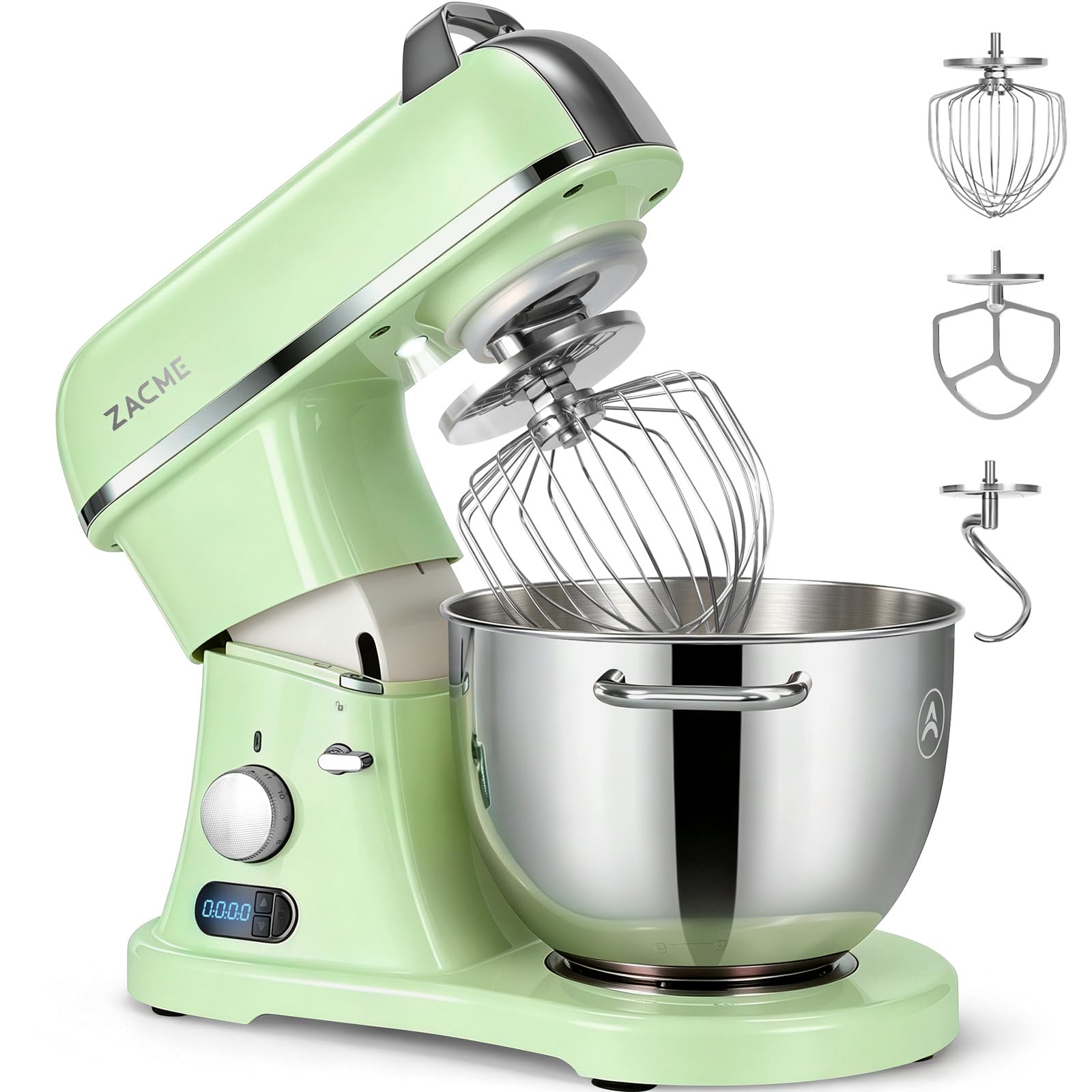
1. ZACME 8.4QT Commercial Stand Mixer 800W with Aluminum Die Casting
Our pick — over 4.5★ from 750+ verified ratings; the strongest balance of quality and price.
An 8.4-quart bowl that takes a 3 kg dough load in one run.
If you bake for a household that eats a lot of bread, or you sell what you bake, size stops being a nice-to-have. The ZACME holds 8.4 quarts of bowl volume — a figure the CUSIMAX below does not come close to at 5 quarts. That gap is what turns four loaves of sourdough from a full afternoon into a single run. The maximum dough load is 3 kg, which is 6.6 lbs or 105.8 oz, and the motor delivers 800W through durable metal gears across 11 speed settings. The ZACME runs at 800W, while the CUSIMAX runs at 650W, so this one has more muscle behind the hook when the dough turns stiff.
The feature that keeps bakers attached to this machine is how quiet it stays while working hard. The first gear runs at ≤48 dBA (a decibel reading, where lower numbers mean less noise) and the highest gear tops out at ≤68 dBA. For context, a normal conversation sits around 60 dBA, so even on top speed you can keep talking over it. The tilt-head design lets you flip the top back and lift the bowl out without unthreading anything, and the stainless steel dough hook, flat beater, and wire whip all go in the dishwasher. A digital display shows the running time and lets you set a countdown, so you can walk away while a 15-minute knead finishes itself.
What wins people over is raw performance — the machine simply handles what you throw at it, from double cookie batches to stiff bread dough, and does it without heating up or slowing down. It also meets the standard of NSF/ANSI 8-2023, the public-health certification for commercial kitchen equipment, which is the kind of rating you normally only see on restaurant gear. The honest catch is footprint. At 33 pounds and 18.11″D x 12.18″W x 16.3″H, this is a machine that claims a permanent counter corner — you will not be tucking it into a cupboard between bakes. If your counter is already crowded with a coffee maker and a toaster, measure first.
Where it earns its place
- 8.4-quart stainless steel bowl takes a 3 kg dough load, so double and triple batches happen in one run
- Quiet enough to keep a conversation going — ≤48 dBA on low gear, ≤68 dBA at max speed
- NSF/ANSI 8-2023 commercial certification backs up the build for serious, repeated use
- Countdown timer plus digital display means you can start a knead and walk away
The honest trade-offs
- 33 pounds and a wide 18.11-inch depth footprint — this is a permanent counter resident, not a cupboard appliance
- An 8.4-quart bowl is overkill for creaming a couple of eggs or a single small cake
- The machine shakes slightly once you push past four loaves at once
Built for volume: Buy this if you routinely bake in bulk — sourdough loaves, 3-dozen cookie batches, frosting for a crowd — and you have the counter depth to park it.
Overkill if: You bake one cake or one small batch of cookies a week; the 8.4-quart bowl will feel cavernous and the machine will eat counter space you do not have.
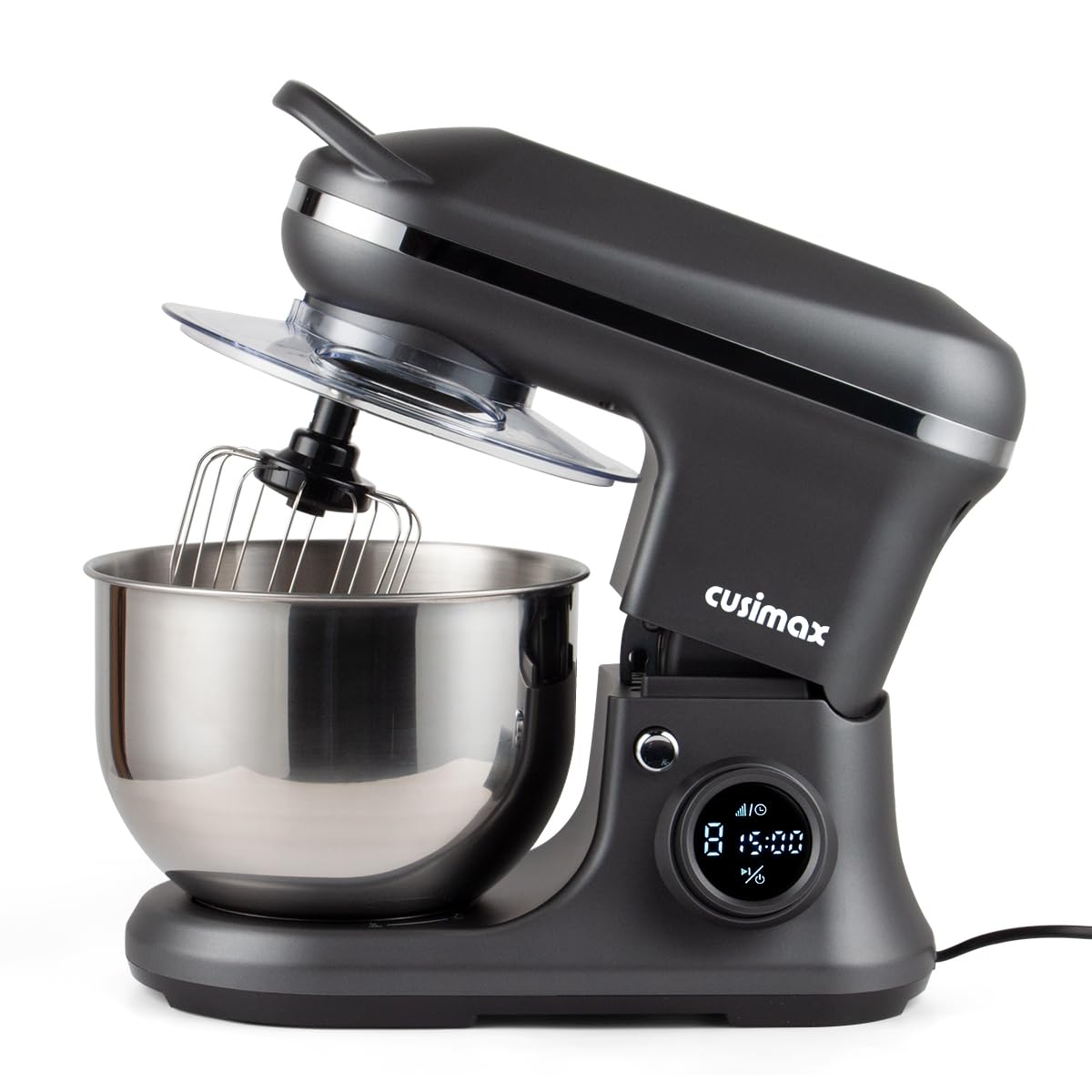
2. Khul. CUSIMAX Kitchen Mixer with Digital Switch Control, 650W
A 5-quart, 650W mixer that fits a 7.08-inch-wide strip of counter.
The CUSIMAX is what you buy when you want a real stand mixer without committing your whole countertop or budget. Its 5-quart stainless steel bowl handles one cake, one batch of cookies, or a single loaf of bread comfortably. The 650W motor drives a 5-quart bowl compared to the ZACME’s 8.4 quarts — a smaller machine in every dimension. It measures 14.56″D x 7.08″W x 12.99″H (depth, width, height), so it slips into tight kitchens, RV counters, and small apartment setups where a full-size mixer would barge into everything.
The standout feature is the digital switch control. Eight speeds pair with a 15-minute adjustable timer, and the electronic display shows both. The splash guard with a pour-through access port lets you add flour or liquid without stopping the machine or dusting your whole counter. Three attachments come in the box — a wire whip, a dough hook, and a flat beater — and they clip onto the shaft without tools.
Bakers who use this machine tend to love the digital timer above all else, because it stops the mixer for you and prevents overmixing, which is the easiest way to ruin whipping cream. Suction cups on the base hold it firmly, and the whole thing is light enough for one hand to move. Just set expectations on the attachments: they are lightweight and some are not metal. That is a fair trade at the budget end of the category, but if you plan to knead heavy rye dough four times a week, a heavier machine will last longer under that load.
Reach for this if: You want a genuine stand mixer that fits tight kitchen space and will not strain your arms to lift it.
Look elsewhere if: You are a serious bread baker kneading dense dough several times a week — the lightweight attachments will not love that workload.
3. CEBORY 3-IN-1 Electric Stand Mixer, 6.5QT Bowl 660W 10-Speed
A 6.5-quart bowl that doubles a cookie recipe without a commercial-size body.
At 6.5 quarts, the CEBORY splits the difference between the CUSIMAX 5-quart bowl and the ZACME 8.4-quart behemoth. That extra 1.5 quarts over the smaller machine is the room you need to actually double a cookie recipe without powdering your counter with flour. The DC motor runs at 660W with 10 speed settings plus a Pulse function, and the tilt-head design lifts back so you can drop in ingredients or scrape the bowl one-handed. The bowl and all three attachments — dough hook, beater, and whisk — are food-grade stainless steel, which means no rust spots and no plastic flavor hanging around in your buttercream.
Assembly is the part most people notice first. Attachments clip onto the shaft, the bowl twists into place, and you are kneading within a minute of unboxing. The tilt-head comes back down with a handle you grip rather than fumble for, and a splash guard is included to keep dough spray contained. Cleaning is quick too: the bowl and tools come off without tools, and the mixer body wipes down easily because the controls sit in a single knob rather than a crevice-heavy panel.
Home bakers drawn to this machine tend to praise it passing on a consistent theme — it just does the job well and holds up. It runs quieter than expected for the power it delivers, and home bakers moving up from handheld models report it staying steady on the counter without skittering. The one caveat is the bowl design: it has no handle, which makes pouring batter out a little awkward, and its low profile means you have less headroom to scrape the sides or add ingredients mid-mix. It is a small limitation, but worth knowing before you buy if you are someone who likes to add flour a spoonful at a time.
Where it wins: A 6.5-quart stainless bowl, a 660W DC motor, and 10 speeds at a home-baking price. The green finish is also the kind of splash of color that earns counter space instead of hiding in a cupboard.
Be honest about: No bowl handle and a shallow bowl profile make pouring and scraping less convenient than a handle-and-lip design would be. Fine for most batters, slightly fiddly for very wet doughs.
balance: This suits the regular home baker who wants a bowl big enough for a double batch without stepping up to a heavy commercial machine.
skip it if: Pouring batter out of a handleless bowl would drive you up the wall — that is a deal that designers did not solve here.
4. VIVOHOME Stand Mixer with Dough Proofing, 6-Quart Tilt-Head Mixer

A 6-quart mixer with a 77°F to 113°F proofing setting for the first rise.
Most stand mixers knead dough and then leave you to find a warm spot for the rise. The VIVOHOME bakes that step into the machine. A dedicated Fermentation setting holds a warm temperature so dough can proof right in the bowl — the default is 100°F, and you can adjust it between 77°F and 113°F for specialty bakes like sourdough or bagel dough. The timer runs up to 100 minutes, which is long enough for most first rises. If you are tired of balancing a bowl on top of a radiator or tucking it into an oven with the light on, this is a genuinely useful feature that the CEBORY and CUSIMAX above do not offer.
The kneading side is solid too. A 660W pure copper motor (copper wiring handles heat better than aluminum, so it runs cooler on long sessions) drives 11 speed settings through 360° planetary mixing, which is the motion where the beater sweeps around the bowl rather than just spinning in place. Three one-touch presets cover kneading, whisking, and stirring, each with a preset time and speed dialed in, so you do not have to think about which setting to use. The 6-quart bowl handles dough for three loaves of bread, and the flex-edge beater scrapes the bowl as it turns, which means less stopping to push batter down with a spatula.
Bread-making buyers report their kneading time dropping sharply once this machine takes over; hand-kneading that used to take twenty minutes now takes five to eight. The suction-cup feet grab firmly enough that getting the mixer off the counter takes a firm pull — good news for stability, mildly annoying when you want to move it. The one candidate weakness is the instruction manual, which some buyers found unclear. Set the machine up once by feel and the rest is intuitive, but the first-run learning curve is steeper than it should be.
Best for: Bread bakers who want to skip the separate proofing step and keep the whole loaf process in one bowl.
Not ideal if: You never bake bread — the fermentation setting is the headline feature here, and without it the value proposition narrows.
5. Hauswirt Stand Mixer 6QT XL with 4.5″ LED Touch Screen
A 45 dBA mixer with a 4.5-inch touch screen and a 20-pound die-cast base.
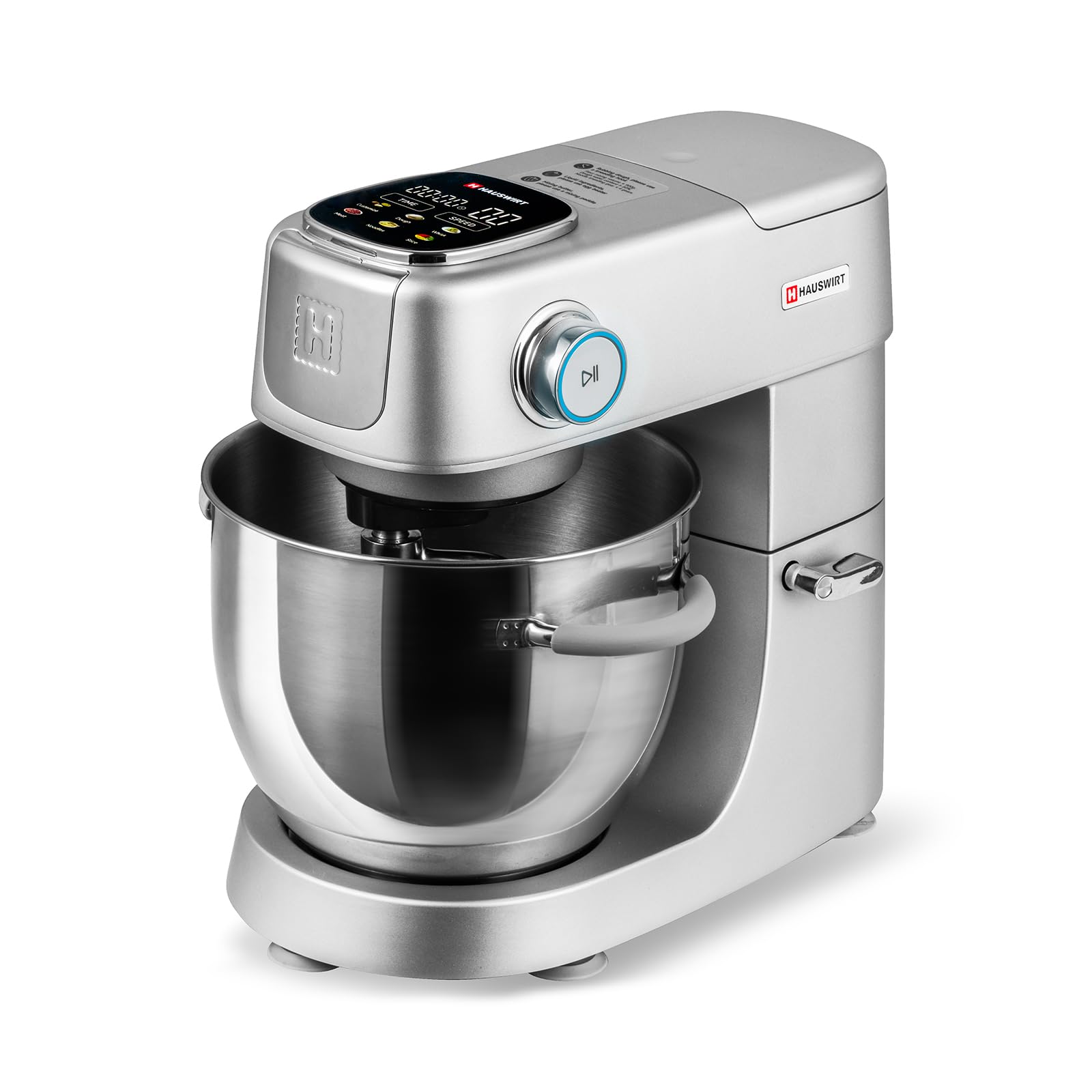
If you have ever had to raise your voice over a mixer running at speed four, the Hauswirt’s 45 dBA noise level will feel like a different category of appliance. That is close to the sound of a quiet library. The rest of the package backs it up: a heavy-duty die-cast aluminum body (molten metal poured into a mold, which gives you one solid frame instead of bolted-together panels), a widened metal base, and a DC motor that can knead up to 1500g of dough at once — roughly 3.3 lbs — without giving up. Rear convection heat-dissipation holes let hot air escape so the machine keeps working through long sessions without overheating and cutting out.
The standout detail is the control system. A 4.5-inch color LED touch screen sits on top of the machine, which lets you read and select functions without bending down to peer at a dial. A side knob handles 11-speed adjustment alongside the screen, so you can nudge the speed with a wrist turn or tap a preset on the display. A thickened Spiral Dough Hook — the spiral shape pushes into the dough from the side rather than down from the top — improves dough elasticity and structure. Three food-grade stainless steel accessories ship in the box: the dough hook, a silicone-edge beater, and a whisk.
First-time stand mixer buyers tend to love how approachable this model is, especially anyone who finds app-connected gadgets intimidating. It cleans up easily because the body is uniform metal, and the 20-pound presence helps it stay planted rather than skating around. The one area where owners are split is the durability of parts, so treat the machine as you would any heavy appliance — do not force the dough hook through an overloaded bowl, and remove the accessories before cleaning. A 6-quart bowl is the balance for a household of three to five who bake one large batch at a time.
The kitchen-counter verdict: 45 dBA quiet, 6-quart capacity, and a full-metal frame give you a machine that feels built rather than assembled — at a mid-range price, this is the mixer that most resembles a premium unit on the counter.
The honest caveat: Feedback on long-term durability is mixed among owners. That is not disqualifying, but it argues for careful use and a bit of respect for the machine rather than commercial-style abuse.
Pick this if: You value a quiet, stable, heavy-duty build with a touch screen interface you can actually read while mixing.
Consider another pick if: You plan on running the machine all day at commercial volumes — reliability past the warranty period is the least certain part of this product’s story.
6. Bosch Universal Plus Stand Mixer 500 Watt, 6.5 Quarts

A bottom-drive mixer rated for 14 loaves or 34 dozen cookies per batch.
The Bosch Universal Plus takes a completely different approach to mixing than the tilt-head machines above — the motor sits at the bottom, driving two beaters up through the bowl instead of a single attachment down from the top. That bottom-drive design is what lets it handle up to 14 loaves (15 pounds) of whole grain bread dough in a single run, or mix up to 34 dozen cookies in one batch. Belt-driven transmission (a rubber belt instead of metal gears transfers power) keeps the motor’s torque constant under load, which is how a 500W motor handles volumes that would stall a higher-wattage direct-drive machine.
The 6.5-quart bowl is BPA-free plastic with an easy-grip handle, and the drive shaft removes so the bowl can go straight into the dishwasher. A splash ring and lid come with the mixer, so you can add ingredients without spraying flour everywhere, and the dual beaters provide triple whipping action — the whips can take on anything from a single egg white to 10 pounds of cooked potatoes, which is unusual range for any home machine. Four speed settings sit on a knob for simple, tactile control. Included in the box: the mixer, wire whips with plastic whip drive, a dough hook, the bowl, a lid, a splash ring, and a NutriMill dough hook extender.
The recurring theme in owner feedback is that this mixer is built for the long haul. Bakers with decades behind them say it handles bread, cake, and cookie dough without strain, and there is talk of machines running for twenty years. The flip side is user experience around the bowl. There is no handle to grip when you tilt the bowl to pour, and a central tube in the middle of the bowl makes getting thick dough out trickier, especially if your grip is not what it was. At four speeds, the machine also wants a hand on it at top setting — the base does not suction down.
Why bread bakers rate it
- Handles up to 14 loaves (15 lbs) of whole grain bread dough or 34 dozen cookies in a single batch
- Belt-driven transmission keeps torque steady so the 500W motor does more work than its wattage suggests
- Bowl and attachments are dishwasher-safe, and the drive shaft removes for cleaning
- Dual beaters whip anywhere from one egg white to 10 lbs of mashed potatoes
What you should know
- No bowl handle and a central tube in the bowl make thick dough harder to empty out
- Only 4 speed settings versus 11 on several picks in this list
- Needs a steadying hand at the highest speed setting since the base does not use suction cups
Your machine if: You knead big batches of whole grain or sourdough bread and want one mixer that outlasts several cheaper ones.
Think twice if: You bake small quantities most days — the central tube and deep bowl are working against you on one-cake sessions.
7. KitchenAid 5.5-Qt Bowl-Lift Stand Mixer, KSM55SXXX
A 5.5-quart bowl-lift with over 10 optional attachments and a 3-point locking bowl.
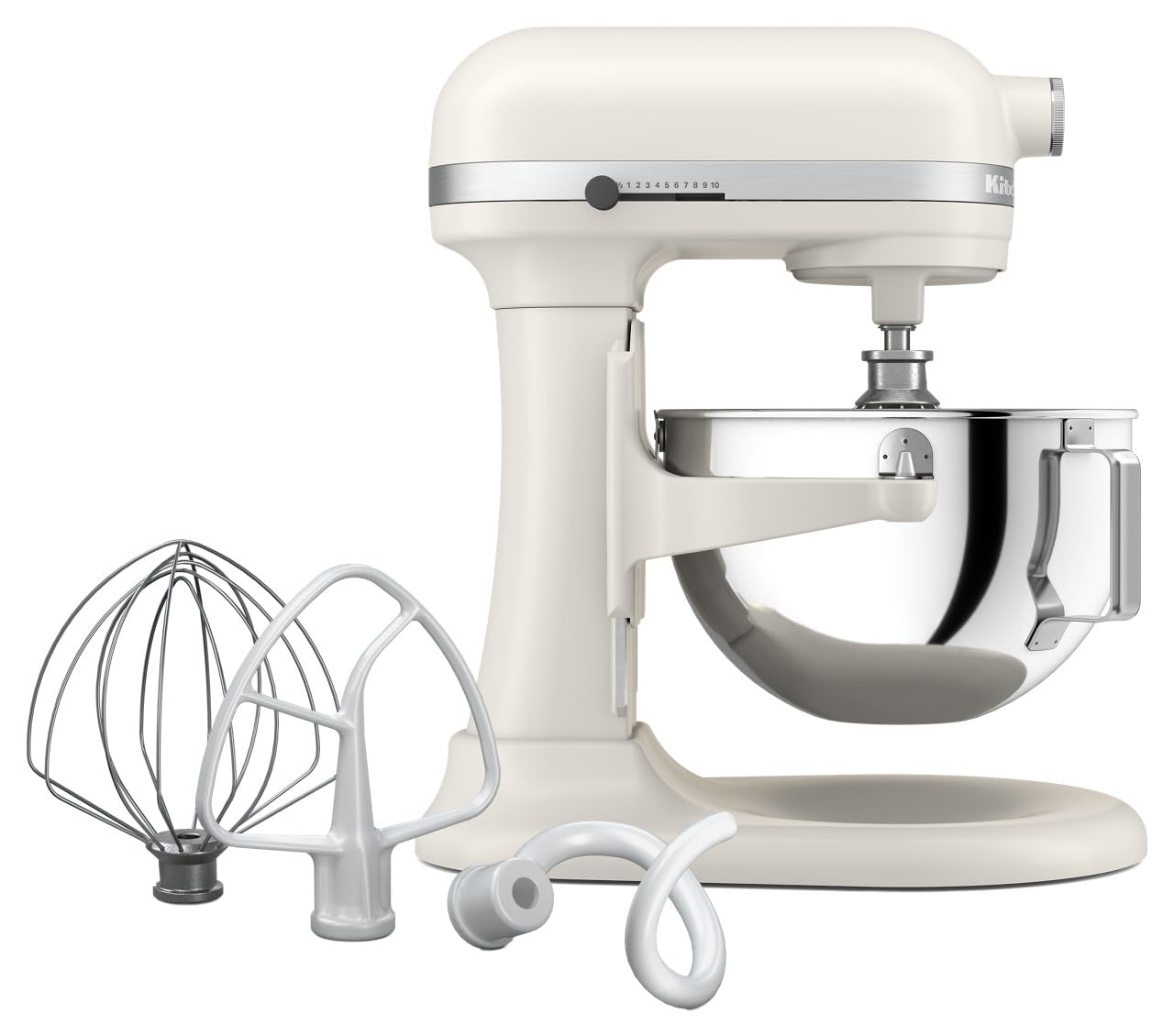
Where the ZACME leans on raw bowl volume, the KitchenAid 5.5-Qt Bowl-Lift leans on what you can do with the machine after you buy it. The 5.5-quart stainless steel bowl takes 11 dozen cookies per batch (using the flat beater with 28g dough each), kneads over 7 lbs of bread, or mashes 6 lbs of potatoes. Bowl-lift design means a lever raises the bowl up into a fixed head — the trade is that you lose the flip-back convenience of a tilt-head but gain extra stability under heavy mixing. A 3-point locking bowl (the bowl clicks in at three spots instead of one) keeps the bowl locked down when the dough gets stiff.
The distinct advantage here is the attachment ecosystem. Over 10 stand mixer attachments are available (sold separately), covering fresh pasta, burgers, veggie noodles, and ice cream. That is the reason someone commits to this brand — the mixer can replace several countertop tools over time. KitchenAid claims 2x the power in the bowl compared to the tilt-head models, measured as peak horsepower at mixing speeds above 2. Eleven speeds include a 1/2 folding speed that gently mixes delicate ingredients like blueberries and egg whites without overbeating. Four pieces come in the box: a 5.5-qt stainless steel bowl, a coated flat beater, a coated dough hook, and a 6-wire whip.
Owners who upgrade to this model from smaller KitchenAid machines tend to describe the jump as significant — one said it was like moving from a compact car to a luxury one, no longer needing a hand on the head to keep it from bouncing during a stiff bread dough. That said, the bowl itself draws mixed feedback: some find 5.5 quarts smaller than expected for a bowl-lift. If you knead very large batches, the ZACME’s extra capacity at 8.4 quarts is the safer bet. This model trades a little volume for the attachment flexibility and the reassuring heft of a die-cast zinc body.
Why buyers commit to this one: The 11 speeds, half-speed folding mode, and over 10 optional attachments (sold separately) make this less a single mixer and more a head unit for years of kitchen expansion. The 3-point locking bowl is the hidden stability upgrade over a tilt-head.
The catch: 5.5 quarts reads smaller than expected to buyers who expected a bowl-lift to be a volume machine. If big bread batches drive your decision, look further up this list at the 8.4-quart ZACME instead.
Great fit if: You want the attachment ecosystem — the future pasta maker, the slicer, the juicer — and you mix several times a week.
Look up-list if: You need maximum bowl volume; the 6.5 and 8.4-quart options earlier in this article will hold more dough in one run.
8. Ooni Halo Pro Spiral Mixer, 7.3 Quart with 58 Speed Settings

A 7.3-quart spiral mixer with a rotating bowl and 58 speed settings.
If pizza night is the reason you want a stand mixer, the Halo Pro is designed exactly for you. Normal stand mixers push a hook down through the dough. Spiral mixing does the opposite — a spiral dough hook works from the side while the bowl itself rotates underneath, mimicking the way a professional bakery or pizzeria kneads. The patent-pending Removable Breaker Bar adds to that process, and the result is stronger gluten networks and better dough for bread and pizza. Where the CUSIMAX and CEBORY mixers above sweep a beater around the bowl, this one sets the whole bowl into motion under a stationary hook.
The control range is what makes it a tool for serious bakers rather than a casual home appliance. Fifty-eight speed settings span from 60 RPM (revolutions per minute, i.e. how many times the mixing head spins in 60 seconds) to over 1,000 RPM. That range spans from gentle combining at the low end to brisk whipping at the top, so you can build dough slowly then ramp up without overworking the gluten. The 7.3-quart stainless steel bowl gives you room for a serious pizza dough batch. Four attachments ship in the box — a breaker bar, a flexible beater, a spiral dough hook, and a geared whisk — so it covers mixing, whisking, and beating, not just dough.
Pizza bakers notice the time savings first; what used to take 45 to 60+ minutes by hand now lands in 10 to 15 minutes in the Halo Pro. Owners also appreciate that the bowl is removable and dishwasher-safe, which is unusual for spiral mixers and makes cleanup much easier. It runs quietly compared to a standard KitchenAid. As for the caveat: this is a dough-first machine. Bakers who use it heavily for bread report rarely touching the paddle and skipping the whisk entirely, so if cakes and frosting are your primary use, you are paying for a feature set you will not use. The bowl does require some flour-and-hydration adjustments to your recipes the first few times you bake, since spiral mixing works the dough differently.
The pizza-night differences
- Spiral mixing with a rotating bowl develops stronger gluten networks — the technique bakeries and pizzerias use
- 58 speed settings ranging from 60 RPM to over 1,000 give you full control from gentle combining to fast whipping
- Turns pizza dough that took 45 to 60 minutes by hand into 10 to 15 minutes of machine time
- Removable, dishwasher-safe bowl makes cleanup easier than typical spiral mixers
What should give you pause
- Paying for the spiral system is wasted if you mostly bake cakes — the paddle and whisk rarely get used
- Your usual recipes may need adjustment to flour-hydration ratios before the dough behaves the way you expect
- Noise levels draw mixed feedback; it is quieter than a KitchenAid but not silent
Worth it if: You are chasing bakery-style pizza pie and sourdough crusts and want to practice on equipment used by real pizzerias.
pass on it if: Your stand mixer will do more frosting and cake batter duty than dough duty — the spiral design earns its price tag on dough alone.
9. KitchenAid KSM8990CU 8-Quart Commercial Countertop Mixer, 10-Speed

The commercial-grade machine for bakers who treat bulk mixing as a regular week, not a treat.
This is a serious commercial mixer wearing home-kitchen clothes. It is NSF certified — that is the public-health standard for commercial food equipment, the same certification a restaurant has to meet. The 8-quart stainless steel bowl handles several batches of cookie dough at once, and the high-efficiency DC motor runs longer with less heat buildup, so it can knead, whip, and mix for long sessions without cutting out. A gear-driven transmission (solid metal gearing rather than a belt) drives the bowl-lift mechanism, and a speed-control protection feature means wiping the machine clean cannot accidentally turn it on mid-wipe.
The bowl-lift design raises the bowl up into a fixed mixing head, giving you a stabilizer for heavy ingredients, and comes with a stainless steel flat beater, spiral dough hook, and 11-wire elliptical whip. The machine sits at 25 pounds, which is heavy on purpose — a heavier machine on the counter resists walking even at speed. Note the machine stands 16.44 inches tall, which means it can fit under a standard upper cabinet without needing space to tilt the head, since there is no hinge to swing back. The accessories and stainless steel construction mean fewer parts to break and easier cleaning, though the rough bowl interior and paddle edges can trap a bit of dough if you are not diligent.
Owners describe this as a machine that scales smoothly. One owner making cakes for local customers has used theirs for six months without complaint. The biggest recurring observation is that this mixer wants a minimum batch size — a small cup of batter or a single egg white does not work well, because the flat beater sits too high above the bowl floor and spins on top of small quantities instead of reaching them. If your baking routine swings from tiny batches to big ones, that is a real limitation to plan around.
The commercial angle: NSF certification, a high-efficiency DC motor, and a gear-driven bowl-lift are what you get when the design brief is reliability through repeated daily use rather than weekend baking.
Plan around this: The 8-quart bowl does not like small batches. A single egg white or a small cup of batter will spin above the beater rather than get mixed — the machine wants volume.
Buy this if: You bake at high volume — cookies by the gross, bread in multiple loaves — and want one machine that does not flinch on a full day of work.
Not for you if: You bake one cake or one dozen cookies at a time; the minimum-capacity behavior will frustrate you.
Understanding the Specs
Capacity in Quarts
Quarts measure the volume of the mixing bowl. A 5-quart bowl is designed for single batches: one cake, one batch of cookies, one loaf of bread. A 6.5 to 7.3-quart bowl handles double batches. An 8.4-quart bowl can take you up to 3 kg (6.6 lbs) of dough in one run. Bigger bowls also take more counter space, so measure yours first. The machine’s advertised capacity is the ceiling, not the ideal — very large bowls can struggle with very small batches, because the attachment may not reach the bowl floor when there is very little inside.
Motor Wattage and Transmission Type
Wattage tells you roughly how much power the motor draws, not how much torque it ultimately feeds the dough hook. A belt-driven transmission, like the one used in the Bosch Universal Plus, delivers steady torque through a belt instead of direct gears. A gear-driven transmission, like the one in the 8-quart KitchenAid commercial model, drives the mixer head directly. Direct-drive and gear-driven machines tend to have punchier torque for stiff dough. Belt-driven machines often run quieter and last longer with fewer internal metal parts wearing against each other. Match the transmission type to your main job — stiff bread dough favors gear-driven, gentle mixing favors belt-driven.
Tilt-Head vs Bowl-Lift
Tilt-head mixers flip the top back on a hinge so you can add ingredients and remove the bowl without moving the machine. Bowl-lift mixers use a lever to raise the bowl into a fixed head, which locks more firmly during heavy mixing. Tilt-head suits daily home use. Bowl-lift suits heavy dough and high volume, and it lets a tall machine fit under a standard upper cabinet since there is no head to swing back.
Speed Settings and Preset Modes
Speed count tells you how finely you can tune the motor. A mixing range typically starts around slow stirring for folding in ingredients and goes up to fast whipping for cream or egg whites. Some machines add a dedicated folding speed — often labelled half speed — to gently combine delicate ingredients like berries or whipped egg whites. Machines with preset modes like kneading, whisking, and stirring automate the time and speed for common tasks, so you do not need to make those decisions yourself.
FAQ
How many quarts do I need for bread?
Is a tilt-head or bowl-lift mixer better for stiff dough?
Can I knead bread in a mixer with a 500W motor?
How quiet are these stand mixers in real use?
Can a stand mixer handle sourdough or is it too stiff?
What does planetary mixing mean?
Do I need suction cup feet for stability?
How long does a stand mixer typically last?
Are stand mixer attachments dishwasher safe?
Does a bigger bowl mean a bigger footprint?
Final Thoughts: The Verdict
For most home bakers who want one machine that covers bread, cookies, and cake without ever feeling underpowered, the ZACME 8.4QT Commercial Stand Mixer is the pick — the 8.4-quart stainless bowl, the 800W motor with 11 speeds, the ≤48 dBA quiet operation, and the NSF/ANSI 8-2023 certification give it a rare combination of capacity, quiet, and verified build quality that no other mixer on this list matches end to end. If noise and a touch screen are what pull you in, the Hauswirt 6QT XL is the one to reach for, with its 45 dBA rating and 4.5-inch LED screen. And if pizza dough and sourdough crusts are the whole reason you want a stand mixer, the Ooni Halo Pro Spiral Mixer earns its place with its 58 speed settings and rotating-bowl spiral design. For quick, budget-friendly runs on smaller batches, the CUSIMAX remains the practical entry point. Whichever way you go, match the bowl to your biggest regular batch — that single decision makes more difference than any wattage number on the box.
How We Picked
We do not accept paid placement. Every pick is matched to a real buyer and a real use-case; we do not hands-on test units.
Sources & Methodology
Specifications: manufacturer listings and product documentation. Review insights: verified customer reviews, as of September 2026. Pricing: not shown on this page (it changes often); check the current price via the retailer link.
As an Amazon Associate, KitchPrep earns from qualifying purchases. This does not affect which products we feature.
Related Guides
