
Specs are compiled from manufacturer listings and verified buyer reviews and can change over time — please confirm the key details on the product page before buying.
To cool a house that is around 1,800 square feet all the way through, you want a central system sized near 3 tons, which is the same as 36,000 BTU of cooling power. Go much smaller and the unit runs nonstop on a hot afternoon. Go much bigger and you pay for power you will never feel. One quick note before we start: this list uses flexible, human-like matching for a home of roughly 1,800 square feet. That means not every pick is the exact tonnage or unit type you typed into the search bar. Each one is the nearest same-type size that serves the same job, and we say so plainly so you are never misled.
I’m Mohammad Maruf — the founder and writer behind KitchPrep. This guide is built by comparing the manufacturers’ published specifications and the patterns across verified customer reviews, so you get each pick’s real strengths and trade-offs instead of marketing spin.
These are the leading central units for a home around that size, and here is how to match one to your ducts, your climate, and your budget. Match the tonnage to your square footage, then use the picks below to judge the best air conditioner for an 1800 sq ft house.
Our Picks at a Glance

How To Choose The Best Air Conditioner for an 1800 Sq Ft House
To cool a house near 1,800 square feet, you shop by tonnage, which is how much heat a system can pull out of your home in an hour. One ton equals 12,000 BTU (a BTU is a unit of heat), so a 3-ton unit moves 36,000 BTU. That 3-ton size is the balance for a house near 1,800 square feet. If your home is well shaded or the summers are mild, a 2.5-ton unit can work. If you have high ceilings, big west-facing windows, or a brutal Southern summer, step up toward 3.5 tons.
Tonnage and BTU — sizing to your square footage
A unit that is too small never gets ahead of the heat. It runs without stopping, which wears the compressor and drives up your power bill. A unit that is too large cools the room fast but shuts off before it pulls the humidity out of the air. That is why you feel clammy in a house with an oversized system. Aim for a close match, and let a licensed pro confirm the final number with a load calculation on your actual home.
SEER2 and what it does to your power bill
SEER2 is the updated efficiency score for cooling equipment. The higher the number, the less electricity it takes to hit the same indoor temperature. A system rated at 14.5 SEER2 uses less power than one at 14.3 SEER2 for the same job. It sounds like a small gap, but over a full summer in a hot state that gap is real money. Pair the outdoor condenser with a matching indoor coil and air handler, because the rated SEER2 figure only holds when the two halves are designed to work together.
R-32 refrigerant and future servicing
R-32 is the newer, lower-impact refrigerant that is replacing R-410A. It runs at a slightly higher pressure, so an R-32 condenser needs an R-32 indoor coil. You cannot mix an R-32 outdoor unit with an old R-410A coil. If you are replacing a system and want to keep the copper lines in your walls, ask the installer to check that they are clean and the right size before the new unit goes in.
Quick Comparison
| Model | Best For | Capacity | Cooling Power | Floor Area | Amazon |
|---|---|---|---|---|---|
| Goodman 3.5 Ton 14.3 SEER2 Condenser (R-32)★ Best Overall | Hot climates and big open floor plans | 3.5 tons | 42000 british thermal units | — | Amazon |
| Senville Central Air Conditioning System, Heat Pump, 3 Ton, 10kW Aux | Year-round heating and cooling | 3 tons | 36000 british thermal units | 2000 square_feet | Amazon |
| Goodman 3 Ton 14.5 SEER2 Condenser with Air Handler | Strong value for a standard two-floor house | 3 tons | 36000 british thermal units | 2100 square_feet | Amazon |
In‑Depth Reviews
1. Goodman 3.5 TON 14.3 SEER2 Air Conditioner Condenser (R-32) GLXS4BA4210
The extra half-ton of headroom that keeps a hot house cool when the afternoon peaks.
If your summers run hot and humid, this is the pick with capacity to spare. The Goodman GLXS4BA4210 puts out 42,000 BTU at a 3.5-ton rating, and that extra capacity over a straight 3-ton unit is what earns it the top spot for a home near 1,800 square feet with tall ceilings or a hot, humid climate. Compared with the Senville below, it carries 3.5 tons against 3 tons and 42,000 BTU against 36,000 BTU, so it cools from a deeper reserve on the worst days of the year.
A single-stage scroll compressor and an R-32 refrigerant charge carry the efficiency here. It leaves the factory pre-charged for up to 15 feet of tubing, and the filter drier and high-pressure switch are already mounted. The outdoor cabinet is built for abuse: a steel louver coil guard over the coil, a wire fan discharge grille, and an architectural gray powder-coat that passed a 500-hour salt-spray check. It runs at roughly 72 dBA, a low, steady hum you notice most when it kicks off.
Owners consistently praise how hard it cools. The owner of a sun-baked Southern home says it cools with ease and calls it an awesome purchase, and the phrase that comes back again and again is how much quieter it is than the unit it replaced. One pattern worth knowing before you pour a pad: buyers report these newer condensers run bigger than the old ones, as one put it: “Unit much larger than ac condensers from past years.” Measure your pad before delivery, because the cabinet stands 35.5 inches deep and 35.5 inches wide and weighs 250 pounds.
Where it earns the crown
- 3.5 tons and 42,000 BTU gives real headroom for hot, humid summers and open floor plans
- R-32 refrigerant with a factory filter drier, high-pressure switch, and easy-access service valves
- Roughly 72 dBA and a powder-coated cabinet with 500-hour salt-spray approval
Before you pour the pad
- Only the outdoor condenser ships — you still need a matching R-32 coil or air handler, lines, and a thermostat
- Needs a larger pad than older same-tonnage units, so measure first
- Professional HVAC installation is required, so factor in labor
Reach for this if: you want the most cooling per dollar here and live somewhere that punishes your walls from June to September.
Budget the rest of the system first if: you have not priced a matching indoor coil, lines, and a pro install — this is one half of a split system, not a full kit.
2. Senville Central Air Conditioning System, Heat Pump, 3 Ton, 10kW Aux
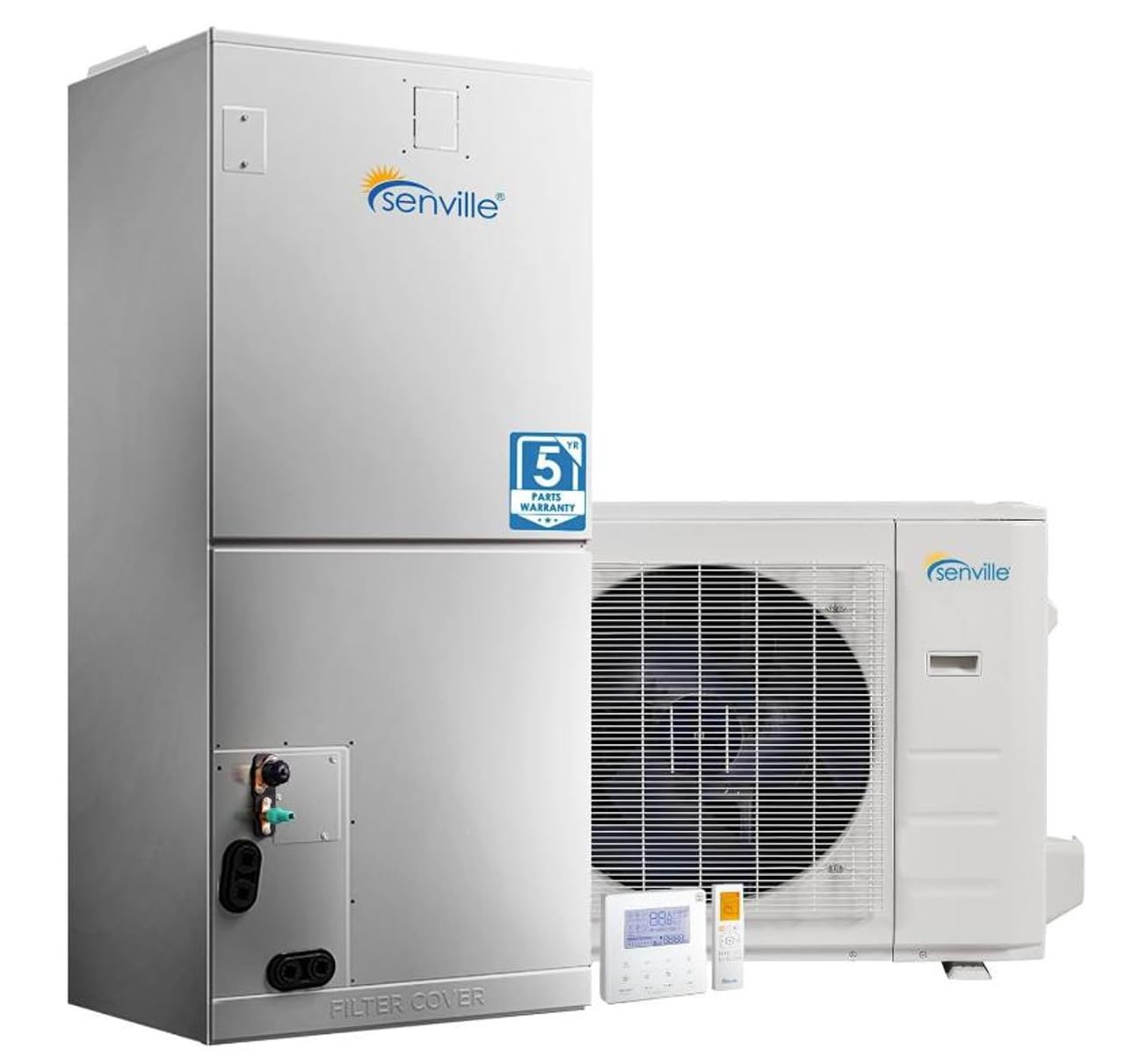
The one system here that keeps you warm too, without a separate furnace.
Buy the Senville if you want one unit to handle both sides of the year. Its variable-speed inverter compressor turns slowly and continuously instead of blasting on and off, which holds a steadier indoor temperature and uses less power at part load. Cooling comes in at 36,000 BTU across up to 2,000 square feet, and the heat-pump side keeps working down to -22F/-30C. That makes it the only true year-round pick of the three, and the one many 1,800 square foot buyers land on when they are replacing an aging furnace-plus-AC combo in one go.
Put it next to the Goodman 3.5 ton above and the tradeoff is clear: you give up a half-ton of capacity and 6,000 BTU to gain heating and inverter control. The system also earns a Cold Climate Energy Star rating and a 16 efficiency figure, with a 10-year warranty on the compressor and a 5-year warranty on parts. The indoor side is a mini-split-style air handler, not the bulky cabinet that sits in a closet, and it needs its own dedicated 15A 208-240V circuit rather than drawing power from the outdoor unit.
Installation is where this one splits opinion. Plenty of buyers rate the build quality highly and call the unit efficient and quiet, and the recurring theme is that a licensed pro should hang it. A professional HVAC installer who reviewed it reported the factory thermostat keeps only about a 5F temperature swing, and the stock piping came in questionable, so plan on swapping the included thermostat for a smart one and adding your own pipe.
The real win: a single 3-ton inverter system that cools 2,000 square feet and heats down to -22F, with a 10-year compressor warranty behind it.
The honest catch: budget for a better thermostat and new piping up front, and hire a pro — the factory controls and stock lines are the weak links owners keep pointing to.
Look here first if: you want heating and cooling from one unit and you are comfortable paying a licensed installer to do it right.
Keep shopping if: you want a simple drop-in AC-only replacement, because this system asks for a dedicated circuit and a thermostat upgrade to run its best.
3. Goodman 3 Ton 14.5 SEER2 Condenser with Multi-positional Air Handler R32 GLXS4BA3610 AMST36CU1300
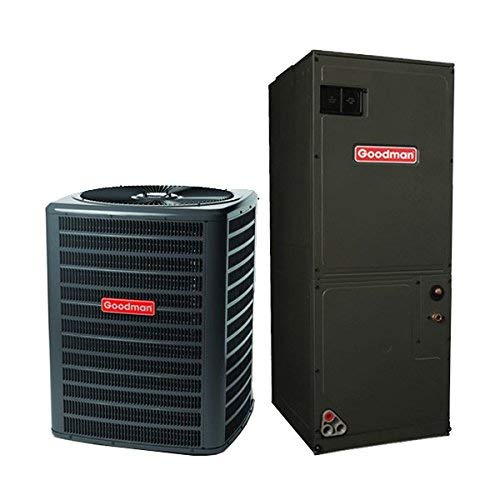
Two matching halves in one box, which is the part of shopping that usually gets messy.
This bundle skips the usual hassle of buying a condenser, then hunting for a matching indoor air handler. Goodman ships the 3-ton 14.5 SEER2 GLXS4BA3610 condenser along with the AMST36CU1300 multi-position air handler, so the two halves are designed for each other from the start. It covers up to 2,100 square feet at 36,000 BTU, which fits a home near 1,800 square feet with room to spare. Compare that 2,100 square foot figure with the Senville above at 2,000, and this is the one that reaches a slightly larger footprint on the same 3-ton cooling rating.
The indoor air handler is the more capable half. It uses R-32 refrigerant with factory-installed thermal expansion valves, corrosion-resistant aluminum construction, and grooved tubing made to move heat better. A direct-drive nine-speed ECM blower motor ramps airflow up and down for steadier comfort, and it can be installed upflow, horizontal right, or horizontal left. A thermostat is included in the box, which is one less part to source. The full package carries a 10-year parts warranty when a qualified installer puts it in and you register it online within 60 days.
Know before you buy: this system cools only, with no heating. It does not provide heat, and adding warmth means a heat kit or a heat-pump system instead. The reviews back the cooling claim loudly. A buyer in south Louisiana calls it oppressive heat and says the unit cools his two-floor home with ease, and another describes it cooling to the right temperature even on the hottest of days while running quietly compared with the banging unit it retired. A caution worth knowing: one long-term owner of a Goodman unit of similar vintage hit a frozen outdoor unit and a leaking indoor coil, and found the refrigerant refill was not covered by the parts warranty.
Why it is the value play: you get the condenser, the air handler, and a thermostat in one purchase, rated 14.5 SEER2 and 36,000 BTU across up to 2,100 square feet.
Read the fine print: it is cooling-only, and the 10-year parts warranty depends on pro installation plus online registration within 60 days — skip it and you lose the coverage.
Reach for this if: you want a matched two-piece system without the parts hunt, and cooling is your only concern.
Look elsewhere if: your winters bite hard, because this one will not warm a single room without an added heat kit.
Understanding the Specs
Tonnage and BTU — the size you buy by
Tonnage is the shorthand for cooling capacity, and one ton equals 12,000 BTU. A 3-ton unit moves 36,000 BTU, while the 3.5-ton Goodman here reaches 42,000 BTU. For a home around 1,800 square feet, a 3-ton system is the target and 3.5 tons adds headroom for hot climates and open layouts. Too small and the system never catches up; too large and it short-cycles before it removes humidity.
SEER2 — the efficiency rating that hits your bill
SEER2 scores how efficiently a unit cools, and higher is better. The Goodman condenser here is rated 14.3 SEER2, while the paired Goodman bundle is rated 14.5 SEER2, and the Senville carries a 16 efficiency figure. Those rated numbers only hold when the outdoor condenser is matched to the right indoor coil or air handler, which is why buying the two halves together saves guesswork.
FAQ
What size air conditioner does an 1800 square foot house need?
Will a 3-ton unit cool a 2000 square foot house?
Is 3.5 tons too big for an 1800 square foot house?
Can I install a central air conditioner myself?
What does SEER2 mean and does a higher rating save money?
Does a condenser come with an indoor unit and thermostat?
What is R-32 refrigerant and can I mix it with an R-410A coil?
How cold can a heat pump keep heating a house?
How long does a central air conditioner last?
Does a central air conditioner need a dedicated circuit?
Final Thoughts: The Verdict
For most homes near this size, the air conditioner for an 1800 sq ft house winner is the Goodman 3.5 Ton 14.3 SEER2 Condenser, because its 42,000 BTU of cooling and rugged outdoor build give you the headroom to flatten the hottest afternoons. If you want one system that heats and cools with inverter control, the Senville 3 Ton Heat Pump is the flexible choice, as long as you plan for a better thermostat and a pro install. And for the cleanest single purchase, the Goodman 3 Ton 14.5 SEER2 Condenser with Air Handler delivers both halves plus a thermostat, with a slightly higher SEER2 rating than the top pick. Run a load calculation, match the tonnage to your climate, and any of these three will cool a 1,800 square foot home through summer.
How We Picked
We do not accept paid placement. Every pick is matched to a real buyer and a real use-case; we do not hands-on test units.
Sources & Methodology
Specifications: manufacturer listings and product documentation. Review insights: verified customer reviews, as of September 2026. Pricing: not shown on this page (it changes often); check the current price via the retailer link.
As an Amazon Associate, KitchPrep earns from qualifying purchases. This does not affect which products we feature.
Related Guides
