
Specs are compiled from manufacturer listings and verified buyer reviews and can change over time — please confirm the key details on the product page before buying.
If you have ever tried to cut a roast into even jerky strips with a kitchen knife, you already know the pain — one end paper-thin, the other end a doorstop, and half an hour gone. The fix is a dedicated slicer that holds the meat steady and repeats the same cut every time. This guide covers the seven machines worth your counter space, from compact electric models built for home kitchens to heavy manual units that chew through a whole deer roast.
I’m Mohammad Maruf — the founder and writer behind KitchPrep. This guide is built by comparing the manufacturers’ published specifications and the patterns across verified customer reviews, so you get each pick’s real strengths and trade-offs instead of marketing spin.
You will see blade sizes, motor watts, and thickness ranges explained in plain language, plus the honest snags owners hit. The crowd favorite — 4.5 stars across 600+ ratings — leads the list below. Every pick here is worth buying, so the real job is matching the machine to the batch size you actually make. The best beef jerky meat slicer is the one that fits your kitchen and your cut, not the biggest box on the shelf.
Our Picks at a Glance


How To Choose The Best Beef Jerky Meat Slicer
Jerky work is different from Sunday sandwich slicing. You are feeding semi-frozen or raw muscle through a machine over and over, and you want every strip the exact same thickness so it dries at the same rate. That single job — repeatability on tough, cold meat — is what separates the picks worth owning from the ones that stall halfway through a roast.
Start with the blade, because it sets your ceiling
A 7.5-inch blade (the round disc that does the cutting) is the common home size, and it handles most roasts once you trim them to fit. A bigger 8.7-inch disc gives you more cutting edge, so wide cuts need less trimming and the machine works through a big piece faster. A manual jerky press takes a totally different route — instead of one spinning disc, it uses a bank of blades that cuts many strips in a single pass.
Motor watts tell you how it behaves on cold meat
The watt rating on an electric slicer describes its electric power draw, and it predicts whether the blade holds speed when it bites into chilled beef. A 200W DC motor (direct current, which runs quieter and steadier than a basic AC motor) is the standard for home units here. A 250W motor is the step up, and it is the one to consider if you regularly slice large, firm cuts.
The thickness dial decides your jerky style
A 0–15mm adjustable range covers everything from paper-thin shaved meat up to thick sandwich cuts. For jerky you typically run the dial near the thin end, then adjust finer until the strips come out the way your dehydrator likes them. On a manual jerky press, thickness is fixed by the blade bank itself — you cannot dial it, so check the strip width the machine is built for before you buy.
Quick Comparison
| Model | Best For | Blade Size | Motor / Operation | Thickness Range | Amazon |
|---|---|---|---|---|---|
| Meat Slicer Machine for Home, 200W Food Slicer (Borlebbi)★ Best Overall | All-round home slicing and jerky prep | 7.5 inches | 200W DC motor | 0–15mm | Amazon |
| FOHERE 200W Meat Slicer, Serrated + Smooth BladesBest Value | Budget-friendly first slicer | 7.5 inches | 200W motor | 0–15mm | Amazon |
| NutriChef Electric Meat Slicer | Deli meat, cheese, and bread | 7.5 inches | 200W motor, 110V | 0–15mm | Amazon |
| FOHERE 250W Electric Meat Slicer Machine for Home | Extra blades, bigger jobs | 7.5 inches | 250W motor | 0–15mm | Amazon |
| OSTBA Meat Slicer, Two 8.7” Blades | Larger cuts and heavier batches | 8.7 inches | 200W DC motor | 0–15mm | Amazon |
| Paladin Equipment 2-in-1 Tenderizer & Jerky Slicer | Manual tenderize plus strip cutting | 2 blade sets | Manual crank | Fixed by blade set | Amazon |
| Weston Manual Beef Jerky Slicer | High-volume jerky strips | 32 blades | Manual crank | .25 inch strips | Amazon |
In‑Depth Reviews
1. Meat Slicer Machine for Home, 200W Food Slicer with Two 7.5″ Blades
Our pick — 4.5★ from 650+ verified ratings; the strongest balance of quality and price.
A quiet 200W home slicer that handles jerky runs and sandwich meat without fuss.
If you make jerky in small-to-medium batches, this Borlebbi machine is the one that keeps showing up as the crowd favorite. A 200W DC motor (direct current, which runs steadier and quieter than a basic motor) gives you stable power without the growl some slicers make. The adjustable thickness dial runs from 0 to 15mm, so you can go shaved-thin for jerky or swing up to thick deli slices for a sandwich.
What makes this one the standout is how well it performs across the board — it works smoothly on both meat and cheese, and owners keep pointing to that flexibility as the reason it earns its counter space. Cleaning is the second thing people bring up, and it holds up: the blades and food tray come off, so you are not scrubbing around a fixed assembly. The review pages put the everyday experience plainly: “Great for making jerky and easy to clean.”
Small details matter here too. Child safety locks and non-slip feet keep the machine planted while you feed meat through, and the blade cover protects your hands during the pass. You get two 7.5-inch stainless steel blades in the box — one serrated and one smooth — plus a stainless steel tray to catch the slices. One honest note on fit: the sliding platform is sized for home portions, so an oversized slab of bacon or a very wide roast may need trimming before it seats properly.
Where it wins
- Two 7.5-inch stainless blades (serrated and smooth) cover raw meat and cooked food without swapping machines.
- The 0–15mm thickness dial lets you dial in thin jerky strips or thick sandwich cuts in one unit.
- Removable blades and tray make cleanup quick enough to do after every batch.
The trade-off
- The sliding platform is compact, so very wide or bulky cuts need trimming to fit the carriage.
- Slice thickness lands in the “mixed” feedback zone — you may need a couple of test cuts to nail jerky-thin.
Pick this if: you want one dependable electric slicer for jerky, deli meat, and cheese at home without a loud motor or a complicated setup.
Pass if: you frequently process very large roasts in single unbroken pieces that need a wide, restaurant-sized platform.
2. FOHERE 200W Meat Slicer 7.5″ Serrated+Smooth Blades & Adjustable Thickness
An entry-level slicer that punches through a jerky roast without emptying your wallet.
For a first jerky slicer, the FOHERE makes a strong case. It runs a 200W motor and comes with two upgraded 304 stainless steel blades (a food-grade steel), one serrated and one smooth, so you can cut cooked and raw meat on separate blades. The idea is to keep raw and cooked food from cross-contaminating. Buyers report the machine handles jerky prep cleanly: “I sliced up a round roast for making jerky with no problem.”
The thickness knob adjusts around 0–15mm, which covers jerky strips all the way up to thick roast slices. The body is die-cast aluminum (molten metal poured into a mold), which helps it resist rust and wipe clean. It also measures 16.33 by 10.63 by 9.84 inches — roughly 12% more footprint than the smaller home model above — so check your counter space before buying.
The honest snag is cleaning and stability. Owners split on how easy it is to break down, and a few note the plastic slide can feel clunky and that narrow items occasionally drop through the gap between the slide and the blade. Durability and motor power also draw some mixed feedback from heavier users. For light home batches, though, it delivers solid slices for the money.
Value in plain terms: you get two quality blades, a stable non-slip base, and a rust-resistant aluminum body for a budget-tier price — the trade is a larger footprint and a cleaning routine that takes a little patience.
Reach for this if: you are testing the jerky-slicer waters and want two separate blades for raw and cooked meat without paying premium prices.
Look elsewhere if: you need a machine that stays easy to clean under heavy weekly use or fits a very small counter.
3. Nutrichef Electric Meat Slicer, 200W with 0-15mm Adjustable Dial

A sealed-case slicer that keeps its cool through deli meat, cheese, and bread.
If your kitchen already does double duty for sandwiches and baking, the NutriChef is built to cover all of it. The 200W motor cuts chilled meat smoothly, and the stainless steel blade holds its edge, while the 0–15mm dial lets you set everything from deli-thin slices to thick bread cuts. A sealed case design is a real plus here — it keeps liquid out of the motor housing, which is exactly where cheaper slicers tend to fail over time.
The convenience factor is what sets this one apart from the slimmer home models. Assembly is simple, the on/off switch sits up front, and the thickness dial is easy to turn, so you are not fighting the machine mid-slice. The blade pops out via the center hub for cleaning, and the whole unit stores neatly thanks to its 13.9 by 9.9 by 10.9-inch footprint. If you have been burned by a slicer that was awkward to set up, this one flips that script.
The catch is counter space and girth. This is a heavier machine that wants a dedicated spot, and some owners note that cleaning the carriage takes real time rather than a quick rinse. Slice consistency also lands in the “mixed” column — fine for home batches, less so if you expect restaurant-grade uniformity every single pass.
Standout strengths
- Sealed case keeps water away from the motor, a real durability advantage over open-frame slicers.
- Front-positioned controls and easy blade removal make it simple to run and clean.
- Handles deli meat, cheese, and bread, so it earns its spot beyond jerky duty.
Where it stumbles
- It is a substantial machine that claims counter or storage space and is not a grab-and-go size.
- Slice consistency draws mixed feedback, so it favors casual home slicing over precision deli work.
Ideal for: a household that slices deli meat, cheese, and homemade bread regularly and wants a sealed, easy-to-run machine.
skip it if: counter space is scarce or you need near-machine-precision identical slices on every batch.
4. FOHERE 250W Electric Meat Slicer Machine for Home
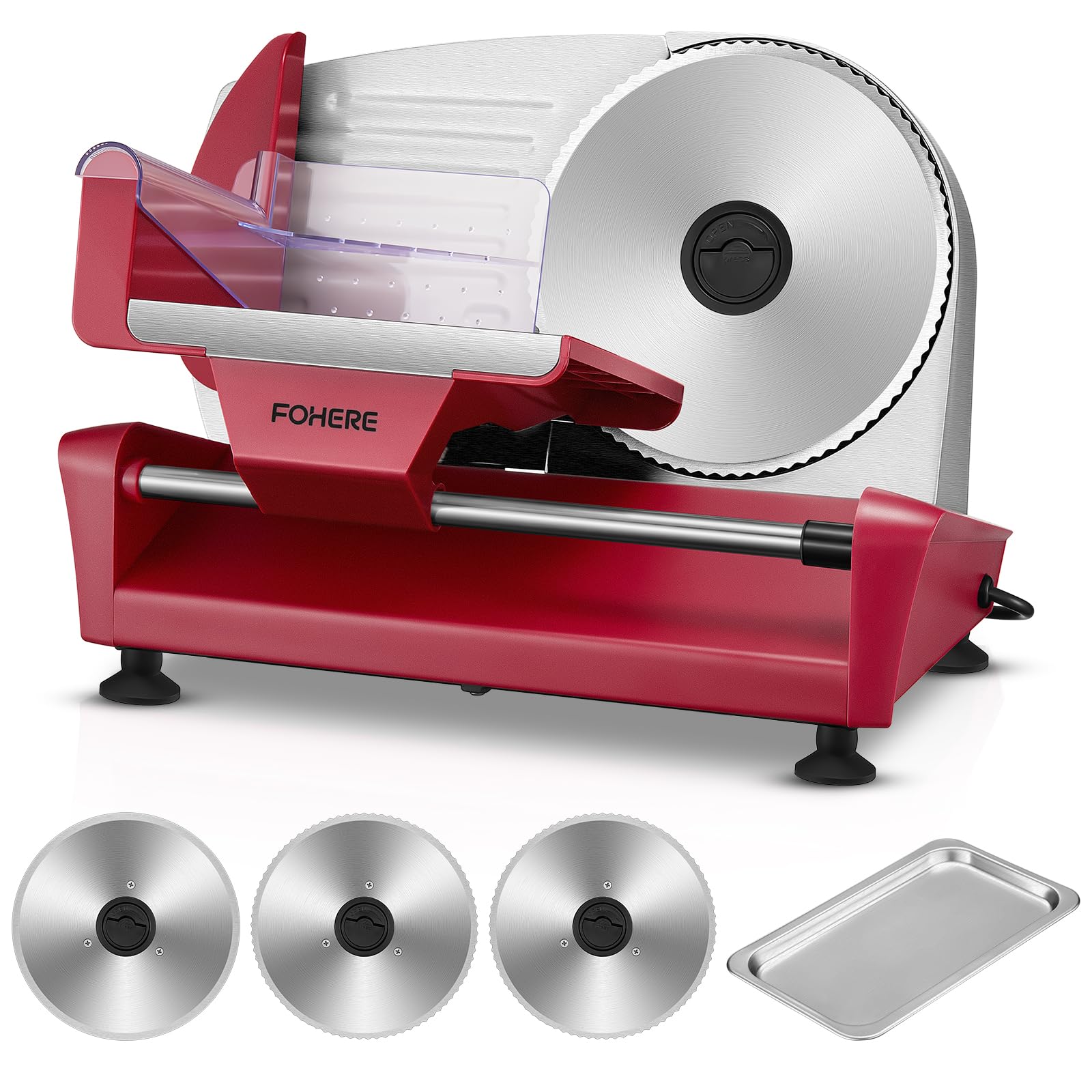
More muscle, more blades: the FOHERE that steps up to bigger cuts.
This red FOHERE is the higher-power sibling in the lineup, running a 250W motor instead of the 200W units around it. That extra wattage shows up when you push through a firm, chilled roast — owners say it powers through deer meat and handles large cuts without stalling. If your jerky batches skew big, that headroom is the reason to look here.
The value story is the blade count. You get three 7.5-inch stainless steel blades in the box — two serrated and one smooth — plus a tray, so you can rotate blades for different foods instead of settling for one. The 0–15mm knob runs the same fine-to-thick range as the rest, and like the other FOHERE model, the body is die-cast aluminum for rust resistance.
The catch is cleaning and build feedback. A few owners find it fiddly to break down fully, noting only the blade and hand slider come off, and some report fragile plastic parts over time. It is also the smallest-batch model on this list in terms of review depth, so treat the durability mixed signals as a “handle gently” note rather than a warning. For slicing sandwich meat and jerky from large cuts, it delivers on power.
What you are paying for: the 250W motor is the highest wattage among the FOHERE home models here, and three blades plus a tray means fewer mid-session swaps — a solid pick if power and blade variety matter more than a spotless cleaning routine.
Great fit for: jerky makers who process large, firm cuts like venison or whole roasts and want the extra motor power and blade options.
Think twice if: you want a machine that disassembles fully for easy cleaning, since only some parts come off.
5. OSTBA Meat Slicer, Two 8.7” Stainless Steel Blades, 200W DC Motor

A bigger 8.7-inch blade that swallows wide roasts and heavy batch work.
When your cuts are wide and your batches are frequent, blade diameter is everything — and the OSTBA leads this list with an 8.7-inch stainless steel disc, the largest here. That extra reach means less trimming before the meat meets the blade and faster work on bulky pieces. It runs a 200W DC motor that keeps the cut steady and quiet, and it comes with both serrated and smooth blades so you can match the blade to the food.
Convenience is where it really separates itself. The removable blade, tray, and pusher are dishwasher safe, so cleanup is genuinely minimal after a jerky run. A food tray catches and organizes the slices, and an assist hand grip gives you better control while feeding meat through. Owners mention it handles jerky, sandwiches, and 30-pound meat runs plus 15 pounds of cheese in one stretch.
The honest catch is the thickness dial. It clicks into set positions but does not lock, so customers note it can creep under heavy pressure on thick cuts. There is also a real durability wrinkle on the pusher — a few buyers found replacements hard to source for this model. Treat both as care notes: keep steady pressure and check the dial stays where you set it.
What earns it a spot
- The 8.7-inch blade is the largest on this list, giving more cutting edge for wide cuts and less prep trimming.
- Dishwasher-safe blade, tray, and pusher make cleanup the least effort of any model here.
- The 200W DC motor stays quiet and steady, and an assist hand grip adds control on long feeds.
What to know going in
- The thickness knob clicks but does not lock, so it can shift under heavy pressure on thick cuts.
- Replacement pushers for this model are reportedly hard to source, so handle the push handle carefully.
Best matched to: frequent jerky makers processing wide roasts in large batches who want the biggest blade and the least cleanup effort.
Not the one if: you need a dial that locks firmly in place, or you value easy access to replacement parts down the road.
6. Paladin Equipment 2-in-1 Manual Meat Tenderizer & Beef Jerky Slicer

A hand-cranked workhorse that tenderizes and cuts strips in one machine.
Not every jerky maker wants electricity. The Paladin is a manual machine that does two jobs — it tenderizes meat to push rubs and seasonings deeper, and it slices strips with a second blade set. Two sets of stainless steel blades handle the work, and it takes any meat up to 0.8 inches thick and 4 inches wide, from beef to chicken to venison. Because there is no motor, it clamps to your counter and runs as long as your arm holds out.
The design is genuinely sturdy for home use. Owners run 20 pounds of venison through it with no rock or sway at the clamps, producing consistent strips once you find the cranking rhythm. That rhythm is the point: many users cut jerky prep time sharply versus chopping by hand, and the steady feed gives you even strips that dehydrate at the same rate.
Be honest about the two trade-offs. Cleaning is the most labor-intensive part — it wants full disassembly and a bottle brush to get into the blade area, so budget real time for it. And a small number of owners hit stripped screws or blades that cut strips thinner than they wanted. The tool rewards care: feed it soft, unfrozen meat and it performs; force it and it will let you know.
Why the manual route: no motor means nothing to stall and it will process any batch size you can crank through, clamped solid to the table — the cost is a meat-feeding rhythm and a genuine cleaning session afterward.
Choose this if: you want one sturdy machine that both tenderizes and slices jerky strips, and you do not mind a hand-crank process.
The caveat: plan on a full disassembly for cleanup each time, and never feed it frozen or bone-in meat — the maker warns it will damage the blades.
7. Weston Manual Support Beef Jerky Slicer, Cuts Up To 5” Wide x 1.25” Thick

One crank, 15 strips: the slicer built purely for jerky volume.
This is the tool for someone who makes jerky by the ten-pound batch. Instead of a single spinning blade, the Weston packs 32 stainless steel blades in a bank that cuts meat into consistent one-quarter-inch strips — up to 15 strips in one pass. It is a completely different approach to the job, and it is why beef jerky fans who process game and big roasts keep coming back to it.
The chute accepts large pieces up to 5 inches wide and 1.25 inches thick, so whole cuts of game, beef, turkey, or duck go straight through without being reduced to fit. It clamps to any flat surface up to 2 inches thick with a built-in C-clamp, and two stainless steel combs feed the meat through to keep it from jamming. Stainless steel tongs come in the box for safe handling. Seasoned jerky makers run 30 pounds through in about 20 minutes, a fraction of the time knife work takes.
The one real frustration is strip thickness. It is fixed at one-quarter-inch, so if you like your jerky thinner, this machine will not give you that, and a few owners wish a thinner blade set were offered. Cleaning is also a project — the blades are razor-sharp and you must disassemble to reach them, so cut-resistant gloves are a smart add. Feed it meat only up to 1.25 inches thick; thicker butcher cuts need to be trimmed first.
Built for jerky people
- 32 stainless steel blades cut consistent quarter-inch strips and up to 15 at once, ideal for large jerky batches.
- The chute takes meat up to 5 inches wide and 1.25 inches thick, so whole game roasts feed straight through.
- Two stainless combs prevent jamming, and stainless tongs handle the meat safely.
What to accept
- Strip thickness is fixed at one-quarter inch, so thinner jerky is not an option on this machine.
- Blades are razor-sharp and require full disassembly to clean — protective gloves are a smart buy.
Made for: serious jerky makers running ten-pound-plus batches who want uniform strips fast and are fine with a fixed thickness.
Wrong tool if: you prefer thin jerky or want a set-and-forget powered slicer over a hands-on crank machine.
Understanding the Specs
Blade Size and Type
The blade diameter sets the ceiling on how wide a piece of meat you can slice in one pass. A 7.5-inch disc is the common home size; an 8.7-inch blade gives more cutting edge for wide cuts. Serrated blades grip through crusty bread and cooked meat, while smooth blades give clean slices on raw meat and cheese. Two blades in the box means you can keep raw and cooked work separate.
Motor Watts and Operation
Wattage predicts how the blade behaves when it bites into cold, firm meat — higher watts hold speed better. A 200W DC motor keeps noise down and runs steady; a 250W motor adds headroom for large cuts. Manual machines skip the motor entirely and trade electricity for crank effort, offering unlimited runtime with no stall point but a slower, hands-on rhythm.
FAQ
What blade size do I need for jerky slicing?
Can an electric slicer cut frozen meat for jerky?
How thin can I slice jerky with an adjustable dial?
Is a manual jerky slicer better than an electric one?
How much meat can these slicers process at once?
Are the blades removable for cleaning?
What wattage should a home meat slicer have?
How do I keep my fingers safe around a jerky slicer?
Will these slicers handle cheese and vegetables too?
Final Thoughts: The Verdict
For most people, the winner in this lineup of beef jerky meat slicer options is the Meat Slicer Machine for Home, 200W Food Slicer because it balances two 7.5-inch stainless blades, a quiet 200W DC motor, and a removable design that makes cleanup easy — and it holds the highest rating here at 4.5 stars across 600+ buyers. If you process wide roasts and want the biggest blade and dishwasher-safe parts, the OSTBA Meat Slicer is the one to reach for. And for the jerky purist running ten-pound batches who wants uniform quarter-inch strips in a single crank, the Weston Manual Beef Jerky Slicer earns its place as the specialist pick.
How We Picked
We do not accept paid placement. Every pick is matched to a real buyer and a real use-case; we do not hands-on test units.
Sources & Methodology
Specifications: manufacturer listings and product documentation. Review insights: verified customer reviews, as of September 2026. Pricing: not shown on this page (it changes often); check the current price via the retailer link.
As an Amazon Associate, KitchPrep earns from qualifying purchases. This does not affect which products we feature.
Related Guides
