
Specs are compiled from manufacturer listings and verified buyer reviews and can change over time — please confirm the key details on the product page before buying.
If you want a small square fan that cools a bedroom, a desk, or a windowsill without sounding like a jet engine, two models do it better than the rest. One runs all night on batteries when the power dies — the other runs off a USB-C cord and tells you exactly when to switch it off. Here is how to pick between them in about two minutes.
I’m Mohammad Maruf — the founder and writer behind KitchPrep. This guide is built by comparing the manufacturers’ published specifications and the patterns across verified customer reviews, so you get each pick’s real strengths and trade-offs instead of marketing spin.
Both fans here move serious air for their size, but they solve different problems — one is built for quiet, timer-controlled everyday cooling, the other for cordless backup when the outlet goes dead. Read on for the full best 10-inch box fan breakdown.
Quick Picks
- JUMXION 10 inch Box Fan with 3 Speeds — Best Overall
- Treva 10 in Portable Fan, Battery or AC Powered — Best for Backup Power
How To Choose The Best 10-Inch Box Fan
A 10-inch box fan fits where a full-size fan won’t — on a windowsill or a desk corner — yet still moves real air. Four things decide which one you should buy: how loud it runs, how it gets power, how much air it pushes, and whether it has a timer.
Noise level in decibels
Noise is measured in decibels (dB) — the lower the number, the quieter the fan. A fan rated below 40dB is roughly the sound of a quiet library, which is why that figure matters most for bedroom use. If you sleep with a fan inches from your head, chase the dB number, not the blade size.
Power source: cord or batteries
A DC adapter fan (a fan that plugs into a wall adapter, often via USB-C) runs cheapest and never needs batteries. A battery fan takes D cells — big cylindrical batteries — and runs cordless, which is the difference between cooling your tent and cooling nothing when the power goes out.
Airflow and blade count
Blade count and motor design drive how much air actually reaches you. A 5-blade fan with a brushless motor (a motor with no carbon brushes to wear down) tends to push steadier airflow than a cheap 3-blade unit. Don’t assume a bigger fan moves more air — a well-built 10-inch fan can beat a flimsy 24-inch one.
Timer and speed settings
A timer function lets the fan shut itself off after a set number of hours — 2, 4, 6, or 8 on some models — so you don’t wake up to run it down manually. Three speed settings give you finer control than two, especially if you want a gentle breeze at night and full blast during the day.
Quick Comparison
| Model | Best For | Speeds | Power Source | Noise Level | Amazon |
|---|---|---|---|---|---|
| JUMXION 10 inch Box Fan | Bedrooms and desks where you want timer control and USB-C power | 3 (low, medium, high) | DC adapter / USB-C cord | Below 40dB (max) | Amazon |
| Treva 10 in Portable Fan | Camping, RVs, and power outages where cordless backup matters | 2 (high, low) | 6 D batteries or AC adapter | — | Amazon |
In‑Depth Reviews
1. JUMXION 10 inch Box Fan with 3 Speeds, 8HRS Timer, and USB-C Power
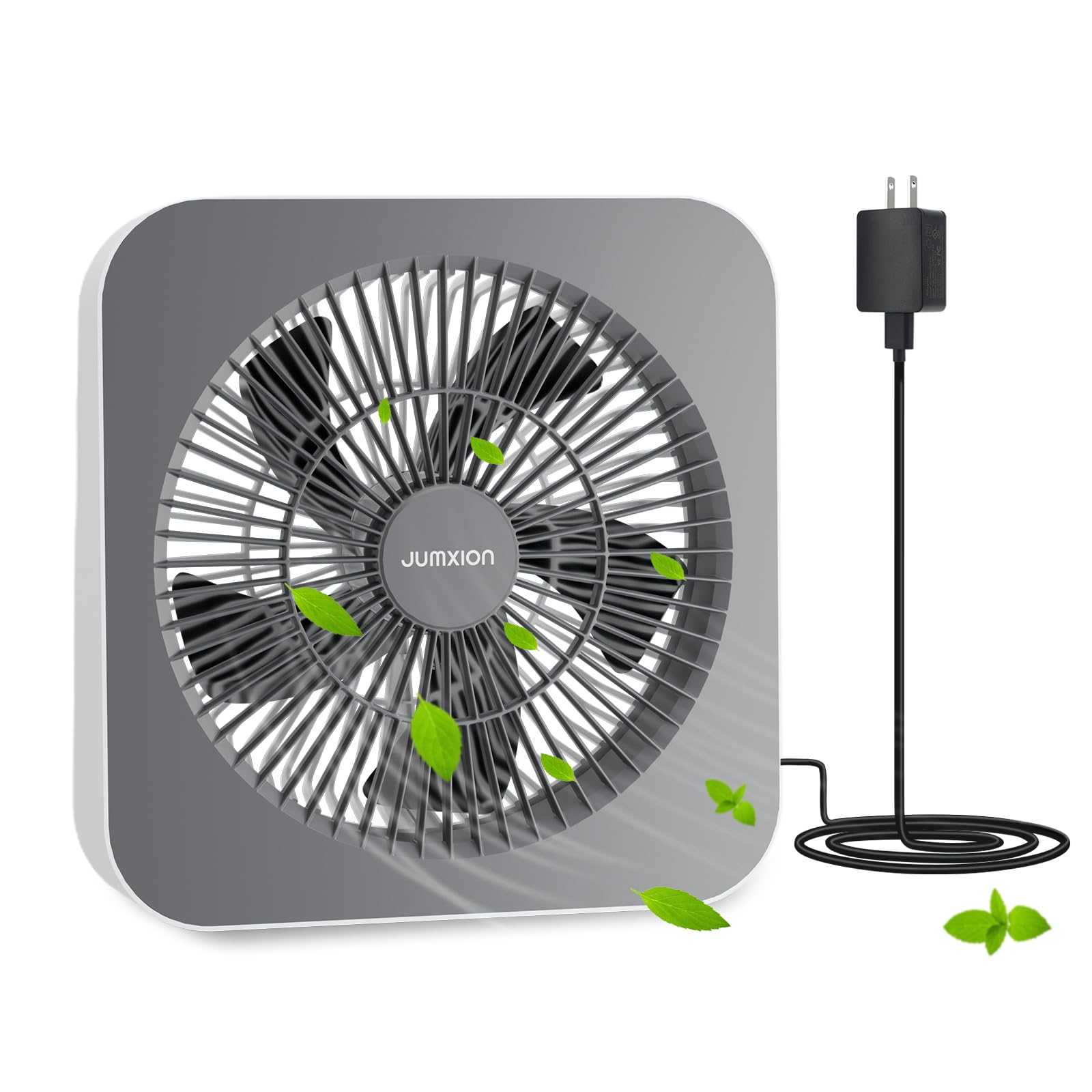
The corded timer fan that slips onto a windowsill and pulls in cool night air
This is the pick for anyone who sleeps hot and wants the fan to switch itself off. It runs on a DC adapter (a wall plug that steps household power down to a safe 5V) or a 4.9ft USB-C cord, so you can power it from a wall outlet, a laptop, or an RV socket. Noise stays below 40dB at its loudest — about the level of a quiet conversation — which is why it earns its place next to a bed. It weighs just 2 pounds, so moving it from the bedroom to the kitchen takes one hand.
What wins people over is how much air this small fan moves. It measures 10.9 inches tall, 10.6 inches wide, and 3.1 inches deep, yet buyers report it out-moves far bigger fans: “Don’t let this smaller 10″ inch fan fool you, it pushes more air than a cheaper 24″ box fan.” The 5-blade design paired with a brushless motor (a motor with no carbon brushes, so it runs smoother and lasts longer) keeps that airflow steady instead of choppy. The low setting is the one owners reach for at night, because the higher speeds are the only time you notice it’s there. The three speed settings — low, medium, high — cover a gentle breeze up to full circulation, and the 2, 4, 6, and 8-hour timer means you can fall asleep without leaving it running all night.
The honest trade-off is durability, which is the one thing reviewers treat with caution. Fan quality and airflow draw the most praise, but a few longer-term owners mention units giving out after a couple of months. The anti-slip base — two silicone pads under a wider footprint — is what keeps it planted on a smooth desk. It also isn’t a travel fan: at 2 pounds with no handle, one buyer called it “too heavy to use as a travel fan” and sent it back. Expect it to live in one room rather than ride in a bag.
Where it wins
- Below 40dB at maximum — quiet enough for a bedside table
- 2, 4, 6, and 8-hour timer settings so it shuts off on its own
- Runs on a DC adapter or any USB-C cord, keeping running costs low
- 2 pounds and a 3.1-inch slim depth that fits window ledges and corners
What to weigh up
- Durability is the recurring gripe — a handful of units failed after about two months
- Too heavy and handle-free to double as a travel fan
- No battery option, so it needs an outlet or USB source to run
Bedside bargain: Buy this if you want timer control, USB-C flexibility, and the quietest airflow for a bedroom, office, or kitchen corner.
Think twice if: You need cordless cooling in a tent or an RV — the JUMXION has no battery bay, so you’ll want the Treva below instead.
2. Treva 10 in Portable Fan, Battery or AC Powered, 2-Speed Desk Fan

The cordless workhorse that keeps blowing when the power cuts out
Two power sources are the whole story here. Slot six D batteries (the large flashlight-size cells) into the bay and the Treva runs on its own; plug in the included adapter (it handles 120-240 VAC, 50-60 Hz — standard household AC power worldwide) and the batteries disconnect from the circuit automatically so you’re not draining them while it’s plugged in. That dual setup makes it the obvious choice for a camper, a tent, a dorm during a storm, or any room where the outlet is behind the couch.
Runtime is where it separates from the JUMXION above. Where the JUMXION has no battery bay at all, this one delivers cordless hours that owners actually count — a rechargeable D-cell setup on low ran 19.5 hours in an RV, and a straight battery run on high managed about 9 hours. Customers note “Treva battery fan in RV with rechargeable Li-ion 1.5V D batteries on low ran 19.5 hrs.” The 10-inch blade is paired with a high and low speed only, but both stay quiet: the fan’s reliability is what owners rave about most, followed by how little noise it makes even on the stronger setting. At roughly a foot wide with a built-in handle, it’s light enough to carry room to room by one finger.
The catch worth knowing is packaging and QC on newer stock — some units arrive with cracked blade guards or a dead high setting because the boxes ship flimsy, and it’s the recurring note on recent orders. The fan itself, once you get a good one, is durable and simple: two speeds, a powder-coated finish, and no app or buttons to fuss over. One thing to plan for: the two-speed design is deliberately not industrial-strength, so if you want fine-grained control from a whisper to a gale, the three-speed JUMXION gives you one more dial to work with.
Built to travel: A patented blade design stretches battery life while maximizing airflow, and the 12.00″ x 3.80″ x 12.90″ body with its built-in handle makes it easy to carry from desk to tent to RV.
One caution up front: Order from a seller with easy returns and inspect the blade guard on arrival — flimsy packaging has left some buyers with a damaged unit.
Best for off-grid: Reach for the Treva if you camp, boondock, RV, or want a fan that survives a blackout on D cells.
skip it if: You only ever plug in and want a timer and a third speed setting — the JUMXION covers that better.
Understanding the Specs
Decibels (dB) and Noise Level
A decibel is a unit for measuring how loud a sound is, and fan listings quote a maximum dB figure — the noise it makes at its highest setting. Lower is better. A fan rated below 40dB (max) is quiet enough to sleep beside, while a fan that climbs higher will start to intrude on conversation or TV. If your fan sits on a nightstand two feet from your ear, treat the dB rating as the single most important number on the box.
Power Source and Running Cost
A DC adapter fan converts household AC power down to a low DC voltage — often 5V — which is why these units are cheap to run and can be fed by a USB-C cord. A battery fan takes D cells (large cylindrical cells, usually six of them) and runs cordless, but each fresh set costs money and the fan dies when they do. Many battery fans also accept an AC adapter and switch themselves off the battery circuit when plugged in, so you get both worlds.
Timer Function
A timer lets the fan shut off after a set number of hours — 2, 4, 6, or 8 on models that offer it. This matters two ways: you don’t have to get up to switch it off once you’re drowsy, and the fan isn’t burning power while you sleep past the point you needed it. If you use a fan every night, the timer is the feature you’ll appreciate most after quiet operation.
Airflow, Blade Count, and Motor Type
Airflow is how much moving air the fan delivers, and a 10-inch box fan can surprise you. Blade count and motor design both matter — a 5-blade fan driven by a brushless motor (a motor with no carbon brushes to wear down) tends to hold steadier airflow than a basic 3-blade setup. Don’t judge airflow by fan size alone; a well-built small fan can move more air than a cheap oversized one.
FAQ
Will a 10-inch box fan actually cool a whole room?
How loud is a 10-inch box fan at night?
Can I run a 10-inch box fan on USB power?
How long does a battery-powered box fan run on D cells?
What is the difference between a DC adapter fan and a battery fan?
Does a timer function save electricity?
Will a 10-inch fan really move more air than a bigger 24-inch box fan?
How do I keep a small box fan from sliding on a smooth desk?
Are box fans safe to run all night?
Can a 10-inch box fan fit on a windowsill or in an RV window?
Final Thoughts: The Verdict
For most people, the 10-inch box fan winner is the JUMXION 10 inch Box Fan because it pairs a whisper-quiet sub-40dB build (under 40 decibels, about as loud as a quiet library) with an 8-hour timer and USB-C flexibility — and it costs less than the Treva while still moving more air than fans twice its size. If your priority is cordless, off-grid cooling that runs for hours on D cells, grab the Treva 10 in Portable Fan. And if you just want the cheapest way to push cool night air through a window, the JUMXION is the one to reach for first.
How We Picked
We do not accept paid placement. Every pick is matched to a real buyer and a real use-case; we do not hands-on test units.
Sources & Methodology
Specifications: manufacturer listings and product documentation. Review insights: verified customer reviews, as of September 2026. Pricing: not shown on this page (it changes often); check the current price via the retailer link.
As an Amazon Associate, KitchPrep earns from qualifying purchases. This does not affect which products we feature.
Related Guides
