
Specs are compiled from manufacturer listings and verified buyer reviews and can change over time — please confirm the key details on the product page before buying.
If you want one straight answer before reading anything else: the BOZYBO Weather Station is the pick most people should start with. It does the three things that actually matter — it runs on batteries so you can park it anywhere, it shows your indoor and outdoor temperature and humidity on a big screen, and it sets its own clock. Everything past that is a question of how much weather you genuinely want to track. A rain gauge matters if you garden. Wind speed matters if you are on open land or near water. Wi-Fi matters if you want to check conditions from your phone while you are at work. This guide sorts nine battery-powered stations by what they really do well, so you can match one to your house instead of guessing.
I’m Mohammad Maruf — the founder and writer behind KitchPrep. This guide is built by comparing the manufacturers’ published specifications and the patterns across verified customer reviews, so you get each pick’s real strengths and trade-offs instead of marketing spin.
Each model here earns its place for a different reason, from a simple bedroom clock to a full backyard weather rig. Here is the honest rundown so you can pick the best battery powered weather station for your own wall in one sitting.
Our Picks at a Glance
How To Choose The Best Battery Powered Weather Station
The first thing to settle is what you are actually trying to learn. A station that only reads temperature and humidity tells you how warm and damp it is. A station with a rain gauge tells you how much water fell on your garden. A station with a wind vane and anemometer tells you how hard the wind is blowing and from which direction. Those are three different jobs, and most buyers only need one or two of them.
Battery power is your placement freedom
Battery power is not about saving electricity — it is about where you can place the display and sensor. A mains-powered console has to sit near an outlet, which usually means a kitchen counter or a hallway. A battery unit can go on a shelf, a windowsill, or a wall where you actually look. The catch is that most color displays only stay lit continuously when they are plugged in; on batteries the screen typically sleeps until you tap it. Decide which you want before you buy.
Transmission range and what blocks it
The outdoor sensor talks to the indoor display over radio or Wi-Fi. Range figures like 328 feet describe an open-air line of sight, not a wall. Brick, metal siding, and a metal roof all cut that number down hard, so mount the sensor on the side of the house facing the display. If you plan to put the sensor out at the back of a large lot, a station that reports a longer transmission distance is the safer pick.
Which sensors you actually need
Temperature and humidity come standard on every station here. Rainfall needs a tipping-bucket or see-saw gauge, which adds a moving part that can jam or wear. Wind needs an anemometer for speed and a vane for direction, and those only read well if the sensor is mounted high and clear of obstructions. Buy only the sensors you will genuinely check, because every extra moving part is another thing to maintain.
Quick Comparison
| Model | Best For | Outdoor Sensors | Display Size | Connectivity | Amazon |
|---|---|---|---|---|---|
| BOZYBO Weather Station Wireless Indoor Outdoor Thermometer Atomic Clock★ Best Overall | Whole-home basics on a budget | 1 included (up to 3 channels) | 5″W x 4″H LCD | Wireless 433/868 MHz | Amazon |
| Weather Station with Rain Gauge (Asenron 5065-3S)Budget Rain Gauge | Backyard rainfall tracking | 1 temp/humidity + rain gauge | 7.5″ LCD | Wireless (no Wi-Fi) | Amazon |
| Newentor Weather Stations with 3-Sensors MonitorThree-Sensor Coverage | Multi-room coverage | 3 included | 7.5″ VA | RF 433 MHz | Amazon |
| SQECH Weather Stations with 7-in-1 Outdoor Sensor | Serious backyard weather tracking | 1 (7-in-1 all-in-one) | 7.4″ HD color | Wireless, 328 ft | Amazon |
| VEVOR YT60234 WiFi Weather Station 7-in-1 | Phone monitoring on a budget | 1 (7-in-1 all-in-one) | 7.5″ LCD | Wi-Fi 2.4 GHz, 150 m | Amazon |
| Sainlogic Smart WiFi Weather Station (Weatherseed AI) | Beginner-friendly Wi-Fi with alerts | 1 outdoor sensor | 6.7″W x 5.2″H LCD | Wi-Fi 2.4 GHz + app | Amazon |
| Govanli 12-in-1 Wireless Weather Station | Large property, no Wi-Fi needed | 1 (12-in-1 all-in-one) | 6.5″ HD color | Wireless, 100 m | Amazon |
| AcuRite Iris (01122M) Weather Station with Wireless Mini Display | Camping, RV, and on-the-go | 1 outdoor sensor | 5.4″W x 5″H monochrome LCD | 433 MHz | Amazon |
| Sainlogic 14-in-1 WiFi Smart Weather Station | Full-feature data logging | 1 (7-in-1 all-in-one) | 8.5″ LCD | Wi-Fi 2.4 GHz, Bluetooth, RF | Amazon |
In‑Depth Reviews
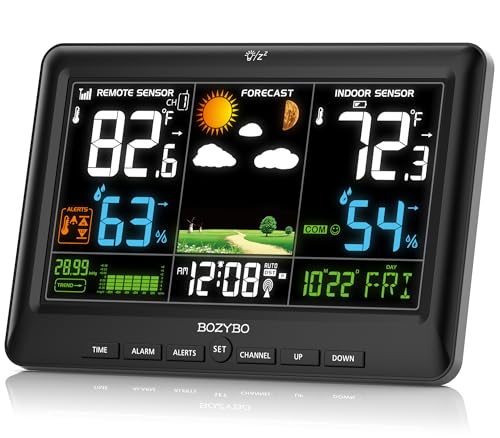
1. BOZYBO Weather Station Wireless Indoor Outdoor Thermometer Atomic Clock
Our pick — over 4★ from 100+ verified ratings; the strongest balance of quality and price.
The screen you can actually read from the couch, without paying for sensors you will never use.
This is the station for the person who wants to glance up and know whether to grab a jacket. It reads indoor and outdoor temperature and humidity on a high-contrast LCD, and the whole unit weighs 8 ounces, so it sits on a shelf without you worrying about it. It runs on batteries for flexible placement, or you can use the included power adapter for continuous operation — that is the real choice here, because on battery power the display sleeps until you tap it, while plugged in it stays lit.
What wins people over is how well the core job is done. Owners describe setup as quick and intuitive, with one summing it up simply: “Wow just was I was looking for.” The reading is legible from across a room and beyond — one long-time user reports it is readable from more than 7 feet away. It also held its settings through a power outage, which matters if you have ever had to re-enter everything after a storm knocked the lights out.
The honest trade-offs are worth knowing up front. The atomic clock sync is not instant — one buyer notes it takes about 24 hours to lock on, and at least one owner in a far-off region could never get the WWVB signal to catch at all, which is a location issue rather than a defect. Screen size also splits opinion: most find it good-sized, but a few wish it were bigger. And it takes 5 AA batteries, which are not included. Compared with the Asenron rain-gauge station below, you are trading the rain gauge for a cleaner, more reliable core — and the BOZYBO is the stronger of the two by a wide margin on owner satisfaction.
What buyers keep coming back to
- Everyday function is the headline — owners praise how consistently it just works
- Bright, dimmable display that is easy to read from across the room and can be turned down for night
- Accurate temperature and humidity that match other household sources
- Battery backup keeps your settings through a power cut
- Monitors up to 3 locations with additional wireless sensors
Where it asks patience
- Screen goes dark on battery power until tapped; stays lit only when plugged in
- Atomic clock can take about a day to synchronize, and some locations never receive the WWVB signal
- Display size draws mixed feelings — fine for most, small for a few
- Requires 5 AA batteries, not included
Reach for this if: you want dependable indoor and outdoor temperature and humidity plus automatic time, without paying for a rain gauge or wind sensor you will never check.
Look elsewhere if: you specifically need rainfall tracking or a station that stays lit all night on batteries alone.
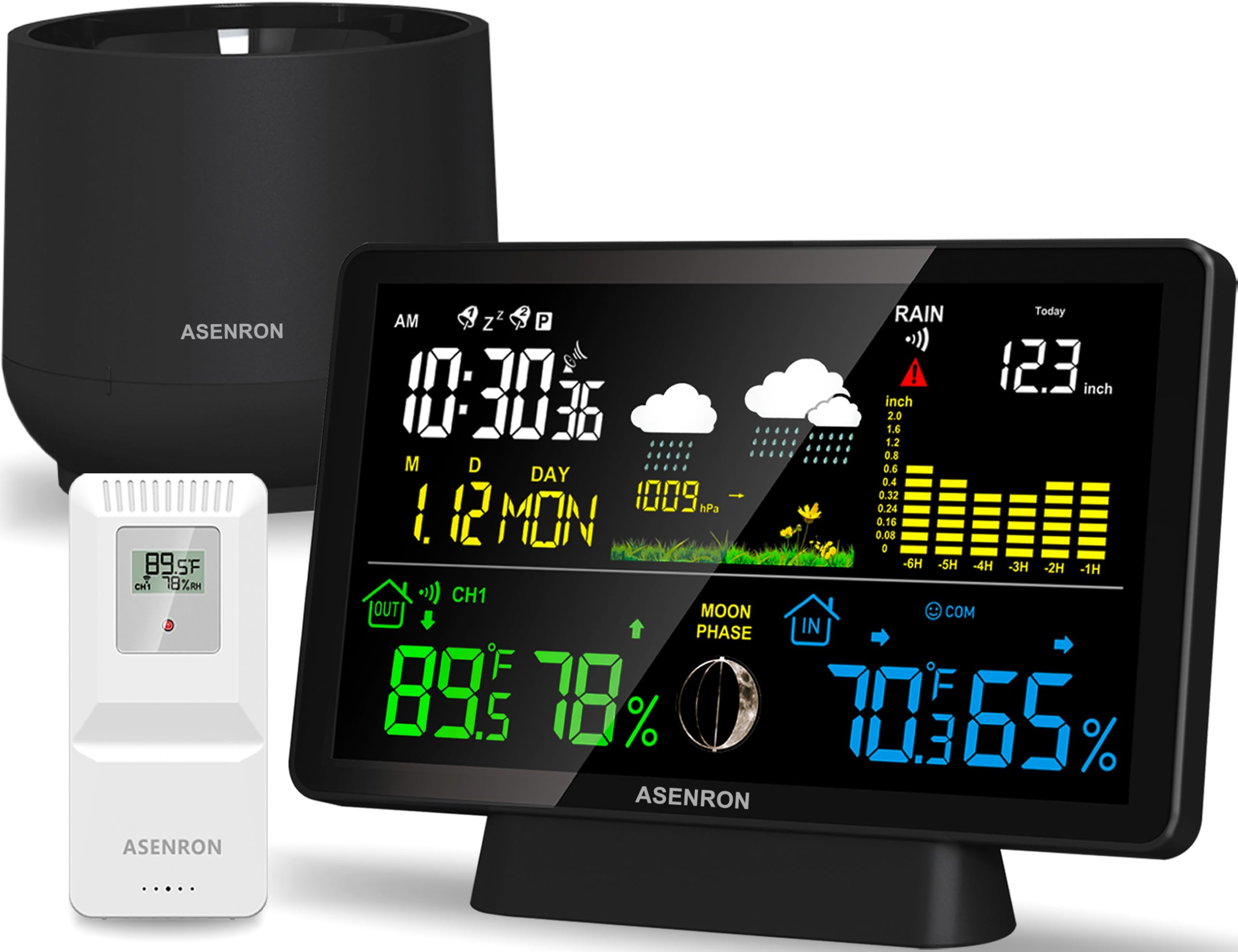
2. Weather Station with Rain Gauge, Home Weather Stations Wireless Indoor Outdoor with Rain Gauge, Thermometer, Barometric Pressure, Humidity Monitor, Atomic Clock, Digital Weather Forecast and Alerts
A three-piece kit that promises a lot and delivers unevenly — read the rain gauge details closely.
On paper this is the value story of the group: a 7.5-inch color LCD, a self-emptying wireless rain gauge, indoor and outdoor temperature and humidity, barometric pressure history, moon phase, and a dual alarm clock with snooze. It also covers up to 3 remote channels, so you could monitor a wine cellar and a vegetable shed alongside your patio — though the package includes just one sensor. When you connect the power adapter, the backlight adjusts across three brightness levels.
The setup story is genuinely good. Owners get it running in about five minutes, and the general impression on arrival is warm — “It works great and looks good also,” as one buyer put it, adding that it was “a very good price for a unit that gives that much information.” The display is bright and vivid, and its wide viewing angles mean elderly family members can read it without leaning in.
Here is the catch, and it is the one that decides this purchase: the rain gauge is the weak link. Multiple owners could not get it to measure at all, and the failure shows up in more than one way — one reports it only reads when it isn’t raining, cutting out the moment the sensor gets wet. Another had the rain gauge break after a few months, and a third unit went dark entirely not long after. Rain sensors dying around the one-year mark recurs often enough in the feedback to be a real pattern, so buy this for the temperature, humidity, and pressure display and treat rainfall as a bonus that may not last. If rainfall is your whole reason for buying, spend more on a station with a better-supported gauge instead.
What works well: Fast five-minute setup, a bright 7.5-inch color screen with wide viewing angles, three backlight levels when plugged in, and a full slate of readings including barometric pressure history, moon phase, and a dual alarm.
The rain-gauge risk: Owners repeatedly could not get rainfall to register, and several saw the gauge fail within the first year — plan on the temperature and pressure display being the dependable part.
Best for: budget shoppers who mainly want a big, colorful indoor/outdoor thermometer with pressure readings, and who will not be heartbroken if rainfall tracking proves unreliable.
Skip if: accurate rainfall totals are the reason you are shopping — this gauge will frustrate you.
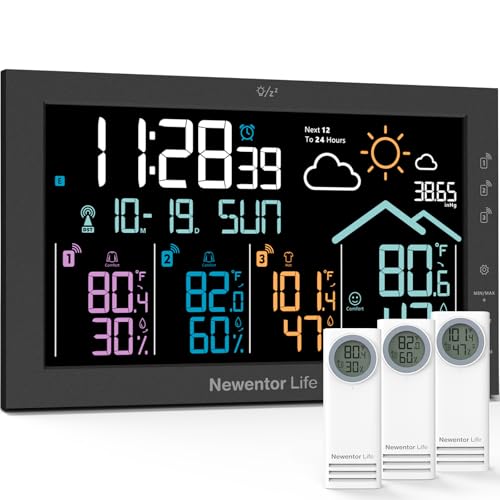
3. Newentor Weather Stations Wireless Indoor Outdoor with 3-Sensors Monitor
Three sensors in the box, which is the whole reason this one lands where it does.
Most stations here ship with a single outdoor sensor. This one includes three, and each has a 328-foot wireless connection range — enough to cover a house, a garden, and a patio at the same time. The 7.5-inch VA display is built for wide angles, with a 170-degree view and large digits that suit older eyes. It runs on an included AC adapter or on 3 AA batteries for the console, while each outdoor sensor takes 2 AA batteries.
Where it pulls ahead is the sensor hardware itself. The outdoor units use a design with up to 9 times the standard number of ventilation holes, which the maker says makes them respond faster to temperature and humidity shifts than an ordinary outdoor thermometer. Owners back up the accuracy — three sensors placed on different sides of a property agree closely with each other and give a fairer average of the local climate than one sensor ever could. That is why this pick suits somebody with a crawlspace, a camper, or a shed who wants eyes in more than one place at once.
The wrinkle is durability, and it is the same theme that runs through the multi-sensor budget tier. While most units hum along fine, the feedback includes more than one report of a station dying within months of arriving and taking its sensors down with it, and one owner found a sensor stopped reporting below -10 degrees until it was moved to a protected spot. The three-sensor convenience is real; just budget for the possibility that you are buying a two-or-three-season unit rather than a decade-long one. Compared with the single-sensor BOZYBO above, you gain coverage and lose a little on the long-haul reliability front.
Why three sensors change the game
- Includes 3 outdoor sensors, each with a 328 ft wireless range — monitor several locations at once
- 7.5″ VA display with a 170° wide-view angle and large digits built for easy reading
- Runs on the included AC adapter or 3 AA batteries for the console
- Sensors track closely together, so the readings you see are a fair average, not one spot
- Atomic clock syncs time and date automatically over WWVB
What to watch
- Some units stop working within the first few months — a recurring theme in this tier
- An outdoor sensor can stall in severe cold until relocated to a sheltered spot
- Batteries for the sensors and console are sold separately
Pick this when: you have more than one place worth watching — an under-house crawlspace, a camper, a shed, a garden — and want all three readings on a single wide-angle screen.
Think twice if: you want one station that will still be running in five years; this tier trades longevity for sensor count.
4. SQECH Weather Stations Wireless Indoor Outdoor with 7-in-1 Outdoor Sensor

One outdoor unit that reads the whole sky, and it manages a 200-foot run to the back field.
The defining feature here is a 7-in-1 outdoor sensor that bundles a rain gauge, wind vane, anemometer, solar panel, temperature and humidity sensor, and transmitter into a single housing. That means wind speed and direction, rainfall, temperature, and humidity all arrive from one mast-mounted unit, needing only a bracket and some AA or AAA batteries you supply. The 7.4-inch HD color screen displays 12 types of information at once and offers 13 alarm settings, so you can flag the conditions you personally care about.
The headline number that sells this pick is transmission distance. The spec says the sensor reaches up to 328 feet to the console, and real-world use backs the range up — one owner mounted it in the open field about 200 feet behind the house and had zero reception trouble. Setting it up is a matter of mounting the multi-function rod on a wall, roof, or mast, and the console links automatically on power-up. The dustproof and waterproof sensor is built to sit out in the weather year-round.
Two things temper the enthusiasm. First, moving parts wear out — one owner who bought three reports the outdoor unit lasts about a year in the elements, and the rain gauge gets called out specifically as a failure point. Second, the console wants AC power, which owners say limits where you can put the display; you lose the placement freedom you get with an all-battery unit. If you want the full backyard kit but need it to keep working past one season, this is the trade you are accepting.
What it gets right: A single 7-in-1 sensor covers wind speed and direction, rain, temperature, and humidity, and the 328 ft range holds up even 200 feet from the house with a clear line of sight.
Where it falls short: The console needs AC power to run, so the display is tethered to an outlet, and the outdoor unit’s moving parts tend to wear within about a year of exposure.
One for the backyard weather watcher: if you want wind, rain, and temperature from a single rooftop or mast-mounted unit and have a spot near an outlet for the screen.
Not for you if: the display must be fully battery-powered and portable, or if you expect the outdoor sensor to last many seasons of weather.
5. VEVOR YT60234 WiFi Weather Station 7-in-1 Weather Stations Indoor Outdoor

The cheapest way here to watch your own backyard from your phone — if it keeps running.
This is a 7-in-1 station with wind speed, wind direction, temperature, humidity, rainfall, and light monitoring, all delivered over a Wi-Fi connection that hooks into Weather Underground and WeatherCloud so you can pull the numbers up on a smartphone. The 7.5-inch LCD has a 4-level dimming function that drops from full brightness to off, and the time syncs over the internet rather than a radio signal. An IPX6 waterproof sensor with a 150-meter transmission range means the outdoor unit can sit well away from the house.
The value case is strong and well-documented. Getting the feed live on Weather Underground generally takes under an hour, and the display layout — temperature, humidity, wind speed and direction, rainfall, UV, and barometric pressure — reads cleanly. Range to the base station is called excellent in practice, and the whole package undercuts the pricier stations here substantially. As one buyer reports: “great station, had issues but the manufacturer made it right.” The outdoor sensor is solar-powered with rechargeable Ni-MH batteries, so you are not swapping cells constantly.
Reliability is the caveat you accept at this tier. Some units run for years; others stop reporting entirely after the warranty window closes, which is exactly when it stings most. One owner had the solar charging system fail after the first year and could never resurrect the outdoor readings. There is also a small but real note worth checking for your own setup: the station’s radio frequency interfered with First Alert wireless-interconnect smoke detectors in one home, so if you rely on those, keep the units apart. No spare parts are sold for the sensor, so a failure usually means buying a whole new kit.
The value argument
- Wi-Fi reporting to Weather Underground and WeatherCloud, typically live in under an hour
- 7-in-1 sensor tracks wind speed and direction, rain, temperature, humidity, and light
- IPX6 waterproof rating and a 150 m transmission range for flexible sensor placement
- Solar-powered sensor with rechargeable Ni-MH batteries cuts routine battery changes
- 4-level dimming on a 7.5″ display with internet-synced time
What to weigh
- Some units fail around the end of the warranty period, often the sensor or solar charging side
- No spare parts sold separately — a sensor failure usually means a full replacement kit
- The radio frequency interfered with First Alert wireless smoke detectors in one user’s home
- Requires the power adapter to stay plugged in for Wi-Fi and time sync
Right pick for: a weather hobbyist who wants phone access, Weather Underground reporting, and a full 7-in-1 sensor array without paying premium-tier prices.
Reconsider if: you need a station you can count on for a decade, or you rely on First Alert smoke detectors that might sit near the sensor.
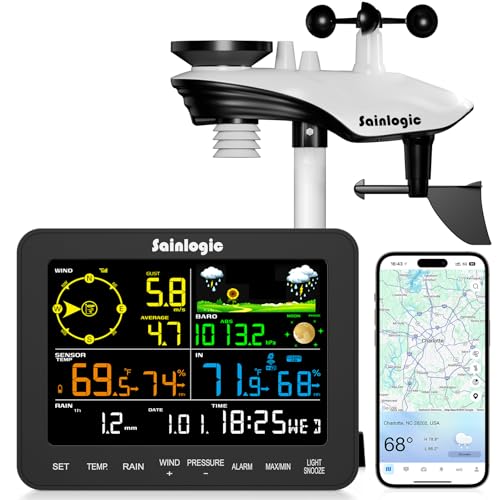
6. Sainlogic Smart WiFi Weather Station with Rain Gauge and Wind Speed, 24/7 AI Weather Forecast by Weatherseed®
Built for the person who gave up squinting at a tiny screen and wants their phone to do the watching.
What sets this station apart is the software. Connect it to a 2.4 GHz Wi-Fi network and the Weatherseed app takes over, delivering AI-driven 24/7 forecasting and pushing a notification to your phone the moment temperature, humidity, or barometric pressure shifts. It also stores a full 24 months of weather records and lets you download any 30-day window as an Excel file for charting — a feature that turns this from a display into a data tool. The rain monitor is rated to ±1mm accuracy for rainfall under 15mm and ±7% across the full 15–9999mm range.
The hardware leans hard into readability. The screen uses extra-large bold digits on a high-contrast layout, specifically aimed at middle-aged and older eyes, and the design is deliberately beginner-friendly — mount the sensor with the included bracket, sync it wirelessly, and connect to Wi-Fi in three steps through the app. That low barrier is what makes this one of the friendliest entries here, and it is the pick to hand a parent who wants the weather without a manual.
There is a catch worth being honest about. The app experience is not universally loved — some owners find the Weatherseed app thin and report it does not push barometer data up to Weather Underground the way a previous station did. There is also a note on sensor sensitivity: a couple of buyers observed indoor temperature moving in larger increments than expected, and one saw outdoor humidity readings run high until the unit settled in. None of that breaks the station, but if you live inside a third-party weather network, check the compatibility before committing.
Why beginners like it: A three-step Wi-Fi setup, a display with oversized bold digits, and an app that alerts your phone the moment conditions change — no manual required for basic use.
The app caveat: The Weatherseed app feels limited to some owners, and it does not report barometer data to Weather Underground, so third-party network users should verify compatibility first.
Best for: first-time buyers, older family members, and anyone who wants their station to send phone alerts and store two years of records automatically.
Not the one for: hobbyists who already run a Weather Underground feed and need every metric to flow through, or buyers who want fine-grained indoor humidity resolution.
7. 12-in-1 Wireless Weather Station for Outdoor Farm Garden, Indoor Outdoor with Rain Gauge, Wind Speed
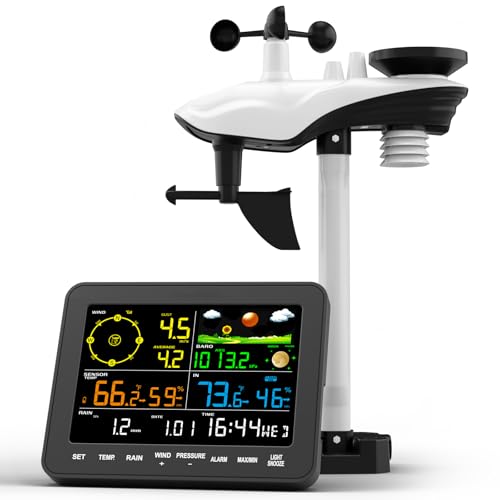
For the open acre behind the house, where the sensor has to reach without Wi-Fi and without wiring.
This one earns its place on range and completeness. The 12-in-1 system covers real-time temperature — indoor from 0°C to 60°C and outdoor from -40°C to 60°C — plus humidity from 10% to 99%, barometric pressure from 300 to 1100 hPa, wind speed and direction, rainfall, dew point, feels-like temperature, moon phase, and calendar. The rain gauge is rated to the same ±1mm accuracy for rainfall under 15mm and ±7% across the 15–9999mm range, logging hourly, daily, weekly, monthly, and total figures. A 6.5-inch HD color LCD with oversized fonts and adjustable backlight handles the display.
Where this pick shines is a property with no reliable Wi-Fi and no convenient outlet near the sensor. It uses wireless transmission rather than Wi-Fi, and the signal is engineered to hold across orchards, farms, and pastures — even through trees and light structures — with a 100-meter range. That is why it targets buyers with land rather than apartment dwellers. Owners praise the setup as genuinely simple, with pre-assembled parts and a clear manual, and the accuracy holds up against local weather apps for temperature, wind, and rain.
The trade-offs are mostly about features this station deliberately leaves out. It has no Wi-Fi, no phone or PC connection, and no daily high/low temperature or wind history stored on the display — so if you want graphs or trend tracking, look at the Sainlogic or VEVOR WiFi entries instead. It also wants to be plugged in in most configurations, and the display angle can wash out when viewed from a distance. A heavy-duty, accurate, self-contained weather rig, this one is — a connected smart station it is not.
The open-land advantage
- Wireless transmission with a 100 m range that holds through trees and light structures — no Wi-Fi required
- 12-in-1 coverage: wind, rain, barometric pressure, dew point, feels-like, moon phase, and more
- Rain gauge logs hourly, daily, weekly, monthly, and total figures at ±1mm accuracy under 15mm
- 6.5″ HD color LCD with oversized fonts and adjustable backlight
- Simple pre-assembled setup with a clear manual, suitable for non-tech users
What it chooses not to do
- No Wi-Fi, phone, or PC connectivity — display-only monitoring
- No stored daily high/low temperature or wind history on the screen
- Display washout at steep viewing angles from a distance
- Generally wants to be plugged in, so location is less flexible than an all-battery setup
Made for: farm, orchard, and large-yard owners who need a self-contained, Wi-Fi-free station that reaches the far end of the property.
Look past it if: you want to check conditions on your phone or pull up stored history charts — this one keeps everything on the wall display.
8. AcuRite Iris (01122M) Weather Station with Wireless Mini Display

A road-trip station you can throw in the RV, tuned for camping above all else.
The whole point of this pick is that both the mini display and the outdoor sensor run wireless on batteries — no cord, no outlet, no fixed address. That makes it the natural choice for RV campers, storm chasers, and weekend road-trippers who want real weather data wherever they park. The compact 5.4 by 5-inch monochrome screen tracks indoor and outdoor temperature, outdoor humidity, wind speed and direction, barometric pressure trends, and rainfall totals, with a freeze indicator that flags when the outdoor temperature hits 32°F or below.
Its signature tech is a self-calibrating forecast that combines the display’s built-in barometer with the outdoor sensor to produce a hyperlocal prediction 12 hours ahead. On top of that, the station keeps historical records — daily and all-time minimum and maximum temperatures and humidity, daily and all-time maximum wind speed, and rainfall for today, yesterday, and the past week, month, and year. It carries the same 433 MHz radio connection that AcuRite uses across its line, and buyers report the outdoor and indoor units never lose their link.
The honest edges here are display-related. The monochrome screen has no backlight, and the blue text can be hard to read in dim light — some owners find it needs holding close. The wind sensor’s refresh rate is slow enough that gust readings can be unreliable even when steady wind is fine, and one owner had a weathervane fail during a storm, taking wind and rain measurement with it. For a camper or a gardener who wants reliable approximations on the road, it is a solid pick; for someone demanding lab-grade wind data at home, it is not the tool.
The travel case: Both display and sensor are battery-powered and wireless, so you can set the station up anywhere you park — and the self-calibrating feature delivers a 12-hour hyperlocal forecast from a built-in barometer.
The readability trade-off: The monochrome screen has no backlight and its blue text is faint in low light, and the wind sensor refreshes slowly enough that gusts can read inaccurately.
Pack it for: RV trips, campsites, and anywhere you want real weather tracking without a wall outlet or a permanent installation.
skip it if: you need a bright, backlit display for nighttime reading, or you want precision wind-gust measurements.
9. Sainlogic 14-in-1 WiFi Smart Weather Station with 24H/7Days Accurate Weather Forecast by Weatherseed® AI, 8.5″ Large Display
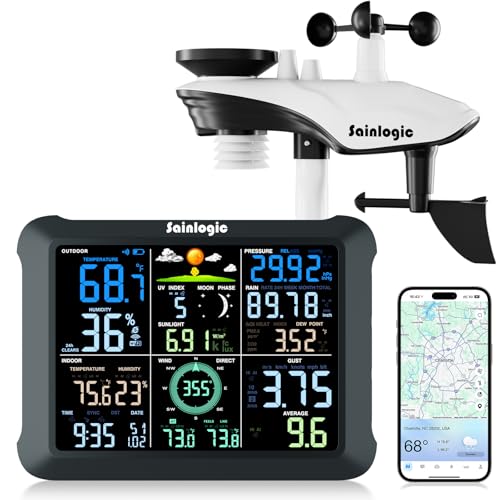
The biggest screen and the deepest data archive in the group, built for someone who tracks the weather seriously.
If you want the most information on the most screen, this is the one. The 8.5-inch display is the largest here and organizes its data into clearly separated sections, and the 14-in-1 system covers temperature in both °C and °F, humidity, rainfall, wind speed and direction, UV, and sunlight levels from a 7-in-1 outdoor sensor that runs on solar power by day and battery backup by night. It updates every 5 minutes and, through the Weatherseed app, stores up to 2 years of historical data as exportable Excel files.
The build is aimed at people who live in rough weather and want proof it holds up. Owners mention it handling a Great Lakes winter with fierce winds, no signal drops, and the wireless link surviving snow-heavy conditions and freezing temperatures. Setup is well-documented — the manual walks you through network connection in about 30 minutes, and the display is bright enough to read across a room. Custom extreme-weather alarms let you set thresholds for the conditions you actually care about.
What holders of this station put up with is software friction. Getting the feed onto Weather Underground can take a couple of days and typically needs a second firmware update after the first, and the companion PC software draws consistent frustration — graphs that cannot be customized, no auto-refresh, and settings that reset between sessions. The mounting hardware is also non-standard enough that one owner had to swap in longer bolts to fit a standard mast. If you want the data and will work through the setup, the hardware delivers; if the app experience is your priority, the beginner-friendly sainlogic above is the smoother ride.
Why the data nerds choose it
- 8.5″ display — the largest in this group — with clearly separated data sections
- 14-in-1 sensor array including UV and sunlight, plus rainfall and full wind tracking
- Stores up to 2 years of history and exports it as Excel files via the Weatherseed app
- Solar power by day with battery backup at night keeps the sensor running
- Custom extreme-weather alarms and a proven record in harsh winter conditions
Software and setup friction
- Weather Underground setup can take two days and may need a second firmware update
- The PC software is clunky — no auto-refresh, limited graph controls, settings reset between sessions
- Mounting pole is non-standard and may need longer bolts for a 2″ mast
- Accuracy and connectivity draw mixed reviews in a share of owner feedback
Suits the data collector: someone who wants the biggest screen, the fullest sensor set, and two years of exportable records for tracking weather over time.
Not the easy route: if a frictionless app and quick Weather Underground hookup matter more than raw data depth, choose a more beginner-tuned station.
Understanding the Specs
Battery Life, Batteries, and Sleep Behavior
Every station here runs on batteries, but the number and type vary — some take AA, some AAA, and most ship without them. The bigger point is how the display behaves on battery power. Most color screens stay lit continuously only when plugged in; on batteries they sleep until tapped to save power. That is normal, not a fault. If you want an always-on glow, plan to use the included adapter. The outdoor sensor’s batteries are the ones that decide how long your station keeps reporting, and sensors exposed to hard cold drain faster, so a fresh set before winter is worth the trouble.
Wireless Range and the Sensors That Move
Range figures describe open-air transmission and always shrink through brick, metal, and distance. A station that advertises a longer range simply gives you more slack when walls get in the way. The other spec to think about is moving parts: a rain gauge uses a see-saw or tipping bucket, and a wind vane and anemometer spin in the breeze. Those mechanical pieces do the most useful work and also wear fastest, so treat any station with a rain gauge or wind sensor as something that will eventually need attention. Simpler battery stations with nothing but a temperature and humidity sensor tend to last the longest.
FAQ
Do battery powered weather stations really run on batteries alone?
How far can the outdoor sensor be from the indoor display?
Why does my weather station screen go dark at night on batteries?
Do I need Wi-Fi on my weather station?
Is a self-emptying rain gauge better than a manual one?
What is an atomic clock and does my station need one?
Why does my rain gauge read zero when it is actually raining?
Can I add extra outdoor sensors to one station later?
Will a weather station interfere with my other wireless devices?
How long should I expect an outdoor sensor to last?
What is the difference between a 7-in-1 and a 12-in-1 outdoor sensor?
Do I need a Wi-Fi weather station or is a radio one enough?
Final Thoughts: The Verdict
For most homes, the battery powered weather station that hits the balance is the BOZYBO Weather Station — it nails the everyday job with an accurate, bright, dimmable indoor and outdoor readout, takes batteries for flexible placement, and adds a WWVB atomic clock without charging you for sensors you will never use. If you want three sensors watching three spots at once, the Newentor is the coverage pick. For phone alerts and beginner-friendly setup, the Sainlogic Smart WiFi Weather Station is the friendliest entry. And if you want the biggest screen and two years of exportable records, the Sainlogic 14-in-1 delivers the deepest data set of the group. Whichever you choose, match the sensors to what you will actually check, and the station will earn its spot wherever you put it.
How We Picked
We do not accept paid placement. Every pick is matched to a real buyer and a real use-case; we do not hands-on test units.
Sources & Methodology
Specifications: manufacturer listings and product documentation. Review insights: verified customer reviews, as of September 2026. Pricing: not shown on this page (it changes often); check the current price via the retailer link.
As an Amazon Associate, KitchPrep earns from qualifying purchases. This does not affect which products we feature.
Related Guides
