
Specs are compiled from manufacturer listings and verified buyer reviews and can change over time — please confirm the key details on the product page before buying.
If you want laundry that actually comes out clean, the old-fashioned center agitator is still the tool that does it. The catch is that most new top loaders have quietly dropped the agitator in favor of an impeller — a low, finned disc that swirls clothes around in a shallow puddle of water. It looks modern and uses less water, but it also treats stains gently, which is the last thing you want on a muddy jersey or a greasy work shirt. So the real question is not which machine has the longest feature list. It is which one still has that tall center post, moves clothes through real wash water, and leaves the lid open up.
I’m Mohammad Maruf — the founder and writer behind KitchPrep. This guide is built by comparing the manufacturers’ published specifications and the patterns across verified customer reviews, so you get each pick’s real strengths and trade-offs instead of marketing spin.
Three agitator machines hold up against that test, and each one suits a different laundry room. Before you commit to the machine that will sit in your home for the next decade, you need to know three things: how much each drum holds, how many cycles you get, and the quirks owners run into. That is what this guide to the basic washing machine with an agitator covers.
Our Picks at a Glance

How To Choose The Best Basic Washing Machine with an Agitator
An agitator washer is a simple machine dressed up in confusing marketing. Strip away the buzzwords and four things decide whether you will love it or resent it. First, is the drum big enough for your biggest load? Second, do the controls let you set the water level, or do they guess for you? Third, does the machine hold up after the warranty ends? Fourth, can you actually reach the clothes without fighting a locked lid? Here is what to weigh before you buy.
Capacity in cubic feet versus real loads
Capacity is measured in cubic feet — the interior volume of the drum. A larger number means bigger individual items fit, not that you should stuff the drum every week. An agitator needs free space to move clothes past the wash basket, so an overstuffed drum cleans worse than a half-full one. If comforters and blankets are on your list, size up. If you mostly run shirts, towels, and jeans, a smaller drum fills faster and uses less water per cycle.
Controls that let you pick the water level
Some machines sense load size and set the water themselves. Others give you a knob or buttons so you choose. For an agitator washer, manual control matters because heavily soiled or bulky loads often want more water than an auto-sense cycle is willing to give. Look for a load-size selector and more than one soil level — those small choices are what separate a good wash from a mediocre one on work clothes.
Lid locks and access while running
A lid lock stops you from opening the washer mid-cycle. That is a safety feature, and it can also be a nuisance if you like to drop in a forgotten sock or watch the load slosh. Some agitator models simply do not lock the lid. Decide how much that matters to you, because it is a feature you either use daily or never notice.
Quick Comparison
| Model | Best For | Capacity | Wash Cycles | Item Weight | Amazon |
|---|---|---|---|---|---|
| BLACK+DECKER 4.1 Cu. Ft. Top Load Washing Machine with Agitator, BTLW41MW★ Best Overall | Everyday family loads | 4.1 cubic feet | 10 | — | Amazon |
| Kenmore 4.4 cu. ft. Top Load Washer with Triple Action Agitator – White | Big loads and bulky items | 4.4 cubic feet | 10 | — | Amazon |
| Speed Queen TC5003WN 26″ Top Load Washer with 3.2 cu. ft. Capacity, 6 Wash Cycles, in White | Long-term durability | 3.2 cubic feet | 6 | 200 pounds | Amazon |
In‑Depth Reviews
1. BLACK+DECKER 4.1 Cu. Ft. Top Load Washing Machine with Agitator, BTLW41MW
Our pick — over 4★ from 9,000+ verified ratings; the strongest balance of quality and price.
A 4.1-cubic-foot drum with a real agitator, a stainless tub, and a lid that stays open up while it runs.
Start with the number that carries this machine: 4.1 cubic feet of drum volume. That is big enough to swallow a bulky load of towels or a week of family laundry without choking the agitator, and it gives clothes room to actually circulate. The center post drives them down through the wash basket instead of letting them float on top, which is why the cleaning complaints you see on impeller machines rarely show up here. The stainless steel tub resists rust and wear over years of wet cycles, and a glass lid lets you watch the fill without opening anything.
Ten cycle selections cover the practical spread, so you rarely have to guess which setting fits a load. The named options are Bulky, Heavy Duty, Normal, Towels, and Whites. A 24-hour delay lets you schedule a cycle for off-peak hours and let the machine work while you sleep. Controls are touch-based with an LED display, and the inverter motor (a variable-speed drive that spins up and down smoothly instead of just on and off) keeps the running noise low. This is a full-size freestanding unit that installs in a standard laundry position, and the feature set stays deliberately simple rather than piling on gadgets that break.
What holds up over time is the day-to-day reliability. Owners consistently report clean clothes coming out of the spin nearly dry, a machine quiet enough to run while the house is asleep, and a drum that handles a decently full laundry basket in two to three loads. The recurring gripe is the spin cycle, which some owners find fussy about balance — a load that shifts to one side can stop the machine until you even it out. Buyers report “0.9cf fits 5-6 shirts+1 towel,” a reminder that a smaller vintage tub and this 4.1-cubic-foot drum are not the same animal. The other caution is the drain hose, which needs to stay raised above the water level or it will self-drain during the fill.
What earns its place
- 4.1 cubic feet of drum space handles bulky family loads, so comforters and towel piles are not a squeeze.
- Ten cycle choices plus Heavy Duty and Bulky settings give you a real lever for soiled work clothes.
- Stainless steel tub resists rust and wear, which keeps the drum honest after years of wet cycles.
- 24-hour delay lets you run a load overnight without standing over the machine.
- Inverter motor runs smoothly and keeps cycle noise low enough for open-plan homes.
Where it asks for patience
- Heavily unbalanced loads can stall the spin cycle until you redistribute the clothes.
- The drain hose has to be kept above basin water level, or water drains out during the fill.
- Going past the drum’s practical fill line costs you cleaning power, not just time.
Made for: households that want maximum capacity, a real agitator, and simple controls without a premium tag.
Look past it if: you pack drum-busting loads and rarely check the balance, because the spin cycle will remind you to even things out.
2. Kenmore 4.4 cu. ft. Top Load Washer with Triple Action Agitator – White

The biggest drum here, driven by an agitator that sprays, rocks the basket, and swirls clothes at the same time.
When the hamper is winning, 4.4 cubic feet is the number that saves you. That is the largest drum in this lineup. Compare it directly to the Speed Queen: the Kenmore holds 4.4 cubic feet against 3.2 cubic feet, so the Kenmore’s drum is 38% larger. If king-size comforters are part of your regular rotation, that gap is the difference between fitting one in comfortably and wrestling it.
The agitator here is not a plain post. It works three ways at once — a spray that drives detergent through the fabric, a wash basket that rocks back and forth, and an agitator arm that rolls clothes in a circular path. That combination is built for the kind of soil that hangs on, which is exactly the reason to buy an agitator machine instead of an impeller. Ten cycles cover Heavy Duty, Whites, Towels, Delicates, and Express, with four temperature options and an Extra Rinse for anyone with sensitive skin. Express Wash handles a small load in 28 minutes, and the soft-close lid uses tempered glass so it will not slam shut on your hands.
The efficiency claim worth knowing is Cold Clean, which the maker says uses up to 90% less energy than the normal cycle at default settings on an 8-pound load. Owners describe this one as whisper-quiet and easy to set up, with the kind of drum that takes a king-size comforter without complaint. One caution to file away: remove the shipping bolts before you run the first cycle, and if the machine arrives damaged, inspect before the delivery team leaves, because returns on a heavy appliance are slow and painful.
The capacity case: At 4.4 cubic feet, this drum out-sizes the Speed Queen’s 3.2 cubic feet by 38%, so a king-size comforter fits with room to move. It also carries a triple-action agitator that attacks dirt from three angles at once — a genuine edge for soaked, soiled family loads.
The honest trade: A bigger drum and more cycles mean more to learn, and the tempered-glass soft-close lid and touch controls add parts that a simpler machine does not have. Delivery and installation also carry the usual heavy-appliance risk if the unit arrives damaged.
Worth it if: your laundry piles up fast and comforters are folded into the routine — the 4.4-cubic-foot drum earns its place on volume alone.
Think twice if: you want the absolute fewest moving parts, because the triple-action system and touch controls add complexity a bare-bones machine skips.
3. Speed Queen TC5003WN 26″ Top Load Washer with 3.2 cu. ft. Capacity, 6 Wash Cycles, in White
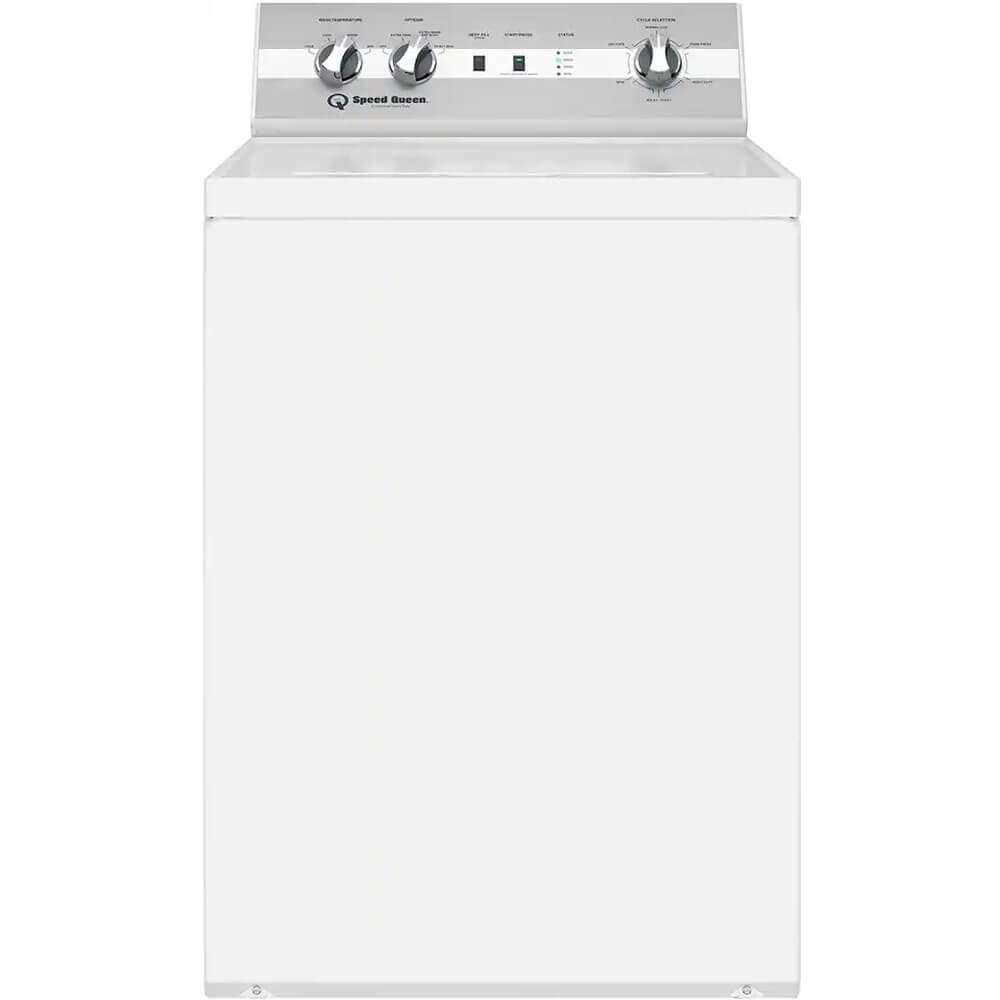
A 200-pound commercial-style build that fills with real water and runs a full cycle in minutes, not hours.
Two numbers tell you what this machine is about before you read a single review: a 710 RPM max spin speed and a 200-pound body. That weight comes from a stainless steel wash tub and a 2-speed, 1/2 HP motor built for retail-grade duty. It is the reason this machine does not walk across the floor mid-spin the way lighter top loaders can. The controls are a knob, not a touchscreen, and there is no lid lock — open it whenever you want to drop in a stray sock or watch the load. For anyone who has fought an auto-locking, auto-sensing washer, that is the point.
Where it parts ways with the other two is capacity. The drum measures 3.2 cubic feet against the Kenmore’s 4.4 cubic feet, so the Speed Queen’s drum is 38% smaller — a real constraint if bulky bedding is your normal load. Six preset cycles, two load-size selections, two soil levels, four temperature selections, and a variable water level selector keep the choices few and direct. A bleach dispenser and a fabric softener dispenser sit right where you need them, and rear self-leveling legs make installation on an uneven basement floor less of a fight.
Durability is the reason buyers pick this over cheaper machines, and owners talk about it in decades, not months — one review puts it plainly: “I don’t think you can get a better, more durable washer.” Where the others run quiet, this one is loud by design, and it fills to a real water line instead of trickling. The honest trade-off is the water level: on a big bulky load, that small drum and a high fill line can mean more than one cycle to get through everything. It is a machine you buy for the decade of simple, fast, reliable washes, not for a feature list.
Why the weight matters: That 200-pound frame and 710 RPM max spin come from a 2-speed, 1/2 HP motor and a stainless tub. The spin pulls water out hard, and the whole machine stays planted instead of shimmying across a concrete floor.
The drum is the catch: At 3.2 cubic feet this is the smallest drum here — the Kenmore’s 4.4-cubic-foot tub is 38% larger — so a king comforter and a pile of towels will not ride together. You trade volume for a build that is meant to keep going year after year.
The long-haul buy: choose this if you would rather run one appliance for the next decade with a knob, real water, and no lid lock than chase cycles and screens.
The capacity caveat: with only 3.2 cubic feet, this is not the machine for a household that washes bulky bedding every week.
Understanding the Specs
Agitator versus impeller
An agitator is the tall post in the center of the drum that pushes clothes down through the water and past the basket wall. An impeller is a low disc that swirls clothes on top of a shallower pool of water. The agitator provides more mechanical scrubbing per cycle, which is why it tends to handle heavy soil better. The trade is water use: an agitator washer typically fills to a higher level than an impeller design, and that fill is part of what makes the wash water do the work.
Capacity, spin speed, and load size
Capacity is the drum’s interior volume in cubic feet — a bigger number fits bulkier single items. Spin speed is measured in RPM, the rotations per minute the tub reaches at the end of the cycle; higher RPM pulls more water out of the fabric, so clothes come off the drum damper. Load-size and soil-level selections tell the machine how much water and agitation to use. An agitator needs room to move, so a load that fills the drum to the top cleans worse than one with space to tumble.
FAQ
Why choose an agitator washer over an impeller model?
Will a king size comforter fit in these washers?
What does cubic feet mean on a washing machine?
How many wash cycles do I actually need?
Do agitator washers use more water than high efficiency models?
Why does the Speed Queen not have a lid lock?
How long do these agitator washers typically last?
Can I open the lid while the washer is running?
What causes a top load washer to stop mid cycle?
Is a smaller drum easier to keep balanced?
Final Thoughts: The Verdict
For most people, the basic washing machine with an agitator winner is the BLACK+DECKER 4.1 Cu. Ft. Top Load Washing Machine with Agitator. It pairs a genuinely large 4.1-cubic-foot drum with a real agitator, a rust-resistant stainless steel tub, and ten cycles. It also holds 4.4 stars across 9,000+ ratings. If your priority is maximum drum space and you regularly wash king-size comforters, the Kenmore 4.4 cu. ft. Top Load Washer gives you the biggest tub here, at 4.4 cubic feet versus the Speed Queen’s 3.2. And for a machine you mean to keep for a decade with a knob, real water, and no lid lock, the Speed Queen TC5003WN is the one to reach for — just accept the smaller drum as the price of that 200-pound build.
How We Picked
We do not accept paid placement. Every pick is matched to a real buyer and a real use-case; we do not hands-on test units.
Sources & Methodology
Specifications: manufacturer listings and product documentation. Review insights: verified customer reviews, as of September 2026. Pricing: not shown on this page (it changes often); check the current price via the retailer link.
As an Amazon Associate, KitchPrep earns from qualifying purchases. This does not affect which products we feature.
Related Guides
