
Specs are compiled from manufacturer listings and verified buyer reviews and can change over time — please confirm the key details on the product page before buying.
If you cut metal for a living or a serious weekend project, the cord is the enemy. A battery-powered band saw frees you to work on a ladder, inside a trench, or at the far end of a job site where no outlet reaches. The right one slices pipe, conduit, strut, and threaded rod clean and quiet, with no sparks and no cord to trip over. The tricky part is that every saw here runs on a different battery platform, and the voltage, cutting capacity, and blade length change what a saw can actually chew through. This guide sorts out which saw fits your material and your batteries.
I’m Mohammad Maruf — the founder and writer behind KitchPrep. This guide is built by comparing the manufacturers’ published specifications and the patterns across verified customer reviews, so you get each pick’s real strengths and trade-offs instead of marketing spin.
You will see how blade length, cutting angle, and battery platform decide which jobs each saw handles. By the end, you will know which band saw battery setup fits your work and your existing tools.
Our Picks at a Glance


How To Choose The Best Band Saw Battery Setup
The single biggest decision is not the saw — it is the battery platform you already own or are willing to commit to. A bare tool with no battery is a paperweight until you add the right pack, and buying the saw that shares your existing charger saves the cost and clutter of a second system.
Match the cutting capacity to your material
Cutting capacity is the widest piece of stock the saw can swallow in one pass. A compact saw handling 1-3/4 inches to 2-1/2 inches covers most conduit, rod, and angle iron. A deep-cut saw with a 5-inch capacity takes on bigger pipe and structural steel. Match capacity to the stock you actually cut, or you will be flipping material and making two passes.
Voltage and runtime go hand in hand
Voltage tells you how much punch the motor has. Amp-hours (Ah) tell you how long a single charge lasts — a 2.0Ah pack dies sooner than a 6.0Ah pack under the same load. Higher voltage generally means more cutting force, but a higher-capacity battery at a lower voltage can still run all day on light work. Check both numbers against your shift length.
Think about weight and grip before the spec sheet
These saws get held overhead, on ladders, and one-handed in tight framing. A heavier tool fatigues your arm fast, and a lightweight saw you can keep level cuts straighter. Look for soft-grip handles and an integrated LED so you can see the cut line in dim spaces.
Quick Comparison
| Model | Best For | Blade Length | Cutting Angle | Item Weight | Amazon |
|---|---|---|---|---|---|
| MILWAUKEE’S 2729-20 M18 Fuel Deep Cut Band Saw Tool Only★ Best Overall | Serious daily metal cutting | 5 inches | 90 degrees | 13.6 pounds | Amazon |
| Cordless Bandsaw, 20V Brushless Portable Bandsaw (ONEMANA)Best Value | Budget-friendly all-rounder | 2.5 inches | 180 degrees | — | Amazon |
| RIDGID 18V Compact Band Saw Tool ONLY R8604BCompact Pick | One-handed framing work | — | — | 9.7 pounds | Amazon |
| FLEX 24V Brushless Cordless 2-1/2-Inch Compact Band Saw FX2331-Z | Tight-space precision cuts | 2 inches | — | 3 pounds | Amazon |
| DEWALT ATOMIC 20V MAX Compact Bandsaw (DCS377B) | Overhead and one-hand cutting | 4 inches | — | 7.7 pounds | Amazon |
| Milwaukee Electric – M12 Fuel Compact Band Saw | Light, nimble small cuts | 2 inches | — | 6.0 pounds (net) | Amazon |
| DEWALT 20V MAX XR Bandsaw (DCS378B) | Biggest single-pass capacity | 8 inches | — | 10.8 pounds | Amazon |
| BOSCH GCB18V-2N 18V Compact Band Saw (Bare Tool) | Overhead work in tight spots | 2 inches | — | 7.3 pounds | Amazon |
| BOSCH GCB18V-5N 18V 5 In. Deep Cut Band Saw (Bare Tool) | Deep cuts on larger stock | 5 inches | — | 14 pounds | Amazon |
| Milwaukee 2729-20 M18 FUEL Deep Cut Band Saw (Tool Only) | High-volume pro jobsites | 5 inches | — | 15 pounds | Amazon |
| Makita XBP02Z 18V LXT Cordless Portable Band Saw, Tool Only | Fast, clean cuts on pipe | 8 inches | — | 15 pounds | Amazon |
In‑Depth Reviews
1. MILWAUKEE’S 2729-20 M18 Fuel Deep Cut Band Saw Tool Only
Our pick — over 4.5★ from 500+ verified ratings; the strongest balance of quality and price.
The deep-cut Milwaukee that makes corded saws look surplus
For crews who cut pipe and strut all day, this 5-inch deep-cut band saw earns its place at the top of the pile. Its long blade gives you the reach to drop through thick material in one pass, not two. As the crowd favorite with 4.8 stars across 500+ owners, it is the saw most experienced hands reach for first.
What wins people over is sheer build quality — engineering that holds up under daily jobsite abuse and keeps cutting straight. It slices a 1-1/2 inch solid steel rod in 10 to 15 seconds, and buyers report that the cordless M18 setup keeps pace with 11-amp corded deep-cut saws. A 6.0Ah battery reportedly runs a full day. The 90-degree cutting angle keeps the blade square to the work for accurate, repeatable cuts.
Point it against the FLEX compact below and the gap is measurable: this blade runs 5 inches against that saw’s 2 inches, so it clears far beefier stock in a single pass. The catch is the mass — at 13.6 pounds it is a two-hand tool for many, and single-handed overhead work gets tiring. There is a 5-year tool warranty backing it.
Where it earns its keep
- Cordless runtime that matches corded deep-cut saws, per the review pages
- Tears through 1-1/2″ steel rod in roughly 10–15 seconds
- 5-year tool warranty for long-term jobsite confidence
Weigh before you buy
- 13.6 pounds makes one-handed overhead use a chore
- Requires M18 batteries and charger, sold separately
Reach for it: pipefitters, electricians, and fabricators who want corded performance without a cord.
Think twice: if most of your cutting happens one-handed on a ladder, the lighter compact saws below suit you better.
2. Cordless Bandsaw, 20V Brushless Portable Bandsaw, 2.5″ Deep Cut Metal (ONEMANA)
An entry-level saw that lands real cuts without the premium tag
If you want a cordless band saw to tackle steel, aluminum, and PVC around the shop without climbing the price ladder, this ONEMANA is the one to look at first. The complete package arrives with a 2.0Ah lithium-ion battery and charger, so you can cut the day it lands. Its brushless motor (a motor with no brushes to wear out, so it runs cooler and lasts longer) handles the hardest part for you.
You can reach awkward angles in tight framing because this saw cuts at a 180-degree angle — double the 90-degree angle of the Milwaukee deep-cut above. Six speed settings let you slow down for PVC and speed up for steel. Owners call it a “cuts-all” tool that handles any material, and one construction plumber reported it performs on par with a Makita. An LED work light helps you see the cut line in dim corners, and it accepts Makita-platform batteries if you already run them.
Fair warning: it ships with the band saw blade uninstalled and needs assembly — owners mention it briefly slowed the first job. The included 2.0Ah pack is modest, so heavy users may want a spare. One buyer did note a bag would be nice, though it fits an 18-inch tool bag fine.
Passes the daily-use test: a plumber running it every day found it just as good as the Makita, which is high praise for an entry-level saw.
Best for: weekend cutters and newcomers who want a battery and charger in the box.
Skip if: you need a tool that arrives blade-ready out of the crate.
3. RIDGID 18V Compact Band Saw Tool ONLY R8604B
The featherweight that climbs and cuts without wearing you out
Cutting pipe up on a ladder or in a cramped ceiling cavity is where this one shines. At 9.7 pounds it undercuts the Milwaukee deep-cut by a real margin — that saw weighs 13.6 pounds, so this is a full lighter load in your hand during sustained overhead work. Its 2-1/2 inch cut capacity covers conduit, rod, angle iron, and small wood without flipping the stock.
The variable-speed range of 320 to 680 SFPM (surface feet per minute, the speed the blade edge travels) lets you ease into tramp metal and throttle up for clean cuts. A retired welder praised its one-handed handling, low battery consumption, and built-in wall hook. Soft start keeps the saw from jerking when you squeeze the trigger. One electrician even rated it above Milwaukee or DeWalt units, crediting the speed adjustment for the blades lasting longer.
The recurring gripe is that the thin blades occasionally pop off the rollers or snap — tracking care matters here. Blade and battery sell separately, so factor in the RIDGID 18V platform.
The field report: the words “light weight and fast cutting” sum up what owners keep coming back to.
Grab it: solar and electrical crews who log long hours working overhead.
Look past it: if you are already invested in a non-RIDGID battery platform.
4. FLEX 24V Brushless Cordless 2-1/2-Inch Compact Band Saw FX2331-Z

An ultra-light 24V cutter built to sneak into tight corners
At just 3 pounds, this bare tool is the lightest saw in this roundup by a wide margin — and that low weight is exactly what makes it work in spaces where a heavier saw would jam. It carries a cobalt bi-metal blade, a tough blend built to hold a sharp edge through hard steel. Its maker claims the 24V lithium platform brings 20% more power than standard and 25% longer runtime through heat management.
The real story lives in the test reports. Tradesmen report it slicing channel strut both deep and shallow, plus EMT conduit up to 2 inches and 2-inch rigid (RMC), with zero cutting issues. One electrician said it out-performed coworkers’ Milwaukee M18 and DeWalt 20V. It has a variable-speed trigger, a quick-release tool-free blade cover, a rafter hook for hanging between cuts, and cross-compatibility with all FLEX 24V batteries.
Be aware the 2-inch blade is shorter than the 5-inch blade on the Milwaukee deep-cut above, so this is a compact saw, not a deep-cut one, and FLEX 24V batteries and chargers sell separately. Registering within 30 days extends the tool warranty to 5 years.
Brings the muscle: experienced metalworkers who already own FLEX 24V packs and want a nimble cutter.
Move on if: you need deep single-pass cuts on large-diameter pipe.
5. DEWALT ATOMIC 20V MAX Brushless Cordless 1-3/4 in. Compact Bandsaw, Bare Tool Only (DCS377B)

A one-handed bandsaw that makes overhead conduit work feel civil
This is the pick for the technician who spends half the day reaching up at ceiling-height conduit. The integrated guard lets you cut one-handed and overhead, which is rare in this class. At 7.7 pounds it sits in the balance — heavier than the FLEX but far more manageable one-handed than the 13.6-pound Milwaukee deep-cut. The 4-inch blade and 1-3/4 inch capacity cover unistrut and conduit comfortably.
What is great to know is how compact it stays for its output — owners note it slips into a drill-size bag with a battery and charger, so it travels light with the rest of your kit. Quality is the trait that stands out most, with functionality close behind, and the most-praised cutting capacity for strut and conduit. A variable-speed trigger and speed dial let you match blade speed to the material. The metal latch secures the pivoting guard during blade changes, and a single-point tracking adjustment keeps the blade on line.
Source notes flag one honest catch: the included blade has been reported to wear out over roughly two months of steady use, so buy a second. A rare unit has arrived with a poor blade weld that snags. It is bare-tool only, so the 20V MAX batteries are on you.
Why it wins the overhead jobs
- One-handed and overhead cutting with the integrated guard
- Fits a drill-size bag for easy transport to the job
- Tool Connect Chip ready for jobsite asset tracking
Hold the mental note
- Capacity tops out near 1-3/4 inches
- Included blade is a wear item — keep a spare on hand
Pick it: electricians and installers who cut unistrut and conduit overhead all day.
Keep shopping: if your stock runs wider than 1-3/4 inches.
6. Milwaukee Electric – M12 Fuel Compact Band Saw

The nimble M12 that slices small stock without the bulk
Running on the compact 12V M12 platform, this saw is built to be carried, not hauled, at just 6.0 pounds net with a built-in work light and a 2.5-inch throat depth. It will power through conduit, PVC, small metal, and chain-link posts up to 2 inches, all on a straight grip you can run comfortably one-handed. Its top speed of 570 feet per minute (how fast the blade edge travels, so cuts stay fast and clean) keeps the work moving.
Where this one earns its keep is around smaller stock. Owners call it a hard-working little tool that cuts through almost anything 2 inches and smaller, and one pipefitter runs it daily on all-thread and strut. A deeper gap than some competing compact models lets it take bigger pipe than you would expect. It uses a single 12V battery, sold separately, so it stays light and never needs charging overnight for short jobs.
Two honest limits: it is a small-cut saw, not a substitute for the 5-inch deep-cut above, and the 570 feet per minute top speed is modest, so a few users wish it ran faster. It leans on one M12 battery to keep its weight down.
The size story: reviewers rate it as a small saw that handles bigger pipe than its frame suggests.
Suits you: handymen and electricians who cut pipe, rod, and PVC in the 2-inch-and-under range.
Pass by: if you regularly cut stock wider than 2-1/2 inches.
7. DEWALT 20V MAX XR Bandsaw, Brushless Motor, Portable and Cordless, 3-3/8 Inch Cut Capacity, Bare Tool Only (DCS378B)

The wide-capacity cordless that cuts dense metal without your arm paying
For the buyer who wants a big single-pass capacity in a portable frame, this DeWalt delivers a 3-3/8 inch cut capacity — noticeably more reach than the 1-3/4 inch ATOMIC above. The brushless motor puts out 535 MWO (maximum watts output, a measure of usable cutting power) at 570 SFPM, so it holds speed in demanding commercial work. It also weighs 10.8 pounds, which keeps it a genuinely one-handed proposition for many users.
Owners do not hold back about what wins them over: this is the most versatile band saw they own, equally at home on PVC, copper, steel pipe, all-thread, and unistrut. A woman owner said she cuts through dense metal quickly and accurately without the tool being too heavy on her arm. An integrated blade guard shields the blade and keeps the saw clean to extend durability, and a built-in LED lights the cut line for accurate work. A variable-speed trigger plus a speed dial give you two ways to control blade speed.
Here is the tradeoff: a rare unit develops blade drift near the rear guide wheel, and the fixed rear guide lets a blade veer off track, which causes crooked cuts. Because blade tracking matters most here, plan on a quality replacement blade. Tool Connect Chip ready and Lanyard Ready for jobsite tethering.
The capacity winner
- 3-3/8 inch cut capacity covers a wide range of stock
- Built-in LED and blade guard aid accurate, safer cuts
- Variable-speed trigger and speed dial for material matching
The one to plan around
- Blade drift issue requires a quality replacement blade as a backup
- Weighs 10.8 pounds — sustained overhead work will wear on your arm
Buy it: plumbers and fabricators who cut a mix of materials and want the biggest single-pass reach.
Look elsewhere: if you want the absolute lightest overhead saw in your hand.
8. BOSCH GCB18V-2N 18V Compact Band Saw (Bare Tool)

A 7.3-pound electrician’s saw built for wiring and strut
At 7.3 pounds and just 2-1/2 inches of cut capacity, this Bosch is a compact tool, but it makes the most of that light frame with a rugged aluminum base and a centered handle that stays balanced for control. The 2-inch blades are easy to change without tools, thanks to a blade guard held on by a few clips. Its 18V motor cuts 2-1/2 inches in a single pass on common conduit and strut.
Reviews from working electricians are where it proves itself. Customers note a 6.0Ah battery ran a full day and handled 300 easy unistrut cuts plus 1.5-inch EMT. Users describe it as sturdier than the comparable DeWalt and quieter than the Milwaukee, with blades lasting months of steady use. A commercial electrician touted its straight cutting and the difficulty of snapping the blade, plus the LED that lights the cut line for more accurate work.
The trade-off: the 18V brushed motor means it is a bit of an old-school design, and heavy 8.0Ah packs make it top-heavy, so a 3, 4, or 6Ah battery is the better match. A few users wish the 2-1/2 inch capacity were 3 inches on pipe work. It runs bare-tool only, so batteries are separate.
The field read: the recurring wish is more capacity, not fewer problems — a sign the core tool is doing its job.
Your saw if: you cut conduit, wire, and strut in tight ceilings and want a light, balanced tool.
Not your saw if: you frequently cut pipe larger than 2-1/2 inches.
9. BOSCH GCB18V-5N 18V 5 In. Deep Cut Band Saw (Bare Tool)
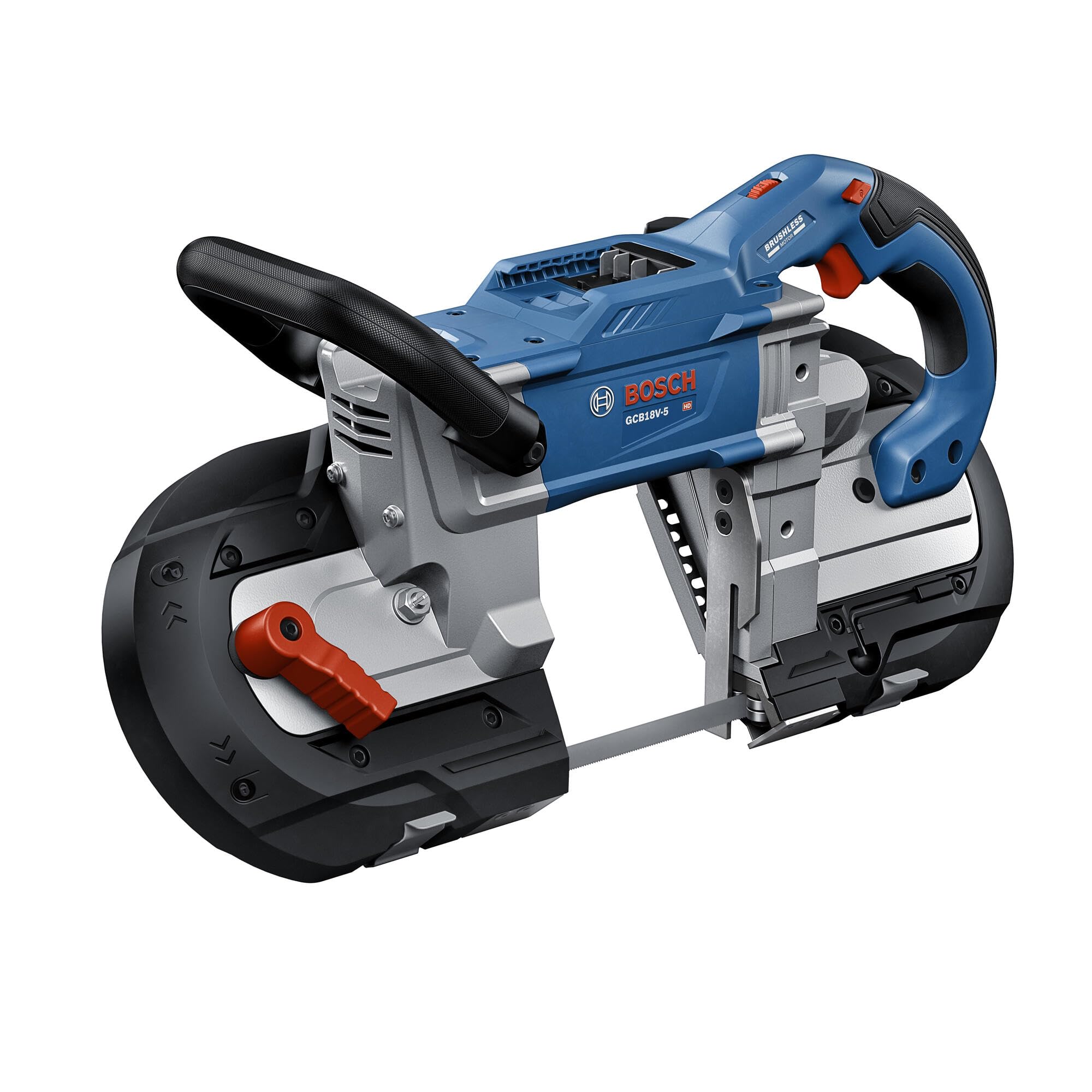
A 5-inch Bosch hog that trades weight for serious cutting power
When your job is pipe handrails, stainless channel, or 4×4 wood posts, this deep-cut Bosch brings the 5-inch capacity to reach through it all — its blade length of 5 inches is the same reach class as the Milwaukee deep-cut above. The brushless motor boost battery runtime so a single charge stretches further, and the variable-speed trigger with a speed dial tailors the cut rate to each material. It uses the AMPShare system — a battery system designed to be multi-brand compatible across many cordless products — making it easy to share packs.
What stands out is the cutting confidence seasoned users report. A long-time Milwaukee 18V user said this Bosch “cuts faster for longer than its Milwaukee equivalent” — high praise from a loyalist. Others describe a very smooth, clean cut that keeps the surrounding area neat, quieter and cleaner than a grinder inside the workshop. An adjustable material guide tailors the cutting area for close, accurate cuts, and the hanging hook stores it conveniently between jobs.
The honest catch is weight. At 14 pounds it is a two-handed tool, and its frame is large enough that it will not fit in tight spots — reviewers point out so plainly. That is the price of the deep capacity. Blade and battery are separate.
Worth it: fabricators already on the Bosch/AMPShare platform doing deep cuts on rails and posts.
Think twice: if your work zones are cramped and every inch of clearance counts.
10. Milwaukee 2729-20 M18 FUEL Cordless Lithium-Ion Deep Cut Band Saw (Tool Only)
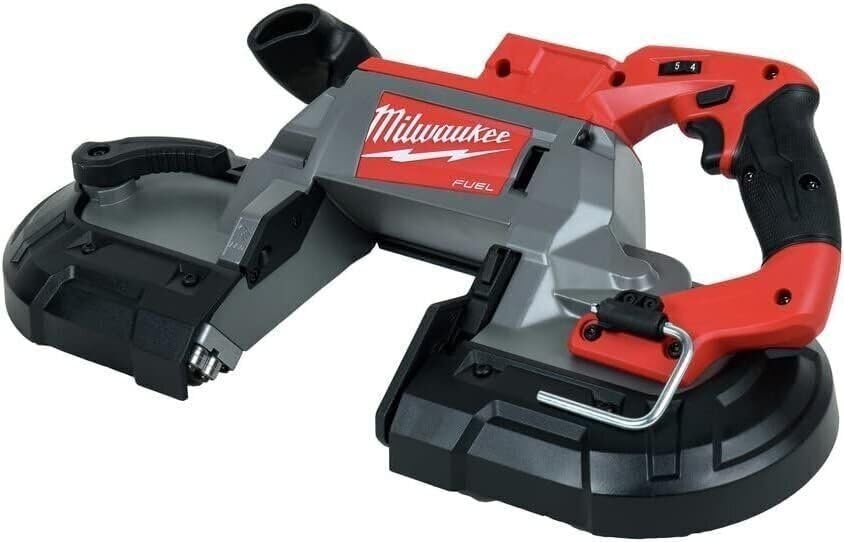
The bigger M18 deep-cut that turns into a bench saw
This is the same 18V M18 FUEL deep-cut design as the Best Overall pick above, but a heavier build at 15 pounds with a 5-inch blade. That mass is not wasted on a bench — shoppers say mounting it to use as a vertical cutting saw, even buying a second one to convert into a chop saw. It cuts rebar, EMT, leaf springs, hardwood, and copper, replacing an angle grinder, jigsaw, sawzall, and Dremel for many owners.
The quality and cutting performance are what buyers come back for, with durability and battery life drawing more mixed feedback. Many note the blade outlasts a sawzall blade by a wide margin — one owner put it at roughly a hundred times longer. It is quick, quiet, and cuts accurately one-handed for short work. But some note it is awkward, that the opening size limits certain cuts, and that it strays on long cuts that need the material flipped halfway through.
Blade changes are rated fair. Given the 18V platform and the 5-inch capacity, this is the workhorse for shop setups and heavy repeat work.
Bench-ready gear: the practical value here is the ability to bolt it down and cut vertically, which transforms how fast you process small parts.
Buy it: shop owners who want a mountable deep-cut saw for constant bench cutting.
Skip it: if you need a light saw for overhead work — the compacts above win that job.
11. Makita XBP02Z 18V LXT Lithium-Ion Cordless Portable Band Saw, Tool Only

The steel-hungry Makita that runs long and cuts clean
Metal workers who cut pipe, rebar, and channel all day will recognize what makes this 18V LXT saw special. Its 4-3/4 inch cutting capacity accepts a 44-7/8 inch blade and handles multiple metal materials in one tool. The motor delivers variable speed from 275 to 530 feet per minute, letting you slow the blade for hard stock and speed it up for thin material. A built-in alert light warns you of over-torque to protect the motor.
Cutting performance is the trait owners praise most, with value for money close behind. One metalworker said it goes through steel like butter with no noise, no sparks, and no heat, and urged anyone still using a grinder or sawzall to switch. It handles mild steel from 1/8 to 1/4 inch with ease. Battery life gets solid marks too, with a 3.0Ah pack giving long runtime versus a sawzall. A locking safety trigger requires two actions to power on, and a conveniently placed variable-speed dial lets you match speed to the cut.
The most common honest gripe is weight — at 15 pounds it is heavy and awkward for long overhead sessions, and reviewers wish for a lighter brushless version. Another note is that it only has a lock-off switch, not a lock-on, so it cannot be locked running for a vertical stand. It runs bare-tool only.
The job-site verdict: the fast, clean, sparkless cut is what turns grinder users into converts.
Pick it: metalworkers already on the Makita LXT platform who cut pipe and channel all day.
Reconsider: if you mainly cut overhead and want a lighter tool.
Understanding the Specs
Cutting Capacity and Blade Length
Cutting capacity (the widest material the saw can handle in one pass) and blade length work together. A 5-inch blade on a deep-cut saw reaches through larger pipe and structural steel, while a 2-inch blade on a compact saw tops out around 2-1/2 inches of stock. If you cut bigger pipe or angle iron, choose a saw whose capacity matches your daily material, or you will be flipping stock and cutting twice.
Voltage, Amp-Hours, and Runtime
Voltage sets the motor’s punch, while amp-hours (Ah) set how long one charge lasts — a 6.0Ah battery outlasts a 2.0Ah pack doing the same work. Higher voltage usually means more cutting force, but a higher-capacity battery on a lower-voltage saw can still run a full day on lighter jobs. Always match the battery to your shift length and check that the saw uses a platform you already own, since bare tools ship without a battery or charger.
FAQ
Do cordless band saws cut as well as corded ones?
Will a bare tool work if I already own the batteries?
Can these saws cut wood and PVC or only metal?
How long does a band saw blade last?
What cutting capacity do I need for conduit and pipe?
Is a heavier band saw harder to control?
What does cutting angle mean on a band saw?
Do these saws come with a case and blades?
Which battery platform should I pick for a band saw?
Can I mount a portable band saw as a bench saw?
Final Thoughts: The Verdict
If you cut metal for a living, the MILWAUKEE’S 2729-20 M18 Fuel Deep Cut Band Saw is the one to build around — top-rated in this group and backed by a 5-year tool warranty, it cuts like a corded saw without the cord. If cutting overhead on a ladder is your daily reality, grab the lighter DEWALT ATOMIC DCS377B for its one-handed reach. And if you want cordless capability on a budget, the ONEMANA 20V bandsaw arrives with a battery and charger to get you started. Match the saw to the battery platform you already own, and the cutting will take care of itself.
How We Picked
We do not accept paid placement. Every pick is matched to a real buyer and a real use-case; we do not hands-on test units.
Sources & Methodology
Specifications: manufacturer listings and product documentation. Review insights: verified customer reviews, as of September 2026. Pricing: not shown on this page (it changes often); check the current price via the retailer link.
As an Amazon Associate, KitchPrep earns from qualifying purchases. This does not affect which products we feature.
Related Guides
