
Specs are compiled from manufacturer listings and verified buyer reviews and can change over time — please confirm the key details on the product page before buying.
If your garage doubles as a workshop, a gym, or just the place you actually want to spend a Saturday, a heater that plugs into a normal wall outlet is the whole ballgame. The catch most people hit first is amperage, not wattage — every pick below runs on standard 120 volt household current, and the real split is whether the unit moves air or radiates straight at you.
I’m Mohammad Maruf — the founder and writer behind KitchPrep. This guide is built by comparing the manufacturers’ published specifications and the patterns across verified customer reviews, so you get each pick’s real strengths and trade-offs instead of marketing spin.
Radiant quartz units warm your body and your bench instantly; convection panels take longer but heat the air evenly. Both work in a garage, and picking the right one matters more than picking the most powerful one. This breakdown of the best 120 volt garage heater covers what actually earns its wall space.
Our Picks at a Glance
How To Choose The Best 120 Volt Garage Heater
The first thing to understand is that a 120 volt garage heater can only pull so much power before it trips a standard 15 or 20 amp household circuit. That ceiling is roughly 1500 watts, which is why almost every sensible pick here tops out there. Within that limit, the real choices are about how the heat gets delivered.
Radiant versus convection is the biggest fork
A radiant quartz unit warms people and objects directly, so it feels like standing near a campfire — you get warmth within seconds, but it fades as you step away. A convection or forced-air model warms the air itself, which takes longer to feel but spreads more evenly around the room. If you mostly work at a bench or one spot, radiant wins on comfort; if you want the whole bay warmer, forced air does more for you.
Match the coverage to your actual square footage
Heating coverage is quoted in square feet, and it assumes decent insulation. A 200 square-foot rating is honest for a small single bay; a 350 square-foot rating fits a larger room. An uninsulated, drafty garage will never fully hit those numbers, so treat coverage as a starting point and size up if your space is leaky.
Mounting and circuitry before you buy
Ceiling and wall mounts save floor space, which matters in a busy garage. Check the amperage draw against your circuit — a 12.5 amp heater needs a dedicated 15 amp line to run safely, and pairing it with other high-power tools on the same breaker invites nuisance trips. Confirm the form factor fits where you want it, and whether an overheat shut-off is included.
Quick Comparison
| Model | Best For | Heat Output | Amperage | Heating Method | Amazon |
|---|---|---|---|---|---|
| Brightown 1500W Smart Wall Heater★ Best Overall | Smart control and quick wall warmth | 1500 watts | 12.5 A | Forced Air (PTC) | Amazon |
| BEYOND HEAT Electric Garage HeaterBest for Workshops | Ceiling-mount targeted shop heat | 1500 watts | 12.5 A | Radiant | Amazon |
| Shinic Electric Garage Heater | Bench and workstation warmth with light | 1500 watts / 750 watts | 12.5 A | Dual Quartz Elements | Amazon |
| Stiebel Eltron CK Trend | Quiet, reliable whole-small-room heating | 5118 BTU/hour | 15 A | Forced Air | Amazon |
| EconoHome Wall Heater Panel | Budget-friendly silent background warmth | 400 watts | 3.33 A | Convection / Radiant | Amazon |
| Smart EnviMAX 1000W | App-scheduled convection for larger rooms | 1000 watts | 8.33 A | Convection | Amazon |
In‑Depth Reviews
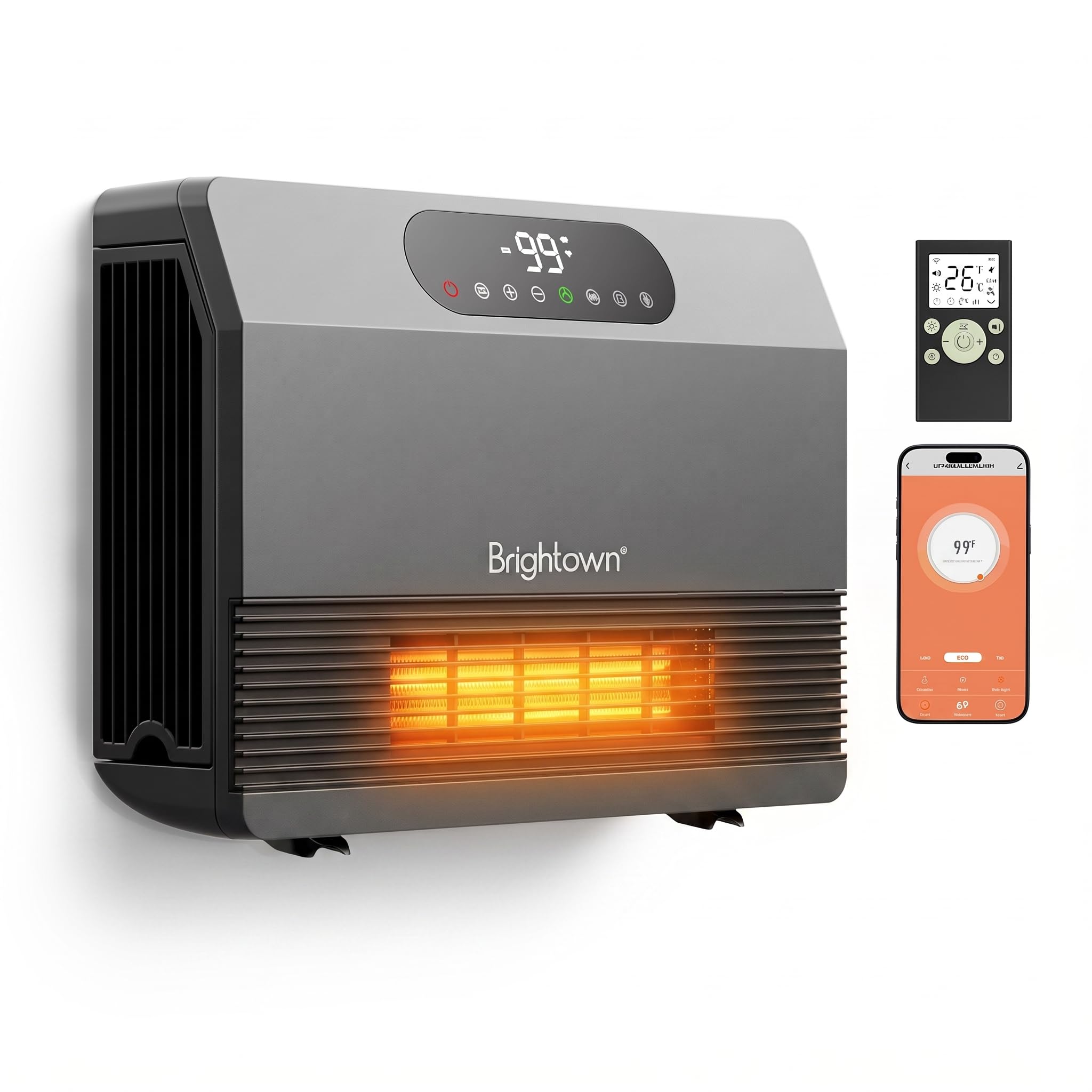
1. Brightown 1500W Smart Wall Heater for Indoor Use, Remote Control/APP, Wifi
Our pick — 4.5★ from 200+ verified ratings; the strongest balance of quality and price.
The wall heater that warms a room before you step inside it.
For a garage or basement you only use part of the day, the Brightown’s 1500 watts of PTC (positive temperature coefficient — a ceramic element that self-regulates as it heats) forced-air output is the standout. What wins people over most is raw heat delivery, and the second-biggest love is its footprint. The tidy proportions are a deliberate fit for tight garages — the body measures 16.1 inches deep by 11 wide by 4.3 high, and it mounts on the wall to keep your floor clear.
The smart side is the real differentiator. You get a 40 to 99°F set range with accuracy of up to 1°F, five modes — ECO, P3 at 1500W, P2 at 1000W, P1 at 600W, and FAN Only — plus touch, remote, app, and Alexa voice control. Owners describe firing it up from the car on the way home and walking into a warm house. The fan also runs quietly enough that it fades into the background.
Honest trade-off: the WiFi and settings get mixed reception. Connectivity can be finicky for some, and the five modes feel like more options than a garage really needs. In the P1/P2/P3 modes it heats steadily rather than cycling to a target, and in ECO the display goes dark, hiding the temperature. As the maker notes, avoid running it alongside other high-power appliances on the same circuit.
What Earns It The Top Spot
- 1500W PTC forced air with 200 sq. ft. coverage for a single bay
- Five modes including a 600W low and FAN Only, so you can dial back the draw
- Wall mount frees floor space; app, remote, and Alexa control from anywhere
- V-0 flame-retardant build and ETL listing with overheat protection
Where It Gets Fussy
- At 12.5 A it wants its own circuit to avoid tripping a shared breaker
- App and WiFi setup is the single most common sticking point for owners
- P1/P2/P3 run hot continuously instead of cycling at your set temperature
Made for: a cold garage, office, or bedroom you want warm on arrival, controlled from your phone.
Consider elsewhere: if your WiFi reaches the garage poorly, the app-first design loses its edge — a dumb pull-string unit serves better.
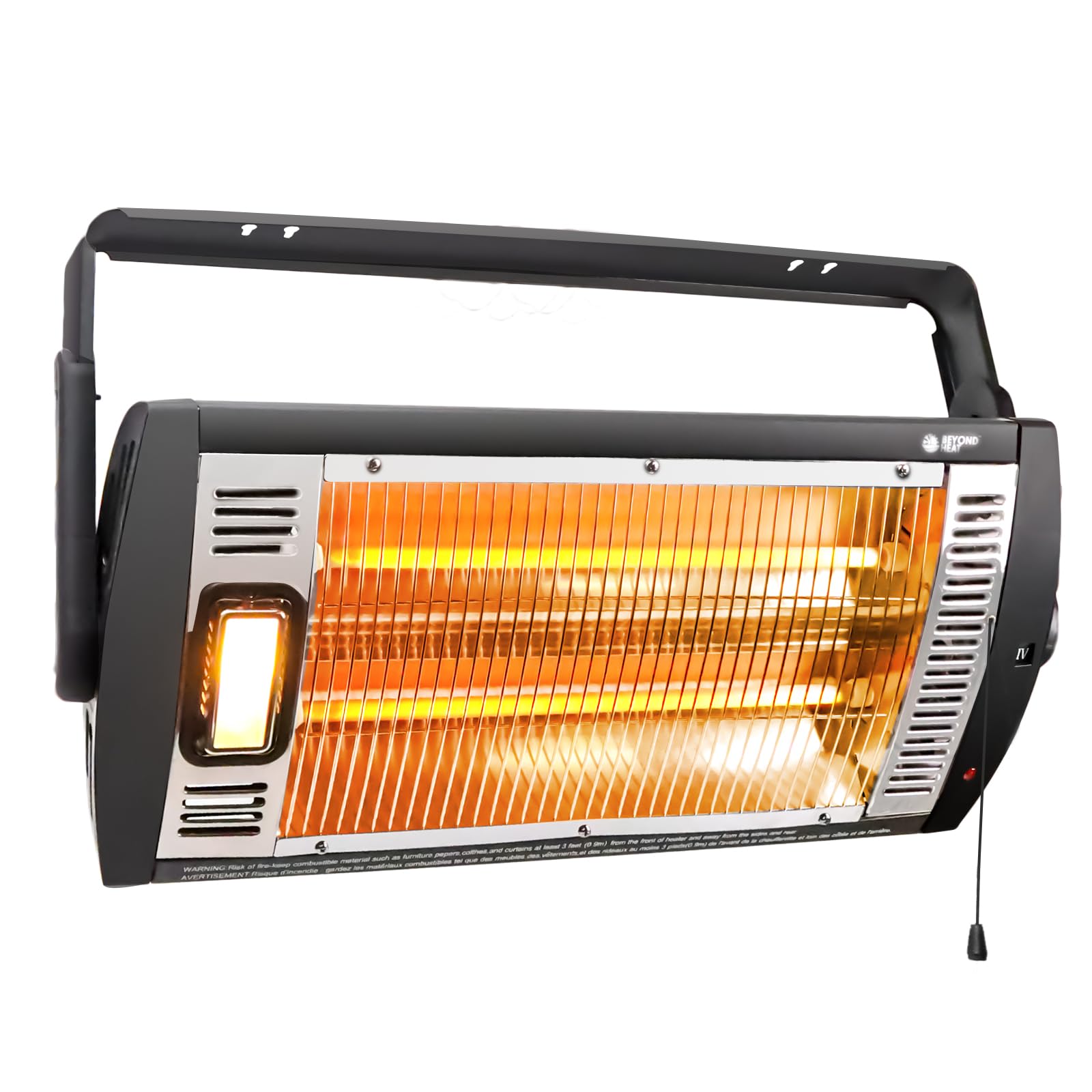
2. BEYOND HEAT Electric Garage Heater 120V, 1500W Radiant Space Heater, 1-Pack
Two quartz tubes that aim warmth straight at your back while you work.
This one solves a different problem than the Brightown. Instead of heating air, its dual quartz tubes deliver radiant heat from a 90-degree adjustable tilt head, so the warmth lands on you and your project while the rest of the garage stays cold. Ceiling-mounting keeps it out of the way, and at 24 inches long by 3.3 wide and 12.2 high it tucks overhead. That is the same 24-inch depth as the Shinic, but this block’s data lists no second number to compare it against.
There is also a halogen light with its own angle adjustment, so the unit doubles as task lighting over a bench, and the heat runs with or without the light. Safety is handled by a metal grille over the elements, a three-prong grounded plug, and overheat shut-off that cuts power at unsafe temperatures. A two-pack ceiling setup over a two-car garage is how a lot of woodworkers run it — warm the shop a half hour before starting and it turns comfy.
The catch is reliability variance. Plenty of owners swear by them through harsh winters, but the review pages split on quality — a few units arrived with a dead bulb or elements that only fired part of the tube. There is no easy bulb replacement, which is the practical rub if the light fails. Treat this as targeted spot heat, not a room-filler; it will not thaw a frozen garage quickly.
Honest verdict: a strong pick for anyone who works in one spot and wants instant radiant warmth plus a work light, priced well within the mid-range. The reliability split is the gamble — buy from a seller that stands behind returns.
Pick this: if you want radiant heat directed at your work area and a built-in halogen light overhead.
Look past it: if your priority is evenly warming the whole garage rather than one zone.
3. Shinic Electric Garage Heaters with Remote Control, 1500W/750W Ceiling Mounted Radiant Quartz Heater with Work Light, 90° Rotation, 5 Mode Settings

A tilting ceiling-mounted quartz heater that throws both light and directed warmth.
The Shinic shares the radiant-quartz playbook with the BEYOND HEAT — dual quartz elements, a 90-degree tilt head, a halogen work light, and a ceiling mount that keeps the floor clear. It adds a remote and a two-level output that switches between 1500W and 750W, so you can run it gentler on mild days. Its quoted coverage is 200 to 300 square feet, wider than the single-bay figure of the Brightown.
Owners run these hot and close. The recurring theme is that directly underneath it throws serious warmth — pointed at a workbench or a simulator bay, it does exactly what it should. One owner heating a 20×24 garage found a single unit insufficient and picked up two, and the same feedback notes it struggles when the space drops under about 40 degrees. The remote is the weak link; it is reported to work only about a foot from the sensor, and the light runs small and dim.
There is one safety note worth knowing. One reviewer noted a low setting drawing far more power than spec, with both rods at full heat and an acrid smell. That is a single report against 184 ratings, but with any quartz heater, run it on a dedicated circuit and stop using it immediately if it smells or behaves oddly. Otherwise, the work light and tilt make it a practical overhead choice for a workstation.
Straight read: buy it for directed bench heat and the built-in light, floor space saved by the ceiling mount. Skip the remote features mentally — you will adjust by hand anyway.
Right for you: if you want multi-directional quartz heat over a bench or simulator bay with light included.
Think twice: if you expect one unit to warm a whole two-car garage in deep cold — owners say it takes two.
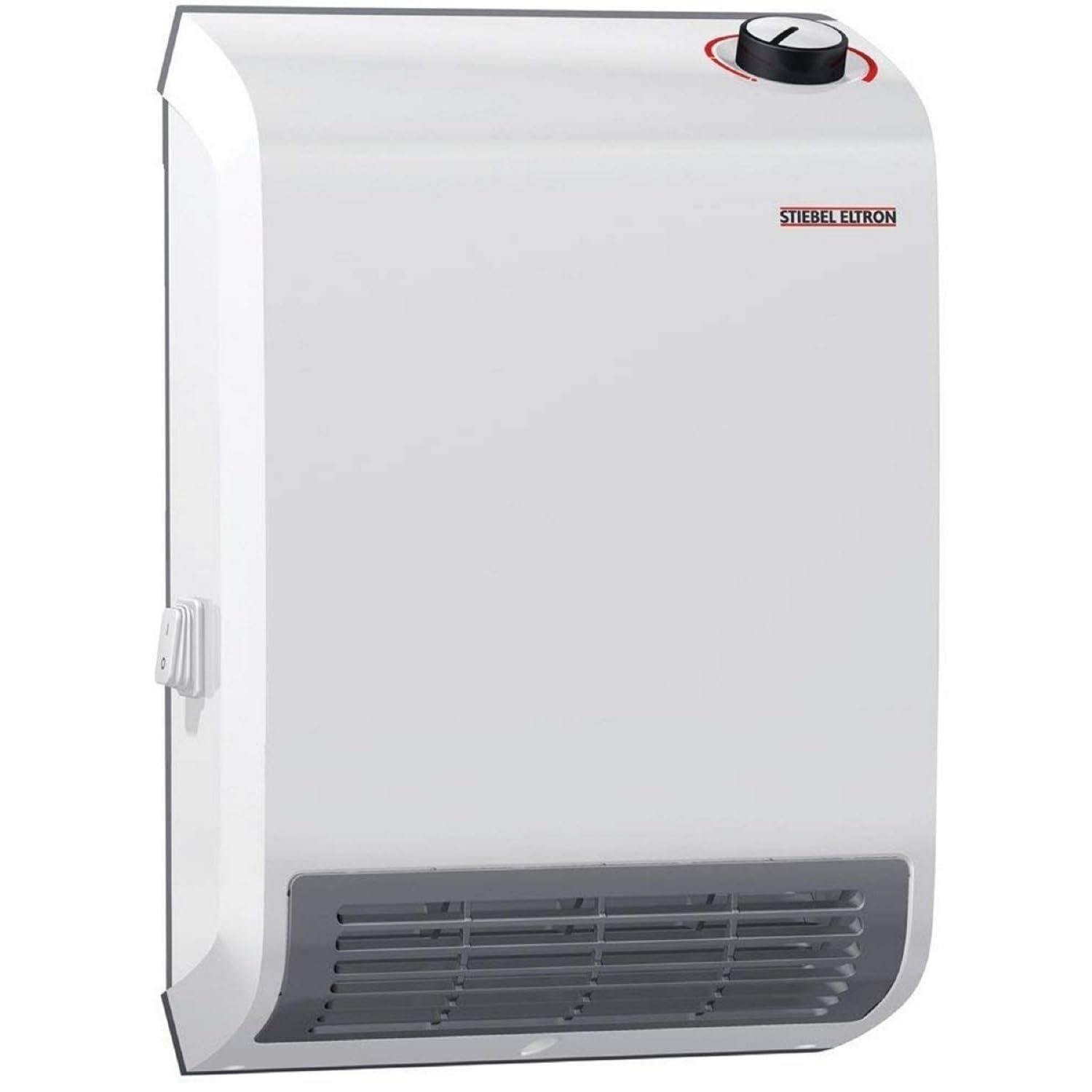
4. Stiebel Eltron CK Trend Wall-Mounted Fan Heater, 1500W, 120V, plug-in
German-built forced-air warmth that leans on quiet and dependability, not gadgets.
If what you want is a heater to install once and largely forget, this is the one. It runs on a 120 volt outlet with a 71-inch cord and plug, puts out 1500 watts and draws 12.5 amps, and delivers 5118 BTU/hour (a heat measure roughly equal to the warmth of a typical 1500W space heater, just stated differently). A glass-reinforced polycarbonate radial fan keeps the noise down to 49 dB(a), which is about the level of a quiet conversation. It carries a 3-year warranty against defects.
What owners lean on is reliability and performance, and it holds up in real settings — a park-model camper or a 10×14 room, staying comfortable even in 30 to 40 degree conditions. The ceramic PTC element gives steady forced-air heat, and its typical uses are the same small, chilly rooms a garage heater serves: basements, offices, porches. It is ETL listed to CSA and UL standards, and can be wired to work with a remote line-voltage thermostat.
Two things to know. The amperage is listed at 15 A (the unit draws up to 12.5 A per the specs), so give it a solid circuit. And the noise splits buyers — some find it decently quiet, others notice a whine. Owners also grumble that the included instructions do not explain how to bypass the built-in thermostat for a wall thermostat. Still, it comfortably heats a small room and stands behind its name.
Suits you if: you value a quiet, low-fuss name-brand heater for a small garage room or workshop nook.
Pass if: you need smart controls or coverage well beyond a compact space.
5. EconoHome Wall Heater Panel with Thermostat – Electric Wall Mounted Heater for Indoor Use – 400Watt Convection Heater – Perfect for Rooms Up to 120 Sq Ft – 120V – Updated Model

A silent, paintable wall panel that sips electricity instead of gulping it.
The EconoHome plays a completely different game: it is a flat convection panel, not a hot blast of air. At 23.5 by 23.5 inches and a quarter inch thick, it sits flush to the wall and can be painted to blend in.
Because it has no fan, it needs no fan noise — owners call it silent, odorless, and easy on the skin since it does not dry out the air. It targets rooms up to 120 square feet, and the temperature range runs 41 to 86°F with a plug-in thermostat. One buyer heating a 150 square-foot room reported only a small bump in the monthly power bill while running it continuously. It is cETL approved and UL-2021 and RoHS compliant, with overheat protection and a 3-year warranty.
The trade-offs are real for a garage. At 400 watts, this is gentle supplemental heat — it warms slowly, and one owner saw the temperature dip a few degrees before the panel recovered, which is normal for a large ceramic surface. It is also the most likely to feel underpowered in a cold, uninsulated bay, and there is at least one report of a unit arriving cracked from a third-party seller. For a small finished room, though, it is efficient and unobtrusive.
Context for the choice: if your “garage” is really a converted craft room or insulated office, this panel gives you steady, silent warmth for the least power. If you need to stand in the cold and feel heat within seconds, this is not that product.
Best match: a small, well-insulated room where you want quiet, low-draw background warmth you can paint over.
Not the pick: for a big drafty garage where you need fast, high-output blast heat.
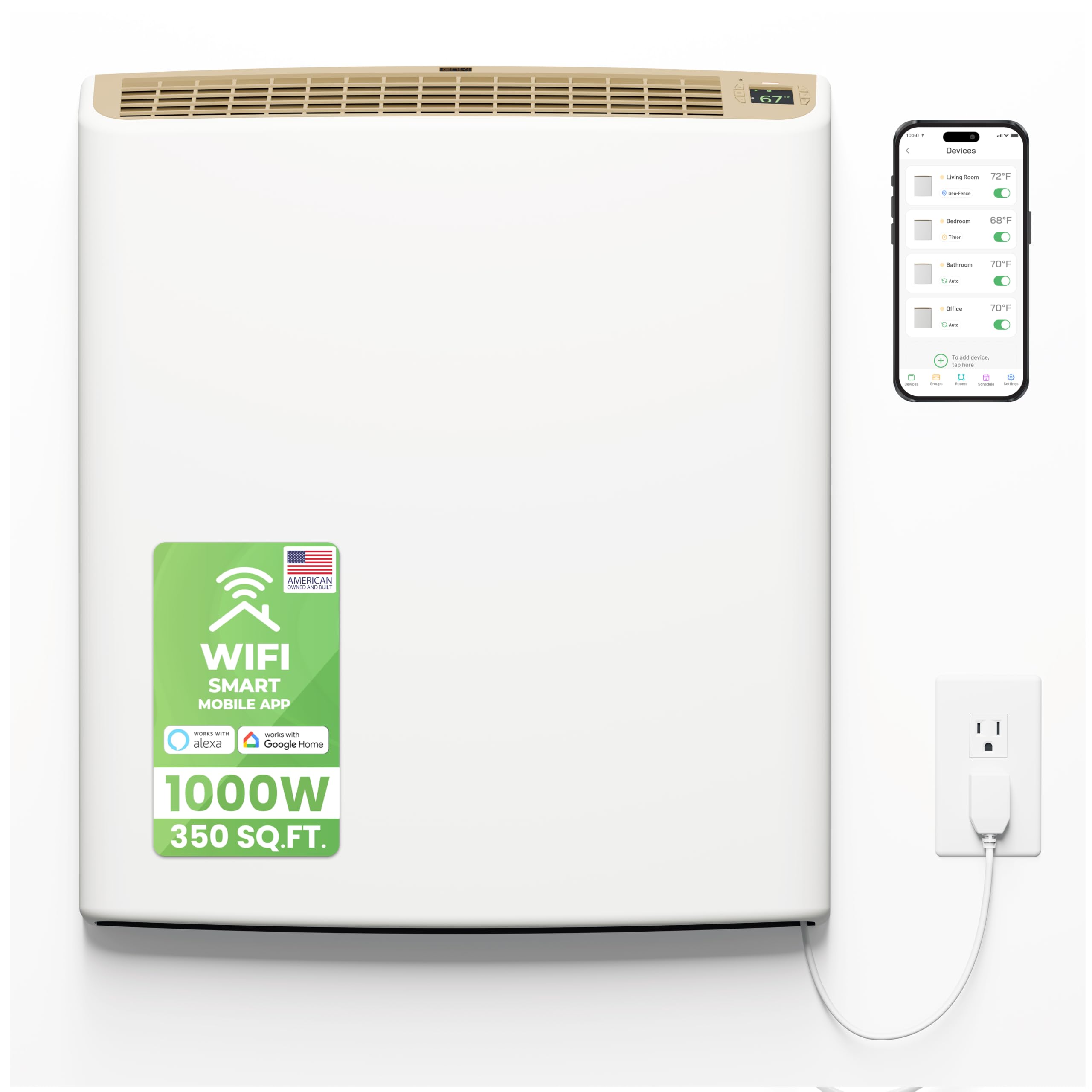
6. Smart EnviMAX 1000W Wi-fi Plug-in Electric Wall Heater – Energy Efficient Smart Heaters for Large Rooms – App Controlled Electric Heater with Thermal Shut Off Switch – Works with Alexa & Google Home
The app-scheduled convection heater you can set to warm the room on your commute home.
This is the premium end of the list, and it earns the spot with what it can do on a schedule. It runs 1000 watts on 8.33 amps — the gentlest draw of the high-precision models here — and uses triple-stack convection to spread heat across a quoted 350 square feet. The draw at 8.33 amps leaves more headroom on a shared circuit than a 12.5 amp 1500W unit. It arrives with a slim 3.1-inch-deep profile you mount flush and plug into a standard outlet.
The smart layer is the reason to pay up: a no-hub proprietary app with timer and scheduling, geofencing that reacts to whether you are home, plus Alexa and Google Home for voice control (the maker notes separate hardware is needed for voice). There is also a Wall-Sens feature, child lock, and freeze protection, a thermal shut-off switch, and a 3-year warranty. One owner runs a morning and evening schedule — warmer at night, cooler by day — through the app in a master bedroom, and another keeps one as backup heat to cut propane use.
Heat output divides buyers. Silent and steady when it works, but at least one owner found it produced barely any heat and others note it is tune-driven background warmth, not a fast blast. The app itself gets mixed reviews — setting a schedule requires creating a Room and assigning the device to it, which some find clunky. A couple of units also arrived defective, though support replaced them within a week. Keep it for supplemental heat in a room up to 150 square feet for the best results.
Worth it if: you want convection heat controlled by an app and voice, with a schedule that runs itself and a slim wall-mounted look.
Skip the splurge: if you want power-first performance in a cold workspace, or a simple on-and-off heater with no app to navigate.
Understanding the Specs
Watts and Amps on a 120 Volt Circuit
A 120 volt heater can only draw so much before it overloads a standard household circuit. Watts measure the heat it produces, and amps measure how hard it pulls on the wiring — they move together. The common 1500 watt, 12.5 amp units want a dedicated circuit to run cleanly. Lower-watt models, like a 1000 watt at 8.33 amps or a 400 watt at 3.33 amps, leave more room on the breaker for other things.
Radiant, Forced Air, and Convection
Radiant heat warms people and objects directly, so you feel it fast when you are in front of it. Forced air pushes warm air with a fan, which spreads heat around a room but adds a little fan noise. Convection relies on air rising over a warm panel to circulate warmth — silent and even, but slower to get going. Match the method to how you use the space: spot warmth for a bench, room warmth for a whole bay.
FAQ
Will a 120 volt garage heater run on a normal household outlet?
How many amps does a 1500W 120 volt heater use?
Radiant or forced-air — which is better for a cold garage?
How large a garage will a 120 volt garage heater actually warm?
Can I mount a garage heater on the ceiling instead of the wall?
Are these heaters safe to leave running unattended?
Do smart garage heaters need WiFi to work?
What is the difference between the 1500W, 1000W, and 400W options?
Will a garage heater dry out the air or make noise?
How long does a 120 volt garage heater last?
Final Thoughts: The Verdict
For most garages, the 120 volt garage heater winner is the Brightown 1500W Smart Wall Heater, because it combines fast 1500W PTC heat with app and voice control that lets you warm the room before you walk in. If your work happens at a bench or in one spot, the BEYOND HEAT and Shinic radiant quartz units aim heat straight at you with a built-in work light. And for the lightest draw in a small, insulated room, the silent EconoHome panel or the app-scheduled Smart EnviMAX will keep you comfortable without straining your circuit.
How We Picked
We do not accept paid placement. Every pick is matched to a real buyer and a real use-case; we do not hands-on test units.
Sources & Methodology
Specifications: manufacturer listings and product documentation. Review insights: verified customer reviews, as of September 2026. Pricing: not shown on this page (it changes often); check the current price via the retailer link.
As an Amazon Associate, KitchPrep earns from qualifying purchases. This does not affect which products we feature.
Related Guides
