
Specs are compiled from manufacturer listings and verified buyer reviews and can change over time — please confirm the key details on the product page before buying.
When you replace a valve on a pool line, a well, or a water heater feed, you want one that shuts off cleanly and keeps shutting off cleanly a year later. Three things decide that: whether the valve is full port (a bore as wide as the pipe, so it does not choke your flow), what it is made of (brass, PVC, or stainless steel), and how it connects (glued socket or threaded NPT, the standard tapered pipe thread). This guide covers that choice in plain terms.
I’m Mohammad Maruf — the founder and writer behind KitchPrep. This guide is built by comparing the manufacturers’ published specifications and the patterns across verified customer reviews, so you get each pick’s real strengths and trade-offs instead of marketing spin.
You will see how each valve handles pressure ratings, port style, and connection type so you can match one to your pipe. Every pick below is a strong option among the 2-inch ball valve choices.
Our Picks at a Glance


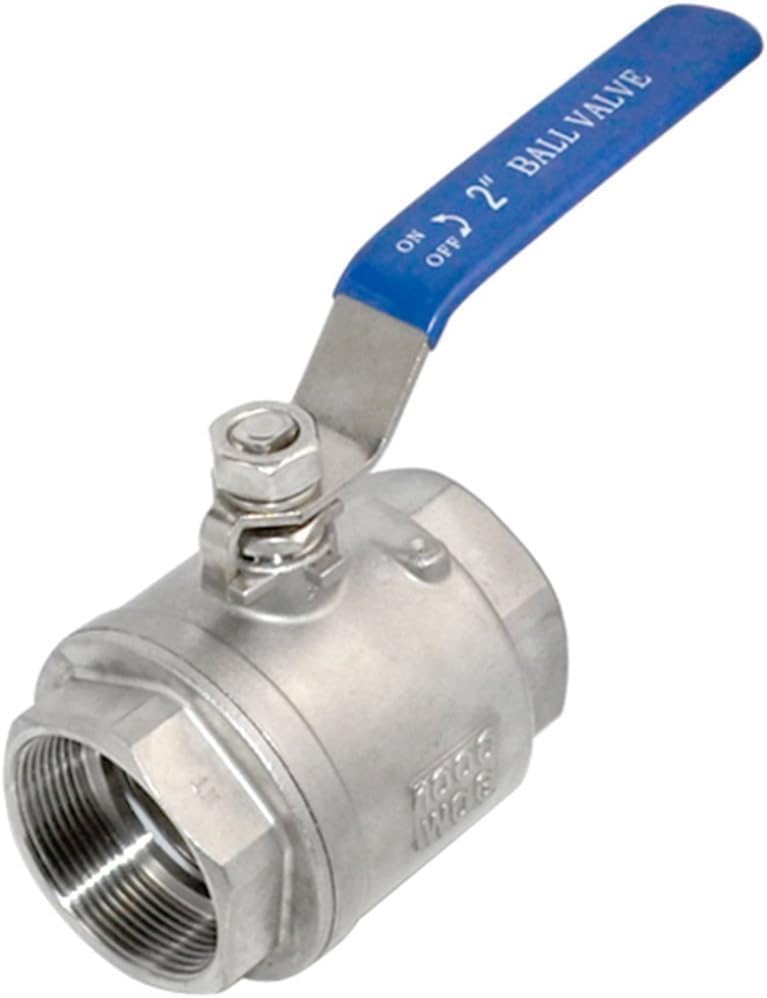
How To Choose The Best 2-Inch Ball Valve
Before you buy, match three numbers to your system: the port style, the connection type, and the pressure rating. Matching all three before you buy avoids a second shutdown of the line.
Full Port vs Standard Port
A full port valve has an opening through the ball that matches the pipe’s inside diameter, so water or gas flows through without a pinch. A standard port valve has a narrower opening, which restricts flow. The DERNORD 1PC valve, for example, is standard port, and its own listing warns that the marked size is only the thread size it fits — not the bore. If you are feeding a pressure washer, a tankless heater, or a pool return line, full port keeps your volume up.
Socket vs Threaded Connections
Socket valves glue onto the pipe, which makes a permanent, low-profile joint — the HYDROSEAL Kaplan is socket-only. Threaded valves (NPT) screw on, so you can remove and service them later without cutting pipe. If you may need to swap the valve later, choose threaded NPT. If the joint must stay permanent, choose glued socket.
Material: PVC, Brass, or Stainless
PVC suits pools and irrigation where cost and glue joints make sense. Brass handles potable water and gas well and resists rust when the body is lead-free. Stainless steel resists chemicals and outlasts brass and plastic on carwash and chemical lines, as DERNORD buyers report.
Quick Comparison
| Model | Best For | Max Pressure | Connection | Material | Amazon |
|---|---|---|---|---|---|
| HYDROSEAL Kaplan 2’’ PVC True Union★ Best Overall | Pools, tanks, and reef systems | 200 psi | Socket (glue-on) | PVC | Amazon |
| 2″ PVC Ball Valve, Smooth Handle (2 Pack)Best Value | Irrigation and pool lines on a budget | 150 psi | Solvent | PVC | Amazon |
| Megairon 316 Stainless Steel Full PortHighest Pressure | High-pressure water, oil, and gas | 1000 psi | NPT threaded | 316 Stainless Steel | Amazon |
| DAN SPEED 2″ NPT 316 Stainless Full Port | Ranch and well systems that chew up PVC | 1000 psi | NPT threaded | 316 Stainless Steel | Amazon |
| DERNORD 1PC Stainless Steel Ball Valve | Carwash and chemical lines | 1000 psi | NPT threaded | 304 Stainless Steel | Amazon |
| WiseWater 2″ NPT Full Port Brass | Potable water and compressed air | 600 psi | FIP threaded | Brass | Amazon |
| REVALVED Full Port 2″ Brass Ball Valve | Residential plumbing and gas lines | 600 psi | NPT threaded | Brass | Amazon |
| VALFLUIDS Full Port Forged LF Brass | Drinking water and gas service lines | 600 psi | NPT threaded | Brass | Amazon |
| Eastman 2 Inch IPS Heavy Duty Full Port | Whole-house shutoffs and water heaters | 600 psi | IPS full port | Brass | Amazon |
In‑Depth Reviews
1. HYDROSEAL Kaplan 2’’ PVC True Union Ball Valve with Full Port, ASTM F1970, EPDM O-Rings and Reversible PTFE Seats
Our pick — over 4.5★ from 800+ verified ratings; the strongest balance of quality and price.
The true union that lets you service a pool line without cutting pipe again.
What sets this valve apart from a plain glued ball valve is the true union design: both ends unscrew, so if the seal ever fails you swap the cartridge instead of sawing out the joint. That serviceability is what wins people over, and the review pages call it one of the better ball valves going. It is rated for 200 psi (pounds per square inch, a measure of pressure) at 73F, and it carries the ASTM F1970 standard, the specification that sets performance requirements for PVC ball valves used in this kind of plumbing. Its socket connection means you glue it on, so plan for a permanent bond rather than a screw-on fit.
Its size is compact for a 2-inch valve — the body measures 4.72 x 2.36 x 0.5 inches — which helps it tuck into tighter equipment pads. The full port bore lets water move through without a pinch, so a reef return or an irrigation zone keeps its flow. Inside sit two EPDM O-rings and two PTFE seats; EPDM is a rubber compound that handles water and ozone well, and PTFE is a slick, non-stick plastic that lets the ball turn smoothly. It is also actuator-ready, meaning you can bolt a powered actuator on later if you ever want to automate the valve.
The honest catch is sealing consistency. Some units hold tight and some develop a slow weep, so this is a valve that rewards careful glue-up and clean threads. If your pipes sit close together, measure your clearance first: installation wants a gap around the valve body so the union nuts can spin.
What owners single out
- Quality is the most-praised trait — well over 70 owners call it out, with durability close behind
- True union design lets you replace the cartridge without cutting the pipe
- Smooth quarter-turn operation on reef tanks and pool equipment alike
- Full port keeps flow open; 200 psi rating tops the 150 psi PVC pick below
Where it asks more of you
- Socket-only connection means a permanent glued joint, not a screw-on swap
- Sealing gripes come up in review pages — prep and clean threads matter
- One owner measured the inside opening as less than claimed, so expect some restriction if you run Schedule 40
Reach for this if: you want a serviceable valve on a pool, tank, or reef line and you are willing to glue it in.
Look elsewhere if: you need a threaded fit you can unscrew on the pipe end — the Kaplan only takes a glued socket.
2. 2″ PVC Ball Valve, Shut-Off Valve with Smooth and Excellent Handle, Rated at 150 PSI (2 Pack)
Two sturdy glue-in valves with a handle your hands will actually enjoy gripping.
For a pool or irrigation repair, this AIPOR two-pack covers two lines at 150 psi. You get two 2-inch valves rated at 150 psi and 140 degrees Fahrenheit, both built to fit Schedule 40 PVC pipe by solvent weld — solvent weld is the glue-on method, so the joint fuses permanent. The handle is the part everyone notices: it is larger than the short T-handle most builders leave behind, and ease of use is the second-most-praised trait in the review pages, right behind overall quality. It suits sprinkler zones, sewage lines, pool equipment, and agricultural irrigation, and the one-piece body removes redundant joints that tend to weep.
Where this pick stands apart from the HYDROSEAL above is price-per-valve and simplicity — it is the budget-friendly route, and you pay for that with a lower 150 psi ceiling and a glued-only connection rather than a serviceable union. For a pool line running normal household pressure, that ceiling is plenty.
One caution worth sizing correctly: a handful of owners found the size felt off for their setup, and the occasional unit went stiff after a few months in service. Treat it as a fit-and-torque note rather than a flaw — most buyers install it and forget it. It is the value pick you grab when you want two reliable shutoffs without paying for union hardware you may never service.
Fair value read: two glue-in valves at a budget-friendly point, each rated 150 psi, with a wide handle that beats the standard stubby design for grip and access in tight pits.
Best for: the do-it-yourselfer running a pair of pool or sprinkler lines who wants simple and affordable.
Think twice if: you need a threaded connection or you plan to service the valve in place — this one glues on for good.
3. 316 Stainless Steel 1/8″~3″ Full Port Ball Valve with Blue Vinyl Handle, NPT Female x Female Thread, 1000 WOG (2 Inch)
Heavy stainless muscle that shrugs off pressure the PVC valves cannot touch.
If your system runs hard, this Megairon valve is the pressure king. It is rated at 1000 psi for water, oil, and gas, and that ceiling dwarfs the 150 psi of the budget PVC pick and the 200 psi Kaplan above — it holds up to a genuinely tougher duty cycle. The body and ball are 316 stainless steel, the grade that resists corrosion from salt and chemicals better than the 304 stainless in the DERNORD below, and it runs a temperature range of minus 60 degrees Fahrenheit to 450 degrees Fahrenheit, so steam-adjacent and cold-service jobs are both on the table.
The full port bore means no flow penalty, the lever turns with low torque, and the valve is serviceable — it comes apart at the threads so you can inspect and reseat it. The ports are female NPT on both ends, which is the tapered national pipe thread standard that seals as it tightens. Practical uses run wide: flushing a water heater, feeding an IBC tote, or isolating a garden watering line all show up in how owners actually run it.
Here is the honest trade. Sealing performance is the weak point in owner feedback — thread leaks crop up, and the fix reported by buyers is proper prep: a few wraps of tape plus a dab of pipe sealant before you tighten. The bore itself can read smaller than the number suggests, so a few buyers found it restrictive next to a true full-bore valve. Threaded connections also need pipe support so the weight does not stress the joint. Set your line up right and this valve rewards you with pressure headroom the plastic valves simply do not offer.
The pressure case: a 1000 WOG rating and a full port bore put this a full tier above the 200 psi plastic options for water, oil, and gas work.
Pick this when your job runs high pressure or aggressive fluid and you want stainless durability over plastic economy.
Sixty-second warning: thread prep is not optional — skip the tape and sealant and you invite the drips owners mention.
4. DAN SPEED 2″ NPT Female 316 Stainless Steel Full Port Ball Valve Vinyl Handle WOG1000

Built for the buyer who is done replacing PVC and brass valves every season.
Ranchers and well owners pick this one because the 316 stainless body survives hard use. The 316 stainless body and ball resist the crud and pressure swings that kill plastic, and it is rated 1000 psi across water, oil, and gas with the same minus 60 to 450 degrees Fahrenheit range as the Megairon above. The full port bore delivers unrestricted flow, the vinyl-wrapped handle gives you a solid grip, and the female NPT ends screw straight onto standard tapered pipe threads.
Where it feels different from the Megairon is in the break-in. The ball can be stiff from the start, and getting it moving sometimes takes real leverage — the honest advice from the review pages is to disassemble and lubricate it if you want buttery operation. Once worked in, it seals and holds. The body dimensions list as 2 x 1 x 1 inches, and the item ships as a single valve.
Thread fit is the other thing to expect. Because NPT threads are not always cut to identical depths between makers, a few owners found adapters did not seat fully and had to add tape, sealant, and patience. Run it on a well line or a ranch water system where the valve sees hard use, and the stainless steel pays that friction back in years of service.
Why the ranch crowd sticks with it
- 316 stainless outlasts the brass and PVC it replaces on hard-used ranch lines
- Full port and a 1000 psi rating handle pressure without flow loss
- Long service life means you are not digging the line up every couple of years
Before you commit
- The ball turns stiff and may want lubrication for smooth action
- Thread fit varies between makers, so adapters may need extra tape and sealant
- It costs more than the plastic options, a spend you justify by longevity
For the buy-once crowd: if you are tired of replacing valves on a well or ranch system, this stainless full port earns its keep.
skip it if: you want a turn-key smooth action straight from the box — this one may need a strip-and-lube first.
5. DERNORD Stainless Steel Ball Valve 1PC Type 2 Inch NPT Standard Port for Water, Oil, and Gas
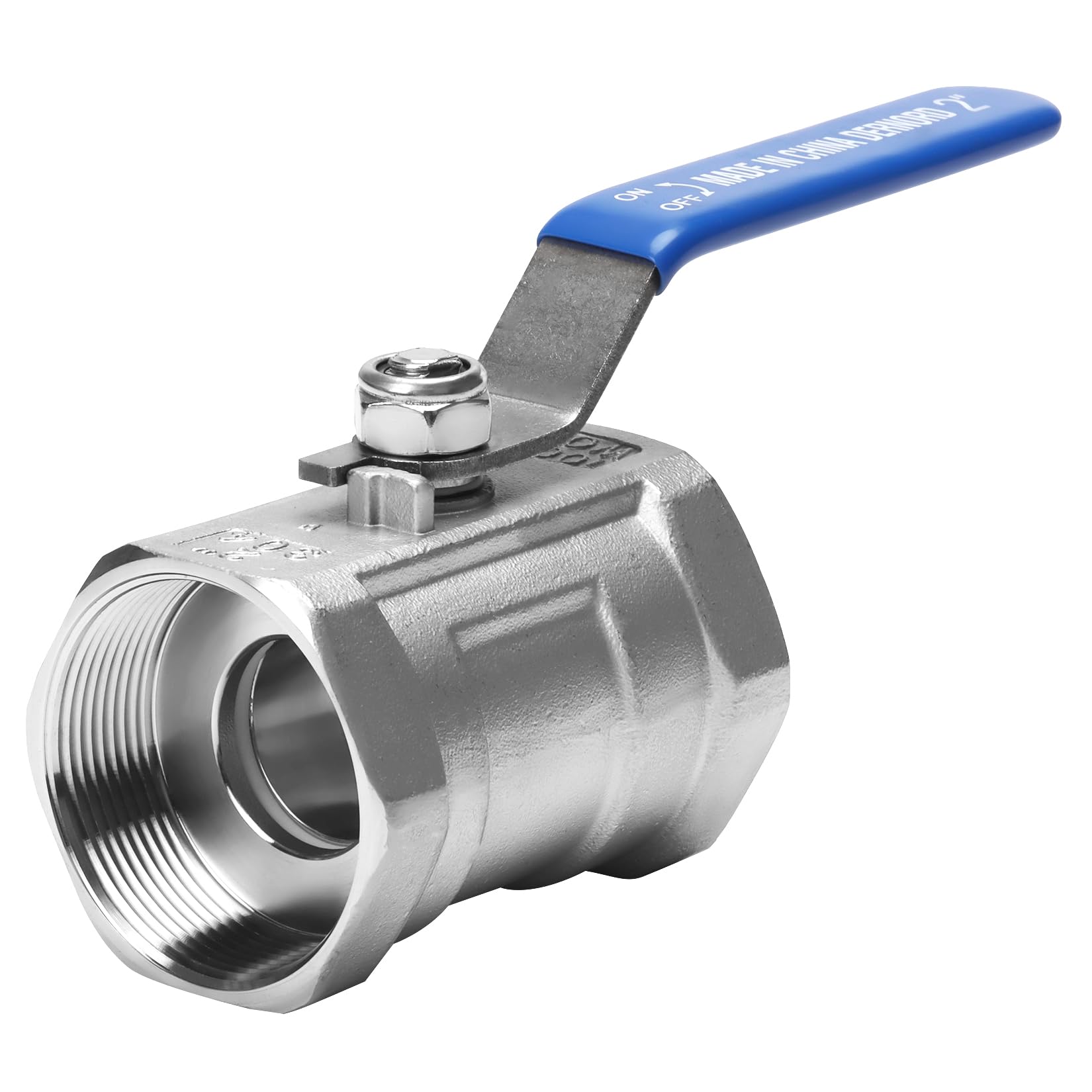
A one-piece stainless workhorse built to survive chemicals and years of use.
This DERNORD valve is the one to think about if your line carries something nasty. It is built from 304 stainless steel, rated 1000 psi for water, oil, and gas, and it handles a temperature range of minus 60 to 450 degrees Fahrenheit. Carwash operators and users of aggressive chemicals report it outlasts the brass and plastic valves that gave out on the same lines — its own listing warns plainly that this is a standard port, not a full port, so the marked 2-inch figure is the thread size it fits, not the bore through the ball.
Because it is standard port, it does restrict flow compared to the full port valves above, and that is the deliberate trade for a compact body and a lower price. The one-piece body keeps it simple and strong, with a blue-vinyl handle and female NPT ends. It meets ASTM and NSF specifications, and it comes apart at the threads for servicing.
You get exactly what the listing describes — a solid stainless valve, no leaks, easy install — but expect the narrower bore to slow a high-volume fill. For a bead blaster, an RO unit, or a carwash chemical line where reliability beats raw flow, this is the value-minded stainless pick. For a system where every gallon of flow counts, step up to a full port valve instead.
Where it wins: 304 stainless, a 1000 psi rating, and a reputation for outlasting brass and plastic on chemical and water lines.
The durable-value choice for carwash, chemical, and utility lines where stainless outlasts the alternatives.
Only caveat: standard port narrows your flow — if you need full bore, look to the stainless full port picks instead.
6. WiseWater 2″ NPT Full Port Brass Ball Valve, UPC Certified, 1 Pc
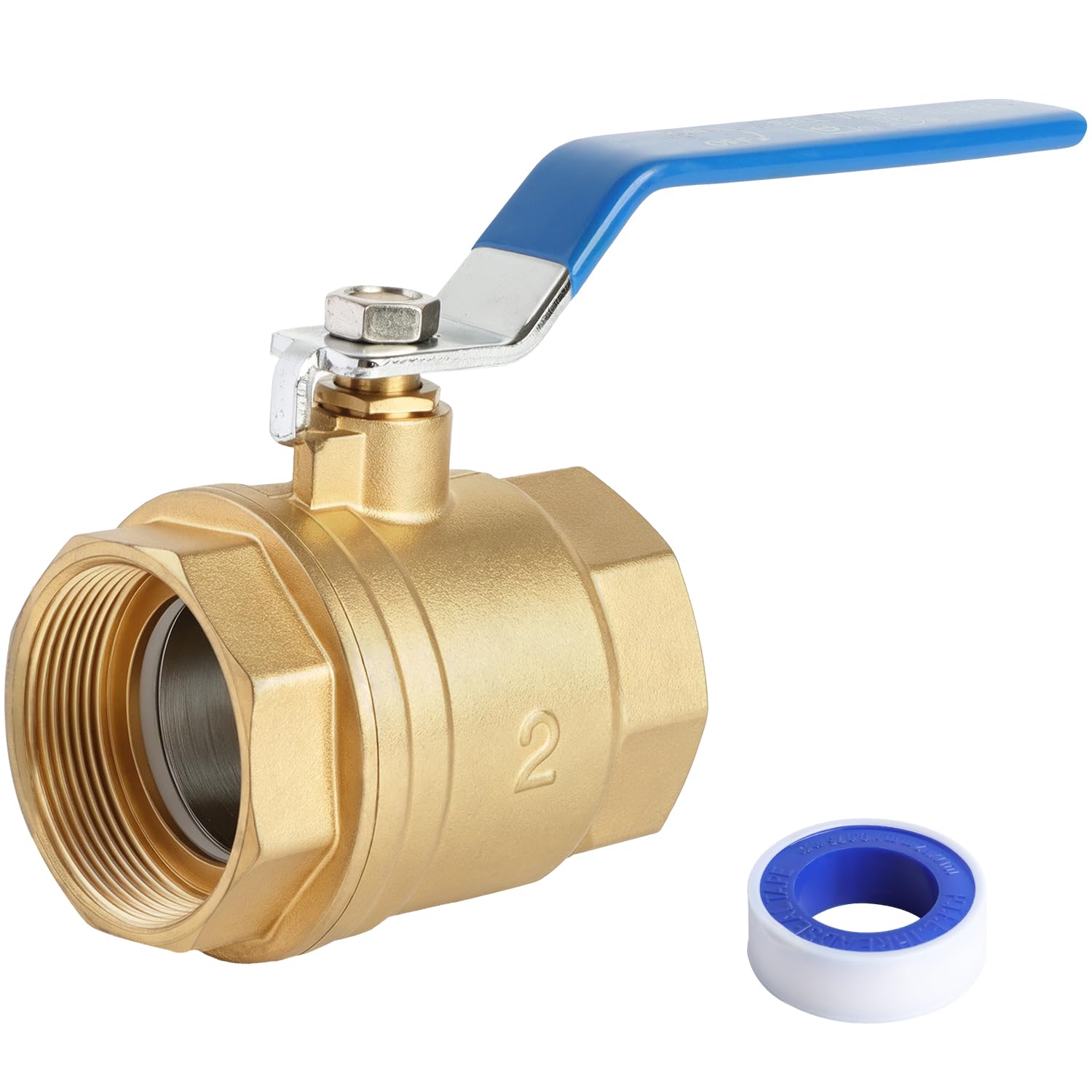
A lead-free brass full port that seals tight on a quarter turn.
Brass brings something the plastic valves cannot — it handles the heat and abuse of a compressor or a potable water line without complaint. This WiseWater valve is full port, rated 600 psi for water, oil, and gas, and shuts off on a quarter turn with the ball seated behind two FIP connections. FIP is the internal-thread fitting that accepts a matching threaded male pipe end, and the maker notes the valve arrives in the open position by default, so you know its starting state.
What earns this one attention is the seal and the smoothness once it breaks in. The valve is built to close completely, and owners who run it on air compressor main lines and pressure-washer feeds report good flow and clean operation — bigger ball valves gave them the volume they wanted. It pairs well with the pick above when you are converting a whole rack of outside valves for better flow.
The one quirk is the break-in. New from the start the handle can be stiff and wants some force before it loosens into its smooth action. A couple of buyers also found stray metal shavings in the threads, so a quick wipe before install is smart, and upgrading to a thicker thread tape helps the seal hold. Sized and seated correctly, this is a clean-shutting full port brass valve at a fair value for the material.
What makes it shine: a full port, lead-free brass body rated 600 psi that seals fully and moves oil, air, and water through a quarter-turn handle.
Right for: anyone wanting a full port brass valve for potable water, compressed air, or gas who will clean and prep the threads first.
Bear in mind: it breaks in stiff, so expect a little force on the first open and clean any thread debris before you install.
7. REVALVED Full Port 2″ Brass Ball Valve, Lead-Free, Female Threaded NPT, 150 PSI WSP / 600 PSI WOG

Finger-tip control from a chrome-plated body you can trust on the main line.
This REVALVED valve is the one to reach for on a residential main shutoff. It is forged brass with a chrome-plated body, lead-free, and built as a full port valve rated 600 psi for water, air, or gas, and it turns on a 90-degree grip-coated handle that many owners describe as a fingertip control. The female NPT ends take standard tapered pipe threads, and the body carries the number 2 x 1 x 1 inches as its listed dimensions.
Its strength shows in the finish and function. Owners who replaced an old gate valve with this one report more confidence in being able to cut the supply off completely, and the smooth turn is the trait that comes up most. It also holds up on a home gas line — one reviewer noted it to cut gas service for repairs, and the gas company approved its use. It comes with a 30-day money-back guarantee from the maker.
Two things to know before ordering. Fit is the most-discussed mixed point: some applications are not threaded to match, so the seal depends on getting the threads right. And packaging can arrive rough — a few units reached buyers with small dings on the brass, though the ball itself sealed tight. New valves also open and close stiff at first, then loosen up. Prep the threads, inspect on arrival, and this becomes a solid full port brass shutoff for home water and gas.
Where it earns its spot
- Quality and functionality lead the feedback — forged lead-free brass with a full port bore
- Smooth 90-degree grip handle gives fine control, down to a fingertip
- 600 psi rating and a chrome-plated body suit residential water, air, and gas service
Take care with
- Thread fit varies by application — not every line matches cleanly
- Some units ship with minor dings on the brass; inspect on arrival
- Stiff from the start, loosening only after a few cycles
A confident pick for: replacing a household main shutoff or adding a gas cut-off with smooth, controlled action.
Hold off if: your existing threads are non-standard — this valve needs a clean NPT match to seal.
8. VALFLUIDS Full Port Forged LF Brass Ball Valve With Female Thread NPT Connector, 150 PSI WSP / 600 PSI WOG (2 Inch)

The certified brass valve you fit on a drinking-water or gas service line.
When a code inspector is going to look at the joint, you want the paperwork to match. This VALFLUIDS valve is forged lead-free brass with a two-piece full port body, PTFE seats, and a blowout-proof stem, and it carries CSA and CUPC approval and meets potable water standards. It is rated 600 psi WOG — WOG stands for water, oil, and gas, the three media the rating covers — with a 150 psi working steam pressure figure as well. Its working medium is drinking water, which is why the certifications matter here rather than on a pool line.
The application range is broad. Owners run it to fix a leaking check valve on a compressor, to control gas supply for a ceramic kiln, and on natural gas lines where the CSA approval gave confidence. The handle adjusts easily and gives fine flow control, and the forged brass body feels solid and heavy in hand. The full port bore keeps volume up, and the stem is engineered so it cannot blow out under pressure.
Being honest about the occasional miss: a rare unit has arrived with internal parts missing or a defective thread, so open the box and confirm the ball is present before you install. Value opinions split, and a few leaks show up if the water is turned on hard against a fresh joint — tape, sealant, and correct tightening cure that. Come to it expecting certified, code-friendly brass and it delivers.
Why it stands out: forged lead-free brass certified to CSA and CUPC, rated 600 psi WOG, and cleared for drinking water and gas service where approval counts.
Made for: code-conscious installs on potable water or gas where a certified, lead-free full port valve is the requirement.
Check first: rare units arrive incomplete, so inspect the internals before plumbing it in.
9. Eastman 2 Inch IPS Heavy Duty Full Port Ball Valve, Brass Plumbing Fitting, 20055LF
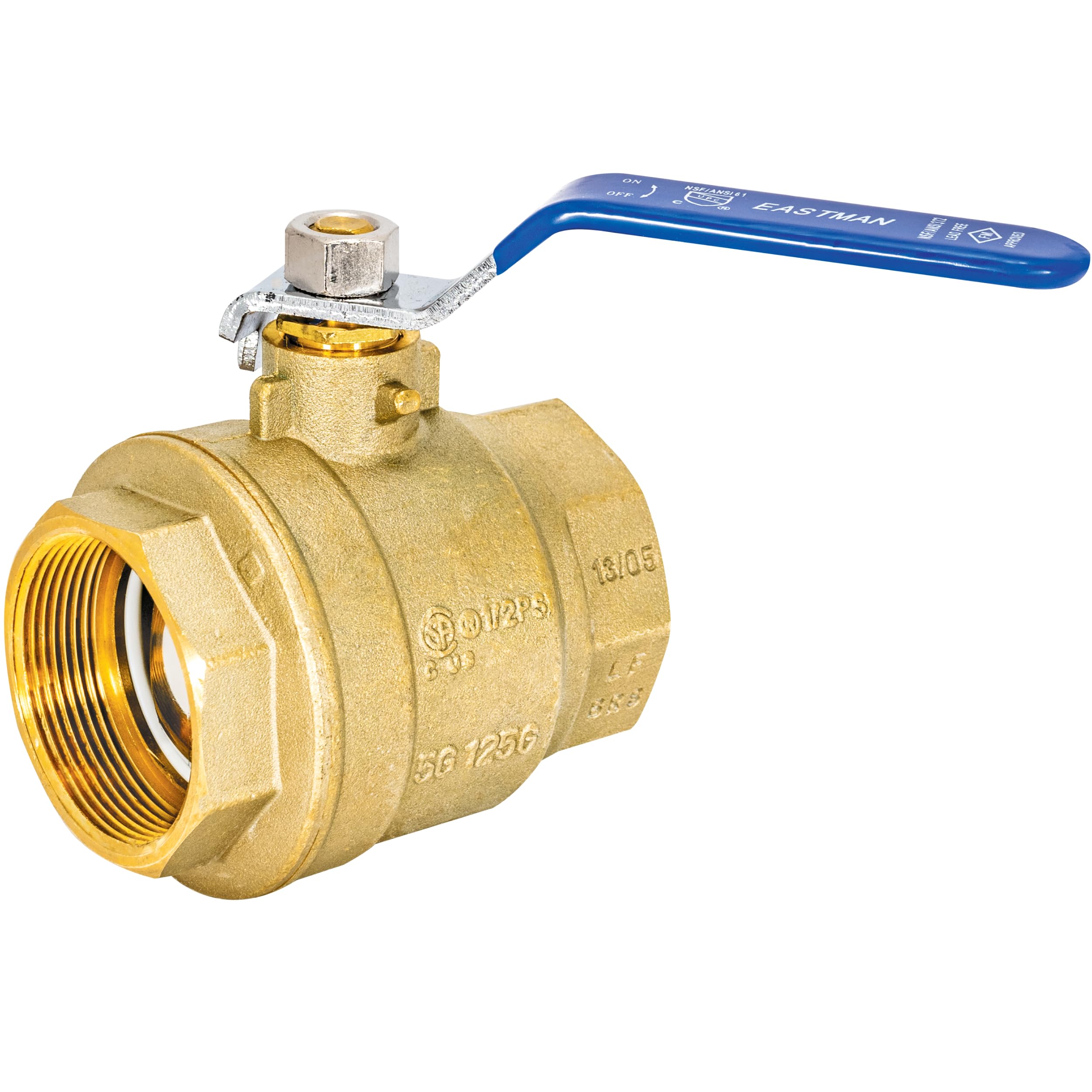
The heavyweight brass shutoff built for a whole-house main and a water heater feed.
This Eastman valve is the solid, substantial one of the group — a 3.6-pound brass body with a full port bore and 2-inch IPS connections on both ends. IPS is the iron pipe size standard, the common sizing used for water-system pipe and fittings, so it slots into standard water plumbing. It is rated 600 WOG and 150 psig for saturated steam, and it is UPC approved, CSA certified, and meets potable water standards, so it is cleared for the drinking-water side of your system. The stamped steel handle carries a vinyl coat for a comfortable grip.
Its best-loved trait is that it simply works. Owners who swapped out a failing water heater shutoff or a well main report the new valve sits clean, operates easily, and holds without leaking once tape and pipe dope are applied. The full port bore reduces pressure drop, which is why it shines as the main shutoff for a house. The heavy brass body also takes high-temperature and high-pressure work in stride.
The honest caveat is small but real. Some users find the handle needs significant force to move, and at least one buyer saw the fastening nut on the valve rust within a year of outdoor use — a reminder that even a good brass valve wants a dry, sheltered spot or a little care. Sized onto a main line or a boiler feed, though, this is a sturdy brass shutoff that should serve for a long run.
The case for the Eastman
- Quality is the runaway favorite trait — well over 60 owners call it out, with value close behind
- Full port IPS design keeps pressure drop low on a main shutoff
- Certified for potable water and rated for saturated steam service
Room to note
- The handle can take real force to open and close
- The fastening nut may rust outdoors over time — keep it sheltered
- Heaviest body here at 3.6 pounds, so it wants solid pipe support
Solid choice for: a whole-house main line or water heater feed where you want a heavy, certified brass valve that holds for the long haul.
Think about it if: you want a light, easy-flip handle — this one is beefy and wants some muscle.
Understanding the Specs
Pressure Ratings (PSI and WOG)
PSI means pounds per square inch — the amount of force the valve can hold without failing. WOG stands for water, oil, and gas, the three media a rating covers, so “600 WOG” tells you the valve is cleared for all three at 600 psi. WSP is the working steam pressure number, the limit when the valve handles steam rather than liquid. Match the rating to your line’s real pressure — a 1000 psi stainless valve is overkill for a sprinkler zone, while a 150 psi PVC valve is the fitting choice for a pool with household pressure. The Eastman, for example, lists 600 WOG and 150 psig for saturated steam.
Port Style: Full vs Standard
Full port means the opening through the ball matches the pipe’s inner diameter, so flow passes without being pinched — the pick for any line where volume matters. Standard port has a narrower opening, which is more compact and often cheaper but restricts flow. If you are feeding a tankless heater, a pressure washer, or a pool return, go full port. The DERNORD listing states plainly it is standard port, so factor that restriction in before you buy.
FAQ
How do I know if I have a 2-inch ball valve or a different size?
What is the difference between full port and standard port in a ball valve?
Can I use a 2-inch ball valve on a pool line?
How long does a 2-inch ball valve last?
Should I choose a threaded or glued ball valve?
Is brass better than PVC for a 2-inch ball valve?
Why does my new ball valve leak at the threads?
Can I use a 2-inch brass ball valve for natural gas?
What does WOG mean on a ball valve rating?
Does the handle style affect how easy a 2-inch ball valve is to operate?
Final Thoughts: The Verdict
For most buyers replacing a valve on a pool, tank, or water line, the 2-inch ball valve winner is the HYDROSEAL Kaplan — it pairs a true union design you can service without cutting pipe with a 200 psi rating and full port flow. If you want maximum pressure and stainless durability, grab the Megairon 316 Stainless Steel Full Port, which carries a 1000 psi rating. And for a whole-house main or a water heater feed that wants a heavy, certified brass body, the Eastman Heavy Duty Full Port is the one to reach for.
How We Picked
We do not accept paid placement. Every pick is matched to a real buyer and a real use-case; we do not hands-on test units.
Sources & Methodology
Specifications: manufacturer listings and product documentation. Review insights: verified customer reviews, as of September 2026. Pricing: not shown on this page (it changes often); check the current price via the retailer link.
As an Amazon Associate, KitchPrep earns from qualifying purchases. This does not affect which products we feature.
Related Guides
