
Specs are compiled from manufacturer listings and verified buyer reviews and can change over time — please confirm the key details on the product page before buying.
If you need internet where there is no wall socket, the short answer is this: buy for the battery and the band, not for the marketing. A battery powered router only helps you if it stays awake as long as you do and can actually find a tower where you are standing. The eight picks below split cleanly into two jobs: a serious office-grade mobile router for power outages and worksites, and light pocket hotspots for travel, camping, and campsite streaming.
I’m Mohammad Maruf — the founder and writer behind KitchPrep. This guide is built by comparing the manufacturers’ published specifications and the patterns across verified customer reviews, so you get each pick’s real strengths and trade-offs instead of marketing spin.
You also get the honest trade-offs, like units that run hot in a pocket or simply go dark where there is no tower. Below you get the battery sizes, the carrier bands, and the failover behavior (how the router switches to a backup connection when the main one drops) spelled out, so picking the best battery powered router depends on your trip, not guesswork.
Our Picks at a Glance
How To Choose The Best Battery Powered Router
Choosing a battery powered router is really about matching two numbers to your life: hours of runtime and the cellular bands your carrier uses. Everything else is a bonus.
Battery capacity and runtime
A bigger battery number in mAh (milliamp-hours) usually means more hours before you need a wall. The GL.iNet GL-XE3000 pairs a 6400mAh battery with up to 8 hours of connectivity, which is roughly a full workday away from an outlet. The iotesimglo hotspot’s 3500 mAh battery reaches up to 12 hours of use with power-saving mode enabled. So the capacity alone is not the whole story, but it is the first thing to check.
Band support and travel compatibility
Your router is only as useful as the towers it can talk to. This is where models diverge sharply: the KuWFi covers B1/B3/B5/B7/B8/B20 and TDD-LTE B38/B39/B40/B41, which suits Europe, Asia, Africa, and the Middle East, but not every corner of the world. The NETGEAR M6 Pro lists far broader 5G Sub-6 and mmWave bands, so if you roam internationally, verify the specific bands your destination carrier uses before you commit.
Setup complexity
Most of these devices require you to insert a SIM, then log into a browser-based admin panel to adjust the APN (Access Point Name, the carrier settings your router needs to connect). Some do it automatically, some do not. Do not assume plug-and-play, even when the SIM is compatible.
Quick Comparison
| Model | Best For | Battery | Wi-Fi Speed | Max Devices | Amazon |
|---|---|---|---|---|---|
| GL.iNet GL-XE3000 Puli AX★ Best Overall | Offices and worksites | 6400mAh | 574Mbps (2.4GHz) + 2402Mbps (5GHz) | — | Amazon |
| KuWFi 4G LTE Mobile WiFi HotspotBudget Travel Pick | Europe and Africa travel | 2400mAh | 150 Mbps | 10 | Amazon |
| AT&T Turbo Hotspot 3Best Battery Life | Camper and rural backup | 3000 mAh | 10 Gbps (max) | 16 | Amazon |
| S2 Portable WiFi Hotspot | No-SIM US travel | Up to 15 hours | Wi-Fi 6 | 8 | Amazon |
| iotesimglo Portable WiFi Travel Router | Flexible multi-country | 3500 mAh | 150 Mbps | 8 | Amazon |
| Linklan eSIM Global WiFi Hotspot | International business | 5000mAh | 433 Mbps | 16 | Amazon |
| GL.iNet GL-E750V2 MUDI | Networking enthusiasts | 7000mAh | 300Mbps (2.4G) + 433Mbps (5G) | — | Amazon |
| NETGEAR Nighthawk M6 Pro | 5G roamers | 5040mAh | 3600 Mbps | 32 | Amazon |
In‑Depth Reviews
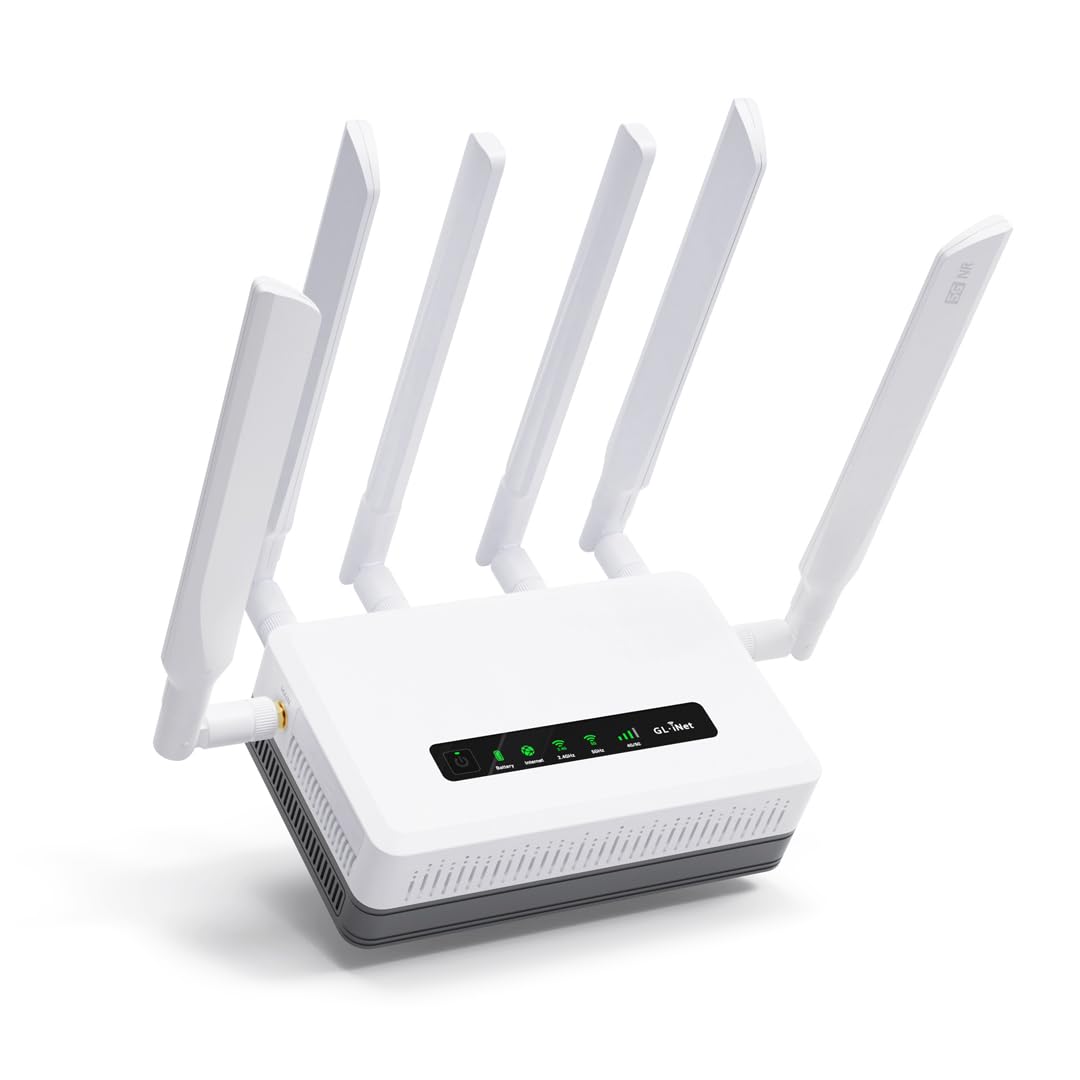
1. GL.iNet GL-XE3000 Puli AX 5G Router with Dual SIM and 6400mAh Battery
Our pick — over 4★ from 150+ verified ratings; the strongest balance of quality and price.
The office-grade router that keeps working after the power strip goes dark.
This is the pick for anyone who needs internet to survive a power cut. A 6400mAh battery keeps its 5G link live for up to 8 hours without any wall power, so meetings, card payments, and cloud services keep running through an outage. That battery is the reason it sits at the top of this list rather than simply the fastest spec sheet here.
Where it decisively leads is raw throughput. Its 3000 Mbps data rate dwarfs the KuWFi hotspot’s 150 Mbps, the difference between a laggy video call and a smooth one. Frequencies run at 5 GHz versus the KuWFi’s 2 GHz, which helps in crowded airspace. With dual-SIM you can hold two carriers on a single standby and let it fall over to the stronger one automatically when one drops.
What owners value most is the freedom to move it anywhere, then the sheer depth of control. Set it up and it auto-connects, and you can then dig into a proprietary firmware built on OpenWrt with more than 5,000 plug-ins if you want to customize further. The catch is real: some buyers hit setup frustration, with one noting it took six hours to connect and that support runs through a self-troubleshooting web page rather than a phone line. Weigh that against the fresh-out-of-box experience many others describe.
Why this leads the list
- 6400mAh battery delivers up to 8 hours of connectivity without a wall socket.
- 3000 megabits per second data rate, versus 150 on the budget KuWFi pick.
- 5 GHz frequency vs the KuWFi’s 2 GHz for less crowded airspace.
- Dual-SIM with automatic failover keeps you online when one carrier drops.
The honest catch
- Setup can stall, and support leans on a self-help web page.
- Cellular features are restricted in several regions including Russia and Cuba.
- It is a hefty unit, not a pocket device — it rides in a backpack.
Go with this if: you run a small office, a jobsite, or an RV and need the connection to survive a blackout without you babysitting it.
Look past it if: you want something that slips into a jeans pocket, or you do not want to touch any settings to get it working.
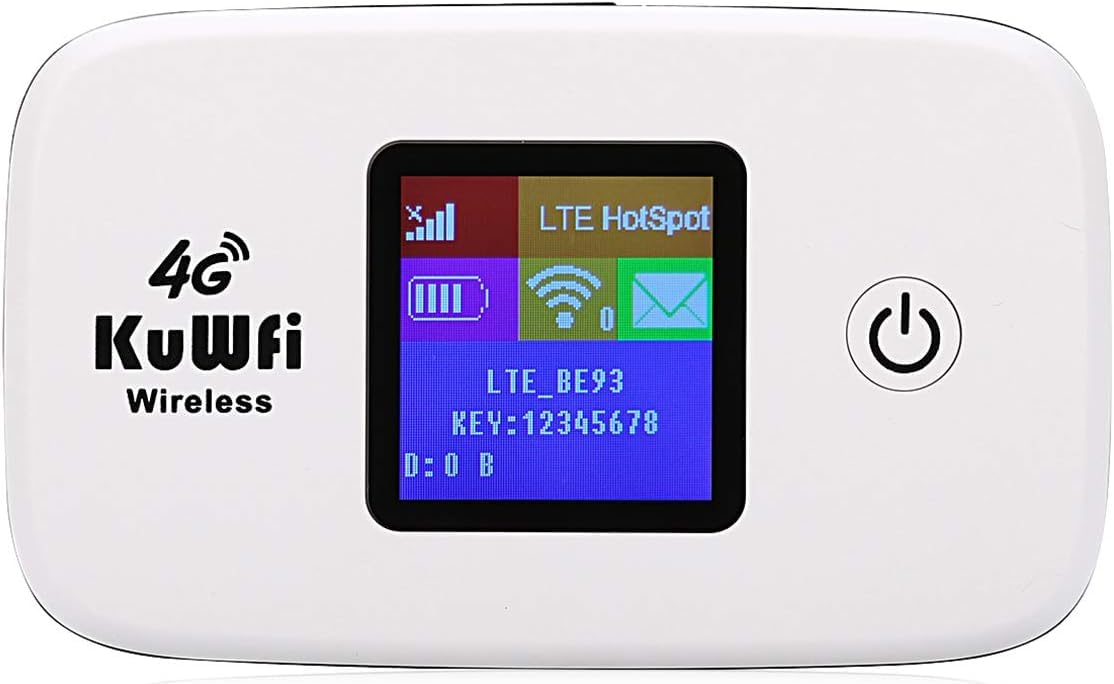
2. KuWFi 4G LTE Mobile WiFi Hotspot open up Wireless Internet Router Devices with SIM Card Slot
An affordable way to get online across Europe, if you pick your country carefully.
The KuWFi L100EU is built for a specific job: hopping onto a local 4G network in Europe, Asia, Africa, or the Middle East without paying roaming fees. It supports a 2400mAh battery for a few hours of use, then you plug it in. Its band list, B1/B3/B5/B7/B8/B20 plus TDD-LTE B38/B39/B40/B41, is the key spec here, because a hotspot only helps if the towers in your destination speak the right language.
Weigh it honestly before buying. Feedback is genuinely split, and the numbers that come up most are functionality and quality, both mixed. Some find it works well with an Orange Egypt SIM; others say it will not work at all in some regions. Setup and compatibility also draw mixed-to-negative comments. This is a device that rewards a little homework, not a blind purchase.
Two practical notes are worth acting on. As owners put it, the hotspot “gets hot in backpack” when it cannot breathe, so leave it out in the open rather than buried in a bag. And make sure you tell the seller your target country, because buyers who did received a correctly matched replacement unit. Match the bands to your destination and it is a solid overseas travel value.
It is worth it when you plan ahead: pick a country whose bands match the B1/B3/B5/B7/B8/B20 list, and this becomes a very economical travel hotspot.
Where the risk lives: it depends on a strong cell signal, so in weak coverage it simply will not work, and setup can require manual APN edits.
Reach for this if: you are traveling to a supported region and want the cheapest way to get onto a local 4G network.
skip it if: you need guaranteed connectivity, because its reliability hinges entirely on how strong your local signal is.
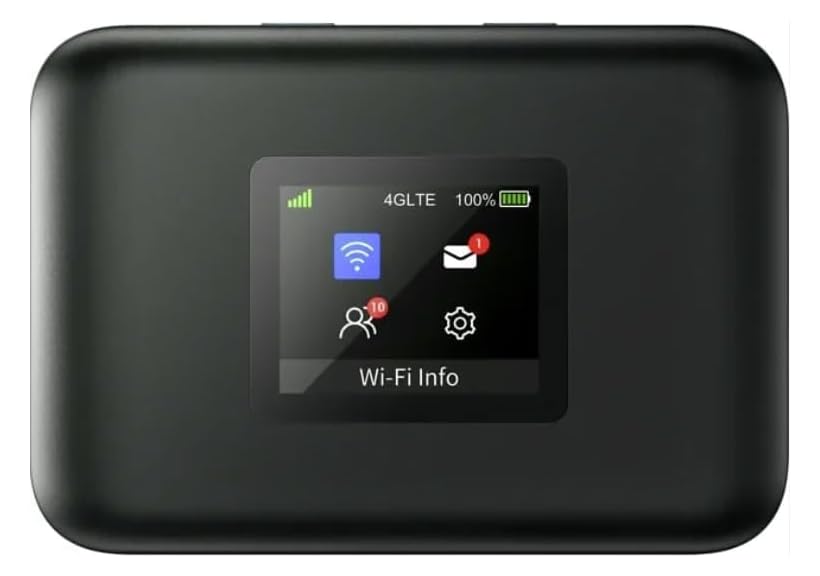
3. AT&T Turbo Hotspot 3: 256 MB, Black – Prepaid Hotspot (open up), Connects Up to 16 Devices, Dual Band Wi-Fi
The camper’s compromise: long battery life, but it demands an AT&T prepaid plan.
The headline here is staying power. A 3000 mAh battery delivers over 15 hours of use on a single charge, which is the longest quoted runtime in this lineup. That is what makes it a natural fit for a camper or a rural backup, where the whole point is to be away from an outlet for a full day. It connects up to 16 Wi-Fi enabled devices at once, and a 1.77-inch LCD keeps the essentials visible on screen.
Compared with the iotesimglo pocket router, this one trades pure portability for that longer 15-hour runtime, but the iotesimglo counters with a lighter 106 g body and global roaming across 130+ countries while this one is tethered to AT&T’s network. Its dual-band Wi-Fi (2.4 GHz and 5 GHz signals) helps reduce network congestion when several people are sharing the connection, which matters in a campground or a full camper.
There is one non-negotiable before you buy. This device requires a separate AT&T prepaid plan, and it will not connect without one. That is the reason one buyer found AT&T refused to register their IMEI (the device’s unique cellular ID) until they went to a store, while others found the opposite. If you are already on AT&T and want a long-lasting single-charge hotspot, this earns its spot.
The two standout specs
- Over 15 hours of use on a single charge from the 3000 mAh battery, the longest quoted runtime here.
- Up to 16 simultaneous Wi-Fi devices, so a whole camper can share one connection.
What to know first
- It requires a separate AT&T prepaid plan and will not work without one.
- No Ethernet port, so wired-only devices like some security cameras cannot plug in.
Ideal for: existing AT&T customers who want the longest possible single-charge runtime for camping or rural use.
Not for you if: you are on a different carrier or need a wired Ethernet connection.
4. S2 Portable WiFi Hotspot, 10GB Free USA Data 4g LTE Mobile MiFi
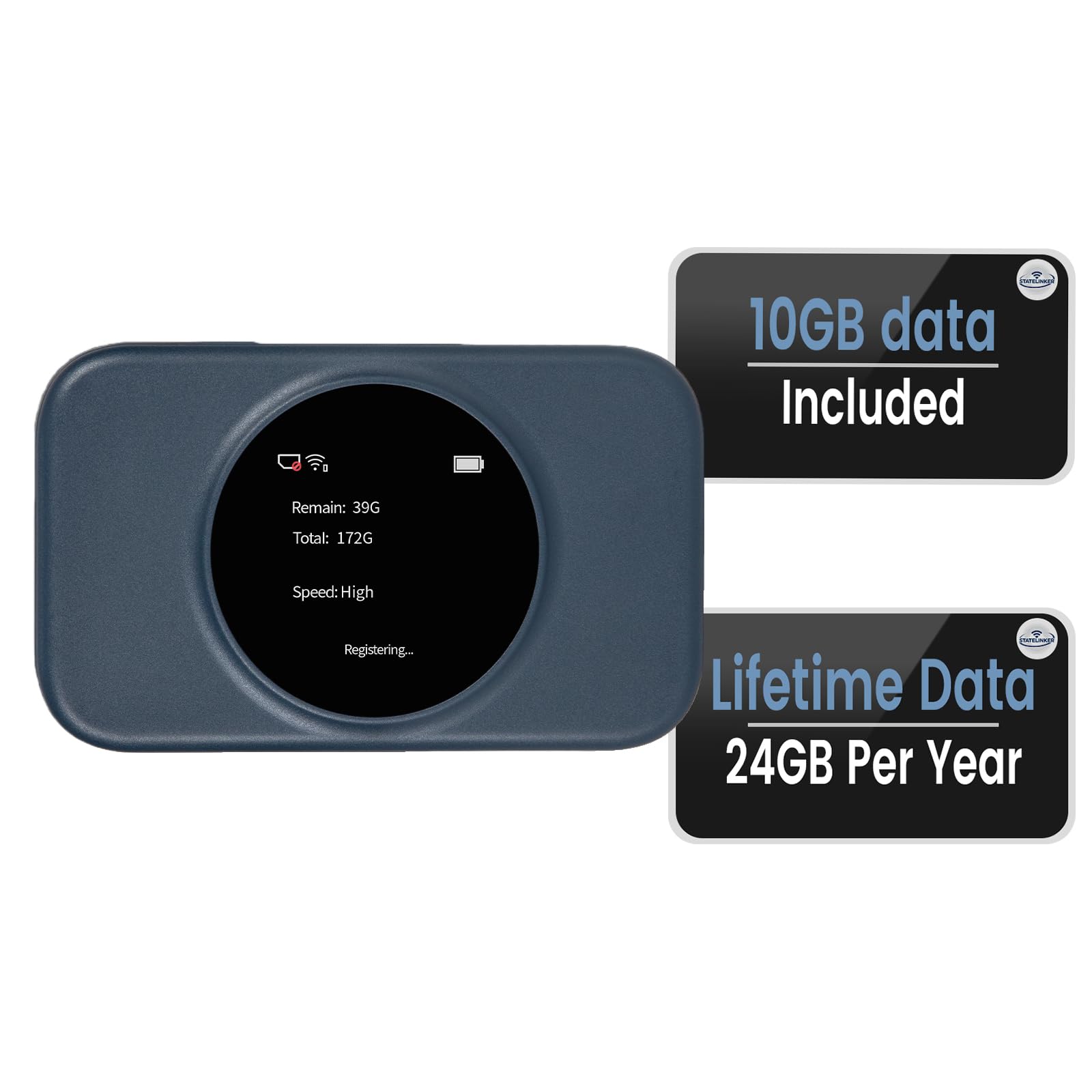
A no-contract US hotspot that shows you exactly what data you have left.
This one skips the SIM entirely. You get 10GB of complimentary US data to start, valid for 30 days, plus 2GB free every month with unused data rolling over. It is designed for North America, so there are no roaming fees and no contracts to lock you in. Wi-Fi 6 keeps the local connection efficient, and it shares with up to 8 devices, which covers a family or a small group on the road.
At just 100 grams it genuinely disappears into a pocket, and the battery is quoted at up to 15 hours of continuous use. The built-in display shows real-time remaining data, so you are never guessing. Owners put it to work streaming more than one TV during an outage and as a pocket connection for fishing and camping trips where speed was fine for messages and photos.
Two honest notes. The screen is the device’s best assistant, but it does not show the automatic post-trial data top-ups, and the unit can shut off after roughly 15 minutes of inactivity without a warning. International travel is not the point here, by design, so treat it as a domestic tool. If you want a US-only hotspot with free starter data and a clear usage readout, this is the one.
The data story: free starter data with rollover and no contract removes the biggest friction of hotspot ownership.
Know before you buy: it is North America only, and the device does not surface automatic monthly top-ups on its screen.
Pick this for: domestic travel, camping, and outage backup where you want free data and no contract.
Choose differently if: you are heading overseas, since this device is built for the US.
5. Portable WiFi Travel Router 15GB US Data, No SIM, No Contract
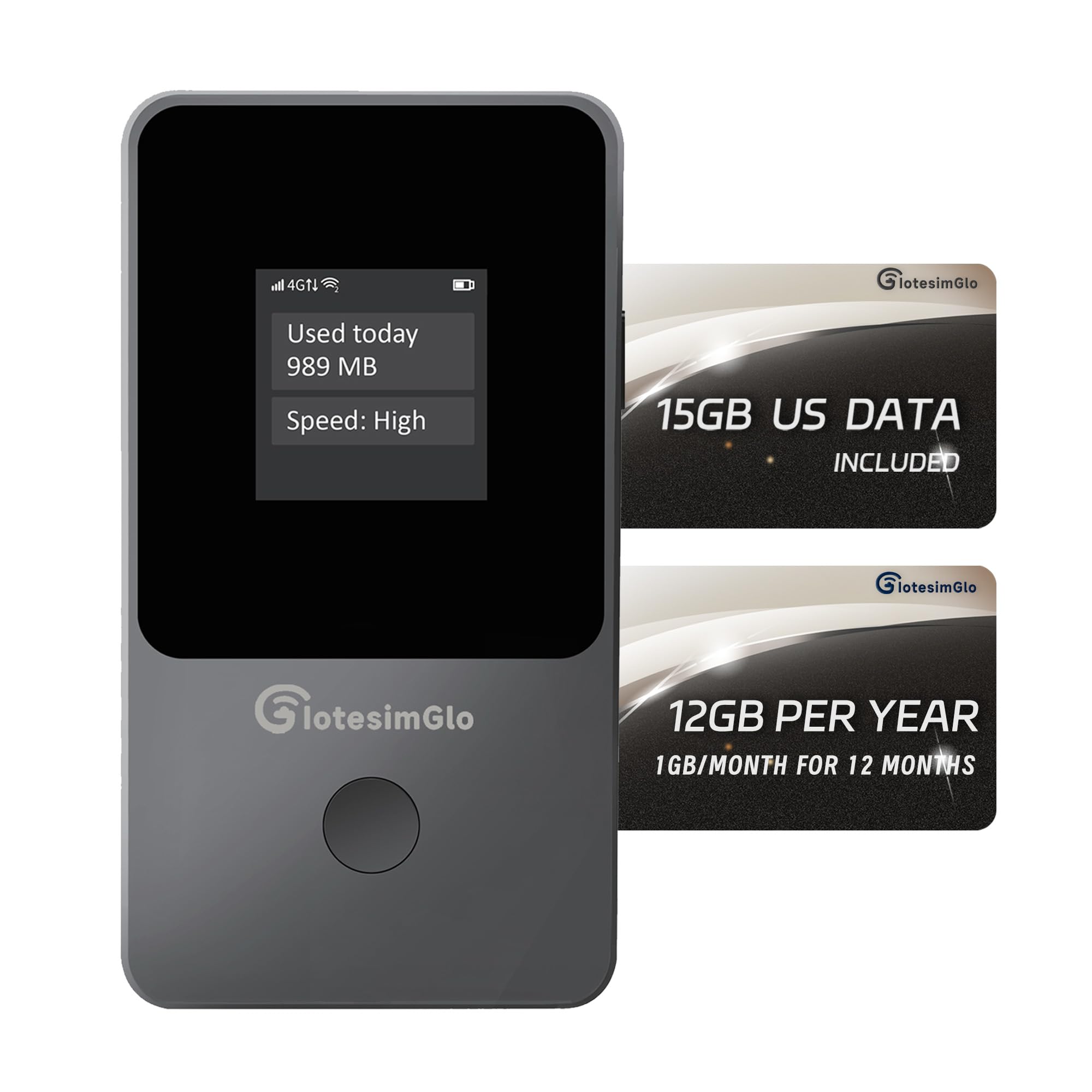
The traveler’s multi-tool: pay-as-you-go data here, your own SIM abroad.
This device earns its place by being flexible. It arrives with 15GB of high-speed US data valid for 30 days, and the plan activates automatically the moment you first power it on. No physical SIM, no app download, no contract. But here is what separates it from the no-SIM crowd: it also has a built-in slot for your own compatible Nano-SIM, so you can flip to a local plan without buying a second device.
Coverage stretches to 130+ countries and regions, and it automatically selects the strongest available local network. Wi-Fi 6 shares the connection with up to 8 devices, and the 3500 mAh battery plus a power-saving mode stretches to up to 12 hours of use. At just 106 g and pocket-height, it rides alongside a phone without a second thought. Owners keep a smart TV connected in a Sprinter van rolling down the highway, and it holds up for FaceTime on a metal-bodied camper.
The real-world caveat is signal. Deeper rural spots with no tower nearby will simply leave you offline, which is a limitation of every cellular device here, not a fault of this model. A couple of units have also run warm under heavy load, so give it some airflow. Where it shines is city and suburban travel, remote work, and backstopping hotel Wi-Fi.
what separates it
- Built-in Nano-SIM slot for a local plan abroad, alongside the 15GB US starter data.
- 3500 mAh battery with power-saving mode for up to 12 hours of use.
- Just 106 g, so it travels like a second phone.
Where it falls short
- No cell tower means no internet, so remote areas can defeat it.
- Some units heat up under heavy streaming loads.
Suits: city and suburban travelers, remote workers, and campers who stay within range of a tower.
Think twice if: you expect coverage deep in the backcountry, where no hotspot can reach.
6. eSIM Global WiFi Hotspot 4G LTE for 180+ Countries Travel & Business
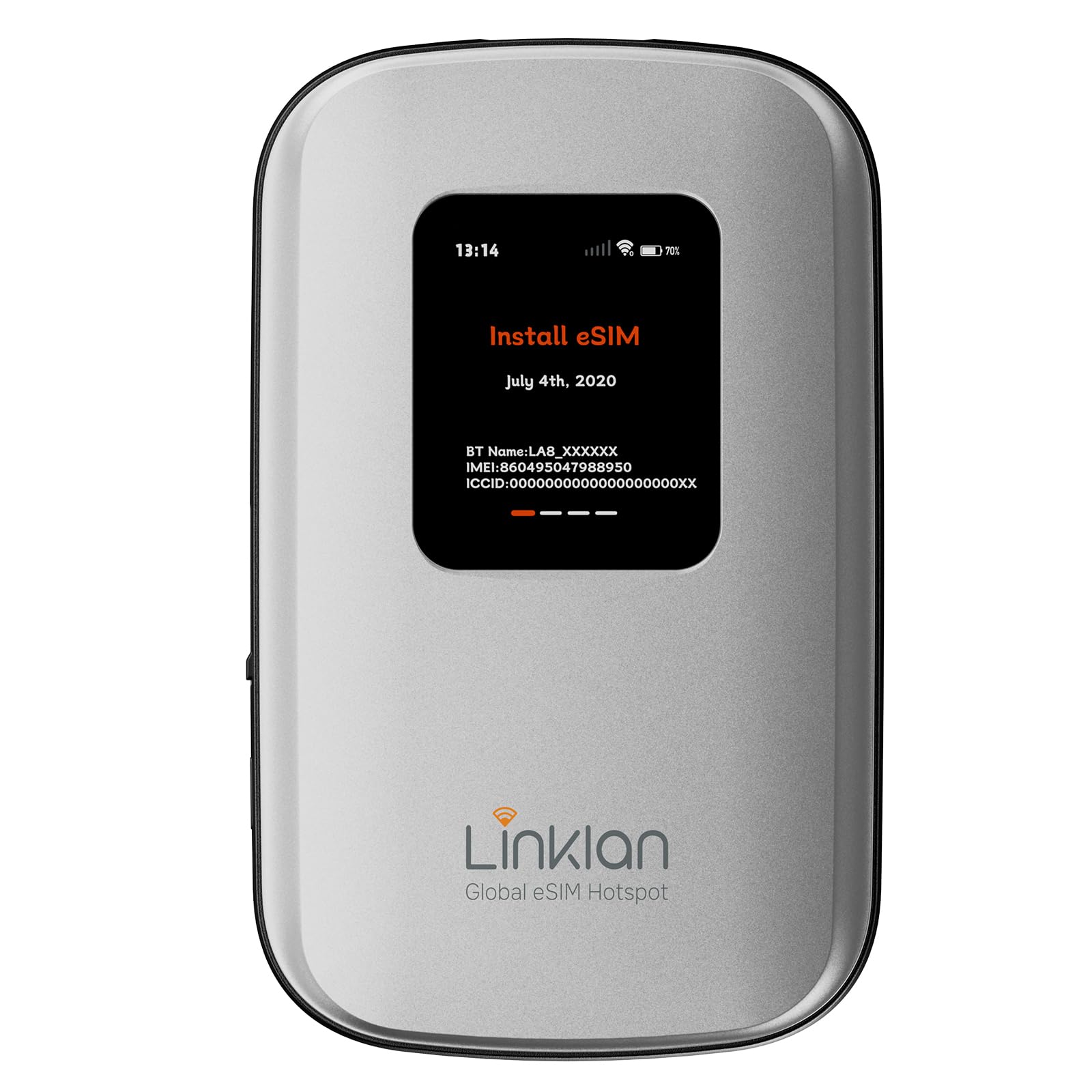
An eSIM hotspot that cuts the physical SIM card out of international travel.
Forget fumbling with a tiny SIM tray on a jetway. This is the eSIM-first travel router: it activates local data plans in about five minutes through a dedicated app, then connects to the strongest local network automatically across 180+ countries and regions. A 5000mAh battery delivers 12+ hours of continuous use and recharges overnight, so one charge covers a travel day.
Its 433 Mbps peak speed matches the GL.iNet MUDI’s 5GHz figure, but the real advantage is sharing that connection with up to 16 devices at once. It supports up to 16 devices at once, which is enough for a family or a small team sharing one connection. Owners used it to bypass carrier-locked phones in Europe and even got it working on ocean cruises from a common deck area.
Be deliberate about coverage. A handful of travelers report it failing on cruise ships and some land-tour locations, with one noting no connection across three international trips. The pattern suggests it is more reliable in mainstream city coverage than at sea or off the beaten path. Keep it for the markets it is clearly good at, and it does exactly what an eSIM traveler wants.
Why travelers like it: no physical SIM, automatic local network selection, and 16-device sharing from one 5000mAh battery.
Set your expectations: performance is inconsistent at sea and on some tours, so lean on it where mainstream coverage exists.
Best for: international business travelers and families who want one eSIM device instead of several SIM cards.
Consider elsewhere if: cruise-ship coverage is your primary need.
7. GL.iNet GL-E750V2 MUDI 4G LTE Portable Travel Router with SIM Card Slot

The biggest battery here, paired with controls only a network hobbyist will thank you for.
The MUDI carries the largest battery in this lineup at 7000mAh, which drives up to 8 hours of usage. VPN is the core feature: it supports OpenVPN and WireGuard and can reach 30+ servers, so you can secure traffic even on public Wi-Fi. It runs at up to 300Mbps on 2.4GHz and 433Mbps on 5GHz, and includes DDR2 128MB RAM, 16MB NOR Flash, and 128MB NAND Flash, with up to 1 TB MicroSD for storage.
Compared with the GL-XE3000 above, this is the more portable, more customizable sibling: smaller and lighter at 285g, but limited to 4G LTE rather than 5G. If you value control over raw speed, its OpenWRT foundation and support for the GL.iNet physical eSIM card give you real room to tinker. Some owners happily push near 50 Mbps downstream on a budget unlimited SIM and adjust TTL settings for their carrier.
Weigh the trade-offs openly. The battery is sealed and non-replaceable, so its lifespan is finite, and one reviewer noted it runs warmer than other 4G hotspots and feels heavy for what it delivers. The interface, while powerful, is described as confusing for beginners. If you are comfortable in a settings panel and want maximum battery plus VPN flexibility, this is your pick.
Built for tuners
- 7000mAh battery, the largest here, for up to 8 hours of use.
- OpenVPN and WireGuard with 30+ server support for secure public Wi-Fi.
- Expandable to 1 TB via MicroSD and compatible with GL.iNet physical eSIM cards.
Trade-offs to accept
- No 5G, so it tops out at 4G LTE speeds.
- The battery is sealed and non-replaceable.
- It runs warm and feels heavy, and the settings panel is not beginner-friendly.
For you if: you want a huge battery, deep VPN control, and are happy adjusting settings yourself.
Not for you if: you want plug-and-play simplicity or 5G speeds.
8. NETGEAR Nighthawk M6 Pro Mobile Hotspot 5G mmWave, 8Gbps, open up, AT&T & T-Mobile (MR6500) (Renewed)

The most advanced connection here, running on a fast 5G modem and Qualcomm hardware.
If 5G speed is the whole point, this is the ceiling of the list. It runs mmWave and Sub-6 5G with a Qualcomm SD X65 chipset (a powerful processor dedicated to cellular and 5G handling), a 5040mAh battery, and a 2.8-inch color touch LCD. It tops out at a 3600 megabits per second data rate and can share with up to 32 devices, backed by a 2.5G Ethernet port for a wired connection.
Speed and flexibility are strengths. Its 3600 Mbps data rate beats the GL-XE3000’s 3000 Mbps, and it is open up for most GSM and CDMA carriers including AT&T, T-Mobile, and MetroPCS. Owners ran it as a rural backup that handled business, TV streaming, and VoIP, and it integrated neatly with an Eero mesh system. Guest Wi-Fi privacy separation keeps visitors on their own network.
Two things to weigh. It needs a Nano SIM and a data-only plan from your carrier, since no SIM or service is included. And performance rises and falls with your tower: it shines near a 5G signal but degrades as you add devices, and a few renewed units have arrived less than perfect. Near strong 5G and treated as a versatile mobile router, it delivers breadth the 4G picks cannot.
The power story: mmWave and Sub-6 5G plus a 2.5G Ethernet port make it the most connected device here.
Check before buying: you supply your own Nano SIM and data plan, and 5G speed depends on being near a 5G tower.
Grab this if: you want 5G speeds, a wired 2.5G port, and support for a large device count.
Pass if: you are not near 5G coverage or want an included data plan from the start.
Understanding the Specs
Battery capacity in mAh
A milliamp-hour (mAh) is a unit of stored charge, and it is the first thing to compare on a battery powered router. A larger number usually means more hours before you need a wall, but it is not the only factor. The GL.iNet MUDI’s 7000mAh battery supports up to 8 hours of use, while the iotesimglo’s smaller 3500 mAh battery reaches up to 12 hours with power-saving mode enabled. Cell signals and screen brightness also drain the battery, so treat the runtime figures as best-case.
Wi-Fi speed and frequency bands
Data transfer rate, quoted in megabits per second, tells you the ceiling for downloads and video calls. The GL.iNet GL-XE3000 reaches 3000 Mbps, the KuWFi hotspot 150 Mbps, and the NETGEAR M6 Pro 3600 Mbps. Frequency (2.4 GHz, 5 GHz) affects how the router communicates with your devices and how congested the connection feels.
FAQ
How long does a battery powered router actually last on a charge?
Do I need a SIM card to use a battery powered router?
Will a travel hotspot work in another country?
How many devices can one mobile hotspot connect at once?
Why does my hotspot get hot while I use it?
Is 5G worth it on a battery powered router?
Can I use my own SIM with a no-SIM hotspot?
What does a router with failover actually do?
Do these hotspots work during a power outage?
Is a 4G hotspot fast enough for video calls and streaming?
Final Thoughts: The Verdict
Match the device to the trip, and you will be happy with any of these. If you need internet to survive a blackout and you run a small office, jobsite, or RV, the GL.iNet GL-XE3000 Puli AX is the strongest overall pick, with a 6400mAh battery for up to 8 hours of connectivity, a 3000 megabits per second data rate, and dual-SIM failover (it switches to a second SIM card when the first loses signal). If long single-charge runtime is what you need for camping, the AT&T Turbo Hotspot 3 delivers over 15 hours on a 3000 mAh battery. And for travel with an eSIM (a digital SIM card built into the device) and no physical card, the Linklan eSIM Global WiFi Hotspot covers 180+ countries and shares with up to 16 devices. Buy for the battery and the bands, and you will have real internet wherever you park it.
How We Picked
We do not accept paid placement. Every pick is matched to a real buyer and a real use-case; we do not hands-on test units.
Sources & Methodology
Specifications: manufacturer listings and product documentation. Review insights: verified customer reviews, as of September 2026. Pricing: not shown on this page (it changes often); check the current price via the retailer link.
As an Amazon Associate, KitchPrep earns from qualifying purchases. This does not affect which products we feature.
Related Guides
