
Specs are compiled from manufacturer listings and verified buyer reviews and can change over time — please confirm the key details on the product page before buying.
Cooling roughly 2,000 square feet is not a job for the biggest window unit you can carry home. You need a system with enough cooling power to move serious air across a whole floor, and enough control to keep it from running full-tilt all day. This guide covers three ductless and central-style systems built for that exact size of space, so you can pick the one that actually fits your house instead of guessing.
I’m Mohammad Maruf — the founder and writer behind KitchPrep. This guide is built by comparing the manufacturers’ published specifications and the patterns across verified customer reviews, so you get each pick’s real strengths and trade-offs instead of marketing spin.
Before you read on, know that sizing is a range, not a single magic number. We matched each system to the roughly 2,000-square-foot target and picked the nearest same-type size that serves the same purpose. Below you’ll find units that cover that square footage without overspending on capacity you’ll never use, plus the specs that decide whether a 2000 sq ft air conditioner keeps your whole house comfortable in August and still heats it in January.
Our Picks at a Glance
How To Choose The Best 2000 Sq Ft Air Conditioner
Three numbers decide almost everything here: cooling power in BTU, the factory-rated floor area in square feet, and how cold it still heats. Get those three right and you have skipped most of the expensive mistakes.
Match cooling power to the rooms you actually have
Cooling power is measured in BTU (British thermal units) — the amount of heat the system can pull out of your home in an hour. A unit rated for 36,000 BTU and a unit rated for 48,000 BTU are both sold as covering 2,000 square feet, but the larger one has more headroom for an open floor plan, tall ceilings, or a room that faces the sun all afternoon. If your space has a lot of glass or an unconditioned loft above it, lean toward the more powerful unit.
Decide if you need heating, and how much
All three systems here are heat pumps, which means they cool in summer and reverse to heat in winter. What separates them is how cold it can get outside before the heat pump gives up and relies on a backup. If you live somewhere with a real winter, that low-end heating number matters as much as the cooling number you started shopping for.
Quick Comparison
| Model | Best For | Cooling Power (BTU) | Rated Floor Area | Heating Low-End | Amazon |
|---|---|---|---|---|---|
| ACiQ Essentials 36000 BTU 230V 20 SEER2 Mini Split★ Best Overall | Whole-floor cooling plus a garage or studio | 36000 british thermal units | 2000 square feet | -4°F | Amazon |
| Senville Central Air Conditioning System, Heat Pump, Inverter, 3 Ton | Replacing an old central system in a whole house | 36000 british thermal units | 2000 square feet | -22°F | Amazon |
| Senville Central Air Conditioning System, Heat Pump, 4 Ton, 10kW Aux | Large open layouts that need backup heat | 48000 british thermal units | 186 square meters | -22°F | Amazon |
In‑Depth Reviews
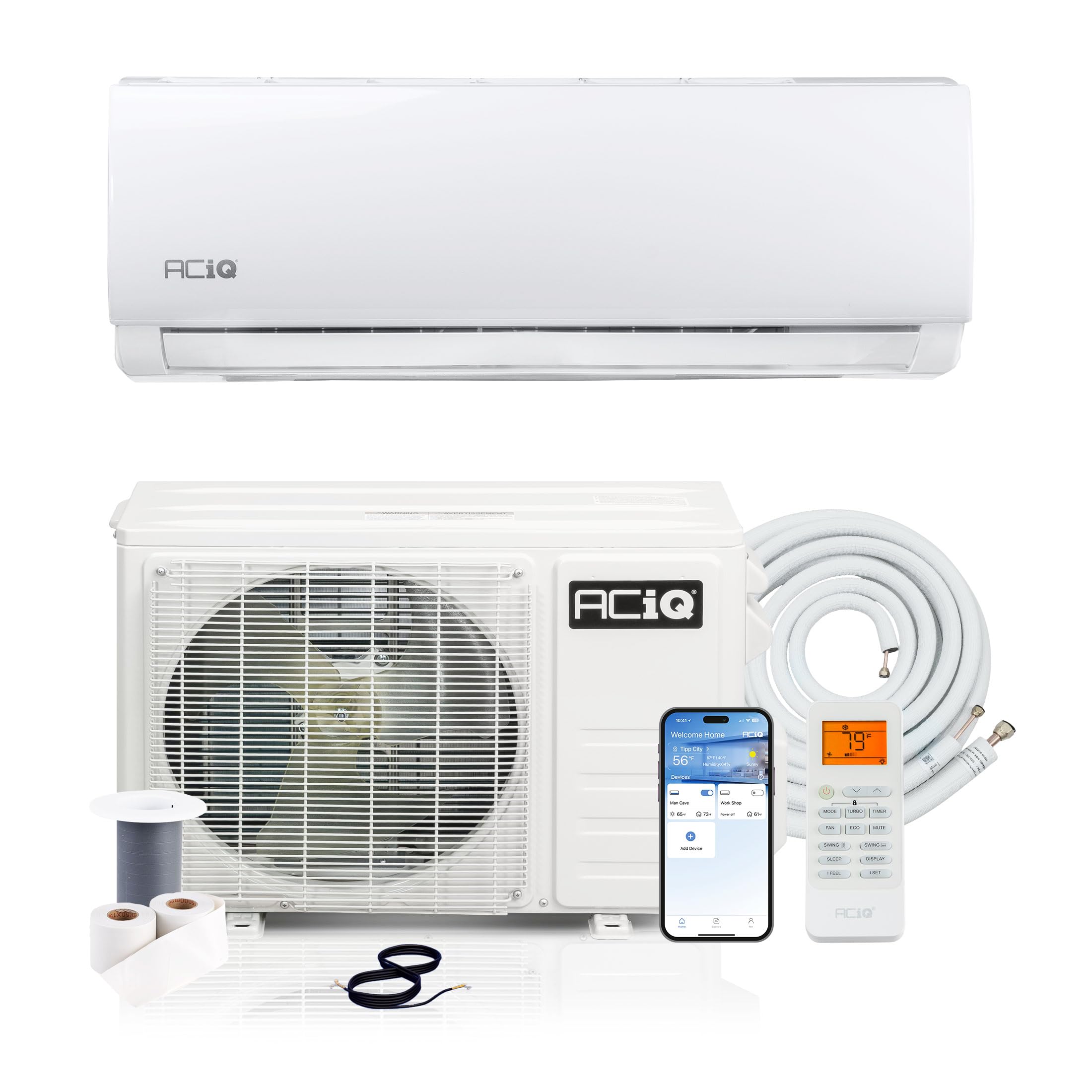
1. ACiQ Essentials 36000 BTU 230V 20 SEER2 Mini Split AC/Heating System, White
Our pick — over 4.5★ from 40+ verified ratings; the strongest balance of quality and price.
A 36,000 BTU ductless mini split rated for 2,000 square feet, with a 20 SEER2 inverter compressor that holds temperature quietly.
For a single-level 2,000-square-foot home with bedrooms off a central hall, this is the pick to beat. Its 36,000 british thermal units of cooling power and its 2,000-square-foot floor-area rating line up exactly with the space you are trying to cool. It runs on a rotary DC inverter compressor — a motor design that ramps speed up and down instead of slamming on and off, which keeps the temperature steady and the noise low.
The temperature range is wider than most people expect from a mini split. It keeps cooling down to 5°F outdoors and keeps heating down to -4°F, so it stays useful through a real winter rather than becoming a summer-only box. The installation kit spares you a scavenger hunt: a 16 ft. line set, remote control with mount, power cable, indoor mounting plate, outdoor rubber feet, wall cap, drain elbow and line, and the screws and anchors all arrive together. Buyers report “Great unit, quiet and cold,” and the pattern across owner feedback backs that up — this thing cools a garage studio without announcing itself.
A few honest things to plan around. You still need a technician with a vacuum pump to evacuate the line set before first startup, so the DIY savings stop well before you think they do. The interior air handler is large and heavy, and the included 16-foot line set runs out fast on a big house. The remote also skips time-of-day programming, meaning no weekday schedule unless you add controls. And a rare unit shows up with a cracked valve cover in transit — inspect the pallet before you sign for it.
Where it earns its keep
- 4.6 stars across 40 ratings — the strongest score in this group
- 20 SEER2 efficiency rating keeps summer running costs down for its size
- Cools down to 5°F and heats down to -4°F outdoors, so it works year-round
- Complete install kit included: 16 ft. line set, remote, mounting plate, wall cap and more
- Washable, reusable mesh filter means no replacement filters to keep buying
What to plan around
- Professional vacuum pump and licensing still required at startup
- 16 ft. line set is short for a spread-out floor plan
- No time-of-day scheduling on the included remote
- Interior air handler is bulky and takes real wall space
Buy it for: a single-level 2,000-square-foot home or a large shop you want kept cold and quiet all year.
Think twice if: your ductwork is already good and you would rather replace a central unit than mount a wall head.
2. Senville Central Air Conditioning System, Heat Pump, Inverter, 3 Ton
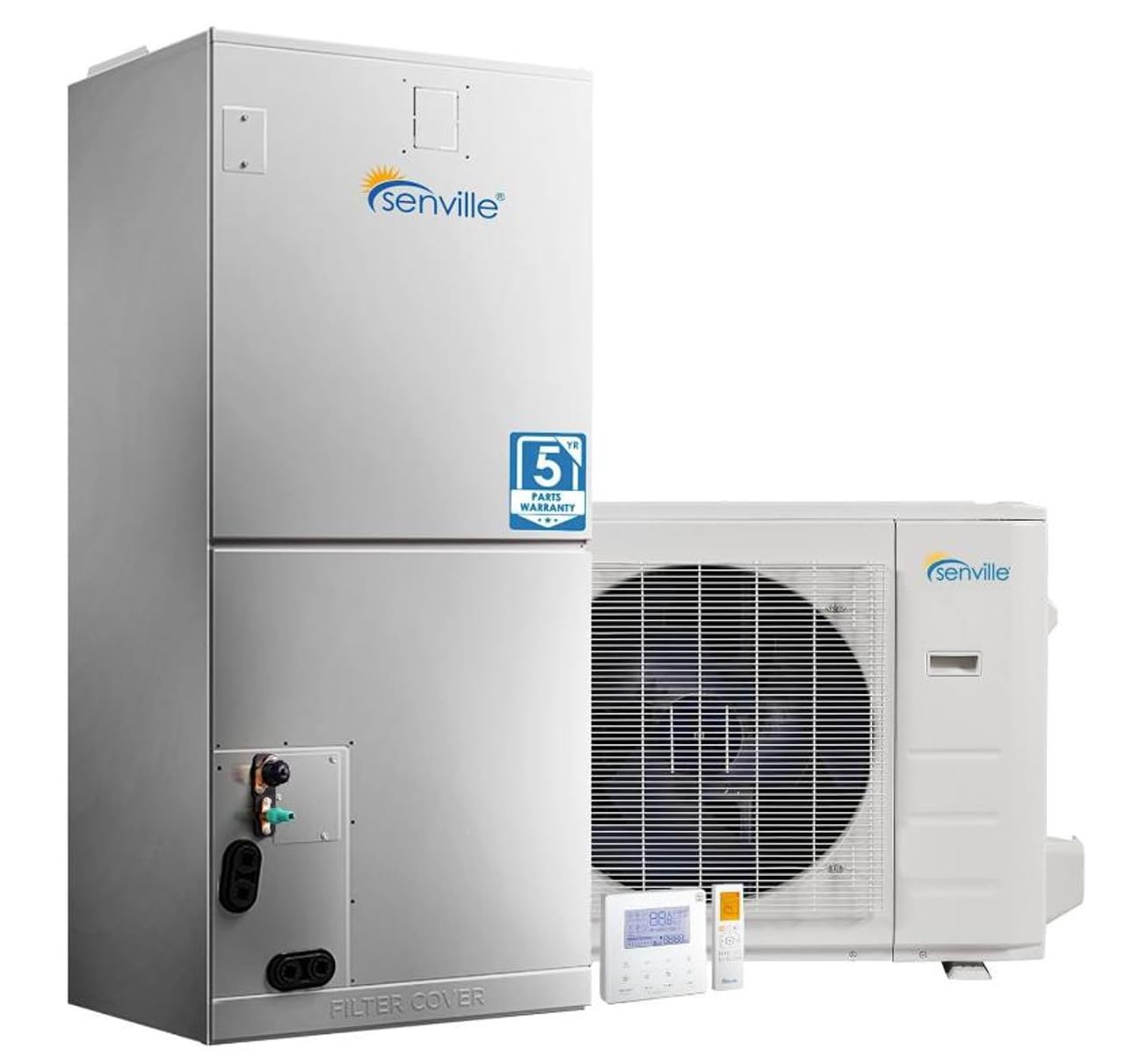
A 3-ton central heat pump rated to keep heating at -22°F outdoors, with a 10-year compressor warranty.
It keeps heating at outdoor temperatures as low as -22°F, the lowest rating in this group. If your winters drop well below zero, this is the one built for it. It runs the same 36,000 british thermal units of cooling power and the same 2,000-square-foot floor-area rating as the ACiQ above, so the cooling side of the job is a wash — the furnace-grade heating is where it pulls ahead.
The inverter compressor holds temperature instead of cycling hard on and off, which is exactly what owners describe: it never truly shuts off, it just slows down and holds the room steady. The quiet operation earns consistent praise, and the build quality is rated right up alongside it. Warranty coverage is the longest here — 10 years on the compressor and 5 years on parts. The catch on that coverage is real, though: the warranty requires a professional startup, and finding a technician willing to do that paperwork in a busy season can be its own project.
Installation is where expectations need managing, and the owner feedback is genuinely split rather than uniformly glowing. Some describe a fairly simple job; plenty of others hit real friction, from charge ports that need 5/16 to 1/4 adapters to a drain pipe that will not snap into place and a 16 ft. line set that comes up short on a larger home. The manual is also peppered with translation omissions that can stall a first startup. Senville states plainly that this is not suitable for DIY installation, and the owner experiences line up with that warning. Treat the install quote as part of the purchase.
What owners keep coming back to: once it is running, the cooling performance does the talking — it holds a whole house steady and does it quietly.
Where it asks patience: the controls lag the hardware. There is no time-of-day programming, and the smart thermostat shows no current usage data and is awkward to read on the wall.
Reach for this if: you need genuine cold-weather heating and want the longest compressor coverage in this lineup.
Look elsewhere if: you were hoping to install it yourself and save on labor.
3. Senville Central Air Conditioning System, Heat Pump, 4 Ton, 10kW Aux
A 4-ton, 48,000 BTU central heat pump with a 10kW auxiliary heater for open layouts that outrun a 3-ton system.
In a 2,000-square-foot open space with high ceilings, a 36,000 BTU system can leave the far corner lagging. This unit steps up to 48000 british thermal units, and it also carries the beefier 4-ton capacity rating against the 3-ton rating of the two systems above — a 33% gap on both counts. More cooling power means faster recovery after the door has been open all afternoon, and more heat output when you need it most.
The included 10KW Auxiliary Heat gives you a resistive backup heater that kicks in behind the heat pump when outdoor temperatures dive. The heat pump itself still handles the -22°F low end, so the auxiliary element is a safety net for the worst days rather than your primary heat. Annual energy consumption is listed at 5173 KW (kilowatt-hours — the unit your electric bill is measured in), a genuinely relevant figure when you are comparing the running cost of a 4-ton machine against a smaller one. Expect that the unit is rated for commercial use as well as residential.
The practical reality here is the installation. Wiring the auxiliary heat and its breakers is an electrician’s job, and owner feedback supports treating this as a professional-only install rather than a weekend project. The flare fittings have been called mediocre, and the supplied controller functions as a control panel rather than a true thermostat, sensing temperature on the wrong side of the coil — a real annoyance if the ducts around it are poorly insulated. Set against that, quality earns high marks from buyers here, and the system runs quietly enough to sit outside a bedroom window without intruding.
Where the extra capacity pays off: open-plan homes and commercial spaces that overwhelm a standard-size system on the hottest afternoons.
The honest trade: expect installation to run into serious money once an electrician is involved — this is not a weekend hardware swap.
Pick this one if: your square footage is real but your ceiling height and layout make it feel larger than the number suggests.
Skip the upgrade if: a normal-height, well-sealed house of the same size — the smaller capacity covers it for less.
Understanding the Specs
BTU and tonnage
BTU — British thermal units — measures how much heat the system removes in an hour, and a “ton” is simply a bigger unit of the same thing, equal to 12,000 BTU. That is why a 4-ton system is a 48,000 BTU system and a 3-ton is a 36,000 BTU one. For a space around 2,000 square feet, both sizes appear, and the deciding factor is often ceiling height and how open the floor plan is rather than the raw square footage alone.
SEER2 and energy consumption
SEER2 is the efficiency score for air conditioners, and a higher number means more cooling per unit of electricity. Energy consumption is listed in kilowatt-hours per year, the same unit that shows up on your utility bill — so it is the closest thing you get to a running-cost comparison on a spec sheet, though it assumes typical usage and not your actual habits.
Inverter compressors
A standard compressor switches fully on or fully off, so the room swings between slightly too warm and slightly too cold. An inverter compressor varies its speed instead, holding a steady temperature and using less energy to do it. On a ductless system it is also the main reason the indoor unit stays quiet once the room has reached its target.
Heating range and auxiliary heat
A heat pump reverses itself in winter to warm the house, but it has a limit on how cold the outside air can be before that stops working well. The numbers to compare are the low-end outdoor temperatures each system can still heat in. Where a system lists an auxiliary heat rating, that is a backup electric element that picks up on the coldest days — convenient, but it draws far more electricity than the heat pump alone.
FAQ
How many BTU do I need for 2,000 square feet?
Can I install one of these myself or do I need a professional?
What does the low-end heating temperature actually mean?
Is a ductless mini split better than a central air system for this size?
What does SEER2 measure on a 2,000 square foot system?
Will the included line set be long enough for my house?
What is auxiliary heat and do I need it?
How often do I need to clean the filter?
Final Thoughts: The Verdict
For most people cooling around 2,000 square feet, the ACiQ Essentials 36000 BTU Mini Split is the pick — it is the highest-scoring system in this group, it ships with a full installation kit, and it stays quiet while it works. If you need heat pump performance in serious cold, grab the Senville 3 Ton for its -22°F rating and 10-year compressor warranty. And when your square footage just will not behave — high ceilings, open plan, a commercial space — the Senville 4 Ton with 10kW Aux brings the extra capacity and the backup heater to match.
How We Picked
We do not accept paid placement. Every pick is matched to a real buyer and a real use-case; we do not hands-on test units.
Sources & Methodology
Specifications: manufacturer listings and product documentation. Review insights: verified customer reviews, as of September 2026. Pricing: not shown on this page (it changes often); check the current price via the retailer link.
As an Amazon Associate, KitchPrep earns from qualifying purchases. This does not affect which products we feature.
Related Guides
