
Specs are compiled from manufacturer listings and verified buyer reviews and can change over time — please confirm the key details on the product page before buying.
If you are shopping for a 200 Ah lithium battery, the amp-hour number on the box is the least interesting thing about it. A 200 Ah lithium iron phosphate (LiFePO4) battery stores the same energy as several heavy lead-acid blocks, but the one that actually works for your boat, camper, or solar shed depends on the battery management system (the electronic protector that cuts power if current, temperature, or voltage goes out of range), the cold-weather cutoff, and whether the weight is something you can lift alone. That is what this guide sorts for you.
I’m Mohammad Maruf — the founder and writer behind KitchPrep. This guide is built by comparing the manufacturers’ published specifications and the patterns across verified customer reviews, so you get each pick’s real strengths and trade-offs instead of marketing spin.
One thing to know up front: this list uses flexible, human-like matching. Every pick here is a lithium 12-volt class battery in the roughly 200 Ah range, but a few sit slightly above or below the exact number because that nearest same-type size serves the same job. Below, you will find the 200 ah lithium battery options that hold up best in real use.
Our Picks at a Glance
How To Choose The Best 200 Ah Lithium Battery
A 200 Ah lithium battery is a multi-year purchase for a boat, camper van, or off-grid solar setup, so the decisions you make before ordering matter more than the badge on the front. Four numbers separate a battery that fits your system from one that fights it.
Match the BMS amp rating to your biggest load
The BMS, which stands for battery management system, is the small electronic brain that shuts the battery off if anything goes wrong — and its amp rating decides how much current you can pull before it trips. A 200A BMS (200 amps of continuous flow) handles most RV inverters and mid-size trolling motors, while a 100A unit will cut out the moment you start something hungry. If you run an air conditioner or a large inverter, buy the higher amp rating and stop worrying about it.
Check the footprint against your existing tray
Lead-acid batteries came in standard box sizes, and lithium replacements often mimic them. Group 31, Group 4D, and 8D are the three trays you are most likely to be swapping out of. Measure your compartment and battery tray before ordering, because a battery that is too tall for the lid or too long for the strap is a return waiting to happen.
Confirm the cold-weather behavior you need
Lithium cells should not be charged below freezing, because plating can permanently damage them. Most quality batteries here simply stop accepting charge at that point and resume when warm. A few add self-heating, which warms the cells so charging can restart sooner. If you camp in winter or leave the battery in an unheated shed, this is the spec to read twice.
Quick Comparison
| Model | Best For | Capacity / Energy | BMS Rating | Weight | Amazon |
|---|---|---|---|---|---|
| Litime 12V 200Ah Mini★ Best Overall | Boat and trolling motor weight savings | 200 Ah / 2560Wh | 200A | 28 lb | Amazon |
| DUMFUME 12V 200AhBest Value | Budget off-grid expansion | 200 Ah / 12.8V | 200A | 58.9 lb | Amazon |
| ELEFAST 12V 200AHCompact Pick | Small trolling motors and portable solar | 200 Ah / 2560Wh | 200A | 45.1 lb | Amazon |
| Power Queen 12V 200Ah | Camper and trailer installs | 200 Ah / 2560Wh | 200A BMS | 19.9 kg | Amazon |
| Power Queen 12V 200Ah PLUS | Longer runtime between charges | 200 Ah / 2560Wh | 200A | 22.5 kg | Amazon |
| Humsienk 12V 200Ah | Running high-power RV appliances | 200 Ah / 2560Wh | 250A | 58.5 lb | Amazon |
| Wattcycle 12.8V 200Ah | Compact spaces and harsh climates | 200 Ah / 12.8V | 200A | 45.2 lb | Amazon |
| Redodo 12.8V 200Ah Plus | Replacing a group of lead-acid blocks | 200 Ah / 2.56kWh | 200A | 49.6 lb | Amazon |
| yeagulch 2X 12V 200Ah | Building a bank from scratch | 2 × 200 Ah | 200A | 58.9 lb each | Amazon |
| Litime 12V 230Ah | Group 4D drop-in upgrades | 230 Ah / 12V | 200A | 46 lb | Amazon |
| Renogy 12V 200Ah Pro | Winter boondocking and cold charging | 200 Ah / 12.8V | 60+ protections | 23 kg | Amazon |
| CHINS 12V 200AH | Whole-home backup and RV power | 200 Ah / 12V | 200A | 22.2 kg | Amazon |
In‑Depth Reviews
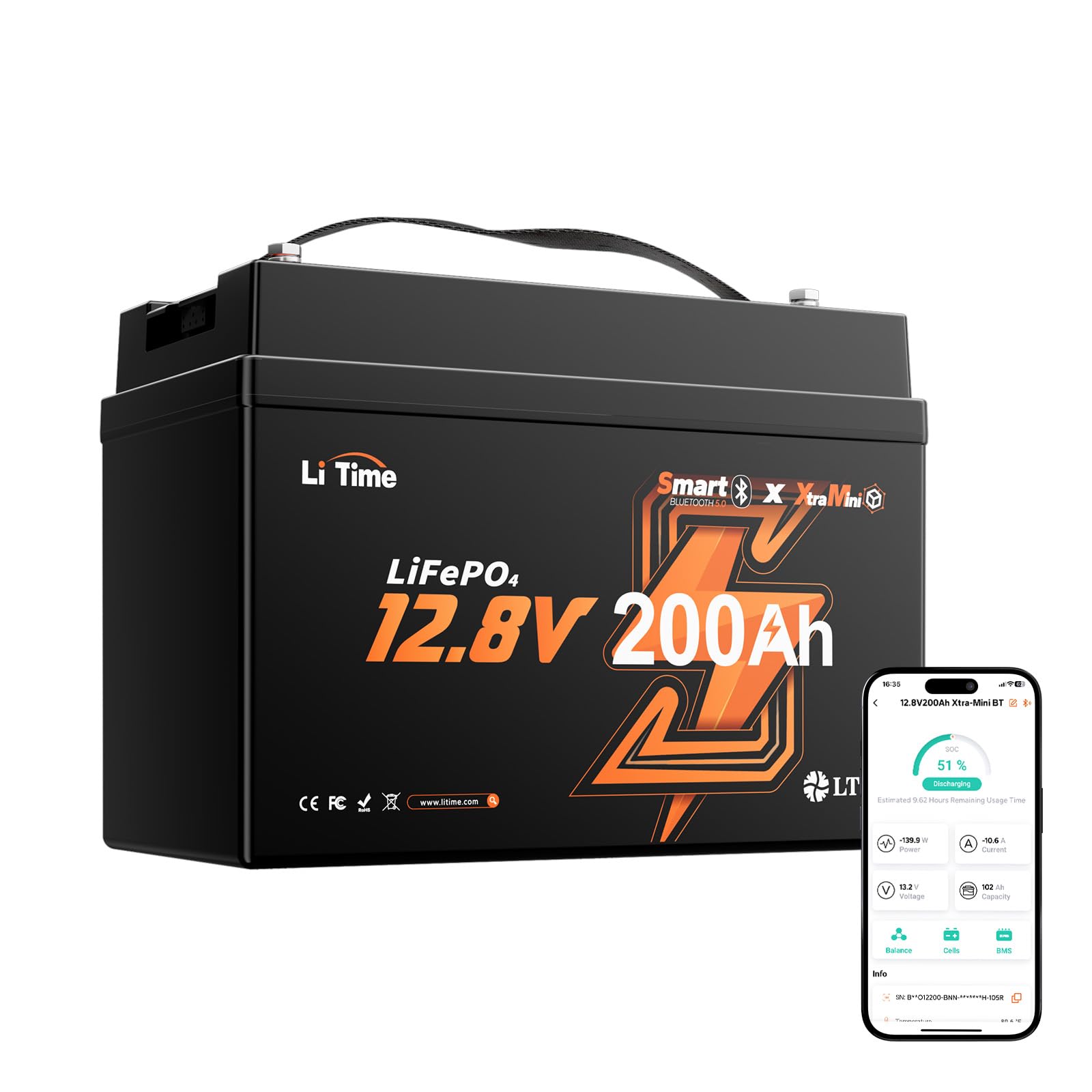
1. Litime 12V 200Ah Mini Trolling Motors LiFePO4 Lithium Battery for RV
Our pick — over 4.5★ from 600+ verified ratings; the strongest balance of quality and price.
The 28-pound 200 Ah battery that makes every other block on this list feel like a bag of cement.
The weight is the headline. At 28 pounds, this Litime is the lightest battery here by a wide margin, and the difference is huge compared with heavier options. The DUMFUME 12V 200Ah weighs 58.9 pounds, so this one is barely half as heavy for the same 200 Ah nameplate — that is the gap that decides whether you can lift a battery into a boat locker alone. Pair that with a 200A BMS (a battery management system that allows a 200-amp load) and 2560Wh of stored energy (2560 watt-hours, which is 12 volts times 200 amp-hours), and you get a battery that will run a 12-volt, 10-cubic-foot fridge for 12+ hours without complaint.
What wins people over is the build inside. Two of these in series on a 24-volt Minn Kota still showed 72% after four hours in 25 mph gusts. Scan the QR code on the case and the Litime app pairs over Bluetooth 5.0, so you can watch state of charge, voltage, and current on your phone instead of crawling to the battery with a multimeter. When someone ran one powering a Garmin LiveScope, the app let them toggle discharge on and off remotely and check how much capacity was left after a ten-hour day.
There are two honest catches. This battery is built for energy storage, not for starting an engine — no golf carts, no jacks. And in cold weather, the built-in low-temperature protection stops charging below 32°F and stops discharging below -4°F, which is good for the cells but means you will need to warm it back up before it takes a charge.
Where it wins
- 28 lb — the lightest 200 Ah battery in this roundup, with the DUMFUME weighing over twice as much at 58.9 lb
- Grade A cells rated for 6000 deep cycles at 100% depth of discharge
- Bluetooth 5.0 app for live state of charge, voltage, and current
- Expandable to 4P4S for a 51.2V 800Ah, 40.96kWh bank
Worth knowing
- Bluetooth needs a lithium-activation or MPPT charger to wake it on first use
- Not for starting batteries, golf carts, or jacks
Grab it if: you are mounting the battery in a boat locker or camper compartment and want the easiest lift on the market with full phone-based monitoring.
Think twice if: you need a starting battery for an engine or a golf cart — this one is energy-storage only.
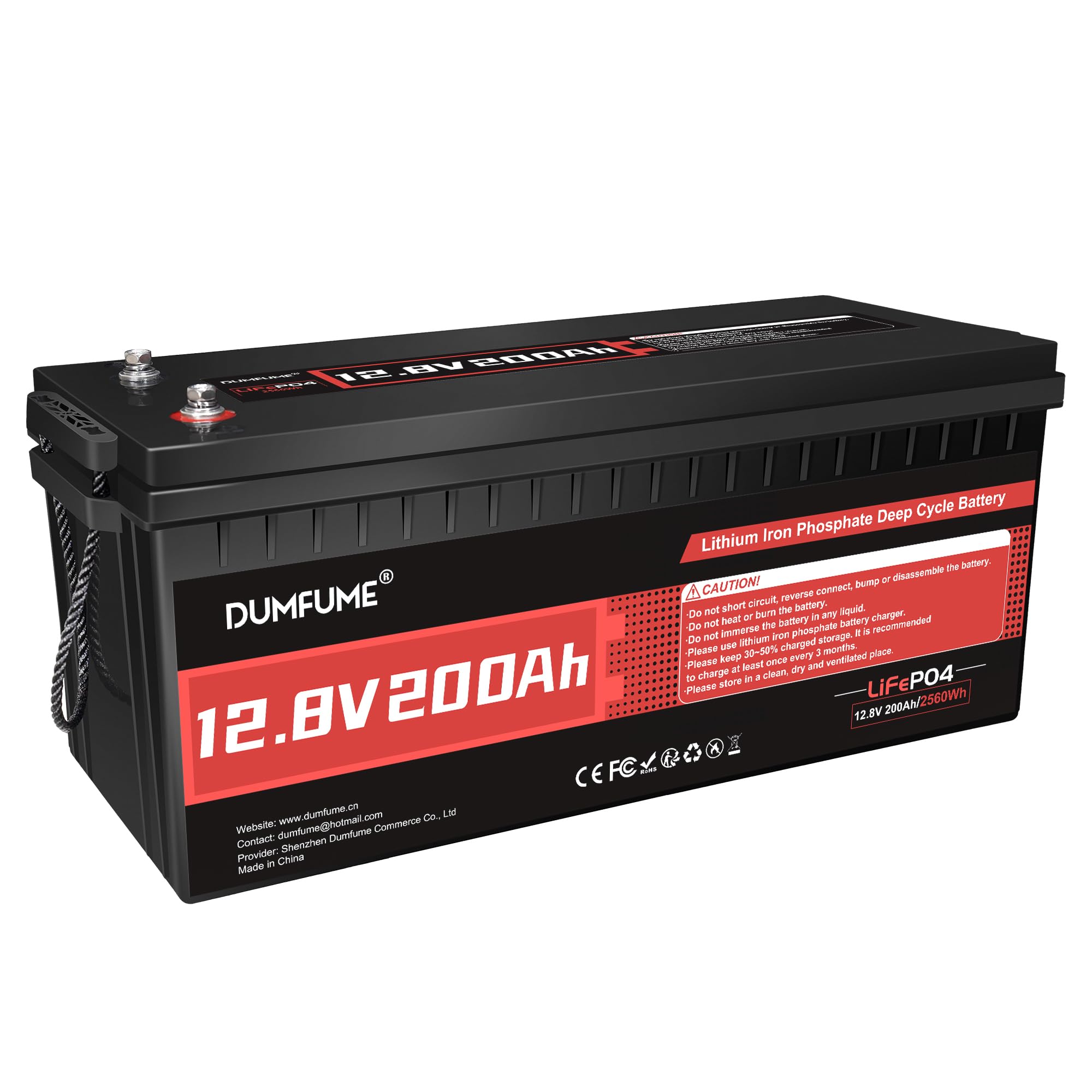
2. 12V 200Ah LiFePO4 Lithium Battery 200A BMS 2560Wh IP65
A budget 200 Ah battery that gets the numbers right and asks you to verify the charge yourself.
If you are building a solar shed or an off-grid cabin and want the most energy per dollar, this DUMFUME is the value play in the group. It packs the same 2560Wh as the more expensive picks and expands to the same 4S4P ceiling — 16 units in a 51.2V 800Ah, 40.96kWh bank — while staying well under the mid-range price band. At 58.86 pounds it is the heaviest battery here, but that weight is a sign of the metal casing, which carries an IP65 rating (dust-tight and able to shrug off low-pressure water jets from any direction).
The engineering details are unusually specific. Overcurrent protection trips within 50 milliseconds for loads over 200A, and short-circuit protection activates in less than 100 microseconds — the kind of instant fault isolation that matters when you are wiring a 12-volt system in a camper van. Charging cuts off automatically below 0°C (32°F) to prevent lithium plating (a chemical reaction that damages the battery), and the BMS resumes charging once the cells warm back to 5°C (41°F), so a cold night does not permanently wreck the pack.
The catch is consistency. Buyers report that some units arrive at 12.2 to 12.4 volts and will not take a charge until jump-started in parallel with a charged battery. It works fine once awakened, and the build quality and performance are both well regarded, but plan to check voltage on arrival and keep a charged battery handy for the first top-up.
What you are really buying: a no-frills, non-Bluetooth deep-cycle battery with a genuinely rugged IP65 shell and a 5-year warranty with 24/7 support. No app, no monitoring — just raw capacity and a low price.
Reach for this if: you want maximum amp-hours per dollar and are comfortable checking voltage on delivery.
Look elsewhere if: you want app-based monitoring from the start — this one is deliberately non-smart.
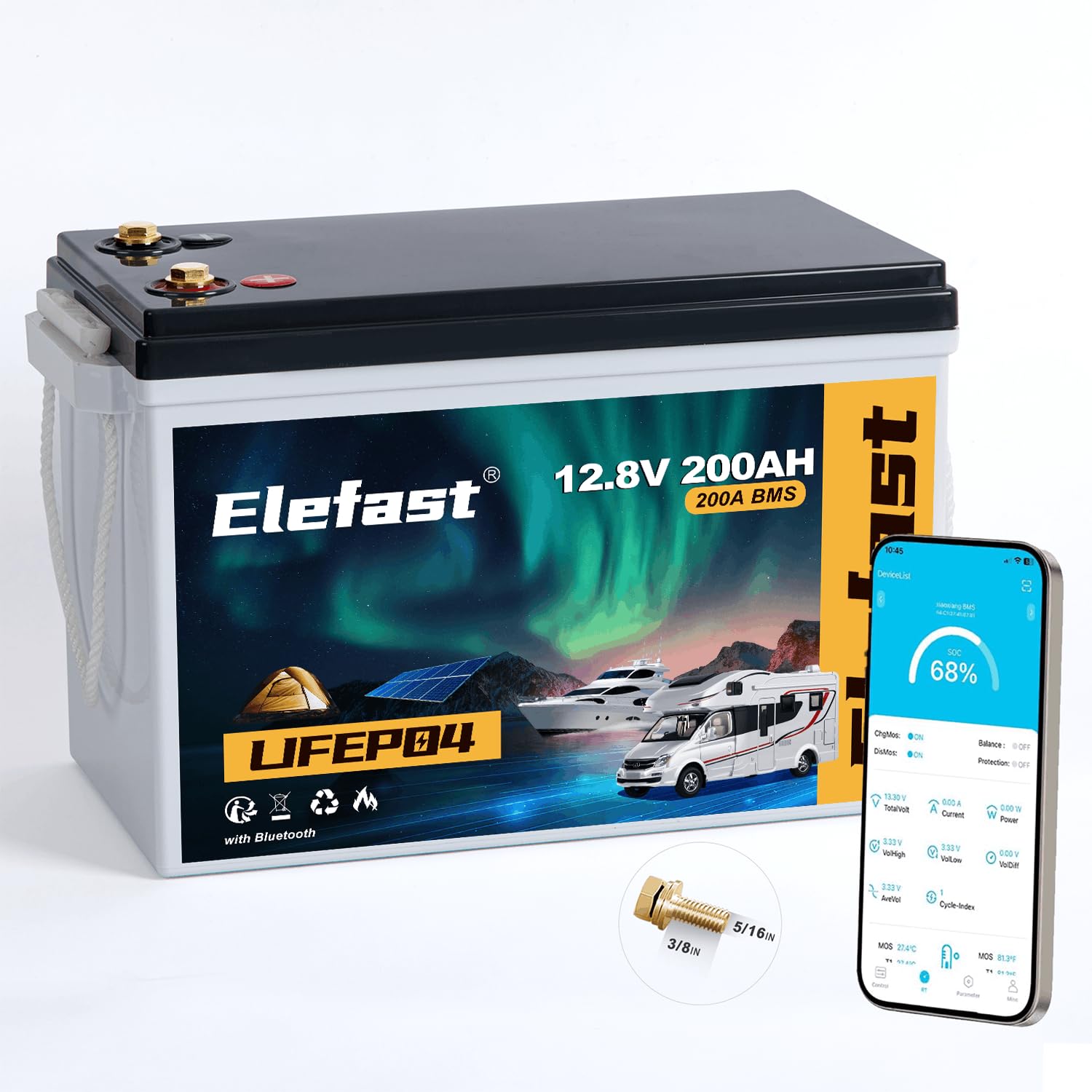
3. ELEFAST 12V 200AH Lifepo4 Battery with 200A Smart BMS & Bluetooth
A trolling-motor specialist with a BMS built to swallow the startup surge that trips lesser batteries.
Starting a trolling motor draws a huge spike of current in the first instant, and that spike is what shuts most batteries down. The ELEFAST BMS is rated to handle 600 amps for one second during that inrush, plus up to three minutes at 2C discharge (twice the battery’s capacity), and it recovers from overload protection in 30 seconds rather than leaving you stranded on the water. That is the whole pitch here — a battery that will not abandon you halfway across the lake.
At 45.1 pounds it sits in the middle of the field, lighter than the DUMFUME 12V 200Ah and the yeagulch 2X 12V 200Ah, both of which tip the scale at 58.9 pounds, but heavier than the 28-pound Litime Mini. Reviewers using it on 28 to 80 pound thrust motors report the BMS app showing live battery level and individual cell readings, and One owner’s two-hour trolling run dropped the meter only from full to 192 Ah. Charge it with a dedicated 29.2V 20-amp lithium charger and it refills the 2560Wh pack in roughly five hours.
The honest trade-off: a couple of owners find it slow to charge on solar. The app works fine, but the charge rate on panel or vehicle DC input is not this battery’s strength. If your plan is daily fast solar top-ups, weigh that against the excellent motor performance.
The surge test: that 600A/1s rating is the single most relevant number if you are running a trolling motor, and it is backed by UL, IEC, CE, and RoHS certifications plus 5-year support.
One more thing to plan: budget for a proper lithium charger, since the fast-charge claim assumes a specialized 29.2V 20A unit, not a standard lead-acid trickle charger.
Suits: trolling-motor owners and small solar builders who value surge protection over raw watt-hour price.
Not ideal for: anyone expecting quick recharge from a modest solar array.
4. Power Queen 12V 200Ah LiFePO4 Lithium Battery 2560Wh for Trailer, Motorhome

The 2560Wh workhorse that powered one owner’s entire home for 39 hours straight.
This is the classic Power Queen 200 Ah build, and the customer stories around it are the kind of thing that sells a battery on its own. One owner ran a 36-hour test at 4 to 14 amps and found it exceeded its 200 Ah rating and outperformed the lead-acid bank it replaced. The 56Wh/lb energy density and roughly one-third-the-weight-of-lead-acid packaging make it a straightforward carry for a travel trailer or motorhome.
On safety, this one carries 20+ BMS protections plus IP65 dust and water resistance with salt-spray protection, which matters if you are mounting it near a marine environment. The automotive-grade LiFePO4 cells are rated for 4000+ cycles at 100% depth of discharge. Expansion stops at the same 4P4S, 48V 800Ah, 40.96kWh ceiling as most of the field, so you can grow the bank without changing brands.
What to watch for is the charger. A few owners found their rig’s converter would not detect LiFePO4 and charged on the lead-acid profile instead, which only partially fills the pack. Pair it with a proper lithium-profile charger and you avoid that entirely.
Strong points
- 2560Wh with 56Wh/lb energy density
- 20+ BMS protections with IP65 and salt-spray rating
- 4000+ cycles at 100% DOD on automotive-grade cells
- Expandable to a 48V 800Ah system
Trade-offs
- At 19.9 kg it is not a featherweight for solo lifting
- Needs a real LiFePO4 charger — some RV converters will not detect it
A solid fit for: motorhome and travel trailer owners who want a battle-tested name with a long install history behind it.
Skip if: you plan to use your existing lead-acid converter without upgrading it.
5. Power Queen 12V 200Ah PLUS LiFePO4 Lithium Battery with 200A BMS for RV

The PLUS version squeezes more usable energy out of 200 Ah and holds it longer between trips.
Up to 95% usable capacity and just 2% low self-discharge — that is where this Plus model beats its own non-Plus sibling and the rest of the entry-level field. Practically speaking, you can discharge almost the entire pack instead of stopping at the usual lead-acid halfway point, and the charge you leave in it will still be there weeks later. That combination is exactly what removes the “will it start the fridge tomorrow” worry on a long trip. It still delivers the same 2560Wh and 200A BMS, with 20+ protections watching overcharge, over-discharge, over-current, and over-heat.
The 51.61Wh/lb energy density packs those 2560 watt-hours into about 55 pounds, and owners cooking dinner, running an oven for an hour and twenty minutes, and keeping a 12-volt fridge-freezer going 24/7 report power to spare. It expands the same way as the rest, up to 4 in series for 48V or 4 in parallel for 800 Ah, so a motorhome, boat, or home backup bank can grow with you.
One practical note from the field: these are heavy enough that owners build extra-duty shelves or mount them to a steel frame rather than trusting a flimsy tray. Plan the mounting, not just the wiring.
The capacity upgrade: the jump from the standard model to this Plus version buys you 95% usable capacity and a 2% self-discharge rate, meaning more usable power and less topping off between camping trips.
Plan the mounting: at roughly 55 pounds, build or buy a shelf rated for it before the battery ever leaves the box.
Pick this one if: you want the most usable capacity per charge in the Power Queen line and the lowest idle drain for a seasonal camper.
If weight is your top worry: the lighter Litime Mini above will serve better in a tight boat locker.
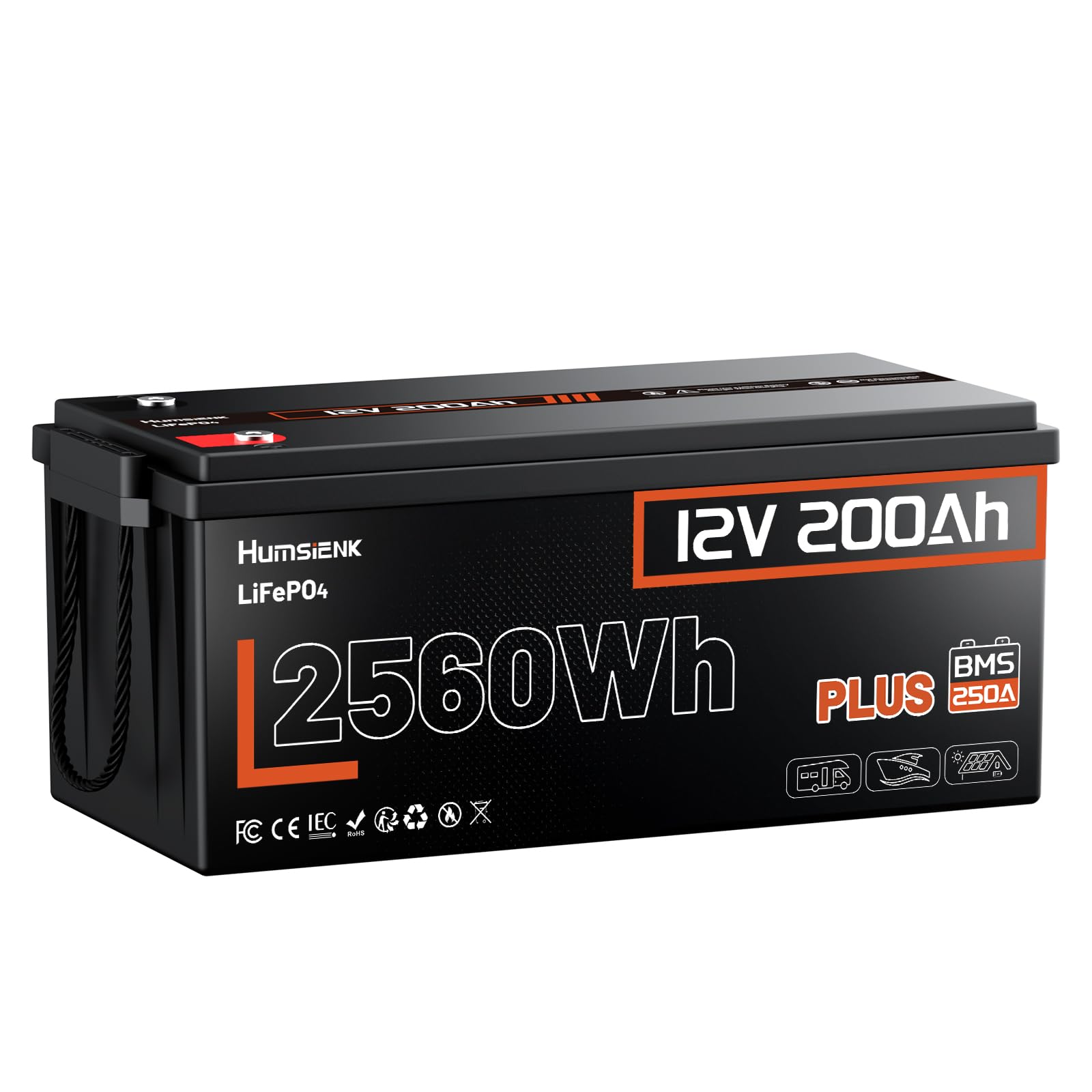
6. Humsienk 12V 200Ah LiFePO4 Lithium Battery 2560Wh 250A BMS 6000+ Deep Cycle
A 250-amp BMS that lets this battery feed heavy appliances without flinching.
Most 200 Ah batteries here use a 200A BMS. This Humsienk steps up to 250A and delivers 3200W of continuous output, so it will run an RV air conditioner, fridge, or power tool that would trip a lesser unit. The 2560Wh of stored energy sits in a compact 58.2-pound body, and the 250A BMS combines with 10+ safety protections to keep current flowing cleanly. If your rig has one hungry appliance that keeps shutting down the battery, this is the spec that fixes it.
Longevity is rated at 6000+ deep cycles at 80% depth of discharge, which the maker describes as over 10 years of reliable service with slow capacity fade. It runs safely from -4°F to 140°F with an IP65 waterproof rating, so dust, rain, and rough outdoor storage are all fair game, and the compact footprint slots into RV, boat, or home solar installs without complex wiring.
The main friction point is charging from a vehicle alternator while driving. One owner’s camper fridge drained the pack over a five-hour drive despite the manual’s alternator-charging claim, and the battery died. Customer service resolved the issue and the owner bumped the rating up, but it is a reminder that this battery wants a dedicated lithium charger or solar setup, not a casual alternator top-up.
The power-first pick: if an air conditioner or a 3200W load is on your list, this 250A BMS headroom is the reason to choose it over a standard 200A unit.
The charging caveat: plan on solar or a proper shore charger — do not count on your alternator alone to keep it fed.
Built for: RV owners running high-wattage appliances who need a stronger BMS to avoid nuisance shutdowns.
Think again if: your main charge source is the vehicle alternator rather than solar or shore power.
7. Wattcycle 12.8V 200Ah LiFePO4 Battery 200A BMS 15000+ Cycles

A 45.2-pound lithium pack that shrugs off heat, cold, and just about everything else.
The temperature window is the standout here. This Wattcycle runs from -4°F (-20°C) to 158°F (70°C), which covers a camping trip in the mountains and a baking afternoon in a truck bed alike. It carries an IP67 rating (dustproof and able to survive temporary water immersion), a step beyond the IP65 protection most rivals offer. The A+ grade cells are rated for up to 15,000 cycles, and it carries SDS, UN38.3, FCC, CE, and ROHS certifications.
At 45.2 pounds it cuts both space and weight by more than 50% compared with lead-acid and AGM blocks, and the compact 9.4″H x 19″W x 6.7″L footprint helps it fit tighter compartments. It supports devices over 1000W and expands up to 4 units in series or parallel for 40.96kWh. Owners use it to power trolling motors and to feed power stations, and one reported the BMS protective threshold sitting around 900A of instantaneous current before it steps in.
Note that the weatherproofing is for storage and outdoor exposure, not for full-time submersion while in use, and Wattcycle asks you to confirm the size before ordering since return postage is on you. Measure first.
Built for weather: IP67 plus that -4°F to 158°F range makes this the pick for anyone storing a battery in an unheated shed or a hot truck.
Measure twice: a return ships on your dime, so confirm the footprint fits your tray before you commit.
The one for: boats, buses, and campers that live outdoors in extreme climates all year round.
Not the cheapest route: if budget leads and you store indoors, a more affordable pack works just as well.
8. Redodo 12.8V 200Ah Plus LiFePO4 Battery Built-in 200A BMS 4000+ Deep Cycles
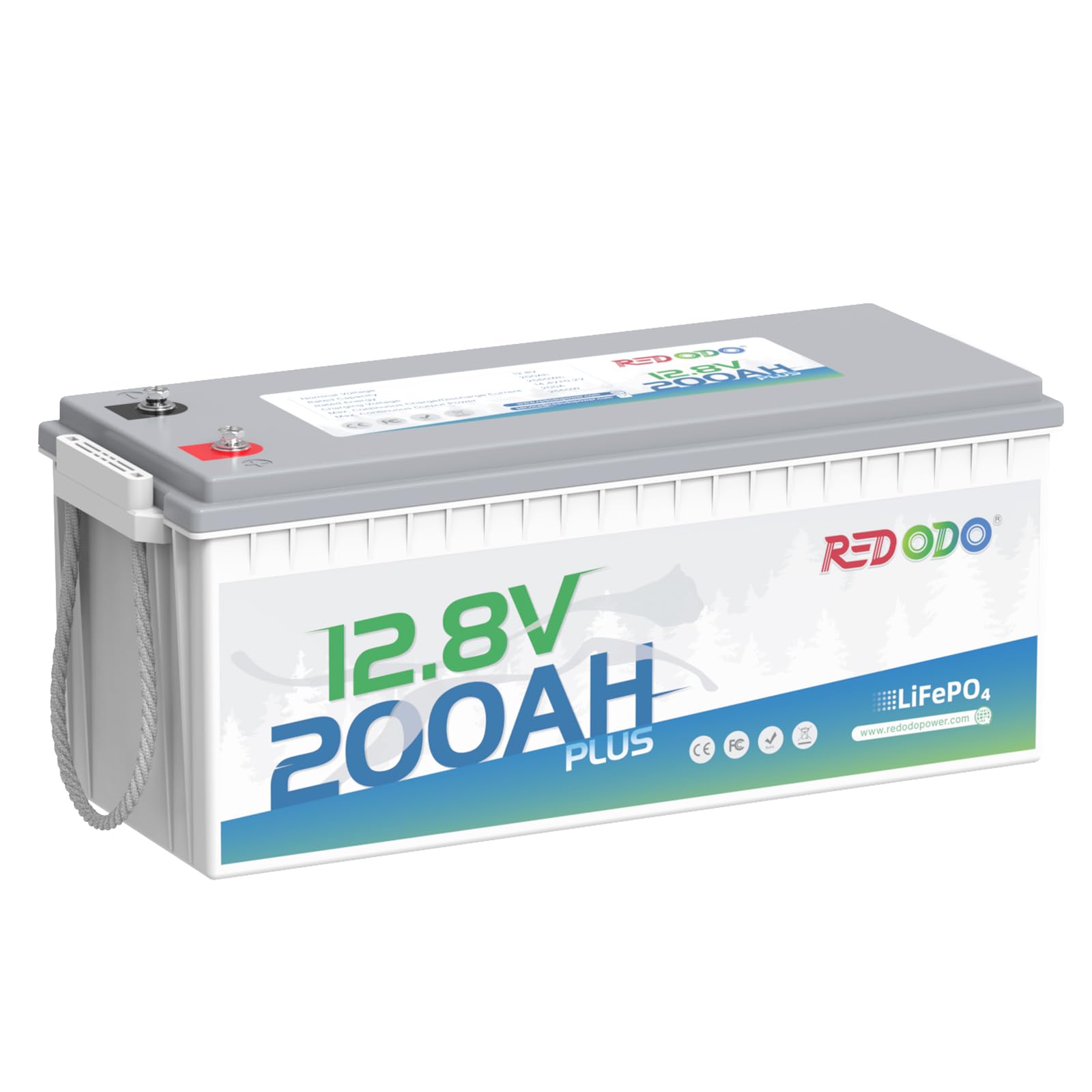
Four lead-acid blocks of usable energy in a single package at a fifth of the weight.
Do the math that few sellers spell out. One Redodo 200Ah Plus delivers 2.56kWh — because 12.8 volts times 200 amp-hours at 100% depth of discharge is 2560 watt-hours — which is equivalent to 4 × 100Ah lead-acid batteries’ usable energy (4 × 12 volts × 100 Ah × 50% usable). Yet the whole pack weighs just 49.6 pounds, roughly one-fifth of that bank of AGM blocks, in a BCI Group 6D box (a standard battery size) that drops into the same tray. One battery doing the work of four in the same footprint is the clearest case for going lithium.
It is a 200A BMS with 2560W max load power and protections against over-charge, over-discharge, over-current, short-circuit, and over-temperature. The cells are automotive-grade LiFePO4, rated for up to 15,000 cycles at 60% depth of discharge (4000+ cycles at 100%), and the battery carries UL testing reports. Expansion goes to 16 batteries in 4P4S for a 51.2V 800Ah system and 40.96kWh of storage.
The one spec to read carefully is the charging window. Redodo recommends charging at 0.2C (a rate of 40 amps for a 200 Ah battery) — around a 40-amp charger will bring it to full in roughly 5 hours — and specifically warns this battery is for energy storage and trolling motors, not for starting cars, golf carts, water pumps, or electric jacks. Work within that brief and it performs.
Why owners like it
- 2.56kWh matching 4 × 100Ah lead-acid in usable energy
- 49.6 lb versus a heavy bank of AGM blocks
- Drop-in BCI Group 6D footprint
- UL testing reports and up to 15,000 cycles at 60% DOD
Read the brief
- Not for high-power loads like water pumps, electric jacks, or mowers
- Charging takes longer on solar than on a dedicated 40-amp charger
Ideal for: sailboat and RV owners replacing a group of lead-acid blocks and wanting a single drop-in replacement.
Avoid if: you need a starting battery or plan to run high-draw motor-driven appliances.
9. 2X 12V 200Ah LiFePO4 Battery Built-in 200A BMS 2560Wh 15000+ Deep Cycle
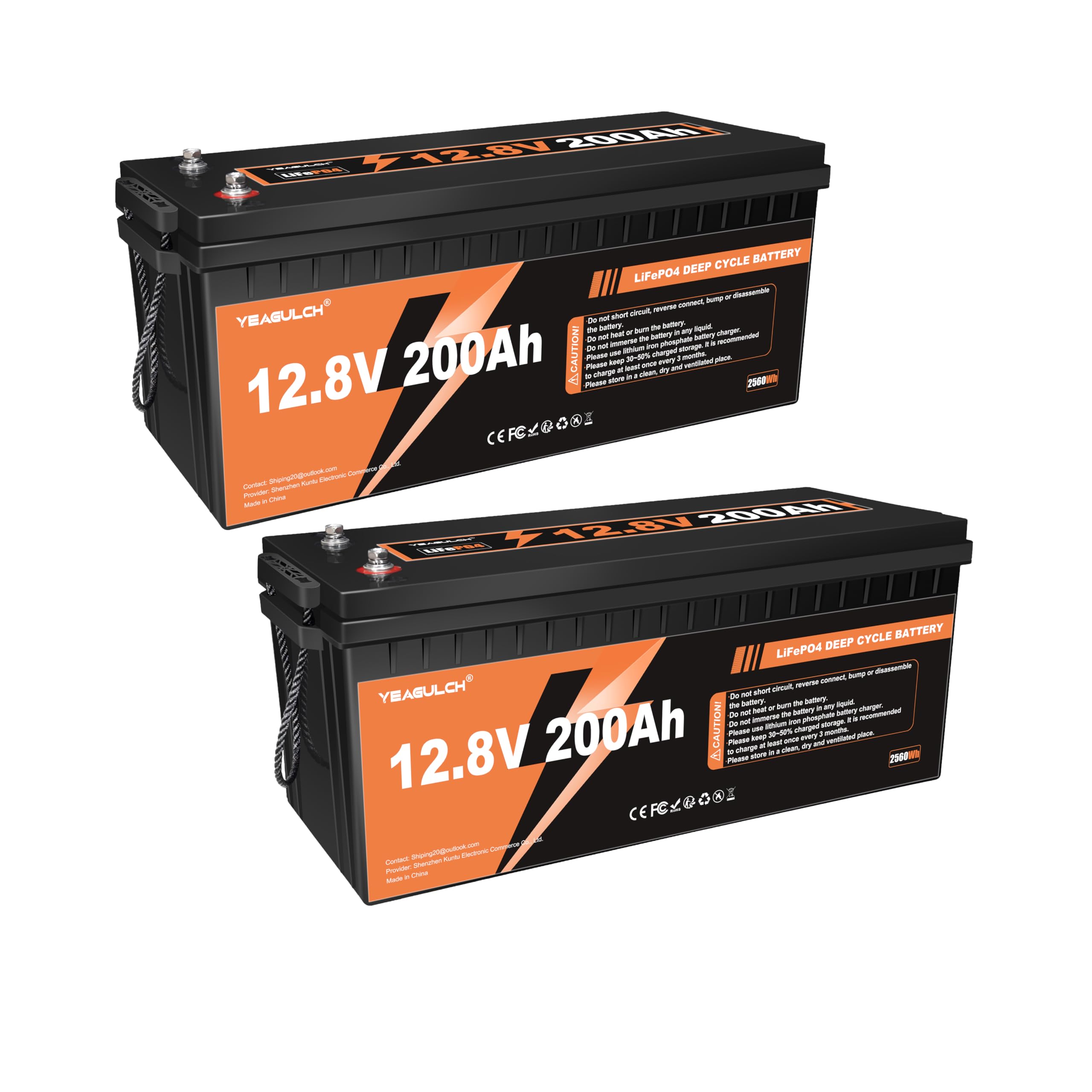
Two 200 Ah packs in one order — the shortcut to a bank that holds serious energy.
If you already know you need more than one battery, this yeagulch 2-pack saves you a second order. Each unit carries the full 200 Ah, 2560Wh spec with a 200A BMS, and owners get the flexibility of parallel or series wiring to build the voltage and capacity their setup needs. That makes it the natural starting point for a bigger 12-volt, 24-volt, or 48-volt system without buying mismatched singles over time.
Each module is 1/3 lighter than equivalent lead-acid and weighs in at 58.86 pounds, which is a comfortable solo lift for most people. The ABS shell is IP67 waterproof, with automatic high and low temperature cut-off to keep charging and discharging safe. Owners who upgraded from a lead-acid setup report the power output felt like a different class of battery entirely.
Two small things to note. Charge speed is mixed — reviewers see fast charging with a proper 40A unit but slower results from basic chargers, so get a good lithium charger. And the manufacturer asks you to charge and discharge each battery at least once every six months to keep it healthy.
The bank-building shortcut: buying two at once keeps cells matched from the same batch and lets you grow the system with identical units instead of hunting for a compatible single later.
Battery-care reminder: set a six-month calendar note to cycle each pack, since this maker specifically recommends it to avoid disuse damage.
Worth it for: anyone building a bigger bank from the start and wanting matched cells in one purchase.
Overkill if: you only need a single replacement battery for a small RV.
10. Litime 12V 230Ah LiFePO4 Lithium Battery for RV, Travel Trailer, Solar
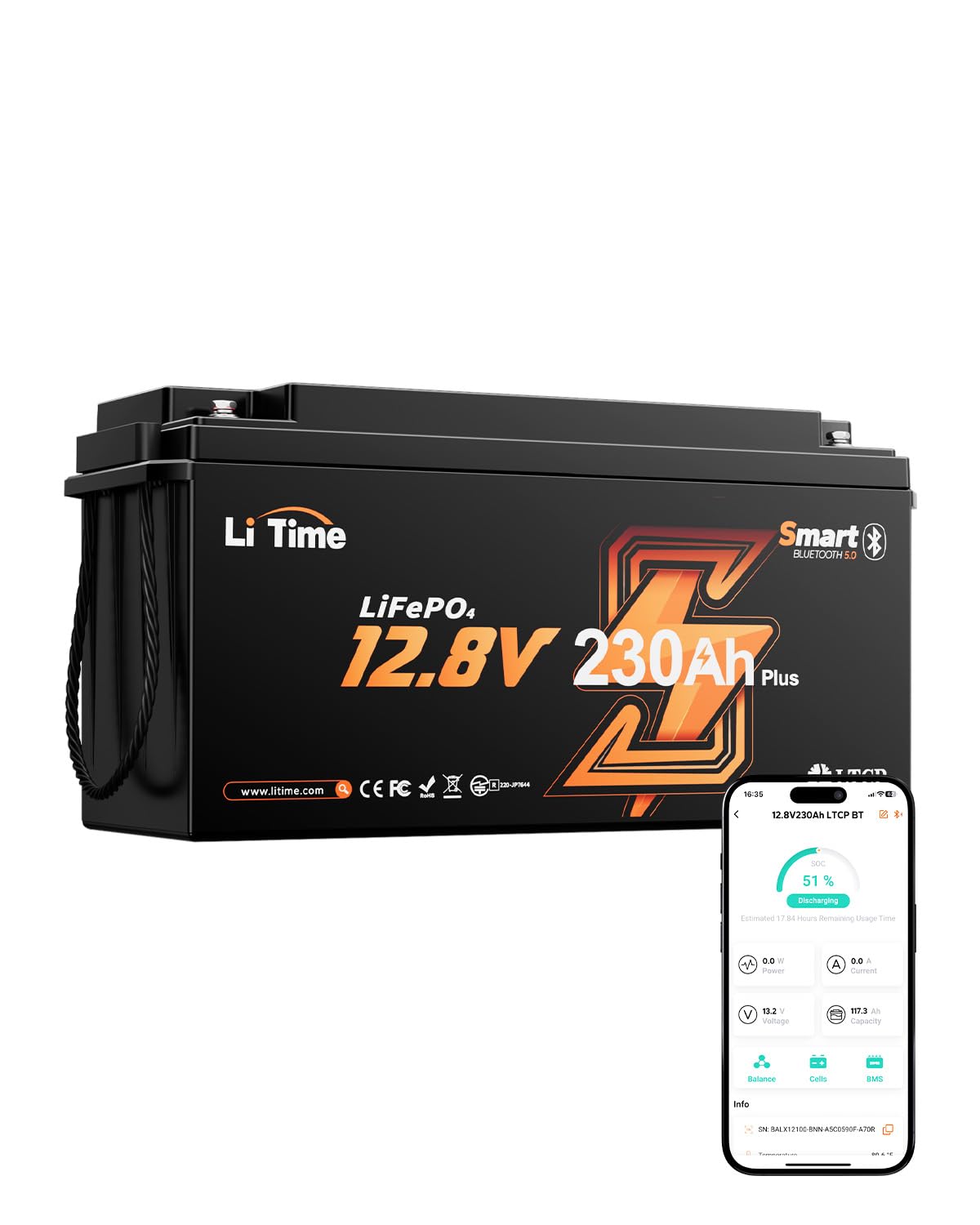
A touch more capacity in a Group 4D package that drops straight into the old lead-acid tray.
It weighs just 45.98 pounds, about a third of the lead-acid it replaces, and adds Bluetooth 5.0 monitoring so you can see state of charge from your phone without crawling underneath. Owners mention it fits perfectly in double battery boxes and takes up a smaller footprint than the flooded battery it replaced.
The 200A BMS layers on 20+ safeguards, and the low-temperature protection pauses charging below 0°C (32°F) to protect the cells and extend their lifespan. The A+ automotive-grade LiFePO4 cells are rated for a 10-year lifespan with 4000+ deep cycles, and the battery expands up to 16 units in 4P4S (a wiring setup that combines four batteries in parallel and four in series) for a 48V, 920 Ah, 47.1 kWh system — a bigger ceiling than most of the field. It is backed by a 5-year warranty and 24/7 support.
The Bluetooth app has a learning curve, and this battery is not heated, so charging in freezing weather needs the battery to warm up first. If you routinely camp below freezing and want help starting a charge sooner, the self-heating Renogy later in this list is the better answer.
The drop-in upgrade: 230 Ah in a Group 4D footprint at 45.98 pounds means more overnight capacity without a single change to your existing tray or straps.
Worth knowing: the app takes some getting used to and this model has no self-heating, so cold-weather chargers will have to wait for the battery to warm on its own.
Best for: travel trailer and Class C owners who want a slightly bigger tank in the same physical slot.
Consider the Renogy model instead if you boondock in freezing conditions and want active self-heating.
11. Renogy 12V 200Ah Bluetooth Self-Heating LiFePO4 Deep Cycle Battery Pro Series
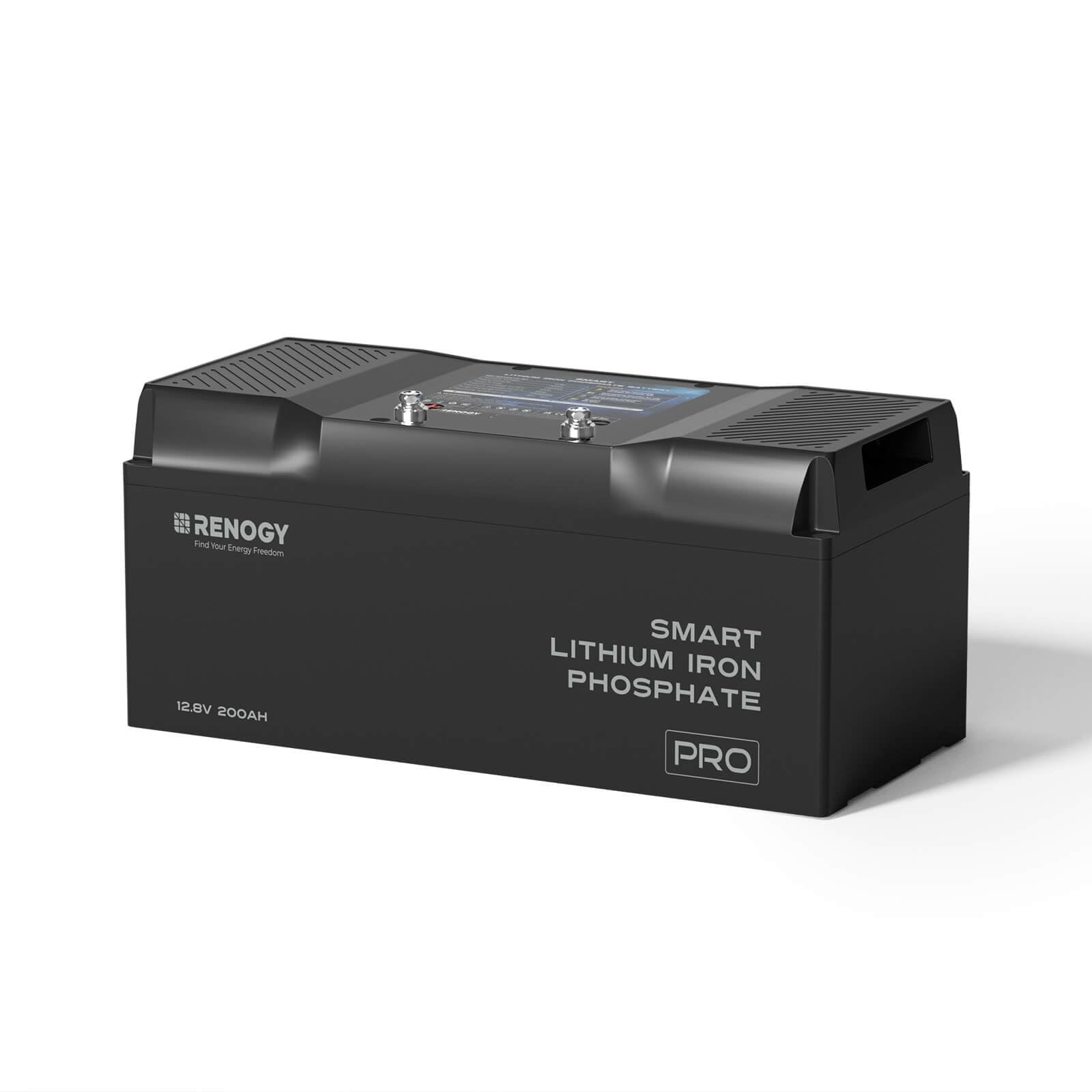
The battery that heats its own cells so you can charge below freezing without a workaround.
For anyone boondocking through winter, the self-heating feature is the whole reason to pick this one. Built-in overheat protection lets the cell temperature rise so charging can resume safely — you do not have to warm the compartment first. The 60+ BMS protections and integrated self-control fuses act as a backup line of defense, breaking the circuit if hardware ever fails. The casing carries a UL94 V-0 fire-retardant rating, and the ISO 9227 corrosion-resistant build is designed for coastal and salt-water environments.
The rugged internal structure is built to resist vibration from rough roads, and mounting holes with fix brackets secure it to an RV frame. Bluetooth monitoring keeps an eye on everything from the cab, and the 7-year prorated warranty is the longest coverage in this roundup.
The trade-off is the safety lockout. Drawing the battery too low triggers a protective mode that blocks solar and trickle charging, and reviving it needs a proper jump or a direct charge — so watch your depth of discharge, or carry a way to jump it. Some owners have also run into Bluetooth and support snags, so plan for a follow-up call if something misbehaves.
Built for winter: self-heating plus a 7-year warranty is the combination that makes this the pick for cold-weather and coastal camping.
Keep an eye on depth of discharge: over-discharging locks the BMS into a protective mode that needs a jump or direct charge to clear.
The right one for: year-round boondockers and coastal users who need self-heating and corrosion protection.
Not the value leader: if you camp in mild weather and do not need self-heating, spend less and get the same amp-hours elsewhere.
12. CHINS Lithium Battery 12V 200AH LiFePO4 Battery Built-in 200A BMS

The premium tank that runs a van’s appliances, a sailboat’s bank, and a home’s backup — all from one 200 Ah block.
This is the priciest pick here, and what you pay for shows up in the spec sheet and the support stories. CHINS rates the cells for 2000 to 5000 cycles versus just 300 to 500 for lead-acid, adds a smart BMS against overcharge, over-discharge, over-current, and short-circuit, and cuts high-temperature charging above 122°F. It carries no memory effect (a trait that lets you top it off without losing capacity), so partial discharges do not rob capacity, and it holds charge when idle. The 200A BMS supports devices over 1000W and expands up to 4 units in series for 48V or parallel for 800 Ah — combine both for 48V 800Ah — with the caveat that only same-voltage batteries bought within 6 months qualify for pairing.
Owners have pushed this one hard. One owner ran a 3000W inverter pulling 100 to 120 amps on a week-long sailboat trip without a hiccup. Two units replaced a bank of 4D AGMs in a sailboat with a straight drop-in. One long-term owner’s 2020 CHINS still holds 13.4 to 13.5 volts after days of powering an RV heater, chainsaws, fridges, and a 1500W space heater. A bench test at 20 amps over nine hours delivered 194 Ah, essentially meeting the 200 Ah factory mark.
The catch worth flagging: voltage alone is not a reliable state-of-charge read on this battery, and one owner had the BMS cut out overnight until a shunt confirmed the true capacity. If you want to know exactly what is left, add a shunt. The high price and the relatively low cycle rating compared with the 15,000-cycle rivals are the two reasons to weigh it against the cheaper Wattcycle and Redodo above.
What you are paying for
- 2000–5000 cycles and a smart BMS with high-temp cutoff above 122°F
- No memory effect and low self-discharge for seasonal storage
- Documented real-world runs: entire home backup, 3000W inverter sailing trips, and construction-truck daily use
- Expands to 48V 800Ah for large banks
The honest caveats
- Voltage is not a reliable state-of-charge readout — a shunt is recommended
- Pairing for expansion needs same-voltage batteries bought within 6 months
Choose it for: a premium build with a strong repair-or-replace reputation and plenty of documented heavy-use history.
Look at the budget picks first if: cycle count and price matter more to you than the premium build and support story.
Understanding the Specs
What “200 Ah” Actually Means
Amp-hours (Ah) measure how much current a battery can deliver over time. A 200 Ah battery running a 10-amp load gives you roughly 20 hours — but only if the battery is rated to discharge that far. That is why depth of discharge (DOD) matters as much as the Ah number. Lead-acid batteries are typically only safely discharged to 50%, so a 200 Ah lead-acid gives you about 100 usable Ah, whereas most LiFePO4 cells here run to 100% DOD, giving you the full 200 Ah. That is how a single lithium block replaces two or more lead-acid ones.
The BMS and Its Amp Rating
Every lithium battery in this guide has a built-in battery management system (BMS) — the electronic protector that cuts power if current, temperature, or voltage goes out of range. The number that matters most is the continuous amp rating: a 200A BMS allows a 200-amp load, which covers most RV inverters and mid-size trolling motors, while a 250A unit handles heavier draws without tripping. Several models also add low-temperature cutoff to stop charging below freezing, and IP ratings (like IP65 or IP67, which indicate how well the case keeps out dust and water) to seal against dust and water.
FAQ
Can a 200 Ah lithium battery run a trolling motor all day?
Do I need a special charger for a LiFePO4 battery?
How long does a 200 Ah lithium battery last?
Can I connect two 200 Ah lithium batteries in series or parallel?
Will a 200 Ah battery run an RV air conditioner?
What happens to charging in cold weather?
Is a 230 Ah battery better than a 200 Ah battery?
Can a 200 Ah lithium battery be used for home backup power?
Are lithium batteries heavier than lead-acid batteries?
Which size battery box fits a 200 Ah lithium battery?
Final Thoughts: The Verdict
Put simply, the 200 ah lithium battery to beat is the Litime 12V 200Ah Mini — it holds the strongest owner verdict in the group, and its 28-pound build is class-leading in this roundup, which is why it takes the top spot with the lowest review count of the leading picks.
If you want to spend a little less and do not need Bluetooth, the dumfume 12V 200Ah is the value champion. For a slightly larger tank that drops into a Group 4D tray, the Litime 12V 230Ah is the one. And if you camp through freezing weather, the self-heating Renogy 12V 200Ah Pro is worth the splurge.
How We Picked
We do not accept paid placement. Every pick is matched to a real buyer and a real use-case; we do not hands-on test units.
Sources & Methodology
Specifications: manufacturer listings and product documentation. Review insights: verified customer reviews, as of September 2026. Pricing: not shown on this page (it changes often); check the current price via the retailer link.
As an Amazon Associate, KitchPrep earns from qualifying purchases. This does not affect which products we feature.
Related Guides
