
Specs are compiled from manufacturer listings and verified buyer reviews and can change over time — please confirm the key details on the product page before buying.
Buying a generator is really about one question: what do you need to keep running when the grid goes down? If it is just a fridge, a few lights, and your phone chargers, a small inverter unit that weighs about 30 pounds will do the job and stay quiet enough for a campground. If you want to run a whole house — air conditioning, well pump, and all — you need something in the 13,000-watt class that can feed a transfer switch. This guide covers both ends of that range, plus the middle ground that fits most RV owners and storm-season homeowners.
I’m Mohammad Maruf — the founder and writer behind KitchPrep. This guide is built by comparing the manufacturers’ published specifications and the patterns across verified customer reviews, so you get each pick’s real strengths and trade-offs instead of marketing spin.
The biggest mistake first-time buyers make is chasing peak wattage and ignoring running watts — the number that actually decides whether your air conditioner stays on. Every pick below is ranked around that reality. The list covers the generators worth your money, from a 30-pound tailgate companion to a tri-fuel whole-home unit.
Our Picks at a Glance

How To Choose The Best Generators
Before you compare models, figure out what you are actually powering. Write down the running watts of everything you want to run at the same time — the fridge, the furnace fan, the lights, the internet router. That total is your floor. Then add the starting watts of the biggest motor in the mix, which is usually an air conditioner or a well pump.
Running watts versus peak watts
Every generator lists two power numbers, and they are not interchangeable. Peak watts (also called surge or starting watts) is a brief burst the unit can deliver for a few seconds — exactly what a compressor motor needs to kick over. Running watts is the steady output the generator can hold for hours. A unit rated at 4000 peak watts and 3000 running watts will not run a 3500-watt load continuously, no matter what the box implies.
Inverter versus open-frame
Inverter generators convert the engine’s output into clean, stable power with low total harmonic distortion (THD — a measure of how clean the electrical waveform is). That matters if you are plugging in a laptop, a TV, or a CPAP machine, because dirty power can damage sensitive electronics over time. Open-frame units are typically louder and heavier but cost less per watt, which is why they suit job sites and whole-home backup rather than campgrounds.
Fuel type and runtime
Gasoline delivers the most power per tank but goes stale and requires stabilizer for storage. Propane stores indefinitely and burns cleaner, though you lose some wattage on it — the Westinghouse 6500 Watt drops from 5300 running watts on gas to 4800 on propane. Natural gas never runs out if your home is plumbed for it, which is why tri-fuel models appeal to homeowners who want an outage to be a non-event.
Quick Comparison
| Model | Best For | Running Watts | Peak Watts | Weight | Amazon |
|---|---|---|---|---|---|
| Champion 4000-Watt RV Ready Portable Inverter Generator★ Best Overall | RV owners and home renovation backup | 3000 | 4000 | 48.1 lbs | Amazon |
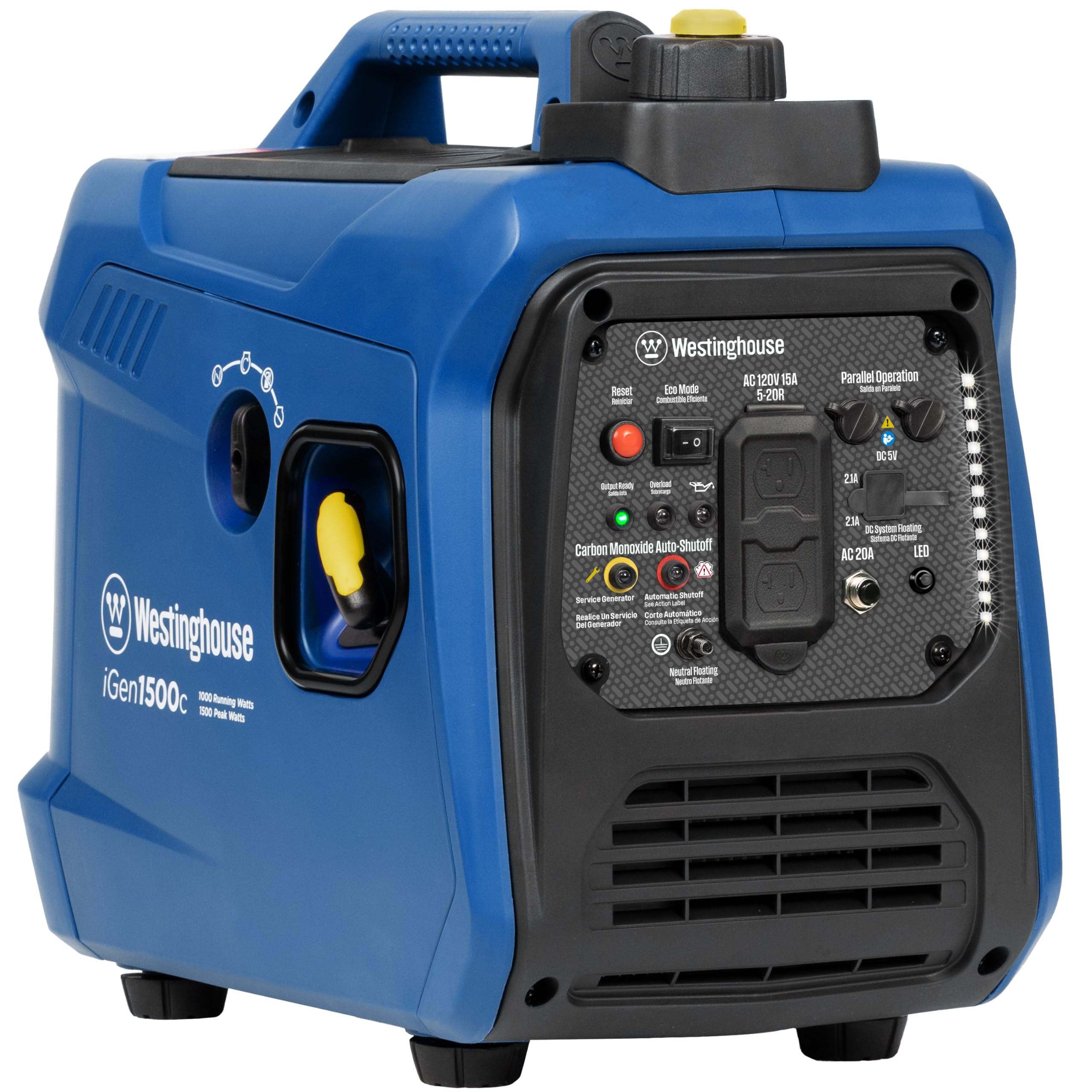
| Westinghouse 1500 Peak Watt Portable Inverter GeneratorBest For Camping | Camping and CPAP/phone power | 1000 | 1500 | 30.1 lbs | Amazon |
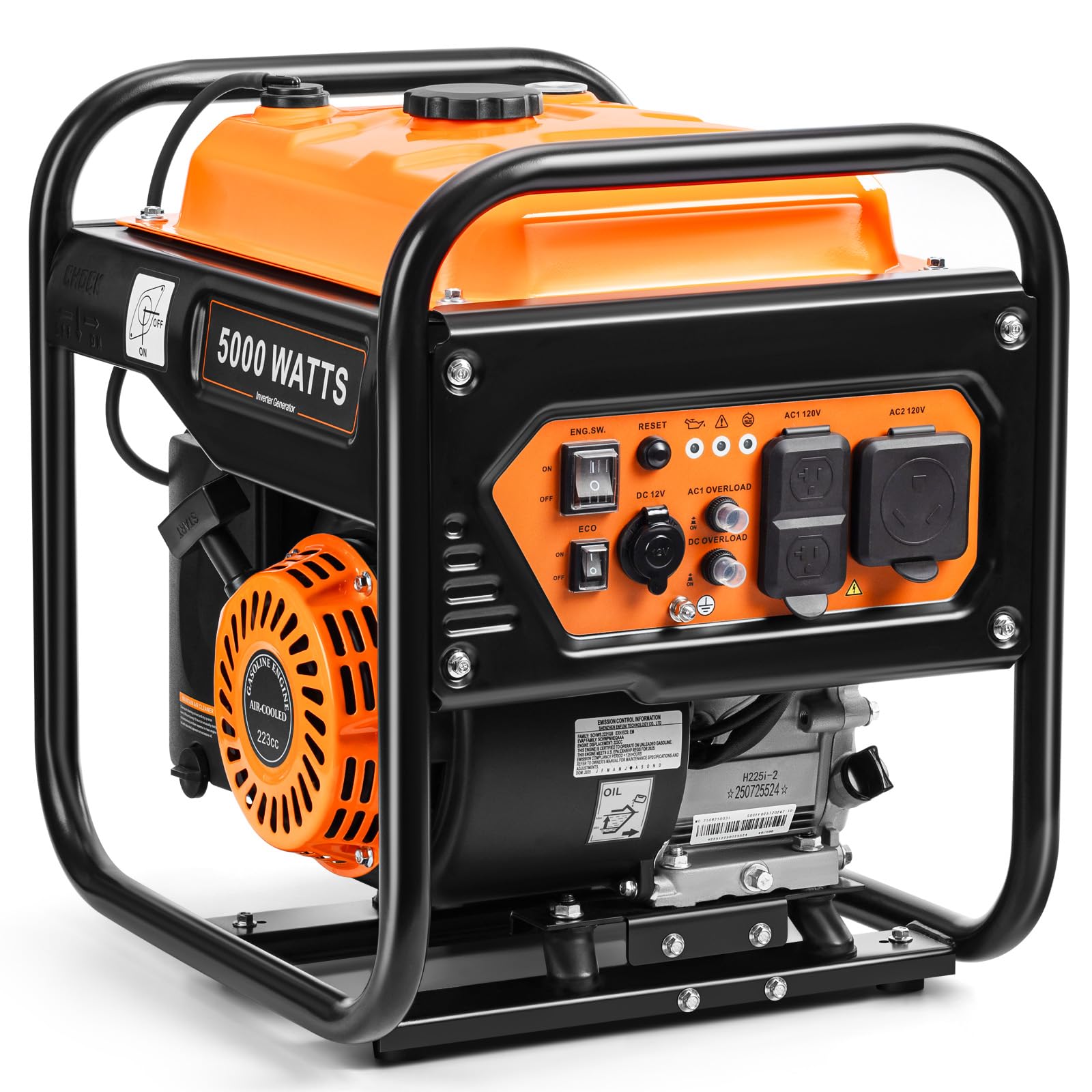
| Oxseryn 5000W Inverter GeneratorMost Power Per Pound | Light RV use and general camping | 4000 | 5000 | 59 lbs | Amazon |
| Pulsar PGD40ISCO 4000W Portable Gas Inverter Generator | Emergency power and small travel trailers | 3200 | 4000 | 47.3 lbs | Amazon |
| ERAYAK 4500W Portable Inverter Generator | Storm outages and multi-device charging | 3500 | 4500 | 54 lbs | Amazon |
| WEN 3600-Watt Portable Inverter Generator (56360i) | Camper storage and light emergencies | 2900 | 3600 | 46 lbs | Amazon |
| Westinghouse 6500 Watt Dual Fuel Home Backup Generator | Whole-home backup on a budget | 5300 (gas) / 4800 (propane) | 6500 (gas) / 5800 (propane) | — | Amazon |
| WEN 4800-Watt RV-Ready Portable Inverter Generator (56477i) | Home backup with onboard wheels | 4000 | 4800 | 72.7 lbs | Amazon |
| DuroStar DS13000MX 13,000-Watt Dual Fuel Portable Generator | Whole-home backup with transfer switch | — | 13000 | — | Amazon |
| DuroMax XP13000HXT 13,000-Watt Tri Fuel Portable Generator | Natural gas whole-home backup | — | 13000 | 240 lbs | Amazon |
In‑Depth Reviews
1. Champion 4000-Watt RV Ready Portable Inverter Generator
Our pick — over 4.5★ from 650+ verified ratings; the strongest balance of quality and price.
The 48-pound inverter that runs a 30-amp RV without waking the campground.
What makes this the pick to beat is a combination no other unit in this group matches: a 149cc engine pushing 4000 starting watts and 3000 running watts, all wrapped in a body that weighs 48.1 pounds. Champion calls it one of the lightest 4000-watt inverters in the industry, and the spec supports it. You get clean power at less than 3% THD, which is the number that keeps a TV or a laptop safe, plus a 30-amp RV outlet and up to 10 hours of run time. It arrives with oil and a funnel, and it is backed by a three-year limited warranty with free lifetime technical support.
RV owners get the most out of it here. It runs a 15,000 BTU air conditioner plus lights and a 12V fridge, though not the air conditioner and a microwave at once. Compare the running watts directly to the WEN 56477i at 4000 — the Champion gives up 1000 running watts but carries 4000 peak watts of surge for motor startups. If you are a light-load user who mostly runs fans and chargers, the smaller WEN 56360i will save your back at 46 pounds; if you are hauling a 30-amp trailer, the 30A outlet here is the deciding feature.
You get quiet running for camping, but the noise climbs when you push it hard. Champion rates it at 64 dBA (decibels, a measure of loudness) from 23 feet, and at full load it climbs toward 70 dBA — quiet enough to talk over at a campsite, but not silent. Two more things to know before you buy. It ships without oil in the crankcase (the engine’s oil reservoir), so you must add oil before the first pull. And the CO Shield sensor (a carbon-monoxide detector that shuts the engine off) can be sensitive enough to cut the engine in a stiff breeze — one of the few complaints that shows up across the review pages.
Why It Earns The Top Spot
- 4000 starting watts and 3000 running watts from a 149cc engine
- Clean power under 3% THD protects phones, laptops, and TVs
- 48.1 pounds — light enough to load solo
- 30A RV outlet plus duplex 120V and a 12V automotive outlet
- CO Shield carbon monoxide auto-shutoff built in
What To Plan Around
- 64 dBA at 23 feet and louder under full load
- Runs about 8 to 10 hours under heavy load, so expect an overnight refuel
- Ships without oil — add it before the first start
Worth it if: you tow a travel trailer or run a renovation site and want one box that covers both.
Skip ahead if: you need to run a whole house through a transfer switch — this is a 30-amp RV-class unit, not a panel-fed backup.
2. Westinghouse 1500 Peak Watt Super Quiet & Lightweight Portable Inverter Generator
Thirty pounds, 52 decibels, and enough power to keep a CPAP breathing all night.
Here is a generator you can carry in one hand. At 30.1 pounds with a 56cc engine, this Westinghouse is 28.9 pounds lighter than the Oxseryn 5000W, and that 56cc displacement is roughly a quarter of the Oxseryn’s 223cc. It puts out 1500 peak watts and 1000 rated watts at less than 3% THD, which is the clean-power threshold that matters for electronics. For scale, the Champion above pushes 4000 peak watts from nearly the same footprint — but the Champion weighs 18 pounds more and is not something you want to lift onto a tailgate one-handed.
A 0.79-gallon tank runs up to 12 hours in Economy Mode, and the noise floor drops as low as 52 dBA, which is quieter than a normal conversation. The starting story is simple too: a recoil (pull) start that fires on the first or second pull, which matters when you are doing it in the dark. You get two 120V 20-amp outlets, two USB outlets, and parallel capability if you later want to combine it with another Westinghouse inverter for more wattage.
The catch is that this is a small generator and reviewers who expect more get frustrated. The engine cover tabs are thin plastic, and a few long-term owners have had units seize after light use despite oil changes — that is a rare outcome on a small engine, but it is worth knowing. The CO sensor is also sensitive enough to cut out in a gust of wind, so placement away from a breeze helps. Treat it as a 1000-watt machine for camping and light backup, not a 1500-watt one for the duration.
The clean-power case: a low-THD inverter rated at 1500 peak watts is the right tool for sensitive devices — laptops, phones, and CPAP machines — where dirty power is a risk.
Value read: the parallel port is the feature most buyers overlook; it is the difference between a one-time camping unit and a system you can grow.
Reach for this if: you camp, tailgate, or want a grab-and-go backup for phones and a laptop.
Look elsewhere if: you plan to run an air conditioner — 1000 running watts will not start one.
3. Oxseryn 5000W Inverter Generator Gas Powered, Open Frame Generator
A 223cc open-frame inverter that hits 5000 peak watts and still rolls on two wheels.
If peak watts are the spec you care about, this is the value play of the mid-range group. You get a 30A RV outlet, two 120V AC ports, and a 12V DC port, all fed by inverter technology that keeps total harmonic distortion low enough for laptops, phones, and cameras.
Fuel economy is the standout here in real use. The 2-gallon tank with a built-in fuel gauge is rated for up to 10 hours at 25% load, and owners in eco mode report stretching it to roughly 16 hours. That is the kind of runtime that turns an overnight outage into a single fill-up. It is also a compact machine for its class, and it rolls on a sturdy frame rather than relying on a handle alone.
Plan your loads around 3000 running watts, not the full 4000, and you will be happy. As buyers report, “it’s not 4000 watts (more like 3000, as it will stall above that) but it runs stable and has great fuel economy in eco mode.” Assume the full 4000 and you will be disappointed. It is also louder than a true suitcase inverter (a sealed, quiet-style portable generator) — 70 dBA at 23 feet — and a handful of owners note that it lacks a traditional ignition switch, so the choke and on/off layout takes a read of the manual to learn.
The Strong Arguments
- 5000 peak / 4000 running watts from a 223cc 4-stroke OHV engine
- Low-THD inverter output safe for laptops, phones, and cameras
- 2-gallon tank with a built-in fuel gauge rated for up to 10 hours at 25% load
- 30A RV outlet for travel trailers
The Warts
- Real-world running watts run closer to 3000 before it stalls
- 70 dBA at 23 feet — louder than a true suitcase inverter
- No traditional ignition switch; the choke layout needs the manual
Pick it up if: you want big wattage numbers and long eco-mode runtime without paying premium prices.
Walk past if: silence is non-negotiable — this is an open-frame machine with the noise to match.
4. Pulsar PGD40ISCO Ultra Light Quiet 4000W Portable Gas Inverter Generator

Rated at 59 decibels — the quietest number on this page — from a 47-pound body.
Pulsar’s headline spec is noise, and it earns it on paper: 59 dB, which is roughly the sound of a normal conversation, from a 4000-peak-watt inverter that weighs 47.3 pounds. The 145cc engine delivers 3200 rated watts, so it is built around real-world load, not just a big surge number. It handles sensitive electronics and air conditioning units up to 13,500 BTU, and the automatic voltage regulation keeps sensitive gear protected. For RV and emergency use, that is a well-rounded package.
Long-term owners have put real hours on it. One recorded 410 hours over three summers with no issues, running a 13.5k BTU air conditioner with a soft-start kit, and could run a microwave and the air conditioner together once. The one-gallon tank gives about 4 hours at half load, and real owners mention 4 to 6 hours running an air conditioner, so plan fills around that. It is parallel-ready if you want to link a second unit later.
Two caveats worth knowing before you buy. The first is noise under load: it is rated 59 dB, but owners who compare it directly to a Honda or a Predator find it louder than those at higher RPM. The second is durability of the fuel system — a rare but serious report of a tank leaking gasoline twice is the kind of thing that is worth watching in the first week of ownership. Neither makes this a bad generator; both are worth tracking during your warranty window.
Why the noise spec holds: 59 dB is a conversation-level rating, and one-hand carry at 47.3 pounds means you can move it without help.
How it holds up: 410 hours across three summers with the 13.5k BTU load is real wear, not a demo run.
Suits you if: quiet operation and portability top your list — for fleamarkets, small RVs, or backup for pellet stoves.
Reconsider if: you need truly silent operation — it is quiet, but not Honda-quiet under heavy load.
5. ERAYAK 4500W Portable Inverter Generator for Home Use

The cleanest power in this lineup — 0.2% THD — plus a TT-30R, duplex 120V, 12V DC, USB-A, and USB-C on one panel.
The clean-power number is the story here. ERAYAK rates this 4500-watt inverter at 0.2% to 1.2% total harmonic distortion, which is a lower distortion figure than the Champion’s sub-3% THD spec. That level of purity means a CPAP machine, gaming console, and TV can all share the same circuit without worry. Inside, a 208cc engine delivers 4500 peak watts and 3500 running watts, and the 60.5 dB(A) rating puts it between the Pulsar’s 59 dB and the Oxseryn’s 70 dBA.
The outlet list is where it separates from the field: a 30A L5-30R (TT-30R) outlet for RV power, two 120V AC outlets, a 12V 5A cigarette lighter port, and both USB-A and USB-C ports. That is the widest combination in this group. The 50A parallel connection lets you run two units for a rated 7,000 watts and a 9,000-watt peak, which is a serious whole-house ceiling for a pair of portables.
Fuel economy is well-documented: 0.561 gallons per hour at rated load and 0.21 gallons per hour at 25% load, which is why owners in storm outages describe running it for six days straight across two houses. One thing to know before the first start: it ships factory-tested but with no oil in the crankcase, and the low-oil protection will prevent it from starting until you add it. Buy the wheel kit for real mobility, since the base unit is a 54-pound lift.
Where It Wins
- 0.2%–1.2% THD — the cleanest power rating in this lineup
- TT-30R, duplex 120V, 12V DC, USB-A, and USB-C all on one panel
- 50A parallel-ready for 7,000 rated / 9,000 peak watts with a second unit
- 60.5 dB(A) operation for campgrounds and residential areas
Worth Knowing
- Ships without oil — the low-oil sensor locks the start until you fill it
- Parallel kit is sold separately
- Noise can climb above its rating under heavy load
Choose this if: you want the cleanest power spec, the widest outlet selection, and the ability to double up later.
Think twice if: you want it in a carry bag — 54 pounds wants the wheel kit.
6. WEN 3600-Watt Portable Inverter Generator, RV-Ready (56360i)

Forty-six pounds with a fuel shut-off that keeps the carburetor clean between trips.
The fuel shut-off is the feature you will appreciate after a winter in storage. It runs the remaining fuel out of the carburetor before shutdown, which protects the engine between uses and is a maintenance win for anyone who stores a generator for months. The 149cc engine produces 3600 surge watts and 2900 rated watts, clean enough to protect phones, tablets, and laptops, and the compact 17.9″L x 11.6″W x 19.7″H body fits into a camper bay without drama.
Outlets cover the bases: two three-prong 120V receptacles, one TT-30R RV receptacle, a 12V DC receptacle, and two 5V USB ports, plus a three-year warranty. It starts on the second pull for most owners, and one reported four pulls at 14°F. Real owners put the runtime at approximately 1 gallon per 5 hours, so the fuel shut-off has a second job — protecting a machine you will actually keep for years.
Two real limits. First, this is a 2900-running-watt machine; the running watts number matters and it will not carry a big air conditioner or a well pump, which owners with lighter uses seem to accept and heavy-load users do not. Second, above 2,000 feet elevation you need a high-altitude kit that WEN sells separately — going without one causes the engine to sputter and refuse to run. If you camp in the mountains, price the kit into your plan before you buy.
What the shutdown valve buys you: a carburetor running dry after each session, which is a real-world lesson for anyone who has cleaned a gummed carburetor in spring.
Value read: for a camper setup, the sweet spots are the included TT-30R outlet (a 30-amp RV plug that powers a trailer directly), the USB ports, and the 46-pound body you can lift yourself.
Hands-down for: camper owners who want a light inverter with a clean shutdown ritual.
Wrong tool for: anyone at altitude without buying the high-altitude kit, or anyone needing more than 2900 running watts.
7. Westinghouse 6500 Watt Dual Fuel Home Backup Portable Generator

Two fuel sources and a transfer-switch-ready 30A outlet — the mid-priced home backup pick.
Dual fuel is not a marketing add-on here; it is the whole point. On gasoline this Westinghouse makes 5300 running watts and 6500 peak watts; switch to propane and it steps down to 4800 running watts and 5800 peak watts. That gap is what you plan around — if propane running watts need to carry an air conditioner, size the load to 4800. The 4.7-gallon tank and 120/240V selector switch give up to 14.5 hours of run time, and the L14-30R 30A transfer-switch-ready outlet is the connector that makes a panel tie-in possible.
What sells it in real use is the everyday practicality. You get a 5-20R household duplex, a TT-30R RV outlet, and the transfer-switch outlet, all with rubber covers. The 274cc OHV engine has a cast-iron cylinder sleeve and automatic low-oil and CO shutdown, and it ships with oil, a funnel, a propane hose, a tool kit, a wheel kit, and a manual. Customers note running it 13 days straight during storm recovery — as one put it, “this thing ran for 13 days straight without a hitch.”
The honest trade-off is noise, and it is the one aspect that splits reviewers. It is louder than the inverter units above — this is an open-frame machine with a 274cc engine, not a suitcase inverter. If you are comparing it to the WEN 56477i, the WEN is quieter and cleaner but gives up a transfer-switch outlet and the gasoline-and-propane flexibility. If you need whole-home readiness on a budget and have a place to put a loud machine away from the bedroom windows, this is the pick.
Best for: homeowners who want propane flexibility and a transfer-switch outlet without whole-home-generator pricing.
One caveat before you commit: it is not a quiet machine — plan its location around that.
8. WEN Quiet and Lightweight 4800-Watt RV-Ready Portable Inverter Generator (56477i)

Onboard wheels, a telescoping handle, and 4000 running watts you can roll anywhere.
The rolling chassis is the decision-maker here. At 72.7 pounds, this is not a machine you want to lift; it has onboard wheels and a telescoping pull handle so you roll it into position. That weight buys you a 224cc engine that produces 4800 surge watts and 4000 rated watts, clean enough for sensitive electronics, plus the CO Watchdog sensor for carbon monoxide auto-shutoff and a fuel shut-off valve for storage. Outlets cover a whole camper setup: four three-prong 120V receptacles, one TT-30R RV outlet, one 12V DC receptacle, and two 5V USB ports.
Owner reports back the spec up. During the Palisades fire recovery, one owner ran it nine days straight, powering WiFi, TV, chargers, fridge, freezer, cappuccino machine, and an air fryer (unplugging the fridge and freezer for the high-wattage appliances) at about 8 hours per tank. Another paired two units into a whole-house setup using a Phase Sync Box (a kit that links two generators so their power adds together) for 9600 watts total. That is a serious ceiling for a machine this size.
The one real note is starting behavior. It usually catches on the first or second pull, but a small number of shoppers say occasional hard starts after the unit has been running a while — hot-start behavior. Cool-down before restart helps. If you want a machine that never needs a warm restart, a push-button start model like the DuroStar is the alternative; if you want a wheeled inverter with 4000 running watts and full outlet coverage, this is it.
What Buyers Get
- 4800 surge / 4000 rated watts from a 224cc engine
- Onboard wheels and telescoping handle for 72.7 pounds of machine
- CO Watchdog carbon monoxide auto-shutoff built in
- Four 120V receptacles plus a TT-30R RV outlet, 12V DC, and dual USB
- Pairs with a Phase Sync Box for a 9600W whole-house setup
The Honest Limits
- Occasional hard starts after running hot
- 72.7 pounds — wheels are not optional
- Parallel sync requires the separately sold Phase Sync Box
Built for: RV owners and homeowners who want a wheeled inverter with real 4000-watt output and a CO safety shutoff.
Not the one if: you want push-button starting — the recoil pull is the trade-off for the price tier.
9. DuroStar DS13000MX 13,000-Watt 500cc Dual Fuel Portable Generator

A whole-home beast with 13,000 watts, push-button start, and a 50-amp transfer-switch outlet.
This is a different class of machine. The 500cc engine produces 13,000 watts, and the 50A outlet connects directly to a transfer switch, so it can feed an entire house panel rather than just run extension cords. Push-button electric start replaces the recoil pull, and the front-facing fuel selector lets you flip between gasoline and propane without tools. The CO Alert system shuts it down automatically if dangerous carbon monoxide levels are detected, and the all-metal frame and reinforced power panel are built for what the brand describes as years of harsh-weather use.
In real service, it does what the spec promises. One owner powered an entire home — 1.5-ton air conditioner, split unit, fridge, stove, microwave, TVs, and water heater — with only a slight whine when the main air conditioner kicked in. Others report monthly test runs that start reliably every time, with the remote start and dual-fuel selector making operation simple even for a first-time user. Its dual-fuel flexibility makes it a direct alternative to the DuroMax XP13000HXT, though the DuroMax adds natural gas capability on top of gas and propane.
Two things to respect here. First, it is heavy — plan a hand truck for delivery day, since a single person cannot wrestle this out of a truck. Second, the CO Alert system (a carbon-monoxide shutdown feature) has one documented case of tripping a shutdown repeatedly despite the unit sitting on improve ground with no obstructions — a reminder that where the CO sensor sits matters, and running long extension cords away from the structure avoids the issue. Assembly is required but the manual is clear, and a mechanic’s touch helps.
Why the electric start matters: no pull cord and a remote option means starting is a button press rather than a wrestling match with a 500cc engine.
Consider the route: the oil drain tube located near the tire is a documented snag point — route the line carefully during setup and it stays a non-issue.
For you if: you want a full-panel home backup with gasoline and propane options and push-button simplicity.
Not for you if: you cannot handle the loading and storage demands — this is a delivery and placement decision, not a grab-and-go.
10. DuroMax XP13000HXT 13,000-Watt 500cc Tri Fuel Gas Propane Natural Gas Portable Generator
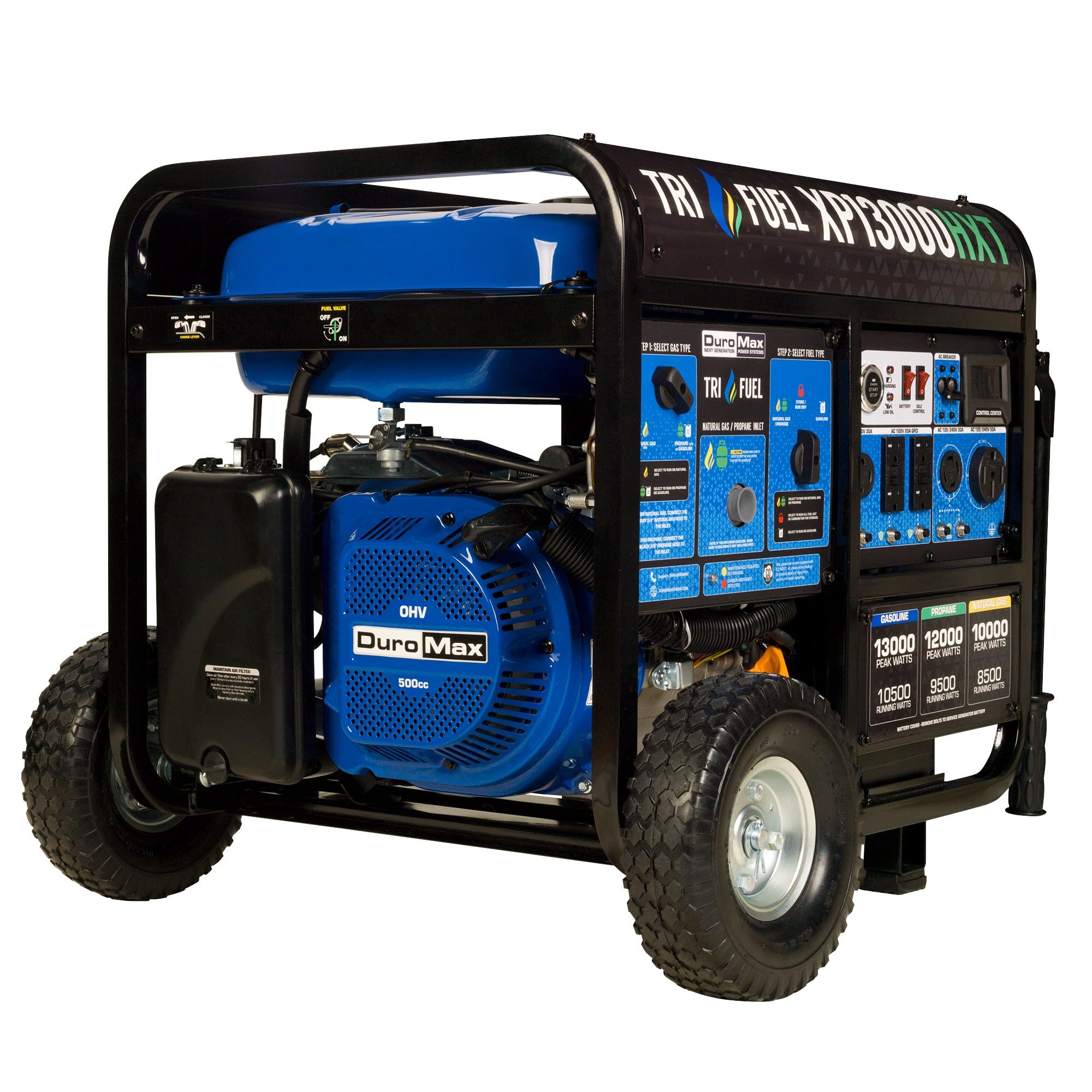
The fuel-flexible giant — 13,000 watts on gasoline, propane, or your home’s natural gas line.
Three fuel options in one 13,000-watt machine is the entire reason this sits at the top of the DuroMax range. Run it on gasoline for maximum power, on propane for longer storage-friendly runtime, or on natural gas for unlimited fuel during an outage. The 500cc OHV engine and 50A transfer-switch-ready outlet let you power a whole home panel, and the front-facing interface lets you flip fuel sources in seconds. Push-button start is standard, and remote start is included if you want to fire it up before you walk out the door. At 240 pounds, this is a vehicle-mounted machine — plan your placement before delivery.
Real owners put serious hours on it. One ran it through a seven-day outage, using 10 gallons of gasoline per 24 hours to run the fridge, TV, lamps, and fans through extension cords. Others talk about natural gas operation, where the 15-foot 3/4-inch natural gas hose connects to home plumbing — it draws 225,000 BTU/hr at full load, so a 3/4-inch gas line is required. When it is running a smaller air conditioner, two refrigerators, and light loads at around 60% demand, the system handles it comfortably.
The honest catch is that this is a serious investment and a serious machine. Startup retries: one owner reports the starter engages four to five times before catching, which is a personality of this engine. The 50-amp outlet is one step up from the 30-amp on the DuroStar, and that is what lets it start a larger air conditioner. If your home is plumbed for natural gas and you want the outage to be a non-event, tri-fuel is the reason to spend here rather than on a dual-fuel alternative.
Why Tri-Fuel Matters
- Gasoline, propane, or natural gas in a single 13,000-watt machine
- 50A transfer-switch-ready outlet for whole-home panels
- Push-button start plus remote start
- 500cc OHV DuroMax engine with a 15-foot 3/4-inch naturalgas hose included
- CO Alert carbon monoxide auto-shutoff
What To Keep In Mind
- 240 pounds — plan a vehicle-mount or permanent placement
- 225,000 BTU/hr draw at full load requires a 3/4-inch gas line
- Starter retries four to five times before catching
- Ships without oil and without a battery maintainer
Reserve this for: homeowners plumbed for natural gas who want the outage to cost nothing but a flip of a switch.
Cross it off if: you cannot dedicate permanent space and a fuel line to it — this machine wants a home.
Understanding the Specs
Peak watts vs running watts
Peak watts (also called surge watts or starting watts) is the short burst a generator can deliver for a few seconds when a motor tries to start. Running watts is the level it holds continuously. A compressor-driven appliance like an air conditioner needs a surge of two to three times its running watts to kick over, and the generator must have both the surge number and enough running watts to keep it going. If the generator only has the peak number, it will stall under continuous load.
THD (Total Harmonic Distortion)
THD measures how clean the electrical signal is. The lower the percentage, the closer the power is to what comes out of a wall outlet. Inverter generators commonly produce less than 3% THD, which is safe for sensitive electronics. A unit rated at 0.2% to 1.2% THD (like the ERAYAK 4500W) offers the cleanest signal in this group; open-frame generators usually have higher distortion and are less ideal for laptops and TVs on the same circuit.
dBA (noise ratings)
Generators list noise in dBA — the decibel scale adjusted to how human ears hear sound. Lower is quieter. A rating around 52 to 60 dBA is roughly conversational, quiet enough for a campground. A rating above 65 dBA starts to feel intrusive in a residential setting. Ratings are measured at different distances, usually 23 feet, so compare like-for-like.
CO shutoff sensors
Carbon monoxide (CO) is odorless and invisible, and generators produce it — which is exactly why modern units now include auto-shutoff sensors. CO Shield on Champion, CO Alert on DuroStar and DuroMax, and CO Watchdog on WEN all do the same job: they cut the engine if CO levels get dangerous. The trade-off is sensitivity — some buyers report shutdowns in a strong breeze or a small enclosed space, so placement matters. Run these outdoors only, away from windows and doors.
Fuel type and how it changes output
Gasoline produces the most power per displacement but goes stale in storage unless you add stabilizer. Propane stores indefinitely, but the same engine makes less power on it — the Westinghouse 6500 runs 5300 running watts on gasoline and 4800 on propane. Natural gas is unlimited if your home is plumbed for it, so the fuel flexibility is worth the setup work if outages are a recurring concern.
Inverter vs open-frame construction
Inverter generators run the engine through electronics that produce clean, stable power. Open-frame units skip the inverter and run louder, but are usually priced lower per watt and better suited to powering tools and panel feed-throughs. The cleanest inverter rated in this group runs under 3% THD; the toughest open-frame unit handles a 50-amp transfer-switch outlet that no suitcase inverter offers.
FAQ
What size generator do I need to run a refrigerator and a few lights?
Can a portable generator power a whole house?
Is it safe to run a generator inside a garage?
How long does a portable generator run on one tank of gas?
What is the difference between dual fuel and tri fuel generators?
Do I need to add oil before starting a new generator?
What is low THD and why does it matter for my electronics?
Are inverter generators quieter than regular generators?
Can I parallel two generators together for more power?
How long will a generator last with proper maintenance?
Final Thoughts: The Verdict
For most owners, the generators pick that fits the widest range of real needs is the Champion 4000-Watt RV Ready Portable Inverter Generator. It gives you 4000 starting watts and 3000 running watts from a 48.1-pound body, so it covers a trailer, a campsite, and a home renovation site without compromise. If your version of an outage means the whole house goes dark, the DuroMax XP13000HXT with its 13,000 watts and tri-fuel capability (it runs on gasoline, propane, or natural gas) is the one that makes an outage a non-event. If your home is not plumbed for natural gas, the DuroStar DS13000MX delivers the same 13,000 watts on gasoline and propane alone. And for camping in its simplest form — a CPAP machine, a phone charger, and silence — the Westinghouse 1500 Peak Watt is all you need to carry.
How We Picked
We do not accept paid placement. Every pick is matched to a real buyer and a real use-case; we do not hands-on test units.
Sources & Methodology
Specifications: manufacturer listings and product documentation. Review insights: verified customer reviews, as of September 2026. Pricing: not shown on this page (it changes often); check the current price via the retailer link.
As an Amazon Associate, KitchPrep earns from qualifying purchases. This does not affect which products we feature.
Related Guides
