
Specs are compiled from manufacturer listings and verified buyer reviews and can change over time — please confirm the key details on the product page before buying.
A crooked, wavy floor-to-wall gap needs a flexible shoe molding that bends with the surface; a rigid strip pops loose within a week. The real decision depends on three things: how the strip grabs your surface, how much thickness it adds at the bottom of the wall, and whether it can bend around a staircase curve without cracking. This guide covers which strips hold on tile, drywall and concrete, where buyers report adhesive failure, and which pick fits your gap width.
I’m Mohammad Maruf — the founder and writer behind KitchPrep. This guide is built by comparing the manufacturers’ published specifications and the patterns across verified customer reviews, so you get each pick’s real strengths and trade-offs instead of marketing spin.
Peel-and-stick base shoe has become the standard fix for awkward floor-to-wall gaps, but the strips vary wildly in thickness, adhesive strength and how well they flex around a bend. Below, every pick is sorted by gap type — curved stairs, slim cabinet seams, wet shower floors — so you can match one to your actual gap. These are the best baseboard shoe trim options for that wavy edge no caulk will cover.
Our Picks at a Glance



How To Choose The Best Baseboard Shoe Trim
Shoe molding is the slim strip that sits at the bottom of the wall where the floor meets the baseboard. It covers the ugly gap that opens up when floors are uneven or when you install new flooring and cut the baseboard short. A rigid vinyl strip kinks at a stair curve; a weak adhesive lifts at the corner within days. A flexible silicone strip pressed onto a clean surface reads as a finished carpenter’s line. Here is what separates the two.
Match the material to your surface
Silicone and rubber strips bend easily and grip smooth surfaces like tile, glass and painted drywall, which is why they work around curved stairs. Vinyl strips are stiffer and cheaper, good for flat run-of-the-mill baseboards, but they can fight you at a tight bend. Polystyrene trim is rigid and meant to be nailed or glued like traditional baseboard — it will not curve at all, but it holds a straight line better than anything flexible. On textured, bumpy or peeling drywall, no peel-and-stick backing holds; smooth and seal that surface first, then choose a strip.
Understand the gap you are actually filling
Measure the gap before you buy anything. A strip listed at 4 inches wide often includes a lower flap, so the part that actually covers the wall ends up shorter than the number on the box — you want the height that shows, not the width that ships. Check the gap between your finished floor and the bottom of the baseboard: if it is under half an inch, a slim quarter round is plenty. If it is wider, you need a taller profile or the strip will leave a visible lip.
Plan for the adhesive, not just the strip
Most of these trims stick straight on with a peel-off backing, no glue, nails or tools required. The catch is that fresh adhesive bonds far better on a warm, clean, dry surface than a cold or dusty one. Wipe the wall down, let it dry completely, and warm the strip with a hairdryer if your room runs cold. Longer single pieces look cleaner than short chopped-off bits, but they are harder to lay evenly — measure, dry-fit, then peel and press from one end so you never have to lift it back off.
Quick Comparison
| Model | Best For | Thickness | Length | Material | Amazon |
|---|---|---|---|---|---|
| FlexTrim #WM126 Base Shoe Molding★ Best Overall | Curved stairs and columns | 0.5 inches | 8 feet | Polyurethane | Amazon |
| Kneelisa Flexible Quarter Round Molding TrimBest for Tight Gaps | Tight wall and cabinet gaps | 15 millimeters | 118 inches | Silicone | Amazon |
| 118” Flexible Quarter Round Bendable TrimBest for Wet Rooms | Showers and wet floors | 0.6 inches | 118 inches | Soft silicone | Amazon |
| POPAKAN Peel and Stick Baseboard Trim | Long baseboard runs | 0.08 inches | 15 feet | Vinyl | Amazon |
| Storystore Wall Baseboard Trim | Bathrooms and damp rooms | — | 20 feet | Rubber | Amazon |
| Daopu Vinyl Wall Base Molding Trim | Commercial and rental spaces | 0.08 inches | 20 feet | PVC | Amazon |
| Risunpet Flexible Quarter Round Molding | Tub and shower bases | 0.86 inches | 10 feet | Silicone rubber | Amazon |
| ESUFEIR Flexible Quarter Round Molding Trim | Window sills and vanities | — | 236 inches | Silicone | Amazon |
| Art3d High Impact Baseboard Wall Molding | High-traffic commercial areas | 0.39 inches | 8 pieces, 56 inches each | Polystyrene | Amazon |
In‑Depth Reviews
1. FlexTrim #WM126: 1/2″ x 3/4″ Flexible Base Shoe molding – 8′ feet Long
Our pick — 4.5★ from 400+ verified ratings; the strongest balance of quality and price.
The one strip that bends a full radius around a staircase and still looks like real wood
The trademark move here is flex. This eight-foot length of polyurethane molding (a dense plastic that behaves like wood but yields under pressure) will curve to a minimum radius of 5 inches — a tight, half-circle turn that wraps a newel post or a stair bullnose without kinking or splitting. That is the number that makes this the best overall pick for anyone whose floor does not run straight. At 0.5 inches thick, it also sits slightly taller than the FlexTrim alternative and its flatter profile, which nudges it slightly ahead on how much of the wall it masks.
Install it with ordinary woodworking tools, then finish it to match. The surface ships with a light oak grain, so you can either paint it or stain it with a gel-based stain — and the gel is the key detail, because gel sits on top of the material and grabs where a penetrating wood stain would bead up and refuse to take. Makers report it is fully waterproof and US-made, which matters in kitchens and powder rooms where the strip meets a wet floor. Owners describe it taking a golden oak stain and nailing into place around a rounded staircase base with a result they call professional-looking, applying oil-based stain that held well once dry and gave a texture that reads as wood rather than plastic.
Where it slips is at the very end of the roll. A few owners mention the last foot running noticeably smaller in dimension than the rest of the stock, so if you are cutting close, measure your run and buy a touch of spare length. And staining to a precise color takes some fuss — the material is plastic, not wood, so the tone you see mid-project may not be the tone you get when it dries. Neither issue stops this from being the trim to beat, but both are worth knowing before you commit.
What earns it the top slot
- Flexes down to a 5-inch radius, so it hugs curved stairs, columns and rounded wall returns rigid trim cannot reach
- Accepts both paint and gel-based stain, letting you match existing wood tones instead of settling for plain white
- Waterproof polyurethane holds up where the floor gets wet, unlike a raw wood strip
- Runs an 8-foot length, so a staircase base or long wall takes fewer seams
Before you order
- The final foot of a roll can arrive undersized — allow a little spare when you measure your run
- Staining a plastic surface to an exact wood color takes patience; plain paint is far more forgiving
Pick this if: your base gap runs around a curve, a stair return or a column, and you want it to read as stained or painted wood.
Look elsewhere if: you are trimming a long straight wall and would rather skip the staining step for a ready-white peel-and-stick strip.
2. Kneelisa Flexible Quarter Round Molding Trim Peel and Stick 118Inch White
A slim 15-millimeter silicone strip built to vanish into the seam between wall and floor
If your gap is narrow and you want it gone without calling anyone, this is the shape to reach for. The profile is a right-angle (a squared-off L that sits flat against the wall and turns cleanly across the floor), and it brings a wider contact surface than a rounded strip — meaning more of the adhesive touches the surface, which is exactly what keeps a small strip from lifting. It fills gaps up to 15 millimeters (roughly 19/32 of an inch), sized for the everyday wall-to-floor crack, the seam behind a cabinet, or the edge along a countertop. The white silicone is waterproof and wipes clean with a damp towel.
Buyers lean on the looks more than anything. The thing owners appreciate about it is how it reads as a finished surface — clean, bright, and smooth against white cabinetry or a skirting board, with enough flexibility to bend around corners and enough give to be snipped to size with a pair of scissors. It arrives on a roll in 3-meter, 6-meter or 12-meter lengths, so a long run can go down in fewer cuts and with less waste. Warming the backing with a hairdryer first is the step worth remembering in a cold room, because the adhesive wakes up considerably once it is warm.
One honest fit note: this strip wants a smooth, dry, stable surface underneath it. It does not bond to silicone, and it struggles on damp or peeling walls, so prep the surface properly before you peel the backing. Get that right and the low profile all but disappears into the seam — the fact that it cannot be painted is the only thing you cannot change after the fact.
Where it disappears to: at 15 millimeters wide, this strip is slim enough to tuck behind a cabinet toe or run along a countertop edge without ever drawing the eye.
The one constraint: it is white-only and cannot be painted, so it is a fit for bright trim, not for matching a dark stain.
Reach for this if: you have a slim white gap to close along a wall, cabinet or counter and want it done in minutes with no tools.
skip it if: your surface is damp, uneven, or is itself silicone — the strip will not hold there, no matter how well you prep.
3. 118” Flexible Quarter Round Molding Bendable Peel and Stick Trim,White
The wider, taller silicone strip that survives a shower floor and bends around the stairs that feed it
This one is built for moisture. The soft silicone rubber strip measures 0.6 inches tall and 0.6 inches wide — noticeably beefier than the slim Kneelisa strip — and it is rated waterproof, heat resistant and corrosion resistant, which is why it ends up lining shower perimeters, tub edges and bathroom floors. The interior is winged and porous, a honeycomb-style core that makes the whole strip softer and more flexible so it can curve around stair nosing, columns and irregular edges without deforming over time. Running 118 inches long, one length covers a standard tub surround with room to spare.
Installation is peel-and-stick after a clean-down, then press as you go so the two vertical bottom edges seat into the curve. Buyers describe cutting it easily, caulking the joints for extra waterproofing, and watching it hold up in a main shower through months of use — durable even in a household with heavy shedding, and a real defense against water creeping under a floor. The softness that makes it bend so well also makes it forgiving; the trick is simply to lay it straight and press firmly rather than stretch it.
Heat is where the adhesive shows its limits. A warm room softens the bond, and on a cold or dusty surface the strip can lift at the corners, so clean first and add sealant at the joint for a long-term hold. It takes stain or paint if you want to color-match, and cutting it short with scissors is fine because the material is soft. For a wet room where the gap is wide and the surface curves, this is the pick that does the most work.
Why wet rooms like it
- Waterproof, heat and corrosion resistant silicone suits shower, tub and bathroom floors
- The winged porous core bends around curved stairs and columns without cracking
- 0.6-inch height covers a wider gap than a slim quarter round
- Can be stained or painted if you need to match a tone
Where the prep matters
- The adhesive loosens in heat — caulk the joints and it holds far better long term
- Needs a clean, dry surface first; a dusty wall lets the corners lift
Best suited to: showers, tub surrounds and bathroom floors where the gap is wide and the surface curves.
Think twice if: your wall runs cold and dusty and you would rather not add sealant at the joints.
4. Peel and Stick Baseboard Trim 4″ x 15 ft, Vinyl Baseboard Molding White
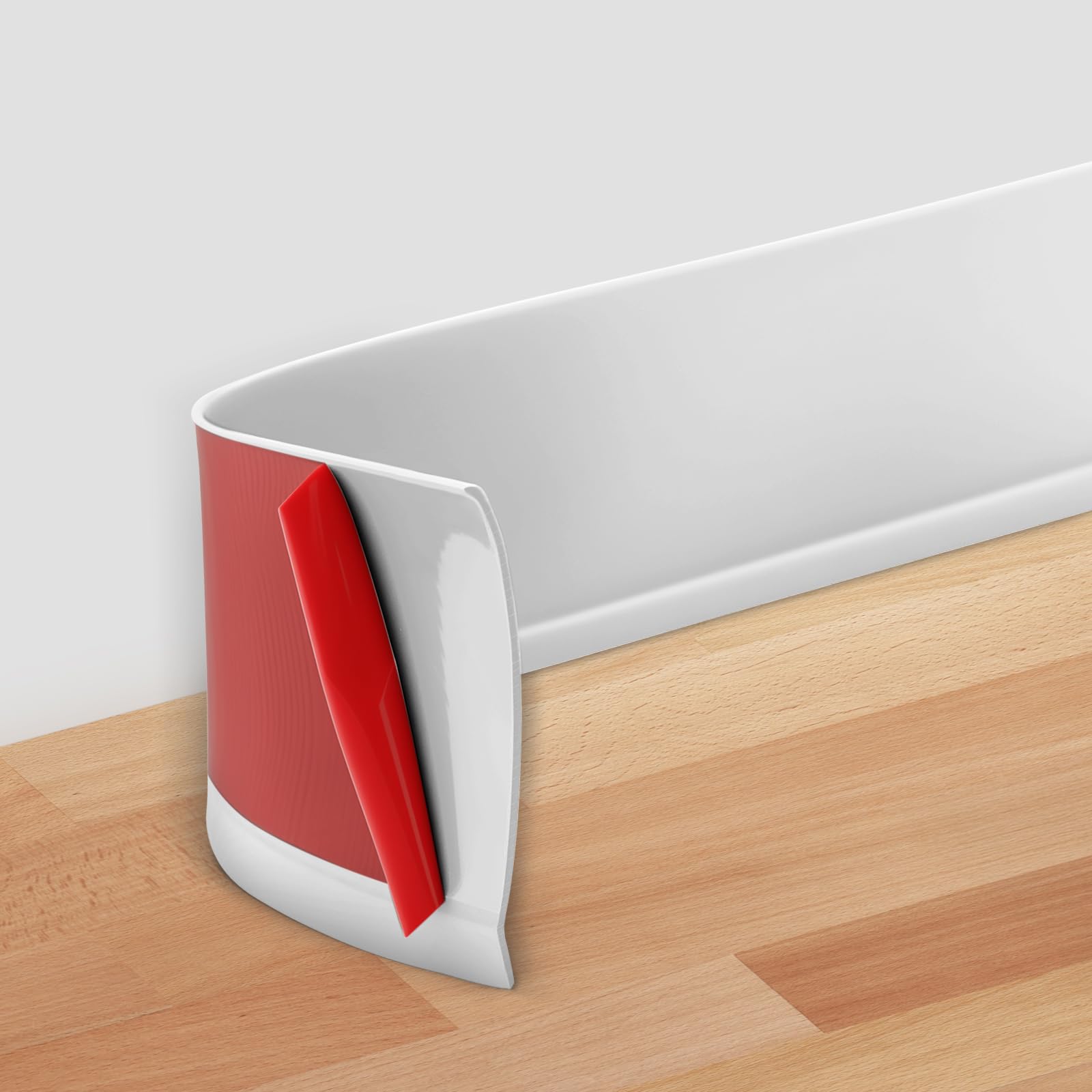
A 15-foot roll of sticky vinyl that turns a rough floor-to-wall seam into a finished line
This one is all about coverage per roll. You get 15 feet of flexible vinyl baseboard, 4 inches wide and 0.08 inches thin, with a full adhesive backing that presses flat against tile, wood, marble, glass or painted wall. That thinness is the point: it hugs a surface with almost no lip, so it slips under cabinets, behind furniture and along a garage wall without standing proud. The strip carries a toe design along the bottom that tucks into the floor gap and blocks dust from collecting in the crevice. Cut it with scissors, pull the tape, press firmly, and a whole room can be trimmed in an afternoon.
What owners like most is how little mess it makes — no nails, no adhesive bucket, no hammer marks to spackle. The backing grips hard, and because the roll is long, you run a continuous strip across a wall instead of piecing together short segments. It also does not mind a rough industrial setting; it holds on a painted shop wall, keeps shavings out of a horse trailer, and looks tidier than bare drywall. Being vinyl, it wipes clean with a cloth and resists the scuffs that come with daily traffic.
Two things to plan around. First, the 4-inch figure is the overall width and includes a bottom flap, so the height that actually shows on the wall runs a little shorter — measure the visible height you need, not just the box number. Second, on a wall with loose paint, pulling the strip back to adjust can lift the paint with it, so get your line straight the first time rather than repositioning. That makes it a strong, quick, budget-friendly choice for flat surfaces and long runs.
The vinyl advantage: at 15 feet per roll with a 0.08-inch profile, it lays flat and continuous along a wall with barely any edge showing.
Measure carefully first: the listed width includes a bottom flap, so the installed height on the wall is what you want to check against your gap.
Good match for: long straight baseboard runs on smooth floors, where a quick no-mess install beats carpentry.
Not the one for: a tight curve or a freshly painted wall you do not want to risk lifting when you reposition.
5. Storystore Wall Baseboard Trim 4 Inch x 20 Feet, Flexible Self-Adhesive Rubber Baseboard for Walls, Peel and Stick Wall Molding Trim
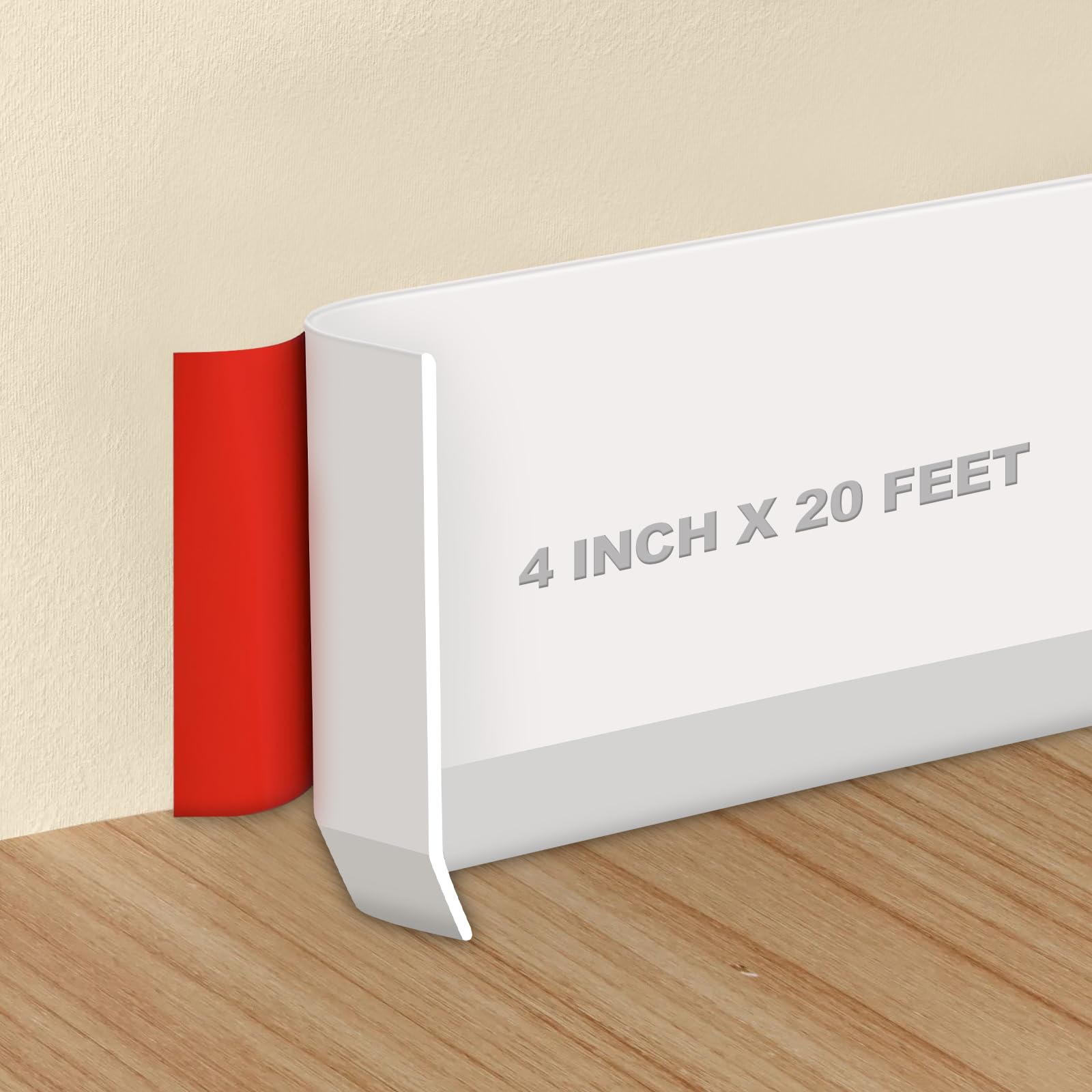
A forgiving rubber roll that sticks in a humid bathroom and lets you fix a crooked line without wrecking the wall
Grip and forgiveness are what this 20-foot rubber roll delivers. The adhesive lets you peel the strip back and reposition it while you get the line level, then it locks down once pressed — a small mercy when you are working along a long wall. It is flexible enough to wrap corners and cover uneven ground, and it handles damp conditions that send cheaper sticky trim sagging; the review pages are full of buyers reporting it holding firm even in a steamy bathroom. That humid-room performance is the standout, because moisture is where peel-and-stick trim most often fails.
What buyers rave about is how quickly a space transforms: laid along a bathroom or kitchen base, the rubber hides old water stains and covers the floor-to-wall gap, and the room instantly reads clean. A four-inch width covers a generous gap, the 20-foot length reaches across a whole wall or a small room, and it cuts to size with a box cutter or scissors. It wipes down easily, which keeps a high-use area looking fresh.
The trade-off is behind the strip, not the strip itself. This rubber is thin, so any bump or uneven surface behind it telegraphs straight through to the front — it wants a solid, flat wall or it reads lumpy. It also pushes in and looks off over a wide gap rather than spanning it. So prep the surface smooth first and this becomes among the most forgiving trims on this list; skip that step and the thinness works against you.
What readers keep coming back to
- Sticks in humid bathrooms where other sticky trim gives up
- Strong adhesive allows repositioning while you level the line
- 20-foot roll and 4-inch width cover a generous run in one go
- Cuts easily by hand and cleans with a simple wipe
The honest catch
- Thin material shows every bump behind it — it needs a solid, flat surface
- Over a very wide gap the strip can push in and look uneven
Fits best when: your walls are solid and you want a forgiving, repositionable strip for a bathroom or kitchen base.
Pass on it if: your wall is bumpy or the gap is especially wide — the thinness will work against you there.
6. Vinyl Wall Base Baseboard Molding Trim 4″ Flexible Self Adhesive Rubber Wall Base Moulding Trim Peel and Stick Design(20Ft, White)
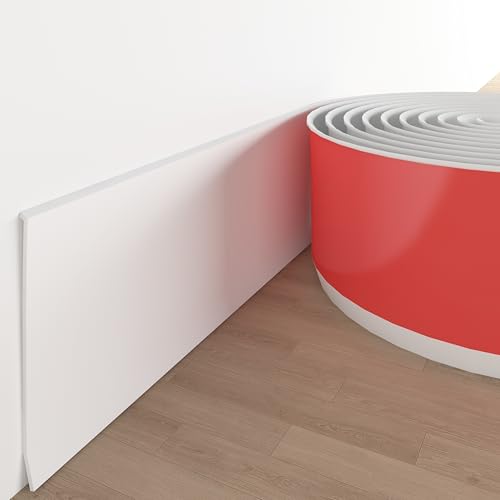
A 20-foot commercial-grade vinyl roll that covers a rental or office wall for the price of a snack run
For volume on a tight budget, this 20-foot PVC roll is hard to argue with. The trim is 4 inches wide and 0.08 inches thick, rated for commercial use, and comes as a single roll with a peel-off backing — no screws, no drills, just a clean baseboard, a strip of backing tape, and a firm press. It is built for the places that take a beating: hallways, offices, rental units, garages, even institutional settings, anywhere a wall base takes daily scuffs and stains. The matte white surface hides marks and wipes down in seconds.
The install is genuinely quick. One person can lay a room solo in minutes, pressing the strip down over a worn drywall edge or a tired tiled floor to give it a fresh, renewed look. It covers the rough bottom edge of drywall and protects the wall base from water when you hose a floor, which makes it a sensible pick for utility spaces and workshops. Because it comes in a long roll, a hallway goes down almost smoothly.
The weak link is temperature. On a hot day the adhesive can let go, and the strip may release every couple of days until you back it up with a stronger glue — the fix works, but you end up doing the job twice. The bottom flap also does not stick fully, so fine grit can still gather under it, and it does not love bending sharp corners. Run it in cooler weather or add glue at the ends, and this budget roll earns its keep as a fast cosmetic cover-up.
The budget math: a single 20-foot commercial-grade roll covers a full hallway or office base in one pass, making it the fastest way to hide a battered wall bottom.
Install it cool: on a hot day the adhesive releases, so plan the job for a cooler stretch or keep a tube of stronger glue on hand.
Right for: rentals, garages, offices and utility rooms where you want fast, cheap wall-base protection and do not mind a little touch-up glue.
Not ideal when: you are installing in summer heat or need the strip to wrap a sharp corner cleanly.
7. Flexible Quarter Round Molding, Peel and Stick Trim, 10 ft

A tall silicone rubber strip that seals a slippery floor edge and rolls straight over in a wheelchair
Height is this pick’s whole reason for being. At 0.86 inches tall and 0.7 inches wide, it stands taller than most quarter round, which matters for two reasons: it covers a deeper gap between floor and wall, and its gentle slope is accessible and friendly to wheelchairs. That low-ramp profile lets a chair or walker roll across the floor-to-tub or floor-to-wall transition without catching, which is a real consideration in a bathroom or a hallway. The silicone rubber is soft and elastic, cuts easily with a utility knife, and is rated waterproof, high-temperature resistant and corrosion resistant.
It goes on with a peel-off backing, then you press it down over a few minutes and add extra glue at the ground joint for a long-term hold. Buyers use it to bridge the gap between a floating floor and a tub, cutting, peeling, warming the strip with a hairdryer until soft, then pressing it into place and caulking the top edge white — a combination that ends up looking professional and keeps water from creeping under the floor. The stickiness is the surprise; customers note the glue holding far firmer than they expected on a clean surface. It works across windowsills, stoves, countertops, bathtubs, shower pans, kitchen sinks and toilets.
The one thing to keep in mind is that this strip is designed as a gap cover, not a full replacement for caulk or a structural baseboard — on a floor edge that moves, a proper sealant still belongs underneath. And because it is smooth silicone, dust and hair cling to the matte surface and need an occasional wipe, though it is barely noticeable in a bathroom. Prepped and pressed properly, this is the toughest performer here for a wet, single-gap job.
The height advantage: the 0.86-inch profile covers a deeper gap and its sloped face lets wheels pass cleanly, which slimmer strips cannot match.
Where it stops: it is a gap cover, not a sealant — on a moving floor edge you still want actual caulk beneath it.
Choose it for: tub and shower bases, plus any floor-to-wall edge where a wheelchair or walker needs to roll across.
Consider something else if: you need a flexible painter’s-caulk-style seal, since this strip covers a gap rather than sealing it.
8. Flexible Quarter Round Molding Trim – Peel and Stick Silicone Caulk Strip

The concave strip that folds into right angles instead of bulging out of them
Most seal strips round off at the corner and leave an awkward bulge. This one takes the opposite approach: a U-shaped concave profile, 9/16 of an inch wide and tall, that curves inward to hug right-angled spots like window sills, bathtub perimeters, baseboard edges and countertops. The result is a smooth edge transition with no raised ridge, which is the difference between a job that looks done and one that looks patched. It runs 236 inches of soft silicone a strip, fills gaps up to 0.6 inches, and the material cuts easily and resists deforming. The surface is hydrophobic and stain resistant, so a damp cloth keeps it clean.
Where other strips make you fight for a bond, this kit supplies the tools: gloves and an adhesive promoter wipe come in the box, and the backing carries 7/16-inch double-sided expanded adhesive for a stronger hold than a bare peel-and-stick. The three-step install is spelled out clearly — clean and dry the surface, apply the promoter wearing the gloves, then press from the bottom up and work both sides down firmly. In cold weather a 30-second warm-up with a hairdryer restores the tack. Owners describe exactly this: good instructions, the prep wipes and gloves included, and a strip that sticks well and feels solid once set.
The tricky part is the very start. On slick or particularly broad gaps the strip can lift at the top and bottom edges until you add sealant at the joints, and a cold surface makes that worse — so take the promoter step seriously rather than skipping to the peel-and-press. Get the prep right and this becomes the pick that handles the widest range of spots, from a vanity against a wall to an irregular bathtub sealing onto laminate flooring.
Why the prep set wins
- U-shaped concave profile folds into right angles without the bulge a round strip leaves
- Adhesive promoter wipes and gloves included, so the bond beats a bare peel-and-stick
- 236 inches per strip and a 0.6-inch gap fill cover long runs and wider seams
- Waterproof, stain-resistant silicone suits kitchens and bathrooms
Where it needs care
- Edges can lift on very slick or broad gaps until sealant backs them up
- A cold surface weakens the bond — warm the strip first for a solid set
Works well for: window sills, vanities and tub perimeters where you want a corner that folds in instead of bulging out.
pass on it if: you would rather not fuss with the promoter wipe — a plain peel-and-stick strip suits a quick, low-stakes fix better.
9. Art3d High Impact Baseboard Wall Molding Trims, Skirting Board, Black

The rigid polystyrene baseboard that holds a dead-straight line and refuses to flex — the premium answer for a high-traffic wall
This is the pick for anyone who does not want a floppy strip, and it is the most premium option here for a reason. Where the flexible trims on this list bend to follow every floor, this one is made of high-impact polystyrene (a stiff, dense plastic) that stays rigid and aligns in a dead-straight line. It is paintable and resists moisture, warping and cracking, so it keeps its finish over time — a fit for the middle of a hallway or a commercial space where the wall base takes constant punishment. The pack includes 8 pieces, each 56 inches long and 3.2 inches wide, covering roughly 448 inches across a wall, and the trim itself is about 0.39 inches thick.
What buyers appreciate most is how it looks — owners say it reads like real wood baseboard rather than plastic, which is why people order it for a bathroom remodel and then come back for a second room. Installation is straightforward: it goes up with adhesive or glue (sold separately) or with nails, and it can be cut with a coping saw, so no chop saw is required. One owner glued it with painter’s caulk, painted it before fitting, and liked that there were no nail holes to fill afterward. It goes 8 feet to a run piece-free and can be paired with connectors where two lengths meet.
The honest limit is its rigidity. It will not bend around a curve or cope around a tight radius the way the silicone strips do — that straight-line stiffness is exactly what you buy it for, but it also tells you where it does not belong. It is hollow, so finishing an exposed end cleanly takes a miter rather than a straight cut, and on a sharp saw the edges can chip slightly. For long, straight, hard-wearing runs in a dark or painted finish, it is the sturdiest choice on the list.
The rigidity payoff: at 3.2 inches wide across 8 pieces of 56 inches, this covers 448 inches of wall and holds a perfectly straight line where a flexible strip would wave.
The rigidity cost: it will not bend around corners, so curved walls, stair returns and radius edges belong to the silicone picks instead.
Built for: long, straight, high-traffic runs in a home or commercial space where you want a rigid, paintable, wood-look baseboard.
Not the one for: curved stairs, columns or any edge that has to flex — that job belongs to the silicone strips above.
Understanding the Specs
Thickness and installed height
Thickness is how far the strip stands off the wall once it is on, and it decides how much it hides and how much of a bump it leaves. A slim 0.08-inch vinyl strip lies almost flat and tucks under cabinets, while a 0.6-inch silicone strip stands proud enough to cover a deeper gap but shows more of a lip at the floor. Watch out for a listed width that includes a bottom flap — the height that actually shows on the wall is shorter than the number on the box, so measure your gap and compare it to the visible height, not the overall width.
Flex versus rigidity
Flexible strips like silicone and rubber bend to follow curved stairs, columns and uneven floors, and they cut easily with scissors or a knife — but being soft, they can telegraph every bump behind them. Rigid polystyrene holds a perfectly straight line and resists warping, but it will not curve, so it belongs on long flat runs rather than around a radius. Flex suits curved stairs and uneven floors; rigid polystyrene suits long straight runs. Match flex to curves and rigidity to straight, hard-wearing walls.
FAQ
Will peel-and-stick shoe molding hold up in a bathroom?
How do I measure the gap before buying trim?
Can flexible shoe molding go around a curved staircase?
Can I paint or stain flexible shoe molding?
What is the difference between shoe molding and quarter round?
Why is my adhesive strip peeling off at the corners?
Can shoe molding be installed over uneven floors?
Do I need nails, glue or screws to install base shoe trim?
How long does peel-and-stick base trim last?
Final Thoughts: The Verdict
For the widest range of awkward gaps, the winner is the FlexTrim #WM126, because its polyurethane body flexes down to a 5-inch radius for curved stairs and still accepts paint or a gel-based stain to match real wood. If your problem is a slim white seam along a cabinet or counter, the KneelYb”>Kneelisa Flexible Quarter Round is the neatest fix. And for a wet shower or tub base that needs a taller, waterproof strip, reach for the 118-inch Flexible Quarter Round Trim. Whichever you pick, wipe the wall clean and dry first — that single step is what makes the adhesive hold.
How We Picked
We do not accept paid placement. Every pick is matched to a real buyer and a real use-case; we do not hands-on test units.
Sources & Methodology
Specifications: manufacturer listings and product documentation. Review insights: verified customer reviews, as of September 2026. Pricing: not shown on this page (it changes often); check the current price via the retailer link.
As an Amazon Associate, KitchPrep earns from qualifying purchases. This does not affect which products we feature.
Related Guides
