
Specs are compiled from manufacturer listings and verified buyer reviews and can change over time — please confirm the key details on the product page before buying.
If you want one bottle that does the most for you, buy the oil with the highest verified phenolic number you can find, and buy it from a brand that prints its harvest date. That single habit separates real Greek extra virgin olive oil from the bottles that only look the part. Extra virgin olive oil is simply juice pressed from olives without heat or chemicals, and “authentic Greek” means the olives were grown and pressed in Greece — not blended in from Spain or Italy. The label detail most people miss is phenolics (natural plant compounds, measured in mg/kg, that give good oil its peppery catch in the throat). A bottle that tickles your throat is doing its job; a bottle that tastes flat usually is not.
I’m Mohammad Maruf — the founder and writer behind KitchPrep. This guide is built by comparing the manufacturers’ published specifications and the patterns across verified customer reviews, so you get each pick’s real strengths and trade-offs instead of marketing spin.
You want real Greek olive oil, but the labels all sound the same. Below are nine genuinely Greek bottles, sorted by what they actually do well — from a phenolic heavyweight to a mild everyday cooking oil and a three-liter tin that quietly outperforms its own packaging. Every pick is Greek-origin, cold-pressed, and traceable to a real harvest, so the only hard choice left is if you want a best authentic greek olive oil for sipping by the spoonful or one for everything in the pan.
Our Picks at a Glance
How To Choose The Best Authentic Greek Olive Oil
Greek olive oil is not one product — it ranges from a mild, buttery all-purpose oil to a bitter, throat-tingling oil you take by the spoon. Before you compare bottles, decide which job the oil has to do in your kitchen, then let the numbers on the label guide you.
Start with the harvest date, not the price tag
Freshness is the whole point of extra virgin olive oil, because the flavor and the natural compounds fade over time. A bottle that prints a specific harvest season and a best-before date is telling you the oil was pressed recently. A bottle with no date at all is the one to leave on the shelf, no matter how Greek the label looks. Dark glass or a tin also protects the oil from light, which is what slowly turns it stale.
Decide between a sipping oil and a cooking oil
High-phenolic oils are bold, bitter, and peppery — great for a daily spoonful, drizzling over finished dishes, or dipping bread. Mild oils like a delicate Koroneiki are easier to cook with and to serve to guests who dislike a strong bitter edge. Most kitchens end up wanting one of each, which is why a mild bottle and a bold bottle can both earn a spot on your counter.
Check the origin claims for real traceability
You can trust a bottle more when it names where the olives grew. Look for PDO (Protected Designation of Origin — an official European Union certification that the oil was produced, processed, and packaged in one named region using traditional methods) and single-origin. Bottles that name the region, the olive variety, and the mill are the ones you can actually trace. If a label only says “Mediterranean blend,” it is not the Greek oil you are shopping for.
Quick Comparison
| Model | Best For | Size | Polyphenols | Acidity | Amazon |
|---|---|---|---|---|---|
| P.J. Kabos Family Reserve Organic★ Best Overall | Daily spoonful and max phenolic intake | 16.9 fl oz | 900+ mg/kg (HPLC) | — | Amazon |
| Kasandrinos Organic Extra VirginBest Everyday | Everyday cooking and mild flavor | 16.9 fl oz | 5.5 mg per tablespoon | — | Amazon |
| Laconiko Ultra Premium KoroneikiMost Awarded | Award-driven flavor and dipping | 12.7 oz | 578 mg/kg | 0.17% | Amazon |
| Kosterina Original EVOO | Peppery finishing oil and daily shots | 16.9 fl oz | 500+ mg/kg | — | Amazon |
| Heirloom EVOO, Little Gypsy Farms | Single-estate gifting and sturdy cooking | 16.9 fl oz | 428+ mg/kg | — | Amazon |
| Iliada Kalamata PDO | Certified-region cooking and frying | 33.8 fl oz | 1000+ mg/kg | ≤0.2% | Amazon |
| Mythology PDO Kolymvari Crete | Bulk cooking from a named region | 101 fl oz | — | 0.5% | Amazon |
| Kirkland Signature Greek EVOO | High-volume everyday cooking | 67.63 fl oz | — | — | Amazon |
| Kouzini Organic Greek EVOO | Gifting and lighter dressings | 17 fl oz | — | — | Amazon |
In‑Depth Reviews
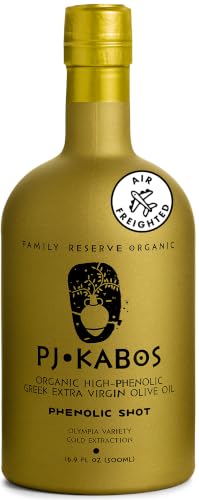
1. P.J. Kabos Family Reserve Organic Phenolic Shot
Our pick — over 4.5★ from 750+ verified ratings; the strongest balance of quality and price.
The bottle that means it when it calls itself a phenolic shot.
This is the pick for the person who treats olive oil as a daily health ritual rather than a cooking ingredient. It carries 900+ mg/kg of phenolics by HPLC and 1400+ mg/kg by NMR — two different lab methods, two high numbers. For context, the Laconiko further down this list logs 578 mg/kg, so this bottle sits well above it on that one number. Harvested in September and October of 2025 and stamped best before 12/2027.
What wins people over is the quality first and the taste a close second, and the two are linked — a genuinely high-phenolic oil tastes bitter and peppery, and the brand warns you outright to expect it. The payoff is the throat catch. Buyers report taking a daily spoonful: “One reviewer noted taking 2 Tbsp daily and noticing less back, hip, and thigh pain within 10 days.” Others describe a smooth body with a peppery end note, a light fresh olive aftertaste, and even sipping it straight. It arrives by airplane rather than container ship, which the brand says keeps the oil in better condition in transit — and the 2.84-pound glass bottle travels in a boxed 3.35 x 3.35 x 8.07 inch footprint.
The honest catch is twofold. It is priced like the specialty item it is, and the bitterness is real — a first-timer used to mild supermarket oil may flinch. Chasing it with water or bread is the common fix. A few people also find the throat irritation stronger than they enjoy, so start with a small pour before committing to a full spoon.
What earns it the top spot
- 900+ mg/kg phenolics by HPLC and 1400+ mg/kg by NMR — the highest verified number here
- 2025/26 harvest with a printed best-before of 12/2027
- Air-freighted from Greece instead of shipped by container
- Platinum medal plus USDA Organic and Kosher certification
Where it asks patience
- Specialty-tier pricing for a single 16.9 fl oz bottle
- Intensely bitter and pungent by design — not a beginner’s drizzle
- Throat irritation runs stronger than some buyers expect
Buy it if: you want the strongest phenolic evidence on the label and will use it daily by the spoonful.
Think twice if: you mainly fry, roast, or want a neutral flavor your whole family will accept.
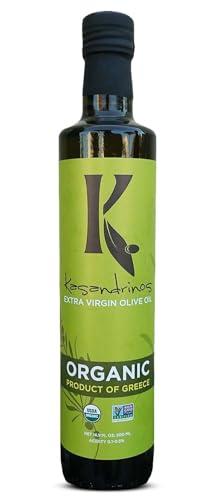
2. Kasandrinos Organic Extra Virgin Olive Oil
Delicate enough for salad dressing, pure enough for a daily spoonful.
If the bitter, throat-burning style of the top pick sounds like too much, this is where you land. Kasandrinos is a mild and delicate oil with a butter-like mouthfeel that owners describe enjoying straight from the bottle on salads, bread, and meat. The family that runs it presses olives hand-picked from orchards more than 100 years old, and the bottle carries USDA Organic, Non-GMO, Paleo Certified, Keto Certified, and Kosher stamps.
This bottle gives you a different way to read polyphenols (natural antioxidants that make olive oil bitter and peppery): 5.5 mg per tablespoon rather than a mg/kg figure, plus Vitamin E and hydroxytyrosol, the same family of compounds the phenolic-heavy bottles chase. Buyers trading up from supermarket oil often say it converted them: one reported it beat every other oil they had tried, and another flagged that it tested very low for plastic toxicity, a purity point that shows up repeatedly in the feedback. The 16.9 fl oz bottle is the same size as the P.J. Kabos, so you are choosing on flavor and style, not volume.
What keeps it from a perfect score is the price-to-size ratio — it costs the same middle-tier outlay as a bottle half a size bigger elsewhere on this list. One four-star note called it out plainly: very expensive for a smaller size bottle, and rated the oil itself fine. A damaged delivery also showed up in the reviews, though the brand replaced it immediately, which is a service point rather than a product flaw.
Why it earns its spot: you get authentic Greek origin without a bitter punch — smooth enough to pour on your morning bread and neutral enough for dressings and finishing warm dishes.
The trade-off: you pay specialty pricing for a 16.9 fl oz bottle, and if you specifically want a big peppery throat hit, this oil will feel tame by comparison.
Reach for this if: your kitchen wants one gentler bottle that does salads, marinades, and straight-off-the-spoon use.
Look elsewhere if: you are chasing maximum polyphenol numbers or a bold throat burn.
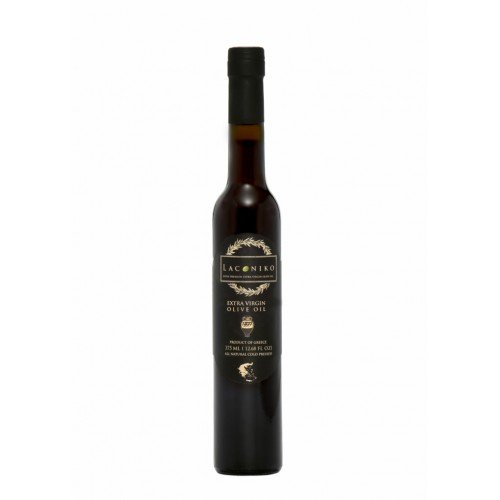
3. Laconiko Ultra Premium Koroneiki EVOO
A trophy case in a bottle, with the acidity number to back it up.
Two numbers define this one. The acidity is 0.17%, which is four times lower than the level required to even qualify as extra virgin — lower acidity reflects careful production and a fresh press. And the polyphenol count is 578 mg/kg, with 308 mg/kg of that being oleocanthal, the specific compound behind that peppery catch at the back of your throat. It compares to the P.J. Kabos above at 900+ mg/kg, so if the raw phenolic number is your whole reason for buying, the Kabos leads on that single metric.
Laconiko pulls ahead on reputation hardware: 100% hand-picked Koroneiki olives harvested November 2nd through 27th, 2025, non-GMO and Kosher certification, and a wall of medals including Gold at the 2021 New York International Olive Oil Competition, Best in Show at the 2025 Athens International Olive Oil Competition, and a claim to be the most awarded Greek olive oil brand in the Olive Oil Times world ranking. Tasting notes run grassy and herbal with hints of fruit and a peppery finish.
Owners mostly validate the flavor — a smooth, savory oil that shines on dipping bread and salads, with packaging thoughtful enough that it earned unprompted praise. The catch is the bottle size: 12.7 oz, the smallest in this entire lineup, so a household that cooks with olive oil daily will finish it fast at a specialty price.
The flavor payoff: grassy, herbal, peppery and lingering — the profile that wins medals tends to show up in the glass too, and the 0.17% acidity is a strong freshness signal.
The catch: at 12.7 oz it is the smallest pour here, so budget it as a finishing and dipping oil rather than your pan workhorse.
Best for: the buyer who wants a decorated, low-acidity Koroneiki for drizzling and tasting flights.
Skip this one if: you need volume — 12.7 oz disappears quickly in a busy kitchen.
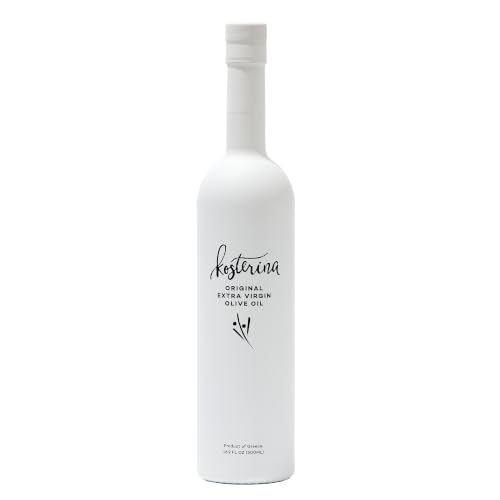
4. Kosterina Original Extra Virgin Olive Oil
Early-harvest Koroneiki with a throat sting you can feel coming.
Kosterina cold-presses early-harvest Koroneiki olives from southern Greece, and early-harvest fruit is where the bold stuff lives — the company claims 500+ mg/kg of polyphenols and packages it in opaque glass or tin, the only material that keeps light from breaking the oil down. That 500+ mg/kg figure sits below the P.J. Kabos at 900+ mg/kg, but above the Heirloom at 428+ mg/kg, so it lands in the middle of this lineup on raw phenolics.
The pepperiness is the point. Owners describe a strong peppery throat burn they read as a quality signal, a smooth texture, and health-focused daily use like a spoonful in the evening. This is a finishing and drizzling oil first — one reviewer bought the white bottle for its higher polyphenol count and the blue bottle (formulated with a higher smoke point) for frying, so if you cook at high heat, know which version you are grabbing. It is also 100% pure, non-GMO, gluten-free, and vegan.
Freshness is the one place reviews split rather than agree, so check the harvest and best-by dates on the label when it arrives. At 16.9 oz it matches both the Kasandrinos and the P.J. Kabos in volume, which makes the three a straight flavor-and-style decision rather than a size one.
Reasons it stays in rotation
- 500+ mg/kg polyphenols from early-harvest Koroneiki olives
- Opaque glass or tin packaging blocks light damage
- Strong peppery finish that confident palates enjoy
- Non-GMO, gluten-free, and vegan
Worth knowing before you click
- Freshness feedback is mixed — read the label dates carefully on arrival
- Bold and bitter by design, so mild-oil fans may find it sharp
- White and blue bottles serve different jobs — pick deliberately
Choose this if: you want a light-protected, peppery Greek oil that doubles as a finishing drizzle.
Consider a gentler bottle instead if: bitter and sharp flavors put you off.
5. Heirloom EVOO from Little Gypsy Farms

One family, one estate, one traceable origin in the Southern Peloponnese.
Traceability is the whole pitch here. A single family has owned and operated this heirloom olive estate for generations, giving the oil a 100% single traceable origin in the Southern Peloponnese Region of Greece. Independent lab tests put it at 428+ mg/kg of polyphenols, and the producer states that is five times more polyphenol antioxidants than most EVOO brands sold in the US — a manufacturer claim, not a verified guarantee. For a straight number-to-number read, the P.J. Kabos at 900+ mg/kg carries the higher verified figure.
It took a NYIOOC Gold Medal, and the flavor runs sturdy and earthy with a full nutty, artichoke-pepper finish and intense green color. Olives are hand-picked and pressed within 24 hours at a local mill, and the oil is first cold-pressed and preservative-free. Owners reserve it for the good stuff — salads, dipping, avocado toast, even olive oil ice cream — and the opaque bottle with its low-air spout earns its own share of praise.
Price draws the loudest pushback, though most callers-in still say it is worth it, and a couple of skeptics asked the brand for more documentation on the bottle. It is a fair ask for a small-farm label, and it does not dent the oil itself.
What it does best: provenance you can point to — family estate, Southern Peloponnese, pressed within 24 hours, plus a gold-medal flavor profile with a nutty, peppery finish and a low-air-spout bottle built for pouring.
One honest caveat: the pricing runs specialty-tier, and a few buyers wanted clearer verification of the harvest on the label itself.
Fit for: the home cook who wants a single-estate, gift-worthy bottle with a sturdy finish for salads and dipping.
Not the pick if: you want the biggest volume or the highest verified polyphenol number for the outlay.
6. Iliada Kalamata PDO Extra Virgin Olive Oil
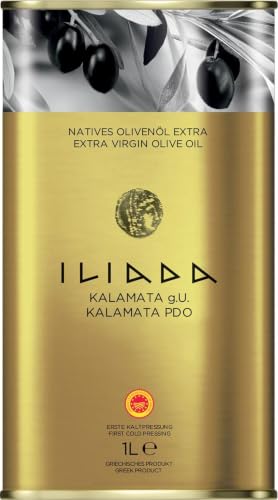
The fortified tin that holds the most oil on the shortest shelf.
This is the one for the cook who wants a certified-region bottle they can pour without flinching. It carries full PDO status — European Union certification that the oil was produced, processed, and packaged in a named geographical area using traditional methods — and it traces specifically to the city of Kalamata, Greece. The Koroneiki olives are milled within 24 hours of harvest, the free acidity is ≤0.2%, and every container is numbered with traceability back to the farmer and mill.
It holds 33.8 fl oz, double the 16.9 fl oz you get from the P.J. Kabos — that 2x capacity is the whole reason a family kitchen gravitates here. The label lists polyphenols at 1000+ mg/kg, and the reviewers who came from cheaper “high polyphenol” bottles say it tastes rich enough to drink straight. The monovarietal Koroneiki profile is medium-fruit with green banana, artichoke, fresh grass, tomato, and a slight peppery aftertaste. Refill it, and the tin and lid go in the recycling.
The one thing to know is that it is built for cooking and frying rather than delicate drizzling — the flavor is rich but it does not pretend to be a sipping oil. Buyers who want a daily spoonful usually pair it with a more specialized bottle above. It has also won Extra Virgin Olive Oil of the Year six years running, 2020 through 2025.
The volume argument: 33.8 fl oz under a PDO seal with a ≤0.2% acidity and a 1000+ mg/kg polyphenol label — double the container size of the bottle picks and honest about being a cooking oil.
The single caveat: it is not designed to be the star of a spoonful tasting, so treat it as your kitchen workhorse and finish dishes with something bolder.
Best matched to: high-volume cooks who want PDO provenance and a big tin for frying, roasting, and salads.
Better to skip if: you want a delicate sipping oil for a daily spoon.
7. Mythology PDO Kolymvari Extra Virgin Olive Oil

Three liters of named-region Crete oil built for people who cook for a crowd.
This tin pours 101 fl oz, the second-largest volume here, and it comes from a place specific enough to print on a label: PDO Kolymvari, in the Chania region of Crete. The olives are hand-picked from trees on the island of Crete, of the Koroneiki variety the producer says have been harvested for centuries in the Kolymvari groves. It is cold-extracted at up to 27°C with an acidity of 0.5%, so heat never touches the oil during pressing.
The flavor feedback is warm across the board — smooth, buttery, grassy with a slight peppery edge, and several cooks who have used it for years say people ask what salad dressing they use when it is only the oil. It works across sautéing, roasting, marinades, and bread dipping, and the tin itself makes a decent counter display or a gift.
The recurring gripe is the can, not the oil — it can arrive dented and unable to stand upright, and the spout can dribble if you are not careful. Neither touches the flavor, and a siphon-style pour helps, but it is the one thing to expect when the box lands.
Why cooks keep buying it
- 101 fl oz tin — the second-biggest volume in this lineup
- Certified PDO Kolymvari from the Chania region of Crete
- Cold-extracted at up to 27°C with 0.5% acidity
- Smooth, buttery, grassy flavor that holds up to cooking
What to expect on the doorstep
- The tin can arrive dented and refuse to stand upright
- The spout can drip if you pour fast
- Not a high-phenolic specialist — buy it for volume and everyday cooking
Ideal for: households that go through olive oil fast and want named-region PDO provenance in a bulk tin.
Look at a glass bottle instead if: a dented tin or a drippy spout would genuinely bother you.
8. Kirkland Signature Greek Extra Virgin Olive Oil

A no-frills plastic jug built for people who cook with olive oil daily.
If you want the lowest cost per pour and do not need a specialty bottle, this is your entry point. It pours 67.63 fl oz — larger than every glass bottle here and beaten only by the 101 fl oz Mythology tin. The label says first cold pressed, produced from Greek-grown olives, and a product of Greece, so the origin claim is real and simple, even if it stops short of a PDO seal or a named region.
There is no polyphenol number printed, no printed acidity, and no harvest date, and the jug is plastic rather than light-blocking glass or tin. That is the honest trade-off lurking behind the volume — light and time are the two enemies of fresh olive oil, and a clear plastic container protects against neither as well as dark glass would. For a cooking oil you will work through quickly, that is an acceptable compromise; for a bottle you plan to nurse for a year, it is not.
The flavor feedback is approving — one reviewer simply called it light but fully flavorful and a good price, which is the whole idea. This is the jar you keep by the stove for sautéing, roasting, and everyday cooking rather than the one you pour into a tasting glass.
The value case: 67.63 fl oz of first cold-pressed Greek-origin olive oil at the lowest cost-per-ounce here, and the flavor runs light and clean rather than dull.
The honest limit: no printed polyphenol figure, no harvest date, and plastic packaging — so buy it to cook with fast, not to store for a year.
Worth it for: anyone who wants large-format everyday Greek oil and cares about volume above all.
Look past it if: you want printed polyphenol numbers, a harvest date, or light-blocking dark glass.
9. Kouzini Organic Single Origin Greek EVOO

The dark glass bottle you are happy to leave out on the table.
Kouzini is the entry-level bottle in this lineup, and it earns its place on three things: it is certified USDA organic, it is single-origin and never blended, and it is bottled in dark green glass to protect freshness. The oil comes from handpicked Koroneiki olives and is cold-pressed and unfiltered, then processed within hours of harvest. It holds 17 fl oz, right in line with the mid-range bottles here.
The flavor runs mild and fruity with just a hint of peppery finish — this is the oil for marinades, dressings, veggie sautés, and vinaigrettes rather than a spoonful habit. Owners use it as the one they keep out, and the reusable bottle gets second life as a gift or counter piece. Buyers praise the quality first and the taste second, the sort of oil that holds up against more expensive bottles in a side-by-side pour.
The trade-off is that mild means lower phenolics, and a couple of notes described it as lacking the peppery backbone a high-phenolic oil delivers. The package-level details also run lean — production and best-before dates are on an added sticker rather than the bottle itself, so read it on arrival instead of assuming.
The fit: a mild, organic, single-origin everyday bottle in dark green glass that works for cooking, keeps the light out, and is good enough to hand over as a gift.
The limit: no polyphenol number printed, the dates sit on a sticker rather than the bottle, and it is built for cooking rather than a daily straight spoonful.
Suits you if: you want one organic bottle that is gentle enough for all the everyday cooking jobs and pretty enough to give away.
Not the one for you if: you are hunting the highest polyphenol count or the biggest container size.
Understanding the Specs
Polyphenols (mg/kg)
Phenolic compounds are the natural antioxidants that give extra virgin olive oil its bitterness and its peppery catch in the throat. Higher numbers tend to mean a bolder, more pungent oil that many people take by the spoonful. The bottles with printed numbers here run from 428+ mg/kg all the way up to 900+ mg/kg. If a label prints no number at all, you are buying flavor and origin, not a documented phenolic level — that is a fair choice for everyday cooking, just not the one you pick when polyphenol content is the whole reason for the purchase.
Harvest Date and Storage
Olive oil is a fresh juice, so the harvest date tells you more about quality than almost anything else on a label. A bottle harvested in the current season and stored in dark glass or a tin will taste brighter and more peppery than one that has been sitting in a warehouse through two winters in a clear plastic container. Light and heat are what break the oil down. Once you open your bottle, keep it out of the sun, cap it tightly, and plan to work through it within a few months of opening for the best flavor.
FAQ
What does PDO mean on a Greek olive oil label?
Is a peppery burn in the throat a good sign or a defect?
How do I compare a polyphenol listed as mg/kg against one listed per tablespoon?
Should I buy a large tin or a small glass bottle?
Can I fry with high-polyphenol extra virgin olive oil?
Is “Product of Greece” the same as single-origin?
Do I need to refrigerate olive oil after opening?
How long does an opened bottle of Greek olive oil stay fresh?
What is the difference between Koroneiki and Kalamata olive oil?
Does a dark bottle really make a difference?
Final Thoughts: The Verdict
For daily use and maximum phenolic value, the P.J. Kabos Family Reserve Organic Phenolic Shot is the bottle that backs its claim with a number on the label — 900+ mg/kg — and that is why it tops this lineup. If you want a mild, organic every-bottle, the Kasandrinos Organic Extra Virgin is the smoother pour for salads and spoonfuls. And for everyday volume with certified provenance, the Iliada Kalamata PDO tin holds double the oil with PDO traceability, so you can cook without rationing.
How We Picked
We do not accept paid placement. Every pick is matched to a real buyer and a real use-case; we do not hands-on test units.
Sources & Methodology
Specifications: manufacturer listings and product documentation. Review insights: verified customer reviews, as of September 2026. Pricing: not shown on this page (it changes often); check the current price via the retailer link.
As an Amazon Associate, KitchPrep earns from qualifying purchases. This does not affect which products we feature.
Related Guides
